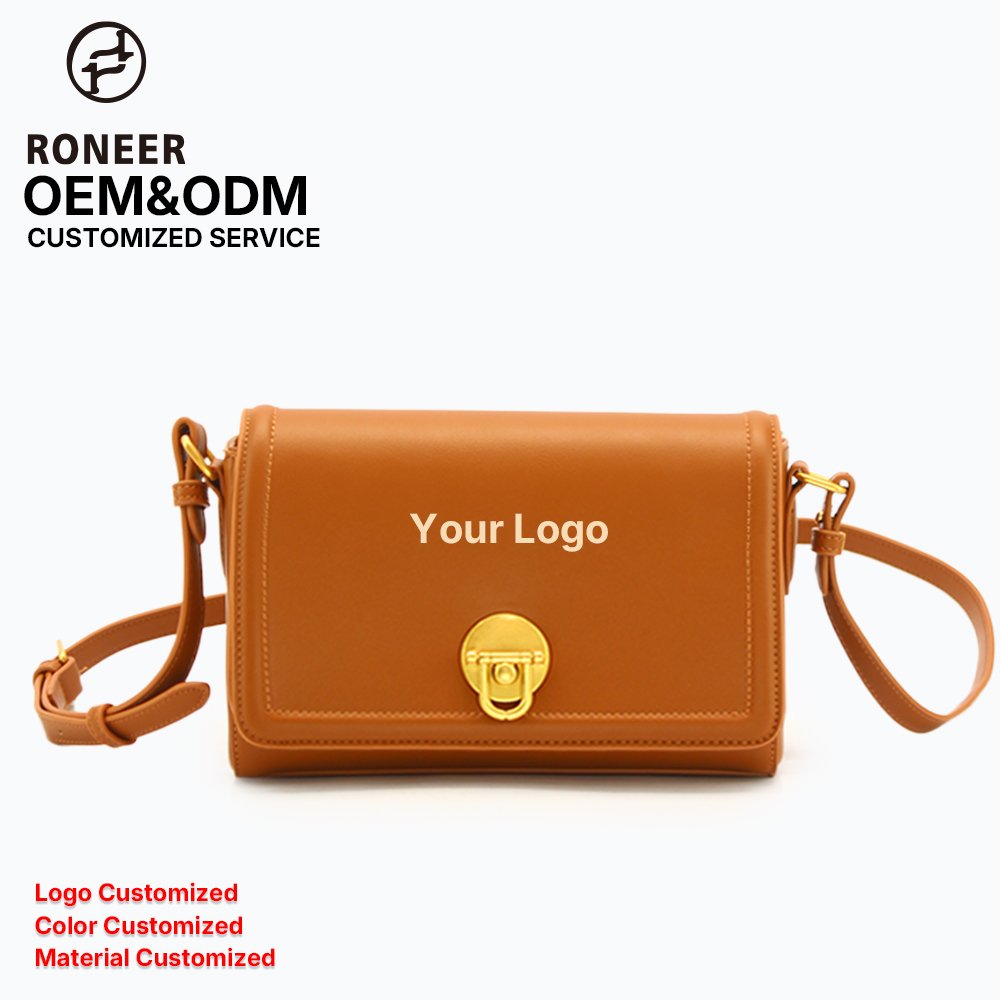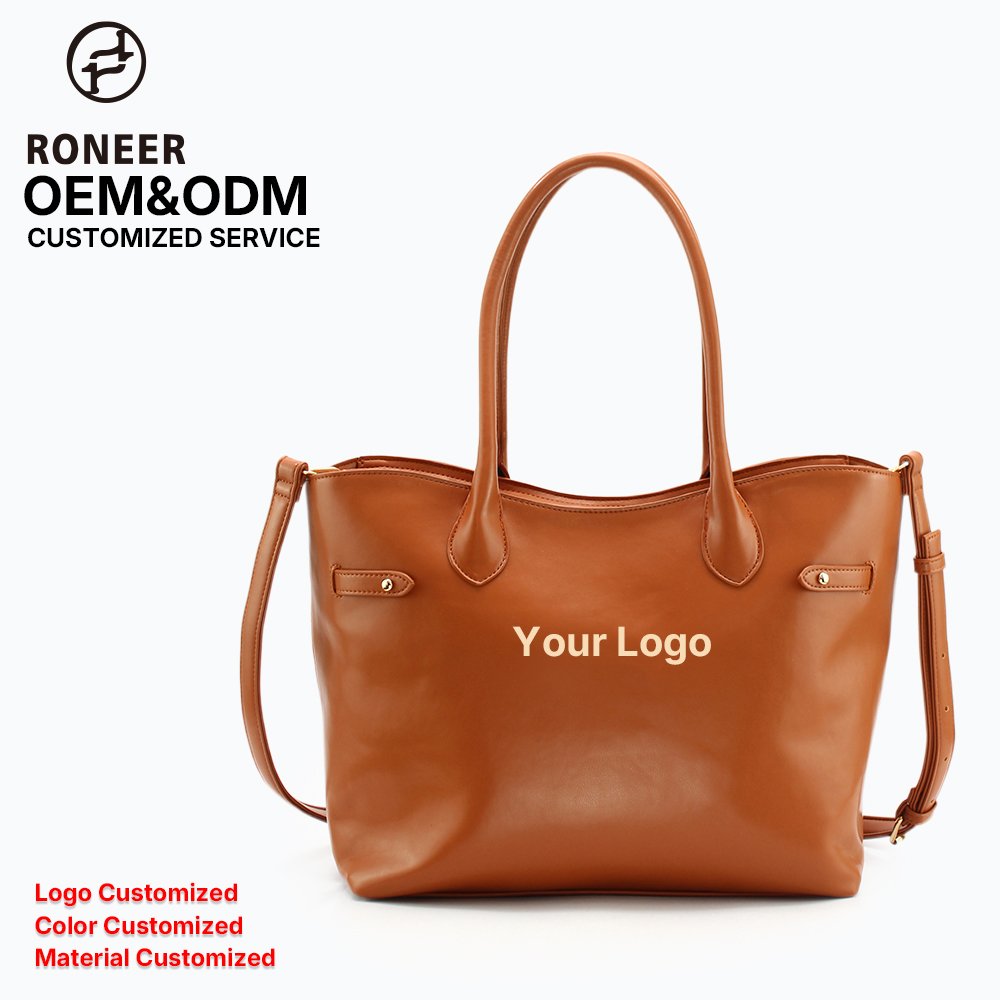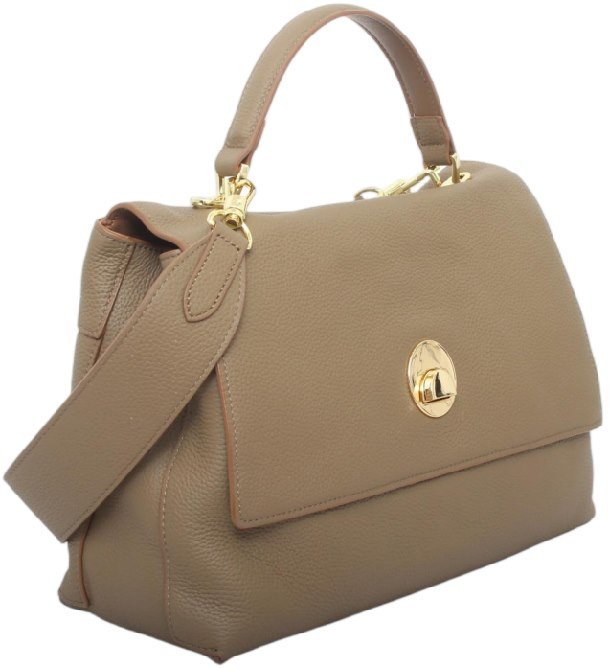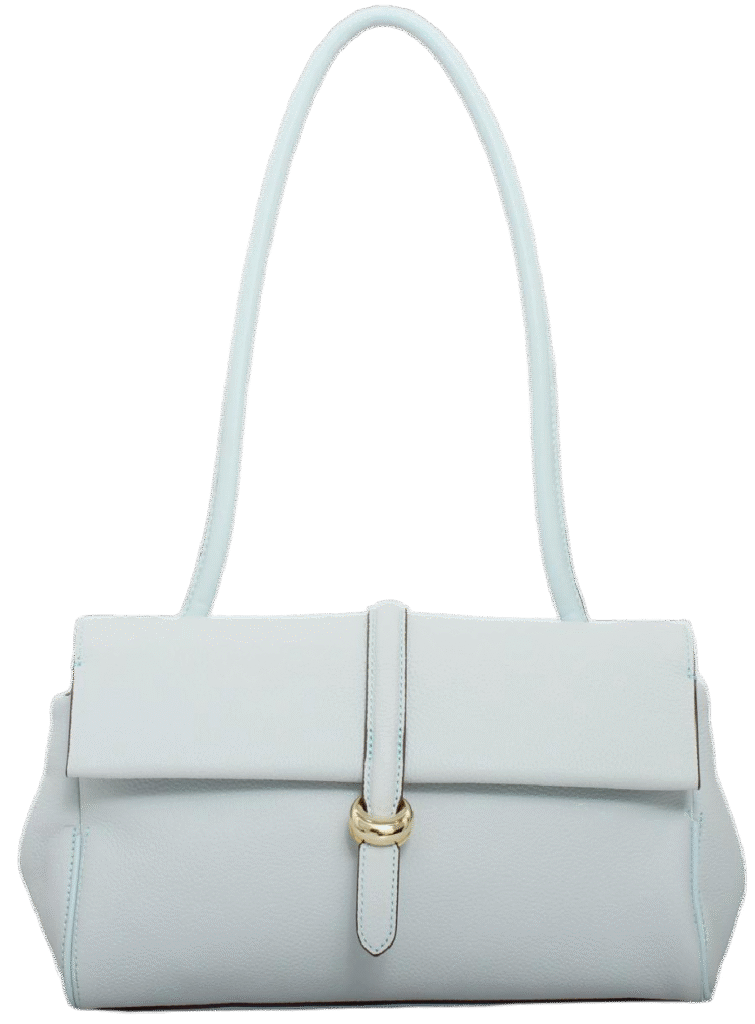









A smaller production order does not automatically create a safer handbag launch.
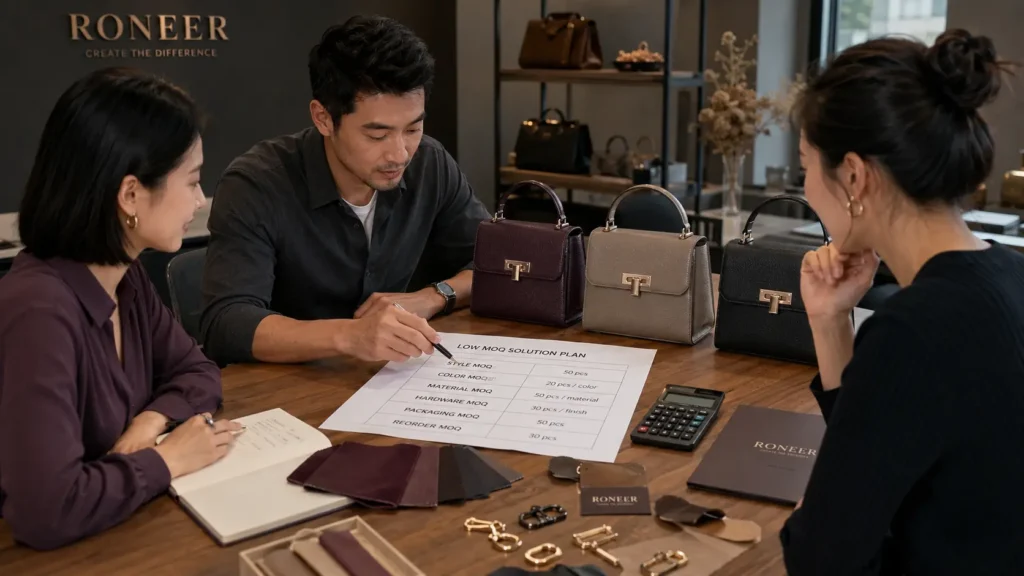
Some brands reduce the number of finished bags but unknowingly commit to large quantities of custom material, metal hardware, printed lining, gift boxes, or branded components. Others accept a low headline MOQ but later discover that the minimum applies to one style, one color, or one material rather than the complete order.
A professional low MOQ handbag manufacturer should explain where every minimum comes from before the buyer pays for sampling or production. The factory should also identify which design decisions can remain customized and which decisions must be simplified to make small-batch production practical.
Low MOQ manufacturing can help startup brands, boutiques, e-commerce sellers, wholesalers, and established companies test a new handbag without carrying excessive inventory. However, the benefits depend on product planning, material availability, sample control, quality standards, and the ability to repeat the product later.
This guide explains how to evaluate a low MOQ handbag manufacturer through 12 practical buyer rules. It covers order structure, OEM and ODM development, materials, colors, branding, quotations, sampling, quality control, packaging, compliance, pilot production, and reorders.
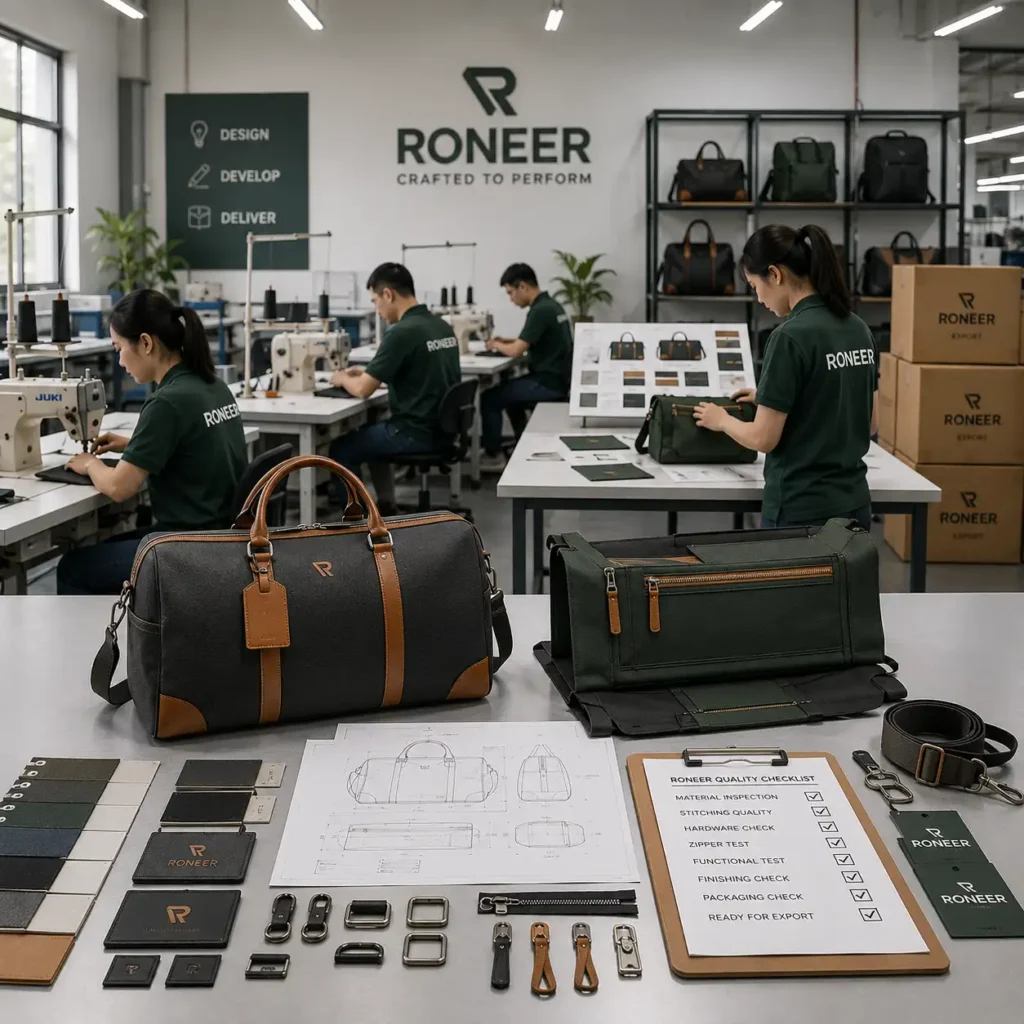
RONEER reviews low MOQ handbag projects according to the handbag structure, material, colors, hardware, logo process, packaging, and required quantity. Its current small-batch service guidance states that some typical custom bag programs may begin around 300–500 pieces, while more complex projects may require higher quantities. This range is not a universal guarantee and should be confirmed for every design.
1. Understand What Low MOQ Actually Means
MOQ means minimum order quantity, but a handbag project can contain several different minimums.
The finished-product quantity is only one of them.
A low MOQ handbag manufacturer may need to calculate:
- Total order MOQ
- MOQ per style
- MOQ per color
- MOQ per exterior material
- MOQ for custom-dyed material
- MOQ for printed lining
- MOQ for custom hardware
- MOQ for a metal Logo mold
- MOQ for dust bags
- MOQ for retail boxes
- Reorder MOQ
For example, a factory may accept 300 finished handbags while the material supplier requires enough material for 500 pieces. The remaining material may need to be stored, purchased by the buyer, used for another color, or replaced with an available stock option.
The same issue can occur with custom metal hardware. The handbag factory may accept a small finished order, but the hardware supplier may require a larger number of logo plates, locks, buckles, or zipper pullers.
Before comparing suppliers, ask each low MOQ handbag manufacturer to show how the minimum is divided.
Useful questions include:
- Is the MOQ calculated per order or per style?
- Can two colors share one material at a minimum?
- Can the same hardware be used across several styles?
- Is unused material included in the quotation?
- Who owns unused custom components?
- How long can materials be stored?
- Does the reorder have the same minimum?
- Can future styles use the remaining materials?
A clear answer is more valuable than a low number without conditions.
2. Confirm That the Product Is Suitable for Small-Batch Production
Not every handbag design is naturally suitable for a low MOQ order.
A simple tote using an available material, standard zipper, existing hardware, and woven label may be relatively straightforward. A structured handbag using custom-dyed leather, exclusive metal locks, molded handles, printed lining, and rigid gift packaging creates several separate minimums.
Before contacting a low MOQ handbag manufacturer, classify the design according to its production complexity.
More suitable for low MOQ development
- Existing or factory-developed structure
- Available material colors
- Standard zipper and hardware
- One or two launch colors
- Simple Logo method
- Standard lining
- Practical dust bag or polybag
- Limited number of SKUs
More difficult for low MOQ development
- Exclusive custom material
- Several colors per style
- Custom metal molds
- Special plating colors
- Printed branded lining
- Complex rigid structure
- Multiple sizes
- Premium gift boxes
- Very short delivery schedule
This does not mean a complex handbag cannot be produced. It means the buyer may need to accept a higher quantity, a higher unit price, additional tooling, or a staged development plan.
A capable low MOQ handbag manufacturer should explain these trade-offs before sample development.
3. Select the Right Manufacturing Route
Private label, ODM, and OEM projects create different MOQ requirements.
Private Label
Private label usually begins with an existing handbag or base style. The buyer may customize:
- Логотип
- Цвет
- Label
- Этикетка
- Мешок для пыли
- Basic packaging
Because the pattern and structure already exist, private label can be one of the more practical routes for small-batch production.
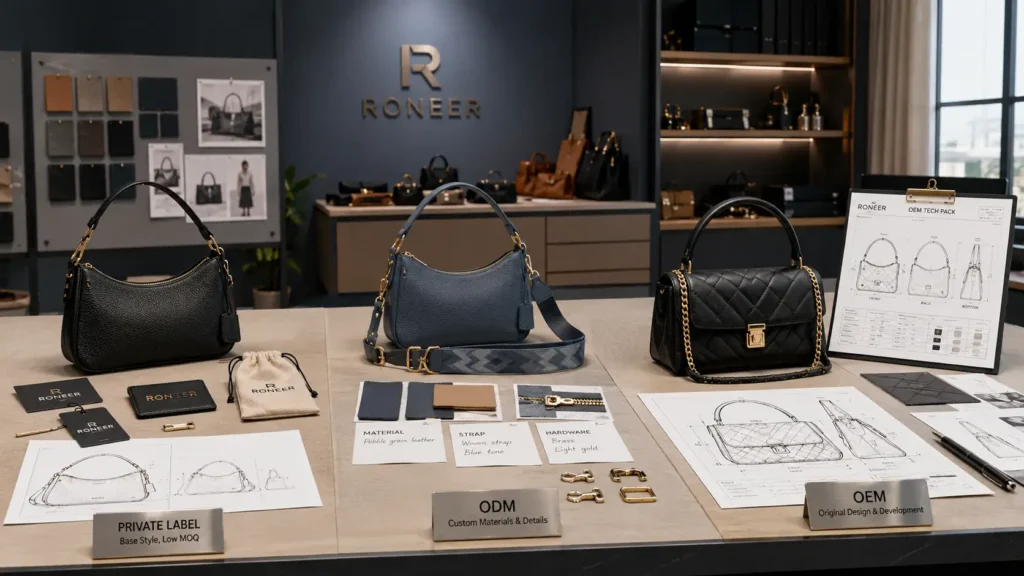
ODM
ODM begins with a factory-developed structure that can be changed through:
- Материалы
- Colors
- Straps
- Pockets
- Подкладка
- Оборудование
- Логотип
- Упаковка
ODM provides more differentiation than simple private label production while avoiding some original pattern-development work.
OEM
OEM develops the buyer’s original handbag from a tech pack, sketch, physical reference, or prototype.
OEM may require:
- Новые модели
- Construction testing
- Several samples
- Special reinforcement
- Custom hardware
- Custom materials
- More detailed inspection standards
A low MOQ handbag manufacturer may support all three routes, but the MOQ, sample fee, development time, and unit cost will not be identical.
Startup brands should not automatically select OEM because it sounds more professional. The correct route is the one that protects the brand’s important product difference without adding unnecessary cost or minimum quantities.
Brands needing a broader comparison can review RONEER’s guide to selecting a handbag manufacturer for startups.
4. Keep the First Collection Focused
A low production quantity can still create excessive inventory when it is divided across too many SKUs.
Consider a launch containing:
- Three handbag styles
- Three colors per style
- Two sizes per style
This creates 18 SKUs before packaging variations are considered.
If the low MOQ handbag manufacturer requires a minimum by style or color, the total inventory can become much larger than the founder originally expected.
A controlled first collection may use:
- One hero handbag
- One supporting style
- One or two colors
- One standard hardware finish
- One packaging system
The objective is not to make the website look full. It is to collect useful information about customer demand, pricing, preferred colors, return reasons, and reorder timing.
Сайт U.S. Small Business Administration’s market research guidance recommends evaluating demand, market size, saturation, customer characteristics, and competitor pricing before committing resources to a business opportunity.
A startup should not use a large production order as its first customer-research method.
5. Prepare a Manufacturer-Ready Product Brief
A vague request does not help a factory determine whether a low quantity is practical.
Before requesting a quotation, provide:
- Handbag category
- Intended customer
- Main use scenario
- Approximate dimensions
- Exterior material
- Подкладка
- Структура
- Отделения
- Закрытие
- Handles and straps
- Отделка корпуса
- Logo method
- Target quantity
- Number of colors
- Упаковка
- Destination market
- Expected delivery date
Reference photographs can communicate appearance, but they do not replace specifications.
Explain which details are essential and which can be adjusted. For example:
Fixed requirements:
- The laptop must fit inside
- Finished width must be 38 cm
- The shoulder strap must be removable
- The logo must remain below 40 mm
Flexible requirements:
- Similar available material is acceptable
- A standard zipper puller can be used
- Lining can use an available color
- Packaging can use a dust bag instead of a box
This distinction allows a low MOQ handbag manufacturer to reduce unnecessary customization without changing the product’s main value.
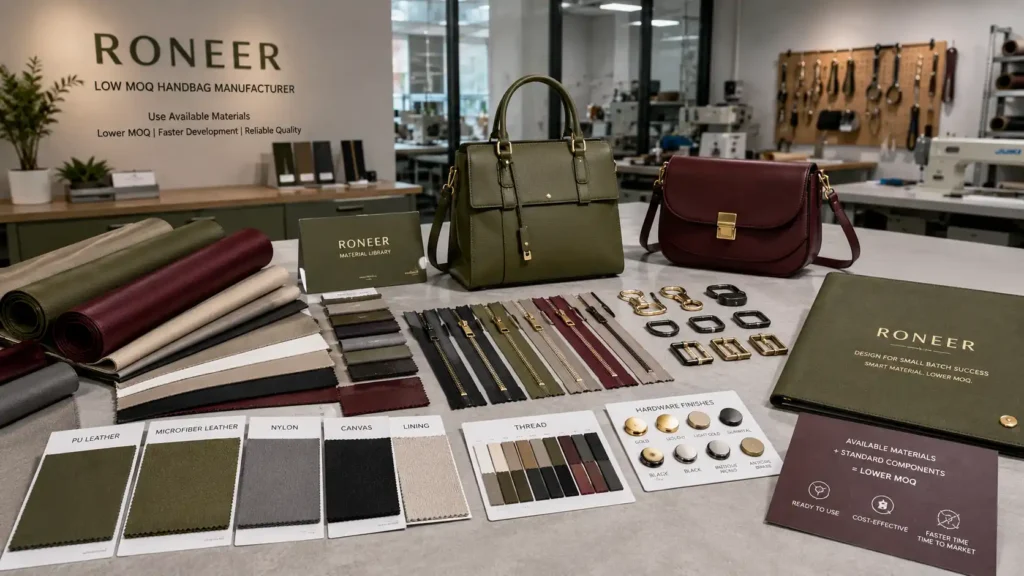
6. Use Available Materials and Standard Components
Material availability is one of the strongest influences on MOQ.
A material supplier may require a minimum for:
- Custom color
- Custom grain
- Special thickness
- Printed surface
- Custom backing
- Exclusive coating
- Recycled-content specification
- Брендовая подкладка
Using an available material does not necessarily mean using poor quality. It means selecting from materials and colors that already fit the factory’s active supply chain.
Buyers can review RONEER’s material customization options when comparing PU leather, microfiber leather, genuine leather, canvas, nylon, polyester, lining, reinforcement, and mixed-material structures.
Ask the low MOQ handbag manufacturer for:
- Current material swatches
- Available colors
- Material composition
- Thickness
- Surface grain
- Backing
- Expected availability
- Batch variation risk
- Reorder conditions
Standard components can also improve small-order feasibility.
These may include:
- Existing zippers
- Standard D-rings
- Standard buckles
- Available sliders
- Regular magnetic snaps
- Existing handle connectors
- Standard thread
- Available lining
A startup can introduce more exclusive materials and components after sales demand becomes more predictable.
7. Simplify Branding Without Weakening the Brand
Custom branding does not always require a new metal mold.
A low MOQ handbag manufacturer may offer several Logo methods:
- Debossing
- Embossing
- Трафаретная печать
- Теплопередача
- Тканая этикетка
- Printed label
- Кожаный нашивной значок
- Резиновая накладка
- Existing metal plate
- Этикетка
- Branded dust bag
The best method depends on material, positioning, Logo shape, quantity, and budget.
Custom metal hardware can create:
- Mold cost
- Sampling cost
- Component MOQ
- Plating minimum
- Longer lead time
- Finish variation risk
For a first test order, a debossed Logo or woven label may provide sufficient brand identity without creating excessive component inventory.
RONEER’s logo customization guide explains common branding options for different bag materials and product positions.
Ask the factory to separate:
- Logo setup fee
- Unit Logo cost
- Mold fee
- Component MOQ
- Sample lead time
- Ownership of the mold
- Storage period
- Reorder conditions
A professional low MOQ handbag manufacturer should recommend the most practical method rather than automatically recommending the most expensive one.
8. Compare Total Launch Cost, Not Only Unit Price
Small production orders often have a higher unit cost because development, setup, material sourcing, line preparation, and quality-control work are spread across fewer pieces.
However, a higher unit price does not always mean a worse business decision.
Consider two options:
Option A
- Lower unit price
- Much larger order
- More inventory
- More warehouse costs
- More cash tied up
- Higher markdown risk
Option B
- Higher unit price
- Smaller test order
- Lower inventory exposure
- Faster customer feedback
- Easier product revision
The correct choice depends on cash flow, gross margin, sales confidence, product seasonality, and reorder speed.
Ask the low MOQ handbag manufacturer to separate:
- Sample fee
- Pattern fee
- Tooling
- Unit price
- Material surcharge
- Logo cost
- Упаковка
- Inspection
- Freight terms
- Payment terms
Also, to calculate expenses outside the factory quotation:
- Import charges
- Warehouse receiving
- Fulfillment
- Photography
- Marketplace fees
- Payment processing
- Marketing
- Returns
- Defect replacements
- Reorder deposit
A small order is only useful when the resulting retail price and margin remain commercially workable.
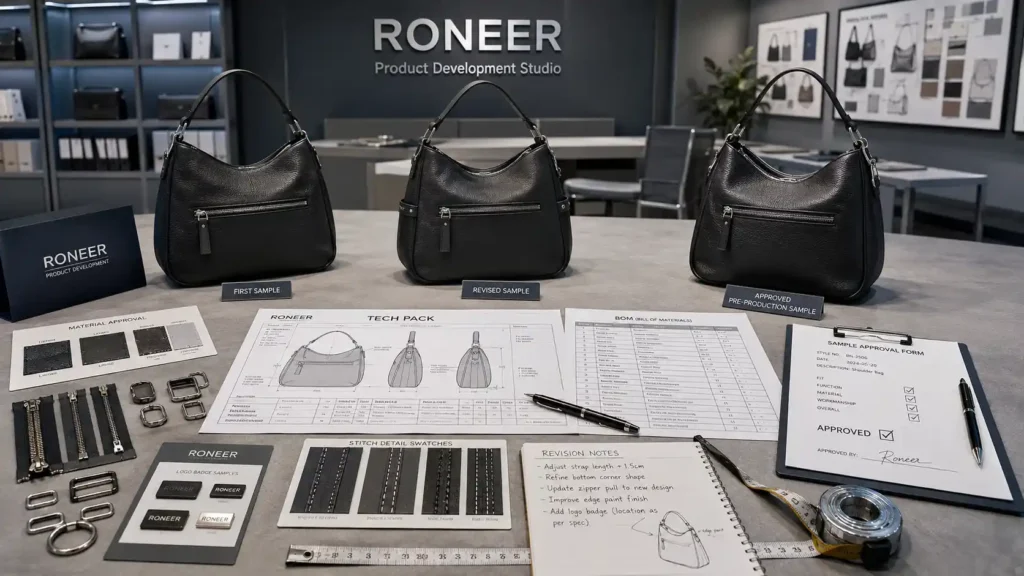
9. Approve a Physical Sample Before Production
The sample process is one of the best ways to evaluate a low MOQ handbag manufacturer.
Sampling tests whether the supplier can:
- Interpret specifications
- Develop the pattern
- Source suitable materials
- Identify construction risks
- Control dimensions
- Apply branding
- Record revisions
- Communicate substitutions
- Meet agreed timing
Before paying the sample fee, confirm:
- Sample price
- Estimated lead time
- Доступные материалы
- Revision policy
- Logo tooling
- Hardware timing
- Shipping responsibility
- Pattern ownership
- Mold ownership
- Whether fees are credited later
Check the physical sample for:
- Размеры
- Proportion
- Вместимость
- Вес
- Текстура материала
- Handle comfort
- Длина ремешка
- Pocket access
- Closure function
- Zipper movement
- Отделка корпуса
- Расположение логотипа
- Stitching
- Reinforcement
- Подкладка
- Edge finishing
- Упаковка
Product photographs cannot fully show stiffness, hand feel, balance, weight, comfort, or zipper resistance.
After revisions, approve a final pre-production sample. Record its style number, color, material, approval date, and revision version.
The approved physical sample should become the reference for production and future reorders.
10. Define Quality Control for the Small Batch
A low order quantity should not mean lower inspection standards.
The startup and low MOQ handbag manufacturer should agree on measurable checks before production.
Common inspection points include:
- Exterior material defects
- Цветовая стабильность
- Размеры
- Panel alignment
- Stitching
- Seam strength
- Handle attachment
- Strap construction
- Функция застежки-молнии
- Отделка корпуса
- Расположение логотипа
- Edge paint
- Lining cleanliness
- Pocket construction
- Упаковка
- Labels
- Картонные знаки
Ask the supplier:
- Are materials inspected before cutting?
- Are measurements checked during production?
- How are major and minor defects defined?
- What happens to rejected products?
- Is the final inspection recorded?
- Can the buyer arrange an independent inspection?
- Will replacement units be produced?
- How will recurring defects be corrected?
SGS states that its bags and accessories services can assess materials and components, evaluate product performance, and support safety, quality, and relevant regulatory requirements. The correct testing plan depends on the handbag, materials, claims, destination, and buyer requirements.
Do not assume that every handbag requires the same laboratory tests. The test plan should reflect actual product risks and market requirements.
11. Prepare Packaging and Market Information Early
Packaging can introduce another minimum quantity.
A startup handbag order may need:
- Мешок для пыли
- Tissue paper
- Этикетка
- Care card
- Barcode label
- Polybag
- Gift box
- Shipping insert
- Inner carton
- Master carton
- Маркировка на коробке
RONEER’s packaging customization options cover common private label and export packing formats.
For a low MOQ order, practical packaging may provide better value than a fully custom rigid box. A branded dust bag, hangtag, sticker, and suitable shipping carton can create a professional presentation without forcing the buyer to purchase excessive packaging inventory.
Packaging should be finalized after the physical handbag sample is approved. Otherwise, changes to product dimensions, handle position, shape protection, or folding method may make the packaging unsuitable.
Material descriptions must also be accurate.
Сайт FTC Leather Guides address misleading representations concerning leather and imitation-leather composition and state that non-leather content should be disclosed when a material appears to be leather but is not.
For products imported into the United States, buyers should also review applicable U.S. Customs and Border Protection country-of-origin guidance. Product-specific marking decisions should be confirmed with qualified customs or compliance professionals.
A low MOQ handbag manufacturer can apply approved labels and packaging instructions, but the brand or importer should verify the rules that apply to its market.
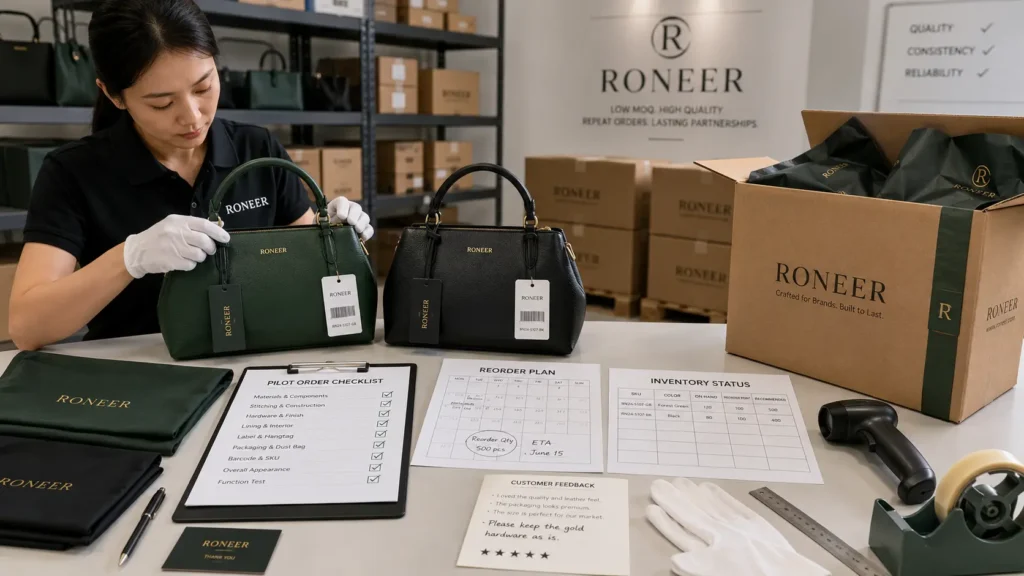
12. Plan the Reorder Before the First Order
The purpose of a small first order is not only to reduce inventory. It is also to create a controlled path toward repeat production.
Before production begins, ask the low MOQ handbag manufacturer:
- Will the material remain available?
- Can unused material be reserved?
- How long can components be stored?
- What is the reorder MOQ?
- Will the reorder price change?
- What production notice is required?
- Can the same hardware finish be repeated?
- Will the original pattern be retained?
- How are approved changes recorded?
- What happens if a material is discontinued?
After the first launch, track:
- Sales by style
- Sales by color
- Customer questions
- Return reasons
- Defect reports
- Packaging damage
- Product reviews
- Inventory turnover
- Reorder timing
Do not wait until the product is sold out before discussing the next order.
Materials, hardware, production capacity, inspection, shipping, and import clearance all require time.
A reliable low MOQ handbag manufacturer should be able to transfer the approved sample, bill of materials, quality requirements, and packaging specifications into the repeat order.
The first batch should create both sales inventory and a repeatable production record.
Low MOQ Development Route Comparison
| Project Route | Main Advantage | Main MOQ Risk |
|---|---|---|
| Private label | Faster launch | Limited product differentiation |
| ODM modification | Balanced customization | Shared base design |
| Original OEM | Stronger differentiation | Patterns, samples, and component minimums |
| Available material program | Lower material minimum | Limited colors or grains |
| Custom material program | More exclusive appearance | Higher material MOQ |
| Стандартная комплектация | Faster and more flexible | Less exclusivity |
| Custom metal hardware | Strong branding | Mold and component MOQ |
| Практичная упаковка | Lower packaging exposure | Simpler presentation |
| Premium custom box | Strong unboxing experience | High box MOQ and storage cost |
The best route depends on which product details create real customer value.
Red Flags When Comparing Low MOQ Suppliers
Be cautious when a supplier:
- Promises any quantity before reviewing the design
- Gives a final price without material specifications
- Refuses to explain color or material minimums
- Avoid making a physical sample
- Changes components without written approval
- Cannot explain unused material ownership
- Offers copied luxury Logos or protected designs
- Uses inconsistent company and payment information
- Cannot define its quality-control process
- Promises unrealistic delivery dates
- Cannot explain the reorder MOQ
- Refuses to retain production records
A technically responsible factory may tell the buyer that a target quantity, material, cost, or schedule is not practical.
That answer can be more valuable than an unrealistic promise.