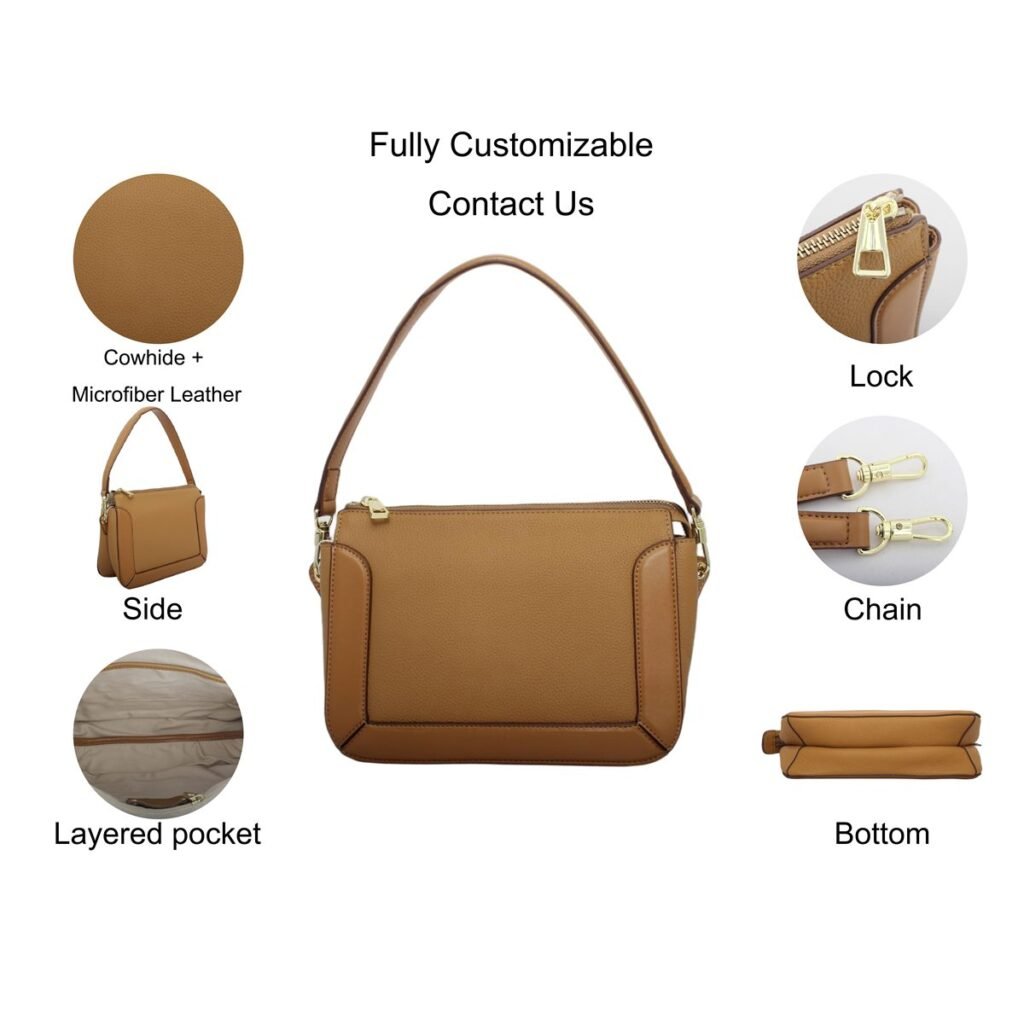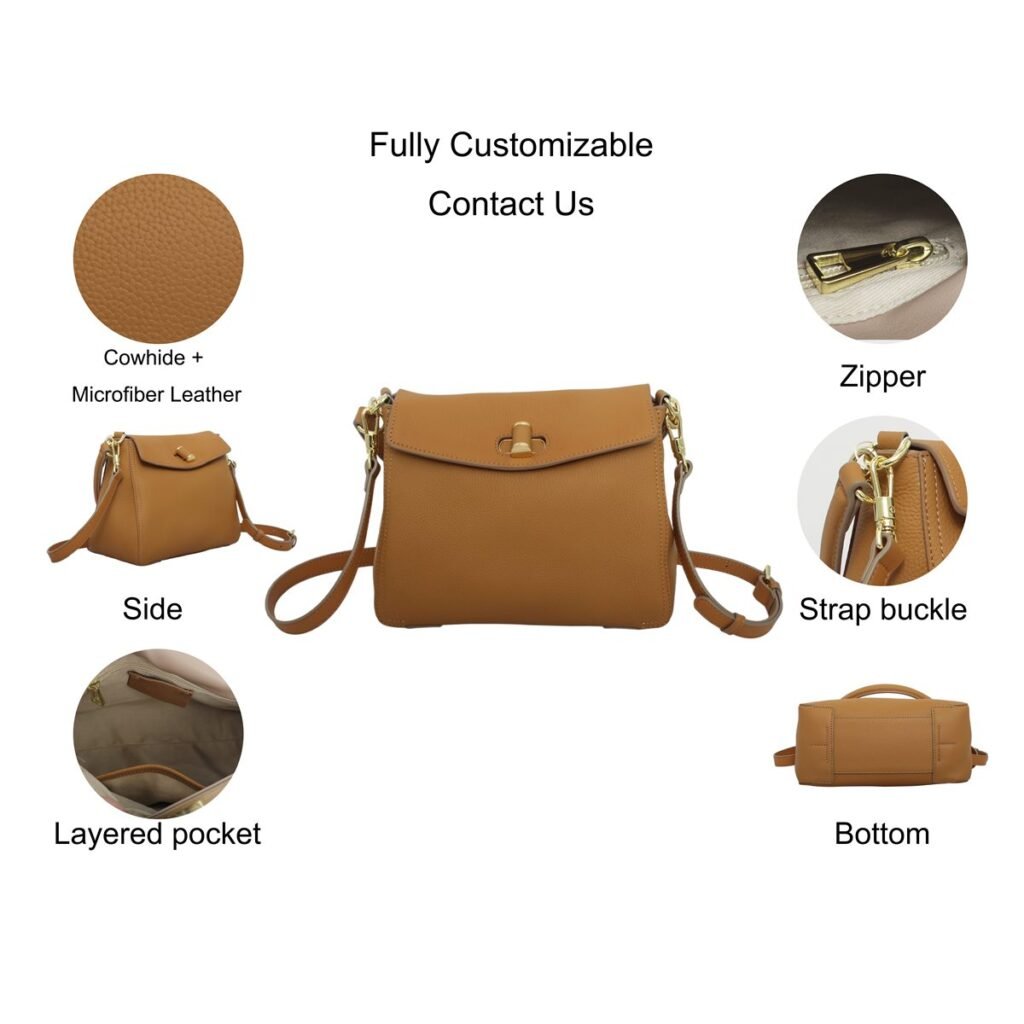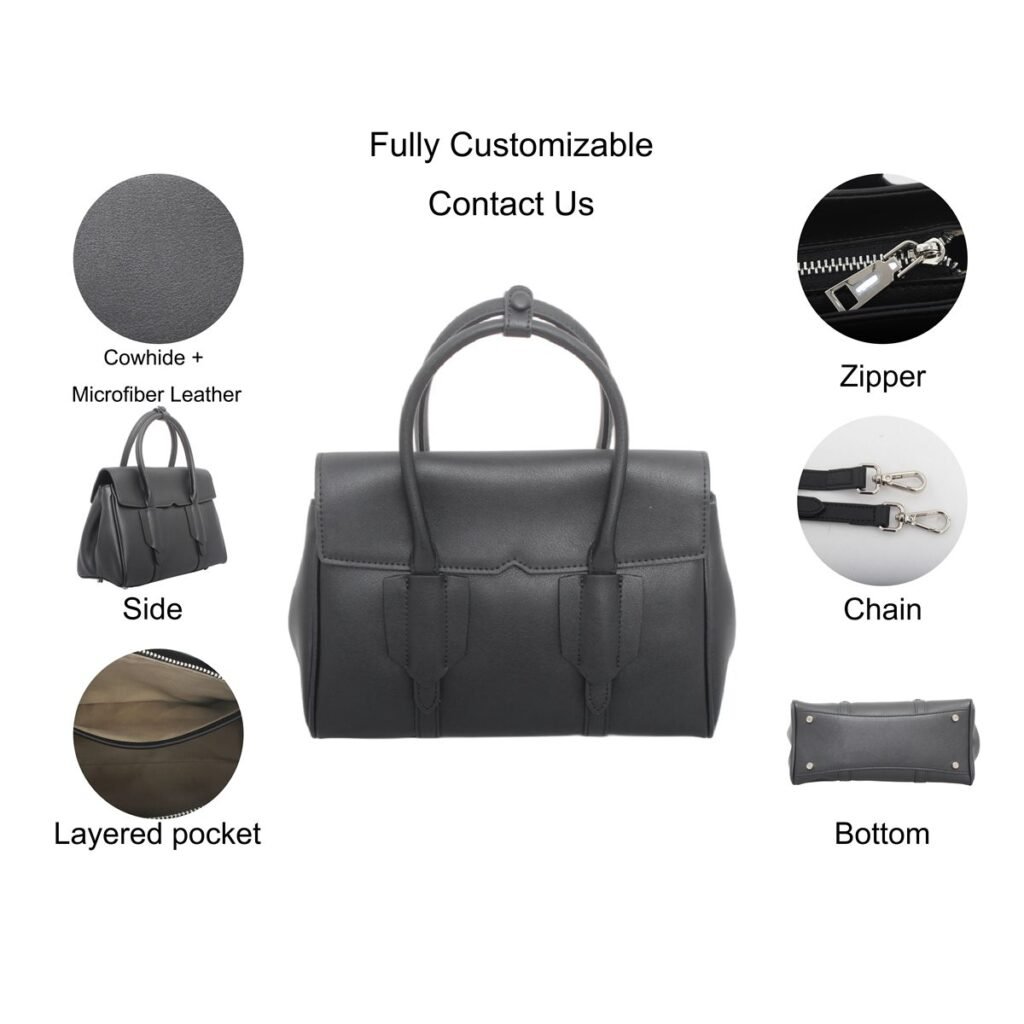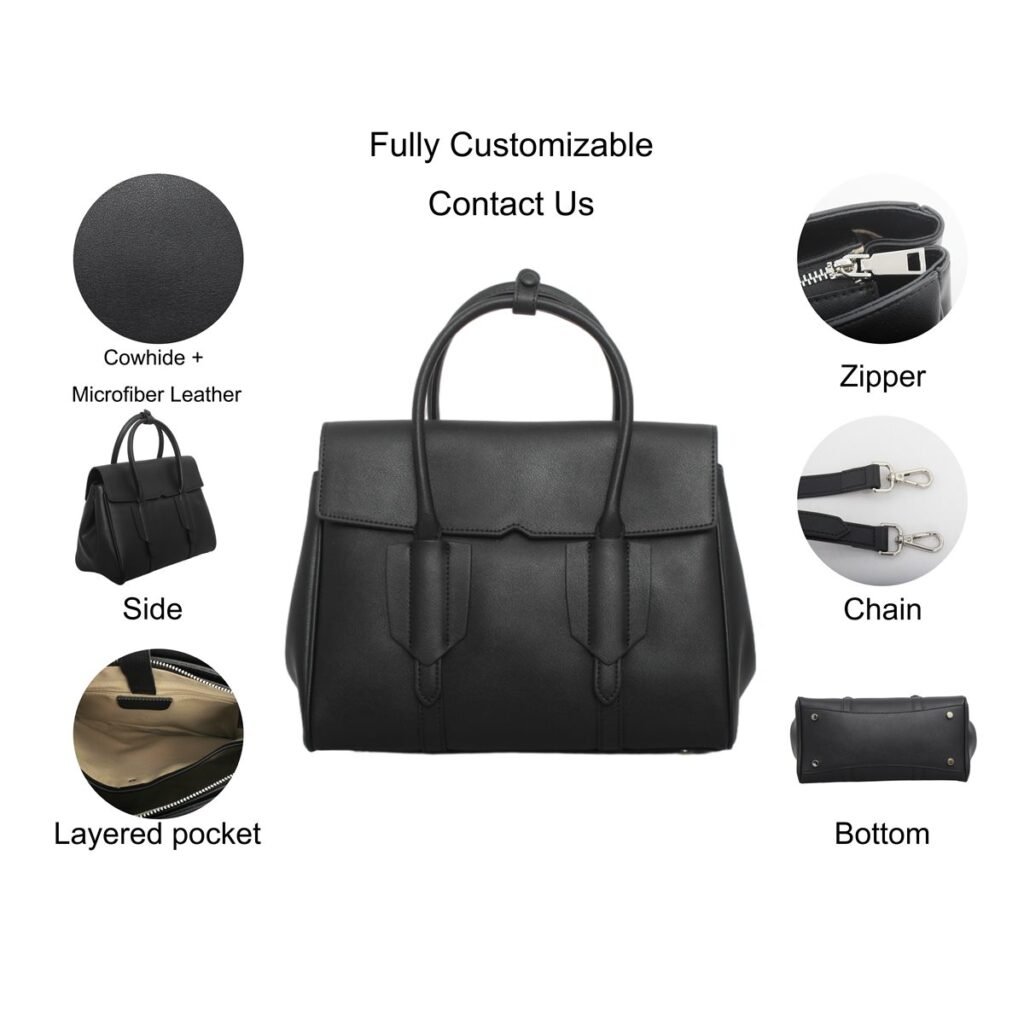








A startup can lose a large part of its first production budget before a single handbag reaches a customer. The problem is not always an expensive quotation. Cash is often absorbed by unnecessary samples, too many launch styles, custom material minimums, new metal molds, oversized packaging orders, unclear quality standards, and inventory that cannot be reordered consistently.
A suitable handbag manufacturer for startups must understand more than how to sew a bag. The supplier should explain which development route fits the brand, where minimum quantities come from, which details increase cost, how samples will be approved, and how the same product can be repeated after the first launch.
Startups normally have less sales data, tighter working capital, smaller teams, and limited manufacturing experience. They need flexibility, but they also need documented specifications, realistic timelines, and measurable quality controls. Selecting a handbag manufacturer for startups is therefore a commercial decision as well as a production decision.
This guide explains 11 practical checks for evaluating a handbag manufacturer for startups. It covers product readiness, OEM and ODM development, MOQ, samples, materials, pricing, quality control, packaging, pilot production, and reorders.
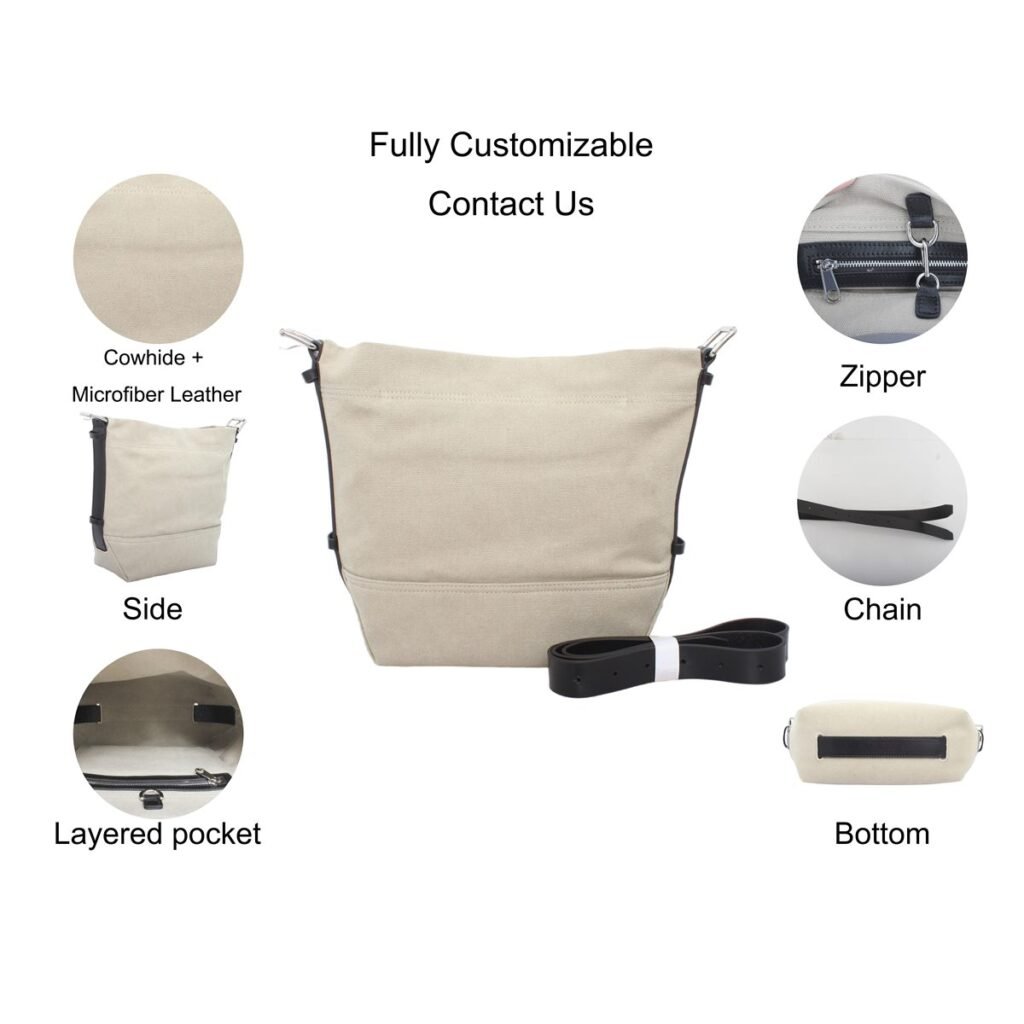
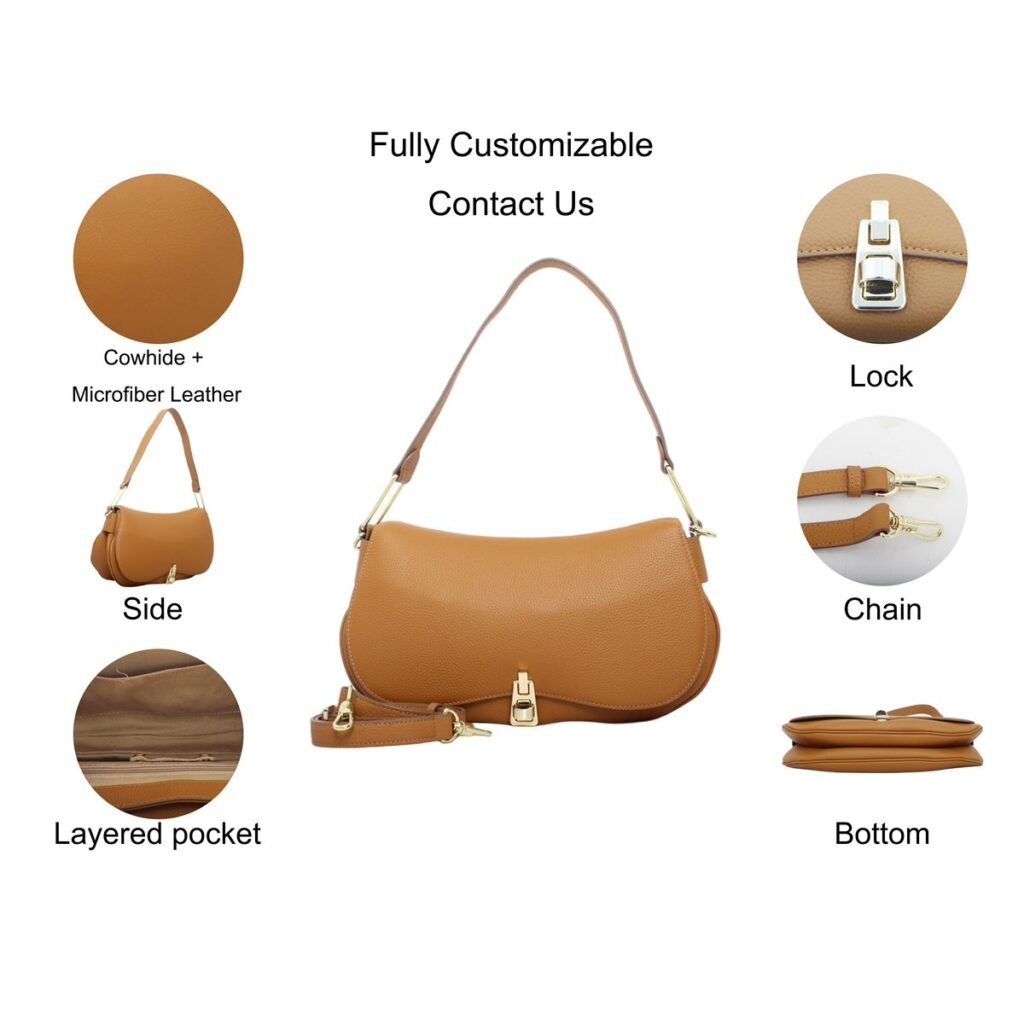
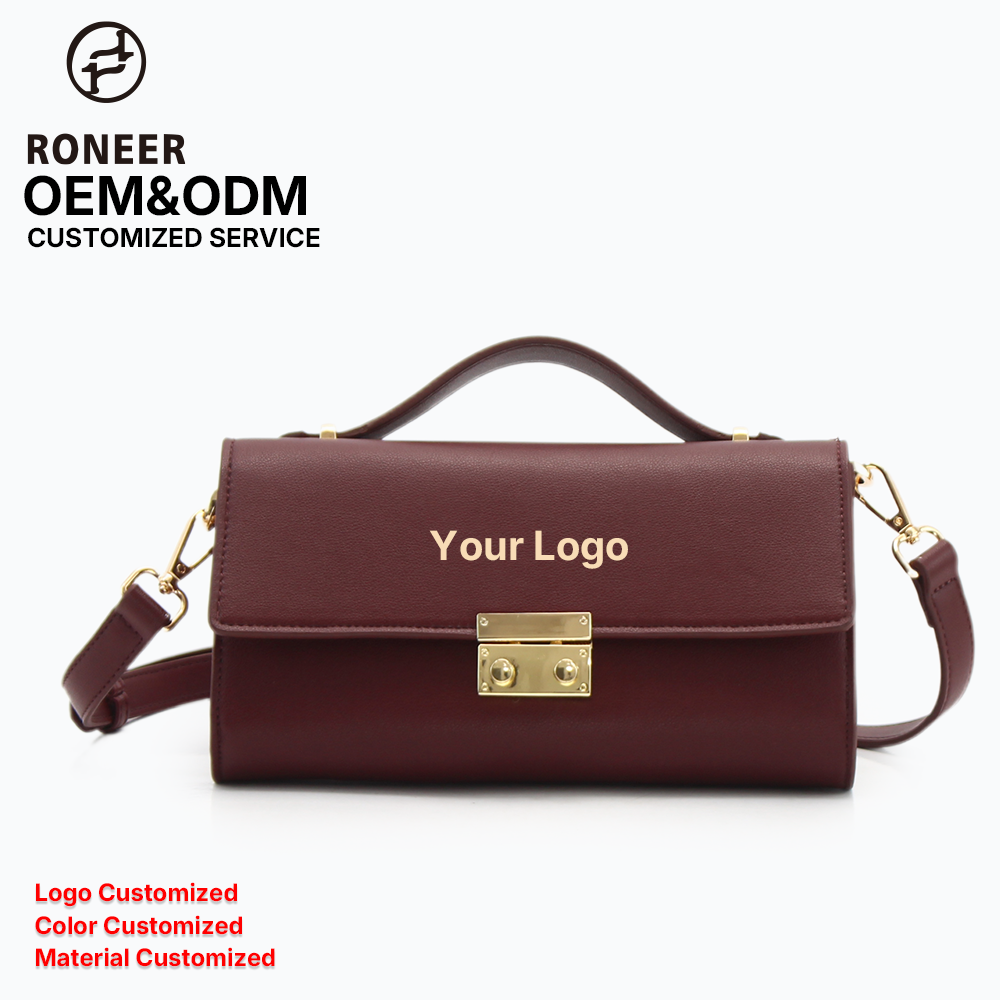
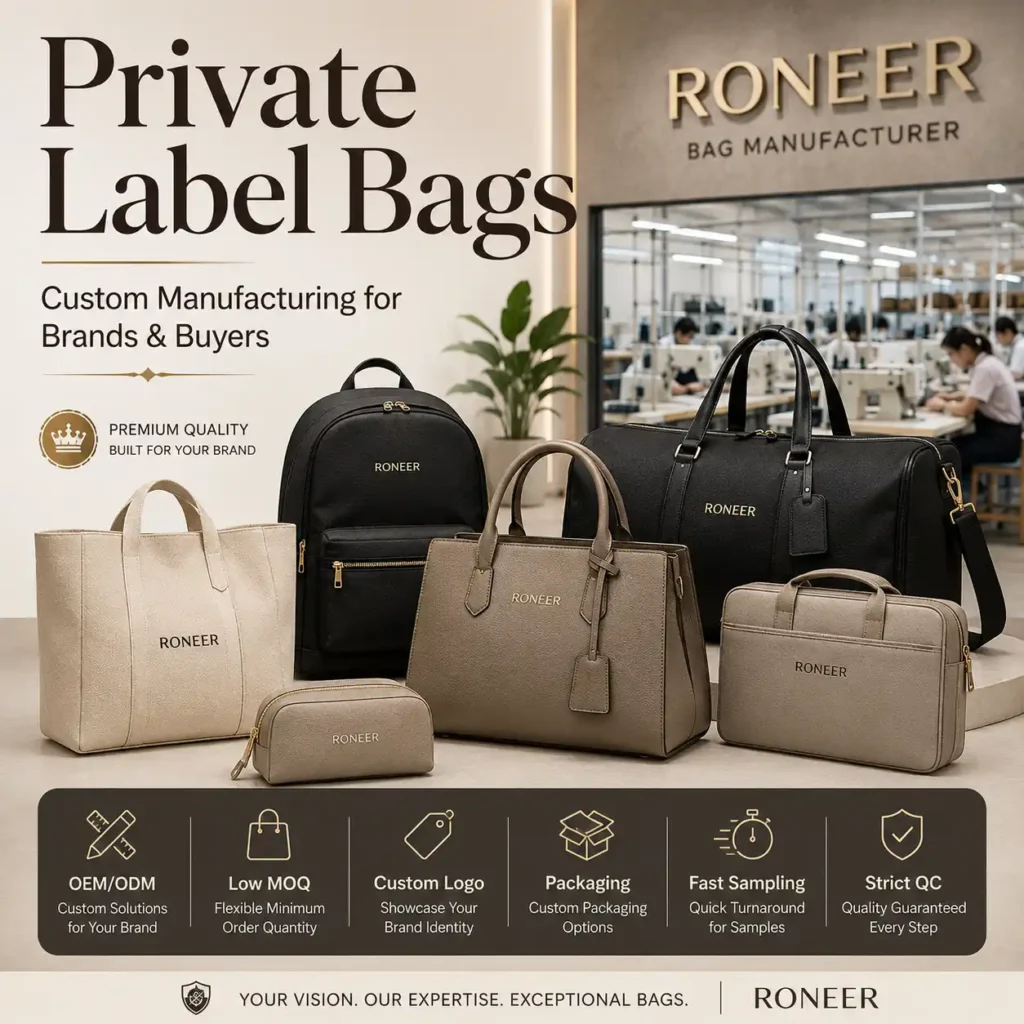
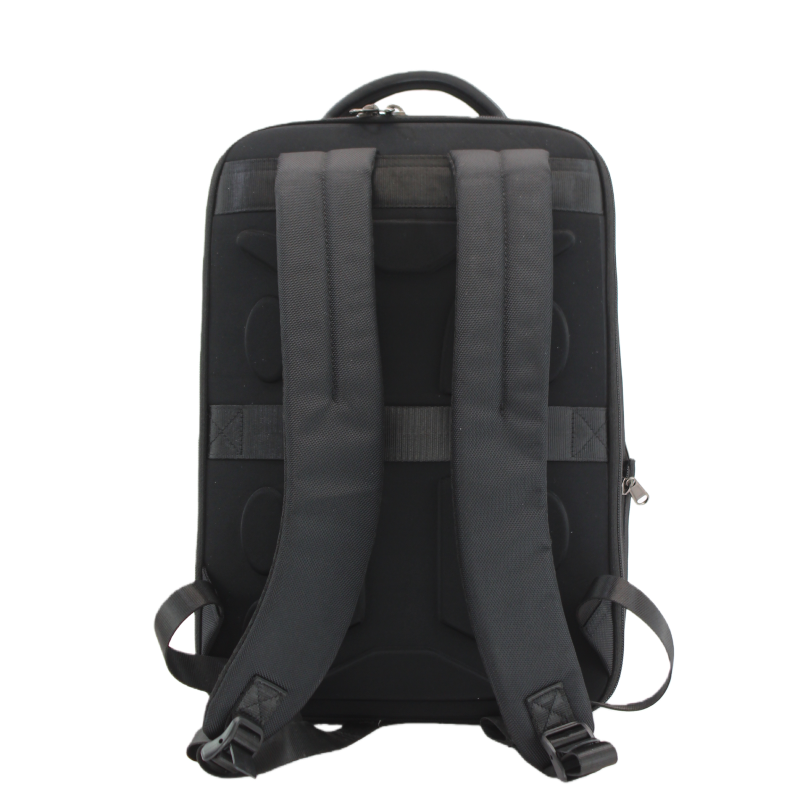
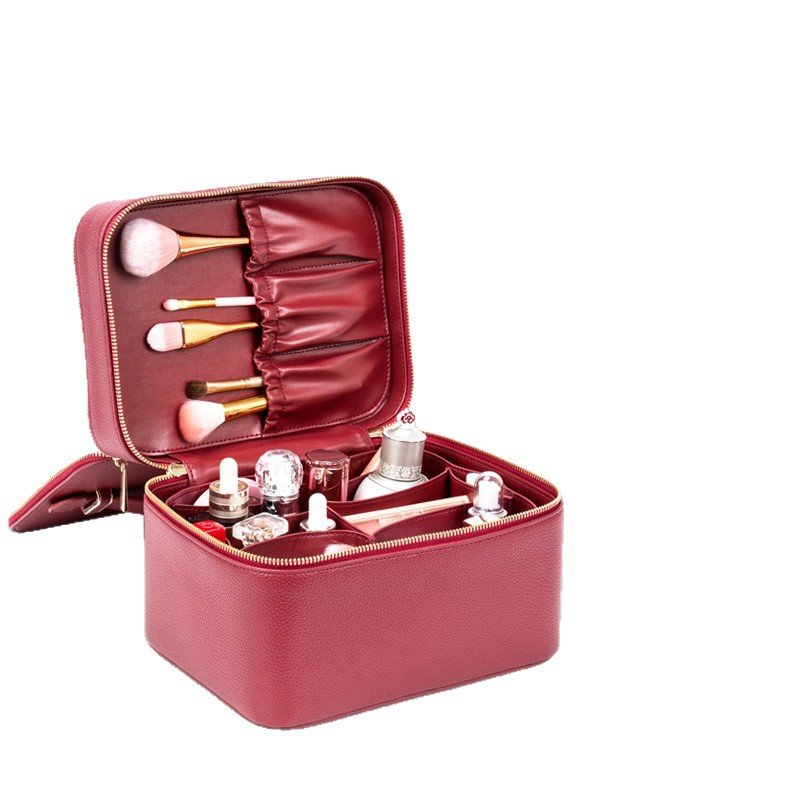
RONEER supports OEM and ODM development for handbags, crossbody bags, totes, wallets, backpacks, travel bags, cosmetic bags, and related private label products. Buyers should still compare every quotation, physical sample, payment term, production schedule, and quality standard against their own project requirements.
1. Match the Manufacturer to Your Startup Stage
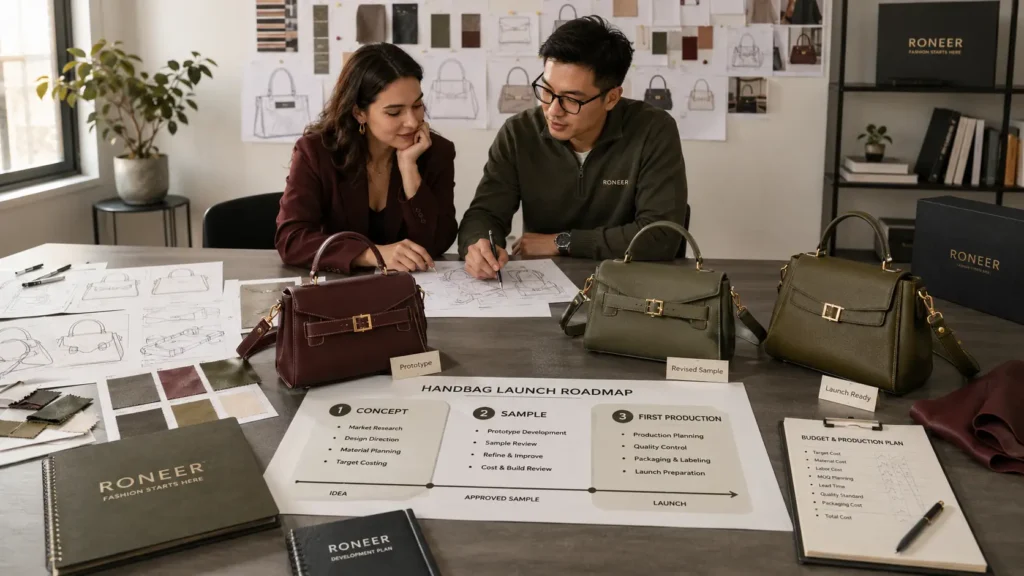
The right handbag manufacturer for startups depends on what the brand has already completed. A founder with only a mood board needs different support from a company with a finished tech pack and approved prototype.
Concept Stage
At this stage, the founder may have a target customer, reference images, a general product idea, an expected retail price, and an approximate order quantity. The brand may still need help defining dimensions, materials, internal organization, construction, and packaging.
A handbag manufacturer for startups working at the concept stage should identify missing information before quoting. Immediate pricing without dimensions, materials, structure, logo method, and quantity assumptions is rarely reliable.
Technical Development Stage
The startup may already have product drawings, measurements, material preferences, hardware direction, pocket layouts, logo artwork, and packaging ideas. The manufacturer should review feasibility, explain construction risks, suggest practical materials, and prepare an itemized sample quotation.
Production-Ready Stage
A more developed startup may provide a complete tech pack, approved prototype, material codes, bill of materials, final artwork, quality tolerances, and quantity by SKU.
At this point, the handbag manufacturer for startups should focus on repeatability, capacity, inspection, lead time, packaging, payment terms, and reorder planning.
Founders who are still organizing the commercial side can review RONEER’s guide on how to start a handbag business before beginning factory development.
2. Define One Launch-Ready Product
A startup does not need a large collection to prove that it is serious. Developing too many products can divide the budget across patterns, samples, materials, colors, packaging, photography, barcodes, and inventory.
A handbag manufacturer for startups should be willing to discuss whether the proposed launch range is practical. A focused first collection may contain one hero handbag, one supporting crossbody, and one small leather good. Another startup may launch only one work tote in two colors.
Before requesting a quotation, define:
- Target customer
- Primary use
- Approximate dimensions
- Exterior material
- Подкладка
- Структура
- Отделения
- Закрытие
- Handles and straps
- Отделка корпуса
- Logo method
- Target quantity
- Number of colors
- Target retail price
- Упаковка
- Destination market
The U.S. Small Business Administration explains that market research helps businesses identify customers, while competitive analysis helps them develop a meaningful advantage.
A startup should therefore validate demand, price expectations, customer preferences, market saturation, and competitor weaknesses before using production as its first market test. Read the official SBA market research and competitive analysis guidance.
A focused brief also helps a handbag manufacturer for startups recommend the correct development route instead of adding complexity that customers may not value.
3. Select Private Label, ODM, or OEM
The production model affects development time, startup cost, MOQ, originality, and technical risk.
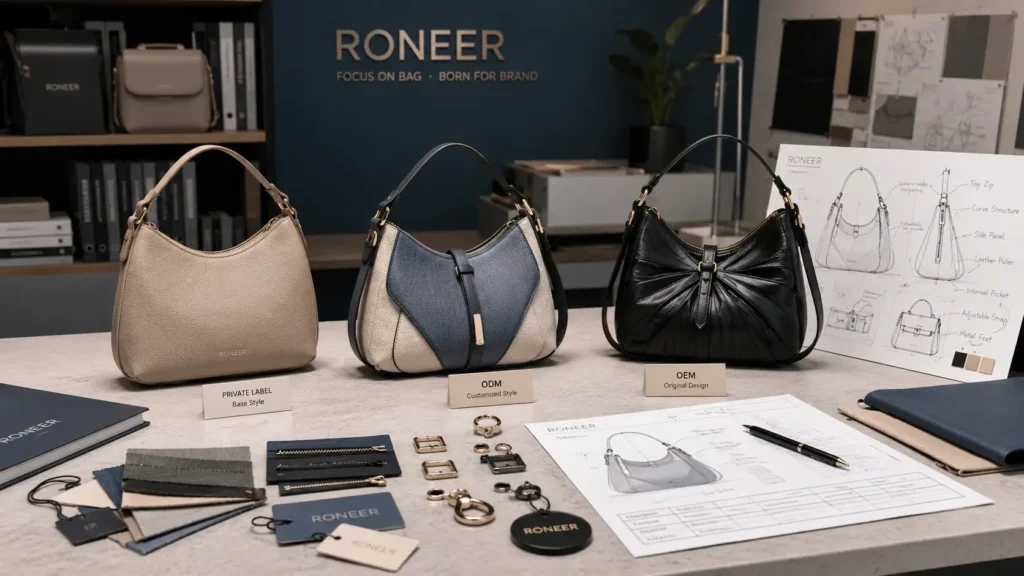
Private Label
Private label normally starts with an existing product or base style. The startup may add:
- Логотип
- Brand label
- Цвет
- Этикетка
- Мешок для пыли
- Branded packaging
Private label can be useful when speed and controlled investment matter more than complete originality.
ODM
ODM uses a factory-developed handbag structure that can be modified through:
- Материалы
- Colors
- Straps
- Pocket layouts
- Подкладка
- Оборудование
- Logos
- Упаковка
ODM can offer more differentiation than simple private label production while reducing some pattern-development work.
OEM
OEM develops an original handbag from:
- A tech pack
- Product drawings
- A prototype
- A physical reference
- A detailed specification
OEM may require new patterns, several sample rounds, custom components, and more technical control.
A responsible handbag manufacturer for startups should not automatically recommend the most expensive development route. The correct choice depends on the customer promise and the product features that create real differentiation.
RONEER’s производитель сумок под частной торговой маркой page explains how existing styles, materials, logos, lining, packaging, and production planning can be adapted for branded programs.
4. Build a Manufacturer-Ready Budget
The amount available for inventory is not the complete development budget.
A realistic handbag startup budget may include:
- Product design
- Tech pack preparation
- Pattern development
- Samples and revisions
- Sample shipping
- Material swatches
- Logo tooling
- Hardware molds
- Packaging development
- Production deposit
- Quality inspection
- Freight
- Import charges
- Product photography
- Fulfillment preparation
- Defect replacements
- Reorder deposit
A handbag manufacturer for startups should separate one-time development charges from recurring unit costs.
Ask the supplier to identify:
- Sample fee
- Pattern fee
- Tooling fee
- Unit production price
- Logo cost
- Packaging cost
- Testing cost
- Inspection cost
- Shipping terms
- Payment terms
A lower unit price is not always the lower-risk option. It may require a larger quantity, more material inventory, simplified components, or a less suitable product specification.
The handbag manufacturer for startups should help the buyer understand how quantity, construction, materials, hardware, lining, branding, and packaging affect the complete commercial picture.
Keep working capital available for the next order. A startup may begin selling successfully but still face a stockout if the entire budget was spent on the first production run.
5. Understand the Real MOQ Structure
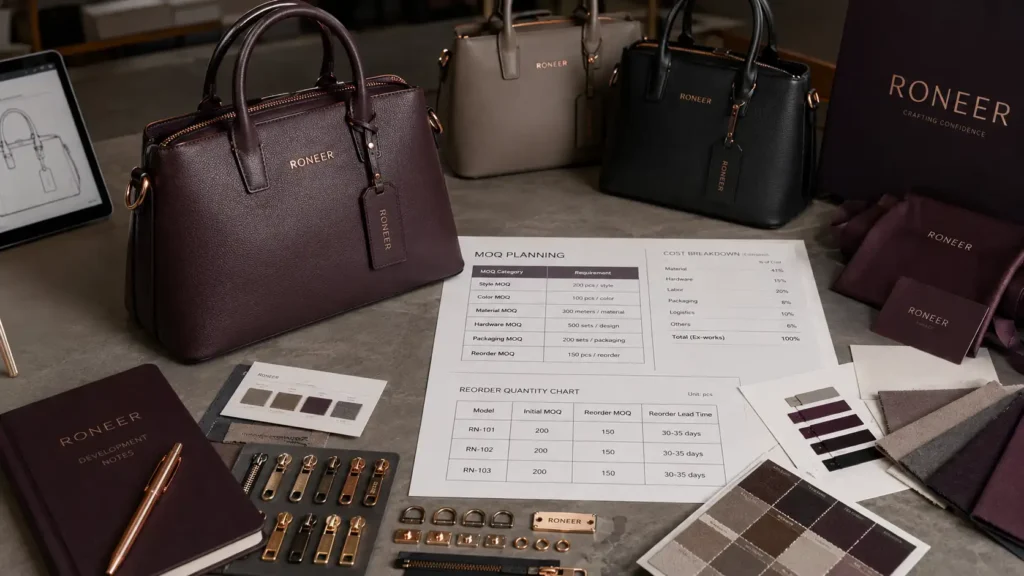
MOQ is rarely one simple number.
A handbag project may contain separate minimums for:
- Finished bags
- Individual styles
- Colors
- Exterior materials
- Custom-dyed fabric
- Подкладка с принтом
- Logo processes
- Metal hardware
- Zippers
- Dust bags
- Gift boxes
- Repeat orders
A handbag manufacturer for startups should explain where every minimum originates. A factory may accept a manageable finished-bag quantity while the material mill or packaging supplier requires a larger order.
Ask the manufacturer:
- Is the MOQ per order, style, or color?
- Can multiple colors share one material minimum?
- Which materials are already available?
- Does custom hardware have a separate MOQ?
- Can unused material be reserved for reorders?
- Does branded packaging require a higher quantity?
- What is the repeat-order MOQ?
- How does the unit price change at different quantities?
- Does the MOQ include defective-unit replacements?
- Can the startup divide production across several delivery dates?
Low MOQ can reduce inventory exposure, but it can also create:
- Higher unit prices
- Standard material choices
- Shared hardware
- Limited colors
- Simpler packaging
- Lower production efficiency
The best handbag manufacturer for startups is not necessarily the supplier offering the smallest number. It is the supplier that can create an order size the startup can sell and the factory can reproduce reliably.
6. Use Sampling as the Main Factory Test
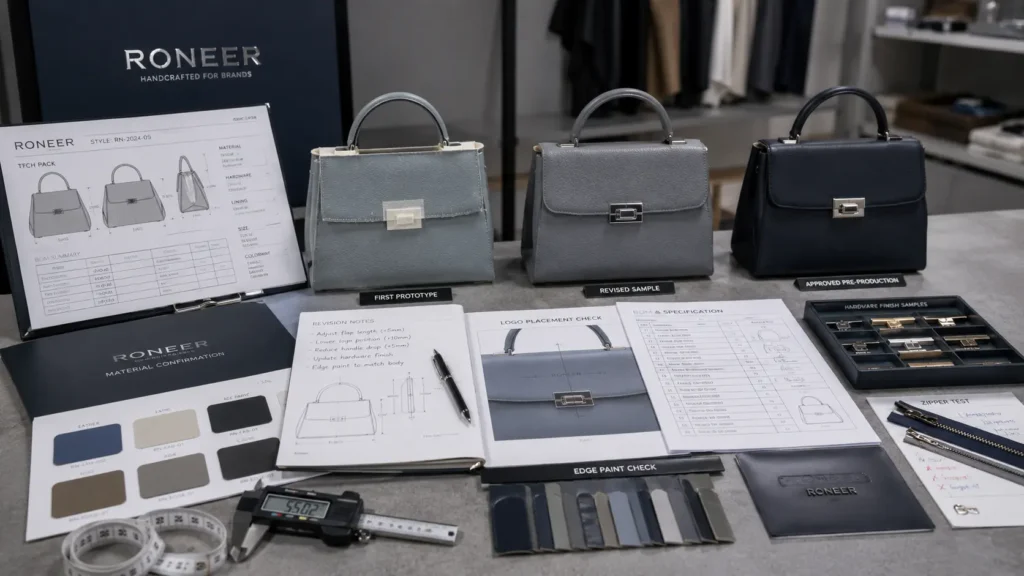
A sample is not only a visual preview. It is a test of the supplier’s technical process.
During development, evaluate whether the handbag manufacturer for startups can:
- Interpret the product specification
- Identify missing information
- Source suitable materials
- Develop accurate patterns
- Explain construction limitations
- Record revisions
- Meet agreed timelines
- Communicate substitutions
- Control measurements
- Apply branding correctly
- Prepare suitable packaging
Before paying for development, confirm:
- Sample fee
- Sample timeline
- Number of revision rounds
- Доступные материалы
- Logo tooling cost
- Custom hardware timing
- Shipping responsibility
- Pattern ownership
- Tooling ownership
- Whether sample fees can be credited to production
Inspect the physical sample for:
- Размеры
- Proportion
- Вместимость
- Вес
- Текстура материала
- Handle comfort
- Длина ремешка
- Pocket access
- Closure function
- Zipper movement
- Отделка корпуса
- Расположение логотипа
- Stitching
- Reinforcement
- Подкладка
- Edge finishing
- Упаковка
Photos do not fully communicate stiffness, weight, balance, comfort, grain, zipper resistance, or hand feel. A professional handbag manufacturer for startups should understand why physical approval matters.
After revisions, request a final approved sample or pre-production sample identified by style number, color, material, date, and approval status.
This sample should become the reference for bulk production.
7. Lock Materials and Protect Reorder Consistency
A successful first sample provides limited protection if the bulk order uses different materials or components.
Create a material record containing:
- Exterior material code
- Color reference
- Thickness
- Surface grain
- Backing
- Lining specification
- Reinforcement
- Thread
- Застежка-молния
- Отделка корпуса
- Edge paint
- Logo material
- Packaging components
RONEER’s настройка материала page outlines common material directions for custom handbag development.
A handbag manufacturer for startups should state whether each component is:
- Regularly stocked
- Purchased specifically for the order
- Custom produced
- Reserved for the buyer
- Likely to change between seasons
- Available for future reorders
This matters because a startup may sell through its first batch and then discover that the original material is unavailable.
A replacement material may appear similar in photographs but have a different grain, thickness, softness, backing, gloss level, color depth, or structural support.
Require written approval before any substitution.
A basic bill of materials connects every component to the approved specification and gives the handbag manufacturer for startups a clearer reference for future production.
8. Define Quality Control Before Production
“Good quality” is not an inspection standard.
The startup and factory should agree on what will be checked, when inspection will occur, and which variations are acceptable.
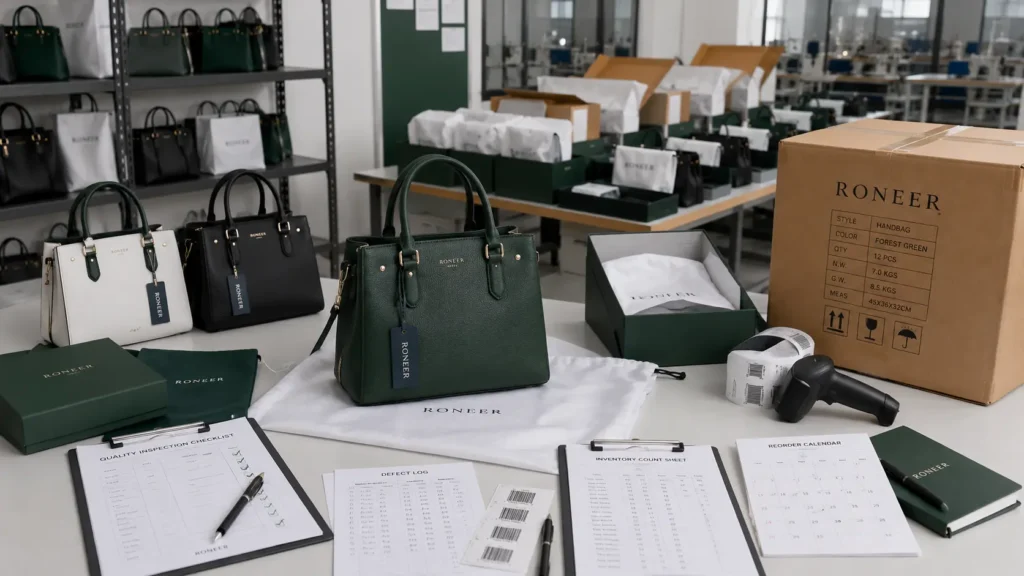
Typical handbag inspection points include:
- Material defects
- Цветовая стабильность
- Размеры
- Panel alignment
- Stitching
- Seam strength
- Handle attachment
- Strap construction
- Функция застежки-молнии
- Отделка корпуса
- Расположение логотипа
- Edge paint
- Lining cleanliness
- Pocket construction
- Упаковка
- Этикетки со штрих-кодом
- Картонные знаки
A handbag manufacturer for startups should explain:
- Incoming-material inspection
- In-line production checks
- Final inspection
- Measurement tolerances
- Defect classification
- Rejected-unit handling
- Inspection records
- Buyer inspection access
- Third-party inspection access
SGS states that its bags and accessories services can assess materials and components, evaluate product performance, and support regulatory and quality requirements.
The appropriate testing or inspection plan depends on the product, material, intended use, destination market, retailer requirements, and buyer expectations. Review the official SGS Bags and Accessories services.
Not every startup order needs the same laboratory tests. Testing should be connected to material claims, product risks, sales-channel requirements, and destination-market rules.
A capable handbag manufacturer for startups should help organize the product information required for testing without claiming that one testing plan fits every handbag.
9. Evaluate Communication and Documentation
Fast replies are useful, but response speed alone does not prove production control.
Evaluate whether the handbag manufacturer for startups:
- Answers technical questions directly
- Identifies missing information
- Confirms decisions in writing
- Uses consistent style numbers
- Records sample revisions
- Updates quotations after changes
- Explains delays early
- Separates estimates from confirmed dates
- Requests approval before substitutions
- Maintains production documents
A startup often needs more guidance than an experienced sourcing team, but the buyer must also control communication.
Important changes should be added to the current tech pack, bill of materials, sample comments, quotation, and approval record instead of remaining scattered across email or chat messages.
RONEER’s guide on how to find a bag manufacturer provides a broader process for supplier sourcing, screening, RFQs, verification, samples, and pilot production.
A reliable handbag manufacturer for startups should make the project easier to understand over time, not more dependent on verbal promises.
10. Prepare Packaging and Market Requirements Early
Packaging can create a separate MOQ, cost, and production timeline.
Depending on the sales channel, a startup may need:
- Dust bags
- Tissue paper
- Care cards
- Клейма
- Этикетки со штрих-кодом
- Polybags
- Gift boxes
- Shipping inserts
- Inner cartons
- Master cartons
- Картонные знаки
A handbag manufacturer for startups should confirm that the packaging dimensions fit the approved product and protect the handbag during storage and transportation.
RONEER’s изготовление упаковки на заказ page presents common options for private label and custom bag programs.
Avoid ordering large quantities of boxes before the final handbag dimensions and packing method are approved.
For the U.S. market, labeling obligations depend on the product’s materials and construction. The Federal Trade Commission explains that covered textile products may need disclosures such as fiber content, country of origin, and the identity of the responsible business.
The FTC’s Leather Guides also address misleading statements about leather and imitation-leather composition. Review the official FTC textile-labeling guidance и FTC Leather Guides.
U.S. Customs and Border Protection states that foreign-origin articles entering the United States generally must be marked legibly with the English name of the country of origin unless an exception applies.
Product-specific decisions should be confirmed with qualified customs or compliance professionals. Review the official CBP country-of-origin marking guidance.
A handbag manufacturer for startups can help implement approved labels and packing instructions, but the importer or brand remains responsible for confirming which requirements apply.
11. Start With a Controlled Pilot Order
The final sample is usually produced under controlled development conditions. Bulk production tests the complete factory system.
A controlled first order allows the startup to evaluate:
- Material consistency
- Цветовая стабильность
- Measurement control
- Workmanship
- Оборудование
- Logo application
- Production communication
- Inspection
- Упаковка
- Delivery
- Defect handling
Before production, confirm:
- Approved sample
- Final tech pack
- Bill of materials
- Quantity by SKU
- Color breakdown
- Measurement tolerances
- Packaging standard
- Inspection method
- Production timeline
- Shipment terms
A handbag manufacturer for startups should discuss reorders before the first order ships.
Ask:
- Which materials will remain available?
- How will unused materials be stored?
- What will the reorder MOQ be?
- How much production notice is required?
- Will the unit price change?
- Which records will be retained?
- Can the same hardware finish be repeated?
- How will approved changes be transferred to the next order?
The first order should generate both inventory and manufacturing knowledge.
Record defects, customer complaints, return reasons, preferred colors, packaging damage, and repeated product questions. Share relevant findings with the handbag manufacturer for startups before the next production run.
Startup Manufacturing Route Comparison
| Startup Situation | Practical Starting Route | Main Risk to Control |
|---|---|---|
| Fast launch with limited development | Private label | Weak differentiation |
| Moderate customization | ODM | Shared or non-exclusive design |
| Original technical concept | OEM | Higher development cost |
| Uncertain customer demand | Controlled pilot order | Higher unit price |
| Custom branded hardware | OEM or advanced ODM | Tooling and component MOQ |
| Several untested ideas | One hero product first | Excess inventory |
| Wholesale sales plan | Scalable OEM or ODM | Margin and reorder capacity |
| Direct-to-consumer launch | Flexible OEM or ODM | Customer acquisition and returns |
No route is correct for every brand. The handbag manufacturer for startups should help match the production method to the startup’s current evidence, budget, product promise, and sales strategy.
Information to Send Before Requesting a Quote
A useful inquiry should contain:
- Brand name
- Target customer
- Handbag category
- Product dimensions
- Reference images
- Tech pack, if available
- Exterior material
- Подкладка
- Отделка корпуса
- Оформление логотипа
- Target quantity
- Number of colors
- Packaging requirements
- Target retail price
- Страна назначения
- Expected sample date
- Required delivery date
Also explain which details are fixed and which may be adjusted.
This allows the handbag manufacturer for startups to suggest practical materials, construction methods, and quantity options without changing the core product idea.
Red Flags for Startup Brands
Be cautious when a supplier:
- Gives a final quotation without specifications
- Promises any MOQ without conditions
- Refuses to make a physical sample
- Avoids explaining material sources
- Changes components without approval
- Pressures the buyer to begin bulk production early
- Uses inconsistent company or bank names
- Cannot explain its inspection process
- Promises unrealistic delivery dates
- Offers copied luxury logos or protected designs
- Cannot explain reorder availability
- Refuses to document approved revisions
A professional handbag manufacturer for startups may reject an unrealistic cost, deadline, material, or construction request.
A technically justified limitation is often more useful than an immediate promise.
FAQ About a Handbag Manufacturer for Startups
1. What makes a handbag manufacturer suitable for startups?
A handbag manufacturer for startups should provide clear development guidance, manageable quantity options, structured sampling, transparent pricing, material information, measurable quality standards, practical packaging support, and a realistic reorder process.
2. What MOQ should a startup expect?
MOQ depends on handbag structure, material, color, hardware, logo, lining, packaging, and production method. Existing materials and standard components may support smaller quantities than custom colors, molded hardware, or printed lining.
3. Is the lowest MOQ always the best option?
No. A very low MOQ may involve higher unit prices, limited materials, standard hardware, or reduced production efficiency. The startup should balance inventory risk with product quality, margin, and reorder stability.
4. Should a startup use OEM, ODM, or private label production?
Private label can support a fast launch, ODM can balance customization with development efficiency, and OEM can support original product ideas.
A handbag manufacturer for startups should recommend the route that fits the product instead of automatically adding complexity.
5. Does a startup need a tech pack?
A detailed tech pack is recommended for original OEM projects. A simpler private label or ODM handbag may begin with a structured specification sheet, but all approved materials, dimensions, logos, and packaging details should still be recorded.
6. How many samples should a startup make?
The number depends on product complexity and the accuracy of the first result. Continue revisions until the handbag meets measurable requirements. Do not approve production only to avoid another sample fee.
7. Can a handbag manufacturer create custom hardware?
Many factories can coordinate logo plates, zipper pullers, locks, buckles, D-rings, chains, and other components. Custom hardware may require tooling fees, higher MOQ, longer development time, and finish approval.
8. How should startups compare quotations?
Compare materials, lining, hardware, construction, logo method, packaging, sample fees, tooling, MOQ, lead time, inspection, payment terms, and shipping terms.
Prices are not comparable when the specifications differ.
9. How can a startup protect its handbag design?
Use original files, dated tech packs, revision records, confidentiality terms where appropriate, written pattern and tooling ownership, and clear restrictions on product photography or marketing use.
10. Should startups use standard materials?
Standard materials can reduce MOQ, development time, and reorder risk. Custom materials may create stronger differentiation but can require higher minimums and more working capital.
11. What should be inspected before shipment?
Inspection may cover materials, color, dimensions, stitching, seams, handles, straps, zippers, hardware, logos, lining, edge finishing, packaging, labels, quantity, and carton marks.
12. How early should a startup plan reorders?
Reorder planning should begin before the first production order ships. The startup needs to understand material lead time, production capacity, reorder MOQ, freight timing, and expected inventory turnover.
13. How does RONEER work as a handbag manufacturer for startups?
RONEER supports OEM and ODM projects through product review, material selection, sample coordination, logo customization, packaging planning, bulk-production communication, quality preparation, export packing, and repeat-order documentation.
The production route depends on the product, quantity, budget, market, and schedule.
Заключение
A handbag manufacturer for startups should help convert a limited budget into a controlled development and production plan. The supplier does not need to agree with every request. It should identify technical risks, explain minimum quantities, provide measurable sample feedback, and document the approved standard.
Product focus comes first. A startup should not divide its budget across too many styles, colors, materials, and packaging variations before demand has been tested. One carefully developed hero handbag may generate more useful sales and manufacturing information than a broad, unproven collection.
The correct manufacturing route also matters. Private label may provide speed, ODM can balance customization and efficiency, and OEM can support original concepts. A capable handbag manufacturer for startups should recommend the route that fits the brand’s actual stage.
MOQ must be reviewed at the product, color, material, hardware, logo, packaging, and reorder levels. A low finished-product MOQ can still create hidden inventory in unused material, boxes, or custom components.
Sampling should be the main technical test. The handbag manufacturer for startups should demonstrate that it can interpret instructions, control dimensions, source appropriate materials, manage revisions, apply branding correctly, and prepare a repeatable production standard.
Startups must also calculate the complete commercial impact of the order. Samples, tooling, packaging, freight, inspection, import charges, fulfillment, returns, marketing, and reorder capital all influence whether the product can become a sustainable business.
RONEER works as an OEM and ODM handbag manufacturer for startups and established brands developing handbags, crossbody bags, totes, wallets, backpacks, cosmetic bags, travel bags, and related products.
Support can include materials, sampling, logos, packaging, production coordination, quality communication, export preparation, and reorder records.
The most suitable handbag manufacturer for startups is not simply the supplier offering the smallest MOQ or fastest reply. It is the manufacturing partner that can match the startup’s product stage, explain production trade-offs, reproduce the approved sample, control the first order, and maintain reliable records for future growth.