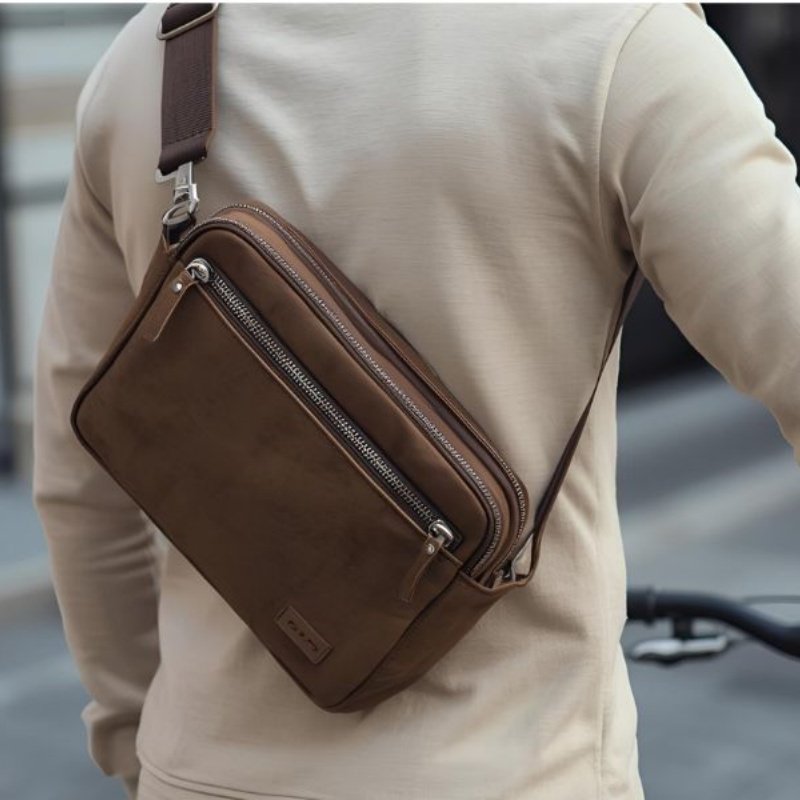










A shoulder bag can look balanced in a product photograph and become uncomfortable within ten minutes of actual use.
The strap may slide toward the edge of the shoulder. A heavy chain can pull the bag backward. The opening may become difficult to reach when the bag is worn under the arm. The body may collapse after a phone, wallet, keys, and cosmetic pouch are placed inside.
These problems are not solved by selecting an attractive silhouette alone.
A professional custom shoulder bag manufacturer must coordinate the bag body, shoulder strap, material, reinforcement, hardware, opening, internal layout, weight, and expected carrying position. Each decision affects comfort as well as appearance.
Brands should therefore evaluate a custom shoulder bag manufacturer through physical product development rather than relying only on catalog photographs or general claims about handbag experience.
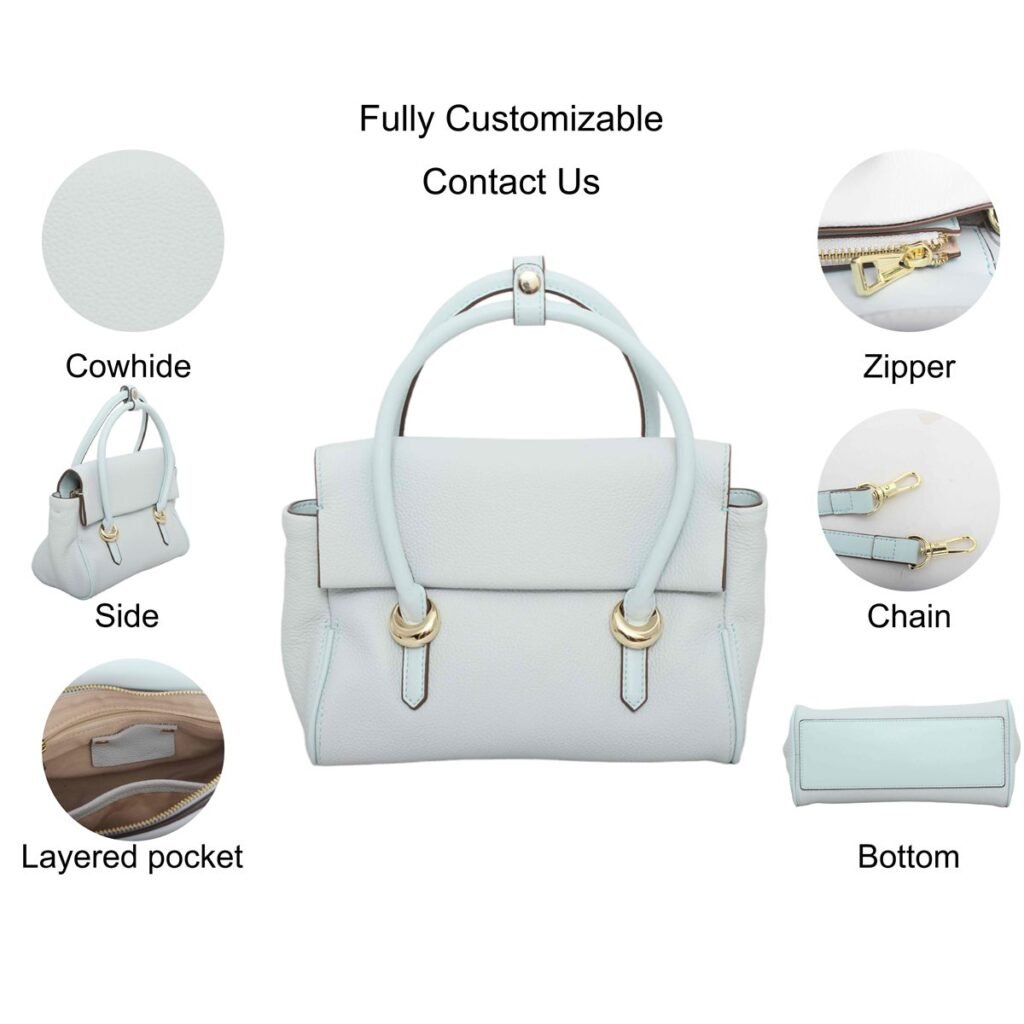
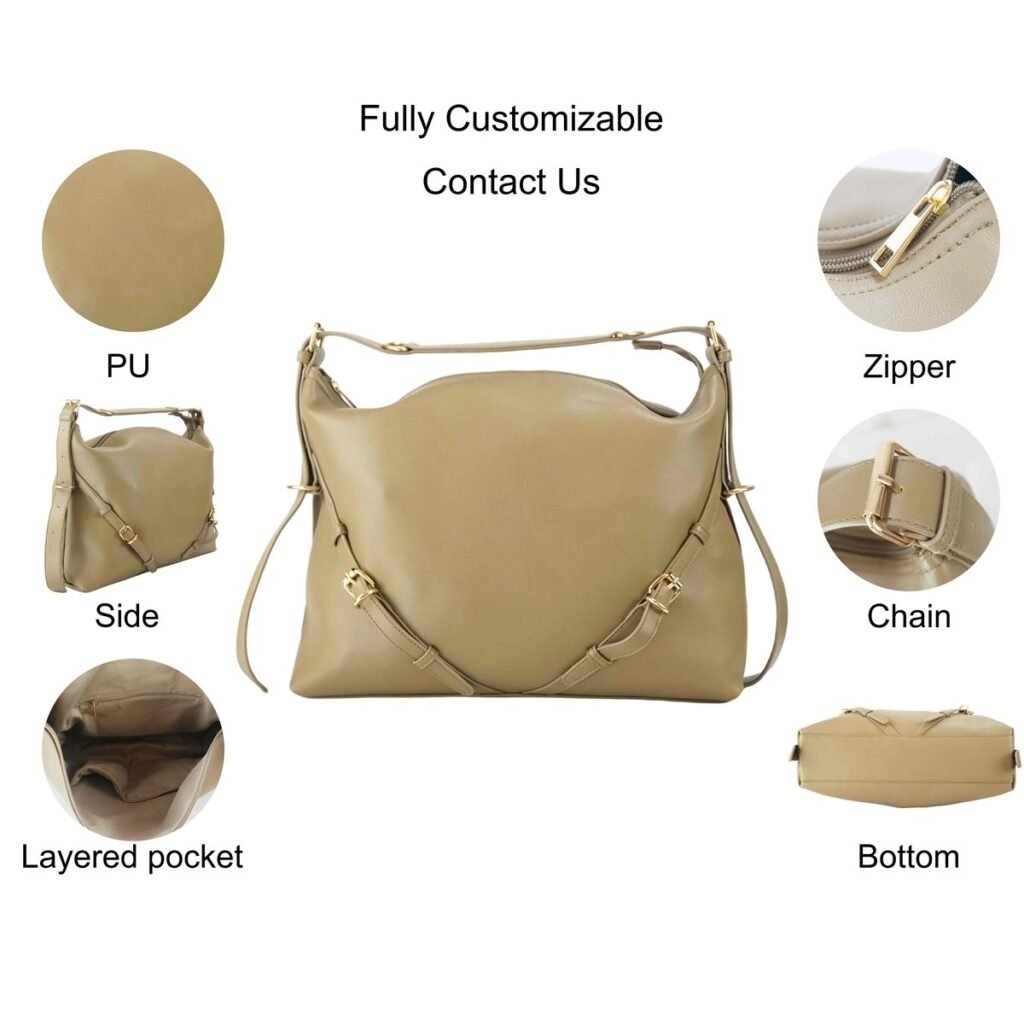
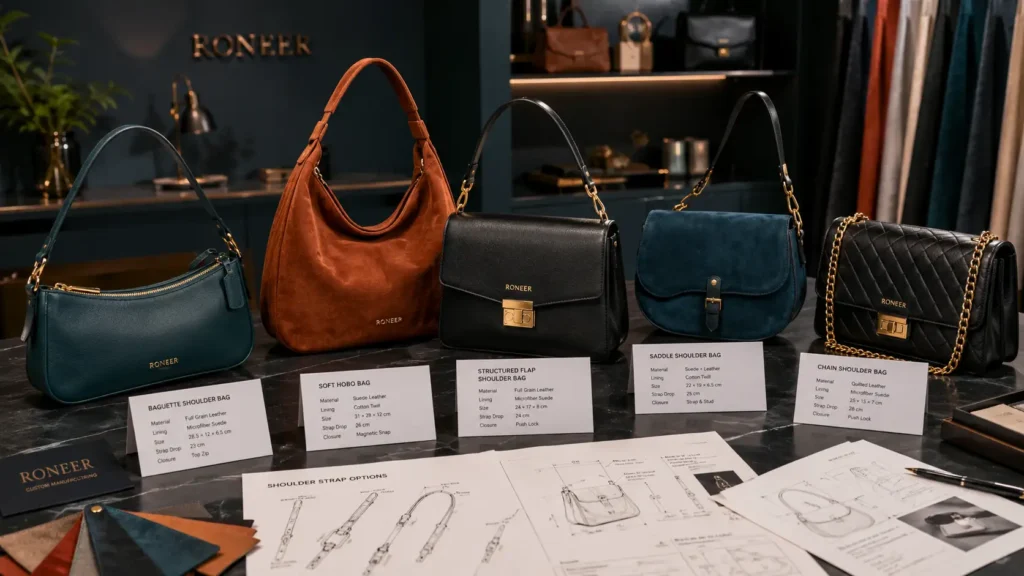
A suitable factory should understand the difference between a short baguette strap, a soft hobo construction, a chain shoulder bag, a structured flap design, and a convertible shoulder-crossbody style. It should also explain how materials, dimensions, hardware, MOQ, sampling, packaging, and repeat production affect the final product.
This guide explains ten checks for selecting a custom shoulder bag manufacturer. It is written for fashion brands, private label companies, boutiques, wholesalers, retailers, e-commerce sellers, designers, and established companies developing shoulder bags for new collections.
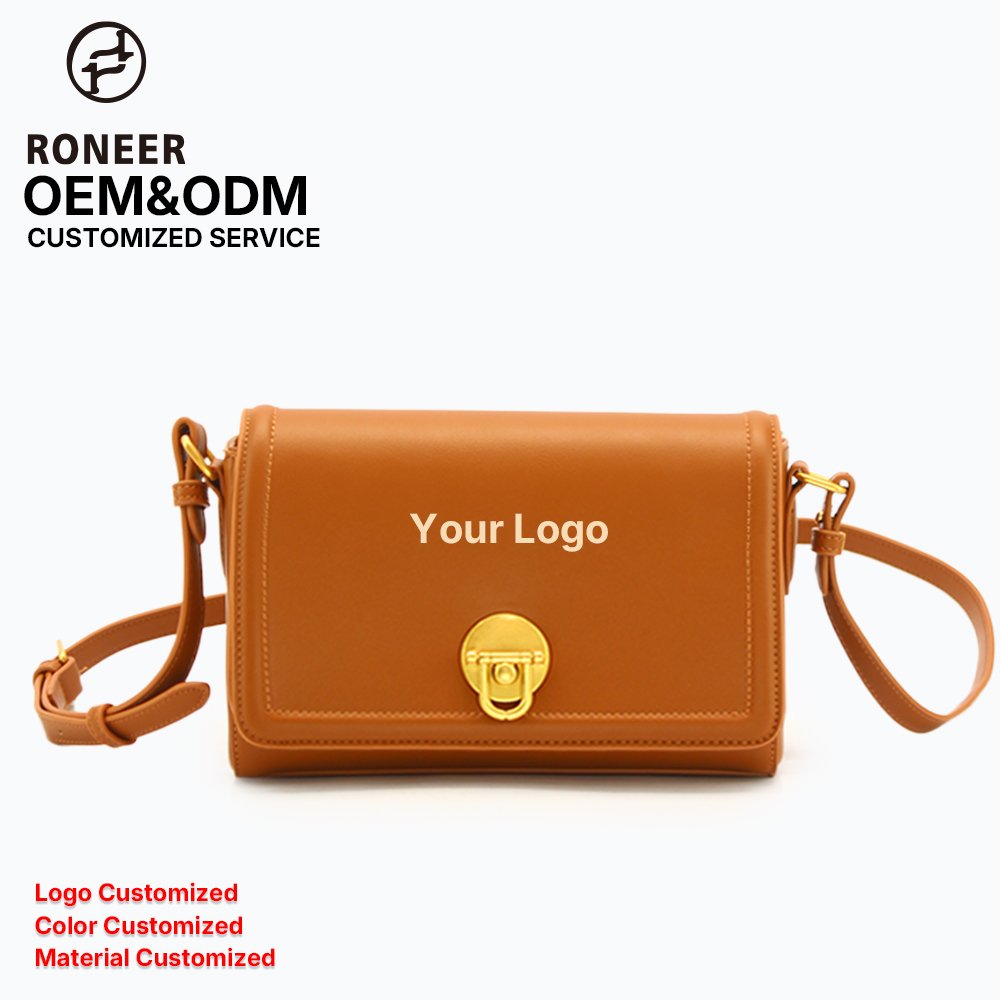
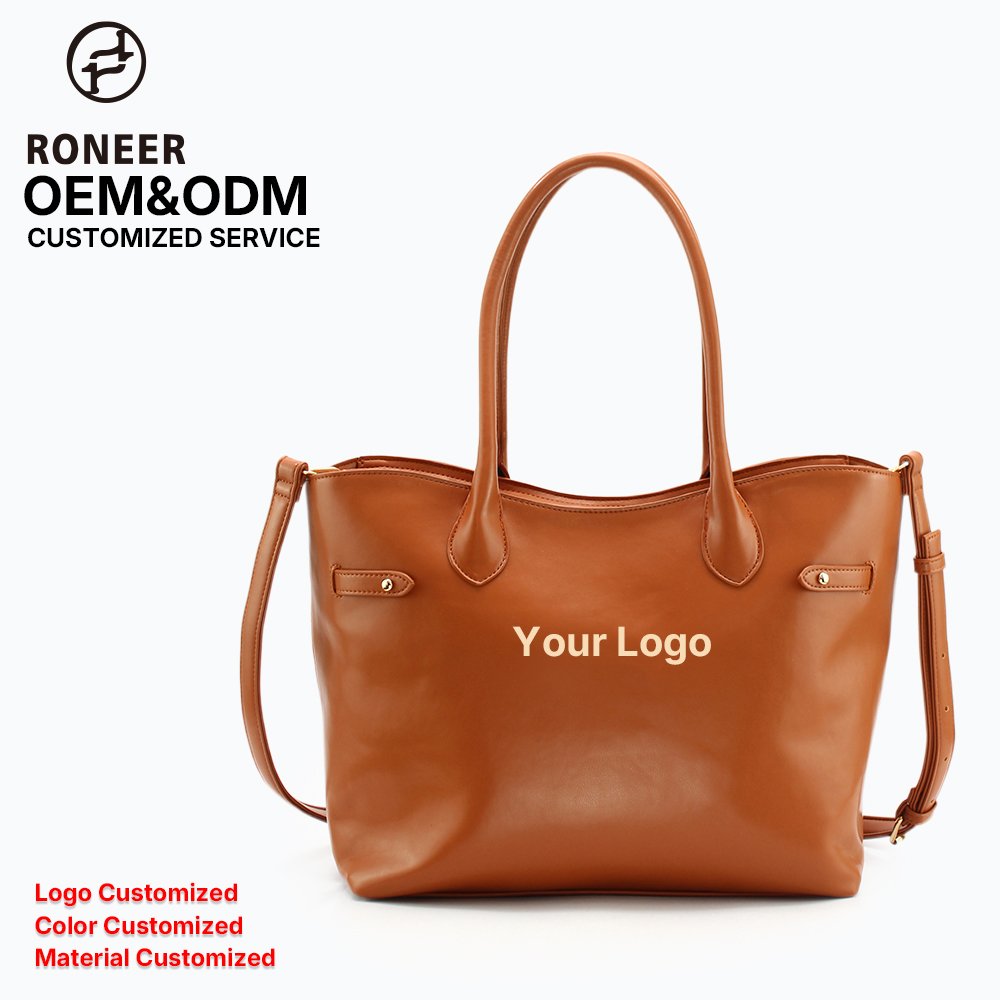
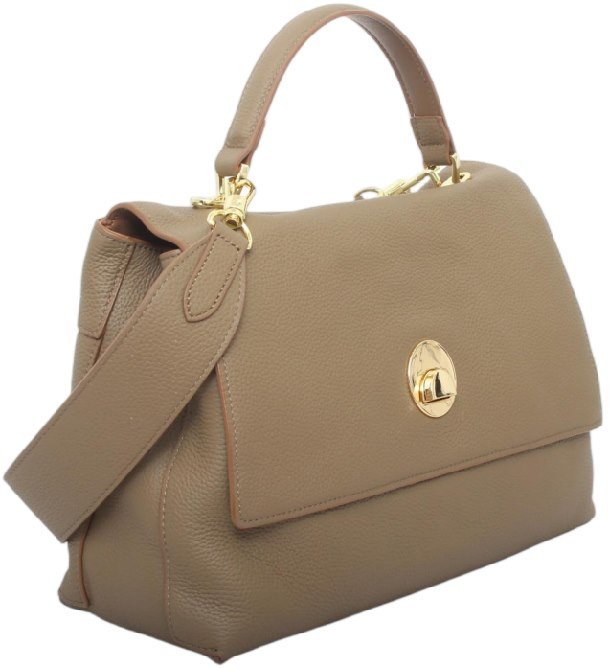
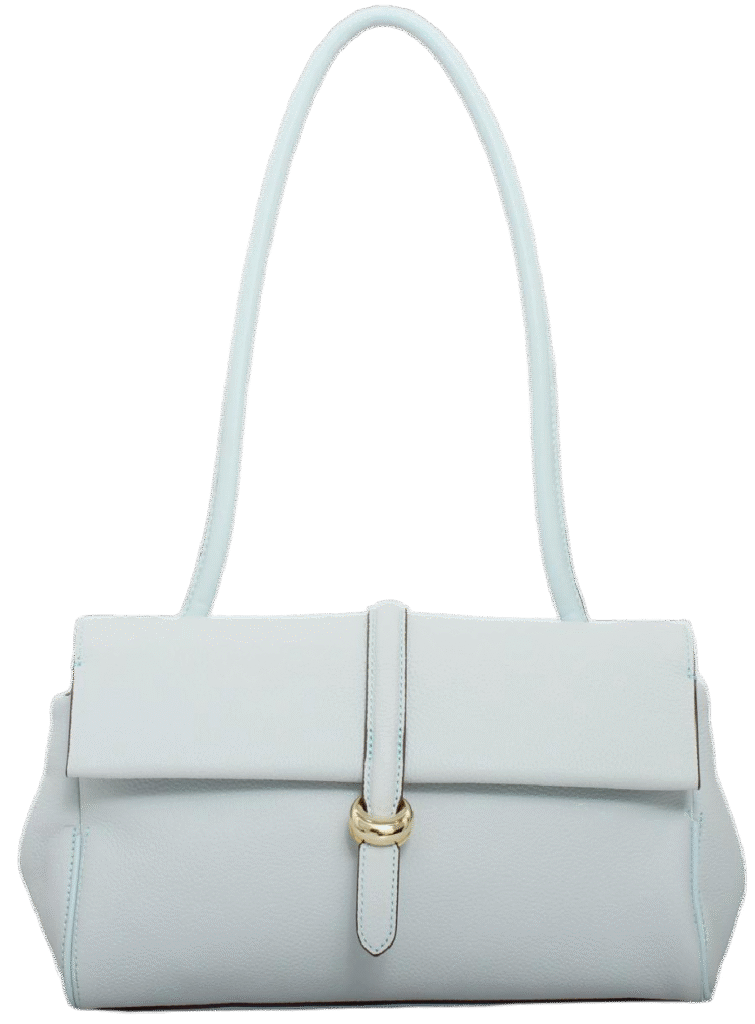
RONEER supports handbag and crossbody projects through material, size, structure, Logo, hardware, lining, sample, packaging, and bulk-production planning. Its existing product categories include shoulder baguette bags, small square shoulder bags, hobo-style products, flap bags, and convertible shoulder-crossbody designs.
Оглавление
Toggle1. Define the Shoulder Bag Type and Use Case
The first responsibility of a custom shoulder bag manufacturer is to understand how the product will be worn.
A shoulder bag is a broad category rather than one construction.
Common styles include:
- Baguette shoulder bag
- Hobo bag
- Flap shoulder bag
- Saddle shoulder bag
- Chain shoulder bag
- Underarm bag
- Bucket shoulder bag
- Shoulder tote
- Mini shoulder purse
- Convertible shoulder-crossbody bag
A baguette bag normally sits close beneath the arm. A hobo bag may hang lower and rely on soft material drape. A structured flap shoulder bag may need stronger reinforcement and a more controlled closure.
Before requesting a quotation, define:
- Target customer
- Intended carrying position
- Main use scenario
- Product dimensions
- Expected capacity
- Strap drop
- Strap width
- Strap adjustment
- Материал
- Закрытие
- Отделка корпуса
- Внутренняя организация
- Target quantity
- Retail position
- Упаковка
A custom shoulder bag manufacturer cannot confirm the correct structure when the buyer has supplied only one front-view image.
The factory should also know whether the customer will use the bag for evening events, commuting, travel, shopping, daily essentials, or fashion styling. Each use case creates different requirements for capacity, security, comfort, and weight.
Brands can review RONEER’s custom handbag styles when comparing tote, top-handle, baguette, shoulder, and crossbody structures.
2. Separate Shoulder-Bag and Crossbody Requirements
A shoulder bag and crossbody bag may use similar components, but their fit requirements are not identical.
A traditional shoulder bag normally hangs from one shoulder using a shorter strap. A crossbody bag uses a longer strap and distributes the bag across the torso.
A convertible design must work in both positions.
A custom shoulder bag manufacturer should confirm:
- Fixed or adjustable strap
- Minimum and maximum strap length
- Finished strap drop
- Detachable or permanent connection
- Shoulder-only or convertible use
- Strap buckle position
- Remaining strap-tail length
- Hardware orientation
- Body angle when worn
- Opening access in each carrying mode
A strap that works well on the shoulder may position the bag too high when worn crossbody. A long adjustable strap may also create excess tail material that affects the clean appearance expected from a compact shoulder bag.
When a design is intended mainly for crossbody use, it should be developed around that primary function. Buyers can review RONEER’s custom crossbody bag manufacturer page for products using longer straps and body-crossing wear.
The new shoulder-bag specification should state the primary carrying mode clearly instead of assuming that one strap length will suit every customer.
3. Select Private Label, ODM, or OEM Development
The production route affects originality, sample work, tooling, MOQ, price, and development time.
Private Label Shoulder Bags
Private label normally begins with an existing shoulder-bag style. The buyer may customize:
- Логотип
- Available material
- Цвет
- Interior label
- Этикетка
- Мешок для пыли
- Упаковка
This route can support a faster launch when the base structure already matches the brand’s target customer.
ODM Shoulder Bags
ODM allows the brand to modify a factory-developed product through:
- Material changes
- Strap shape
- Длина ремешка
- Pocket layout
- Закрытие
- Оборудование
- Подкладка
- Colorways
- Логотип
- Упаковка
ODM can provide more differentiation without requiring a completely new pattern.
OEM Shoulder Bags
OEM develops an original design from:
- Tech pack
- Technical drawings
- Physical reference
- Prototype
- Detailed written specification
OEM may require new patterns, construction testing, several samples, custom hardware, and more detailed quality standards.
A custom shoulder bag manufacturer should recommend the route that protects the meaningful product difference rather than automatically adding development complexity.
If the brand’s value comes from a distinctive crescent body and concealed opening, original development may be justified. If the value comes mainly from material, color, branding, and packaging, an ODM base may be more efficient.
4. Prepare a Factory-Ready Shoulder Bag Specification
An accurate quotation requires more than a mood board.
A factory-ready specification should include:
- Front, back, side, bottom, top, and interior views
- Finished width, height, and depth
- Opening width
- Длина ремешка
- Strap drop
- Strap width
- Strap thickness
- Pocket dimensions
- Закрытие
- Exterior material
- Подкладка
- Reinforcement
- Оборудование
- Logo dimensions
- Расположение логотипа
- Упаковка
- Measurement tolerances
The custom shoulder bag manufacturer should use numbered measurement points so the buyer, pattern maker, sample room, production team, and inspector measure the product consistently.
Strap measurements require particular care.
State whether the dimension refers to:
- Total strap length
- Finished drop
- Length between attachment points
- Adjustable range
- Chain length
- Leather shoulder section
- Detachable extension strap
Do not use only the instruction “make the strap slightly longer.” Replace subjective comments with measurable revisions.
The specification should be updated after each sample revision. Production should not depend on old drawings combined with scattered email or messaging-app comments.
5. Match Material to Structure and Drape
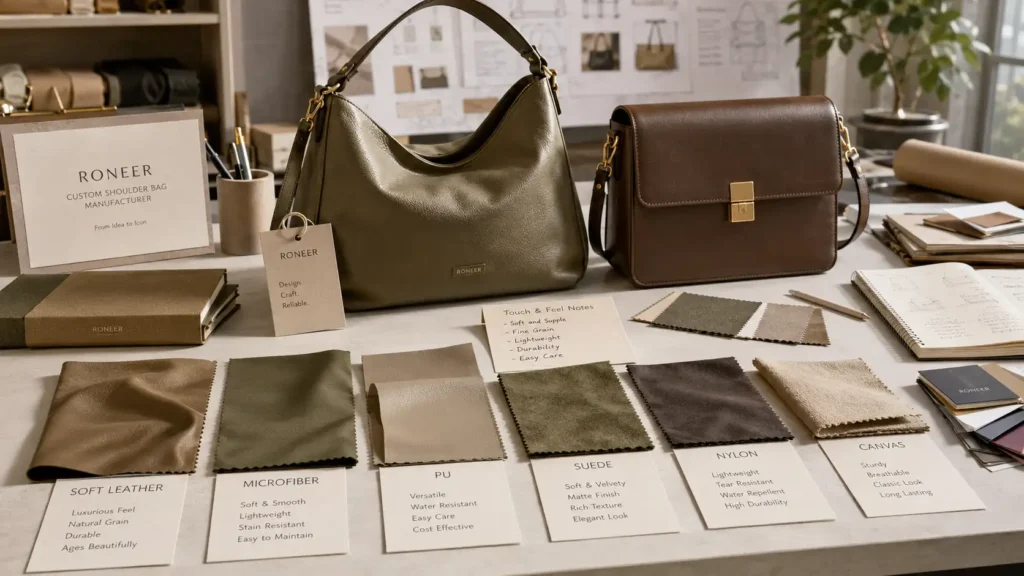
Material affects whether a shoulder bag remains structured, collapses softly, stretches, scratches, or becomes uncomfortable.
A soft hobo bag may depend on:
- Flexible leather or synthetic leather
- Controlled drape
- Lightweight lining
- Soft reinforcement
- Comfortable wide strap
- Flexible opening
A structured flap shoulder bag may need:
- Firmer exterior material
- Panel reinforcement
- Controlled edge finishing
- Stable closure
- Reinforced strap connections
- Shape-supporting packaging
RONEER’s настройка материала page covers material selection according to bag structure, Logo process, target price, MOQ, lining, and bulk-production requirements.
Ask the custom shoulder bag manufacturer for physical material swatches showing:
- Material code
- Composition
- Цвет
- Thickness
- Grain
- Качество поверхности
- Backing
- Softness
- Stretch
- Expected availability
- Reorder conditions
Digital photographs cannot fully communicate softness, thickness, surface grain, stiffness, backing, or hand feel.
Material descriptions used in customer-facing content must also be accurate. The FTC’s leather and imitation-leather guidance includes handbags and other leather goods, so brands should review material descriptions before publishing labels or product pages. Review the FTC apparel and leather guidance.
6. Engineer the Shoulder Strap and Hardware
The strap is a primary functional component, not only a decorative detail.
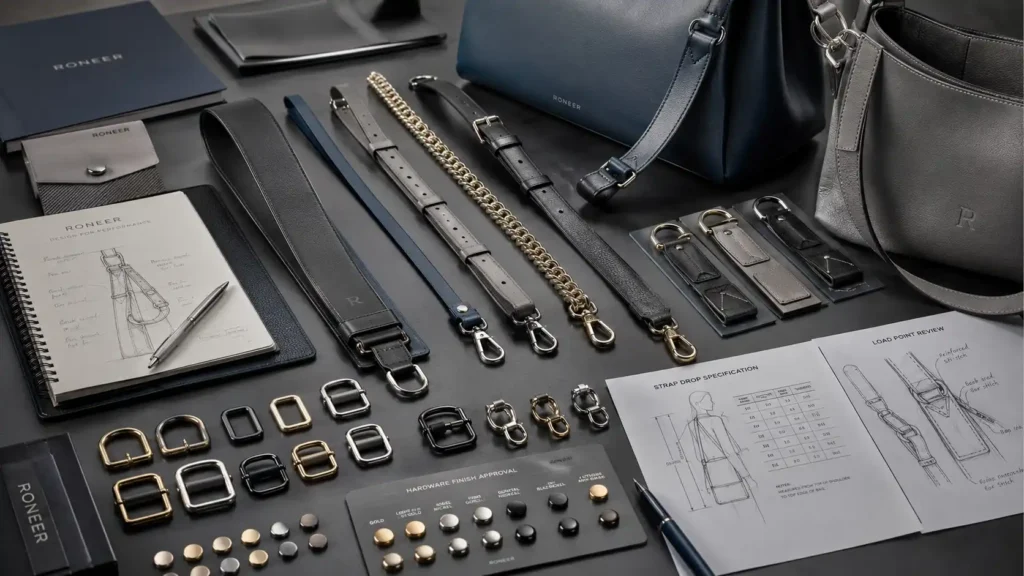
A custom shoulder bag manufacturer should evaluate:
- Strap width
- Finished thickness
- Edge finish
- Internal reinforcement
- Flexibility
- Attachment point
- Adjustment method
- Hardware weight
- Expected load
- Shoulder contact area
A narrow strap may create the desired visual proportion but become uncomfortable when the bag is filled. A wide strap may improve comfort but overpower a small baguette silhouette.
Chain straps create different concerns:
- Total chain weight
- Link shape
- Hair or fabric snagging
- Shoulder pressure
- Plating consistency
- Connection strength
- Noise during use
- Leather shoulder-rest section
RONEER’s настройка аппаратного обеспечения page includes D-rings, hooks, strap adjusters, chains, zipper pullers, magnetic snaps, metal Logo plates, and locks used on shoulder and crossbody bags.
A technical hardware record should identify:
- Component dimensions
- Base material
- Finish
- Количество
- Position
- Attachment method
- Approved sample
- Custom mold reference where applicable
The custom shoulder bag manufacturer should also reinforce the body behind strap rings or handle bases. Attractive external stitching does not guarantee that the internal support can carry repeated loads.
7. Control Weight Distribution and Bag Balance
A shoulder bag can become unstable when its weight sits too far from the body or when the strap connections are incorrectly positioned.
The factory should assess:
- Empty product weight
- Hardware weight
- Strap weight
- Body depth
- Strap connection spacing
- Center of gravity
- Interior load distribution
- Base structure
- Opening direction
A deep bag with high strap attachments may tilt outward when filled. A single wide strap attached too close to the opening may pull the top edge inward. A heavy front lock can make a soft flap collapse.
A custom shoulder bag manufacturer should identify these risks during the first sample instead of waiting for customer complaints after production.
Testing should include realistic contents such as:
- Phone
- Кошелек
- Keys
- Cosmetic pouch
- Small bottle
- Sunglasses
- Tablet where relevant
The design should be examined while empty and while loaded.
Observe whether the bag:
- Tilts forward
- Pulls backward
- Rotates under the arm
- Collapses at the opening
- Slides from the shoulder
- Places excessive pressure on one point
- Distorts around hardware
A balanced physical sample is more reliable than judging proportions only from a rendering.
8. Use Sampling to Test Comfort and Access
Sampling should test how the product behaves on a person.
A custom shoulder bag manufacturer should not evaluate only stitching and dimensions.
The sample review should check:
- Ease of placing the bag on the shoulder
- Space between bag and underarm
- Strap comfort
- Strap slippage
- Opening access
- Closure operation
- Ability to retrieve a phone or wallet
- Body balance
- Bag movement while walking
- Clothing contact
- Hardware pressure
- Overall weight
Test the bag with users of different heights and body proportions when the target market is broad.
A short-strap baguette bag may fit differently over:
- Lightweight summer clothing
- A blazer
- A heavy coat
- A padded jacket
The approved sample should record the final strap dimensions and the clothing conditions used during fitting.
Photos and videos are useful, but physical testing remains necessary for comfort, balance, stiffness, opening resistance, and shoulder pressure.
After revisions, the custom shoulder bag manufacturer should identify an approved pre-production sample connected to:
- Final tech pack
- Material card
- Отделка корпуса
- Strap specification
- Оформление логотипа
- Colorway
- Упаковка
- Approval date

9. Understand MOQ and Complete Cost
Shoulder-bag MOQ may involve more than the completed product quantity.
Separate minimums can apply to:
- Стиль
- Цвет
- Exterior material
- Custom-dyed material
- Подкладка с принтом
- Chain
- Застежка-молния
- Custom Logo plate
- Buckle
- Мешок для пыли
- Retail box
- Reorder
A custom shoulder bag manufacturer should explain where each minimum originates.
For example, the factory may accept a manageable finished quantity while a chain supplier requires more components than the first production order uses.
Ask:
- Is the MOQ per order, style, or color?
- Can several styles share the same chain or hardware?
- Can available materials reduce the minimum?
- Who owns unused custom components?
- How long can they be stored?
- What is the reorder MOQ?
- Does the unit price change by quantity?
- Can future styles use the same components?
The quotation should separate:
- Sample fee
- Pattern fee
- Tooling
- Exterior material
- Подкладка
- Оборудование
- Strap
- Логотип
- Упаковка
- Unit production cost
- Inspection
- Shipping terms
The lowest quotation is not automatically the lowest-risk quotation. Two suppliers may be using different material thicknesses, chain weights, reinforcements, zippers, packaging, or inspection standards.
10. Define Quality Control and Repeat-Order Records
A clear quality plan should be prepared before bulk production.
Common shoulder-bag checks include:
- Exterior material
- Цветовая стабильность
- Размеры
- Body symmetry
- Длина ремешка
- Strap-drop tolerance
- Strap width
- Attachment position
- Reinforcement
- Chain or hardware finish
- Closure function
- Zipper movement
- Расположение логотипа
- Подкладка
- Pocket access
- Упаковка
- Barcode
- Маркировка на коробке
SGS provides testing and inspection services for bags and accessories involving materials, components, product performance, safety, quality, and relevant market requirements. The correct test plan depends on the individual product and destination; this does not mean every factory project automatically has SGS certification. Review SGS Bags & Accessories.
Every style and meaningful product variation should also be planned in the inventory system. GS1 US explains that individual variations may require separate product identifiers, so additional colors, sizes, or packaging formats can increase barcode requirements. Review GS1 US barcode guidance.
For shoulder bags imported into the United States, country-of-origin marking should be planned before labels and packaging are produced. CBP states that foreign-origin articles generally require legible English country-of-origin marking unless an exception applies. Review CBP country-of-origin guidance.
Before the first order ships, the custom shoulder bag manufacturer should retain:
- Approved pattern
- Tech pack version
- Material code
- Color reference
- Strap specification
- Отделка корпуса
- Оформление логотипа
- Упаковка
- Quality tolerances
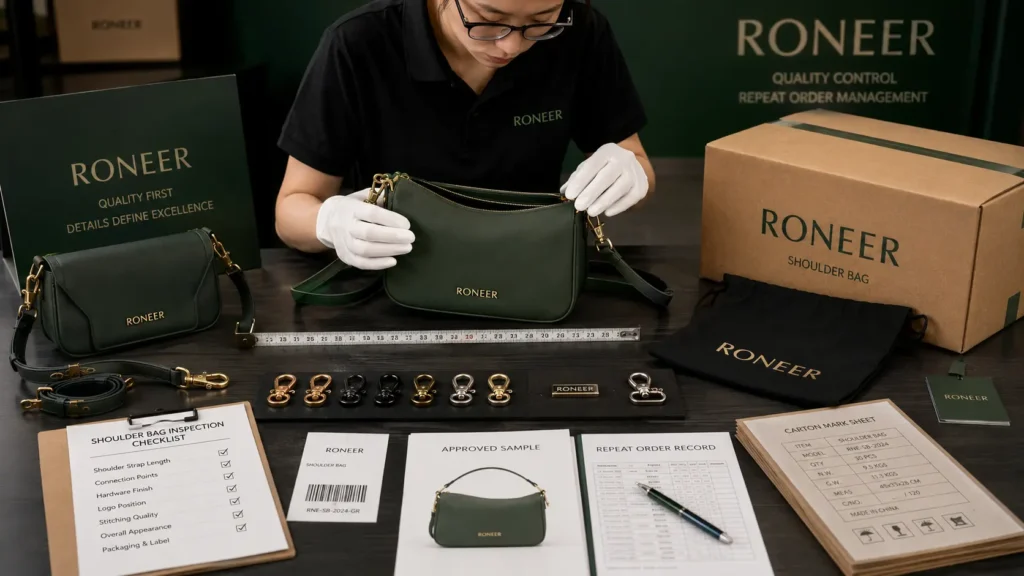
- Approved sample record
These documents help maintain consistency when the brand places a repeat order.
Shoulder Bag Structure Comparison
| Shoulder Bag Type | Important Factory Controls |
|---|---|
| Baguette bag | Short strap drop, underarm clearance, compact opening |
| Hobo bag | Material drape, strap comfort, body collapse and lining |
| Flap shoulder bag | Flap alignment, closure position, reinforcement |
| Chain shoulder bag | Chain weight, plating, shoulder pressure and attachment |
| Saddle bag | Curved pattern, flap balance and edge finishing |
| Shoulder tote | Handle strength, capacity, base structure and weight |
| Mini shoulder bag | Hardware scale, opening access and usable capacity |
| Convertible shoulder bag | Strap range, hooks, adjustment and dual-mode balance |
The custom shoulder bag manufacturer should evaluate each style according to its actual construction instead of applying one generic shoulder-bag specification.
Information to Send Before Requesting a Quote
Provide:
- Shoulder-bag type
- Target customer
- Reference images
- Technical drawings
- Размеры
- Strap drop
- Длина ремешка
- Exterior material
- Подкладка
- Отделка корпуса
- Закрытие
- Оформление логотипа
- Target quantity
- Number of colors
- Упаковка
- Destination market
- Sample schedule
- Delivery target
Also identify which details are fixed and which may be adjusted.
This helps the custom shoulder bag manufacturer recommend available materials, standard hardware, practical construction, and realistic quantity options without changing the product’s main value.
Red Flags When Comparing Shoulder Bag Factories
Be cautious when a supplier:
- Quotes before reviewing strap and material specifications
- Treats shoulder and crossbody dimensions as identical
- Cannot explain strap reinforcement
- Refuses to make a physical sample
- Does not test the bag while loaded
- Changes hardware without approval
- Cannot explain component minimums
- Provides only front-view photographs
- Cannot define inspection tolerances
- Promises unrealistic delivery dates
- Avoids discussing material availability
- Does not retain production records
A professional custom shoulder bag manufacturer may explain that a requested material, chain, quantity, price, or deadline is not practical.
A technically justified limitation is often more reliable than an immediate promise.
FAQ About a Custom Shoulder Bag Manufacturer
1. What does a custom shoulder bag manufacturer do?
A custom shoulder bag manufacturer develops and produces shoulder bags according to a brand’s drawings, tech pack, reference sample, or selected ODM style. Services may include materials, patterns, samples, straps, hardware, Logo application, lining, packaging, bulk production, and quality control.
2. Which shoulder-bag styles can be customized?
A custom shoulder bag manufacturer may develop baguette bags, hobo bags, flap shoulder bags, saddle bags, chain bags, underarm bags, shoulder totes, mini bags, and convertible shoulder-crossbody styles.
3. What is the difference between a shoulder bag and a crossbody bag?
A shoulder bag normally uses a shorter strap and hangs from one shoulder. A crossbody bag uses a longer strap across the torso. Convertible designs need an adjustable or additional strap that supports both carrying positions.
4. Does a custom shoulder bag manufacturer need a tech pack?
A tech pack is strongly recommended for original OEM development. It should record dimensions, strap drop, strap length, materials, structure, hardware, Logo placement, lining, packaging, and tolerances.
5. Can I customize the shoulder strap?
Yes. Strap width, length, drop, material, edge finish, reinforcement, buckle, chain, hooks, adjustment holes, and detachable connections can be developed according to the product.
6. Can the factory create a chain shoulder bag?
A custom shoulder bag manufacturer can coordinate chain straps and chain-related hardware, subject to component availability, finish approval, weight, tooling, MOQ, and construction requirements.
7. Which materials are suitable for shoulder bags?
Options may include genuine leather, microfiber leather, PU, suede, nylon, canvas, polyester, and mixed-material structures. The choice depends on silhouette, drape, weight, target price, Logo method, and intended use.
8. How is shoulder-bag MOQ calculated?
MOQ may depend on style, color, material, lining, chain, hardware, Logo process, packaging, and production setup. Buyers should request a written breakdown rather than relying on one advertised quantity.
9. Should the shoulder bag be physically fitted?
Yes. Physical fitting helps evaluate underarm space, strap comfort, slippage, opening access, hardware pressure, product balance, and behavior while walking.
10. What should be checked on the approved sample?
Check dimensions, strap drop, strap length, material, weight, balance, closure, zipper, hardware, Logo placement, reinforcement, lining, pocket access, and packaging.
11. Can custom shoulder bags use private label packaging?
Yes. Options may include dust bags, hangtags, care cards, barcode labels, tissue paper, polybags, gift boxes, inner cartons, and export cartons. Packaging may have a separate MOQ.
12. How can a brand maintain reorder consistency?
The custom shoulder bag manufacturer should retain the approved pattern, material code, strap specification, hardware finish, Logo artwork, packaging file, quality tolerances, and sample approval record.
13. How does RONEER work as a custom shoulder bag manufacturer?
RONEER reviews shoulder-bag projects according to silhouette, materials, dimensions, strap construction, hardware, Logo, lining, quantity, packaging, market, and production schedule.
As a custom shoulder bag manufacturer, RONEER may support OEM and ODM development, material selection, samples, patterns, strap planning, hardware, branding, packaging, production coordination, quality communication, export preparation, and repeat-order documentation.
Заключение
A custom shoulder bag manufacturer should provide more than an attractive silhouette and basic unit price. The supplier must understand how the shoulder strap, bag body, material, opening, hardware, lining, reinforcement, and expected contents work together.
The first step is defining the carrying position. A baguette bag worn beneath the arm requires different strap measurements and opening access from a lower hobo bag or convertible shoulder-crossbody style.
A capable custom shoulder bag manufacturer should document strap drop, total strap length, width, thickness, adjustment, attachment points, reinforcement, and hardware. Subjective instructions such as “make the strap comfortable” are not sufficient for repeatable production.
Material selection must support the intended silhouette. Soft hobo bags need controlled drape, while structured flap shoulder bags may require firmer material and stronger reinforcement. Physical swatches should be approved before production.
Sampling should evaluate more than appearance. The custom shoulder bag manufacturer should test comfort, shoulder slippage, underarm clearance, opening access, weight distribution, body balance, closure function, hardware pressure, and behavior while the bag is loaded.
MOQ and cost should be examined across the complete product. Material, lining, chain, custom hardware, Logo, packaging, and repeat-order minimums may differ from the finished-bag quantity.
Quality control must include strap measurements and connection points. A shoulder bag may pass a general appearance check while still having inconsistent strap drop, misaligned hardware, weak reinforcement, or poor balance.
Repeat production should be planned before the first order ships. A reliable custom shoulder bag manufacturer should retain the approved pattern, material card, strap specification, hardware finish, tech pack, Logo information, packaging, and quality records.
RONEER supports fashion brands, private labels, boutiques, wholesalers, retailers, designers, and e-commerce businesses developing shoulder bags through OEM and ODM manufacturing.
The most suitable custom shoulder bag manufacturer is not simply the supplier offering the lowest quotation. It is the production partner that can translate the intended silhouette into a comfortable physical sample, control the shoulder strap and hardware, reproduce the approved standard, and preserve reliable information for future orders.