 Русский
  English
  Deutsch
  Español
  Français
  Italiano
  日本語
日本語  العربية
  Türkçe
  한국어
한국어 A factory quotation can look profitable until the shipment reaches the buyer’s warehouse.
The bag may have been quoted at an attractive unit price, but production price is only one part of the commercial decision. Export packing, inland transport, international freight, insurance, customs duty, import fees, customs clearance, destination handling, and final delivery can all change the real cost of each unit.
That is why buyers should calculate custom bag landed cost before confirming a bulk order rather than after the goods have already shipped.
For brands, wholesalers, retailers, e-commerce sellers, importers, and private-label businesses, landed cost answers a more useful question than factory price alone:
How much does each finished bag actually cost once it reaches the place where I can sell or distribute it?
This distinction becomes especially important when comparing suppliers from different countries, different Incoterms, different packaging plans, or different shipping methods.
A lower factory price does not always produce a lower custom bag landed cost.
A slightly higher product price can sometimes be offset by more efficient packaging, better carton utilization, fewer unexpected destination charges, or a quotation that already includes costs another supplier has excluded.
This guide explains seven cost areas buyers should calculate before approving a custom bag order.
What Is Custom Bag Landed Cost?
Custom bag landed cost is the total cost required to purchase, prepare, transport, import, clear, and deliver a custom bag shipment to the buyer’s defined destination.
Depending on the project, the calculation may include:
- Bulk production cost
- Logo and customization charges
- Упаковка
- Tooling or setup allocated to the order
- Inspection or testing
- Inland transport at origin
- Export handling
- International freight
- Cargo insurance
- Import duty
- Import taxes or government fees
- Customs brokerage
- Port or terminal charges
- Destination handling
- Final delivery
- Other documented import costs
The exact components depend on the commercial agreement and destination country.
Вот почему custom bag landed cost should always be calculated against a defined Incoterm and named place.
The International Chamber of Commerce explains that Incoterms® rules allocate tasks, costs, transport responsibilities, customs formalities, and risks between seller and buyer. ICC Incoterms® Rules
Without that delivery basis, two landed-cost calculations may include different cost boundaries even when both buyers believe they are calculating the “total cost.”
1. Start With the Correct Factory Cost
The first number in a landed-cost calculation should be the confirmed production cost for the actual specification being purchased.
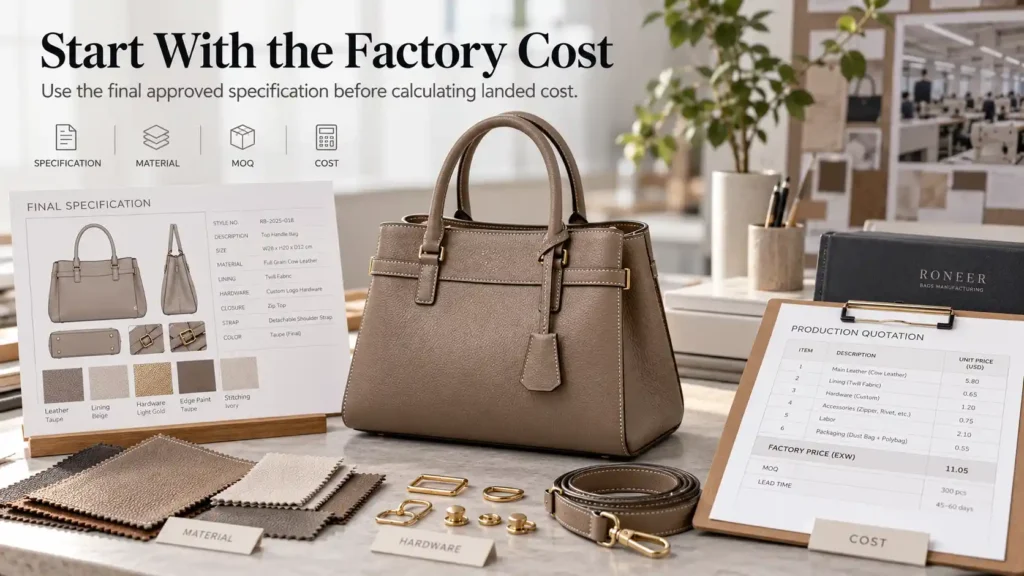
That sounds obvious, but many landed-cost spreadsheets begin with a quotation that is still based on assumptions.
The factory price can change with:
- Материал
- Finished size
- Структура
- Подкладка
- Армирование
- Оборудование
- Метод «Лого»
- Количество
- Color breakdown
- Упаковка
- Quality requirements
RONEER’s Custom Bag MOQ & Cost Guide explains how material availability, structure, customization, packaging, and order quantity can affect manufacturing cost.
Before calculating custom bag landed cost, make sure the factory price corresponds with the current approved specification.
For example, do not calculate landed cost using:
1,000 pcs black nylon backpack quotation
if the final order has become:
600 black + 200 beige + 200 custom green, with upgraded zipper pulls and individual branded boxes.
The total quantity may still be 1,000 pieces, but the purchasing and packing conditions are no longer necessarily the same.
The production cost used in the calculation should therefore match the final commercial order rather than an early RFQ estimate.
2. Confirm What the Supplier Quotation Actually Includes
A factory quotation can stop at very different points in the supply chain.
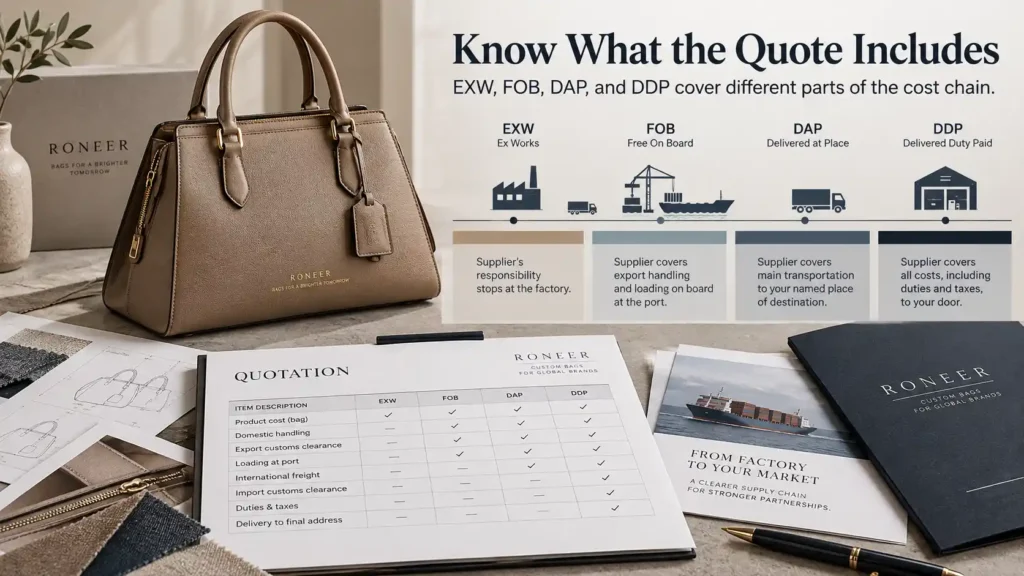
One supplier may quote EXW.
Another may quote FOB.
Another may offer a delivered price.
Comparing those numbers without adjusting their scope can distort the custom bag landed cost calculation.
This is also why buyers should understand why bag suppliers quote different prices before deciding that the lowest unit price is automatically the lowest-cost supplier.
Ask whether the quotation includes:
- Export packing
- Local trucking
- Export customs handling
- Port charges
- Freight
- Insurance
- Import clearance
- Import duty
- Destination charges
- Last-mile delivery
The Incoterm should also include the named place.
For example:
FOB Shenzhen
is more useful than:
FOB price.
Likewise:
DAP buyer warehouse, Los Angeles
provides more commercial context than simply writing:
delivered price.
ICC’s current Incoterms® 2020 framework distinguishes rules such as FOB, CIF, DAP, and DDP by how responsibilities, costs, and risks are divided. Under DDP, for example, the seller takes on import-clearance and duty obligations that normally remain with the buyer under several other rules. ICC Incoterms® Digital Library
A landed-cost spreadsheet should therefore have an explicit field for:
Quoted Incoterm + named place
before any supplier comparison begins.
3. Add Packaging Before You Estimate Freight
Packaging is often treated as a small product cost.
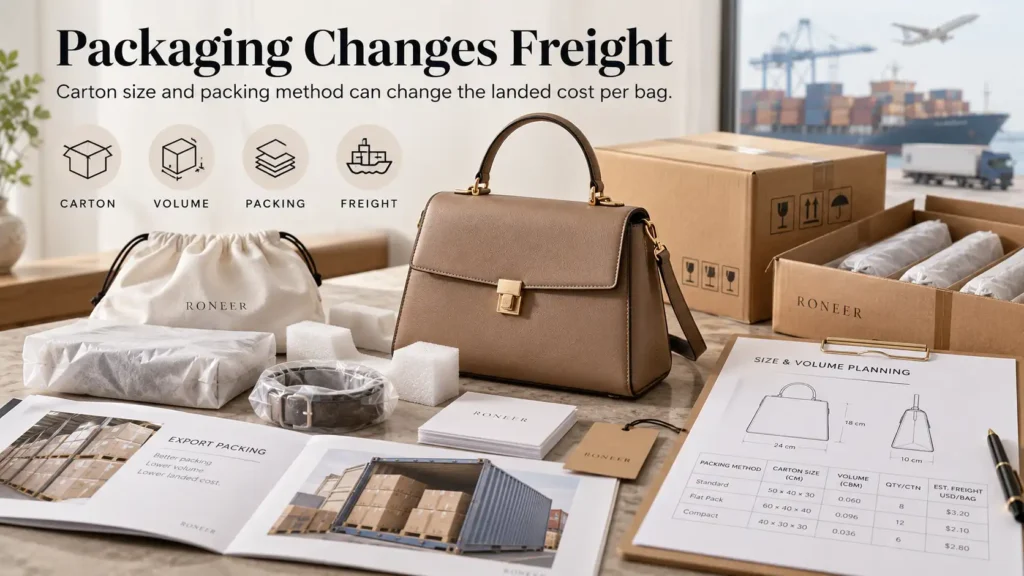
For bags, it can also become a logistics cost.
A soft cosmetic pouch packed flat may occupy very little shipping volume.
A structured handbag with:
- Shape support
- Handle protection
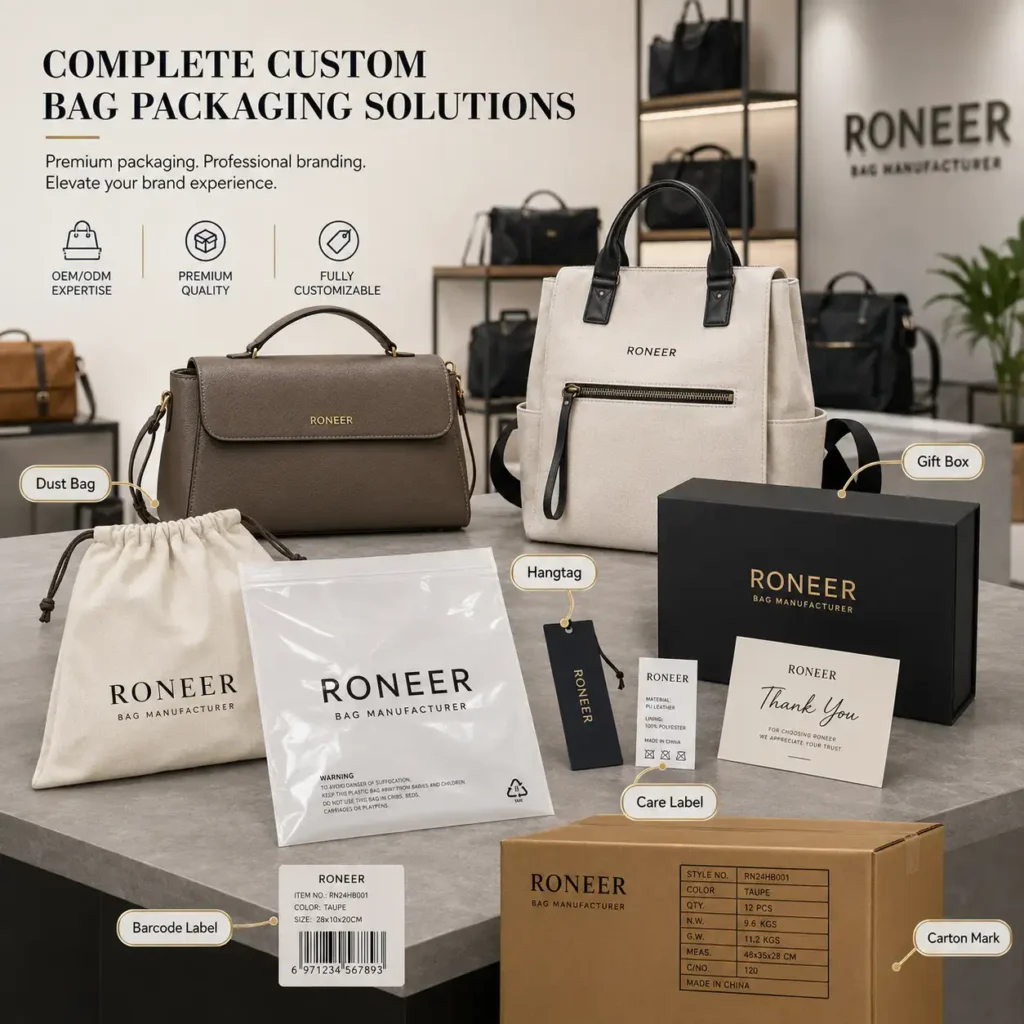
- Мешок для пыли
- Tissue
- Individual box
can require substantially more carton space.
The product itself may weigh only slightly more, while the shipment volume increases significantly.
That affects custom bag landed cost because international freight frequently depends on shipment weight, volume, route, service level, and transport method.
Before requesting freight estimates, confirm:
- Unit packaging
- Bags per carton
- Размеры коробки
- Gross carton weight
- Total carton quantity
- Total gross weight
- Total shipment volume
Do not calculate freight from the handbag dimensions alone.
Use the packed export shipment.
This is particularly important when the packaging plan changes after the first quotation.
For example, switching from a protective polybag to an individual rigid retail box may improve retail presentation but can also change:
- Количество в коробке
- Cubic volume
- Freight
- Warehouse handling
- Final landed cost per bag
Your Custom Bag Quotation Checklist should therefore define packaging before final commercial comparison whenever possible.
4. Calculate International Freight on the Real Shipment
International transport can become one of the largest differences between factory price and custom bag landed cost.
The appropriate shipping method depends on factors such as:
- Shipment volume
- Вес
- Delivery urgency
- Destination
- Order value
- Bag structure
- Launch date
- Warehouse requirements
Common routes may involve:
Courier or express
Useful for samples or smaller urgent shipments, but not automatically economical for larger commercial orders.
Air freight
Faster than ocean freight in many cases and useful when launch timing is critical.
Ocean freight
Often considered for larger commercial shipments where transit time allows.
A buyer should compare freight using the actual shipment data rather than an estimated number copied from a previous order.
Freight conditions can change.
So can:
- Fuel-related charges
- Peak-season surcharges
- Port conditions
- Carrier capacity
- Route availability
- Destination charges
For U.S.-bound projects, RONEER’s Доставка посылок из Китая в США guide covers shipping method, export packing, labels, documents, inspection, trade terms, and supplier coordination in more detail.
The important point for custom bag landed cost is that freight should be calculated from the confirmed shipment configuration.
Do not assume:
$0.80 shipping per bag
because that was the result of the previous order.
A different carton configuration can change the answer even when the product is similar.
5. Estimate Customs Duty From the Correct Product Classification
Import duty should not be guessed from the word “bag.”

Handbags, backpacks, travel bags, cosmetic bags, shopping bags, wallets, and similar containers can be classified differently according to factors such as:
- Product type
- Outer surface material
- Construction
- Предполагаемое использование
- Country of origin
- Страна назначения
For U.S. imports, many bags fall within or around HTS Chapter 42, including heading 4202, which covers categories such as travel bags, handbags, backpacks, shopping bags, wallets, and similar containers.
However, the applicable subheading and duty treatment depend on the actual product.
The U.S. International Trade Commission maintains the current Harmonized Tariff Schedule and states that the HTS sets tariff rates and statistical categories for merchandise imported into the United States. U.S. Harmonized Tariff Schedule
Do not use an article, old spreadsheet, AI answer, or another supplier’s shipment as the final authority for a duty rate.
Classification should be checked against the actual product and current destination-market rules.
This is especially important for custom bags because changing the outer material can potentially change the classification analysis.
For example, two handbags with the same shape may use:
- Кожа
- Plastic sheeting
- Textile outer surface
- Woven vegetable material
The commercial description “handbag” alone does not determine the complete duty calculation.
Your custom bag landed cost model should therefore contain fields for:
HS/HTS classification
Country of origin
Customs value
Applicable duty
rather than using one generic “bag duty” percentage for every style.
6. Include Customs and Destination Charges Beyond Duty
Duty is not always the only import-side cost.
Depending on the destination and transport method, a buyer may also encounter items such as:
- Customs broker charges
- Government processing fees
- Port fees
- Terminal handling
- Documentation charges
- Delivery-order charges
- Storage if clearance is delayed
- Examination-related costs where applicable
- Local delivery
For U.S. imports, Customs and Border Protection explains that imported goods can be subject to customs duties and additional user fees such as the Merchandise Processing Fee; ocean shipments can also involve Harbor Maintenance Fee treatment under applicable conditions. Current fees should be checked against CBP’s official information rather than hard-coded permanently into a costing sheet. U.S. Customs — Duties, Taxes and Import Fees
This matters because a buyer may calculate:
Product + ocean freight + duty
and still underestimate the actual custom bag landed cost.
Destination charges become particularly important for smaller commercial shipments because some fixed charges are distributed across fewer units.
For example, a $400 destination cost spread across:
- 400 bags = $1.00 per bag
- 2,000 bags = $0.20 per bag
The charge itself did not change.
The landed cost per unit did.
This is why quantity planning and logistics planning need to be considered together.
7. Convert the Total Shipment Cost Into a True Unit Landed Cost
Once all relevant costs are collected, the calculation becomes more useful when expressed per sellable unit.
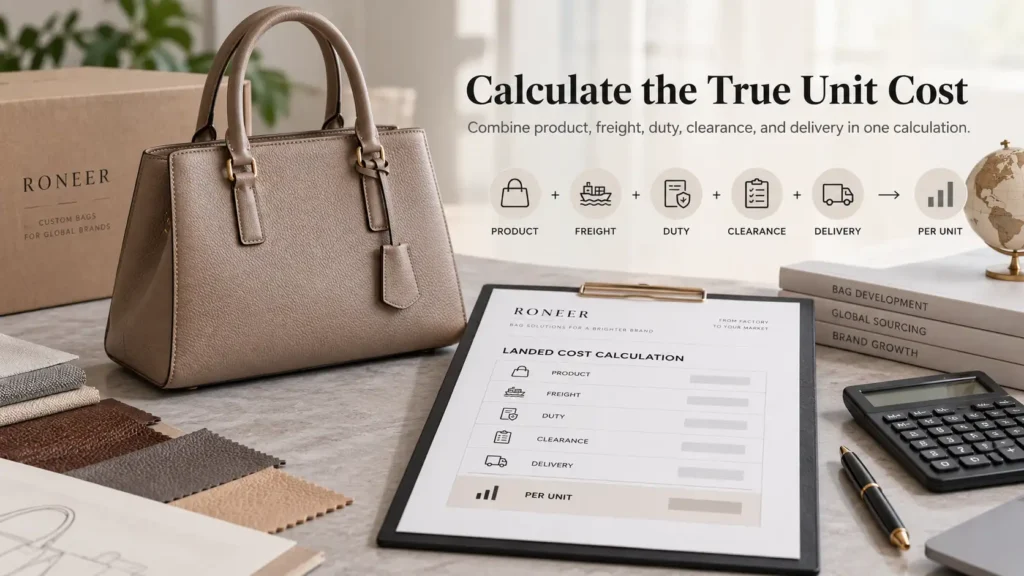
A simplified structure is:
Custom bag landed cost
=
Production cost
- Packaging and allocated setup
- Origin logistics
- International freight
- Insurance
- Import duty and applicable import fees
- Customs clearance
- Destination handling
- Final delivery
Then:
Landed cost per bag
=
Total landed shipment cost ÷ sellable units received
This last phrase matters:
sellable units received
not automatically:
ordered quantity
Suppose the buyer orders 1,000 bags.
If 10 units are used for testing, replacements, photography, samples, or cannot be sold, the commercial denominator may be different depending on the buyer’s accounting method.
The same applies to development costs.
A buyer may choose to allocate:
- Разработка образцов
- Mold charges
- Testing
- Inspection
- Artwork setup
across the first order.
Another business may account for them separately as product-development expenses.
Neither approach should be silently mixed into supplier comparison.
The calculation needs a consistent accounting rule.
A Practical Custom Bag Landed Cost Worksheet
A buyer can organize the calculation like this:
| Cost Component | Shipment Total | Per Bag |
|---|---|---|
| Серийное производство | Enter actual amount | Total ÷ units |
| Упаковка | Enter actual amount | Total ÷ units |
| Tooling/setup allocation | If applicable | Allocation ÷ units |
| Inspection/testing | If applicable | Total ÷ units |
| Origin transport | Actual/quoted | Total ÷ units |
| Export charges | Actual/quoted | Total ÷ units |
| International freight | Freight quote | Total ÷ units |
| Cargo insurance | If applicable | Total ÷ units |
| Import duty | Classification-based | Total ÷ units |
| Import fees | Destination-specific | Total ÷ units |
| Customs broker | Actual/quoted | Total ÷ units |
| Destination handling | Actual/quoted | Total ÷ units |
| Final delivery | Actual/quoted | Total ÷ units |
| Total Landed Cost | Sum all applicable costs | Total ÷ sellable units |
Do not treat every row as mandatory for every shipment.
The purpose of the worksheet is to make costs visible so that exclusions do not disappear.
Factory Price vs. Landed Cost
These two numbers answer different commercial questions.
Factory price
answers:
What does the supplier charge to manufacture and deliver the goods according to the agreed quotation basis?
Custom bag landed cost
answers:
What has the business spent by the time those bags reach the defined destination?
A buyer evaluating gross margin should usually care much more about the second number.
Suppose:
Supplier A has a lower factory price.
Supplier B has a slightly higher factory price but uses more efficient packaging and quotes on a clearer delivery basis.
The landed-cost difference may be much smaller than the factory-price difference.
Sometimes it can even reverse.
That is why sourcing decisions should not stop at the quotation comparison stage.
EXW vs. FOB vs. DAP vs. DDP for Landed Cost Planning
The Incoterm changes which costs are already inside the supplier’s price.
EXW
The buyer normally takes responsibility much earlier in the logistics chain.
The quotation may therefore appear low because many logistics and clearance costs remain outside it.
FOB
For applicable sea shipments, the seller handles obligations up to the agreed point of delivery onboard the vessel under the rule, after which additional freight and import-side costs need to be considered by the buyer.
DAP
The seller arranges transport to the named destination, while import clearance and applicable import duties remain with the buyer under the Incoterms® structure.
DDP
The seller has a much broader cost and import-clearance responsibility, including applicable import duties under the rule.
This does not mean DDP automatically produces the lowest custom bag landed cost.
It means the quoted price includes a different cost scope.
The buyer should still understand:
- What is included
- Who is importer of record where relevant
- What customs value and classification are being used
- Which destination charges remain excluded
- Which documents will be provided
The commercial term does not remove the need to understand the cost structure.
Why the Cheapest Factory Quote Can Produce a Higher Landed Cost
A low quotation can become expensive when it creates downstream costs.
Examples include:
Bulkier packaging
Lower unit manufacturing cost but higher freight volume.
Unclear quotation scope
Low headline price followed by additional export or destination costs.
Different product specification
A lower quotation is based on material or construction that does not match the buyer’s requirement.
Small order quantity
Fixed logistics and customs-related charges are spread across fewer bags.
Late specification changes
New packaging or hardware changes the carton and shipping calculation after the logistics quote has already been prepared.
Wrong duty assumption
The costing sheet uses a tariff estimate that does not match the final product classification.
This is why calculating custom bag landed cost should be part of supplier selection rather than an accounting exercise performed after production.
How to Compare Two Suppliers Using Landed Cost
Start by making the product specification identical.
Then compare:
| Comparison Area | Supplier A | Supplier B |
|---|---|---|
| Product specification | Match | Match |
| Количество | Match | Match |
| Упаковка | Match | Match |
| Incoterm | Confirm | Confirm |
| Named place | Confirm | Confirm |
| Количество в коробке | Confirm | Confirm |
| Total shipment volume | Confirm | Confirm |
| Freight included | Confirm | Confirm |
| Duty included | Confirm | Confirm |
| Destination handling | Confirm | Confirm |
| Final delivery | Confirm | Confirm |
If the specifications or commercial terms are different, calculate adjustments before deciding which supplier has the lower landed cost.
This follows the same principle discussed in Why Bag Suppliers Quote Different Prices: a lower number does not mean much until the buyer confirms what that number actually includes.
When Should You Calculate Custom Bag Landed Cost?
Do not wait until the shipment is ready.
A useful process is:
RFQ stage
Build an estimated landed-cost model.
Утверждение образца
Update material, weight, packaging, and dimensions.
Bulk quotation
Replace estimates with confirmed product cost.
Packing confirmation
Update carton size, carton quantity, gross weight, and volume.
Freight booking
Insert current logistics quotation.
Before shipment
Recheck classification, duty assumptions, clearance costs, and destination charges.
After delivery
Replace estimates with actual costs and save the result for reorder planning.
This creates a useful feedback loop.
The first order may contain estimates.
The second order can use the actual cost history from the first shipment.
FAQ About Custom Bag Landed Cost
1. What is custom bag landed cost?
Custom bag landed cost is the total cost of purchasing and bringing custom bags to a defined destination. It can include production, packaging, freight, insurance, customs duty, import fees, clearance, destination handling, and final delivery.
2. Is landed cost the same as the supplier’s unit price?
No.
The supplier’s unit price reflects the scope of the commercial quotation. Landed cost includes additional expenses required to bring the goods to the buyer’s defined destination.
3. Is freight included in custom bag landed cost?
Usually it should be included when calculating the true cost of importing the product, unless the business is intentionally using a different internal costing definition.
The important point is consistency.
4. Should customs duty be included?
Yes, when duty is payable by the buyer and forms part of the cost of importing the goods.
The rate should be based on the correct product classification, country of origin, destination, customs value, and current regulations.
5. How do I calculate duty for custom bags imported into the USA?
Identify the appropriate HTS classification for the actual product and check the current U.S. Harmonized Tariff Schedule.
Bag classification can depend on product type and outer surface material, so do not assume every handbag, backpack, or travel bag uses the same tariff treatment.
6. Does packaging affect landed cost?
Yes.
Packaging can affect both direct packaging cost and freight volume.
Structured boxes, shape support, dust bags, or retail packaging may increase shipment volume compared with basic export packing.
7. Does MOQ affect custom bag landed cost?
It can.
Larger quantities may improve manufacturing efficiency and spread certain fixed logistics or clearance costs across more units.
However, larger orders also increase total inventory investment, so landed cost should be considered together with sales and cash-flow planning.
8. Is FOB price the same as landed cost?
No.
FOB does not normally represent the full cost of bringing goods to the buyer’s warehouse.
International freight, insurance where applicable, import duty, clearance, destination charges, and inland delivery may still need to be added.
9. Is DDP price the same as landed cost?
A DDP quotation may include substantially more of the delivery and import cost chain, but buyers should still confirm the named destination and any exclusions.
Do not assume that every commercial quote described informally as “DDP” contains identical services.
10. Should sample and tooling costs be included?
That depends on the buyer’s accounting method.
If they are allocated to the first production order, include the agreed allocation when calculating custom bag landed cost per unit.
If they are treated as separate development expenses, keep that method consistent across supplier comparisons.
11. Why can two suppliers have different landed costs even when the factory price is similar?
Differences can come from packaging volume, origin transport, quotation terms, export charges, freight, shipment configuration, customs assumptions, and destination handling.
Always compare the complete cost scope.
12. What information do I need before requesting a landed-cost estimate?
Prepare product specification, order quantity, packaging, carton information, gross weight, shipment volume, origin, destination, Incoterm, and product classification information.
Сайт Custom Bag Quotation Checklist can help organize the commercial information before requesting comparable supplier and logistics quotations.
13. How can RONEER support landed-cost planning?
RONEER can provide confirmed product specifications, packaging details, carton information, production quantities, commercial terms, and shipping-related documentation according to the agreed project scope.
Final custom bag landed cost still depends on the buyer’s destination, freight arrangement, customs classification, applicable duties and fees, and destination logistics requirements.
Заключение
Custom bag landed cost gives buyers a more realistic commercial number than factory unit price alone.
The calculation should begin with the confirmed bag specification and then add the costs required to move the finished order through packaging, origin logistics, international transport, import clearance, and final delivery.
The key is consistency.
Compare suppliers using the same product, quantity, packaging, Incoterm, destination, and cost boundary.
Then verify customs classification and destination charges instead of using a generic “bag duty” or old freight assumption.
For RONEER OEM/ODM projects, product costing can be connected with MOQ planning, specification confirmation, packaging, carton information, production coordination, and shipping preparation according to the confirmed order.
Надежный custom bag landed cost calculation does not guarantee that every future logistics charge will remain unchanged. It gives the buyer a structured way to identify which costs are known, which are estimated, and which still need confirmation before the order becomes a financial commitment.