 日本語
 English
 Deutsch
 Español
 Français
 Italiano
 Русский
 العربية
 Türkçe
 한국어
工場からの見積もりは、商品が買い手の倉庫に届くまでは、採算が取れそうに見えることがある。.
そのバッグは魅力的な単価で提示されていたかもしれませんが、製造原価は商業的な判断の一要素に過ぎません。輸出梱包、国内輸送、国際運賃、保険、関税、輸入手数料、通関手続き、仕向地での荷役、そして最終的な配送など、これらすべてが1単位あたりの実質的なコストに影響を与える可能性があります。.
だからこそ、買い手は計算すべきです カスタムバッグの着陸コスト 一括注文を確定する前、つまり商品がすでに発送された後ではなく。.
ブランド、卸売業者、小売業者、EC事業者、輸入業者、およびプライベートブランド事業にとって、ランデッドコストは、工場価格だけよりもさらに有用な疑問に答えを与えてくれます:
販売や流通ができる段階までたどり着いた時点で、完成したバッグ1つあたりの実際のコストはいくらになるのでしょうか?
この区別は、異なる国、異なるインコタームズ、異なる梱包計画、あるいは異なる輸送方法を採用するサプライヤーを比較する際に、特に重要になります。.
工場出荷価格が安ければ、必ずしも カスタムバッグの着陸コスト.
製品価格がわずかに高くなっても、より効率的な梱包、段ボールの有効活用、予期せぬ仕向地での追加費用の削減、あるいは他社が見積もりから除外している費用がすでに含まれていることなどによって、その差を相殺できる場合があります。.
このガイドでは、特注バッグの注文を承認する前に、購入者が算出しておくべき7つのコスト項目について解説します。.
カスタムバッグの着荷総費用とは何ですか?
オーダーメイドバッグの着陸コスト これは、特注バッグの貨物を購入、準備、輸送、輸入、通関し、購入者が指定した宛先へ配送するために必要な総費用のことです。.
プロジェクトによっては、計算内容に以下が含まれる場合があります:
- 大量生産コスト
- ロゴおよびカスタマイズ料金
- パッケージング
- その注文に割り当てられた金型またはセットアップ
- 検査または試験
- 出発地における内陸輸送
- 輸出手続き
- 国際貨物輸送
- 貨物保険
- 輸入関税
- 輸入税または政府手数料
- 通関業務
- 港湾料またはターミナル料金
- 目的地での取り扱い
- 最終納品
- その他、記録されている輸入コスト
具体的な構成品は、商業契約および仕向国によって異なります。.
これがその理由です カスタムバッグの着陸コスト 常に、定義されたインコタームズおよび指定された場所に基づいて計算されるべきである。.
国際商工会議所(ICC)によると、インコタームズ®の規則は、売主と買主の間で、業務、費用、輸送上の責任、通関手続き、およびリスクを割り当てるものである。. ICCインコタームズ®規則
その引渡条件がなければ、たとえ両方の買い手が「総コスト」を算出していると考えていても、2つの着荷コストの算定において、異なるコストの範囲が適用される可能性があります。“
1. 正確な工場原価から始める
着荷原価の算定において、最初に用いる数値は、実際に購入する仕様に基づく確定した製造原価であるべきです。.
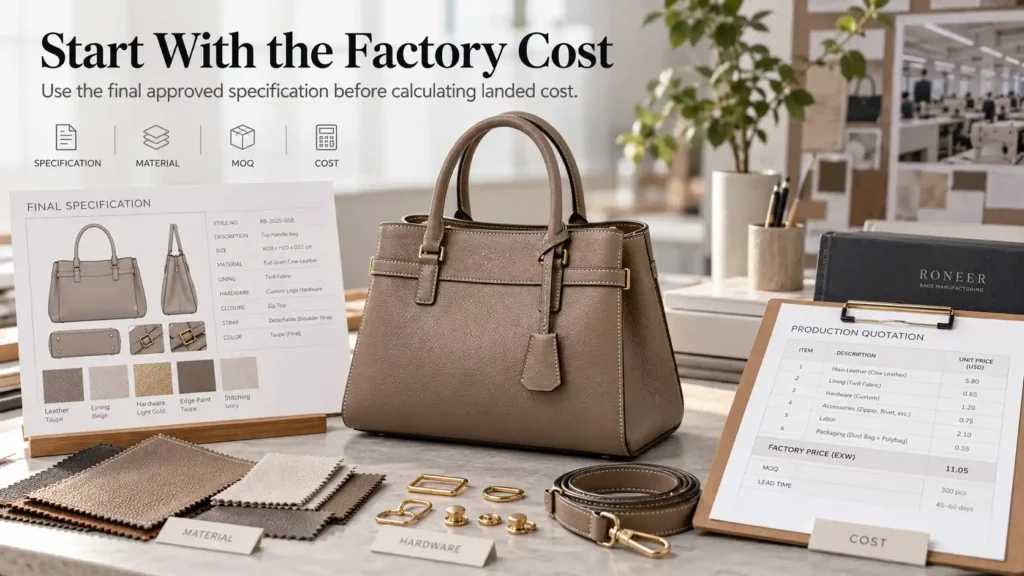
当たり前のように聞こえるかもしれませんが、多くの着陸コスト計算シートは、依然として仮定に基づいた見積もりから始まっています。.
工場価格は、以下の要因により変動する可能性があります:
- 素材
- 完成サイズ
- 構造
- 裏地
- 補強
- ハードウェア
- ロゴ方式
- 数量
- 色の内訳
- パッケージング
- 品質要件
RONEERの オーダーメイドバッグの最小注文数量(MOQ)と費用ガイド 材料の入手可能性、構造、カスタマイズ、梱包、および注文数量が、製造コストにどのような影響を与えるかを説明しています。.
計算を行う前に カスタムバッグの着陸コスト, 、工場価格が現在の承認済み仕様と一致していることを確認してください。.
たとえば、次のような方法で着荷コストを計算してはいけません:
黒のナイロン製バックパック 1,000個の見積もり
最終決定が以下のようになった場合:
ブラック600個、ベージュ200個、カスタムグリーン200個。アップグレードされたジッパープルと、ブランドロゴ入りの個別ボックス付き。.
総数量は依然として1,000個かもしれませんが、購入条件や梱包条件は必ずしも以前と同じとは限りません。.
したがって、計算に用いる製造コストは、初期のRFQ(見積依頼)段階の見積もりではなく、最終的な商業受注に基づいたものであるべきです。.
2. サプライヤーの見積書に実際に何が含まれているかを確認する
工場からの見積書は、サプライチェーンのさまざまな段階で処理が中断されることがあります。.
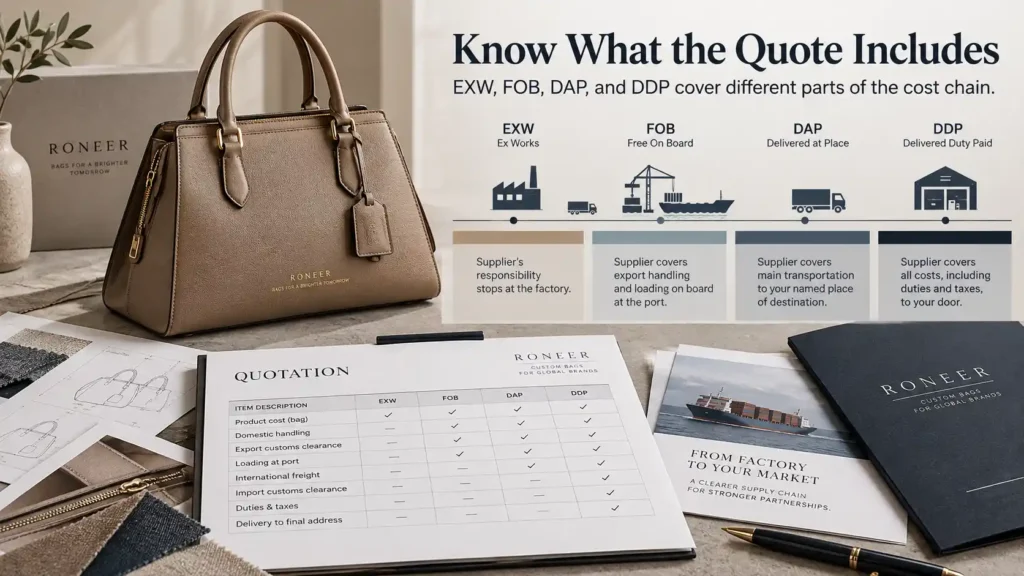
あるサプライヤーはEXWで見積もりを提示する場合があります。.
また、FOBを引用する人もいるかもしれません。.
別の業者では、配送費込みの価格を提示する場合もあります。.
それらの数値の範囲を調整せずに比較すると、結果が歪んでしまう可能性がある。 カスタムバッグの着陸コスト 計算。.
これが、買い手が理解しておくべき理由でもあります バッグのサプライヤーによって見積価格が異なる理由 最低単価の業者が自動的に最安値のサプライヤーであると決めつける前に。.
見積書に以下の項目が含まれているかどうかを確認してください:
- 輸出用梱包
- 地域内のトラック輸送
- 輸出通関手続き
- 港湾料金
- 貨物
- 保険
- 輸入通関
- 輸入関税
- 目的地手数料
- ラストマイル配送
インコタームズには、指定された場所も記載する必要があります。.
例えば:
FOB 深セン
は、以下よりも有用です:
FOB価格。.
同様に:
DAPバイヤー倉庫、ロサンゼルス
単に「書く」という表現よりも、より商業的な文脈を伝えています:
納入価格。.
ICCの現行の「インコタームズ® 2020」の枠組みでは、FOB、CIF、DAP、DDPといった規則を、責任、費用、リスクの分担方法によって区別しています。例えば、DDPの場合、他のいくつかの規則では通常買い手が負うことになる輸入通関手続きや関税の支払いの義務を、売り手が引き受けます。. ICC インコタームズ® デジタルライブラリ
したがって、ランドド・コストのスプレッドシートには、以下の項目を明示的に記載する欄を設ける必要があります:
適用インコタームズ + 指定場所
サプライヤーの比較を始める前に。.
3. 運賃を見積もる前に梱包を手配する
パッケージングは、しばしば製品コストのわずかな部分として扱われる。.
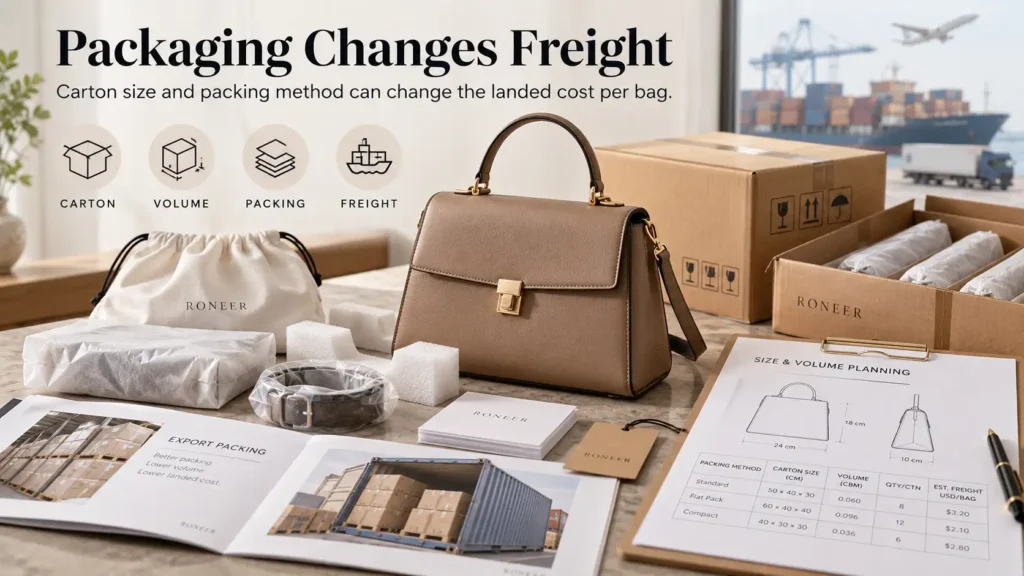
バッグの場合、物流コストとなることもあります。.
平らに折りたたんだ柔らかいコスメポーチは、配送時の体積をほとんど占めない。.
以下の特徴を備えた構造的なハンドバッグ:
- 形状サポート
- ハンドルの保護
- 集塵袋
- ティッシュ
- 個別ボックス
段ボールの収納スペースが大幅に増える場合があります。.
製品自体の重量はほんの少し増えるだけかもしれませんが、出荷量は大幅に増加します。.
それは……に影響を及ぼします カスタムバッグの着陸コスト 国際貨物輸送は、多くの場合、貨物の重量、容積、ルート、サービスレベル、および輸送手段によって左右されるためです。.
運賃の見積もりを依頼する前に、以下の点をご確認ください:
- 単位ごとの梱包
- 1カートンあたりの袋数
- 段ボールの寸法
- カートンの総重量
- カートン総数
- 総重量
- 総出荷量
ハンドバッグの寸法だけに基づいて運賃を計算しないでください。.
梱包済みの輸出貨物をご利用ください。.
これは、最初の見積もり後に梱包計画に変更が生じた場合に特に重要です。.
例えば、保護用のポリ袋から個別の硬質小売用箱に切り替えることで、店頭での陳列効果は向上するかもしれませんが、次のような点も変化する可能性があります:
- カートンあたりの数量
- 体積
- 貨物
- 倉庫作業
- 1袋あたりの最終着荷価格
あなたの オーダーメイドバッグの見積もりチェックリスト したがって、可能な限り、最終的な商業的な比較を行う前に、パッケージ内容を明確に定義しておくべきである。.
4. 実際の出荷に基づく国際運賃を算出する
国際輸送費は、工場出荷価格と カスタムバッグの着陸コスト.
適切な配送方法は、次のような要因によって異なります:
- 出荷量
- 重量
- 配送の緊急度
- 目的地
- 注文金額
- バッグの構造
- 発売日
- 倉庫の要件
一般的なルートとしては、次のようなものがあります:
宅配便またはエクスプレス便
サンプルや少量の緊急発送には便利ですが、大規模な商業注文の場合、必ずしも経済的とは限りません。.
航空貨物
多くの場合、海上輸送よりも迅速であり、出荷のタイミングが重要な場合に役立ちます。.
海上輸送
輸送時間に余裕がある場合、大規模な商業輸送においてよく検討される。.
購入者は、過去の注文から転記した概算値ではなく、実際の出荷データに基づいて運賃を比較すべきです。.
運送条件は変更される場合があります。.
つまり、次のようにすることもできます:
- 燃料関連料金
- 繁忙期の追加料金
- 港の状況
- 伝送容量
- 路線の運行状況
- 目的地手数料
米国向けのプロジェクトについては、RONEERの 中国から米国への配送用バッグ このガイドでは、配送方法、輸出用梱包、ラベル、書類、検査、貿易条件、およびサプライヤーとの調整について、より詳しく解説しています。.
重要な点は、 カスタムバッグの着陸コスト つまり、運賃は確定した出荷構成に基づいて算出されるべきである。.
次のように決めつけないでください:
$0.80 1袋あたりの送料
それは、前の注文の結果だったからです。.
製品が類似していても、段ボールの仕様が異なれば、答えも変わってくることがあります。.
5. 正しい商品分類に基づいて関税を見積もる
「バッグ」という言葉から輸入関税を推測すべきではありません。“

ハンドバッグ、リュックサック、旅行用バッグ、化粧ポーチ、ショッピングバッグ、財布、およびこれらに類する収納用品は、次のような要素に応じて、さまざまな分類が可能である:
- 製品タイプ
- 外装材
- 建設
- 使用目的
- 原産国
- 渡航先国
米国への輸入品のうち、多くのバッグはHTS第42章またはその周辺に分類され、その中には、旅行用バッグ、ハンドバッグ、リュックサック、ショッピングバッグ、財布、およびこれらに類する容器などを対象とする品目番号4202も含まれています。.
ただし、適用される品目分類および関税取扱いは、実際の製品によって異なります。.
米国国際貿易委員会は、現行の「調和関税表(HTS)」を管理しており、HTSは米国に輸入される商品の関税率および統計分類を定めているとしている。. 米国調和関税表
関税率の最終的な判断基準として、記事、古いスプレッドシート、AIによる回答、あるいは他社の出荷情報を用いてはなりません。.
分類については、実際の製品および現在の仕向市場の規則と照らし合わせて確認する必要があります。.
これは特にオーダーメイドのバッグにおいて重要であり、外側の素材を変更すると、分類分析の結果が変わる可能性があるからです。.
たとえば、同じ形のハンドバッグ2つには、次のようなものが使われることがあります:
- レザー
- プラスチックシート
- 繊維製品の外表面
- 織物状の植物性素材
「ハンドバッグ」という商品名称だけでは、関税額の算定が完全に決まるわけではありません。.
あなたの カスタムバッグの着陸コスト したがって、モデルには以下のフィールドを含める必要があります:
HS/HTS分類
原産国
税関評価額
適用される関税
すべてのスタイルに一律の「バッグ代」の割合を適用するのではなく、.
6. 関税および関税以外の仕向地手数料を含める
関税が、必ずしも輸入側の唯一のコストとは限りません。.
仕向地や輸送方法によっては、購入者が以下のような品目に遭遇することもあります:
- 通関手数料
- 政府の手数料
- 港湾使用料
- ターミナルでの荷役
- 書類作成手数料
- 配送・注文手数料
- 通関が遅れた場合の保管
- 該当する場合の試験関連費用
- 地域内配送
米国への輸入に関しては、米国税関・国境警備局(CBP)によると、輸入品には関税や「商品処理手数料(Merchandise Processing Fee)」などの追加利用料が課される場合があります。また、海上輸送の場合、適用条件を満たせば「港湾維持費(Harbor Maintenance Fee)」の対象となることもあります。現在の手数料については、原価計算書に恒久的に固定するのではなく、CBPの公式情報を参照して確認する必要があります。. 米国税関 — 関税、税金、および輸入手数料
これが重要なのは、買い手が次のように計算する可能性があるからです:
商品代金+海上運賃+関税
それでもなお、実際の状況を過小評価している カスタムバッグの着陸コスト.
小規模な商業貨物の場合、一部の固定料金がより少ない個数に割り振られるため、仕向地料金が特に重要になります。.
例えば、$400の宛先コストは、次のように配分されます:
- 400 bags = $1.00 per bag
- 2,000 bags = $0.20 per bag
The charge itself did not change.
The landed cost per unit did.
This is why quantity planning and logistics planning need to be considered together.
7. Convert the Total Shipment Cost Into a True Unit Landed Cost
Once all relevant costs are collected, the calculation becomes more useful when expressed per sellable unit.
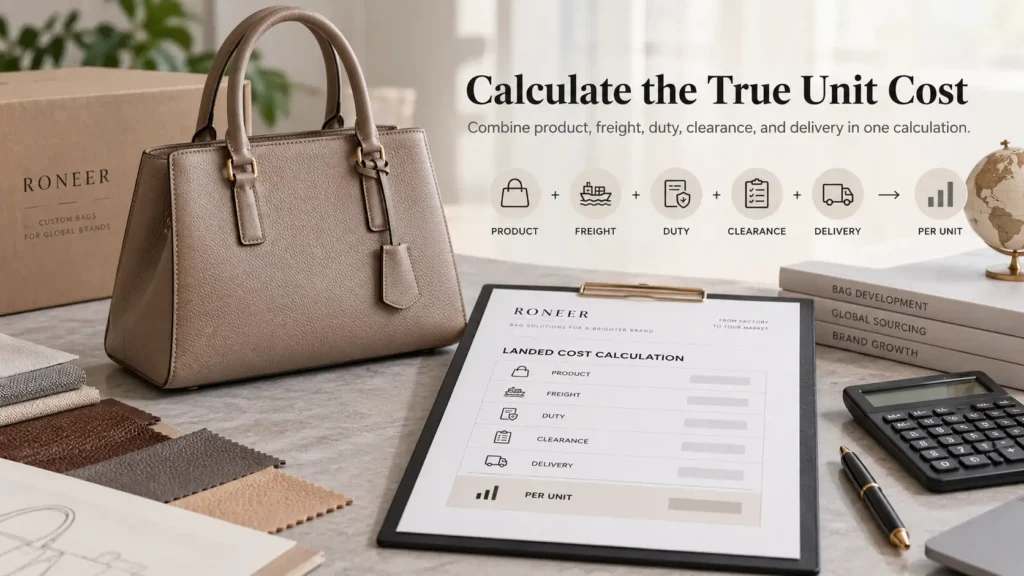
A simplified structure is:
オーダーメイドバッグの着陸コスト
=
製造コスト
- Packaging and allocated setup
- Origin logistics
- 国際貨物輸送
- 保険
- Import duty and applicable import fees
- Customs clearance
- 目的地での取り扱い
- 最終納品
Then:
Landed cost per bag
=
Total landed shipment cost ÷ sellable units received
This last phrase matters:
sellable units received
not automatically:
ordered quantity
Suppose the buyer orders 1,000 bags.
If 10 units are used for testing, replacements, photography, samples, or cannot be sold, the commercial denominator may be different depending on the buyer’s accounting method.
The same applies to development costs.
A buyer may choose to allocate:
- サンプルの開発
- Mold charges
- Testing
- Inspection
- Artwork setup
across the first order.
Another business may account for them separately as product-development expenses.
Neither approach should be silently mixed into supplier comparison.
The calculation needs a consistent accounting rule.
A Practical Custom Bag Landed Cost Worksheet
A buyer can organize the calculation like this:
| Cost Component | Shipment Total | Per Bag |
|---|---|---|
| 大量生産 | Enter actual amount | Total ÷ units |
| パッケージング | Enter actual amount | Total ÷ units |
| Tooling/setup allocation | If applicable | Allocation ÷ units |
| Inspection/testing | If applicable | Total ÷ units |
| Origin transport | Actual/quoted | Total ÷ units |
| Export charges | Actual/quoted | Total ÷ units |
| 国際貨物輸送 | Freight quote | Total ÷ units |
| 貨物保険 | If applicable | Total ÷ units |
| 輸入関税 | Classification-based | Total ÷ units |
| Import fees | Destination-specific | Total ÷ units |
| Customs broker | Actual/quoted | Total ÷ units |
| 目的地での取り扱い | Actual/quoted | Total ÷ units |
| 最終納品 | Actual/quoted | Total ÷ units |
| Total Landed Cost | Sum all applicable costs | Total ÷ sellable units |
Do not treat every row as mandatory for every shipment.
The purpose of the worksheet is to make costs visible so that exclusions do not disappear.
Factory Price vs. Landed Cost
These two numbers answer different commercial questions.
Factory price
answers:
What does the supplier charge to manufacture and deliver the goods according to the agreed quotation basis?
オーダーメイドバッグの着陸コスト
answers:
What has the business spent by the time those bags reach the defined destination?
A buyer evaluating gross margin should usually care much more about the second number.
Suppose:
Supplier A has a lower factory price.
Supplier B has a slightly higher factory price but uses more efficient packaging and quotes on a clearer delivery basis.
The landed-cost difference may be much smaller than the factory-price difference.
Sometimes it can even reverse.
That is why sourcing decisions should not stop at the quotation comparison stage.
EXW vs. FOB vs. DAP vs. DDP for Landed Cost Planning
The Incoterm changes which costs are already inside the supplier’s price.
EXW
The buyer normally takes responsibility much earlier in the logistics chain.
The quotation may therefore appear low because many logistics and clearance costs remain outside it.
FOB
For applicable sea shipments, the seller handles obligations up to the agreed point of delivery onboard the vessel under the rule, after which additional freight and import-side costs need to be considered by the buyer.
DAP
The seller arranges transport to the named destination, while import clearance and applicable import duties remain with the buyer under the Incoterms® structure.
DDP
The seller has a much broader cost and import-clearance responsibility, including applicable import duties under the rule.
This does not mean DDP automatically produces the lowest カスタムバッグの着陸コスト.
It means the quoted price includes a different cost scope.
The buyer should still understand:
- What is included
- Who is importer of record where relevant
- What customs value and classification are being used
- Which destination charges remain excluded
- Which documents will be provided
The commercial term does not remove the need to understand the cost structure.
Why the Cheapest Factory Quote Can Produce a Higher Landed Cost
A low quotation can become expensive when it creates downstream costs.
Examples include:
Bulkier packaging
Lower unit manufacturing cost but higher freight volume.
Unclear quotation scope
Low headline price followed by additional export or destination costs.
Different product specification
A lower quotation is based on material or construction that does not match the buyer’s requirement.
Small order quantity
Fixed logistics and customs-related charges are spread across fewer bags.
Late specification changes
New packaging or hardware changes the carton and shipping calculation after the logistics quote has already been prepared.
Wrong duty assumption
The costing sheet uses a tariff estimate that does not match the final product classification.
This is why calculating カスタムバッグの着陸コスト should be part of supplier selection rather than an accounting exercise performed after production.
How to Compare Two Suppliers Using Landed Cost
Start by making the product specification identical.
Then compare:
| Comparison Area | Supplier A | Supplier B |
|---|---|---|
| Product specification | Match | Match |
| 数量 | Match | Match |
| パッケージング | Match | Match |
| Incoterm | Confirm | Confirm |
| Named place | Confirm | Confirm |
| カートンあたりの数量 | Confirm | Confirm |
| 総出荷量 | Confirm | Confirm |
| Freight included | Confirm | Confirm |
| Duty included | Confirm | Confirm |
| 目的地での取り扱い | Confirm | Confirm |
| 最終納品 | Confirm | Confirm |
If the specifications or commercial terms are different, calculate adjustments before deciding which supplier has the lower landed cost.
This follows the same principle discussed in Why Bag Suppliers Quote Different Prices: a lower number does not mean much until the buyer confirms what that number actually includes.
When Should You Calculate Custom Bag Landed Cost?
Do not wait until the shipment is ready.
A useful process is:
RFQ stage
Build an estimated landed-cost model.
サンプルの承認
Update material, weight, packaging, and dimensions.
Bulk quotation
Replace estimates with confirmed product cost.
Packing confirmation
Update carton size, carton quantity, gross weight, and volume.
Freight booking
Insert current logistics quotation.
Before shipment
Recheck classification, duty assumptions, clearance costs, and destination charges.
After delivery
Replace estimates with actual costs and save the result for reorder planning.
This creates a useful feedback loop.
The first order may contain estimates.
The second order can use the actual cost history from the first shipment.
FAQ About Custom Bag Landed Cost
1. What is custom bag landed cost?
オーダーメイドバッグの着陸コスト is the total cost of purchasing and bringing custom bags to a defined destination. It can include production, packaging, freight, insurance, customs duty, import fees, clearance, destination handling, and final delivery.
2. Is landed cost the same as the supplier’s unit price?
No.
The supplier’s unit price reflects the scope of the commercial quotation. Landed cost includes additional expenses required to bring the goods to the buyer’s defined destination.
3. Is freight included in custom bag landed cost?
Usually it should be included when calculating the true cost of importing the product, unless the business is intentionally using a different internal costing definition.
The important point is consistency.
4. Should customs duty be included?
Yes, when duty is payable by the buyer and forms part of the cost of importing the goods.
The rate should be based on the correct product classification, country of origin, destination, customs value, and current regulations.
5. How do I calculate duty for custom bags imported into the USA?
Identify the appropriate HTS classification for the actual product and check the current U.S. Harmonized Tariff Schedule.
Bag classification can depend on product type and outer surface material, so do not assume every handbag, backpack, or travel bag uses the same tariff treatment.
6. Does packaging affect landed cost?
Yes.
Packaging can affect both direct packaging cost and freight volume.
Structured boxes, shape support, dust bags, or retail packaging may increase shipment volume compared with basic export packing.
7. Does MOQ affect custom bag landed cost?
It can.
Larger quantities may improve manufacturing efficiency and spread certain fixed logistics or clearance costs across more units.
However, larger orders also increase total inventory investment, so landed cost should be considered together with sales and cash-flow planning.
8. Is FOB price the same as landed cost?
No.
FOB does not normally represent the full cost of bringing goods to the buyer’s warehouse.
International freight, insurance where applicable, import duty, clearance, destination charges, and inland delivery may still need to be added.
9. Is DDP price the same as landed cost?
A DDP quotation may include substantially more of the delivery and import cost chain, but buyers should still confirm the named destination and any exclusions.
Do not assume that every commercial quote described informally as “DDP” contains identical services.
10. Should sample and tooling costs be included?
That depends on the buyer’s accounting method.
If they are allocated to the first production order, include the agreed allocation when calculating custom bag landed cost per unit.
If they are treated as separate development expenses, keep that method consistent across supplier comparisons.
11. Why can two suppliers have different landed costs even when the factory price is similar?
Differences can come from packaging volume, origin transport, quotation terms, export charges, freight, shipment configuration, customs assumptions, and destination handling.
Always compare the complete cost scope.
12. What information do I need before requesting a landed-cost estimate?
Prepare product specification, order quantity, packaging, carton information, gross weight, shipment volume, origin, destination, Incoterm, and product classification information.
について オーダーメイドバッグの見積もりチェックリスト can help organize the commercial information before requesting comparable supplier and logistics quotations.
13. How can RONEER support landed-cost planning?
RONEER can provide confirmed product specifications, packaging details, carton information, production quantities, commercial terms, and shipping-related documentation according to the agreed project scope.
Final カスタムバッグの着陸コスト still depends on the buyer’s destination, freight arrangement, customs classification, applicable duties and fees, and destination logistics requirements.
結論
オーダーメイドバッグの着陸コスト gives buyers a more realistic commercial number than factory unit price alone.
The calculation should begin with the confirmed bag specification and then add the costs required to move the finished order through packaging, origin logistics, international transport, import clearance, and final delivery.
The key is consistency.
Compare suppliers using the same product, quantity, packaging, Incoterm, destination, and cost boundary.
Then verify customs classification and destination charges instead of using a generic “bag duty” or old freight assumption.
For RONEER OEM/ODM projects, product costing can be connected with MOQ planning, specification confirmation, packaging, carton information, production coordination, and shipping preparation according to the confirmed order.
信頼できる カスタムバッグの着陸コスト calculation does not guarantee that every future logistics charge will remain unchanged. It gives the buyer a structured way to identify which costs are known, which are estimated, and which still need confirmation before the order becomes a financial commitment.