 Русский
  English
  Deutsch
  Español
  Français
  Italiano
  日本語
日本語  العربية
  Türkçe
  한국어
한국어 A bulk bag order may appear acceptable in production photos and still arrive with inconsistent stitching, faulty zippers, incorrect dimensions, misplaced logos, damaged packaging, or structural weaknesses. These problems do not always mean that the factory performed no quality checks. In many cases, the buyer and supplier simply failed to agree on a measurable inspection standard before production began.
AQL inspection for bags gives buyers, manufacturers, and inspectors a defined method for selecting finished products, classifying defects, recording inspection results, and deciding whether a production lot is acceptable for shipment. By establishing clear sampling rules and defect limits, AQL inspection for bags turns subjective quality expectations into a more consistent shipment decision process.
However, AQL inspection for bags is only reliable when the inspection checklist accurately reflects the approved product specification. A statistical sampling plan cannot compensate for an incomplete tech pack, an unapproved material, unclear measurement tolerances, or subjective descriptions such as “good workmanship.”
For this reason, buyers should prepare the requirements for AQL inspection for bags before bulk production is completed. The approved sample, technical specifications, functional requirements, logo details, workmanship criteria, and packaging instructions should all be available to the inspector.
This guide explains how brands, importers, wholesalers, retailers, and private label buyers can prepare an effective AQL inspection for bags before authorizing shipment.
What Does AQL Inspection for Bags Mean?
AQL stands for Acceptance Quality Limit. It is used in attribute sampling to determine how many units should be inspected from a production lot and how many identified defects can be accepted before that lot is rejected.
The current ISO 2859-1:2026 standard defines sampling schemes indexed by AQL for lot-by-lot inspection. The related ANSI/ASQ Z1.4 standard provides normal, tightened, and reduced sampling plans for attribute inspections.
In practical bag manufacturing, AQL inspection for bags does not mean that every unit in the shipment is guaranteed to be defect-free. Instead, it provides a statistical method for evaluating a randomly selected sample from the completed production lot.
A properly planned AQL inspection for bags requires the buyer to define:
- What counts as a defect
- How defects are classified
- Which inspection level applies
- Which AQL values apply to each defect category
- Which measurements and functions must be tested
- Which workmanship and appearance standards apply
- What happens when the inspection fails
- Whether rework and reinspection are permitted
Without these decisions, an inspector may count defects consistently while still evaluating the wrong requirements. AQL inspection for bags therefore works best when the sampling plan, product specification, approved sample, and defect criteria are prepared as one complete inspection package.
1. Prepare the Inspection Standard Before Production
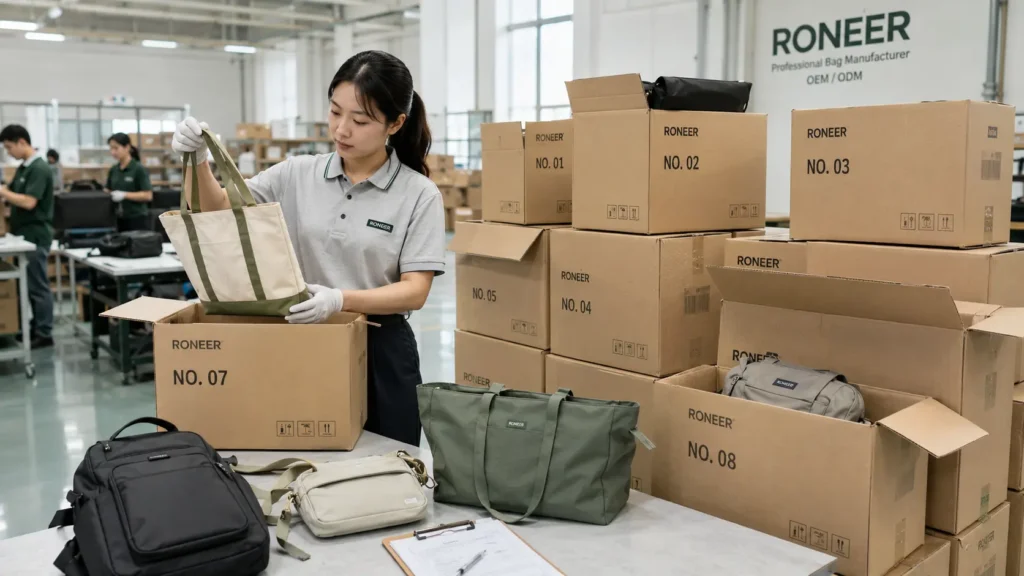
The most effective AQL inspection for bags starts before materials are cut.
The inspection team should receive a complete reference package containing:
- Approved pre-production sample
- Product specification or tech pack
- Measurement table and tolerances
- Material and color references
- Logo artwork and placement requirements
- Hardware finish and component details
- Stitching and reinforcement requirements
- Functional test instructions
- Label and barcode information
- Individual packing requirements
- Carton quantity and shipping-mark instructions
A clear handbag tech pack gives the factory and inspection team the same technical reference. It reduces the risk that production staff approves one construction while the buyer expects another.
The approved sample should not be used by itself. Samples can change during development, and visual comparison does not always reveal dimensions, stitch density, material thickness, loading requirements, or packing quantities. Written specifications should therefore remain part of the inspection file.
2. Select the Sampling Standard and Inspection Level
Most commercial AQL inspection programs for bags use an attribute sampling standard such as ISO 2859-1 or ANSI/ASQ Z1.4.
The buyer then selects an inspection level. General Inspection Levels I, II, and III affect how many units are selected:
- Level I uses a smaller sample and may suit lower-risk or repeat orders.
- Level II is frequently used as a general commercial starting point.
- Level III uses a larger sample and provides a more demanding inspection.
Special inspection levels may be used for tests that are expensive, time-consuming, or destructive. They should not automatically replace the general inspection sample used for appearance and workmanship.
The correct level depends on product complexity, production history, order value, defect risk, retail expectations, and the consequences of a shipment failure.
A first order involving a new factory, new construction, new material, or complex hardware may justify a more extensive inspection than an established repeat order with stable production records.
3. Define Critical, Major, and Minor Bag Defects
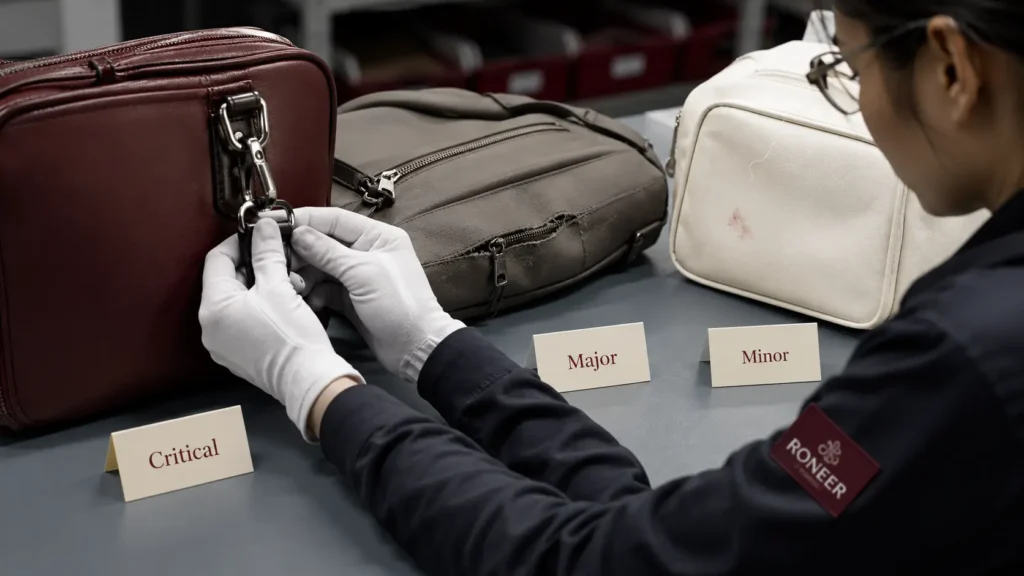
Defect classification is one of the most important parts of AQL inspection for bags. The same problem can produce different commercial consequences depending on the bag’s intended use, sales channel, price position, and destination market.
Critical defects
A critical defect may create an unreasonable safety risk, violate an applicable requirement, or make the product unsafe for its intended use.
Possible bag-related examples include:
- Sharp exposed metal edges
- Broken components that create a cutting hazard
- A detachable small component on a regulated children’s product
- Mold or serious contamination
- Incorrect safety information where such information is legally required
- A structural failure that could create an immediate hazard in normal use
Critical defects are normally treated with the strictest acceptance requirement. Product-specific legal obligations should be reviewed separately. AQL inspection is not a substitute for regulatory or laboratory testing. Buyers selling regulated products in the United States can review relevant CPSC business guidance.
Major defects
A major defect is likely to affect function, durability, saleability, brand presentation, or the customer’s normal use of the bag.
Examples include:
- Broken or jammed zipper
- Incorrect bag dimensions outside the approved tolerance
- Detached shoulder strap
- Missing reinforcement at a load-bearing point
- Incorrect material or color
- Crooked or incorrectly positioned logo
- Missing internal pocket
- Hardware in the wrong finish
- Open seam or skipped stitching
- Incorrect lining construction
- Visible color variation across panels
- Bag unable to perform an agreed function
A major defect may make the product unsellable even when it does not present an immediate safety concern.
Minor defects
A minor defect does not normally prevent use but falls below the approved appearance or workmanship standard.
Examples include:
- Small removable thread ends
- Slightly uneven stitching in a non-prominent area
- Minor surface marks
- Small lining wrinkles
- Slightly uneven edge paint within an agreed tolerance
- Minor packaging presentation issues
- Small differences in stitch spacing that do not weaken the seam
Minor defects still require objective descriptions. Terms such as “small,” “slight,” and “acceptable” should be supported by approved samples, photographs, measurement limits, or location-based rules.
4. Set Separate AQL Limits for Each Defect Class
A single acceptance limit should not be applied to every type of defect.
A frequently requested commercial starting point for consumer bags is:
- Critical defects: not accepted
- Major defects: AQL 2.5
- Minor defects: AQL 4.0
These values are not a universal rule for every bag order. Premium leather goods, technical bags, children’s products, promotional bags, low-price totes, laptop bags, outdoor equipment, and corporate gift bags may require different limits.
AQL inspection for bags should reflect the buyer’s actual risk tolerance. A premium handbag brand may set a stricter limit for visible cosmetic defects. A technical backpack buyer may apply stricter criteria to shoulder straps, buckles, seams, and load-bearing components.
The purchase agreement or inspection instruction should state the selected values clearly. The factory should not be expected to decide the buyer’s commercial tolerance after production has already been completed.
5. Determine the Lot Size and Sample Size
The lot size is the quantity of finished units presented for inspection under reasonably consistent production conditions.
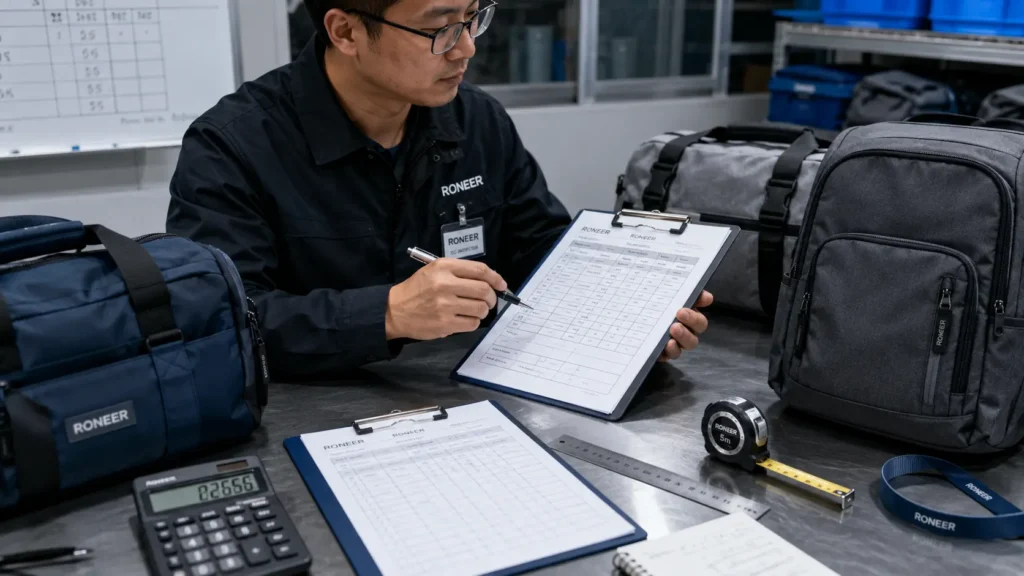
The inspector uses the lot quantity and selected inspection level to identify a sample-size code letter. That code letter leads to the required sample quantity and the relevant acceptance and rejection numbers.
For illustration, a lot of 4,000 units inspected under General Inspection Level II commonly produces code letter L and a sample of 200 units under widely used single-sampling tables. The inspector must then use the selected AQL value to identify the corresponding acceptance and rejection points.
The inspection report should record:
- Total lot quantity
- Number of completed units
- Number of packed units
- Inspection level
- Sample-size code letter
- Sample quantity
- AQL values
- Acceptance number
- Rejection number
- Number of defects by category
- Overall result
Buyers should have the inspector use the applicable current standard or authorized inspection system rather than copying an incomplete chart from an unrelated product category.
6. Select Bags Randomly Across the Shipment
AQL inspection for bags depends on representative sampling.
The factory should not prepare a small group of preferred units for the inspector. Samples should be selected from different cartons, packing positions, production periods, colors, sizes, and product variations included in the lot.
Professional finished-goods inspection programs commonly compare randomly selected products with approved criteria and pre-approved samples. Intertek describes this type of statistical finished-goods inspection in its textile and apparel auditing guidance.
A practical random-selection method may include:
- Confirming the total number of finished and packed cartons.
- Selecting cartons from different pallet or storage positions.
- Opening cartons without allowing the production team to substitute units.
- Selecting units from the top, middle, and bottom of chosen cartons.
- Recording the carton numbers inspected.
- Covering different colors, sizes, or SKUs proportionally.
- Resealing inspected cartons according to the agreed procedure.
When an order contains several styles or colors, the buyer should define whether each SKU forms a separate inspection lot or whether proportional sampling will be used across the combined order.
7. Build a Bag-Specific Inspection Checklist
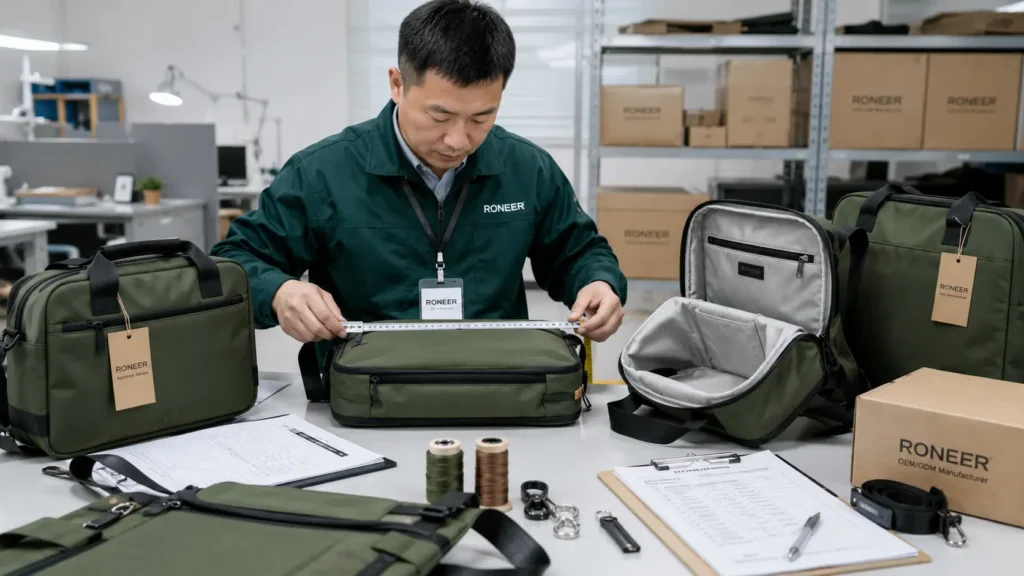
A generic consumer-product checklist is not detailed enough for custom bags. AQL inspection for bags should cover the specifications that affect appearance, function, durability, branding, packing, and retail readiness.
Materials and color
Inspectors should compare the finished bags with approved material references.
Checks may include:
- Main fabric, leather, PU, coating, mesh, or other material
- Материал подкладки
- Material texture and surface appearance
- Color consistency between panels
- Color consistency between production units
- Odor, contamination, stains, or mold
- Material direction or grain orientation
- Lamination or backing
- Edge paint color and coverage
- Webbing, thread, piping, and binding color
Buyers can define the required material direction through the RONEER material customization process.
Dimensions and structure
Measurements should be taken using the method stated in the specification.
Checks may include:
- Width, height, and depth
- Падение рукоятки
- Strap length and adjustment range
- Pocket size and location
- Opening width
- Gusset construction
- Base shape
- Laptop or device compartment size
- Internal divider position
- Symmetry
- Overall shape after packing
Measurement tolerances should be confirmed before production. An inspector should not invent tolerances during final inspection.
Stitching and workmanship
The checklist should define acceptable workmanship at visible and load-bearing locations.
Inspectors may check:
- Open seams
- Skipped stitches
- Loose stitching
- Uneven stitch lines
- Incorrect stitch density
- Untrimmed threads
- Puckering
- Incorrect seam allowance
- Weak reinforcement
- Crooked binding
- Misaligned panels
- Excess adhesive
- Edge-paint defects
- Scratches, dents, or pressure marks
A small cosmetic issue on an interior seam may be minor, while the same construction problem at a shoulder-strap attachment may be major.
Zippers, hardware, and function
Functional checks should be performed repeatedly where appropriate.
They may include:
- Zipper opening and closing
- Slider alignment
- Snap closure
- Magnetic closure
- Buckle engagement
- Hook and ring attachment
- Strap adjustment
- Handle attachment
- Wheel and trolley function for luggage
- Lock function
- Pocket accessibility
- Laptop compartment fit
- Expansion function
- Detachable component installation
Functional testing should use the approved method. A few manual pulls are not equivalent to laboratory durability testing.
Logo and branding
Logo inspection may cover:
- Correct artwork
- Correct spelling
- Position
- Размер
- Цвет
- Orientation
- Глубина тиснения или дебоссирования
- Print coverage
- Metal logo attachment
- Woven label construction
- Hangtag content
- Care-label content
- Barcode and SKU information
Сайт персонализация логотипа page can help buyers define logo methods before sample approval.
Cleanliness and presentation
Inspectors should check for:
- Dust
- Oil marks
- Pen marks
- Glue residue
- Fingerprints
- Odor
- Loose threads
- Protective-film residue
- Deformation
- Poor stuffing
- Mixed packing materials
A functional bag may still be rejected by retailers when its presentation does not meet the agreed sales standard.
8. Use Acceptance and Rejection Results Correctly
Each selected AQL value has an acceptance number and a rejection number for the applicable sample size.
When the number of defects remains at or below the acceptance number, the lot passes that category. When it reaches the rejection number, the lot fails that category.
The buyer should also review the nature and distribution of defects rather than relying only on the final word “pass.”
For example:
- Several identical zipper defects may indicate a component or assembly problem.
- Repeated stitching failures in one production section may indicate an operator or machine-setting issue.
- Color variation concentrated in one group may indicate mixed material batches.
- Packing defects in several consecutive cartons may affect a much larger part of the order.
- One serious safety-related finding may require immediate investigation even when other categories appear acceptable.
AQL inspection for bags is a shipment-decision tool, not permission to ignore defect patterns.
What Happens When a Bag Order Fails AQL Inspection?
A failed result should trigger a documented corrective process.
Possible actions include:
- Hold the shipment
- Identify the defect source
- Separate affected production
- Conduct 100% sorting for the failed issue
- Repair or replace defective units
- Repack affected cartons
- Correct labels or barcodes
- Submit evidence of corrective action
- Conduct a new random inspection
- Renegotiate quantities where correction is impossible
The original failed sample should not simply be removed and replaced with better products. Reinspection should occur after meaningful corrective action and should use a newly selected random sample.
The buyer and supplier should agree in advance who pays for rework, additional inspection, replacement materials, delayed delivery, or repacking when the order fails.
AQL Inspection Versus 100% Inspection
AQL inspection for bags evaluates a sample. A 100% inspection checks every production unit for defined characteristics.
A 100% inspection may be appropriate when:
- A previous AQL inspection has failed
- A repeated defect affects a large part of production
- The order value is high
- The product has unusually strict appearance requirements
- Every unit requires barcode or personalization verification
- A defect can be identified quickly and objectively
- The buyer specifically contracts for full inspection
However, even a 100% visual inspection does not guarantee that every hidden, intermittent, or performance-related problem will be found. Inspector fatigue, unclear criteria, inaccessible construction, and inconsistent testing methods can still affect results.
The most effective quality plan combines clear specifications, sample approval, production controls, in-line checks, final sampling, and targeted full inspection where required.
AQL Inspection Does Not Replace Product Testing
AQL inspection for bags mainly evaluates finished units against visible, measurable, and functional requirements. It does not automatically confirm chemical compliance, long-term durability, colorfastness, corrosion resistance, material composition, or legal compliance.
Separate testing may be needed for:
- Restricted substances
- Colorfastness
- Seam strength
- Прочность ремня
- Zipper durability
- Hardware corrosion
- Coating adhesion
- Fabric abrasion
- Water resistance
- Flammability where applicable
- Children’s product requirements
- Destination-market labeling rules
The buyer should identify testing obligations before material approval and production. Testing after the order is packed may expose the project to preventable delays and replacement costs.
Common AQL Inspection Mistakes Made by Bag Buyers
Using only a reference photo
A photo cannot define internal construction, measurements, tolerances, material specifications, or packing quantities.
Inspecting before enough goods are completed
A final random inspection should represent the production lot intended for shipment. Inspecting a small early portion may not reveal problems introduced later.
Allowing the factory to select all samples
Factory-selected units can create sampling bias and may not represent the complete order.
Failing to define defect categories
Without an approved defect list, the buyer, factory, and inspector may classify the same issue differently.
Applying one tolerance to every bag category
A fashion handbag, promotional tote, laptop backpack, travel bag, cosmetic pouch, and outdoor bag do not have identical risk profiles.
Ignoring packaging
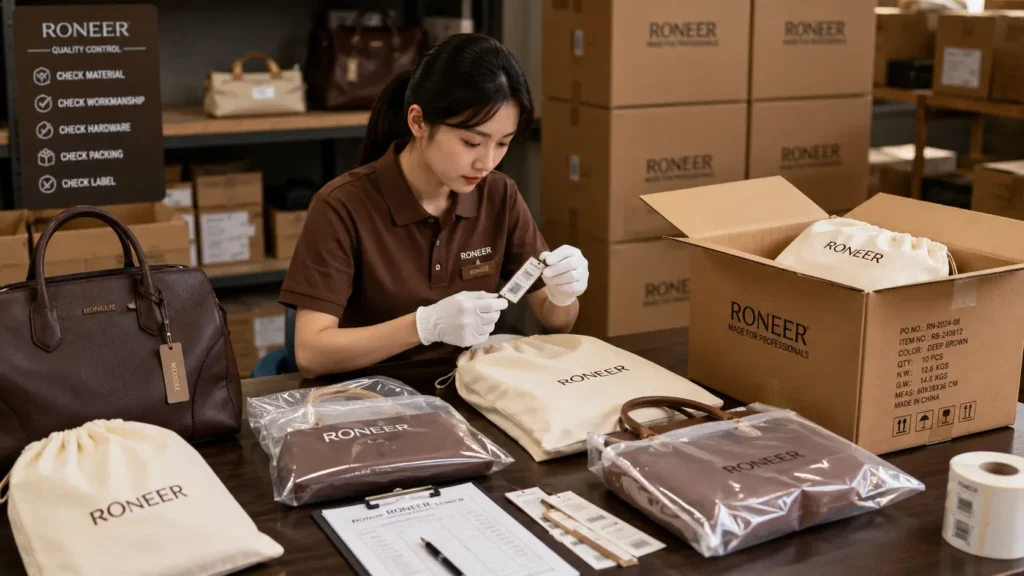
Incorrect quantities, missing labels, weak cartons, insufficient protection, and wrong shipping marks can create claims even when the bag itself is acceptable. Buyers should confirm requirements through a clear packaging customization plan.
Treating AQL as a production-control system
AQL is primarily an acceptance-sampling method. It should not replace material inspection, operator controls, in-line checks, component verification, or process improvement.
How RONEER Supports Bag Inspection Planning
RONEER supports OEM/ODM buyers with specification review, sample development, material confirmation, production coordination, quality checkpoints, packing preparation, and final inspection planning according to the confirmed project.
Before production, buyers can discuss:
- Product specifications
- Approved samples
- Materials and colors
- Logo requirements
- Measurement tolerances
- Functional checkpoints
- Defect priorities
- Packing methods
- Carton requirements
- Third-party inspection arrangements
The inspection scope must be agreed for each project. RONEER does not assume that one generic AQL setting is suitable for every bag category, price level, sales channel, or destination market.
For a broader overview of production-stage controls, review the Bag Quality Control Guide for OEM/ODM Production.
Frequently Asked Questions About AQL Inspection for Bags
What is AQL inspection for bags?
AQL inspection for bags is a statistical sampling method used to evaluate a finished production lot before shipment. An inspector randomly selects a defined number of bags, checks them against the approved sample and specifications, classifies the defects, and compares the results with predetermined acceptance and rejection limits.
AQL inspection for bags helps buyers make shipment decisions based on measurable inspection results instead of relying only on factory photos or subjective workmanship descriptions.
Why is AQL inspection for bags important for OEM and private label orders?
OEM and private label bags often involve customized materials, dimensions, logos, hardware, lining, pockets, labels, and packaging. Any inconsistency can affect product function, retail presentation, customer satisfaction, or reorder planning.
AQL inspection for bags gives the buyer, manufacturer, and inspector one agreed method for evaluating these requirements. It also reduces disputes by defining which defects are critical, major, or minor before the production lot is inspected.
What AQL levels are commonly used for bag inspection?
A commonly requested commercial starting point is:
- Critical defects: not accepted
- Major defects: AQL 2.5
- Minor defects: AQL 4.0
These values are not mandatory for every order. The appropriate limits for AQL inspection for bags depend on bag type, construction complexity, sales channel, target price, previous production performance, and the commercial impact of a defect.
Premium handbags, technical backpacks, children’s bags, travel luggage, and promotional bags may require different acceptance limits.
Is AQL 2.5 suitable for every bag order?
No. AQL 2.5 is frequently selected for major defects in general consumer-product inspections, but it should not be treated as a universal bag quality standard.
For example, a visible logo defect on a premium handbag may require a stricter acceptance limit, while a small cosmetic variation on a low-cost promotional tote may be classified differently. The buyer should define the AQL inspection for bags according to the product specification and market risk.
Which inspection level should be used for AQL inspection for bags?
General Inspection Level II is often used as the standard starting point for finished bag orders. Level I produces a smaller sample, while Level III produces a larger sample.
The selected level should reflect:
- Whether this is a first or repeat order
- The factory’s production history
- Bag construction complexity
- Material and hardware risk
- Order value
- Retail quality expectations
- Consequences of shipment failure
AQL inspection for bags may use a stricter level when a new supplier, new material, new construction, or previously identified defect increases the buyer’s risk.
How many units are checked during an AQL inspection for bags?
The inspection quantity depends on the total lot size and selected inspection level. These two factors determine a sample-size code letter, which is then used to find the required number of units to inspect.
For example, a lot containing several thousand bags may require an inspection sample of approximately 200 units under General Inspection Level II, depending on the applicable sampling table.
The inspection report should clearly record the lot quantity, sample size, code letter, selected AQL limits, acceptance number, rejection number, and defects found.
How should bags be selected for an AQL inspection?
The bags should be selected randomly from different cartons and different positions within those cartons. The factory should not prepare a group of preferred or pre-checked products for the inspector.
A representative AQL inspection for bags should cover:
- Different carton numbers
- Top, middle, and bottom carton positions
- Different production batches
- Different colors or sizes
- Multiple SKUs where applicable
- Products packed at different times
Random selection improves the likelihood that the inspected units accurately represent the entire shipment.
What is considered a critical defect in bag inspection?
A critical defect may create an unreasonable safety risk, violate an applicable legal requirement, or make the bag unsafe for normal use.
Possible examples include:
- Sharp exposed hardware
- Broken metal parts that can cause injury
- Serious mold or contamination
- Unsafe detachable components on regulated children’s products
- A structural failure that creates an immediate hazard
- Missing mandatory safety information where legally required
Critical defects normally have the strictest acceptance requirement in AQL inspection for bags. Regulatory compliance and laboratory testing should still be managed separately.
What is considered a major defect during AQL inspection for bags?
A major defect is likely to affect function, durability, saleability, brand presentation, or normal customer use.
Examples include:
- Broken or jammed zipper
- Detached shoulder strap
- Open seam
- Incorrect dimensions outside tolerance
- Wrong material or color
- Missing pocket or component
- Incorrect logo placement
- Weak reinforcement
- Nonfunctional buckle or closure
- Serious surface damage
- Incorrect lining construction
Even when a major defect does not create an immediate safety concern, it may make the product unsuitable for retail sale.
What is considered a minor defect in a bag order?
A minor defect does not normally stop the bag from functioning but falls below the approved cosmetic or workmanship standard.
Examples may include:
- Small removable thread ends
- Slight stitching irregularity in a non-load-bearing area
- Minor lining wrinkles
- A small removable surface mark
- Slightly uneven edge paint within an agreed tolerance
- Minor presentation issues in individual packaging
Minor defects should still be clearly defined. AQL inspection for bags becomes less reliable when inspectors must interpret vague terms such as “slight,” “small,” or “acceptable” without approved reference photos or measurable tolerances.
Does AQL inspection for bags include measurements and functional tests?
Yes, when these checks are included in the approved inspection checklist.
Typical measurement and function checks may include:
- Bag width, height, and depth
- Падение рукоятки
- Strap length and adjustment range
- Размеры кармана
- Zipper operation
- Buckle and snap function
- Strap attachment
- Усиление ручки
- Interior compartment construction
- Wheel or trolley operation for travel bags
However, AQL inspection for bags normally confirms basic finished-product function. It does not replace laboratory durability testing, repeated-cycle testing, load testing, or regulatory testing unless those procedures are separately specified.
Does AQL inspection for bags include packaging and carton checks?
Yes. Packaging should be inspected when it forms part of the approved order specification.
The inspector may check:
- Correct dust bag or polybag
- Product protection and stuffing
- Hangtags and labels
- Barcode accuracy
- SKU and color information
- Quantity per carton
- Carton dimensions and weight
- Знаки доставки
- Carton sealing
- Retail box condition
- Mixed-product packing errors
A bag order can pass workmanship checks and still create claims if the labeling, carton quantity, or export packing is incorrect.
What happens when an AQL inspection for bags fails?
When an AQL inspection for bags fails, the shipment should normally be placed on hold while the factory identifies the cause of the failed result.
Corrective actions may include:
- Sorting the complete production lot
- Repairing defective units
- Replacing damaged bags
- Correcting labels or barcodes
- Repacking affected cartons
- Separating defective production
- Investigating material or component problems
- Performing a 100% check for the failed defect
- Conducting a new random inspection
The supplier should not simply remove the failed sample units and present replacement bags. Reinspection should take place only after documented corrective action has been completed.
Is AQL inspection for bags the same as a 100% inspection?
No. AQL inspection for bags checks a statistically selected sample from the production lot. A 100% inspection checks every bag for specified characteristics.
A full inspection may be appropriate when:
- A previous AQL inspection has failed
- The same defect appears repeatedly
- Every unit has personalized branding
- Barcode accuracy must be checked on every bag
- The order has unusually strict appearance requirements
- The commercial risk of defects is high
Even a 100% visual inspection does not replace proper specifications, production controls, approved samples, laboratory testing, or corrective-action procedures.
When should the buyer confirm AQL inspection requirements?
The buyer should confirm the AQL inspection for bags before bulk production begins. Ideally, the inspection limits, defect classifications, product checklist, packaging requirements, and reporting method should be reviewed during quotation, sample development, or pre-production approval.
Sending inspection requirements only after production is complete can create disputes because the factory may not have priced, produced, or checked the order according to those standards.
Заключение
AQL inspection for bags provides a structured method for evaluating finished production before shipment, but the sampling table alone does not create an effective quality-control system. Buyers must first define the approved materials, dimensions, construction, functions, logo details, workmanship tolerances, packaging requirements, and defect classifications.
A reliable AQL inspection for bags should combine random carton selection, representative sampling, clear critical-major-minor defect rules, measurement checks, functional testing, workmanship review, label verification, and export packing inspection. The final report should show not only whether the lot passed or failed, but also which defects were found, where they occurred, and whether they indicate a wider production problem.
Buyers should also remember that AQL inspection for bags does not replace material approval, pre-production samples, in-line quality checks, laboratory testing, regulatory review, or corrective action. It is most useful as the final decision point within a broader OEM/ODM quality-control process.
RONEER can coordinate AQL inspection for bags according to the confirmed product specification, approved sample, material requirements, branding details, construction, packaging method, and buyer-defined acceptance criteria. By establishing the inspection plan before production, buyers and the factory can evaluate the shipment using consistent evidence rather than subjective expectations.
A properly prepared AQL inspection for bags therefore protects more than the immediate shipment. It also helps identify repeat defects, improve future production standards, maintain consistent reorder quality, and support a more reliable long-term manufacturing relationship.