 日本語
日本語  English
  Deutsch
  Español
  Français
  Italiano
  Русский
  العربية
  Türkçe
  한국어
한국어 Finding the right private label bag manufacturer for USA brands is not only about choosing a supplier with a competitive price. For American startups, retail brands, Amazon sellers, boutiques, corporate buyers, wholesalers, and e-commerce businesses, the real challenge is building a bag line that looks professional, fits the target market, protects brand identity, and can be produced consistently from sample to bulk order.
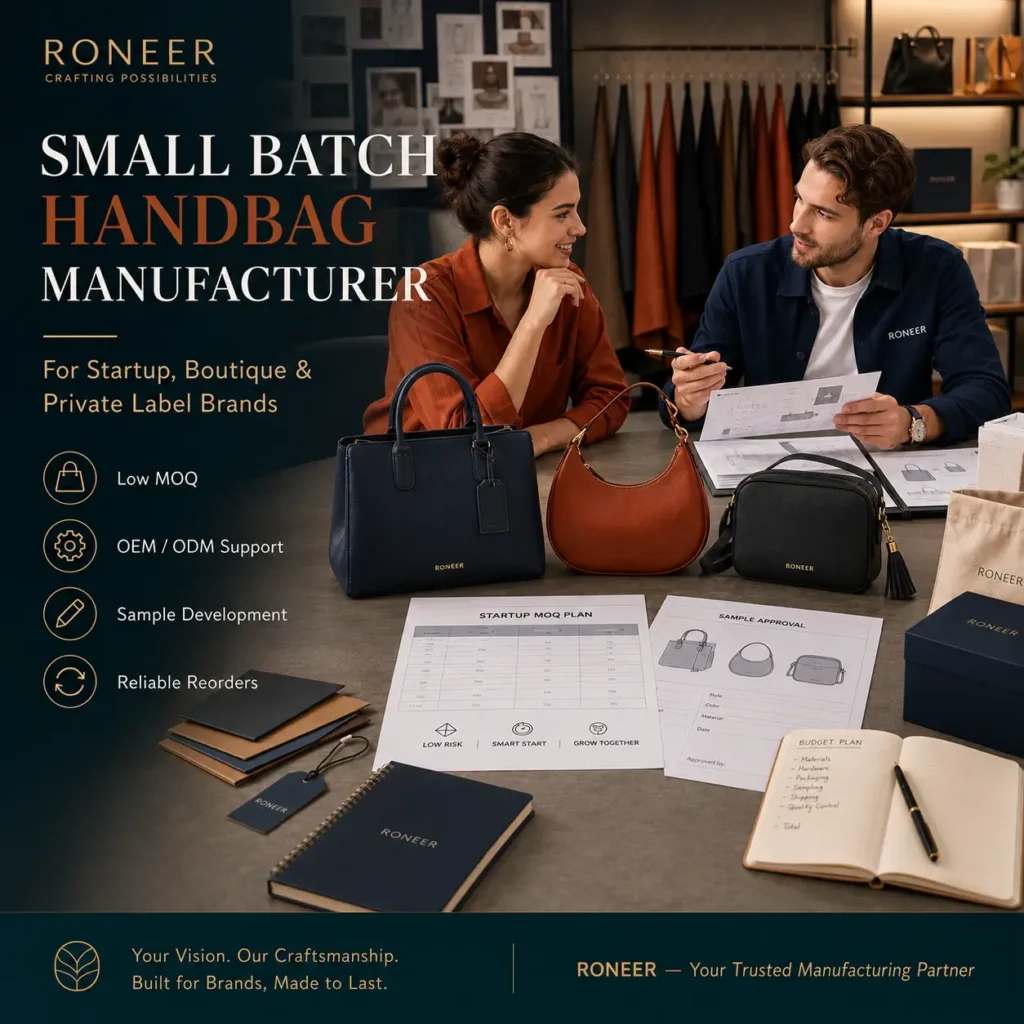
USA brands preparing a handbag line can review RONEER’s private label handbag manufacturing capabilities for logo, packaging, sampling and repeat-order planning.
A reliable private label bag manufacturer for USA brands should understand more than basic bag production. USA buyers often need custom logos, hang tags, barcode labels, dust bags, retail packaging, carton marks, material approvals, sample revisions, size confirmation, quality control, and export packing. If these details are not planned early, the final product may look unfinished or inconsistent, even when the basic bag shape is acceptable.
A good private label bag project usually starts with clear communication between the buyer and the factory. The buyer needs to explain the product type, target customer, sales channel, expected quantity, logo requirements, packaging needs, and quality level. The factory should then help review the design, recommend suitable materials, confirm realistic MOQ, develop samples, and prepare production details. This is why choosing an experienced private label bag manufacturer for USA brands can make the sourcing process much easier and safer.
This guide explains how USA buyers can work with a private label bag manufacturer for USA brands more efficiently. It covers product positioning, MOQ, logo options, material selection, packaging, compliance discussion, sampling, QC, and export support, so your sourcing process becomes clearer before bulk production starts.
Why USA Brands Need the Right Private Label Bag Partner
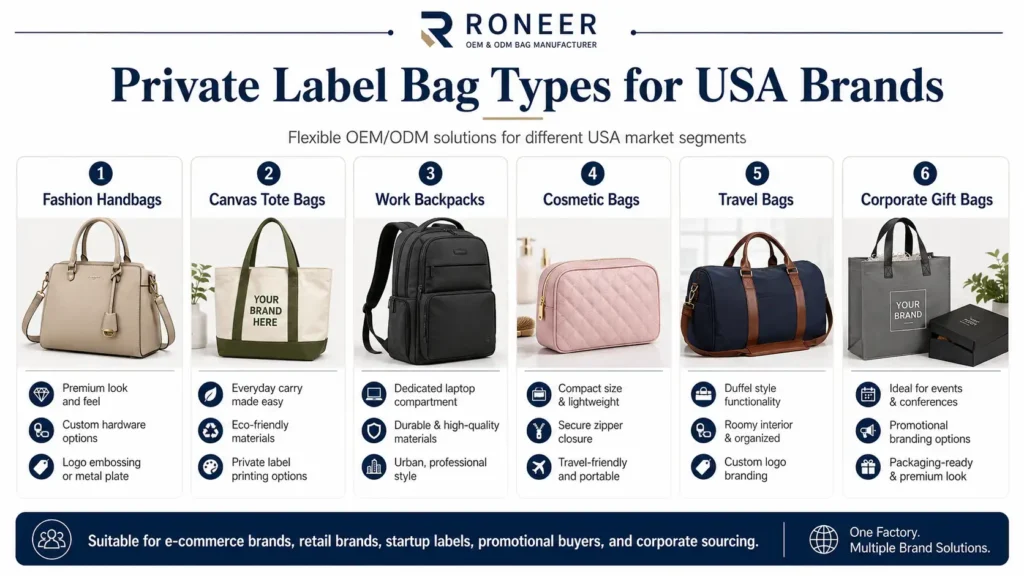
The USA bag market is diverse. Some brands focus on fashion handbags and lifestyle accessories. Some sell practical canvas totes, work backpacks, laptop bags, cosmetic bags, travel bags, sports duffel bags, or promotional bags. Other buyers need corporate gift bags, event merchandise, retail-ready packaging, or small batch products for testing a new market.
Because the market is competitive, USA brands need more than generic products. They need bags that match their brand story, customer price point, packaging style, sales channel, and customer expectations. A private label bag manufacturer for USA brands should understand that the same product may need different details depending on where it will be sold and who will buy it.
For example, an Amazon seller may care about barcode labels, carton marks, compact packaging, product consistency, and stable repeat orders. A boutique brand may focus more on material texture, logo finish, dust bag presentation, premium appearance, and packaging details. A corporate buyer may care about delivery time, logo accuracy, MOQ, and cost control. A wholesale buyer may need stable bulk production, clear carton packing, and reliable export support.
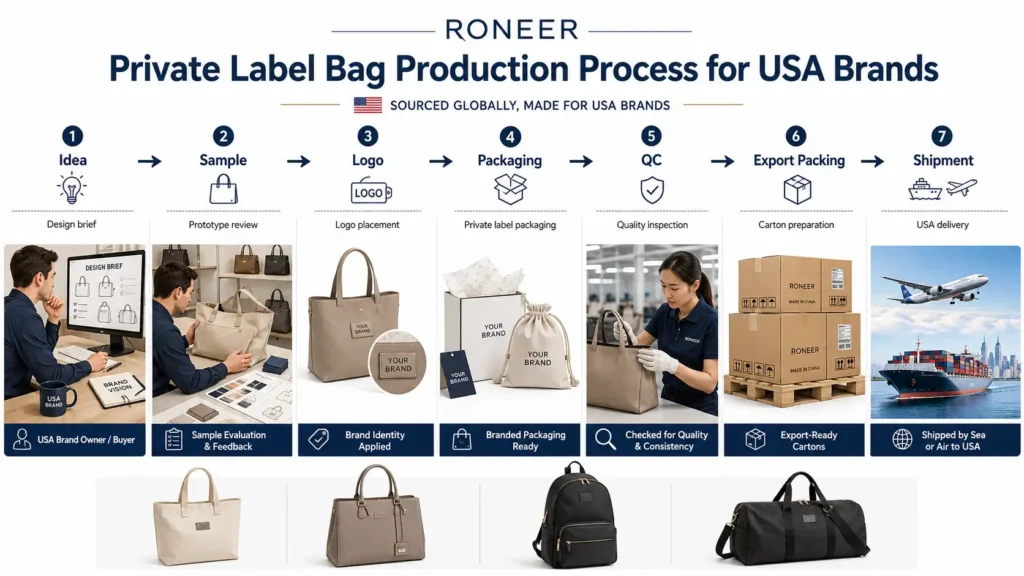
This is why the right private label bag manufacturer for USA brands should not only produce bags, but also help buyers organize the full development process. From material selection and logo customization to sample approval, private label packaging, QC inspection, and export packing, every step affects the final product quality and brand presentation.
RONEER supports OEM/ODM custom bag development for global buyers, including USA brands that need custom bags, private label bags, custom logo bags, low MOQ discussion, material customization, packaging customization, QC, bulk production, export packing, and global shipping support. For buyers looking for a practical private label bag manufacturer for USA brands, RONEER can help turn ideas into finished products with clearer communication, flexible customization options, and stable production support. Buyers can also review RONEER’s main service direction on the custom bag manufacturing website.
1. Define Your USA Brand Positioning Before Asking for a Quote
Before contacting a private label bag manufacturer for USA brands, you should define your product positioning. Many buyers ask for a quote too early, before the design, quality level, and packaging needs are clear. This often leads to inaccurate pricing or samples that do not match the final market expectation.
Start by answering these questions:
- Who is your target customer?
- Will the bag be sold online, in retail stores, through wholesale, or as a corporate gift?
- Is your brand positioned as budget-friendly, mid-range, premium, sustainable, fashion-forward, or functional?
- What is your target retail price?
- What is your expected order quantity?
- Do you need a fully custom design or an ODM base style?
- Do you need custom packaging for retail presentation?
- Do you need barcode labels, carton marks, or platform-specific packing?
A professional factory can give better suggestions when it understands your brand positioning. For example, if your USA brand sells premium handbags, the factory may recommend better surface materials, cleaner edge finishing, stronger hardware, and more refined logo methods. If you sell promotional tote bags, the focus may be lower MOQ, simple logo printing, cost control, and fast delivery.
The clearer your positioning is, the easier it becomes to choose the right material, logo method, packaging style, and production plan.
2. Choose a Factory That Understands Different Bag Categories
A private label bag manufacturer for USA brands should have experience with the specific type of bag you want to develop. Bag manufacturing is not one single skill. Different bag categories require different patterns, machines, materials, reinforcement methods, stitching details, and QC points.
Common private label bag categories include:
- Private label handbags
- Private label tote bags
- Private label backpacks
- Private label cosmetic bags
- Private label laptop bags
- Private label travel bags
- Private label duffel bags
- Private label wallets
- Private label outdoor bags
- Private label promotional bags
A tote bag may look simple, but the handle length, fabric weight, seam strength, lining choice, and logo placement still affect the final quality. A backpack requires more attention to shoulder straps, back panel structure, zipper strength, laptop compartment size, webbing, buckles, and load-bearing points. A handbag may require better shape control, hardware selection, surface finish, stitching accuracy, and lining details.
If you are sourcing multiple categories, choose a factory that can support different bag types or clearly explain which categories it handles best. This helps avoid a common problem: using one supplier for a product category they are not strong at.
3. Plan MOQ Based on Customization Level
MOQ is one of the most important topics when working with a private label bag manufacturer for USA brands. Many USA startups want low MOQ because they need to test a product before placing a larger order. This is reasonable, but MOQ depends heavily on the customization level.
MOQ may be lower when:
- The design uses available materials
- The bag shape is simple
- Hardware is standard
- The logo method is simple
- Packaging is basic
- The order uses existing colors
- No custom molds are needed
MOQ may increase when:
- The material needs a special color
- The bag uses custom metal hardware
- The logo requires molds or special processes
- The structure is complex
- Packaging is fully customized
- The product needs multiple colorways
- The lining, zipper, or webbing must be specially dyed
A reliable factory should not only give you a number. It should explain why the MOQ is set that way and how to reduce MOQ without damaging product quality. For example, you may use stock material for the first order, choose a standard hardware color, simplify the packaging, or start with one colorway before expanding the collection.
RONEER can discuss low MOQ options based on bag type, material availability, logo method, and packaging needs. If you want to understand MOQ and cost control more deeply, you can also read this guide on custom bag MOQ and cost optimization.
4. Confirm Materials for Your Target Price and Market
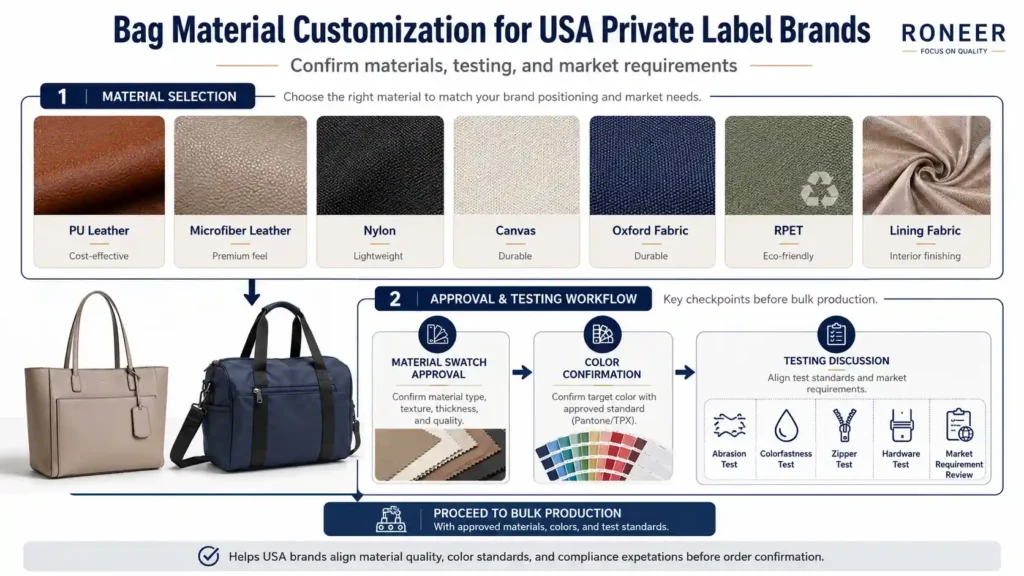
Material selection affects appearance, durability, weight, cost, MOQ, and customer perception. A private label bag manufacturer for USA brands should be able to explain different material options instead of simply asking you to choose from a swatch book.
Common materials for private label bags include:
- PUレザー
- Microfiber leather
- キャンバス
- Cotton fabric
- ナイロン
- オックスフォード生地
- ポリエステル
- RPET fabric
- Mesh fabric
- Denim
- Jacquard fabric
- Waterproof coated fabric
- Lining fabric
For USA brands, material selection should match the sales channel and product promise. A premium handbag line may need a smoother surface, better touch, structured body, and refined hardware. A work backpack may require durable nylon or Oxford fabric, reinforced stress points, and water-resistant performance. A cosmetic bag may need easy-clean lining and good zipper performance. A promotional tote may need a cost-effective canvas or polyester fabric.
If your brand wants recycled, preferred, or lower-impact materials, you can use テキスタイル・エクスチェンジ as a general industry reference for learning about material trends. However, material claims, recycled content, and certification documents should always be confirmed for each specific order. Do not assume that a material is certified unless the supplier provides valid documentation for the project.
RONEER can support material discussions based on your target price, product category, and brand style. You can review more options on the material customization service.
5. Plan Logo, Label, and Packaging Details Early
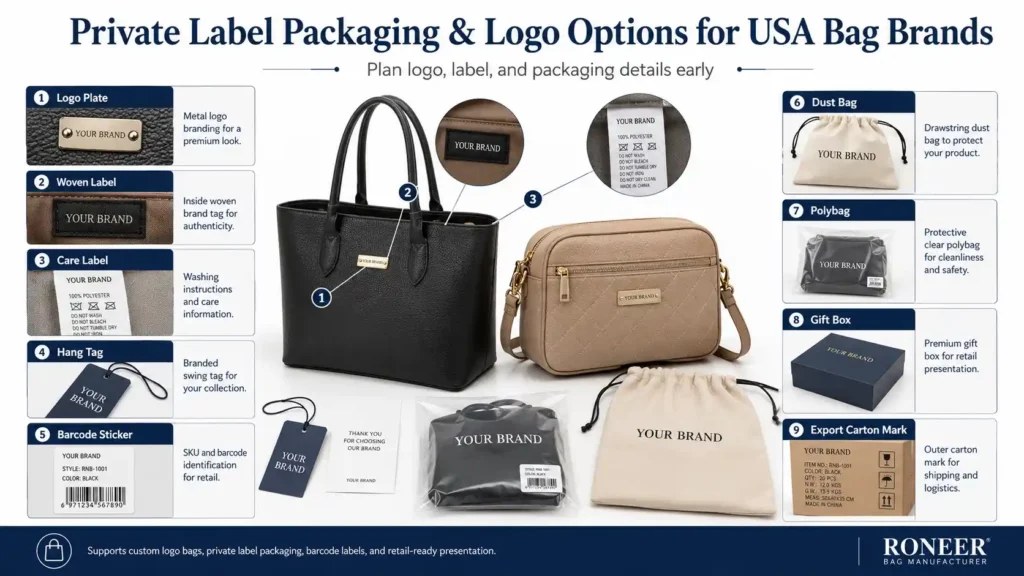
For private label production, branding details are not decoration. They are part of the product. A private label bag manufacturer for USA brands should help you plan the full brand presentation, including logo placement, labels, packaging, and carton information.
Common logo options include:
- Screen printing
- 熱転写印刷
- 刺繍
- 織ラベル
- ラバーパッチ
- PU patch
- 金属製ロゴプレート
- エンボス加工されたロゴ
- エンボス加工されたロゴ
- Foil stamping
- カスタムジッパープーラー
- Custom hardware logo
Not every logo method works for every material. Embroidery may be suitable for canvas, cotton, or fabric bags. Metal logo plates may be suitable for premium handbags, but they may require molds and higher MOQ. Debossing can look clean and understated on some PU or microfiber leather materials, but the effect depends on thickness and surface texture. Heat transfer can work for certain fabric products but should be checked for durability and appearance.
Private label packaging may include:
- 織ラベル
- Care label
- Hang tag
- Barcode sticker
- Size or SKU label
- Dust bag
- Printed polybag
- ティッシュペーパー
- Insert card
- Gift box
- Export carton mark
If your USA brand sells through Amazon, boutiques, retail stores, wholesale channels, or corporate programs, packaging requirements may be different. Confirm these details before sampling because packaging can affect cost, MOQ, lead time, and final customer experience.
You can review RONEER’s logo customization options そして packaging customization service for more private label development ideas.
6. Discuss USA Import, Labeling, and Market Requirements
A private label bag manufacturer for USA brands should help prepare production and packing details clearly, but USA buyers also need to understand their own import and selling requirements. Requirements may vary depending on product type, material, age group, sales channel, and destination.
For imported goods, country of origin marking is an important topic. U.S. Customs and Border Protection provides official information about country of origin marking for U.S. imports. For bags made in China, buyers should normally discuss clear and accurate origin labeling such as “Made in China” where required.
USA brands should also be careful with “Made in USA” claims. The Federal Trade Commission provides guidance on complying with the Made in USA standard. If a bag is produced in China, buyers should avoid misleading origin claims in product packaging, listings, advertising, or website content.
For some products, additional testing or compliance checks may be needed. For example, children’s products, certain textile items, special coatings, or products sold through major retailers may require specific documentation or testing. Organizations such as SGS can be used as a general reference for inspection and testing services, but exact requirements should be confirmed case by case.
RONEER can support communication around labels, packaging marks, material details, and production documents based on order requirements. However, buyers should always confirm final USA import, retail, platform, or legal requirements with their own compliance advisor or importer when needed.
7. Use Sampling to Confirm Every Private Label Detail
Sampling is one of the most important stages when working with a private label bag manufacturer for USA brands. A sample is not only used to check the bag shape. It is used to confirm the full private label experience.
During sampling, check:
- Overall size
- Shape and structure
- Material texture
- Color accuracy
- Logo size and position
- Hardware color
- Zipper smoothness
- Handle or strap length
- Stitching quality
- Lining color and pocket layout
- Label position
- Hang tag design
- 包装方法
- Carton mark or SKU label requirements
For private label projects, small details can strongly affect brand perception. A logo that is 5 mm too low, a tag that feels too cheap, a dust bag that does not match the brand style, or a weak zipper puller can make the final product look less professional.
Do not rush from first sample to bulk production if key details are not correct. A good factory should help adjust the sample, explain what can be improved, and confirm the final approved version before mass production.
8. QC, Export Packing, and Shipping Support Matter
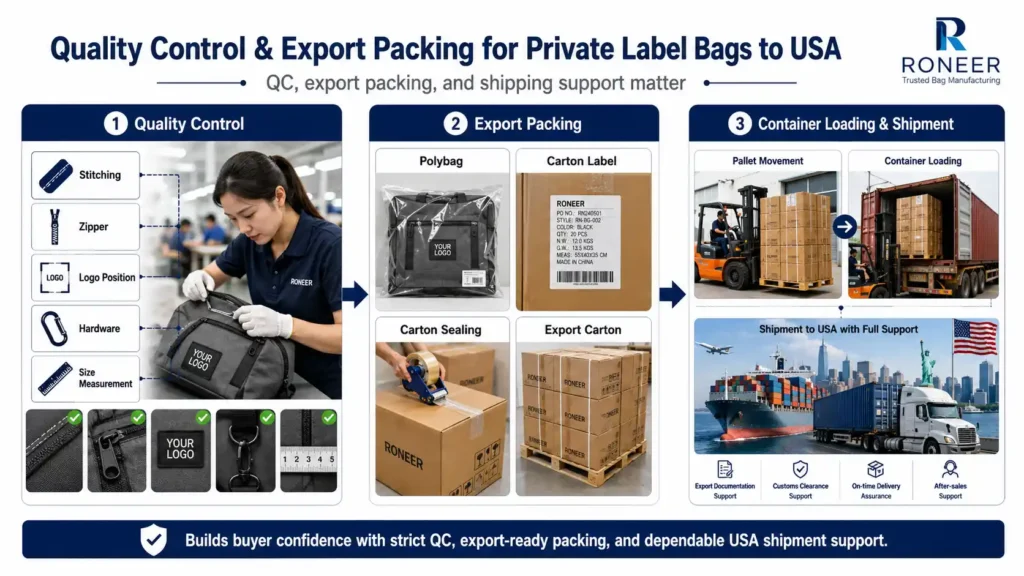
Quality control is critical when choosing a private label bag manufacturer for USA brands. USA buyers often need consistent products because customer reviews, retail returns, and wholesale relationships can be affected by poor quality.
重要なQCチェックポイントは以下の通り:
- Material inspection
- Color checking
- 切断精度
- Stitching quality
- ロゴの位置
- Hardware function
- Zipper smoothness
- Size measurement
- Lining cleanliness
- Strap strength
- Surface defects
- Packaging accuracy
- Carton marking
- 最終無作為検査
Export packing is also important. Bags may be shipped by sea, air, express courier, or combined logistics. Poor packing can cause deformation, scratches, dust, moisture issues, or carton damage. For structured handbags, shape protection may be needed. For light-colored bags, inner protection should reduce the risk of staining or color transfer. For e-commerce products, barcode and SKU labels should be checked carefully.
A professional factory should help organize export cartons, packing lists, carton marks, and shipment preparation according to the buyer’s order needs.
What USA Buyers Should Send Before Getting a Quote
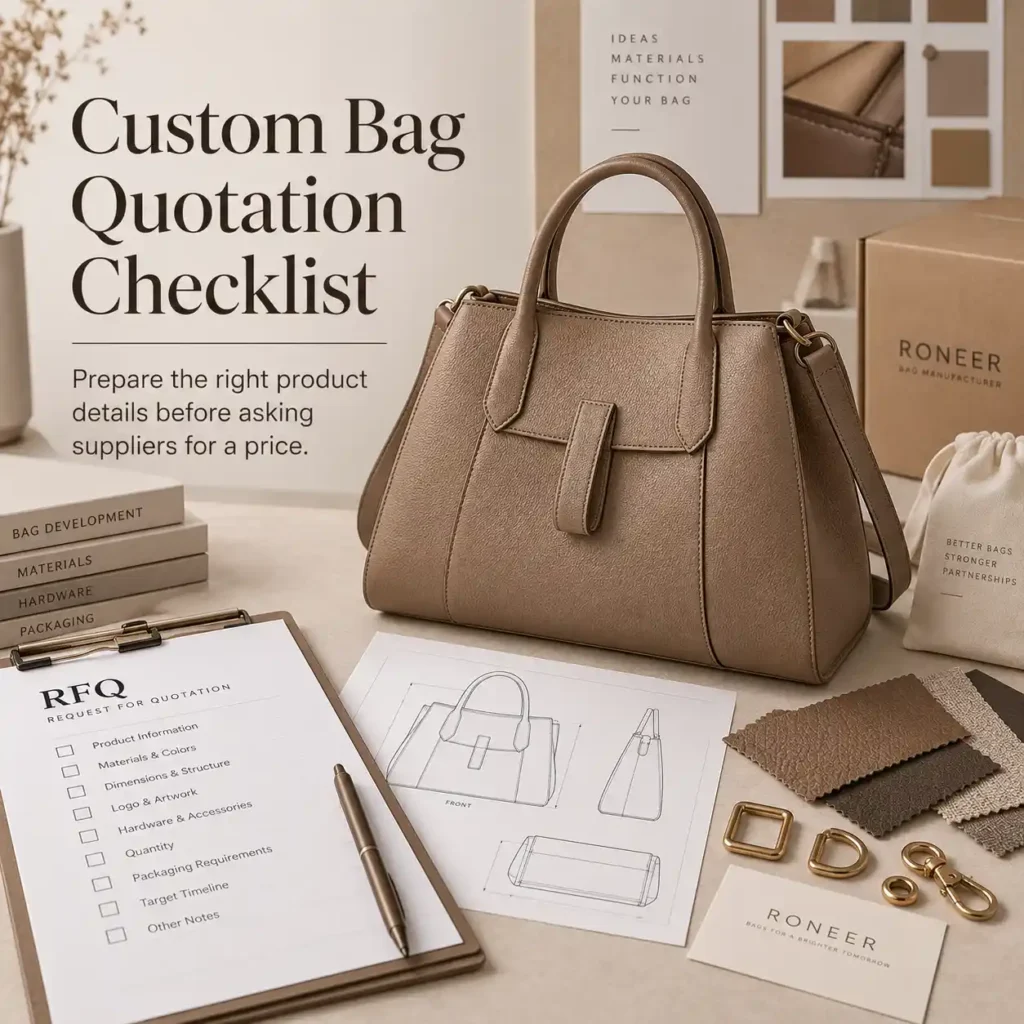
To get an accurate quote from a private label bag manufacturer for USA brands, prepare clear information before contacting the factory. The more complete your information is, the faster the factory can provide practical suggestions.
Send the following details if available:
- Bag type
- Reference image or design sketch
- サイズ
- 素材の好み
- カラー
- Logo file
- ロゴ方式
- Logo size and position
- Hardware color
- Lining requirement
- Pocket structure
- Estimated quantity
- 目標価格帯
- Packaging requirement
- Barcode or label needs
- Destination country
- Expected delivery time
If you do not have a complete tech pack, you can still start with reference images, product purpose, target market, and quantity. A capable factory can help you organize the next development steps.
よくあるご質問
1. How do I choose a reliable private label bag manufacturer for USA brands?
To choose a reliable private label bag manufacturer for USA brands, check whether the factory has experience with your bag category, OEM/ODM development, low MOQ options, custom logo methods, material sourcing, private label packaging, QC steps, and export packing support. A good factory should not only quote a price but also explain how to reduce production risks before bulk orders.
2. What types of bags can a private label bag manufacturer for USA brands produce?
A private label bag manufacturer for USA brands may produce handbags, tote bags, backpacks, cosmetic bags, laptop bags, travel bags, duffel bags, wallets, outdoor bags, shopping bags, and corporate gift bags. The exact product range depends on the factory’s material supply chain, production experience, sewing capability, and customization process.
3. Can a private label bag manufacturer for USA brands support low MOQ orders?
Yes, a private label bag manufacturer for USA brands may support low MOQ orders if the design uses available materials, standard hardware, regular colors, simple logo processes, and basic packaging. MOQ usually becomes higher when the order requires custom molds, special material colors, fully customized hardware, exclusive lining, or complex retail packaging.
4. What should USA brands prepare before contacting a private label bag manufacturer?
Before contacting a private label bag manufacturer for USA brands, prepare the bag type, reference images, size, material preference, logo file, logo position, order quantity, target price, packaging needs, label requirements, destination country, and expected delivery time. Clear information helps the factory provide a more accurate quotation and sample development plan.
5. Can a private label bag manufacturer for USA brands help with custom logos?
Yes, a private label bag manufacturer for USA brands can usually support custom logo options such as screen printing, heat transfer printing, embroidery, woven labels, rubber patches, PU patches, metal logo plates, debossed logos, embossed logos, foil stamping, zipper puller logos, and custom hardware logos. The right logo method should match the bag material, MOQ, cost target, and brand positioning.
6. Can RONEER support private label packaging for USA brands?
Yes, RONEER can support private label packaging for USA brands, including woven labels, care labels, hang tags, barcode stickers, dust bags, printed polybags, insert cards, tissue paper, gift boxes, carton labels, and export carton marks. Packaging details should be confirmed during the sample stage so the final product is better prepared for retail, e-commerce, wholesale, or corporate use.
7. What materials are suitable for private label bags for USA brands?
Common materials include PU leather, microfiber leather, canvas, cotton fabric, nylon, Oxford fabric, polyester, RPET fabric, mesh fabric, denim, jacquard fabric, waterproof coated fabric, and different lining fabrics. A professional private label bag manufacturer for USA brands should recommend materials based on product use, target price, durability needs, appearance, MOQ, and brand style.
8. How long does sampling take when working with a private label bag manufacturer for USA brands?
Sampling time depends on the bag structure, material availability, logo process, hardware selection, packaging complexity, and sample revision needs. A simple tote bag using available material may be faster, while a structured handbag, backpack, travel bag, special color project, or custom hardware order may need more development time.
9. What USA labeling details should buyers discuss with the factory?
USA buyers should discuss country of origin marking, care labels if needed, barcode labels, SKU labels, hang tags, carton marks, polybag warnings if required by the sales channel, and any retail or platform-specific packaging requirements. A private label bag manufacturer for USA brands can help prepare production labels and packaging marks, but buyers should confirm final import and sales requirements based on their own product category.
10. How can USA brands reduce risk before bulk production?
USA brands can reduce risk by approving material swatches, confirming logo size and placement, reviewing the sample carefully, checking stitching and hardware, confirming packaging details, keeping written specifications, and approving a final pre-production sample before mass production. Working with an experienced private label bag manufacturer for USA brands makes this process more organized and easier to control.
11. Can RONEER work as a private label bag manufacturer for USA brands?
Yes, RONEER can work as a private label bag manufacturer for USA brands that need OEM/ODM support, fast sampling, low MOQ discussion, custom logo solutions, material customization, private label packaging, strict QC, bulk production, export packing, and global shipping support. RONEER can help USA buyers develop handbags, tote bags, backpacks, cosmetic bags, laptop bags, travel bags, and other custom bag projects.
12. Why should USA buyers choose private label production instead of generic stock bags?
Private label production allows USA buyers to control the logo, material, color, structure, lining, packaging, and overall brand presentation. Generic stock bags may be faster for very small projects, but working with a private label bag manufacturer for USA brands gives buyers more control over product identity, customer experience, and long-term brand value.
13. Is a private label bag manufacturer for USA brands suitable for startups?
Yes, a private label bag manufacturer for USA brands can be suitable for startups if the factory supports low MOQ discussion, practical material recommendations, simple logo options, sample development, and scalable bulk production. Startups should begin with fewer styles, controlled color options, and clear packaging requirements before expanding into larger collections.
結論
Choosing the right private label bag manufacturer for USA brands is an important step for any buyer who wants to build a professional and repeatable bag business. A reliable factory should not only produce bags, but also help you think through material selection, logo method, MOQ planning, sample approval, packaging details, QC standards, export packing, and delivery preparation. These details directly affect how your final product looks, feels, ships, and performs in the USA market.
For USA brands, private label bag production should start with a clear sourcing plan. Before bulk production, buyers should define the product category, confirm the target customer, choose suitable materials, approve logo placement, review packaging requirements, check country of origin marking, and confirm quality inspection points. This process helps reduce common problems such as wrong material texture, unstable color, poor stitching, weak hardware, inaccurate logo position, packaging mistakes, carton damage, and shipment delays.
RONEER works as a private label bag manufacturer for USA brands that need OEM/ODM development, fast sampling, low MOQ options, custom logo bags, material customization, private label packaging, strict QC, stable bulk production, export packing, and global shipping support. Whether you are developing handbags, tote bags, backpacks, cosmetic bags, laptop bags, travel bags, duffel bags, wallets, shopping bags, or small batch private label collections, RONEER can help organize the development process from initial idea to finished goods.
A professional private label bag manufacturer for USA brands should make your sourcing process clearer and safer. It should help you understand what affects MOQ, which materials fit your target price, which logo process works best on your chosen material, how packaging should be prepared for your sales channel, and what quality details must be checked before shipment. For startups, e-commerce sellers, retail brands, wholesalers, and corporate buyers, this kind of production support can make the difference between a generic product and a bag line with real brand value.
If your company is looking for a dependable private label bag manufacturer for USA brands, RONEER can support your next project with practical design review, material suggestions, logo customization, sample making, private label packaging planning, QC coordination, bulk production, export packing, and global shipping preparation. With the right factory partner, USA brands can develop private label bags with better control, stronger brand identity, and more stable long-term supply.