








For many startups, private label brands, e-commerce sellers, retailers, wholesalers, promotional product buyers, and corporate gift buyers, small batch bag production is a practical way to launch custom bags without committing to a very large first order. Instead of taking high inventory risk, buyers can start with a controlled quantity, test the market, collect customer feedback, improve the product, and prepare for repeat production.
However, small batch production is not simply “make fewer bags at the lowest price.” A professional factory must still manage design review, material selection, logo testing, sample development, production planning, quality control, packaging, and export packing. The goal is to make small batch bag production flexible, brand-ready, and suitable for future scaling.
RONEER supports OEM/ODM custom bag projects for global buyers who need low MOQ options, fast sampling, custom logo solutions, material customization, private label packaging, strict QC, stable bulk production, export packing, and global shipping coordination. Buyers can review RONEER’s overall factory capabilities through Servizio di produzione di borse personalizzate RONEER.
This guide explains how small batch bag production works, what affects cost and MOQ, which bag types are suitable, and how buyers can reduce risk before moving into larger production runs.
What Is Small Batch Bag Production?
Small batch bag production means producing customized bags in a smaller quantity than traditional large-scale manufacturing. It is often used by startups, private label brands, online sellers, boutique retailers, promotional buyers, and buyers testing a new design or market.
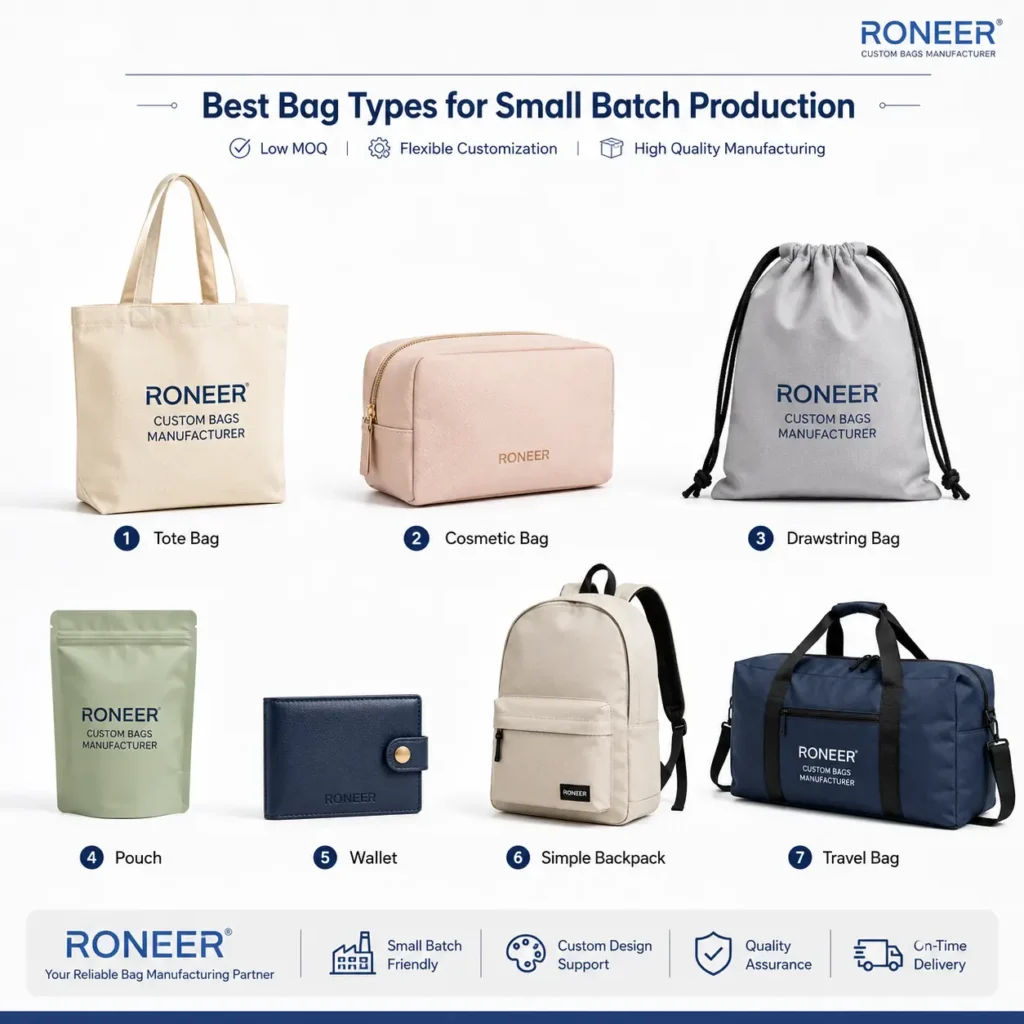
Small batch production can apply to different bag categories, including tote bags, backpacks, handbags, cosmetic bags, toiletry bags, wallets, pouches, drawstring bags, travel bags, and promotional bags. The actual minimum quantity depends on material availability, bag structure, logo method, color requirements, packaging, and production complexity.
A simple canvas tote bag with screen printing may be easier to produce in a small batch. A structured handbag with custom hardware, special lining, and premium packaging may require more planning and may have a higher minimum quantity.
A reliable manufacturer should explain which parts of the product can be customized in small quantities and which details may increase the minimum order requirement.
Why Small Batch Bag Production Matters for B2B Buyers
For B2B buyers, small batch bag production helps reduce inventory pressure and improve product launch flexibility. This is especially important when the buyer is still testing product-market fit, building a new brand, or preparing a seasonal collection.
For startups, small batch production reduces the risk of ordering too many units before customer demand is proven. For e-commerce sellers, it helps test a new SKU before investing in larger stock. For retailers, it allows seasonal style testing. For promotional buyers, it supports smaller campaigns or event-based orders.
Small batch production can help buyers test:
- Product style
- Material choice
- Logo placement
- Color response
- Packaging format
- Retail pricing
- Customer reviews
- Sales channel performance
- Reorder potential
- Bulk production readiness
A well-planned first order can become the foundation for future growth. RONEER helps buyers use small batch bag production as a controlled entry point before scaling into repeat orders or larger bulk production.
Small Batch Bag Production vs Bulk Production
Small batch production and bulk production have different advantages.
Small batch bag production is useful when buyers need flexibility, lower initial investment, product testing, and faster market validation. It helps buyers avoid overstock and gives them room to improve the product after real customer feedback.
Bulk production is better when the product has already been tested and the buyer needs a lower unit cost, stable supply, and larger inventory. Bulk production usually offers better production efficiency, but it requires stronger confidence in the design, sales channel, and demand.
The best sourcing strategy is often to start with a small batch, collect market feedback, adjust the product, and then move into larger orders. This allows buyers to reduce development risk while building long-term supply stability.
RONEER supports both small batch and bulk production, helping buyers move from sample development to first order and then to stable repeat production.
Which Bag Types Are Suitable for Small Batch Bag Production?
Not all bag types have the same small batch flexibility. Some products are easier to produce in lower quantities, while others require more material preparation and production setup.
Borse a tracolla
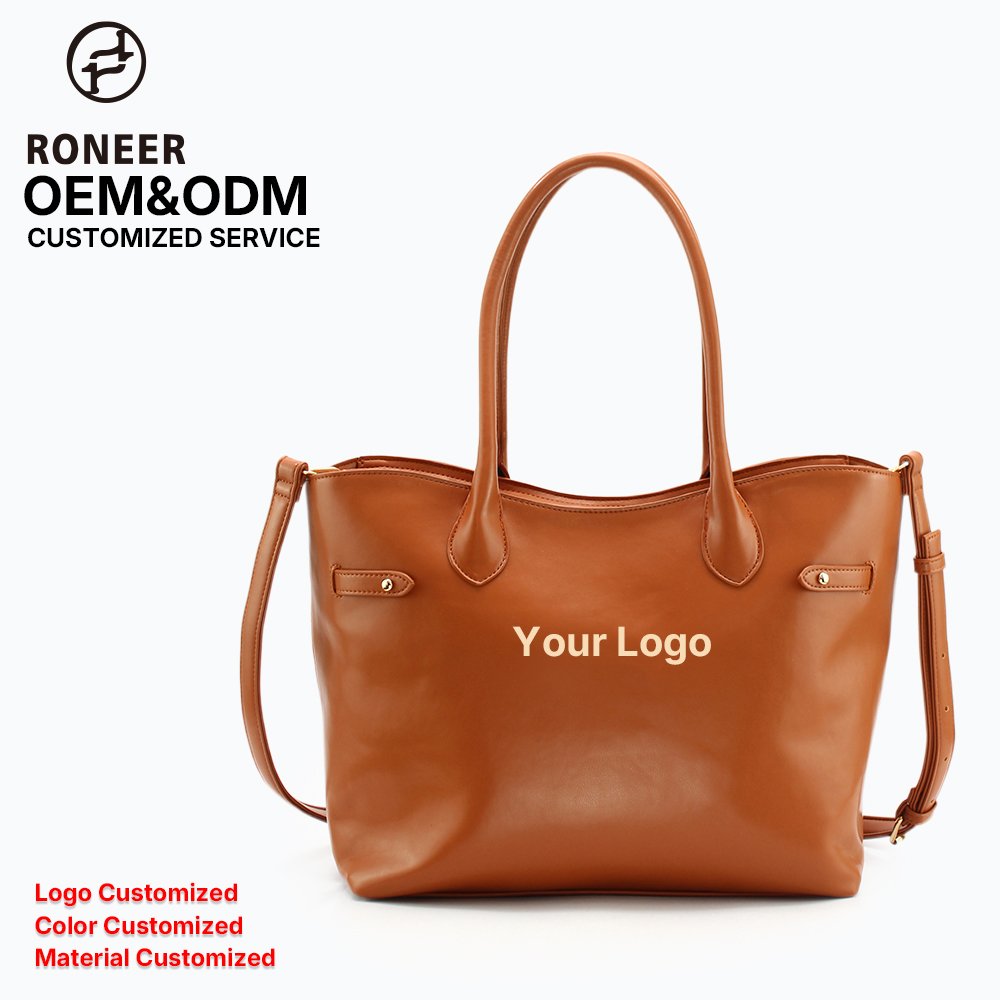
Tote bags are one of the most suitable categories for small batch bag production. Canvas, cotton, polyester, RPET, jute, and non-woven tote bags can often support flexible customization. They are popular for retail, promotional campaigns, trade shows, corporate gifts, and private label launches.
Cosmetic Bags and Pouches
Cosmetic bags, toiletry bags, makeup pouches, and small organizers are often practical for small batch production. Their compact size helps control material usage and shipping volume. Buyers can customize fabric, zipper, lining, logo, and packaging.
Borse con coulisse
Drawstring bags are simple, lightweight, and cost-effective. They are suitable for sports events, schools, promotional campaigns, gym brands, and simple retail packaging.
Zaini
Backpacks can be suitable for small batch production when the structure is not overly complex and the materials are available. Laptop backpacks, outdoor backpacks, or multi-compartment backpacks may need more development time and higher production planning.
Borse
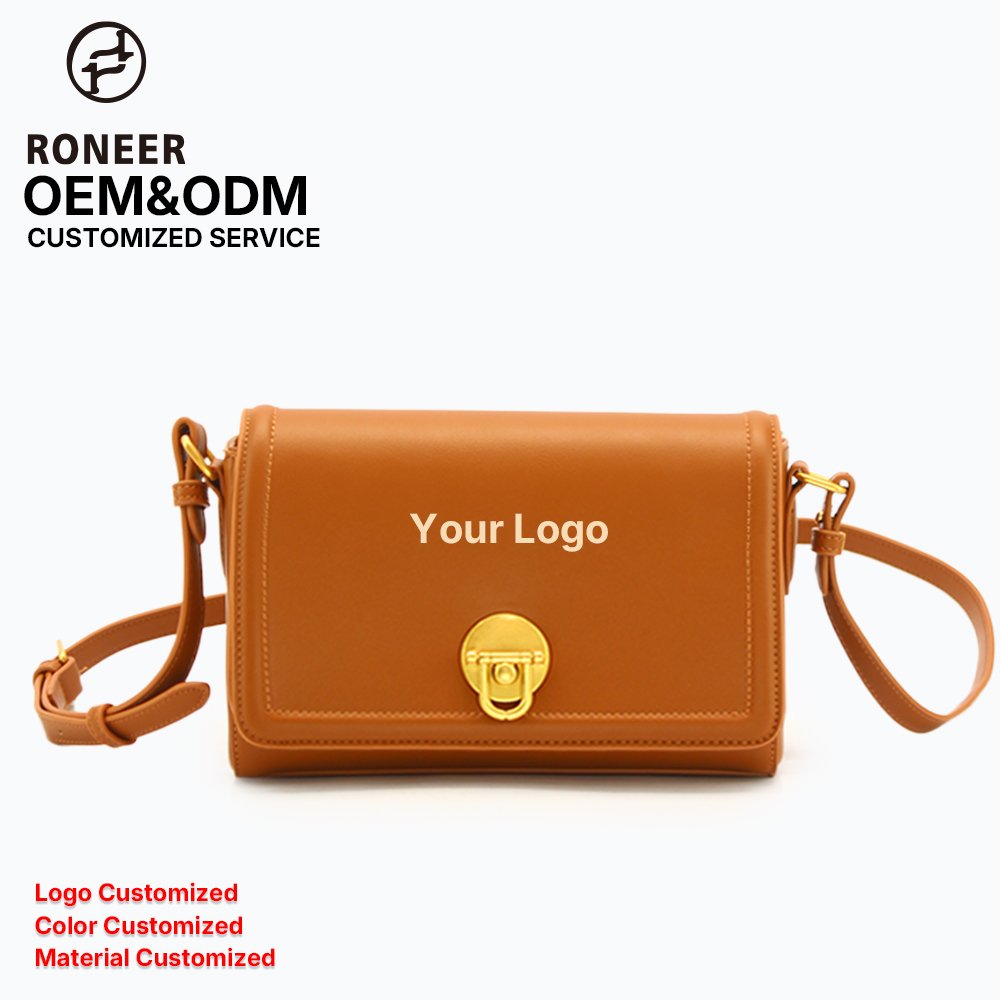
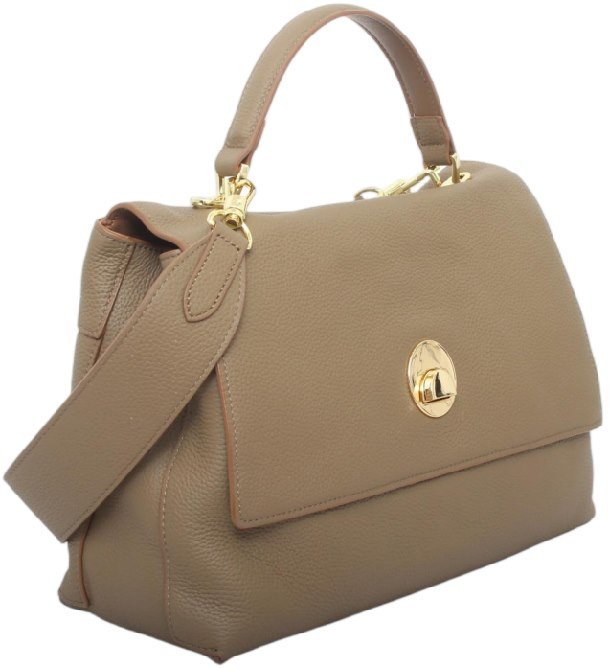
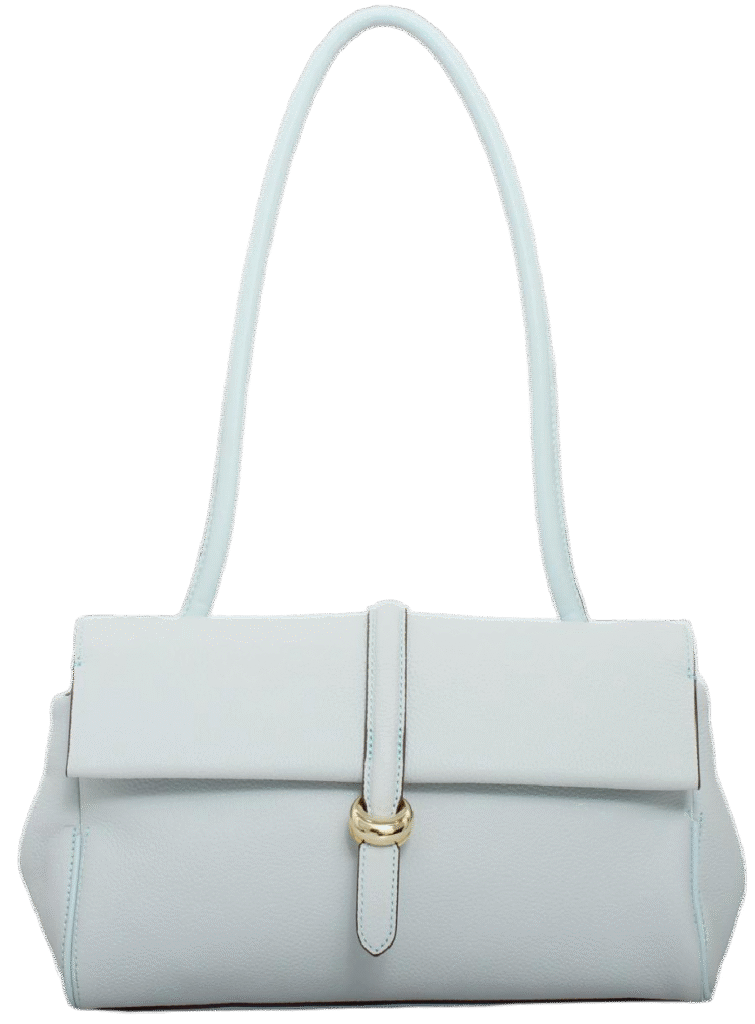
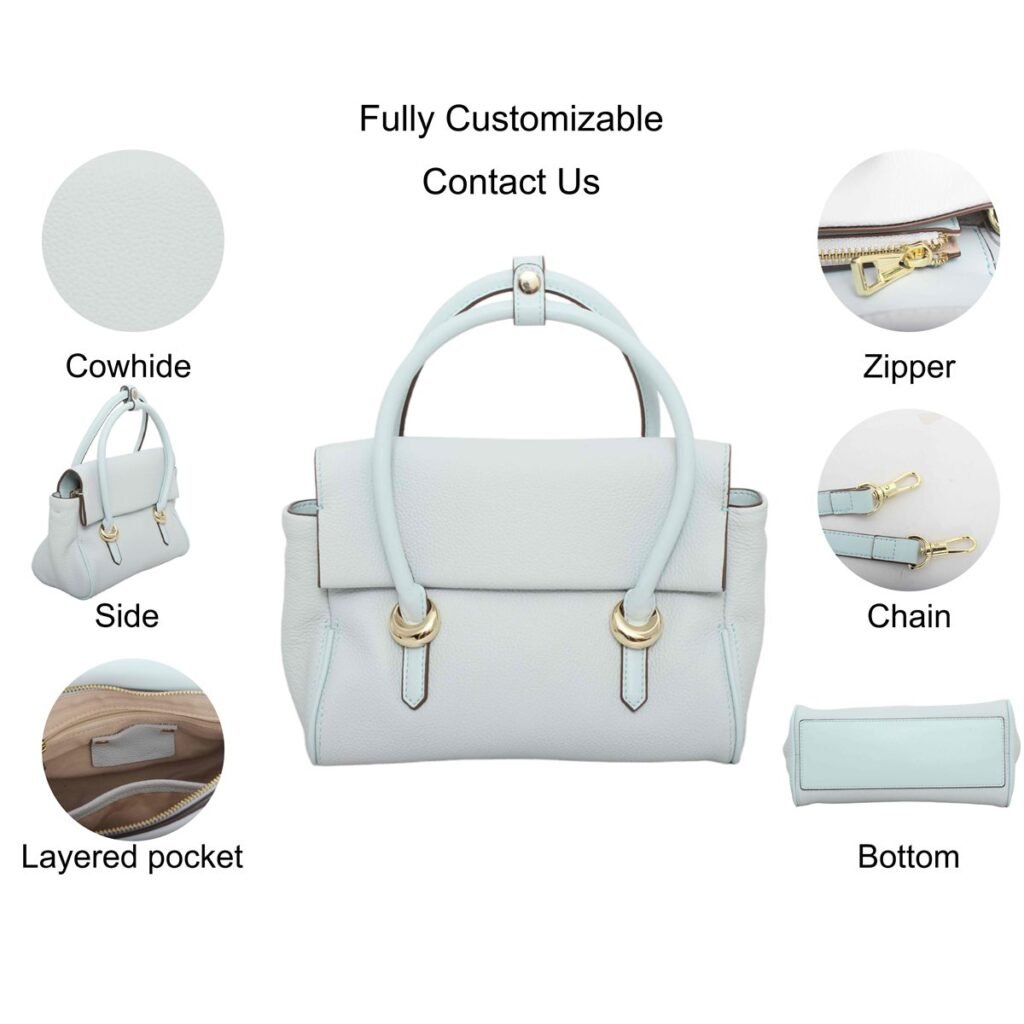
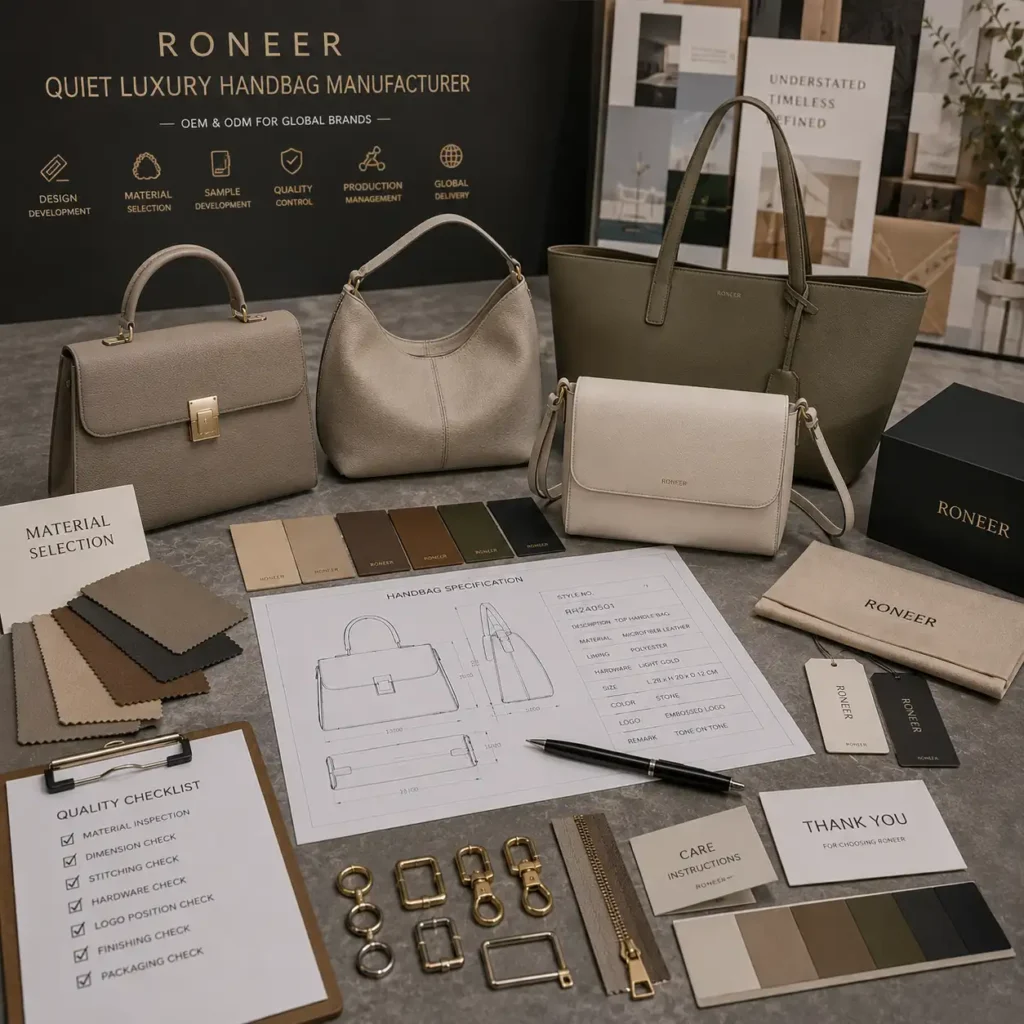
Handbags can be produced in smaller batches if the design is production-friendly. However, structured handbags with custom hardware, special lining, edge finishing, or complex shapes may require higher minimums.
Travel Bags and Duffel Bags
Travel bags and duffel bags require stronger materials, reinforced handles, larger zippers, and careful QC. Small batch production is possible, but buyers should avoid excessive customization in the first order.
Wallets and Small Accessories
Wallets, card holders, coin purses, passport holders, and small accessories are good options for small batch private label development when materials and logo methods are practical.
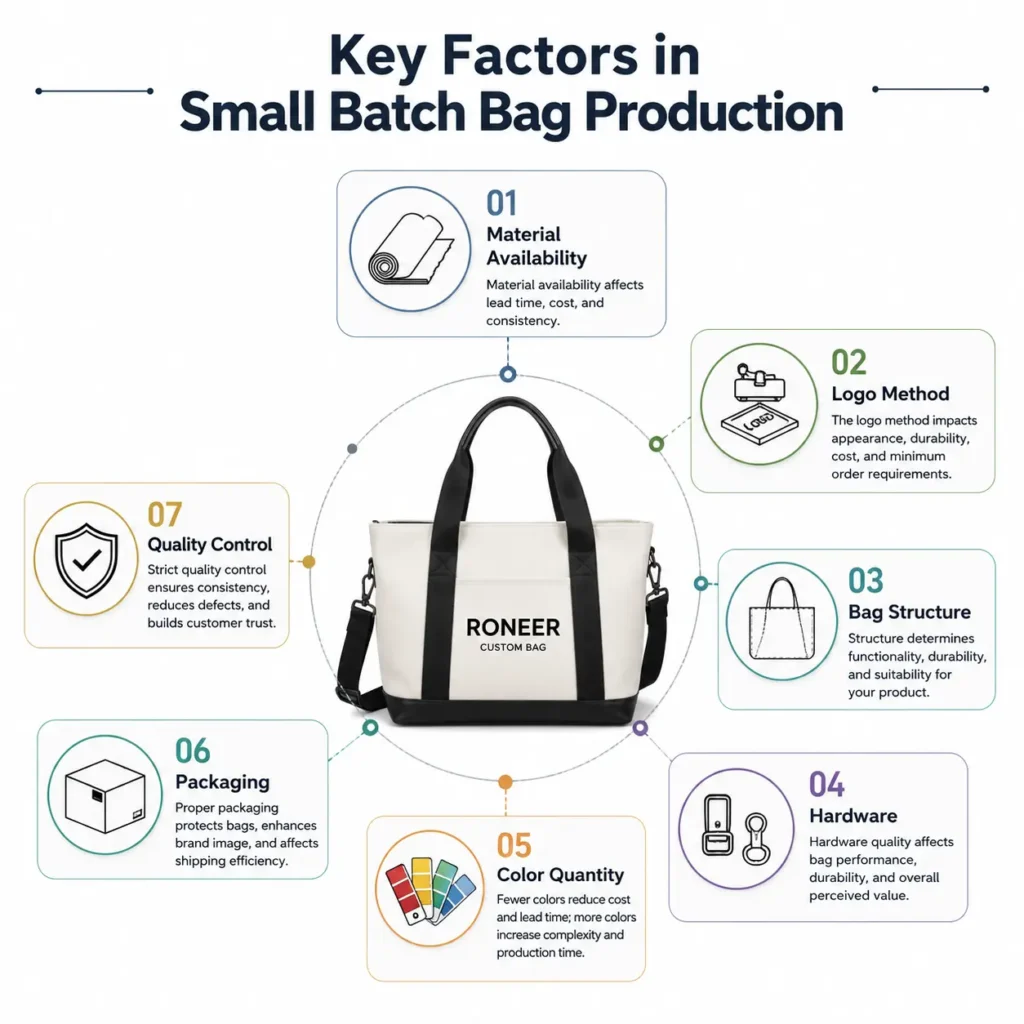
Main Factors That Affect Small Batch Bag Production
Several factors determine whether a small batch order is practical, cost-effective, and production-ready.
1. Material Availability
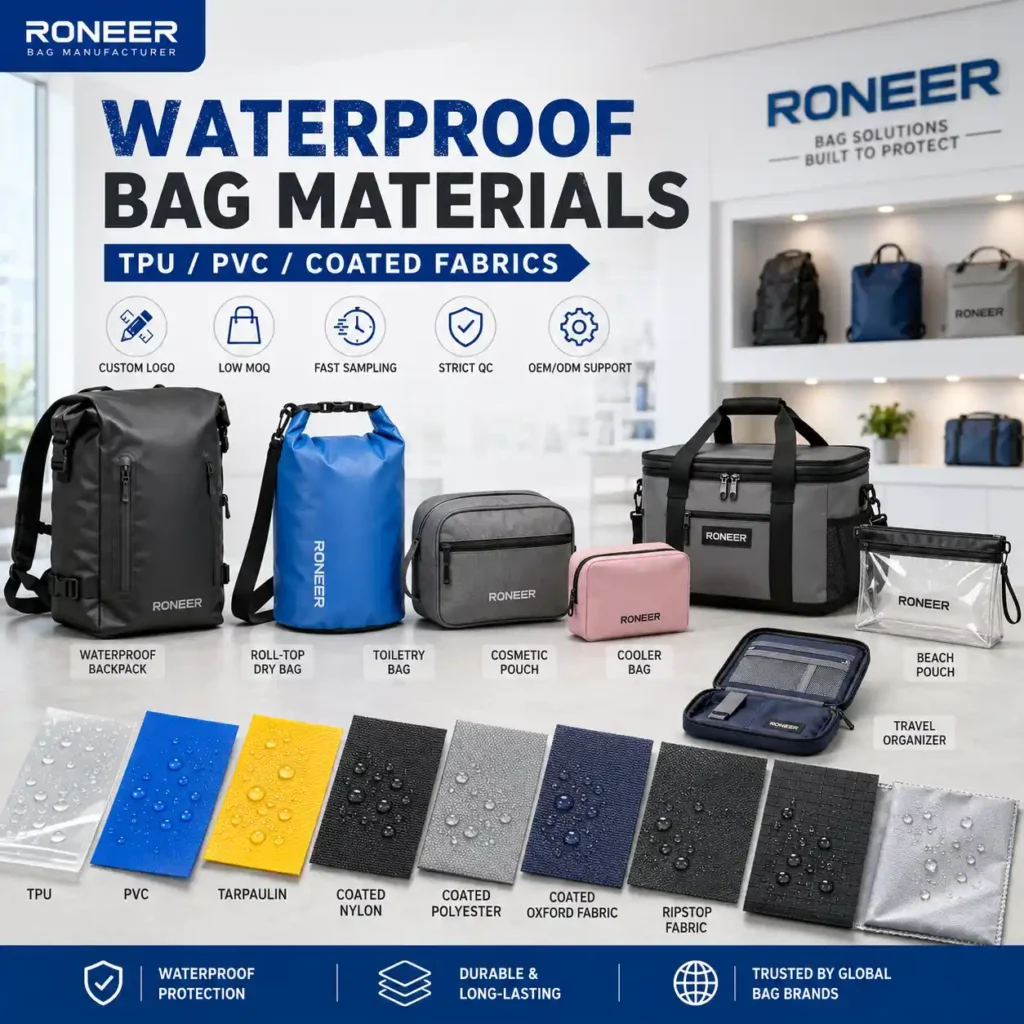
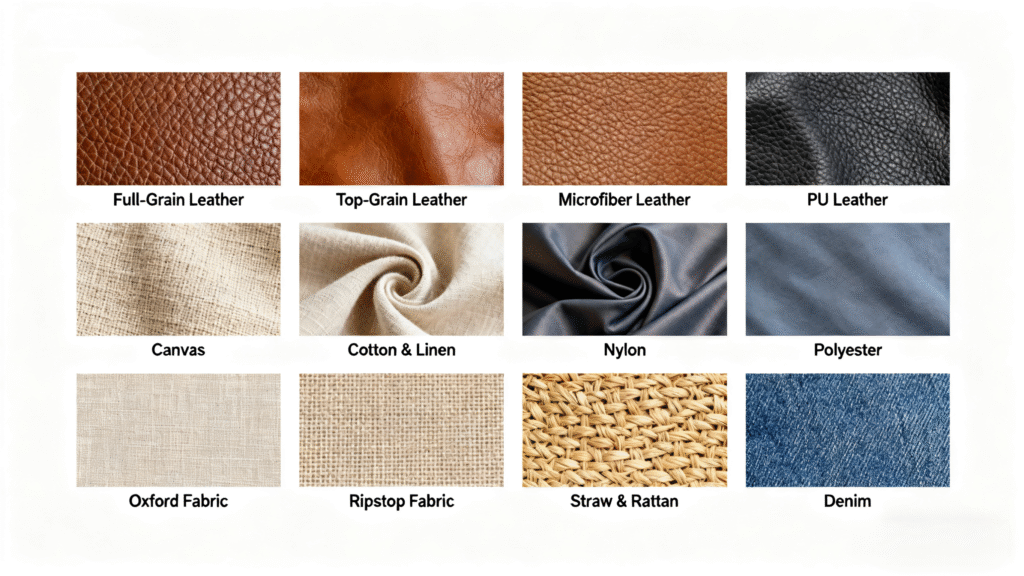
Available materials make small batch bag production easier. Standard polyester, nylon, canvas, cotton, PU leather, microfiber, and available linings can usually support more flexible production. Custom-dyed materials, exclusive colors, special textures, or imported fabrics may require higher supplier minimums.
Buyers can review RONEER’s personalizzazione dei materiali service to understand how material choices affect MOQ, sample development, cost, and lead time. For recycled or preferred materials, Scambio di tessuti can be used as a general industry reference. Actual material claims should always be confirmed with supplier documentation before marketing use.
2. Logo Method
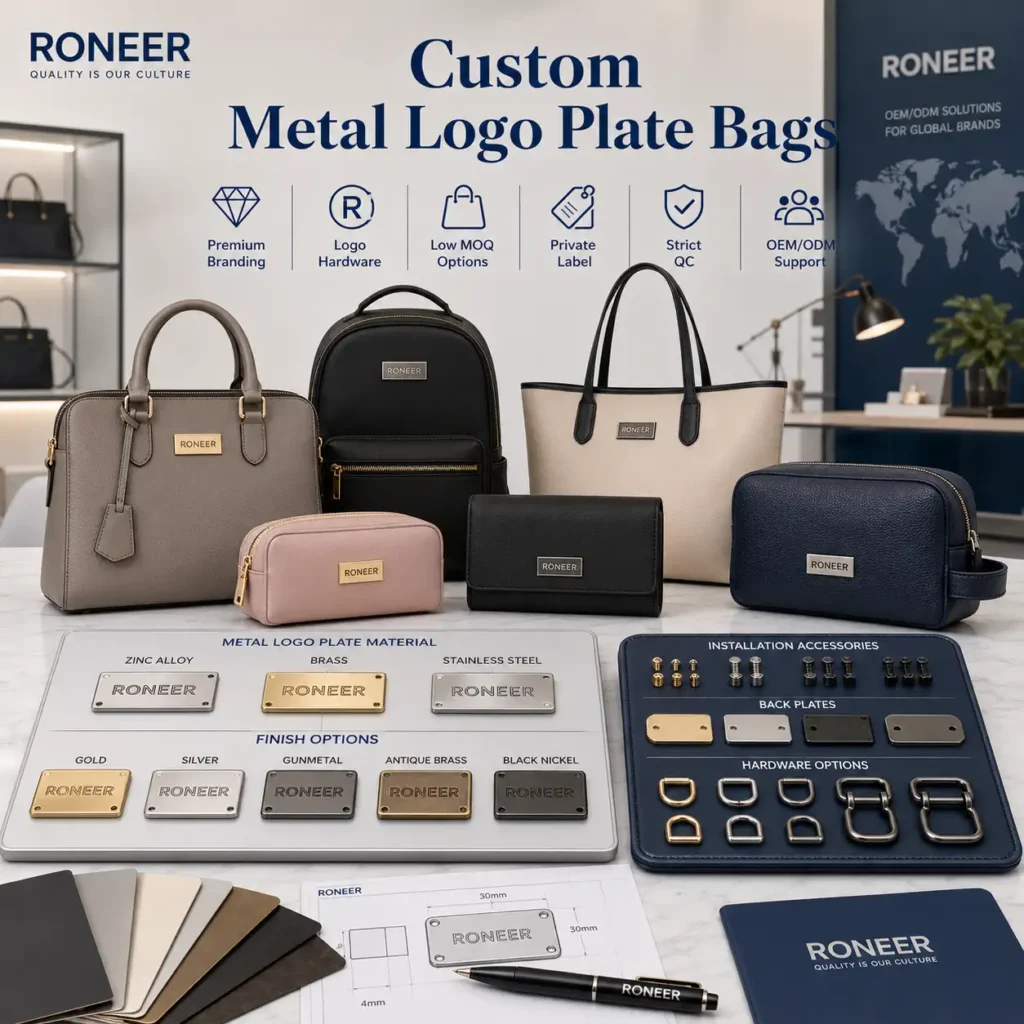
Logo customization is usually possible in small batches, but the method matters. Screen printing, heat transfer, embroidery, woven labels, PU patches, and rubber patches may be suitable depending on the material and quantity. Metal logo plates, custom molded parts, and custom zipper pullers may require higher setup cost or supplier minimums.
Buyers can review RONEER’s personalizzazione del logo options before confirming the sample. The right logo method should balance brand presentation, cost, MOQ, and production feasibility.
3. Bag Structure
Simple structures are easier for small batch production. Extra pockets, padding, lining, laptop compartments, mesh panels, hidden zippers, reinforced handles, and complex shapes increase labor and production time.
4. Hardware Selection
Standard zippers, sliders, buckles, hooks, D-rings, and pullers are usually easier for small batch orders. Custom hardware may look premium but can increase cost and minimum requirements.
Industry suppliers such as YKK can be used as a general reference for zipper and fastening component categories, but buyers should confirm actual zipper brand, specification, and cost during order negotiation. RONEER does not assume premium components unless the buyer requests and approves them.
5. Color Quantity
One style in one or two colors is easier to manage than one style in many colors. Buyers who want smoother small batch bag production should limit colorways in the first order.
6. Packaging Requirement
Simple packaging can help control cost and lead time. Custom boxes, dust bags, insert cards, hang tags, barcode labels, paper sleeves, and printed polybags may increase supplier preparation time.
RONEER’s personalizzazione degli imballaggi service can help buyers choose practical packaging for small batch orders while keeping the product private label ready.
7. Quality Control
Even small batch orders need clear QC. Material color, stitching, logo position, zipper function, hardware strength, lining cleanliness, and packaging accuracy should be checked before shipment.
For inspection and testing background, buyers can refer to SGS. For material safety and harmful substance testing background, OEKO-TEX can also be used as an industry reference. Buyers should confirm any specific testing, certification, or compliance requirement before placing the order.
How to Make Small Batch Bag Production Cost-Effective
Small batch orders often have higher unit costs than large bulk orders because setup, sampling, material preparation, and labor planning are spread across fewer units. However, buyers can still control costs with smart planning.
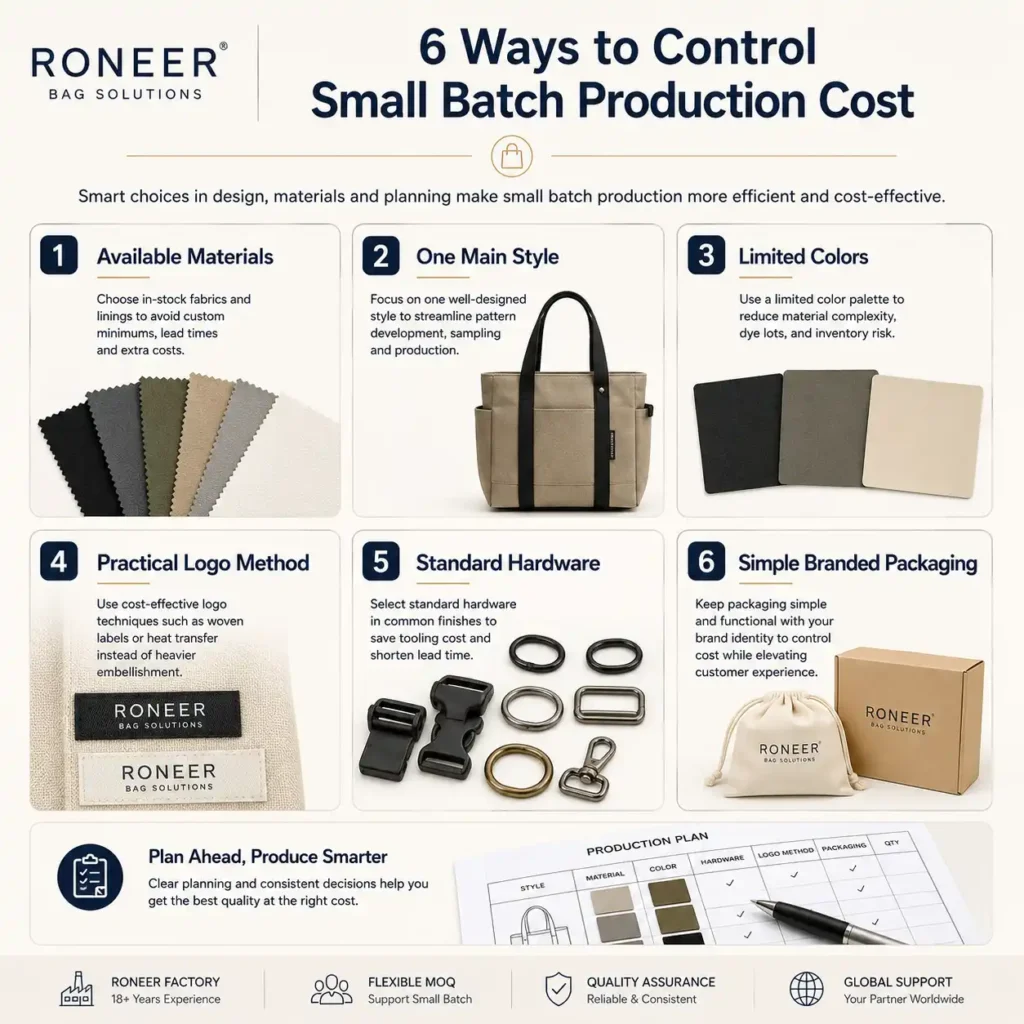
Use Available Materials
Available materials reduce sourcing time, MOQ pressure, and sample cost. Buyers can still create differentiation through logo placement, color matching, structure details, and packaging.
Start With One Main Style
Instead of producing many styles at once, buyers can start with one strong design and test the market. After sales data is clear, more styles can be added.
Limit Colorways
Too many colors increase material preparation and production tracking. One classic color and one seasonal color are often enough for a first order.
Choose Practical Logo Methods
For small batch orders, simple and clean logo methods are often better than expensive molds. Screen printing, heat transfer, embroidery, woven labels, or patches can create a professional brand look.
Avoid Custom Hardware at the First Stage
Custom hardware can be added later after the product is proven. Standard hardware keeps the first production more efficient.
Keep Packaging Simple but Branded
A hang tag, barcode label, insert card, or branded polybag may be enough for early market testing. Premium packaging can be upgraded later.
Plan for Repeat Orders
A good small batch should be designed with future scaling in mind. Buyers should choose materials and logo methods that can be repeated consistently in bulk production.
Buyers who want to understand MOQ and cost planning more deeply can review RONEER’s guide on custom backpack MOQ cost planning. Although the article uses backpacks as an example, many principles also apply to tote bags, handbags, cosmetic bags, travel bags, and other custom bag categories.
Small Batch Bag Production for Startups
Startups often benefit from small batch bag production because they need flexibility and controlled investment. A new brand may not know which color, size, material, or style will sell best. Starting with a smaller production run helps reduce pressure.
Small batch production allows startups to:
- Launch faster
- Test product-market fit
- Build customer reviews
- Improve the design
- Control inventory
- Protect cash flow
- Prepare better reorder plans
- Reduce storage risk
RONEER can help startup buyers choose practical materials, suitable logo methods, reasonable packaging, and production-friendly structures. This helps the first order look professional while staying realistic for budget and MOQ.
Small Batch Bag Production for E-Commerce Sellers
E-commerce sellers often use small batch bag production to test new products before scaling. This is useful for Amazon sellers, Shopify brands, TikTok shop sellers, boutique online stores, and private label accessory brands.
For e-commerce, product details matter. Buyers should check sample quality carefully before production, including photos, function, packaging, barcode labels, and customer experience.
Important e-commerce details include:
- Product size and weight
- Packaging dimensions
- Barcode label placement
- Logo consistency
- Photography sample quality
- Customer review risk
- Reorder timing
- Shipping cost
- Return rate control
A reliable manufacturer should help e-commerce sellers balance product quality, cost, packaging, and lead time.
Small Batch Bag Production for Promotional Projects
Promotional buyers may need custom bags for events, trade shows, corporate gifts, school programs, hotel campaigns, or brand launches. In these cases, timing and logo accuracy are often more important than complex product structure.
Suitable promotional bags include tote bags, drawstring bags, pouches, cosmetic bags, travel organizers, simple backpacks, and reusable shopping bags.
For promotional projects, buyers should confirm:
- Event date
- Quantity
- Logo file
- Logo color
- Printing method
- Bag material
- Imballaggio
- Delivery schedule
- Export packing
- Quality standard
A practical small batch bag production plan can help promotional buyers meet deadlines without unnecessary over-customization.
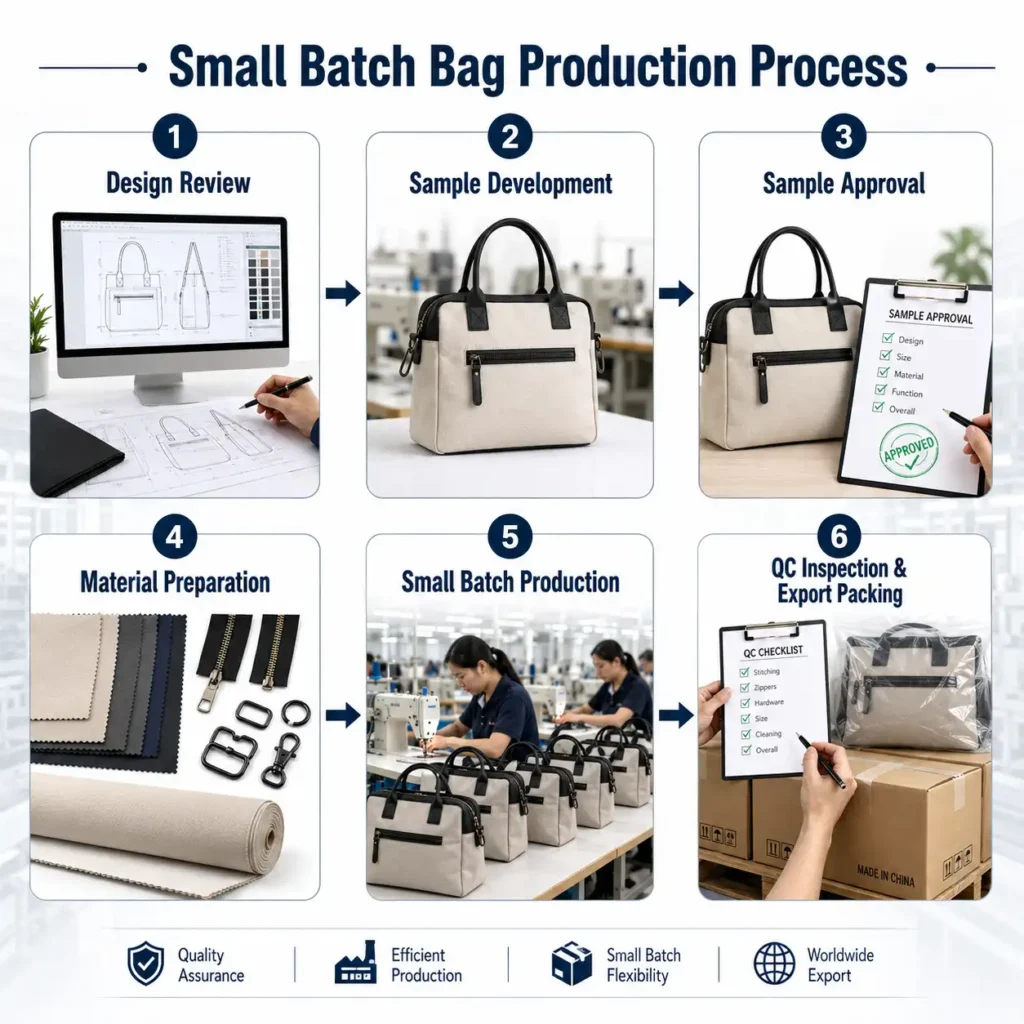
Sample Development Before Small Batch Bag Production
Sampling is important before small batch production. Even if the order quantity is not large, buyers still need to confirm the product before production starts.
A typical sample process includes:
- Buyer shares reference photos, design ideas, logo file, target size, material preference, and expected quantity.
- Factory reviews production feasibility, material availability, logo method, packaging, and cost.
- Pattern maker prepares the bag pattern.
- Sample team creates the first sample.
- Buyer checks material, size, logo, structure, stitching, zipper, hardware, and packaging.
- Factory adjusts the sample if needed.
- Final sample is approved before production.
A clear sample approval process helps reduce mistakes and ensures small batch bag production can move smoothly into finished goods.
Lead Time for Small Batch Bag Production
Lead time depends on product complexity, material availability, logo method, packaging, order quantity, and factory schedule.
Simple small batch bags using available materials and standard logo methods can usually move faster than highly customized products. Complex bags with special fabrics, custom hardware, printed lining, or premium packaging may take longer.
Buyers should consider:
- Design review time
- Sample development time
- Sample revision time
- Material preparation time
- Logo production time
- Bulk production time
- QC inspection time
- Packaging time
- Shipping time
To avoid delays, buyers should prepare complete information before quotation and confirm details early.
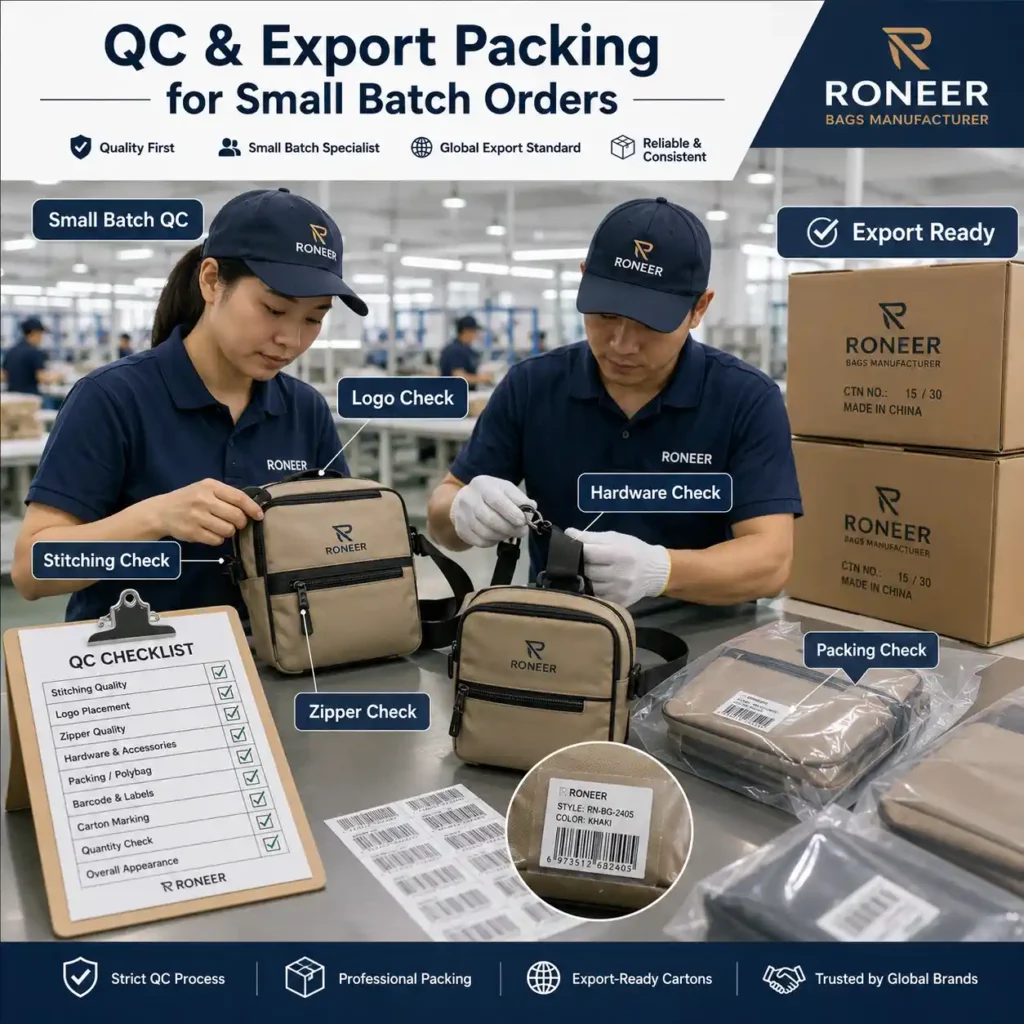
Quality Control for Small Batch Bag Production
Quality control should not be reduced because the order is smaller. A professional manufacturer should inspect small batch orders carefully because they often represent the buyer’s first market launch.
Important QC points include:
- Material color and texture
- Precisione di taglio
- Misurazione delle taglie
- Stitching quality
- Logo position and clarity
- Zipper smoothness
- Hardware function
- Lining cleanliness
- Handle strength
- Pocket function
- Packaging accuracy
- Barcode label check if required
- Export carton condition
RONEER follows QC steps during sampling, production, final inspection, and export packing to help buyers reduce risk and improve product consistency.
OEM vs ODM for Small Batch Bag Production
Buyers can choose OEM or ODM depending on their development stage.
OEM is suitable when the buyer already has a clear design, size, material, logo file, and packaging plan. The factory follows the buyer’s specifications and develops the sample accordingly.
ODM is suitable when the buyer needs factory support with design direction, material selection, structure planning, and sample development. ODM can be useful for startups or buyers who want to launch faster.
Buyers can review this guide on OEM and ODM bag development to better understand which model fits their project. The same logic applies to small batch bag production, especially when buyers need to balance speed, cost, MOQ, and product uniqueness.
How to Choose a Small Batch Bag Manufacturer
Choosing the right manufacturer is important. A supplier that accepts small orders but cannot manage communication, sampling, QC, packaging, or delivery may create problems.
A reliable small batch bag manufacturer should be able to:
- Explain MOQ clearly
- Suggest available materials
- Recommend practical logo methods
- Support sample development
- Control production details
- Provide private label packaging options
- Inspect finished goods
- Prepare export packing
- Communicate clearly with overseas buyers
- Support repeat orders and future bulk production
RONEER works with buyers who need small batch bag production with OEM/ODM service, low MOQ options, fast sampling, custom logo solutions, material customization, private label packaging, strict QC, stable production, export packing, and global shipping coordination.
FAQ About Small Batch Bag Production
1. What is small batch bag production?
Small batch bag production means producing customized bags in smaller quantities than traditional bulk manufacturing. It is suitable for startups, private label brands, e-commerce sellers, retailers, wholesalers, promotional buyers, and corporate gift projects.
2. Is small batch bag production suitable for startups?
Yes. Small batch bag production is very suitable for startups because it reduces inventory risk, protects cash flow, and allows the brand to test product style, color, material, logo, packaging, and customer response before larger orders.
3. What bag types can be produced in small batches?
Tote bags, cosmetic bags, toiletry bags, pouches, drawstring bags, simple backpacks, wallets, card holders, and promotional bags are often suitable for small batch production. More complex handbags, travel bags, and backpacks may need more careful planning.
4. Can I add a custom logo to small batch bags?
Yes. A professional manufacturer can support custom logo options for small batch bag production, including screen printing, heat transfer, embroidery, woven labels, rubber patches, PU patches, hang tags, and packaging logos. The best method depends on material, quantity, and budget.
5. Is small batch bag production more expensive per unit?
Usually, yes. Smaller orders often have higher unit costs because setup, sampling, material preparation, and labor planning are spread across fewer pieces. However, small batch production can still be cost-effective because it reduces inventory risk.
6. How can I reduce the cost of small batch bag production?
Buyers can reduce cost by using available materials, limiting colorways, choosing practical logo methods, simplifying structure, using standard hardware, and keeping packaging simple. RONEER can suggest practical options based on the buyer’s budget and target market.
7. Can small batch production be upgraded to bulk production later?
Yes. A good small batch bag production project should be designed with future scaling in mind. After the product performs well, buyers can increase quantity, add colors, upgrade materials, or improve packaging in repeat orders.
8. Do I need a sample before small batch bag production?
Yes. A sample is recommended before production. It helps confirm material, size, structure, logo, stitching, zipper, hardware, packaging, and production feasibility before finished goods are made.
9. How long does small batch bag production take?
Lead time depends on design complexity, material availability, logo method, packaging, order quantity, QC requirements, and shipping method. Simple bags using available materials can usually move faster than highly customized bags.
10. Can RONEER support private label packaging for small batch orders?
Yes. RONEER can support private label packaging such as hang tags, barcode labels, insert cards, polybags, dust bags, paper sleeves, gift boxes, and export cartons. Packaging should be confirmed early to control cost and lead time.
11. What quality checks are needed for small batch bag production?
Important QC checks include material color, cutting accuracy, stitching, logo placement, zipper function, hardware strength, lining cleanliness, size measurement, packaging accuracy, and export carton condition.
12. Why choose RONEER for small batch bag production?
RONEER supports small batch bag production with OEM/ODM development, low MOQ options, fast sampling, custom logo solutions, material customization, private label packaging, strict QC, stable bulk production, export packing, and global shipping coordination.
Conclusione
Small batch bag production is a practical solution for buyers who want to launch custom bags with lower inventory risk and more flexibility. It allows startups, e-commerce sellers, private label brands, retailers, wholesalers, promotional buyers, and corporate gift buyers to test product ideas before committing to larger orders.
A successful small batch bag production project requires more than a low MOQ. Buyers need to choose practical materials, suitable logo methods, production-friendly structures, clear packaging, and a reliable QC process. The goal is to create a product that is brand-ready, cost-controlled, and suitable for future repeat production.
RONEER works as a practical manufacturing partner for buyers who need small batch bag production with OEM/ODM support, fast sampling, low MOQ options, custom logo solutions, material customization, private label packaging, durable materials, stable production, strict QC, export carton packing, and global shipping experience.
Whether you are developing tote bags, backpacks, handbags, cosmetic bags, toiletry bags, travel bags, wallets, pouches, drawstring bags, or promotional bags, RONEER can help you start with small batch bag production, test the market, reduce sourcing risk, and prepare your product line for long-term growth.