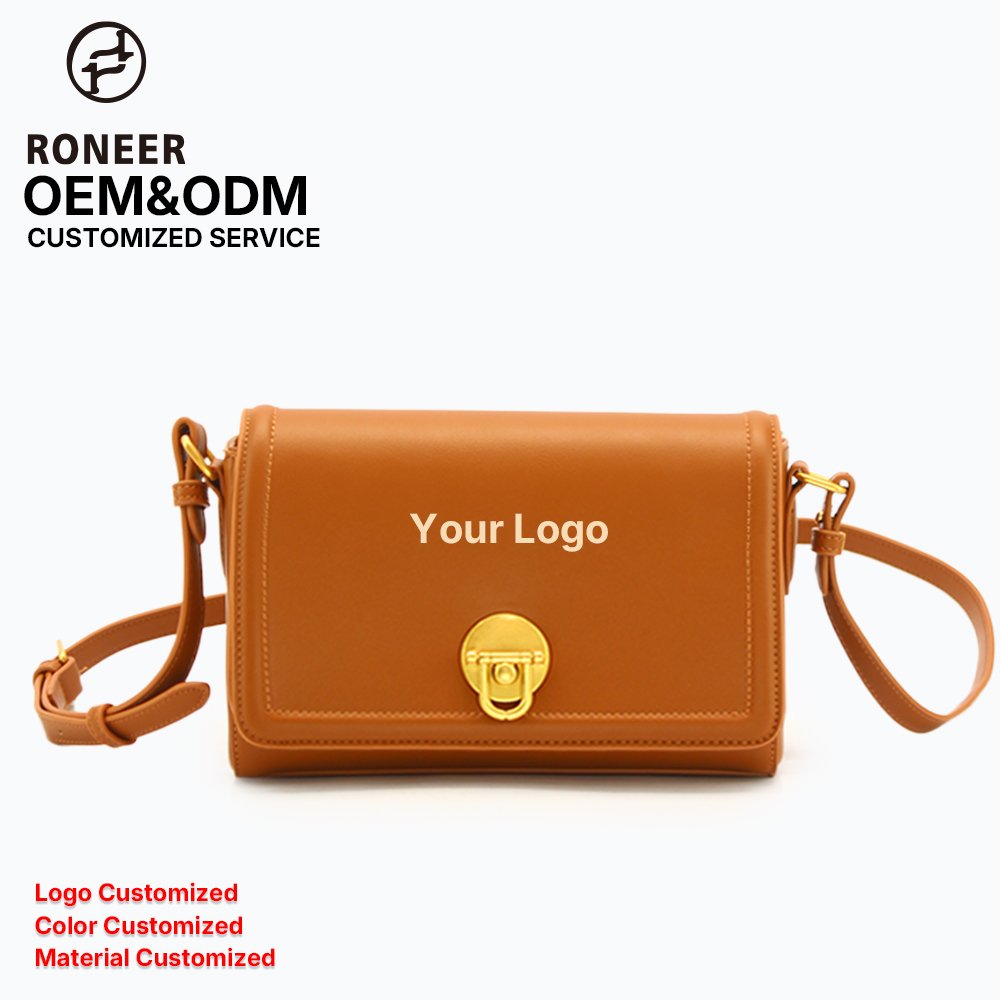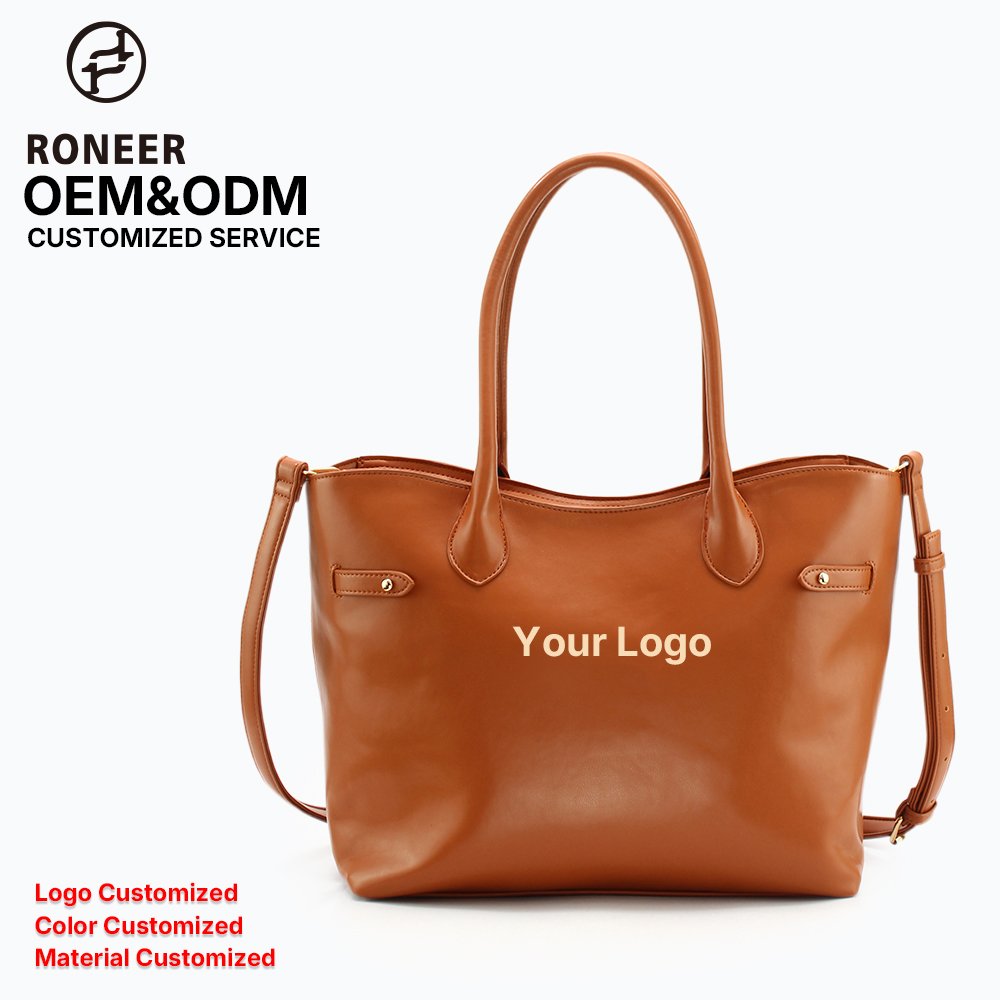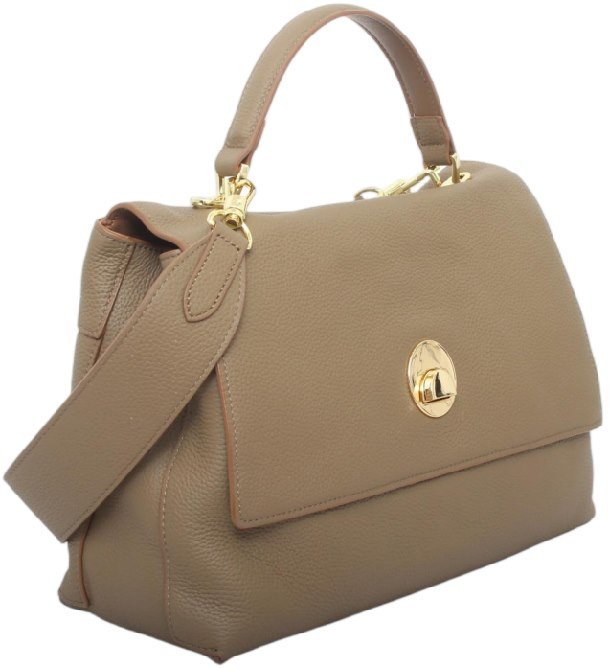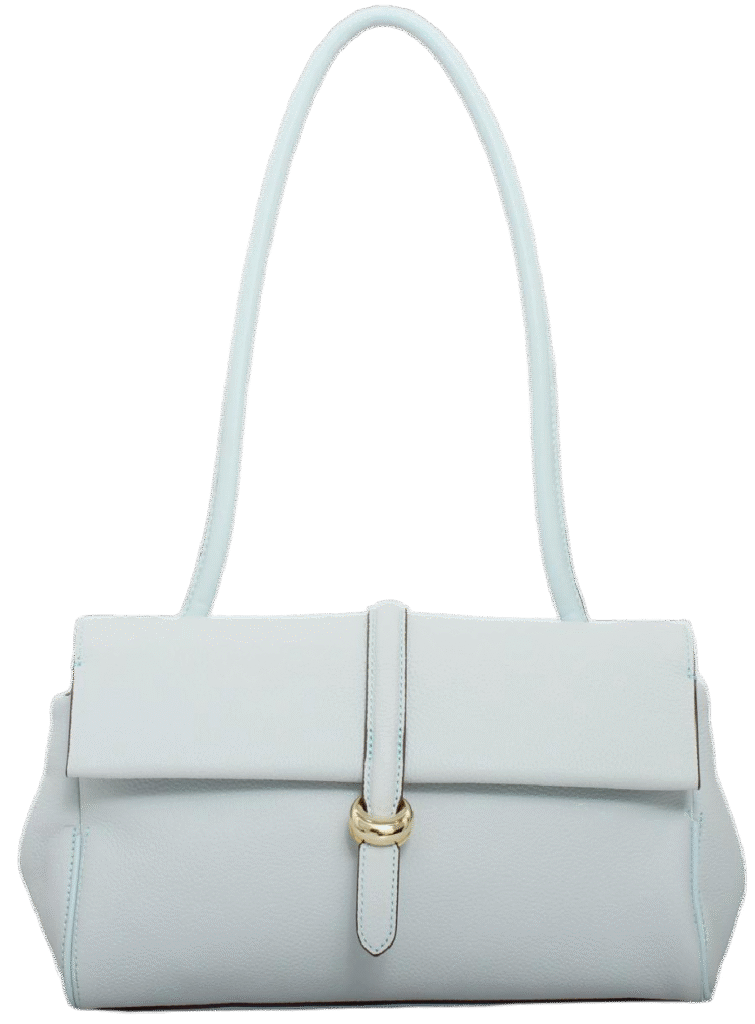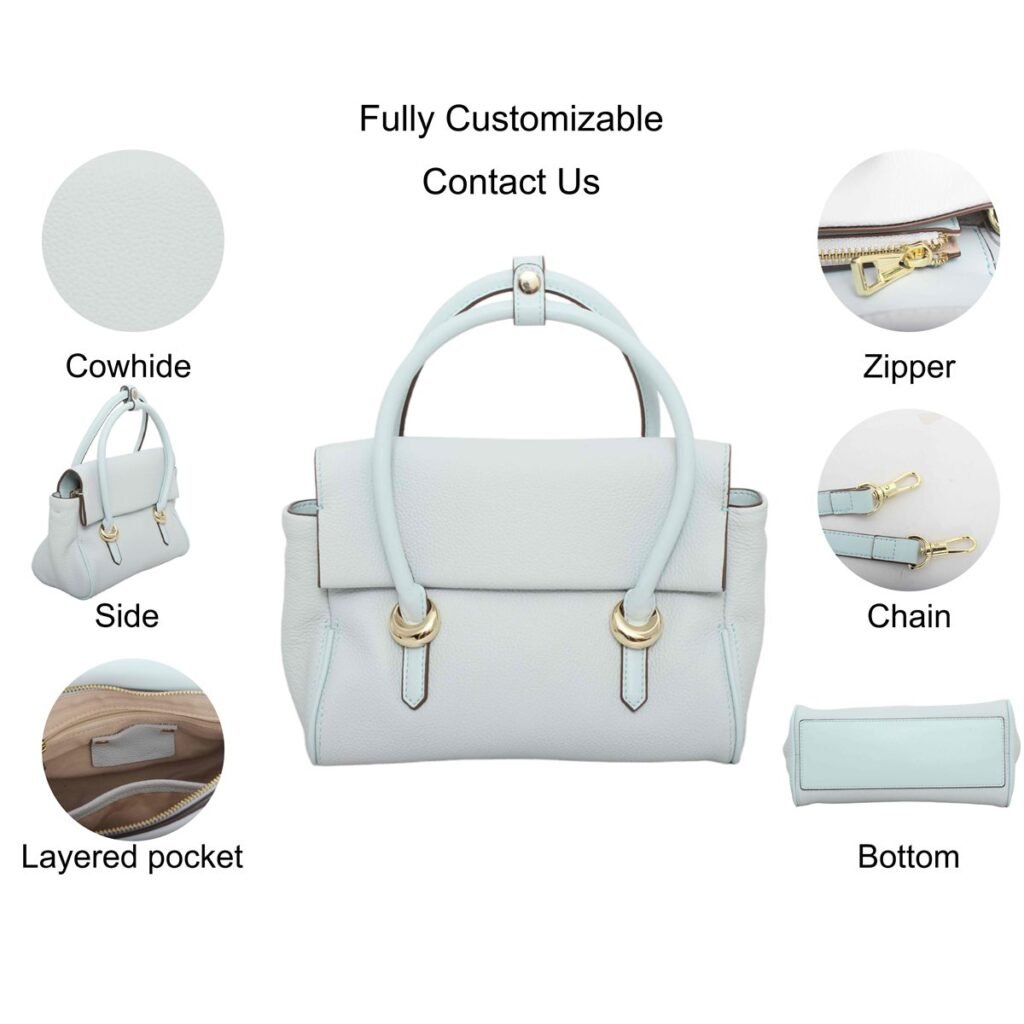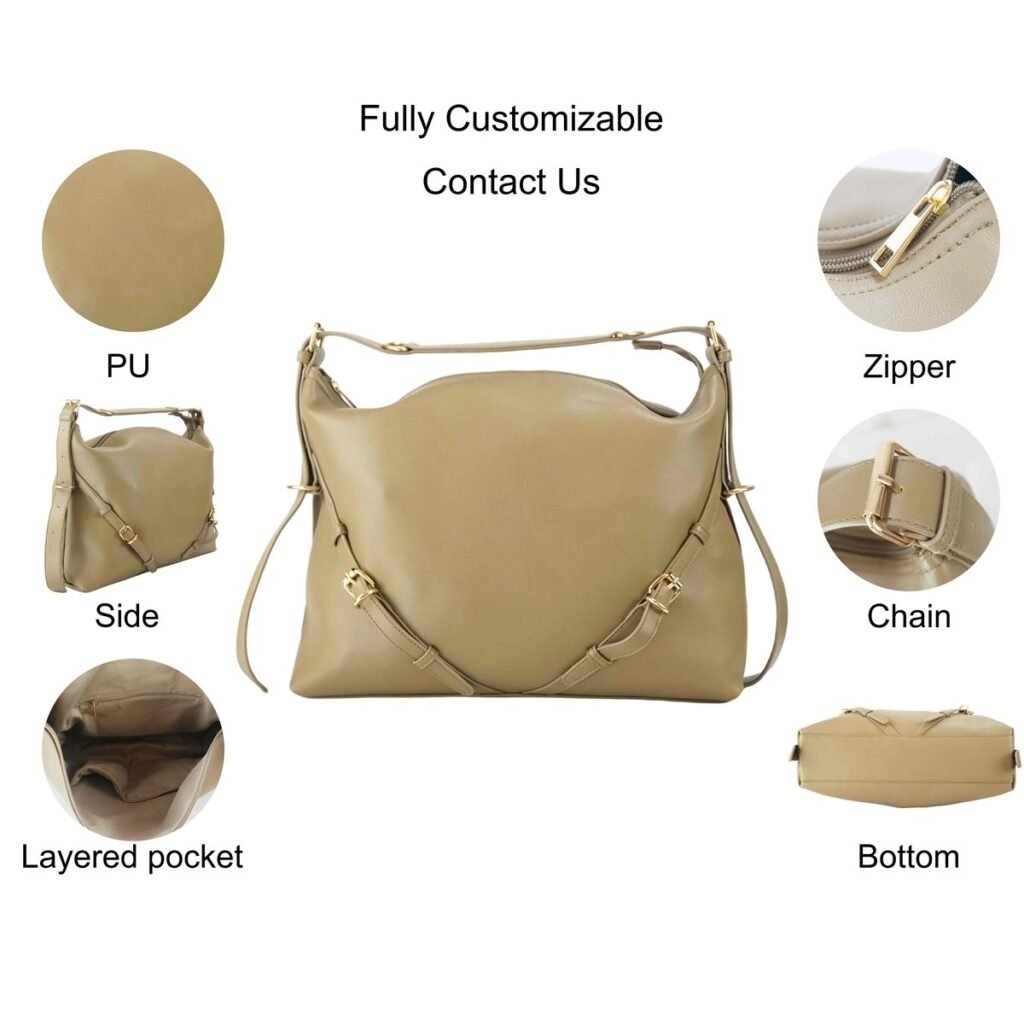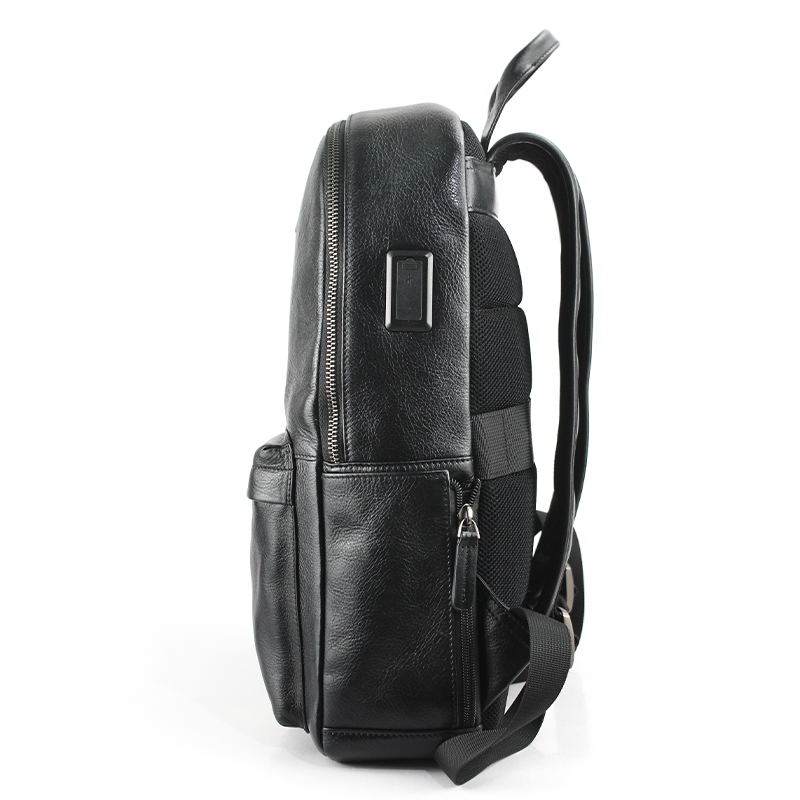










A leather handbag sample can look excellent while hiding serious bulk-production risks.
The sample room may select the cleanest section of a hide, spend additional time on edge paint, carefully match the grain, and correct the shape by hand. During bulk production, the same design may show inconsistent shade, visible scars, uneven thickness, weak reinforcement, heavy hardware, distorted panels, or edge finishing that differs from the approved sample.
A professional custom leather handbag manufacturer must therefore control more than sewing. The supplier needs to understand leather selection, cutting yield, thickness, temper, skiving, reinforcement, pattern engineering, hardware weight, edge finishing, lining, packaging, and repeat production.
Brands should not select a custom leather handbag manufacturer only because the supplier displays attractive leather bags online. The factory must demonstrate that it can interpret the product specification, explain natural material variation, develop an accurate physical sample, document the approved standard, and reproduce that standard during bulk production.
This guide explains 11 checks for evaluating a custom leather handbag manufacturer. It is written for fashion brands, private label companies, boutiques, wholesalers, designers, retailers, e-commerce sellers, and established businesses developing leather totes, shoulder bags, crossbody bags, top-handle bags, wallets, and coordinated leather goods.
RONEER develops custom leather handbag projects through material review, pattern development, sample coordination, hardware, Logo application, lining, packaging, production communication, and quality preparation. Every buyer should still verify that the proposed leather, MOQ, price, sample, quality standard, and production schedule match the individual project.
Índice
Toggle1. Define the Leather Handbag Before Requesting a Quote
The first job of a custom leather handbag manufacturer is not to provide the lowest price. It is to understand what the buyer wants to produce.
“High-quality genuine leather handbag” is not a complete production specification.
A practical product brief should include:
- Handbag category
- Target customer
- Use scenario
- Finished dimensions
- Desired structure
- Exterior material
- Forro
- Compartimentos
- Cierre
- Handles and straps
- Acabado del hardware
- Método del logotipo
- Number of colors
- Target quantity
- Embalaje
- Destination market
- Expected retail position
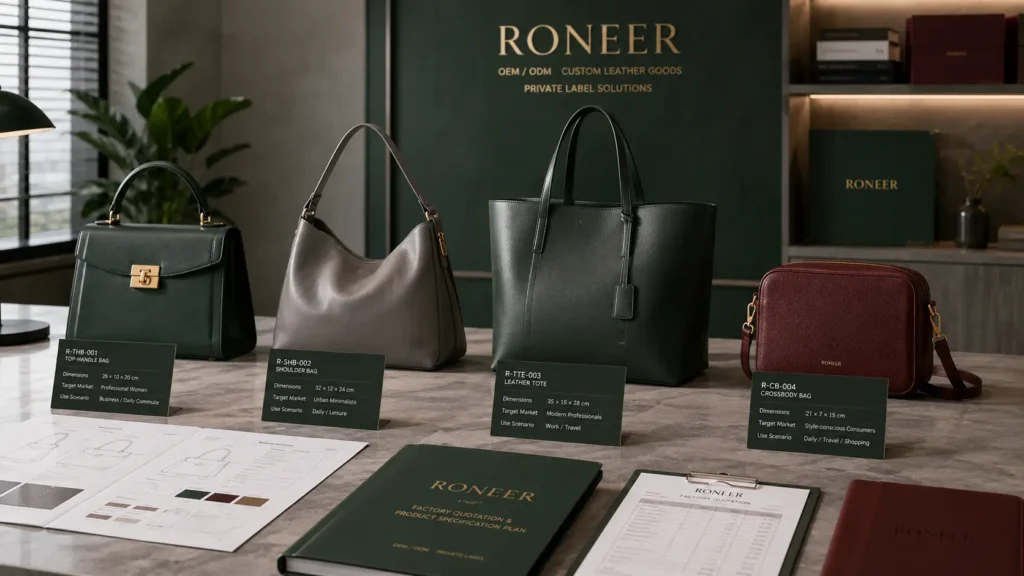
A structured top-handle bag may need reinforced panels, controlled skiving, stable handle bases, edge paint, bottom feet, and carefully balanced hardware.
A soft shoulder bag may depend more on leather drape, softness, grain, weight, lining attachment, and strap comfort.
These products require different patterns, materials, preparation methods, machinery, and quality checks. A custom leather handbag manufacturer should review the construction before confirming feasibility or price.
Brands with original designs should prepare a handbag tech pack showing drawings, dimensions, materials, hardware, Logo placement, internal layout, packaging, and tolerances.
2. Specify the Leather Instead of Using General Descriptions
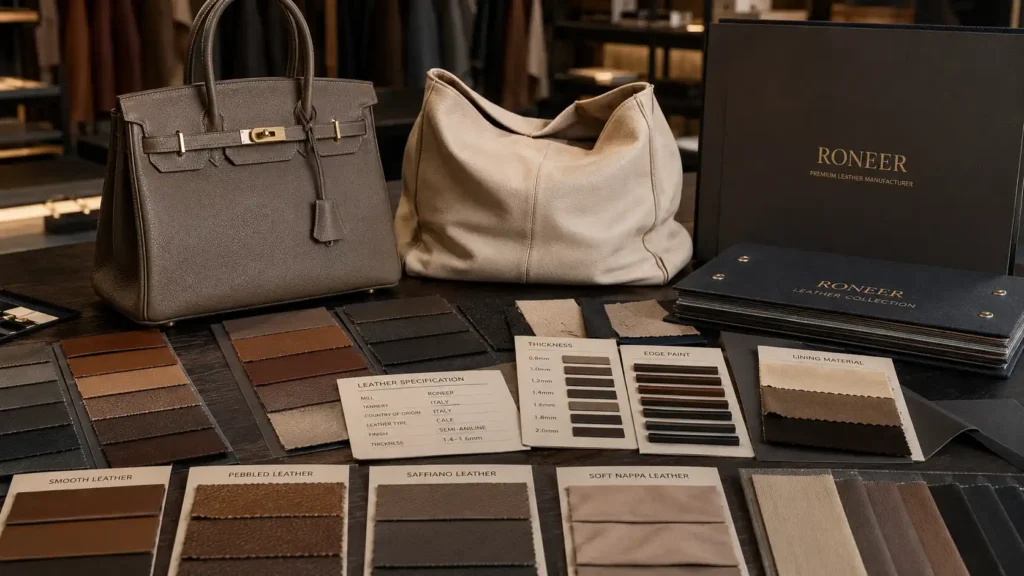
The word leather does not provide enough information for an accurate quotation.
A factory needs to understand:
- Animal source, where relevant
- Leather type
- Surface finish
- Grain direction
- Espesor
- Softness or firmness
- Color
- Backing
- Stretch
- Gloss level
- Intended panel use
- Approved physical reference
The same handbag design can look and perform differently when produced with leather of a different thickness, temper, finish, grain, or backing.
A custom leather handbag manufacturer should provide physical swatches or material cards whenever possible. Digital photographs can help with initial selection, but they cannot fully communicate hand feel, softness, thickness, smell, grain depth, stretch, or structural support.
The approved leather reference should record:
- Supplier or material code
- Color reference
- Thickness range
- Finish
- Approval date
- Approved project
- Expected variation
- Reorder availability
Buyers can review RONEER’s material customization options when preparing leather and alternative-material requirements.
Material descriptions used in marketing must also be accurate. The U.S. Federal Trade Commission’s Leather Guides address misleading representations concerning leather and imitation-leather products and explain that non-leather content should be disclosed when a material appears to be leather but is not.
A custom leather handbag manufacturer can help identify the production material, but the brand remains responsible for approving accurate product descriptions.
3. Match the Factory to the Handbag Construction
Not every leather-goods supplier is equally suitable for every handbag structure.
A workshop focused on soft wallets and pouches may not be the best partner for a rigid top-handle bag. A factory experienced in large leather totes may not automatically have the pattern-making or edge-finishing experience needed for a compact luxury-style handbag.
Ask the custom leather handbag manufacturer to show unbranded products comparable to:
- Leather thickness
- Forma
- Panel construction
- Handle attachment
- Gusset
- Cierre
- Edge finish
- Hardware
- Reinforcement
- Interior organization
Comparable products are more useful than a large catalog containing unrelated bags.
Ask these questions:
- Which leather handbag categories represent most of your production?
- Is pattern development completed internally?
- Is skiving completed in-house?
- Which edge-finishing methods are regularly used?
- Which processes are subcontracted?
- Is the sample room located with bulk production?
- How are leather shades grouped?
- How are visible natural marks handled?
- Can the same leather be sourced for reorders?
A capable custom leather handbag manufacturer should identify construction risks before sampling, instead of promising that every request is easy.
4. Review Leather Sourcing and Traceability Requirements
Leather sourcing affects appearance, consistency, cost, lead time, claims, and repeat-order availability.
Before confirming a material, ask:
- Is the leather normally stocked?
- Is it purchased specifically for the project?
- Does it require a custom color?
- Can the same article be repeated?
- What documentation is available?
- Can the tannery or trader be identified?
- Does the buyer require a particular sourcing standard?
- What happens if the leather is discontinued?
Some buyers request leather connected to Leather Working Group-assessed suppliers. LWG operates several standards for actors in the leather supply chain, and its certification information treats traceability separately from environmental performance. Buyers should verify the specific supplier, audit scope, validity, and traceability information rather than assuming that any leather is automatically LWG-certified. Review Leather Working Group certification information.
A custom leather handbag manufacturer should never claim that a project uses certified leather unless current documentation can be connected to the relevant supplier and material.
Certification requirements should be raised before sampling because they can change available suppliers, colors, thicknesses, MOQ, pricing, and lead time.
5. Understand Leather MOQ and Cutting Yield
Leather handbag MOQ is influenced by more than the number of completed bags.
The project may contain separate minimums for:
- Leather article
- Custom color
- Forro
- Hardware
- Zippers
- Logo tooling
- Edge paint
- Dust bags
- Boxes
- Reorders
Natural leather also requires cutting decisions that differ from uniform synthetic sheet materials. The cutting team may need to avoid or strategically place visible marks, control grain direction, match paired panels, and group shade variation.
A custom leather handbag manufacturer should consider the usable cutting yield rather than calculating material only from the finished surface area.
Ask whether the quotation includes:
- Expected cutting loss
- Shade grouping
- Paired-panel matching
- Extra material for replacements
- Unused leather ownership
- Storage of the remaining material
- Reorder conditions
A low finished-product MOQ can still require the buyer to purchase more leather than the immediate order consumes.
The manufacturer should explain whether unused leather can be stored, how it will be identified, how long it can be retained, and whether storage conditions may affect future use.
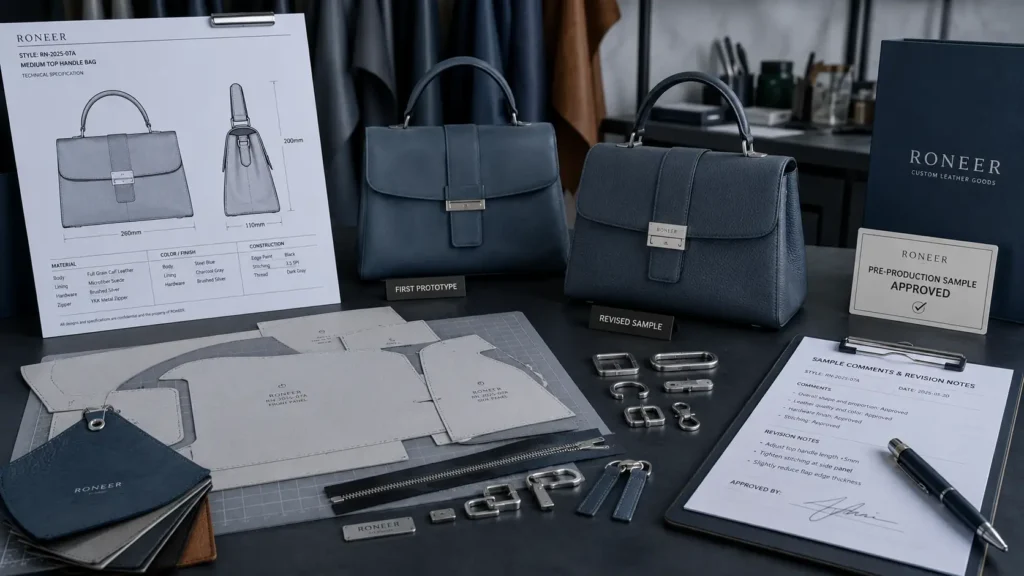
6. Use Sampling to Test Leather Craftsmanship
Sampling is one of the strongest tests of a custom leather handbag manufacturer.
A physical sample tests whether the supplier can:
- Interpret the tech pack
- Select an appropriate leather section
- Control thickness
- Skive edges correctly
- Develop the pattern
- Reinforce stress points
- Attach handles securely
- Install hardware accurately
- Apply edge paint evenly
- Control Logo placement
- Construct the lining
- Preserve the intended shape
Before paying the sample fee, confirm:
- Sample cost
- Disponibilidad de material
- Estimated timeline
- Number of revision rounds
- Custom hardware timing
- Logo tooling
- Shipping responsibility
- Pattern ownership
- Mold ownership
- Sample-fee credit policy
Check the physical sample for:
- Width, height, and depth
- Shape and symmetry
- Leather feel
- Surface character
- Shade
- Peso
- Handle comfort
- Longitud de la correa
- Pocket access
- Closure function
- Zipper movement
- Acabado del hardware
- Logo size and position
- Costura
- Reinforcement
- Edge paint
- Forro
- Embalaje
Photographs cannot fully communicate weight, hand feel, balance, softness, stiffness, grain, zipper resistance, or handle comfort.
After revisions, the custom leather handbag manufacturer should prepare or identify an approved pre-production sample. The sample should be connected to the final tech pack, material card, hardware finish, colorway, and packaging instructions.
7. Control Hardware, Branding, and Product Weight
Hardware can improve a leather handbag’s appearance, but it can also create weight, balance, MOQ, finish, and durability problems.
A hardware specification should include:
- Component name
- Dimensiones
- Base material
- Finish
- Quantity
- Position
- Attachment method
- Approved sample
- Tooling reference where applicable
The custom leather handbag manufacturer should consider how locks, chains, rings, buckles, feet, zipper pullers, and Logo plates interact with the leather thickness and reinforcement.
Heavy hardware can distort a soft flap or pull on a thin strap. A large metal Logo may appear suitable in a rendering but feel excessive on the physical handbag.
RONEER’s personalización del hardware page covers zippers, pullers, clasps, D-rings, chains, locks, metal Logos, and hardware finishes.
Branding may include:
- Embossing
- Debossing
- Foil stamping
- Metal Logo
- Etiqueta tejida
- Forro estampado
- Tirador de cremallera personalizado
- Etiqueta colgante
- Bolsa para el polvo
- Packaging mark
En Logo customization guide explains common application options.
A custom leather handbag manufacturer should recommend a Logo method that suits the leather finish, quantity, brand position, and expected use instead of automatically selecting the most expensive process.
8. Compare Complete Quotations
A leather handbag quotation should identify its assumptions.
Two factories may offer different prices because they are using different:
- Leather types
- Thicknesses
- Cutting allowances
- Forro
- Reinforcement
- Hardware
- Zippers
- Edge-finishing processes
- Logo methods
- Embalaje
- Inspection standards
A custom leather handbag manufacturer should separate:
- Sample fee
- Pattern fee
- Coste de los materiales
- Hardware tooling
- Logo tooling
- Unit price
- Coste del embalaje
- Testing cost
- Inspection cost
- Condiciones de envío
- Payment terms
Do not compare unit prices until the specifications are aligned.
A lower price may reflect thinner leather, simpler reinforcement, standard hardware, fewer edge-paint operations, basic lining, or less protective packaging.
The quotation should also state:
- Quantity assumption
- Number of colors
- Price-validity period
- Included packaging
- Trade term
- Sample status
- Production lead-time assumption
- Excluded costs
The most suitable custom leather handbag manufacturer is not always the factory with the lowest unit price. It is the factory whose quotation reflects the approved design and provides a workable path to repeat production.
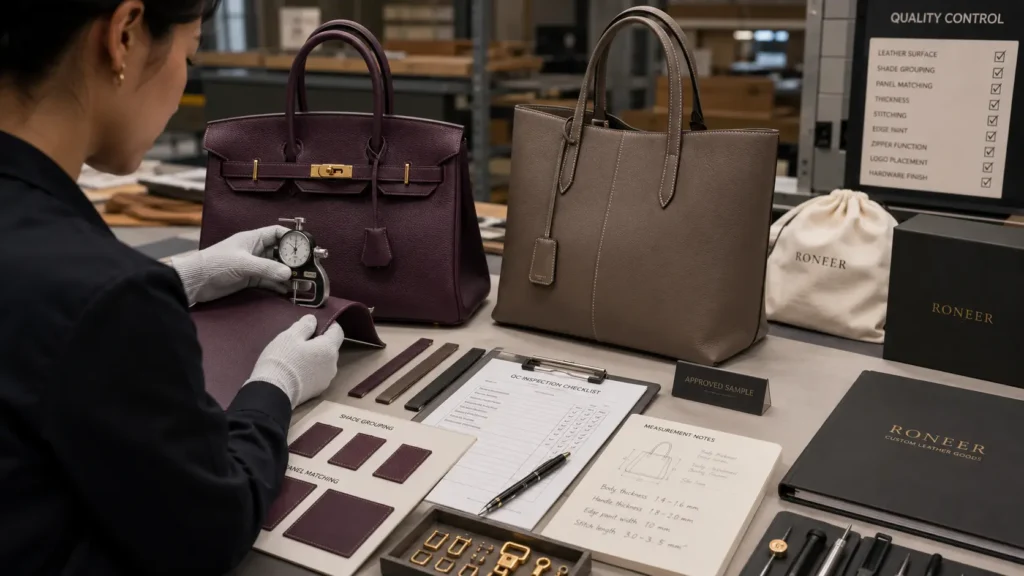
9. Define Leather Quality Control Before Production
“Natural leather variation” should not become an excuse for uncontrolled production.
The buyer and custom leather handbag manufacturer should define what variation is acceptable.
Inspection may include:
- Leather article and color
- Surface appearance
- Shade grouping
- Panel matching
- Espesor
- Grain direction
- Visible marks
- Cutting placement
- Dimensiones
- Forma
- Costura
- Seam strength
- Handle attachment
- Edge paint
- Acabado del hardware
- Función de cremallera
- Ubicación del logotipo
- Lining cleanliness
- Embalaje
The approved material card and pre-production sample should provide the reference.
For some designs, natural marks may be acceptable on the back or base but not on the front flap. Paired handles may need closer shade matching than internal reinforcement pieces.
These expectations should be recorded before cutting begins.
SGS provides bag and accessory services involving materials, components, performance, inspection, and regulatory requirements. The required testing plan depends on the leather, other components, claims, destination market,t and buyer specifications. Review SGS Bags and Accessories services.
Using an independent testing or inspection company does not remove the need for an approved specification and physical sample.
10. Prepare Compliance, Labeling, and Packaging
Testing and labeling requirements depend on the material, components, destination, intended use, and sales channel.
For leather articles entering the European market, relevant REACH restrictions may need to be considered. EU rules restrict chromium VI in leather articles or leather parts that come into contact with skin at concentrations equal to or above the regulatory threshold. Buyers should determine the appropriate test plan for the specific handbag and market.
A custom leather handbag manufacturer may help prepare material samples or finished products for testing, but the buyer should define:
- Mercado destinatario
- Applicable retailer requirements
- Material claims
- Required substances
- Testing stage
- Testing laboratory
- Pass criteria
- Report ownership
Imported products may also require country-of-origin marking. U.S. Customs and Border Protection states that foreign-origin articles entering the United States generally must be legibly marked with the English name of the country of origin unless an exception applies. Review CBP country-of-origin guidance.
Packaging may include:
- Shape support
- Papel de seda
- Protección de hardware
- Bolsa para el polvo
- Care card
- Etiqueta colgante
- Barcode label
- Polybag
- Gift box
- Inner carton
- Master carton
- Marca del cartón
RONEER’s personalización del embalaje page explains common private-label and export-packing options.
Packaging should be approved after the final handbag dimensions, handle position, shape support, and protection requirements are confirmed.
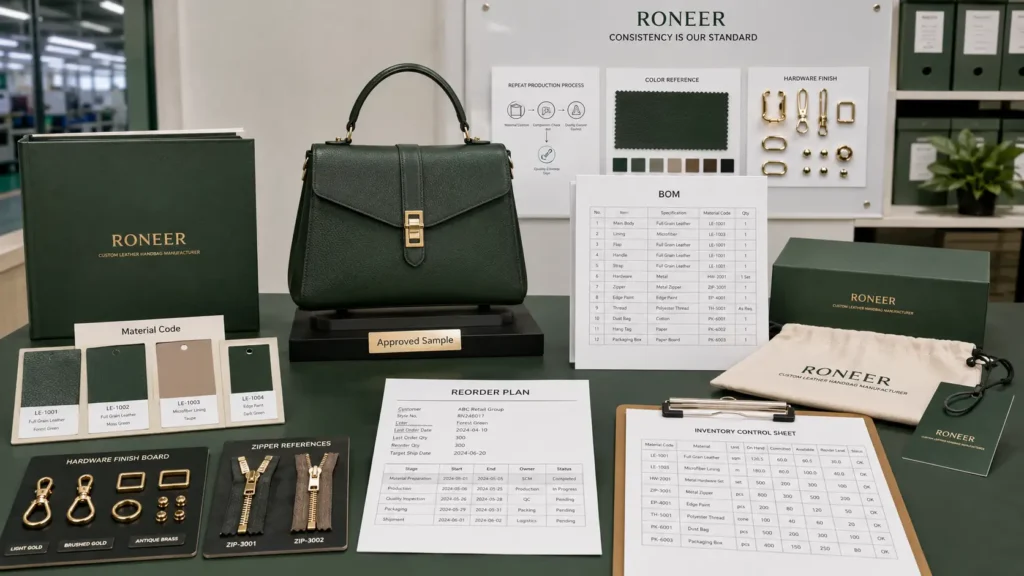
11. Protect Repeat-Order Consistency
A successful first order is only valuable when the same handbag can be reproduced.
Before bulk production, the custom leather handbag manufacturer should retain controlled records of:
- Final pattern
- Tech pack version
- Leather code
- Color reference
- Espesor
- Approved material card
- Forro
- Reinforcement
- Hilo
- Cremallera
- Acabado del hardware
- Edge paint
- Logo dimensions
- Embalaje
- Quality tolerances
Ask before the first order:
- Will the leather remain available?
- Can unused leather be reserved?
- What is the storage period?
- What is the reorder MOQ?
- Could the leather color vary by batch?
- Can the same hardware finish be repeated?
- Will the original patterns be retained?
- How will sample revisions be transferred?
- What production notice is required?
- Will reorder pricing change?
A custom leather handbag manufacturer should identify discontinued materials or unavoidable changes before beginning a reorder.
When a replacement is necessary, the buyer should approve a new swatch or sample rather than relying on the statement that the material is “almost the same.”
Repeat production should use the approved specification as the starting point, while customer feedback, returns, defects, and packaging problems are documented for controlled improvement.
Custom Leather Handbag Development Checklist
Before confirming production, verify:
- Product category and target customer
- Final dimensions
- Approved leather type and code
- Leather thickness and finish
- Accepted natural variation
- Lining and reinforcement
- Pattern version
- Handle and strap construction
- Hardware dimensions and finish
- Zipper specification
- Logo method and placement
- Edge-paint reference
- Approved physical sample
- Packaging specification
- Quality tolerances
- Testing requirements
- Label and origin information
- Quantity by SKU
- Reorder conditions
- Ownership of patterns and tooling
A custom leather handbag manufacturer should confirm these details before cutting bulk leather.
Red Flags When Comparing Leather Handbag Factories
Be cautious when a supplier:
- Quotes without reviewing leather specifications
- Uses “genuine leather” as the only material description
- Refuses to send physical swatches
- Cannot explain cutting or shade control
- Promises every leather color at the same MOQ
- Changes leather without approval
- Avoid making a physical sample
- Cannot define edge-finishing standards
- Gives inconsistent business or payment information
- Claims certification without project-specific evidence
- Cannot explain its final inspection
- Avoids discussing reorder availability
A professional custom leather handbag manufacturer may explain that a requested leather, price, MOQ, or delivery date is not practical. A technically justified limitation is often more reliable than an immediate promise.
FAQ About a Custom Leather Handbag Manufacturer
1. What Does a Custom Leather Handbag Manufacturer Do?
A custom leather handbag manufacturer develops and produces leather handbags according to a buyer’s specifications, reference sample, drawings, or tech pack. Services may include material sourcing, patterns, samples, hardware, Logos, lining, packaging, bulk production, inspection, and repeat-order records.
2. What Information Should I Send to the Factory?
Send the handbag category, dimensions, reference images, tech pack, leather direction, lining, hardware, Logo artwork, target quantity, colors, packaging, destination market, target sample date, and expected delivery schedule.
3. Can a Custom Leather Handbag Manufacturer Develop an Original Design?
Yes. An OEM project may begin with original drawings, a tech pack, a prototype, or a detailed product concept. Original development normally requires new patterns, sample revisions, material approval, and more detailed production documentation.
4. Can I Select the Leather Color and Finish?
Yes, subject to material availability, quantity, price, and supplier minimums. The buyer should approve a physical swatch showing the leather code, color, thickness, grain, finish, and expected variation.
5. Why Does Leather Show Shade or Grain Differences?
Leather is a natural material, so visible characteristics may vary. The buyer and custom leather handbag manufacturer should define acceptable shade grouping, panel matching, surface character, and cutting placement before bulk production.
6. Does the Factory Need a Handbag Tech Pack?
A tech pack is strongly recommended for original projects. It gives the custom leather handbag manufacturer controlled information about dimensions, materials, structure, hardware, Logo placement, lining, packaging, and tolerances.
7. How Many Samples Are Required?
The number depends on product complexity and the accuracy of each sample. Sampling should continue until the physical handbag meets measurable requirements rather than stopping only to avoid additional development costs.
8. Can Custom Hardware Be Developed?
Many factories can coordinate locks, buckles, Logo plates, zipper pullers, rings, hooks, chains, and other components. Custom hardware may require molds, higher component MOQ, longer development time, and finish approval.
9. How Is Leather Handbag MOQ Calculated?
MOQ may depend on the finished style, number of colors, leather supplier minimum, lining, hardware, Logo process, packaging, and production setup. Ask for a written breakdown instead of relying on one headline quantity.
10. How Should I Compare Factory Quotations?
Compare the same leather specification, construction, lining, reinforcement, hardware, zipper, Logo, packaging, sample cost, tooling, quantity, inspection, payment terms, and shipping terms.
11. What Should Be Checked Before Shipment?
Inspection may cover leather, shade grouping, dimensions, shape, stitching, handles, straps, hardware, zippers, Logos, edge paint, lining, packaging, labels, quantity, and carton marks.
12. Can the Same Leather Be Used for Reorders?
It may be possible, but availability should be confirmed before the first order. Record the leather code and retain approved material references. Replacements should require written approval and, when necessary, a new physical sample.
13. How Does RONEER Work as a Custom Leather Handbag Manufacturer?
RONEER reviews each leather handbag project according to design, structure, material, colors, hardware, Logo, lining, packaging, quantity, market, and production schedule.
As a custom leather handbag manufacturer, RONEER may support OEM/ODM development, material selection, samples, patterns, branding, packaging, production coordination, quality communication, export packing, and repeat-order documentation.
Conclusión
A custom leather handbag manufacturer should provide more than a leather sample and a unit quotation. The factory should explain how leather selection, pattern development, cutting yield, skiving, reinforcement, hardware, edge finishing, lining, packaging, and quality control affect the completed product.
The first requirement is a clear product specification. A custom leather handbag manufacturer cannot provide a reliable quotation when the buyer has not confirmed the handbag category, dimensions, structure, leather direction, hardware, Logo, quantity, and packaging.
Leather approval is equally important. General descriptions such as genuine leather, premium leather, or Italian-style leather do not create a measurable production standard. The approved material should be connected to a code, color, thickness, finish, physical swatch, and expected variation.
Sampling should test both the design and the supplier. A capable custom leather handbag manufacturer should demonstrate that it can interpret the tech pack, control the pattern, select appropriate leather sections, manage thickness, reinforce stress points, install hardware, apply branding, and finish edges consistently.
Price should be compared only after the specifications are aligned. Two custom leather handbag manufacturer quotations may appear similar while using different leather, cutting allowances, reinforcement, hardware, lining, edge-finishing processes, packaging, and quality standards.
Quality control must also address the characteristics of leather. Natural surface differences should be discussed and documented rather than accepted without limits. The approved material card and physical sample should define the expected standard for shade, grain, panel matching, visible marks, thickness, and finish.
Compliance and labeling should be planned according to the destination market. Material claims must be accurate, testing should reflect actual product risks and buyer requirements, and packaging should include approved protection, labels, barcodes, origin information, and carton marks.
Repeat production should be considered before the first order begins. A reliable custom leather handbag manufacturer should retain the approved pattern, tech pack, leather code, material card, hardware finish, Logo details, packaging, and quality records.
RONEER works as an OEM and ODM custom leather handbag manufacturer for fashion brands, private labels, boutiques, wholesalers, retailers, and e-commerce businesses. Support can include leather review, sample development, size and structure planning, hardware, Logos, lining, packaging, production coordination, quality communication, and export preparation.
The best custom leather handbag manufacturer is not simply the supplier offering the lowest price or the fastest sample. It is the production partner that understands the leather, documents the approved standard, controls bulk variation, communicates changes before production, and preserves the information required for stable future reorders.