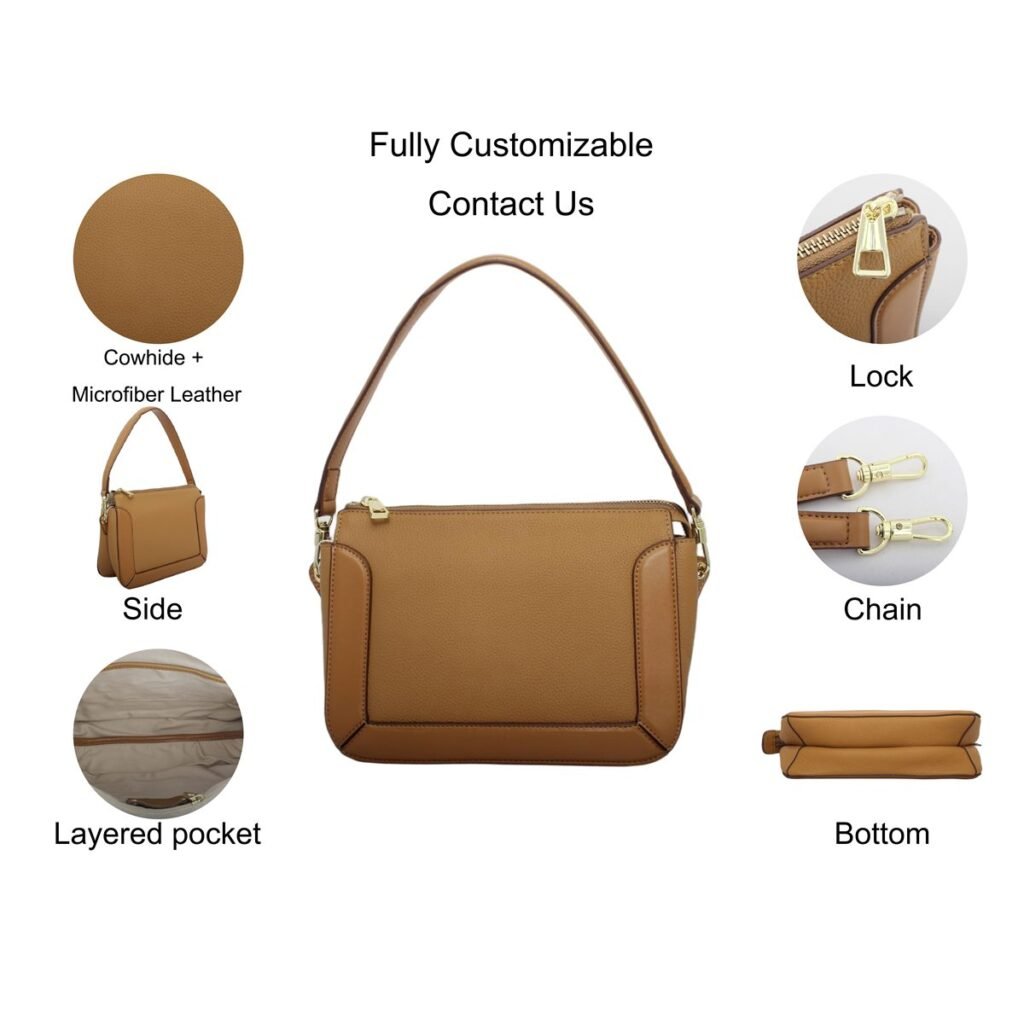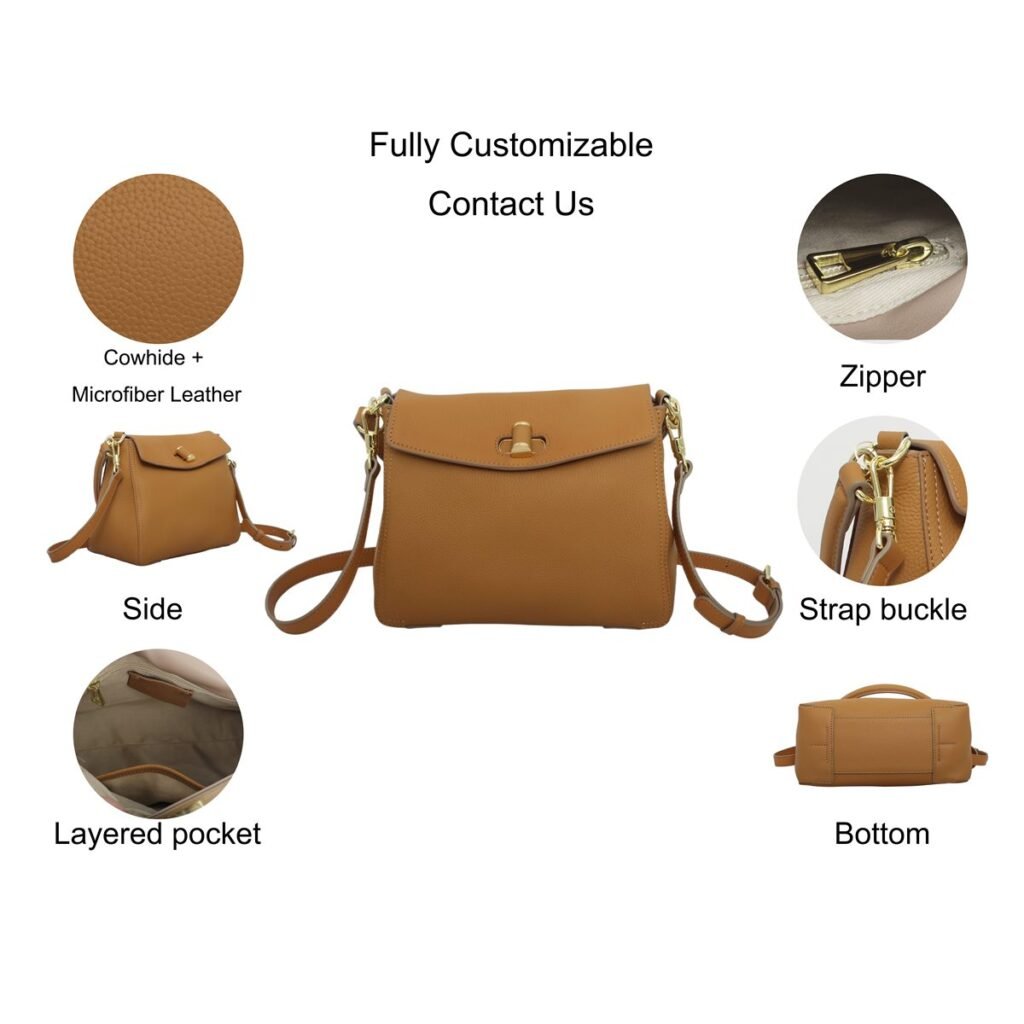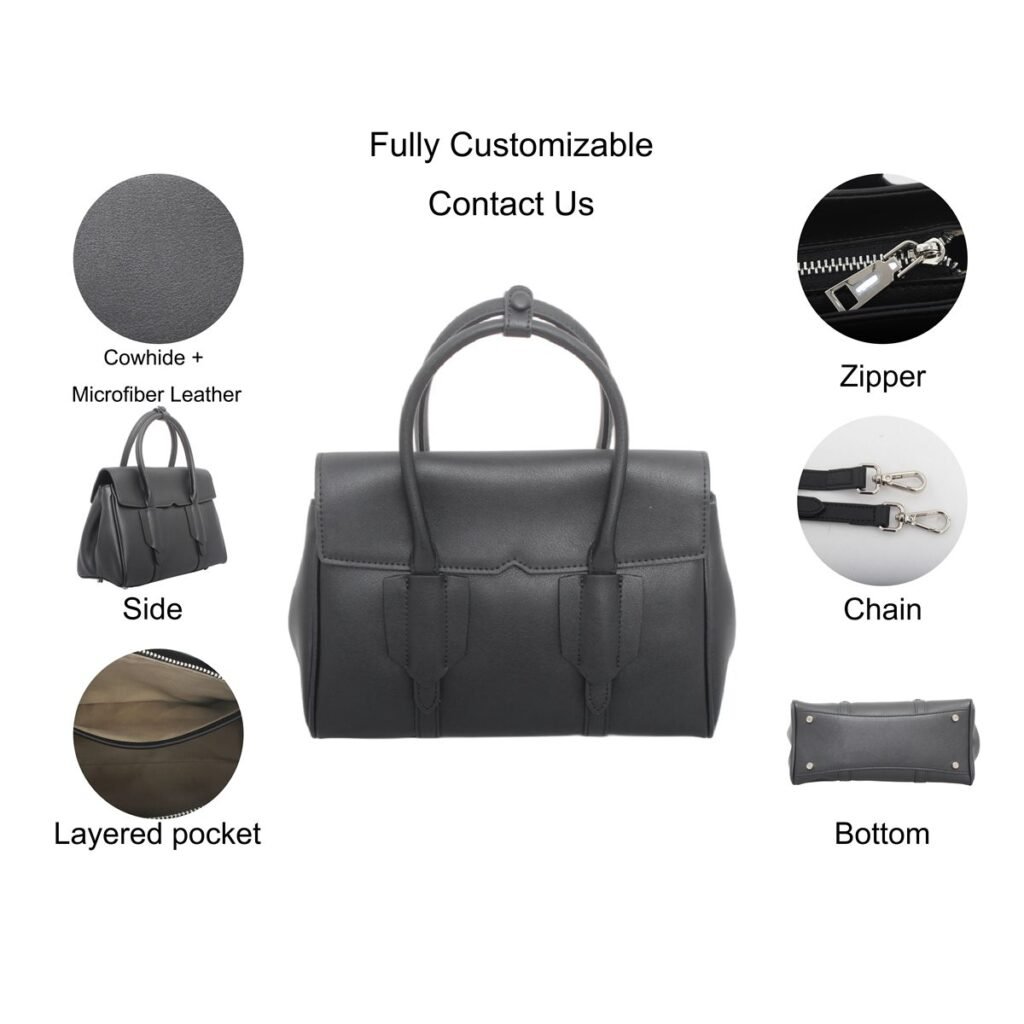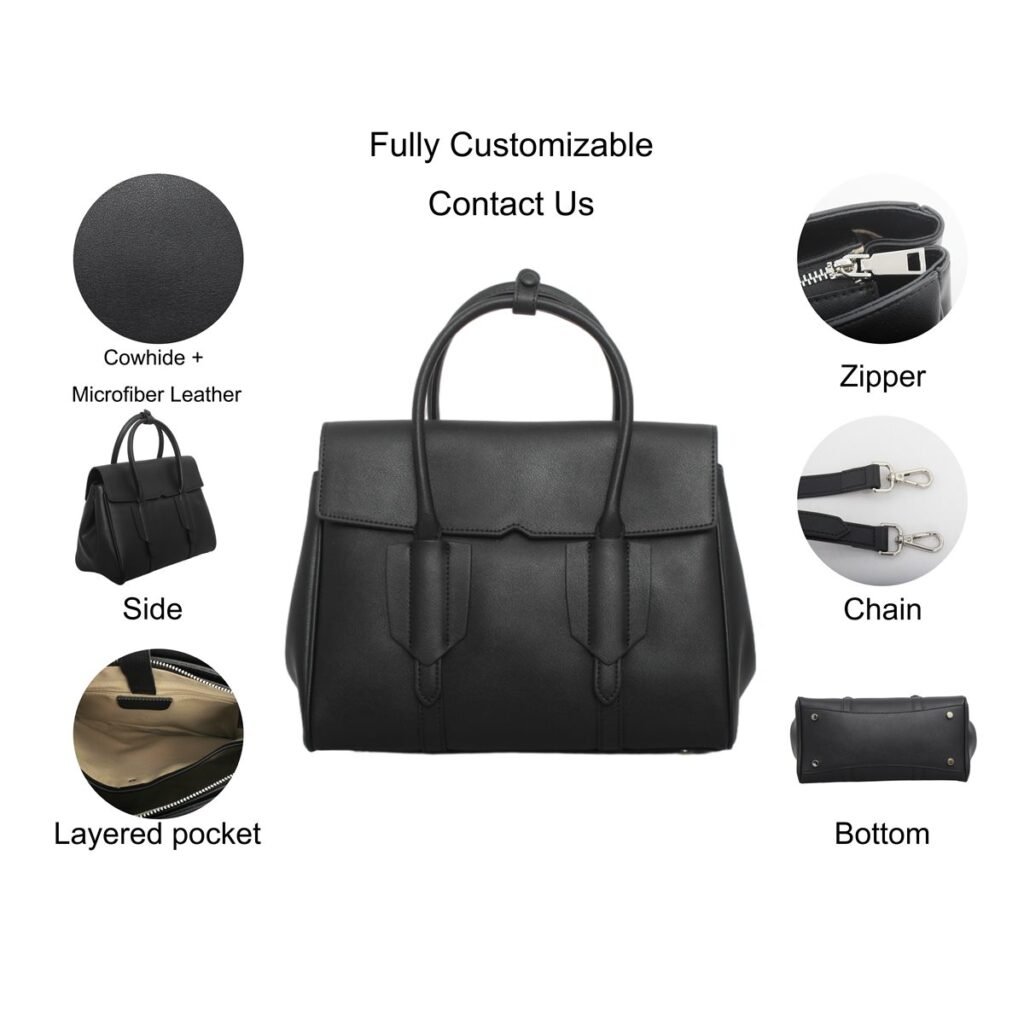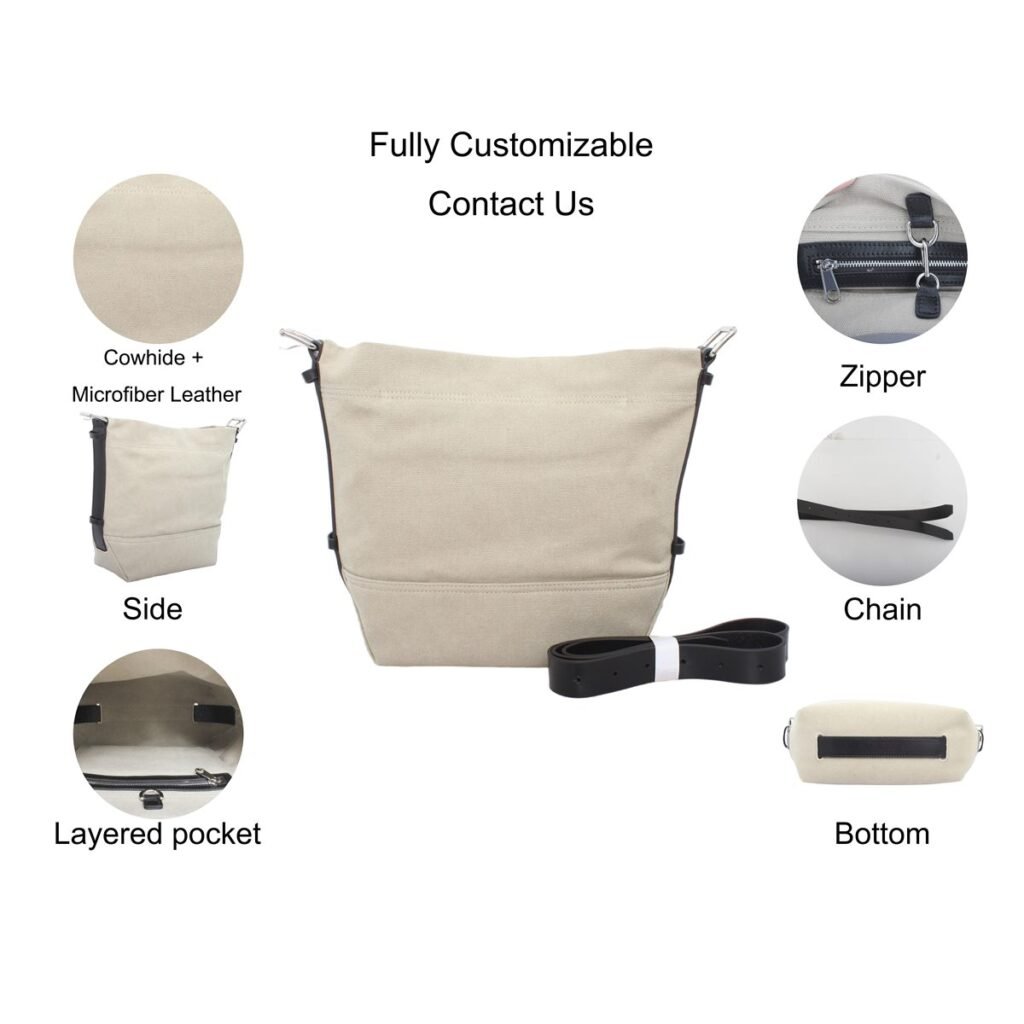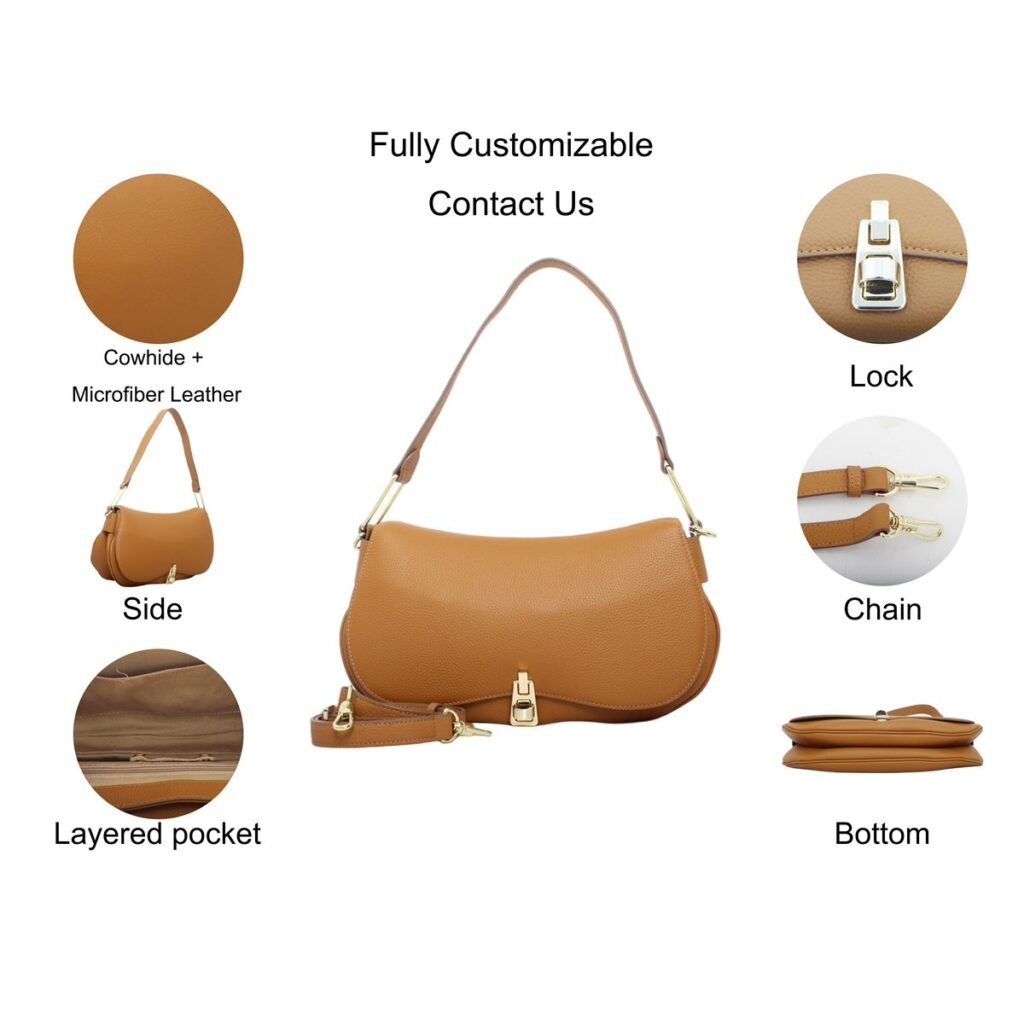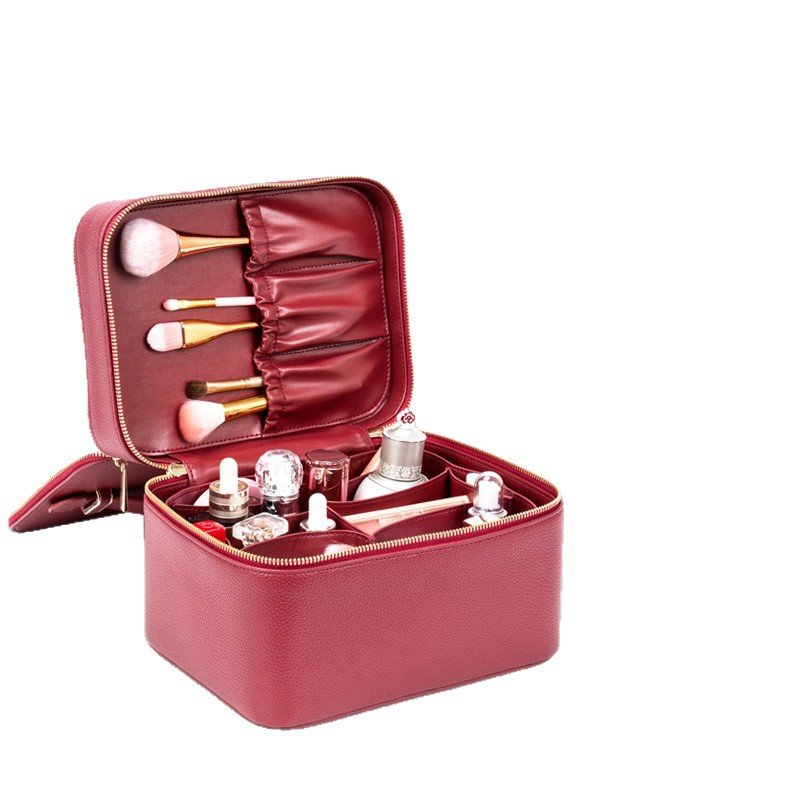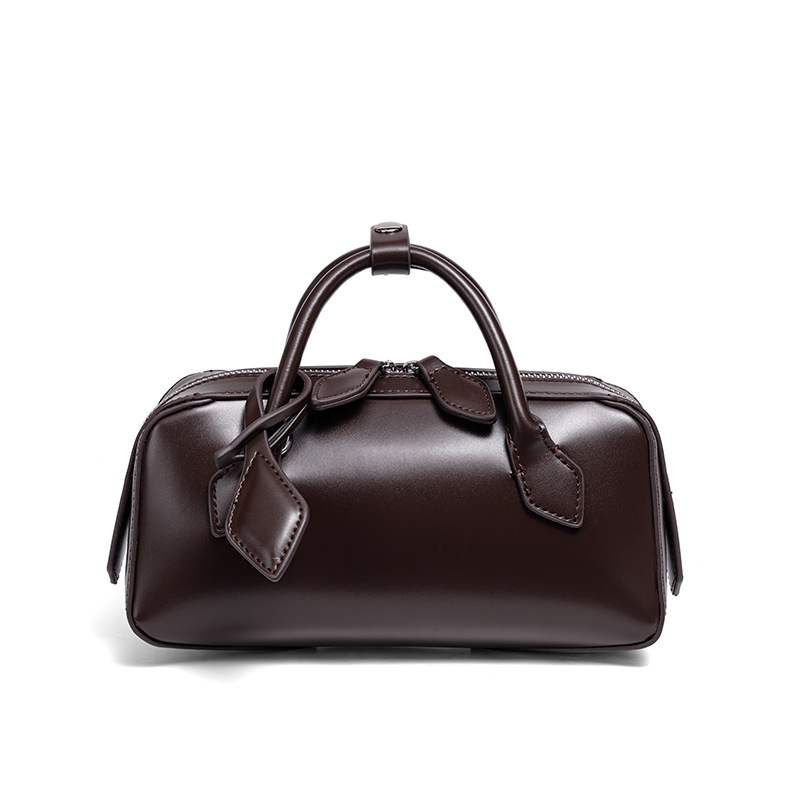










Minimalist bags expose every manufacturing decision.
With fewer decorative panels, printed patterns, oversized logos, external pockets, and visible hardware, there is less visual noise to distract from poor proportion or inconsistent workmanship. A slightly uneven stitch line, weak edge finish, misplaced handle, or low-quality surface becomes easier to notice.
That is why a minimalist bag manufacturer needs more than the ability to simplify an existing style. The factory must understand how function, geometry, material, branding, and production precision work together.
For private label brands, retailers, e-commerce companies, corporate buyers, and startup labels, minimalist bags can include structured totes, slim crossbody bags, clean backpacks, laptop bags, wallets, cosmetic bags, travel organizers, and understated handbags. Each category may look visually simple, but its manufacturing requirements are different.
This guide explains five standards buyers should examine before working with a minimalist bag manufacturer. The focus is not on removing every detail. It is about deciding which details deserve to remain and controlling them accurately through sampling, bulk production, packaging, and reorders.
RONEER supports OEM and ODM development for handbags, tote bags, backpacks, travel bags, cosmetic bags, crossbody bags, wallets, and other private label categories. Buyers can review the RONEER custom bag manufacturing team when preparing a minimalist product collection.
Inhaltsübersicht
Umschalten auf1. Define Function Before Removing Design Elements
Minimalist design often begins with reduction, but a practical bag cannot be reduced without understanding its purpose.
A commuter tote may need a padded laptop section, key leash, bottle pocket, secure closure, and reinforced handles. A minimalist crossbody bag may require only a phone pocket and card section, but strap comfort and access remain important. A clean backpack may hide its pockets and zippers, yet it still needs padding, ventilation, load-bearing seams, and an organized interior.
The product brief should therefore begin with the user rather than the exterior appearance.
Before requesting a quotation, buyers should define:
- Target customer
- Sales channel
- Main use scenario
- Items the bag must carry
- Required dimensions
- Target retail price
- Expected order quantity
- Preferred material level
- Packaging requirements
- Delivery market
A minimalist bag manufacturer should ask which functions are essential and which features can be removed. Removing an external pocket may improve visual simplicity, but it can also make the product less useful. Concealing a zipper may create a cleaner appearance, but the zipper still needs to open smoothly and remain easy to access.
The factory should also understand the difference between categories. A minimalist tote for boutique retail requires different construction from a promotional canvas tote. A minimalist backpack for technology users needs different internal engineering from a fashion backpack. A travel organizer may need compression, washable lining, or lightweight materials even when the exterior is very clean.
OEM and ODM decisions also influence the project. ODM may be suitable when a buyer wants to simplify an existing factory style by changing materials, colors, pockets, branding, and packaging. OEM is more appropriate when the buyer has an original structure, technical drawing, reference sample, or unique function.
Brands comparing these approaches can review this explanation of OEM and ODM bag development.
A professional minimalist bag manufacturer should preserve useful functions while reducing unnecessary visual elements. The result should feel intentional rather than unfinished.
2. Control Shape, Proportion, and Interior Structure
A minimalist product depends heavily on silhouette.
When there is no pattern, large logo, decorative quilting, fringe, or metal ornament, customers pay more attention to the overall shape. Handle height, side depth, corner radius, flap length, strap width, and body proportion become central design elements.
A structured minimalist tote may need:
- Balanced width and height
- Stable side panels
- A reinforced but lightweight base
- Straight handle placement
- A clean top opening
- Hidden magnetic or zipper closure
- Controlled lining volume
A soft shoulder bag requires a different approach. Its curve must look relaxed without appearing collapsed. The body material must drape naturally, while the lining and interior pockets should not distort the outer shape.
For backpacks, minimalism may involve a clean front panel and hidden zipper access. However, the factory must still control shoulder strap placement, back-panel structure, laptop padding, seam reinforcement, and load distribution.
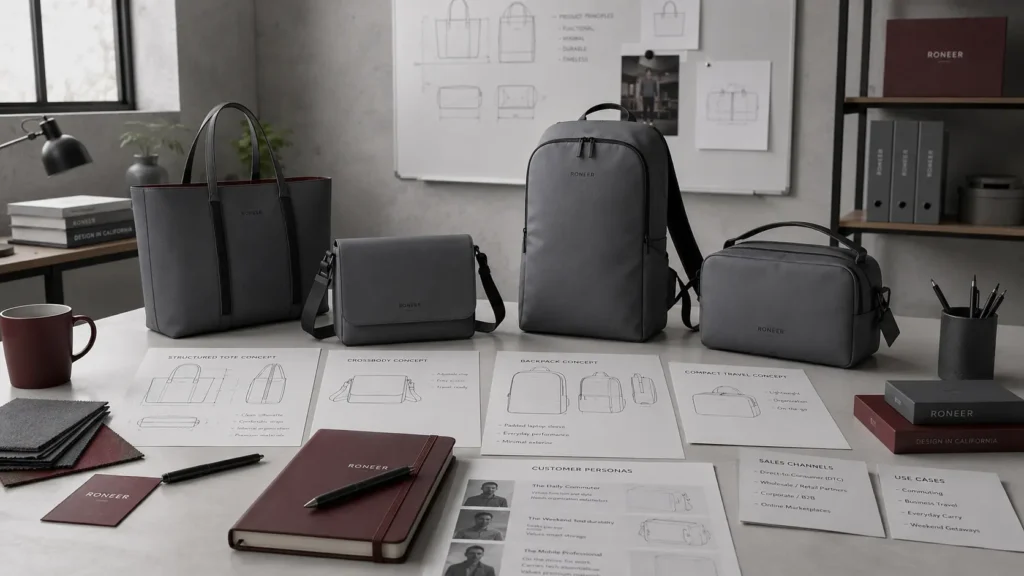
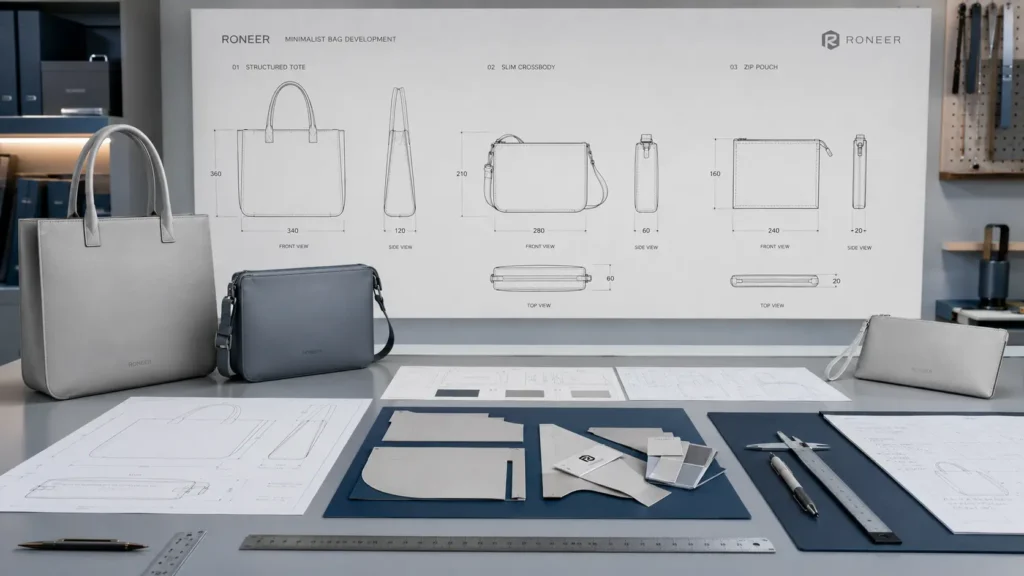
This is why a factory-ready specification is valuable. It should show the front, side, back, and top views of the bag. It should also identify measurements, seam positions, strap dimensions, pocket locations, closure methods, lining, hardware, and tolerances.
Reference photos alone rarely provide enough technical information. Two bags may look similar from the front but have completely different side structures, lining methods, and production costs.
During sampling, buyers should review the physical balance of the bag:
- Does it stand correctly when empty?
- Does it deform after items are placed inside?
- Are the handles visually centered?
- Does the flap remain level?
- Is the opening practical?
- Are interior pockets visible from the exterior?
- Does the shoulder strap pull the bag out of shape?
A capable minimalist bag manufacturer should get the proportions correct before discussing decorative refinement. If the foundation is wrong, better hardware or packaging will not solve the problem.
Clean design is not the absence of structure. It is a structure made visually quiet.
3. Make Materials and Finishing Carry the Design
On a highly decorated bag, multiple features compete for attention. On a minimalist bag, the material surface may occupy most of what the customer sees.
Material selection, therefor,e influences perceived value more directly.
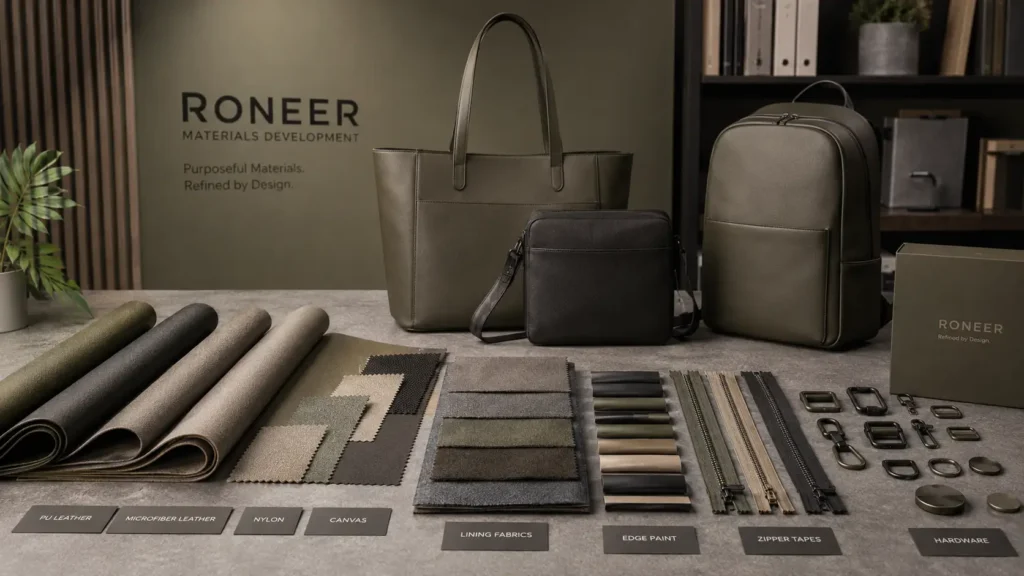
Common choices include premium PU leather, microfiber leather, genuine leather, nylon, Oxford fabric, canvas, polyester, and mixed-material constructions. Buyers can review RONEER’s material customization options when comparing materials for different price levels and functions.
A minimalist bag manufacturer should evaluate more than color. Important points include:
- Surface grain consistency
- Thickness and flexibility
- Shape retention
- Resistance to scratches or creasing
- Edge performance
- Stitching response
- Color consistency between production batches
- Cleaning requirements
- Gewicht
- MOQ and material availability
Smooth materials can create a refined appearance, but they may reveal scratches and glue marks more easily. Pebbled surfaces can hide minor handling marks, although the grain must remain consistent. Technical nylon can support an urban minimalist style, but zipper tape, lining, webbing, and thread should coordinate with the main body.
For recycled-content or preferred materials, buyers may use the Textile Exchange Materials Market Report as an industry reference. Sustainability claims should still be based on the actual material documentation available for the specific order.
Finishing is equally important. Minimalist bags often depend on:
- Straight tonal stitching
- Clean folded edges
- Smooth edge paint
- Accurate panel alignment
- Hidden reinforcements
- Matte or restrained hardware
- Matching zipper tape
- Clean lining installation
- Controlled glue application
Hardware should supporthe t function without dominating the design. Possible options include concealed magnets, recessed zippers, slim buckles, flush feet, small D-rings, matte sliders, and tone-on-tone components.
Not every minimalist bag must use black hardware or neutral colors. Muted blue, deep green, burgundy, clay, charcoal, silver gray, and other controlled palettes can still feel minimalist when the bag uses a unified material and hardware system.
The strongest material is not automatically the best material. The right choice must match the silhouette, target retail price, customer use, packaging method, and reorder plan.
4. Use Subtle Branding Without Losing Recognition
Minimalist branding is not the same as having no brand identity.
A bag can use a restrained logo and still be recognizable through proportion, color language, hardware, lining, packaging, and consistent details.
Common logo options include:
- Blind debossing
- Tone-on-tone embossing
- Small woven labels
- Interior printed logos
- Subtle metal plates
- Logo zipper pullers
- Futter mit Markenlogo
- Hangtags
- Dust bags
- Packaging logos
Buyers can compare RONEER’s logo customization options to identify which method works with the selected material.
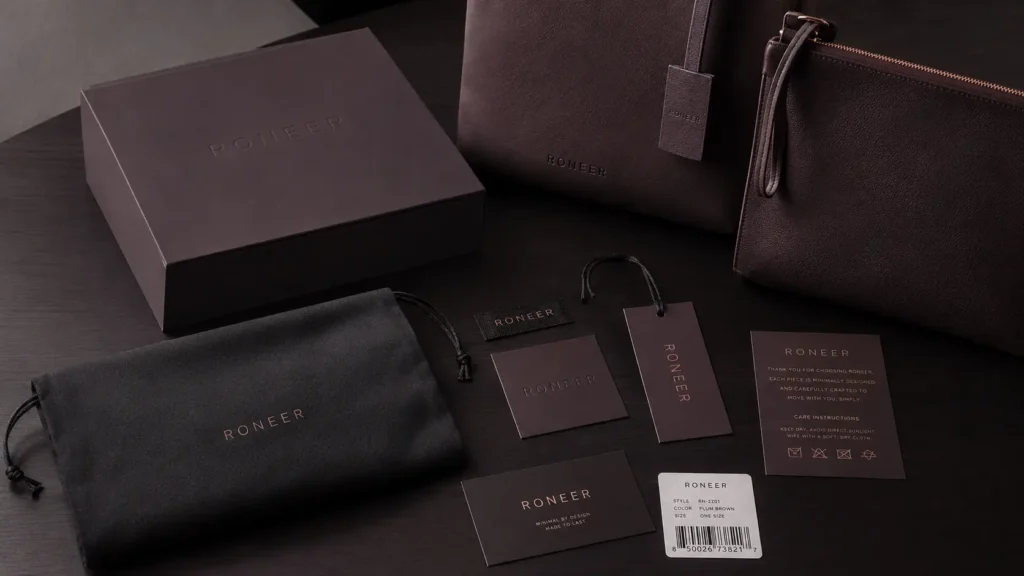
Blind debossing can suit PU leather, microfiber leather, and genuine leather when the logo needs to remain subtle. A small woven label may work better for nylon or canvas. An interior logo can preserve a completely clean exterior, while branded zipper pullers or lining can provide recognition during use.
Logo size should be evaluated on the physical sample. Artwork that appears small on a computer screen may still feel too large on a compact crossbody bag. The logo depth, location, spacing, finish, and contrast should all match the product position.
Packaging should follow the same design language. Buyers may need dust bags, hangtags, care cards, polybags, barcode labels, retail boxes, inner cartons, and export cartons. RONEER’s packaging customization service can support different sales channels and price levels.
A minimalist package does not need to be plain or low-cost. It should be organized, protective, and visually consistent. A single-color dust bag, restrained hangtag, clearly printed care card, and well-proportioned box can feel more considered than excessive decoration.
For products entering the United States, buyers should also plan origin marking and marketing language accurately. The U.S. Customs and Border Protection country-of-origin guidance provides official background on marking imported goods.
If bags are produced outside the United States, brands should avoid inaccurate, unqualified U.S.-origin claims. The Federal TradeCommission’sn Made in USA guidance explains the standards applied to those claims.
A reliable minimalist bag manufacturer should help the buyer coordinate the product, labels, packaging, and export information without turning a restrained brand into a generic one.
5. Set a Stricter Sample and Quality Standard
Minimalist bags require a strict approval process because manufacturing errors are difficult to hide.
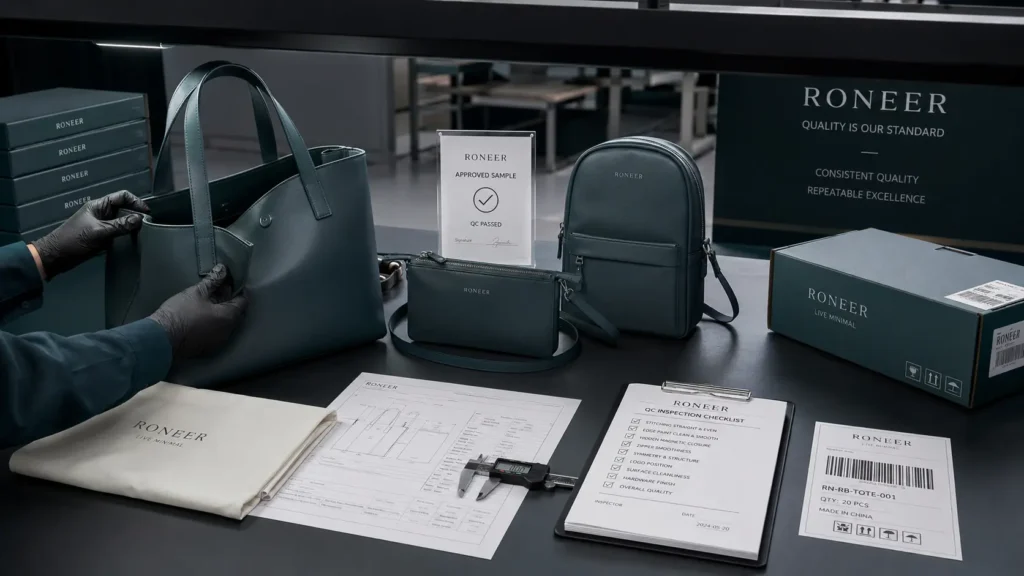
The physical sample should be checked under both normal and directional lighting. Directional light can reveal uneven stitching, surface marks, glue residue, edge defects, panel distortion, and hardware scratches that may not appear in ordinary photographs.
Important sample checks include:
- Overall shape and symmetry
- Measurements and tolerance
- Material color and grain
- Stitch line straightness
- Thread color
- Edge paint consistency
- Closure strength
- Zipper movement
- Handle and strap position
- Reinforced stress points
- Logo size and placement
- Lining fit
- Interior cleanliness
- Packaging method
A buyer should avoid approving the sample only through front-view photos. Physical review allows the brand to check hand feel, weight, balance, opening comfort, lining, hardware sound, and how the bag behaves when carried.
Feedback should be measurable. Comments such as “make it more premium” or “improve the shape” are difficult for the sample team to execute. Better comments include:
- Reduce the logo width by 15%
- Move the handle base 8 mm inward
- Increase the side depth by 10 mm
- Use a lower-gloss hardware finish
- Match the zipper tape to the body material
- Increase the lining weight
- Adjust the edge-paint color to the body tone
After sample approval, the factory should keep a production reference that includes the approved physical sample, material card, color code, tech pack version, hardware finish, logo artwork, packaging method, and carton specification.
Quality control should continue during production. Waiting until final inspection may allow one small mistake to affect an entire batch.
In-line checks should focus on cutting accuracy, stitching, symmetry, closures, handles, pockets, logo position, and surface cleanliness. Final inspection should compare finished goods with the approved sample and packaging standard.
Buyers considering independent inspection or testing can review SGS bags and accessories testing and inspection as an industry reference. This does not mean RONEER automatically holds SGS certification or that every order requires the same testing program.
Repeat production deserves the same attention. A minimalist bag manufacturer should retain material names, color codes, pattern versions, logo dimensions, thread colors, hardware finishes, lining details, packaging files, and carton records.
When a successful style is reordered, the second batch should not feel like a different product.
Minimalist Does Not Mean the Same Thing as Quiet Luxury
Minimalist and quiet luxury can overlap, but they are not identical.
Minimalist design focuses on reducing visual and functional elements to a clear, controlled system. It may appear in fashion handbags, technical backpacks, laptop bags, cosmetic bags, travel accessories, or corporate products.
Quiet luxury usually adds a stronger emphasis on premium materials, heritage-inspired restraint, subtle status, and elevated retail presentation.
A technical nylon backpack with hidden zippers can be minimalist without being quiet luxury. A full-grain leather handbag with subtle branding may fit both categories. A canvas tote with clean geometry and a small woven label may be minimalist at a more accessible price level.
Buyers should therefore explain the intended brand position instead of sending only the word “minimalist.” The factory needs to know whether the desired result is technical, fashion-focused, premium, casual, corporate, sustainable, or luxury-oriented.
Common Mistakes When Selecting a Minimalist Bag Manufacturer
One frequent mistake is assuming that simple bags should automatically be inexpensive. Fewer decorative components may reduce certain operations, but higher-grade materials, accurate cutting, precise stitching, concealed closures, and stricter surface inspection can increase manufacturing requirements.
Another mistake is removing useful details only to make the exterior cleaner. A product that looks minimal but performs poorly will create customer complaints and weak repeat sales.
Some buyers also rely too heavily on neutral colors. Minimalism can use color, but the palette needs hierarchy and control.
Approving materials only through digital photos is another risk. Texture, softness, gloss, thickness, color depth, and shape support should be checked through physical swatches or samples.
Finally, some brands approve a strong first sample without creating complete production records. Without those records, later orders may use different material batches, hardware finishes, logo dimensions, or packaging methods.
The right minimalist bag manufacturer should support both design reduction and production documentation.
Minimalist Bag Development Checklist
Before starting a project, buyers should confirm:
- Product category and use case
- Target customer and sales channel
- OEM or ODM development path
- Final dimensions and capacity
- Exterior and lining materials
- Shape and reinforcement requirements
- Closure and hardware method
- Logo size, method, and location
- Color and tone-on-tone details
- Physical sample approval
- Quality inspection points
- Packaging and barcode requirements
- Origin-marking requirements
- Repeat production records
A clear checklist helps the buyer and minimalist bag manufacturer discuss measurable decisions rather than subjective words such as simple, clean, premium, or modern.
How RONEER Supports Minimalist Bag Projects
RONEER supports brands through OEM and ODM development, material selection, logo customization, sample making, packaging planning, bulk production coordination, quality communication, export packing, and shipping support.
For startups, an ODM-based minimalist collection may reduce development risk by adapting existing structures. For established brands, OEM development can create original silhouettes, internal layouts, concealed closures, custom proportions, and brand-specific packaging.
A capable minimalist bag manufacturer should also explain which ideas are practical for the target quantity and budget. Some visual details can be simplified without weakening the design, while others are essential to the product’s identity and function.
The goal is not to remove as much as possible. The goal is to produce a bag in which every visible and hidden element has a clear purpose.
FAQ About Minimalist Bag Manufacturer
1. What does a minimalist bag manufacturer produce?
A minimalist bag manufacturer develops bags with clean silhouettes, controlled proportions, restrained branding, and practical interior structures. Product categories may include handbags, tote bags, backpacks, crossbody bags, laptop bags, wallets, cosmetic bags, and travel organizers for private label brands, retailers, wholesalers, and e-commerce sellers.
2. How is a minimalist bag manufacturer different from a general bag factory?
A general factory may focus mainly on construction, price, and order quantity. A minimalist bag manufacturer must also control subtle details such as shape balance, panel symmetry, surface quality, hidden closures, tonal stitching, edge finishing, restrained hardware, and accurate logo placement. Because minimalist products use fewer decorative elements, production defects are often more visible.
3. What information should I prepare before contacting a minimalist bag manufacturer?
Before contacting a minimalist bag manufacturer, prepare the bag category, target dimensions, intended use, reference images, material preference, internal layout, closure method, logo artwork, target quantity, packaging requirements, price range, sales channel, and expected delivery date. Clear specifications allow the factory to evaluate cost and production feasibility more accurately.
4. Can a minimalist bag manufacturer support original OEM designs?
Yes. An OEM minimalist bag manufacturer can develop products from sketches, tech packs, physical reference samples, or original design concepts. The OEM process may include pattern development, material sourcing, prototype production, sample revisions, pre-production approval, bulk manufacturing, quality inspection, and packaging preparation.
5. Can minimalist bags also be developed through ODM?
Yes. A minimalist bag manufacturer may offer ODM styles that can be adjusted through material, color, logo, lining, pocket, strap, closure, and packaging changes. ODM can be practical for startups or buyers who want to test a product category before investing in a fully original OEM design.
6. Which materials are suitable for minimalist bags?
A minimalist bag manufacturer may use premium PU leather, microfiber leather, genuine leather, nylon, Oxford fabric, canvas, polyester, suede-like materials, or mixed-material structures. The best choice depends on the required shape, hand feel, durability, target price, customer expectations, and reorder plan.
7. Are minimalist bags easier to manufacture than decorative bags?
Not necessarily. A minimalist bag manufacturer often needs stricter cutting, sewing, alignment, and finishing control because there are fewer visual details to hide defects. Uneven stitching, distorted panels, surface marks, poor edge paint, or incorrect proportions can quickly make a clean design look inexpensive.
8. What logo methods work best for minimalist bag designs?
A minimalist bag manufacturer may recommend blind debossing, tone-on-tone embossing, small woven labels, subtle metal plates, interior printed logos, custom zipper pullers, branded lining, hangtags, or packaging logos. Logo size, contrast, depth, and placement should be confirmed on a physical sample rather than judged only from digital artwork.
9. Why is a physical sample important when working with a minimalist bag manufacturer?
A physical sample allows buyers to evaluate material texture, weight, structure, capacity, handle comfort, zipper movement, closure strength, edge finishing, logo depth, lining fit, and overall balance. A professional minimalist bag manufacturer should use the approved sample as the reference standard for bulk production.
10. What quality checks should a minimalist bag manufacturer perform?
Important checks include material condition, color consistency, measurements, panel symmetry, stitching straightness, seam strength, edge finishing, hardware appearance, closure function, handle position, strap length, logo placement, lining cleanliness, packaging, and carton information. These checks should take place during production as well as before shipment.
11. Can a minimalist bag manufacturer support low MOQ orders?
MOQ depends on the style, material, color, logo method, hardware, and packaging. A minimalist bag manufacturer may offer more flexible quantities when buyers use existing materials, available colors, standard hardware, or ODM structures. Original molds, exclusive materials, custom-dyed colors, and specialized packaging may require higher quantities.
12. How should minimalist bags be packaged?
Packaging should protect the product without weakening its restrained presentation. A minimalist bag manufacturer may support dust bags, polybags, tissue paper, hangtags, care cards, barcode labels, retail boxes, inner cartons, master cartons, and export carton marks. The packaging level should match the sales channel and retail price.
13. How can buyers maintain consistency on repeat orders?
Buyers should ask the minimalist bag manufacturer to retain the approved sample, material codes, color references, pattern version, thread color, hardware finish, logo dimensions, lining details, packaging files, and carton specifications. These records reduce variation between the first production run and future reorders.
14. How does RONEER support minimalist bag manufacturer projects?
RONEER supports minimalist bag manufacturer projects through OEM and ODM development, material selection, pattern and sample development, subtle logo customization, packaging planning, bulk production coordination, quality communication, export packing, and global shipping support. The process is designed to turn a clean design concept into a factory-ready and repeatable product.
Schlussfolgerung
A minimalist bag manufacturer must control more than a simple exterior. Clean design places greater attention on proportion, materials, stitching, hardware, closures, lining, logo placement, and surface finishing. When decorative elements are reduced, every remaining detail becomes part of the product identity.
The development process should begin with the bag’s real function. Before asking a minimalist bag manufacturer for pricing, buyers should define the intended customer, sales channel, dimensions, carrying requirements, material level, internal organization, logo method, packaging standard, and target quantity. These decisions help prevent a visually clean bag from becoming impractical or difficult to reproduce.
Material selection also carries more responsibility in minimalist products. A professional minimalist bag manufacturer should evaluate texture, thickness, structure, color consistency, scratch resistance, sewing performance, edge finishing, MOQ, and long-term availability. The material must support both the silhouette and the intended customer experience.
Physical sampling is essential. The approved sample should confirm shape, balance, measurements, handle placement, strap comfort, closure function, logo scale, lining fit, packaging, and workmanship. Clear revision notes give the minimalist bag manufacturer measurable instructions and reduce misunderstandings before bulk production begins.
Quality control must continue throughout manufacturing. Cutting accuracy, stitch alignment, panel symmetry, surface cleanliness, hardware finish, edge paint, and packaging should be checked against the approved standard. A reliable minimalist bag manufacturer should also maintain production records so that future orders follow the same material, pattern, branding, and packing requirements.
RONEER supports global brands seeking a minimalist bag manufacturer for OEM and ODM handbags, totes, backpacks, crossbody bags, laptop bags, wallets, cosmetic bags, and travel accessories. Support can include material development, technical sampling, subtle branding, production coordination, quality communication, private label packaging, export packing, and shipping preparation.
The strongest minimalist bag manufacturer’s strategy is not based on removing every visible feature. It is based on deciding which functions and details truly matter, then producing them with accuracy and consistency. When product positioning, materials, sampling, quality standards, and repeat production records are handled correctly, minimalist bags become easier to recognize, easier to use, and easier to reorder.