 Deutsch
 English
 Español
 Français
 Italiano
 Русский
 日本語
 العربية
 Türkçe
 한국어
Ein Handtaschenmuster kann zwar korrekt aussehen, während die dahinterstehende Produktionsdatei jedoch noch gefährlich unvollständig ist.
Der Käufer hat zwar möglicherweise das Außenmaterial, die Farbe des Reißverschlusses, die Metalloberfläche, das Futter, die Logo-Plakette und die Verpackung nacheinander genehmigt. Wenn diese Entscheidungen jedoch über E-Mails, Kommentare zu Mustern, Fotos und Messaging-Apps verstreut sind, muss die Fabrik das Produkt dennoch erst rekonstruieren, bevor sie Materialien für die Serienproduktion einkaufen kann.
Genau da kommt ein Stückliste für Beutel ist nützlich.
Es wandelt einzelne Entwicklungsentscheidungen in eine kontrollierte Liste der Rohstoffe, Komponenten, Besätze, Etiketten und Verpackungen um, die für die Herstellung der Tasche benötigt werden.
Für einen Beschaffungsmanager oder Markeninhaber geht es nicht nur um die Dokumentation. Eine gut strukturierte Stückliste hilft dabei, praktische Fragen zur Produktion zu klären:
- Was genau muss gekauft werden?
- Welche Spezifikation wurde genehmigt?
- Wie viel von jedem Artikel wird pro Beutel benötigt?
- Welches Bauteil gehört zu welcher Farbvariante?
- Hat sich seit der Genehmigung des Musters etwas geändert?
- Entspricht das Angebot des Lieferanten den vom Käufer erwarteten Spezifikationen?
Eine Stückliste wird in der Fertigung üblicherweise als strukturierte Auflistung der Rohstoffe, Komponenten, Mengen und Spezifikationen verwendet, die für die Herstellung eines Endprodukts erforderlich sind. Weitere Informationen zur Fertigung finden Sie in der offiziellen Übersicht von Autodesk zum Thema Stücklistenverwaltung. Autodesk-Stücklistenverwaltung
A Stückliste für Beutel wendet dieselbe Fertigungslogik auch auf Textilwaren wie Handtaschen, Rucksäcke, Tragetaschen, Kosmetiktaschen, Laptoptaschen und Reisetaschen an.
In diesem Leitfaden werden neun Prüfschritte erläutert, mit deren Hilfe aus einer einfachen Komponentenliste eine Stückliste erstellt werden kann, die für die Angebotserstellung, die Mustererstellung, den Einkauf, die Produktion, die Qualitätsprüfung und Nachbestellungen genutzt werden kann.
Was ist eine Stückliste für Beutel?
A Stückliste für Beutel, oft mit BOM abgekürzt, ist die kontrollierte Stückliste, die festlegt, was in einer fertigen Tüte enthalten ist.
Dazu können gehören:
- Hauptmaterial der Außenverkleidung
- Sekundärmaterial
- Auskleidung
- Taschenfutter
- Verstärkung
- Schaum
- Einlage
- Gurtband
- Thema
- Einband
- Rohrleitungen
- Kantenfarbe
- Reißverschlussband
- Reißverschlussschieber
- Reißverschlusszug
- Schnallen
- D-Ringe
- Häkchen
- Magnetische Druckknöpfe
- Nieten
- Bodenfüße
- Logo-Schilder
- Gewebte Etiketten
- Pflegehinweise
- Anhänge
- Staubbeutel
- Plastiktüten
- Barcode-Etiketten
- Verkaufsverpackungen
- Exportkartons
Die Stückliste ersetzt weder technische Zeichnungen noch Maßangaben.
Stattdessen arbeitet es mit ihnen zusammen.
Eine Zeichnung gibt an, wo ein Reißverschluss angebracht werden soll. Die Stückliste legt fest, welche Reißverschlussspezifikation verwendet werden soll.
Die Breite des Gurtes wird anhand einer Maßtabelle festgelegt. In der Stückliste sind die Spezifikationen des Gurtbandes bzw. des Materials vermerkt, aus dem dieser Gurt hergestellt wurde.
In der Logo-Zeichnung wird die Platzierung festgelegt. In der Stückliste wird vermerkt, ob es sich bei dem Logo um eine Stickerei, eine Prägung, ein gewebtes Etikett oder ein Metallteil handelt.
Deshalb ist ein Stückliste für Beutel ist in der Regel Teil eines umfassenderen technischen Pakets oder wird daneben angeboten. Käufer, die die vollständige Struktur der Entwicklungsdokumente benötigen, können sich auch die Lösung von RONEER ansehen. Leitfaden zum „Handbag Tech Pack“.
1. Weisen Sie jeder Stücklistenzeile eine eindeutige Komponentenkennung zu
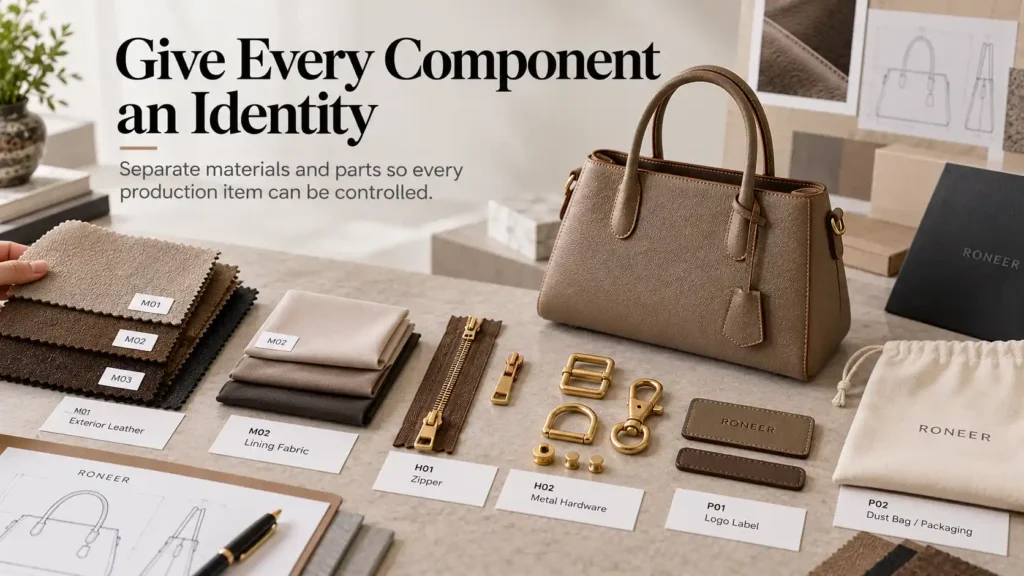
Die erste Regel ist einfach: Eine Stücklistenzeile sollte jeweils ein kontrolliertes Material oder eine kontrollierte Komponente bezeichnen.
In einer Stückliste sollten die genauen Materialien und Komponenten aufgeführt sein, die das Werk beschaffen, vorbereiten und montieren soll.
Vermeiden Sie es, mehrere nicht miteinander in Zusammenhang stehende Elemente in einer ungenauen Zeile zusammenzufassen, wie zum Beispiel:
Hardware – Gold
Das könnte fünf verschiedene Komponenten umfassen.
Eine stärkere BOM trennt sie voneinander:
| Artikel | Komponente |
|---|---|
| H01 | Reißverschlussschieber |
| H02 | Reißverschlusszug am Hauptreißverschluss |
| H03 | D-Ring am Schultergurt |
| H04 | Drehhaken mit Riemen |
| H05 | Logo-Plakette auf der Vorderseite |
Jede Komponente kann dann über eigene verfügen:
- Material
- Abmessungen
- Fertigstellen
- Farbe
- Lieferantenreferenz
- Anzahl
- Genehmigungsstatus
Das Gleiche gilt auch für Stoffe.
Nicht hineinlegen:
Hauptstoff + Futter + Taschenstoff
in eine Zeile.
Sie können unterschiedliche Materialspezifikationen, Mengen, Farben und Lieferanten verwenden.
A strukturiert Stückliste für Beutel erleichtert die Kontrolle von Änderungen, da der Käufer eine Komponente überarbeiten kann, ohne versehentlich die Definition mehrerer anderer Komponenten zu ändern.
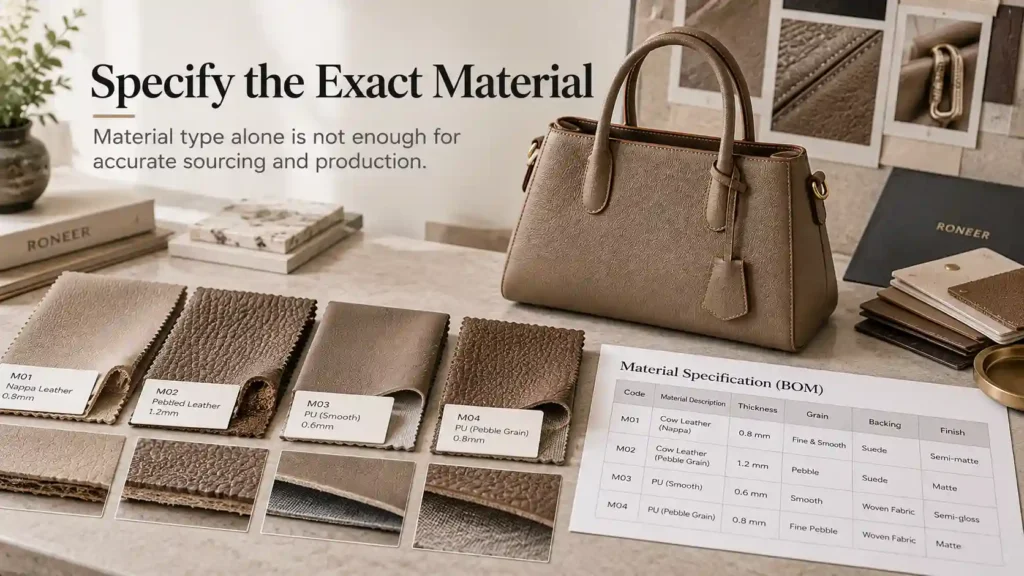
2. Geben Sie das Außenmaterial genauer an, als nur mit seiner allgemeinen Bezeichnung
Das Hauptmaterial der Außenhülle sollte niemals nur als “PU”, “Nylon”, “Canvas” oder “Leder” angegeben werden.”
Diese Beschreibungen sind für die Produktionssteuerung zu allgemein gehalten.
Je nach Projekt kann eine sinnvolle Materialliste Folgendes enthalten:
- Materialkategorie
- Zusammensetzung
- Lieferanten- oder interner Code
- Dicke
- Gewicht
- Bauwesen
- Oberflächenmaserung
- Rückseite
- Beschichtung
- Fertigstellen
- Farbreferenz
- Genehmigte Farbmuster-Referenz
Zum Beispiel:
| Feld | Beispiel |
|---|---|
| Komponente | Außenansicht (Hauptansicht) |
| Material | Mikrofaser-Kunstleder |
| Interner Code | MF-218 |
| Dicke | Genehmigte Spezifikation |
| Oberfläche | Feiner Kies |
| Rückseite | Bestätigte Unterstützung durch den Lieferanten |
| Farbe | Freigegebenes Muster |
| Status | Genehmigt |
Es geht nicht darum, jede Stückliste mit unnötigen technischen Daten zu überfrachten.
Ziel ist es, alle Merkmale zu erfassen, die für die Reproduktion des genehmigten Materials erforderlich sind.
Befindet sich das Produkt noch in der Entwicklung, so ist die Stückliste für Beutel kann das Material wie folgt kennzeichnen:
- Vorgeschlagen
- Nur als Beispiel
- Vorbehaltlich der Zustimmung des Käufers
- Zur Produktion freigegeben
Das ist besser, als zuzulassen, dass ein vorübergehend verwendetes Probenmaterial versehentlich zur Produktionsspezifikation wird.
Für Marken, die Material, Struktur, Farben, Futter, Beschläge und Verpackung noch gemeinsam auswählen, bietet RONEER Übersicht über die Optionen für individuell gestaltete Taschen koordiniert diese Entscheidungen vor der Probenahme und der Produktion.
3. Trennen Sie Futter, Verstärkung, Schaumstoff und verdeckte Materialien voneinander
Einige der wichtigsten Teile der Stückliste sind kaum noch zu erkennen, sobald die Tasche fertig ist.
Eine strukturierte Handtasche kann Folgendes enthalten:
- Futter aus Polyester
- Taschenfutter
- Vliesunterlage
- Schaum
- PE-Platte
- Verstärkung aus Pappe
- Basisunterstützung
- Verstärkung des Griffs
- Klebstoff
- Kantenverstärkung
- Einlage
Diese Stoffe können folgende Auswirkungen haben:
- Form
- Haptik
- Gewicht
- Taschenstabilität
- Griffkraft
- Bodenstruktur
- Nähstärke
- Fertigmaße
Falls sie in der Stückliste für Beutel, könnte eine Wiederholungsproduktion zu stark vom Werksspeicher abhängig sein.
Das wird besonders riskant, wenn das Produkt auf eine andere Produktionslinie verlagert oder Monate später erneut bestellt wird.
Versteckte Materialien verdienen eigene, kontrollierte Zeilen, wenn sie das Endprodukt wesentlich beeinflussen.
Zum Beispiel:
| Artikel | Komponente | Standort | Spezifikation |
|---|---|---|---|
| R01 | Bewehrungsplatte | Unten | Zugelassene Referenz |
| R02 | Schaum | Vorder- und Rückwände | Zugelassene Dicke |
| R03 | Vliesstoff | Befestigung des Griffs | Zugelassene Referenz |
The physical sample remains useful, but the BOM explains what is inside it.
4. Hardware als einzelne Produktionskomponenten definieren

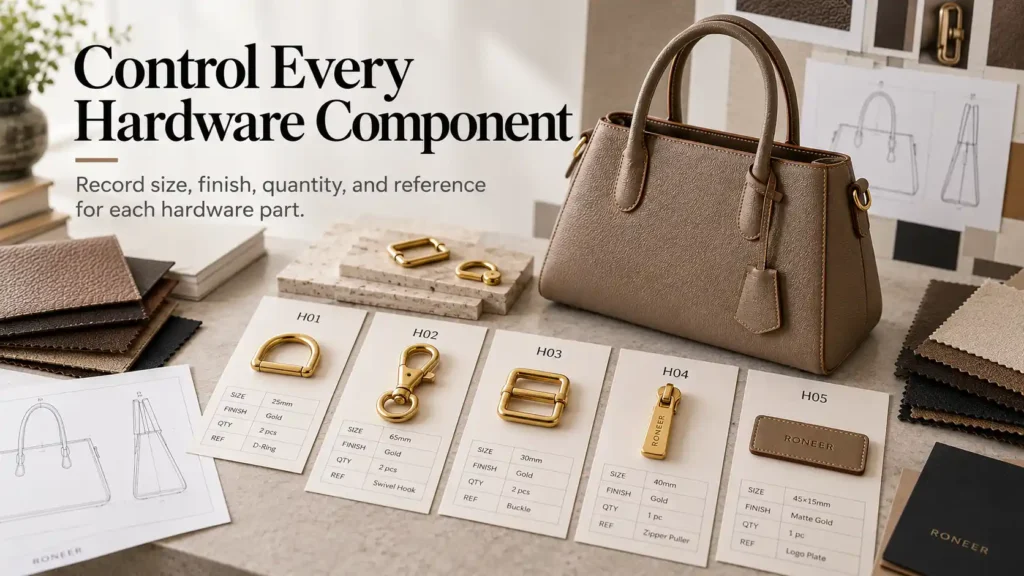
Hardware lines need enough detail to prevent a visually similar but technically different component from being substituted.
A handbag hardware BOM might include:
- Main zipper
- Pocket zipper
- Reißverschlusszug
- D-ring
- O-ring
- Swivel hook
- Schnalle
- Strap adjuster
- Magnetic snap
- Turn lock
- Rivet
- Chain
- Bodenfüße
- Metall-Logo
Important fields may include:
- Component name
- Item code
- Material
- Größe
- Fertigstellen
- Plating color
- Logo
- Lieferantenreferenz
- Quantity per bag
Zum Beispiel:
| Artikel | Komponente | Fertigstellen | Qty / Bag |
|---|---|---|---|
| H01 | D-ring | Approved finish | 2 |
| H02 | Swivel hook | Approved finish | 2 |
| H03 | Strap adjuster | Approved finish | 1 |
| H04 | Logo-Plakette aus Metall | Approved finish | 1 |
Compatibility matters too.
If a buckle is designed for 25 mm webbing, that relationship should be clear in the technical information rather than leaving the production team to discover a mismatch after components arrive.
Die Stückliste für Beutel should therefore be reviewed alongside drawings and dimensions, not as an isolated spreadsheet.
5. Angaben zu Marken, Etiketten und Bildmaterial einfügen
Branding components are materials too.
A private-label bag may require:
- Exterior metal logo
- Geprägtes Logo
- Stickerei
- Printed logo
- Woven brand label
- Interior label
- Care label
- Country-of-origin label
- Anhängeetikett
- Branded zipper puller
- Futter mit Markenlogo
- Packaging artwork
The BOM should identify the production method and connect it with the correct artwork version.
Zum Beispiel:
| Artikel | Branding Component | Reference |
|---|---|---|
| B01 | Front metal logo | Artwork LOGO-03 |
| B02 | Interior woven label | Artwork LABEL-02 |
| B03 | Anhängeetikett | Artwork TAG-04 |
Do not use:
Logo: same as sample
if a controlled artwork file exists.
The physical sample may still help confirm appearance, but the Stückliste für Beutel should identify which artwork version is approved for production.
This becomes particularly important after logo size, font, plating, label wording, or packaging artwork changes during sample revisions.
6. Maßeinheit und Menge pro Beutel eintragen
A BOM becomes much more useful when it records consumption or component quantity.
Typical units may include:
- pcs
- pair
- meter
- yard
- square meter
- sheet
- set
For hardware, quantity is usually straightforward.
Zum Beispiel:
- 2 × swivel hooks
- 2 × D-rings
- 1 × adjuster
- 4 × bottom feet
Material consumption can require additional production calculation because cutting efficiency, material width, pattern layout, defects, and wastage can influence purchasing quantities.
Therefore, the Stückliste für Beutel should distinguish between:
Quantity per finished bag
und
Bulk purchasing quantity
when those are not the same thing.
The BOM can record the product requirement, while purchasing calculations can apply the appropriate order quantity and approved waste assumptions separately.
This prevents purchasing estimates from being confused with the actual product specification.
7. Jede Stücklistenzeile der richtigen Farbvariante zuordnen
Multi-color collections introduce another source of errors.
Suppose one handbag is produced in:
- Schwarz
- Ivory
- Braun
- Burgund
The main material changes, but several other items may change too:
- Auskleidung
- Thema
- Reißverschlussband
- Kantenfarbe
- Gurtband
- Logo finish
- Hardware plating
- Hangtag sticker
- Barcode
- Packaging label
Eine starke Stückliste für Beutel makes those color relationships visible.
For simple collections, a color column may be enough.
For more complicated programs, use a colorway matrix.
| Komponente | Schwarz | Ivory | Braun |
|---|---|---|---|
| Main material | Schwarz | Ivory | Braun |
| Auskleidung | Schwarz | Beige | Braun |
| Thema | Schwarz | Ivory | Braun |
| Reißverschlussband | Schwarz | Ivory | Braun |
| Hardware | Gunmetal | Light gold | Antique gold |
The point is not to create unnecessary paperwork.
It is to prevent the correct component from being used in the wrong SKU.
Colorway control becomes especially useful when several styles share materials or hardware.
8. Fügen Sie die Verpackung in die Stückliste ein, wenn sie Teil der Produktspezifikation ist
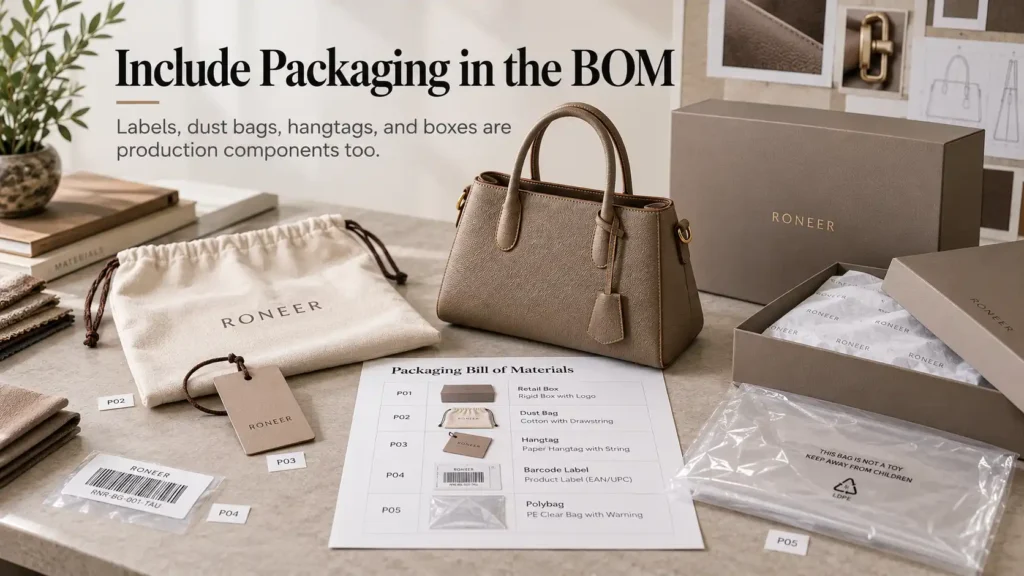
Packaging belongs in the BOM when it is part of the product that must be purchased, printed, labeled, or packed for each unit.
Depending on the project, that may include:
- Tissue paper
- Shape support
- Hardware-Schutz
- Polybag
- Staubbeutel
- Anhängeetikett
- Pflegekarte
- Barcode-Etikett
- SKU sticker
- Geschenkbox
- Retail box
- Master carton
For retail products that require standardized product identification, GS1 provides the global system used for GTINs and retail barcodes. GS1 also explains that barcode graphics can be integrated into packaging artwork, applied through pre-printed labels, or printed directly onto packaging. GS1 Product Barcodes and GTINs GS1 Barcode Application Guidance
A retail packaging BOM might therefore record:
| Artikel | Packaging Component | Qty / Unit |
|---|---|---|
| P01 | Staubbeutel | 1 |
| P02 | Anhängeetikett | 1 |
| P03 | Barcode sticker | 1 |
| P04 | Polybag | 1 |
| P05 | Tissue set | 1 |
Cartons may be handled separately according to packing quantity, but carton specifications and marks should still be controlled somewhere in the production documentation.
Packaging is particularly important when several markets, retailers, or SKU labels are involved.
One handbag can be manufactured correctly and still become the wrong commercial product if its label or packaging version is incorrect.
9. Stücklistenversionen vor der Musterfertigung und der Serienproduktion kontrollieren
Every BOM needs version control because one small design revision can change several material and component lines at once.
Imagine the buyer changes the shoulder strap from 20 mm to 25 mm.
That can affect:
- Strap material
- Buckle width
- Adjuster
- D-ring
- Swivel hook
- Verstärkung
- Pattern pieces
Changing one drawing while leaving the old BOM active creates a production conflict.
A Stückliste für Beutel should therefore include information such as:
- Style number
- BOM revision
- Revision date
- Prepared by
- Reviewed by
- Genehmigungsstatus
- Change notes
Example:
| Version | Change |
|---|---|
| BOM V1 | Initial development |
| BOM V2 | Main material updated |
| BOM V3 | Strap changed from 20 mm to 25 mm |
| BOM V4 | Final hardware and packaging approved |
Do not delete old versions without a trace.
The production team needs to know which file is current, while product-development teams may need the previous version to understand how the design evolved.
For a broader manufacturing reference, Autodesk’s BOM management guidance also emphasizes maintaining BOM data as products and manufacturing requirements change. Autodesk BOM Management Overview
Eine praktische Vorlage für eine Stückliste für Taschen
A basic factory-ready structure can use columns like these:
| Item No. | Category | Komponente | Spezifikation | Farbe | Reference | UOM | Qty / Bag | Status |
|---|---|---|---|---|---|---|---|---|
| M01 | Exterior | Main material | Approved spec | Taupe | MAT-01 | m² | TBC | Genehmigt |
| M02 | Innenbereich | Auskleidung | Polyester | Beige | LIN-02 | m | TBC | Genehmigt |
| R01 | Struktur | Bottom reinforcement | Approved board | Natural | REF-03 | pcs | 1 | Genehmigt |
| Z01 | Reißverschluss | Main zipper | Approved size | Matching | ZIP-01 | pcs | 1 | Genehmigt |
| H01 | Hardware | D-ring | Approved size | Light gold | HW-02 | pcs | 2 | Genehmigt |
| H02 | Hardware | Swivel hook | Approved size | Light gold | HW-03 | pcs | 2 | Genehmigt |
| B01 | Branding | Metall-Logo | Artwork LOGO-03 | Light gold | ART-03 | pcs | 1 | Genehmigt |
| P01 | Verpackung | Staubbeutel | Approved size | Natural | PKG-01 | pcs | 1 | Genehmigt |
| P02 | Verpackung | Anhängeetikett | Artwork TAG-02 | Markenfarbe | ART-04 | pcs | 1 | Genehmigt |
This is only a framework.
A backpack may require webbing, mesh, foam, binding, buckles, sternum-strap components, laptop padding, and multiple zipper specifications.
A structured handbag may require more reinforcement, edge paint, metal hardware, and lining components.
A cosmetic bag may have fewer structural parts but more emphasis on lining, zipper, coating, or printing.
Die Stückliste für Beutel should reflect the actual product rather than forcing every category into one fixed template.
Stückliste vs. Technisches Datenblatt: Was ist der Unterschied?
A BOM is part of the manufacturing information, but it is not the entire tech pack.
A complete bag tech pack may also contain:
- Cover and style information
- Technical drawings
- Finished measurements
- Points of measure
- Construction details
- Stitching notes
- Pocket layout
- Positionierung des Logos
- Colorways
- Packaging instructions
- Revision history
- Quality requirements
Die Stückliste für Beutel answers primarily:
What materials and components make this product?
Technical drawings answer:
Where do those components go?
Measurements answer:
What size should the finished product be?
Construction notes answer:
How should those pieces be assembled?
This is why the BOM and tech pack should reference each other rather than becoming separate documents that gradually contradict one another.
Stückliste vs. Kalkulationsblatt
A Stückliste für Beutel and a costing sheet are related, but they solve different problems.
The BOM defines what the product contains.
The costing sheet calculates what those materials, components, labor, packaging, overhead, and other commercial factors cost.
For example, the BOM may state:
Two approved swivel hooks per bag.
The costing calculation may then use:
- Component purchase price
- Order quantity
- Mindestbestellmenge des Lieferanten
- Currency
- Wastage
- Freight or sourcing cost
Keeping these functions separate makes updates easier.
A material price can change without changing the product specification.
Likewise, changing the hardware specification should trigger a BOM revision even if the new hardware happens to cost the same.
Sollten Angaben zu recyceltem oder zertifiziertem Material enthalten sein?
If a project depends on a specific material claim or documentation requirement, the relevant material reference should be controlled in the BOM.
Do not write vague terms such as:
recycled fabric
when the project requires a particular supplier document, composition, material standard, or approved certificate.
Textile Exchange published its Materials Matter Standard framework for raw materials used in the fashion, textile, and apparel industry, including specific criteria for recycled materials. The current transition framework also distinguishes between material requirements and the documentation needed to support claims. Textile Exchange Materials Matter Standard Recycled Materials Criteria
Die Stückliste für Beutel can record the approved material code and documentation status, while compliance evaluation should follow the buyer’s actual market and project requirements.
Do not treat a generic supplier description such as “recycled polyester” as proof of certification or compliance unless the required project documentation has been reviewed.
Was sollte vor der Serienproduktion eingefroren werden?
Before releasing the order, review whether the BOM matches the approved physical sample and current technical file.
Check:
- Main material
- Sekundärmaterial
- Auskleidung
- Verstärkung
- Schaum
- Thema
- Edge finish
- Gurtband
- Zippers
- Hardware
- Logo
- Labels
- Verpackung
- Colorways
- Quantity per bag
- Revision number
The final question is simple:
If another production team received only this BOM and the approved tech pack, would they know which components to prepare?
If the answer is no, the Stückliste für Beutel still contains assumptions.
Häufige Fehler in Stücklisten, die zu Produktionsproblemen führen
Using Generic Material Names
“Black PU” is not a controlled material specification.
Mixing Several Components in One Row
Different components need separate identities if they can change independently.
Forgetting Hidden Materials
Reinforcement, backing, foam, and adhesives may influence the finished result.
Leaving Hardware Sizes Undefined
A visually similar buckle may not fit the intended strap.
Missing Color Relationships
A black bag may accidentally receive the hardware or zipper tape intended for another colorway.
Using Old Artwork
Logo and label files should identify the approved revision.
Ignoring Packaging
Retail labels, dust bags, tags, and boxes are still production components.
Failing to Update the BOM After Sampling
The approved sample and BOM should describe the same product.
FAQ About Bag Bill of Materials
1. What is a bag bill of materials?
A Stückliste für Beutel is a controlled list of the materials, trims, hardware, labels, and packaging required to manufacture a bag. It can include specifications, colors, references, units, quantities, and approval status.
2. Is a BOM the same as a handbag tech pack?
No. The BOM is normally one part of a larger tech pack. The tech pack may also include drawings, measurements, construction instructions, artwork placement, colorways, packaging information, and revision history.
3. What materials should be included in a bag BOM?
Include all materials that materially define the product, such as exterior fabric or leather, lining, reinforcement, foam, webbing, thread, zippers, hardware, labels, logo components, and packaging.
4. Should hidden reinforcement be included?
Yes, when it affects construction or product performance. Hidden reinforcement should not depend only on factory memory if it is part of the approved product.
5. Should every hardware component have its own BOM line?
Usually, separate components that have their own size, finish, quantity, or sourcing reference should have separate lines. This makes revisions and purchasing clearer.
6. Should packaging be included in a bag bill of materials?
Yes, when packaging is part of the required unit specification. Dust bags, hangtags, polybags, barcode labels, inserts, and boxes can all be controlled through the BOM.
7. How should different colorways be managed?
Use color-specific BOM fields or a colorway matrix so the main material, lining, thread, zipper tape, hardware, labels, and packaging can be matched correctly to each SKU.
8. What does quantity per bag mean?
It records how many pieces or how much material one finished bag requires. Bulk purchasing quantities may require separate calculations for order quantity, cutting yield, supplier MOQ, and production allowances.
9. When should the BOM be updated?
Update it whenever an approved change affects material, hardware, construction components, branding, packaging, quantity, or colorway requirements.
10. Should the sample and BOM have the same revision?
The approved production BOM should correspond with the current approved sample and technical specification. Any differences should be documented rather than left to interpretation.
11. Can a bag factory help create a BOM?
Yes. When a buyer provides a reference design, sample, drawings, or tech pack, the factory may help clarify practical material and component options. Final specifications still need buyer confirmation before bulk production.
12. What should I send with a BOM when requesting a quotation?
Send the relevant technical drawings, dimensions, material references, artwork, quantity, color breakdown, packaging requirements, and project notes. If your BOM is ready and you want the factory to review the project, you can contact RONEER and upload your files here.
Schlussfolgerung
A Stückliste für Beutel is not simply a spreadsheet listing fabric and hardware.
It is a controlled manufacturing reference connecting product design with sourcing, quotation, sampling, purchasing, production, packaging, and repeat orders.
A useful BOM gives every important component an identity. It records the approved exterior material, lining, hidden reinforcement, hardware, branding, labels, packaging, colorway relationships, quantities, and revision status.
Most importantly, it stays synchronized with the approved sample and technical documents.
For RONEER OEM/ODM projects, BOM review can be connected with material selection, structure development, logo options, hardware, lining, packaging, sample revisions, and production planning according to the confirmed buyer specification.
A well-maintained Stückliste für Beutel reduces the number of decisions left to memory and gives both the buyer and factory a clearer reference for building the same approved product again.