 Türkçe
  English
  Deutsch
  Español
  Français
  Italiano
  Русский
  日本語
日本語  العربية
  한국어
한국어 A handbag sample can look correct while the production file behind it is still dangerously incomplete.
The buyer may have approved the exterior material, zipper color, metal finish, lining, logo plate, and packaging one decision at a time. But if those decisions remain scattered across emails, sample comments, photos, and messaging apps, the factory still has to reconstruct the product before purchasing materials for bulk production.
That is where a bag bill of materials becomes useful.
It turns individual development decisions into a controlled list of the raw materials, components, trims, labels, and packaging required to make the bag.
For a sourcing manager or brand owner, the purpose is not simply documentation. A well-built BOM helps answer practical production questions:
- What exactly needs to be purchased?
- Which specification has been approved?
- How much of each item is required per bag?
- Which component belongs to which colorway?
- Has anything changed since the sample was approved?
- Is the supplier quoting the same specification that the buyer expects?
A bill of materials is commonly used in manufacturing as a structured list of the raw materials, components, quantities, and specifications required to assemble a finished product. For a broader manufacturing reference, see Autodesk’s official BOM management overview. Autodesk Bill of Materials Management
A bag bill of materials applies that same manufacturing logic to soft goods such as handbags, backpacks, totes, cosmetic bags, laptop bags, and travel bags.
This guide explains nine checks that help turn a basic component list into a BOM that can support quotation, sampling, purchasing, production, quality review, and repeat orders.
What Is a Bag Bill of Materials?
A bag bill of materials, often shortened to BOM, is the controlled component list that defines what goes into a finished bag.
It can include:
- Main exterior material
- Secondary material
- Astar
- Pocket lining
- Takviye
- Köpük
- Interlining
- Webbing
- Konu
- Binding
- Piping
- Kenar boyası
- Zipper tape
- Zipper slider
- Zipper puller
- Tokalar
- D-rings
- Kancalar
- Manyetik çıtçıtlar
- Perçinler
- Bottom feet
- Logo plakaları
- Woven labels
- Care labels
- Hangtags
- Dust bags
- Polybags
- Barkod etiketleri
- Retail boxes
- Export cartons
The BOM does not replace technical drawings or measurement specifications.
Instead, it works with them.
A drawing tells the factory where a zipper is positioned. The BOM identifies which zipper specification should be used.
A measurement chart defines strap width. The BOM records the webbing or material specification used to make that strap.
A logo drawing defines placement. The BOM records whether the logo is embroidery, debossing, a woven label, or a metal component.
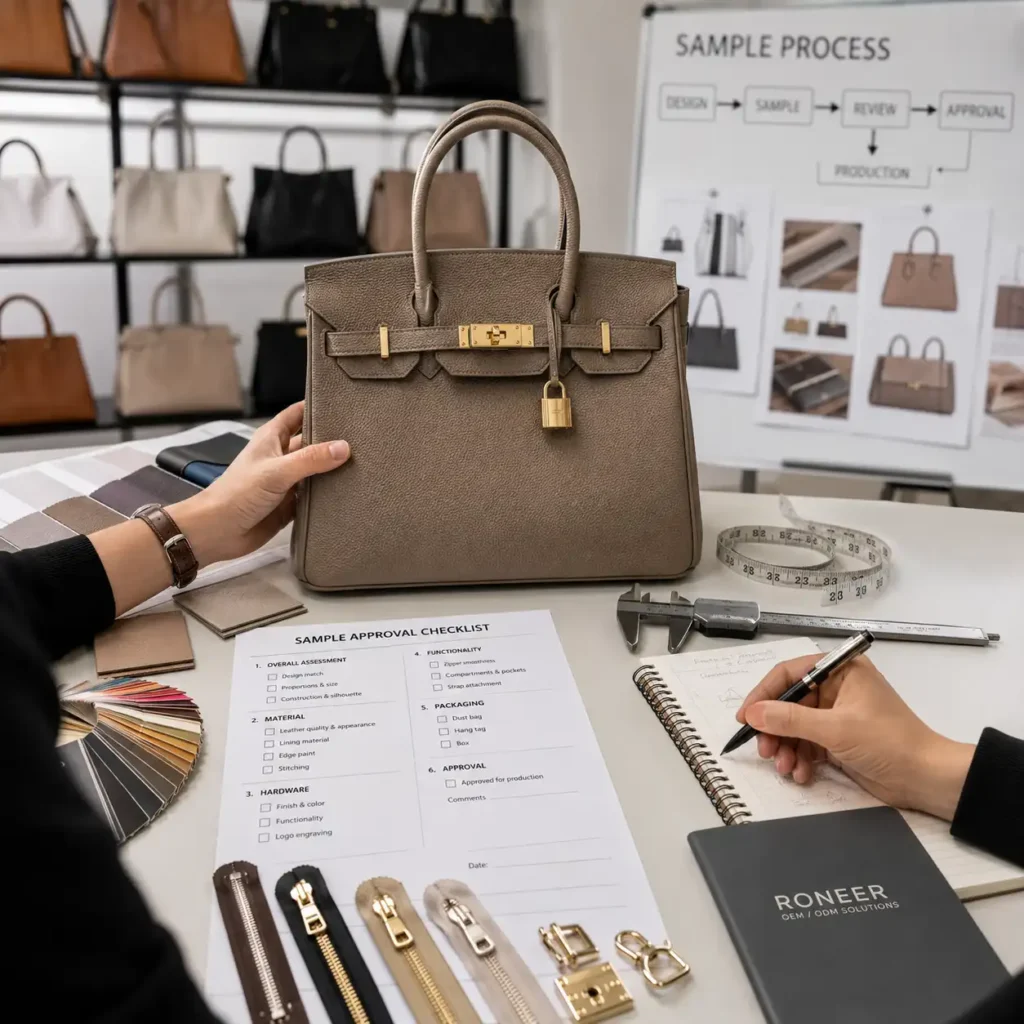
This is why a bag bill of materials normally sits inside or alongside a broader technical package. Buyers who need the full development-document structure can also review RONEER’s Handbag Tech Pack guide.
1. Give Every BOM Line One Clear Component Identity
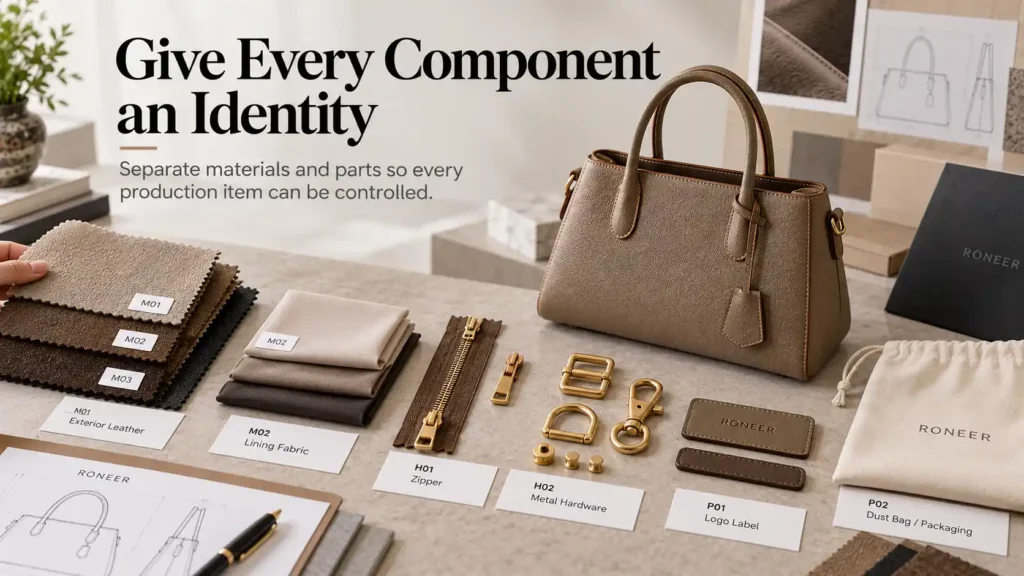
The first rule is simple: one BOM line should identify one controlled material or component.
A BOM should identify the exact materials and components the factory is expected to source, prepare, and assemble.
Avoid combining several unrelated items into one vague row such as:
Hardware — gold
That could represent five different components.
A stronger BOM separates them:
| Öğe | Component |
|---|---|
| H01 | Main zipper slider |
| H02 | Main zipper puller |
| H03 | Shoulder strap D-ring |
| H04 | Strap swivel hook |
| H05 | Front logo plate |
Each component can then have its own:
- Malzeme
- Boyutlar
- Finish
- Renk
- Supplier reference
- Miktar
- Approval status
The same logic applies to fabrics.
Do not put:
Main fabric + lining + pocket fabric
into one line.
They may use different material specifications, quantities, colors, and suppliers.
A structured bag bill of materials makes changes easier to control because the buyer can revise one component without accidentally changing the definition of several others.
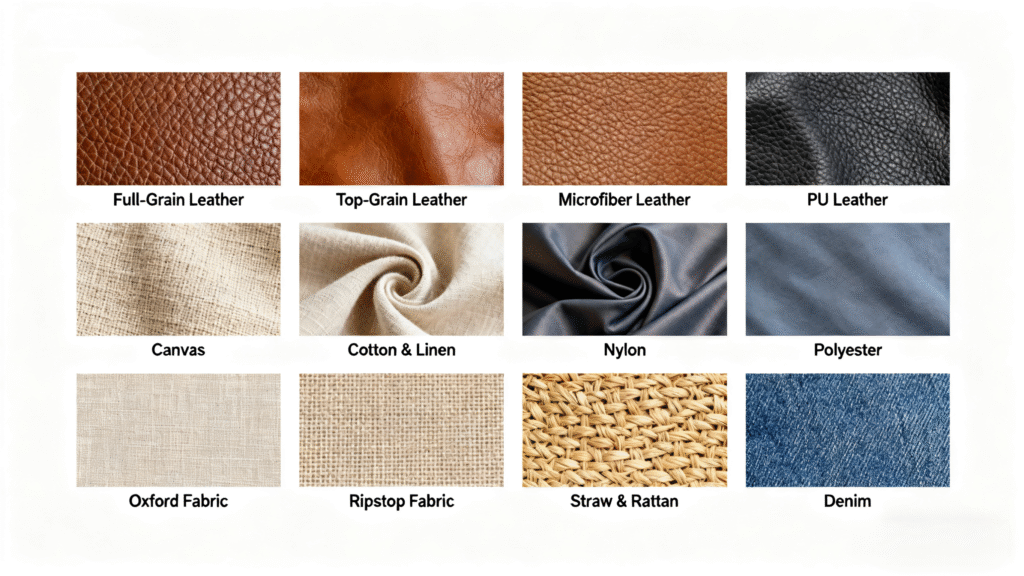
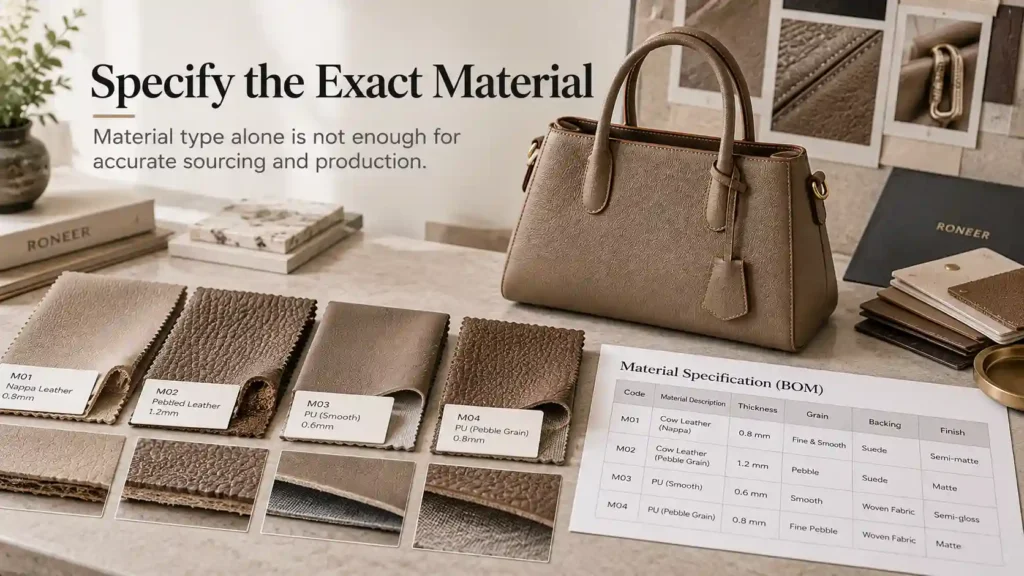
2. Specify the Exterior Material Beyond Its General Name
The main exterior material should never be recorded only as “PU,” “nylon,” “canvas,” or “leather.”
These descriptions are too broad for production control.
Depending on the project, a useful material line may contain:
- Material category
- Composition
- Supplier or internal code
- Thickness
- Ağırlık
- Construction
- Surface grain
- Backing
- Coating
- Finish
- Color reference
- Approved swatch reference
For example:
| Field | Example |
|---|---|
| Component | Main exterior |
| Malzeme | Microfiber synthetic leather |
| Internal code | MF-218 |
| Thickness | Approved specification |
| Surface | Fine pebble |
| Backing | Confirmed supplier backing |
| Renk | Approved physical swatch |
| Status | Approved |
The purpose is not to fill every BOM with unnecessary technical data.
The purpose is to record whatever characteristics are required to reproduce the approved material.
If the product is still in development, the bag bill of materials can mark the material as:
- Proposed
- Sample only
- Pending buyer approval
- Approved for production
That is better than allowing a temporary sample material to become an accidental production specification.
For brands still choosing materials, structure, colors, lining, hardware, and packaging together, RONEER’s Custom Bag Options hub organizes these decisions before sampling and production.
3. Separate Lining, Reinforcement, Foam, and Hidden Materials
Some of the most important BOM items are barely visible once the bag is finished.
A structured handbag may contain:
- Polyester lining
- Pocket lining
- Nonwoven backing
- Köpük
- PE board
- Cardboard reinforcement
- Base support
- Kulpların güçlendirilmesi
- Adhesive
- Edge reinforcement
- Interlining
These materials can affect:
- Şekil
- Hand feel
- Ağırlık
- Pocket stability
- Handle strength
- Bottom structure
- Sewing thickness
- Finished dimensions
If they are missing from the bag bill of materials, a repeat production run may depend too heavily on factory memory.
That becomes particularly risky when the product is transferred to another production line or ordered again months later.
Hidden materials deserve their own controlled lines when they materially affect the finished product.
For example:
| Öğe | Component | Konum | Şartname |
|---|---|---|---|
| R01 | Reinforcement board | Bottom | Approved reference |
| R02 | Köpük | Front/back panels | Approved thickness |
| R03 | Nonwoven | Tutamak bağlantısı | Approved reference |
The physical sample remains useful, but the BOM explains what is inside it.
4. Define Hardware as Individual Production Components
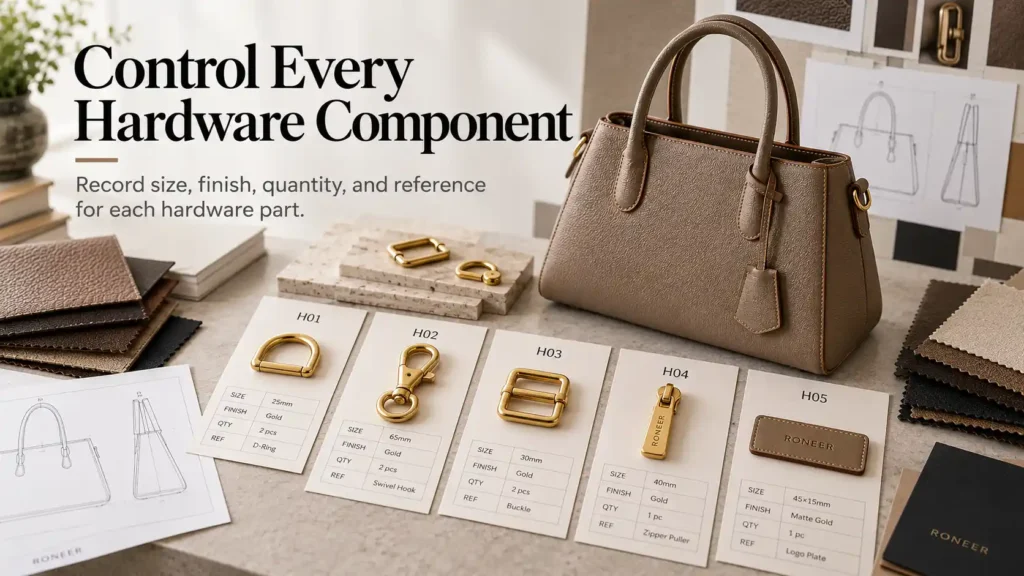
Hardware lines need enough detail to prevent a visually similar but technically different component from being substituted.
A handbag hardware BOM might include:
- Main zipper
- Pocket zipper
- Zipper puller
- D-ring
- O-ring
- Swivel hook
- Buckle
- Strap adjuster
- Magnetic snap
- Turn lock
- Rivet
- Chain
- Bottom feet
- Metal logo
Important fields may include:
- Component name
- Item code
- Malzeme
- Boyut
- Finish
- Plating color
- Logo
- Supplier reference
- Quantity per bag
For example:
| Öğe | Component | Finish | Qty / Bag |
|---|---|---|---|
| H01 | D-ring | Approved finish | 2 |
| H02 | Swivel hook | Approved finish | 2 |
| H03 | Strap adjuster | Approved finish | 1 |
| H04 | Metal logo plakası | Approved finish | 1 |
Compatibility matters too.
If a buckle is designed for 25 mm webbing, that relationship should be clear in the technical information rather than leaving the production team to discover a mismatch after components arrive.
Bu bag bill of materials should therefore be reviewed alongside drawings and dimensions, not as an isolated spreadsheet.
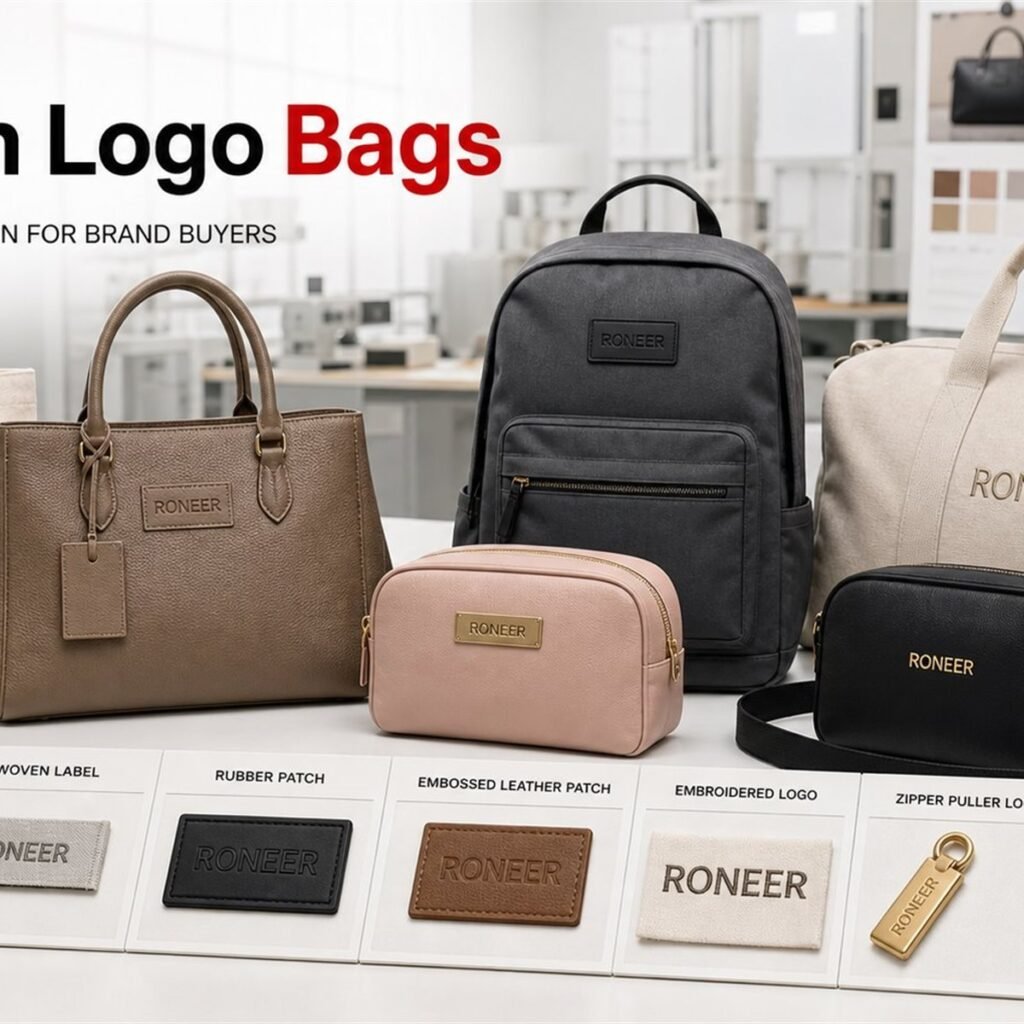
5. Include Branding, Labels, and Artwork References
Branding components are materials too.
A private-label bag may require:
- Exterior metal logo
- Kabartmalı logo
- Nakış
- Printed logo
- Woven brand label
- İç etiket
- Care label
- Country-of-origin label
- Hangtag
- Markalı fermuar çekme ucu
- Branded lining
- Packaging artwork
The BOM should identify the production method and connect it with the correct artwork version.
For example:
| Öğe | Branding Component | Reference |
|---|---|---|
| B01 | Front metal logo | Artwork LOGO-03 |
| B02 | Interior woven label | Artwork LABEL-02 |
| B03 | Hangtag | Artwork TAG-04 |
Do not use:
Logo: same as sample
if a controlled artwork file exists.
The physical sample may still help confirm appearance, but the bag bill of materials should identify which artwork version is approved for production.
This becomes particularly important after logo size, font, plating, label wording, or packaging artwork changes during sample revisions.
6. Record Unit of Measure and Quantity Per Bag
A BOM becomes much more useful when it records consumption or component quantity.
Typical units may include:
- pcs
- pair
- meter
- yard
- square meter
- sheet
- set
For hardware, quantity is usually straightforward.
For example:
- 2 × swivel hooks
- 2 × D-rings
- 1 × adjuster
- 4 × bottom feet
Material consumption can require additional production calculation because cutting efficiency, material width, pattern layout, defects, and wastage can influence purchasing quantities.
Therefore, the bag bill of materials should distinguish between:
Quantity per finished bag
ve
Bulk purchasing quantity
when those are not the same thing.
The BOM can record the product requirement, while purchasing calculations can apply the appropriate order quantity and approved waste assumptions separately.
This prevents purchasing estimates from being confused with the actual product specification.
7. Connect Every BOM Line to the Correct Colorway
Multi-color collections introduce another source of errors.
Suppose one handbag is produced in:
- Siyah
- Ivory
- Brown
- Burgundy
The main material changes, but several other items may change too:
- Astar
- Konu
- Zipper tape
- Kenar boyası
- Webbing
- Logo finish
- Hardware plating
- Hangtag sticker
- Barcode
- Packaging label
Güçlü bir bag bill of materials makes those color relationships visible.
For simple collections, a color column may be enough.
For more complicated programs, use a colorway matrix.
| Component | Siyah | Ivory | Brown |
|---|---|---|---|
| Main material | Siyah | Ivory | Brown |
| Astar | Siyah | Beige | Brown |
| Konu | Siyah | Ivory | Brown |
| Zipper tape | Siyah | Ivory | Brown |
| Donanım | Koyu gri | Light gold | Antique gold |
The point is not to create unnecessary paperwork.
It is to prevent the correct component from being used in the wrong SKU.
Colorway control becomes especially useful when several styles share materials or hardware.
8. Put Packaging Into the BOM When It Is Part of the Product Specification
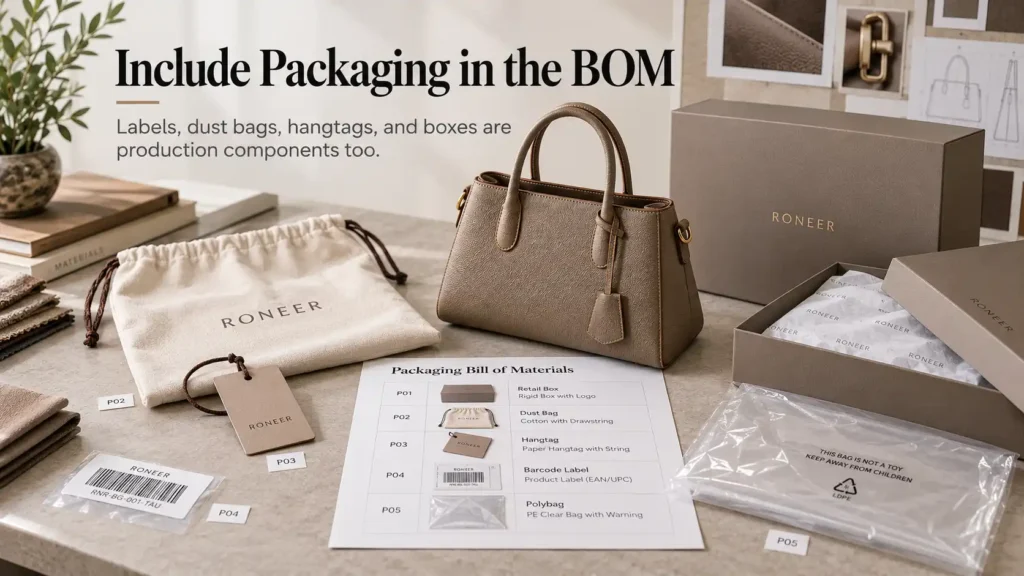
Packaging belongs in the BOM when it is part of the product that must be purchased, printed, labeled, or packed for each unit.
Depending on the project, that may include:
- Tissue paper
- Shape support
- Hardware protection
- Polybag
- Dust bag
- Hangtag
- Care card
- Barcode label
- SKU sticker
- Gift box
- Retail box
- Master carton
For retail products that require standardized product identification, GS1 provides the global system used for GTINs and retail barcodes. GS1 also explains that barcode graphics can be integrated into packaging artwork, applied through pre-printed labels, or printed directly onto packaging. GS1 Product Barcodes and GTINs GS1 Barcode Application Guidance
A retail packaging BOM might therefore record:
| Öğe | Packaging Component | Qty / Unit |
|---|---|---|
| P01 | Dust bag | 1 |
| P02 | Hangtag | 1 |
| P03 | Barcode sticker | 1 |
| P04 | Polybag | 1 |
| P05 | Tissue set | 1 |
Cartons may be handled separately according to packing quantity, but carton specifications and marks should still be controlled somewhere in the production documentation.
Packaging is particularly important when several markets, retailers, or SKU labels are involved.
One handbag can be manufactured correctly and still become the wrong commercial product if its label or packaging version is incorrect.
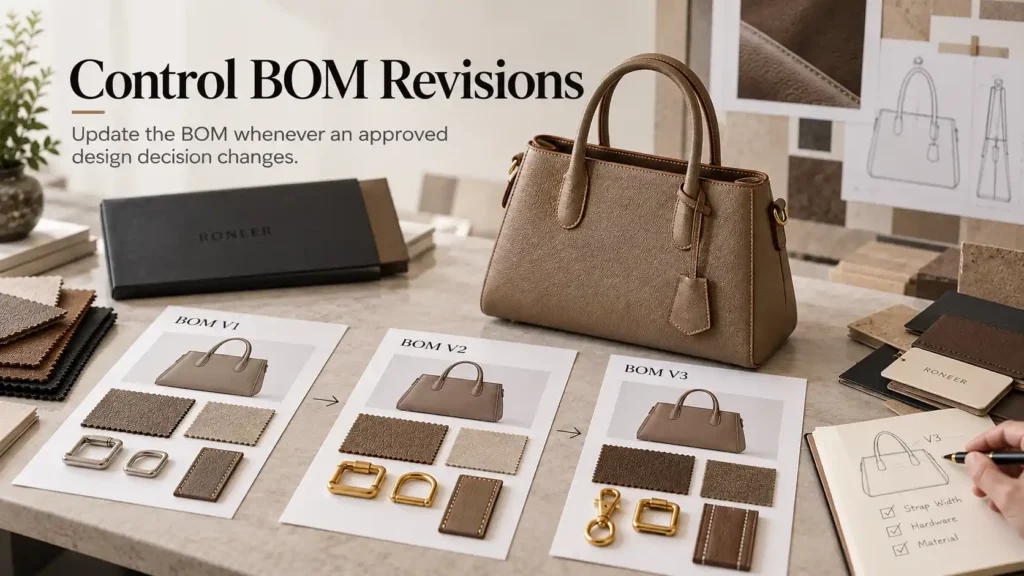
9. Control BOM Versions Before Sampling and Bulk Production
Every BOM needs version control because one small design revision can change several material and component lines at once.
Imagine the buyer changes the shoulder strap from 20 mm to 25 mm.
That can affect:
- Strap material
- Buckle width
- Adjuster
- D-ring
- Swivel hook
- Takviye
- Pattern pieces
Changing one drawing while leaving the old BOM active creates a production conflict.
A bag bill of materials should therefore include information such as:
- Style number
- BOM revision
- Revision date
- Prepared by
- Reviewed by
- Approval status
- Change notes
Example:
| Version | Change |
|---|---|
| BOM V1 | Initial development |
| BOM V2 | Main material updated |
| BOM V3 | Strap changed from 20 mm to 25 mm |
| BOM V4 | Final hardware and packaging approved |
Do not delete old versions without a trace.
The production team needs to know which file is current, while product-development teams may need the previous version to understand how the design evolved.
For a broader manufacturing reference, Autodesk’s BOM management guidance also emphasizes maintaining BOM data as products and manufacturing requirements change. Autodesk BOM Management Overview
A Practical Bag Bill of Materials Template
A basic factory-ready structure can use columns like these:
| Item No. | Category | Component | Şartname | Renk | Reference | UOM | Qty / Bag | Status |
|---|---|---|---|---|---|---|---|---|
| M01 | Exterior | Main material | Approved spec | Taupe | MAT-01 | m² | TBC | Approved |
| M02 | İç Mekan | Astar | Polyester | Beige | LIN-02 | m | TBC | Approved |
| R01 | Yapı | Bottom reinforcement | Approved board | Natural | REF-03 | pcs | 1 | Approved |
| Z01 | Fermuar | Main zipper | Approved size | Matching | ZIP-01 | pcs | 1 | Approved |
| H01 | Donanım | D-ring | Approved size | Light gold | HW-02 | pcs | 2 | Approved |
| H02 | Donanım | Swivel hook | Approved size | Light gold | HW-03 | pcs | 2 | Approved |
| B01 | Branding | Metal logo | Artwork LOGO-03 | Light gold | ART-03 | pcs | 1 | Approved |
| P01 | Paketleme | Dust bag | Approved size | Natural | PKG-01 | pcs | 1 | Approved |
| P02 | Paketleme | Hangtag | Artwork TAG-02 | Brand color | ART-04 | pcs | 1 | Approved |
This is only a framework.
A backpack may require webbing, mesh, foam, binding, buckles, sternum-strap components, laptop padding, and multiple zipper specifications.
A structured handbag may require more reinforcement, edge paint, metal hardware, and lining components.
A cosmetic bag may have fewer structural parts but more emphasis on lining, zipper, coating, or printing.
Bu bag bill of materials should reflect the actual product rather than forcing every category into one fixed template.
BOM vs. Tech Pack: What Is the Difference?
A BOM is part of the manufacturing information, but it is not the entire tech pack.
A complete bag tech pack may also contain:
- Cover and style information
- Technical drawings
- Finished measurements
- Points of measure
- Construction details
- Stitching notes
- Pocket layout
- Logo positioning
- Colorways
- Packaging instructions
- Revision history
- Quality requirements
Bu bag bill of materials answers primarily:
What materials and components make this product?
Technical drawings answer:
Where do those components go?
Measurements answer:
What size should the finished product be?
Construction notes answer:
How should those pieces be assembled?
This is why the BOM and tech pack should reference each other rather than becoming separate documents that gradually contradict one another.
BOM vs. Costing Sheet
A bag bill of materials and a costing sheet are related, but they solve different problems.
The BOM defines what the product contains.
The costing sheet calculates what those materials, components, labor, packaging, overhead, and other commercial factors cost.
For example, the BOM may state:
Two approved swivel hooks per bag.
The costing calculation may then use:
- Component purchase price
- Order quantity
- Supplier MOQ
- Currency
- Wastage
- Freight or sourcing cost
Keeping these functions separate makes updates easier.
A material price can change without changing the product specification.
Likewise, changing the hardware specification should trigger a BOM revision even if the new hardware happens to cost the same.
Should Recycled or Certified Material Information Be Included?
If a project depends on a specific material claim or documentation requirement, the relevant material reference should be controlled in the BOM.
Do not write vague terms such as:
recycled fabric
when the project requires a particular supplier document, composition, material standard, or approved certificate.
Textile Exchange published its Materials Matter Standard framework for raw materials used in the fashion, textile, and apparel industry, including specific criteria for recycled materials. The current transition framework also distinguishes between material requirements and the documentation needed to support claims. Textile Exchange Materials Matter Standard Recycled Materials Criteria
Bu bag bill of materials can record the approved material code and documentation status, while compliance evaluation should follow the buyer’s actual market and project requirements.
Do not treat a generic supplier description such as “recycled polyester” as proof of certification or compliance unless the required project documentation has been reviewed.
What Should Be Frozen Before Bulk Production?
Before releasing the order, review whether the BOM matches the approved physical sample and current technical file.
Check:
- Main material
- Secondary material
- Astar
- Takviye
- Köpük
- Konu
- Edge finish
- Webbing
- Zippers
- Donanım
- Logo
- Labels
- Paketleme
- Colorways
- Quantity per bag
- Revision number
The final question is simple:
If another production team received only this BOM and the approved tech pack, would they know which components to prepare?
If the answer is no, the bag bill of materials still contains assumptions.
Common BOM Mistakes That Create Production Problems
Using Generic Material Names
“Black PU” is not a controlled material specification.
Mixing Several Components in One Row
Different components need separate identities if they can change independently.
Forgetting Hidden Materials
Reinforcement, backing, foam, and adhesives may influence the finished result.
Leaving Hardware Sizes Undefined
A visually similar buckle may not fit the intended strap.
Missing Color Relationships
A black bag may accidentally receive the hardware or zipper tape intended for another colorway.
Using Old Artwork
Logo and label files should identify the approved revision.
Ignoring Packaging
Retail labels, dust bags, tags, and boxes are still production components.
Failing to Update the BOM After Sampling
The approved sample and BOM should describe the same product.
FAQ About Bag Bill of Materials
1. What is a bag bill of materials?
A bag bill of materials is a controlled list of the materials, trims, hardware, labels, and packaging required to manufacture a bag. It can include specifications, colors, references, units, quantities, and approval status.
2. Is a BOM the same as a handbag tech pack?
No. The BOM is normally one part of a larger tech pack. The tech pack may also include drawings, measurements, construction instructions, artwork placement, colorways, packaging information, and revision history.
3. What materials should be included in a bag BOM?
Include all materials that materially define the product, such as exterior fabric or leather, lining, reinforcement, foam, webbing, thread, zippers, hardware, labels, logo components, and packaging.
4. Should hidden reinforcement be included?
Yes, when it affects construction or product performance. Hidden reinforcement should not depend only on factory memory if it is part of the approved product.
5. Should every hardware component have its own BOM line?
Usually, separate components that have their own size, finish, quantity, or sourcing reference should have separate lines. This makes revisions and purchasing clearer.
6. Should packaging be included in a bag bill of materials?
Yes, when packaging is part of the required unit specification. Dust bags, hangtags, polybags, barcode labels, inserts, and boxes can all be controlled through the BOM.
7. How should different colorways be managed?
Use color-specific BOM fields or a colorway matrix so the main material, lining, thread, zipper tape, hardware, labels, and packaging can be matched correctly to each SKU.
8. What does quantity per bag mean?
It records how many pieces or how much material one finished bag requires. Bulk purchasing quantities may require separate calculations for order quantity, cutting yield, supplier MOQ, and production allowances.
9. When should the BOM be updated?
Update it whenever an approved change affects material, hardware, construction components, branding, packaging, quantity, or colorway requirements.
10. Should the sample and BOM have the same revision?
The approved production BOM should correspond with the current approved sample and technical specification. Any differences should be documented rather than left to interpretation.
11. Can a bag factory help create a BOM?
Yes. When a buyer provides a reference design, sample, drawings, or tech pack, the factory may help clarify practical material and component options. Final specifications still need buyer confirmation before bulk production.
12. What should I send with a BOM when requesting a quotation?
Send the relevant technical drawings, dimensions, material references, artwork, quantity, color breakdown, packaging requirements, and project notes. If your BOM is ready and you want the factory to review the project, you can contact RONEER and upload your files here.
Sonuç
A bag bill of materials is not simply a spreadsheet listing fabric and hardware.
It is a controlled manufacturing reference connecting product design with sourcing, quotation, sampling, purchasing, production, packaging, and repeat orders.
A useful BOM gives every important component an identity. It records the approved exterior material, lining, hidden reinforcement, hardware, branding, labels, packaging, colorway relationships, quantities, and revision status.
Most importantly, it stays synchronized with the approved sample and technical documents.
For RONEER OEM/ODM projects, BOM review can be connected with material selection, structure development, logo options, hardware, lining, packaging, sample revisions, and production planning according to the confirmed buyer specification.
A well-maintained bag bill of materials reduces the number of decisions left to memory and gives both the buyer and factory a clearer reference for building the same approved product again.