 English
  Deutsch
  Español
  Français
  Italiano
  Русский
  日本語
日本語  العربية
  Türkçe
  한국어
한국어 A beautiful sample can hide a weak production system.
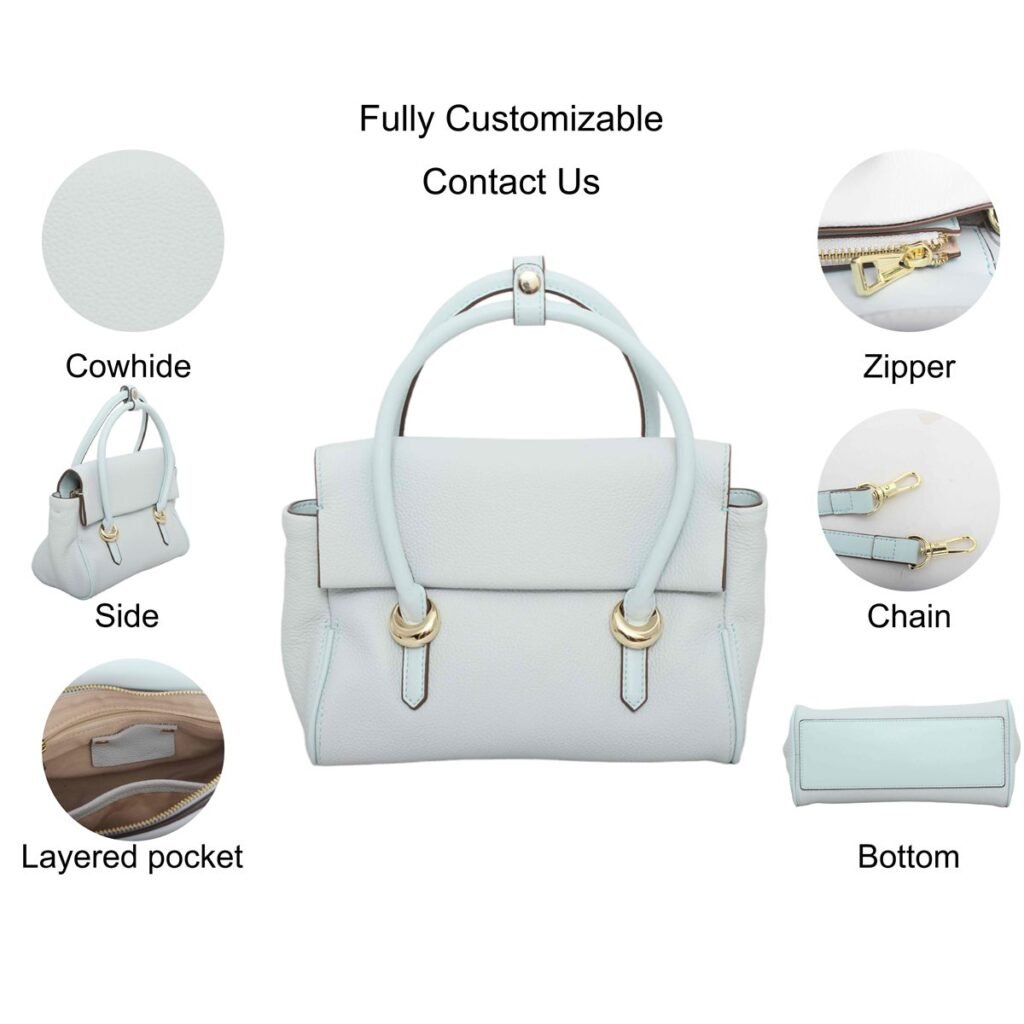
Some suppliers produce an impressive first handbag but struggle to repeat the same material, shape, hardware finish, stitching, or packaging across a bulk order. Others may be strong in promotional tote bags but lack the pattern engineering and finishing control required for structured fashion handbags.
That is why comparing handbag manufacturers in China requires more than collecting quotations.
Fashion brands, boutique retailers, wholesalers, Amazon sellers, corporate buyers, and private label companies need to understand which factory matches their product category, development method, quantity, quality level, and target market.
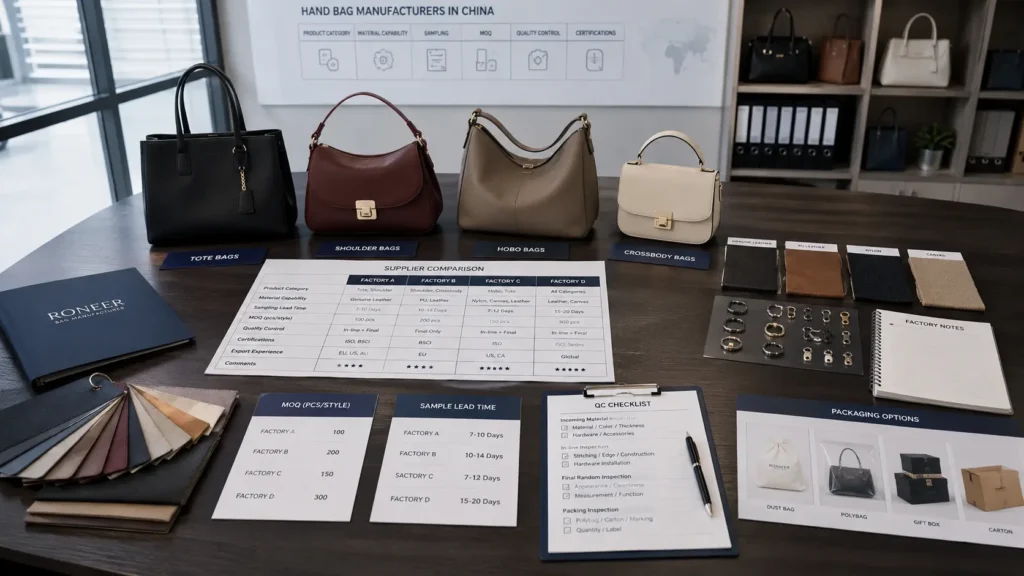
This guide compares 13 handbag manufacturers in China using publicly available information about their product focus and manufacturing services. It also explains how buyers should evaluate OEM and ODM development, sampling, materials, MOQ, quality control, packaging, and repeat production.
This article is published by RONEER, which is included as one of the manufacturing options. The companies are not ranked from best to worst, and inclusion does not represent a guarantee or independent certification. Buyers should verify current factory information, quotations, samples, certifications, production capacity, and commercial terms directly before placing an order.
How We Compared Handbag Manufacturers in China
Different factories serve different buyers. A large manufacturer working with established fashion companies may not accept the same quantity or development method as a startup-focused factory.
The comparison considers several practical factors:
- Primary handbag categories
- OEM and ODM development
- Private label support
- Material options
- Sampling and pattern development
- Suitability for startups or established brands
- Bulk production planning
- Quality control communication
- Packaging and export readiness
- Repeat-order consistency
Public website claims are useful for creating an initial shortlist, but they should not replace due diligence. Buyers should request current factory information, physical samples, production references, inspection procedures, commercial terms, and written specifications.
Quick Comparison of Handbag Manufacturers in China
| Manufacturer | Main Focus | Potential Buyer Fit |
|---|---|---|
| RONEER | OEM/ODM handbags and multi-category custom bags | Startups, private labels, retailers, and growing brands |
| Sitoy Group | High-end handbags and small leather goods | Established premium and high-volume brands |
| Superl Group | Branded affordable-luxury handbags | Larger fashion programs and scalable production |
| SLBAG | Custom ladies’ handbags, purses and wallets | Startups and private label handbag brands |
| J.D. Handbag Factory | Fashion handbags in leather, PU, and fabric | OEM/ODM and private label buyers |
| B.S. Bag Factory | Boutique-ready custom handbags | Lower-volume brands and custom development |
| Mherder | Leather bags and small leather goods | Leather-focused brands and wholesalers |
| Handbagio | Wholesale and custom handbags | Flexible sourcing and ready-to-customize programs |
| XINZIRAIN | Custom bags and footwear | Fashion labels needing coordinated development |
| Fiedle | Genuine leather handbags | Mid- to higher-positioned leather brands |
| JH Handbags | Custom leather handbags | OEM brands seeking leather product development |
| Miya Fashion Bags | Handbags and broader custom bag categories | Corporate, fashion, and multi-category buyers |
| HerminFashion | Ladies’ fashion handbags | Trend-led private label and wholesale buyers |
The table is a starting point rather than a final supplier decision. Actual MOQ, materials, sampling time, capacity, pricing, and market compliance must be confirmed for each project.
1. RONEER
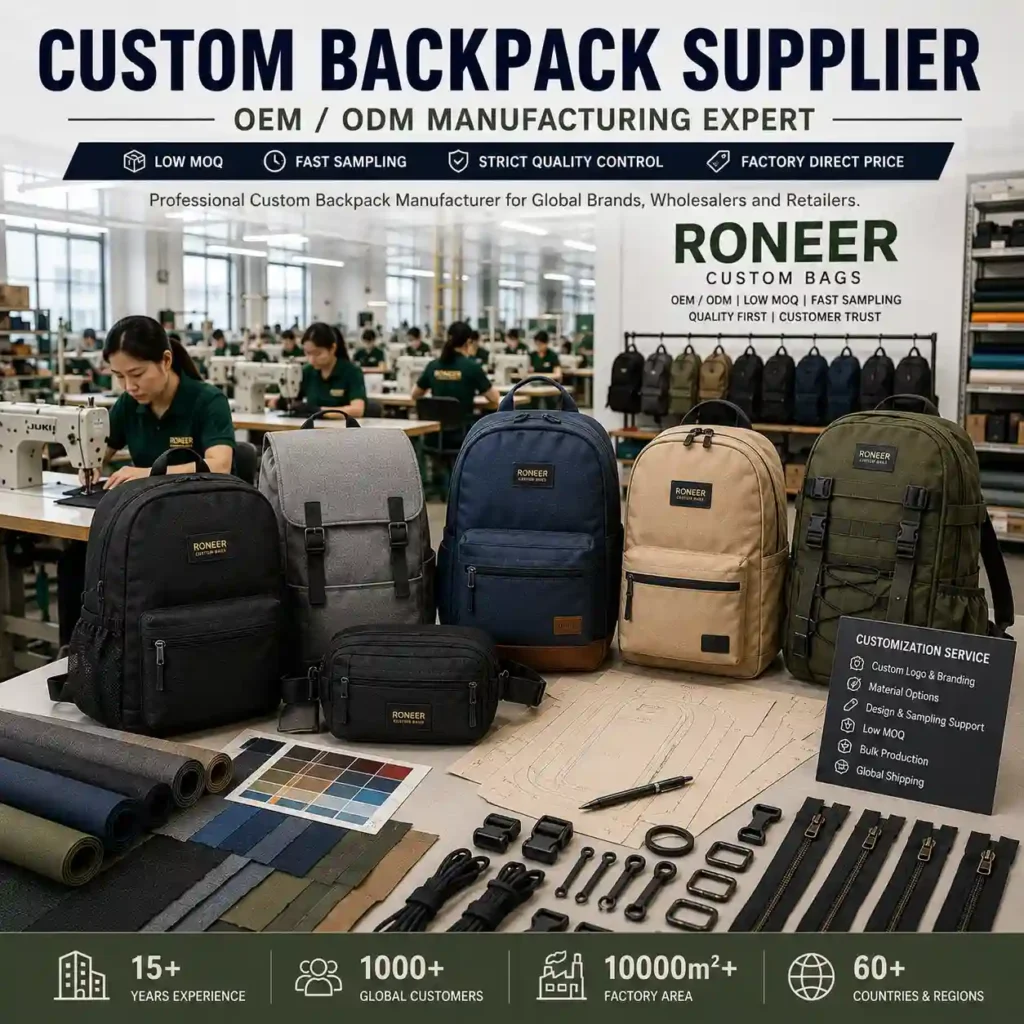
RONEER is the bag brand established by Jiangmen Baijia Leather Products Co., Ltd. Its product coverage includes handbags, crossbody bags, backpacks, travel bags, laptop bags, wallets, and other custom categories. The company presents OEM/ODM development, private label support, material sourcing, logo customization, packaging, sampling, quality communication, and export support as core services.
RONEER may suit buyers who want one manufacturing contact for several bag categories instead of working with separate suppliers for handbags, backpacks, cosmetic bags, and travel products.
The company’s broader category range can be useful for startups planning a coordinated collection or established buyers adding new product categories. Buyers can review the RONEER custom bag manufacturing capabilities before preparing an inquiry.
Because RONEER publishes this guide, buyers should evaluate its quotation, sample, material proposal, quality standard, and production terms using the same criteria applied to every other supplier.
Potential fit: private labels, startups, retailers, wholesalers, and multi-category bag programs.
Confirm before ordering: handbag category expertise, current MOQ, sample cost, material availability, production schedule, and inspection plan.
2. Sitoy Group
Sitoy Group focuses on the design, research, development, and manufacturing of high-end handbags, small leather goods, and travel goods. It’ss official information positions the group toward branded bridge-to-luxury and premium product programs.
Sitoy may be more relevant to established brands that need structured product development, mature supply-chain management, and scalable production. Its profile is different from smaller factories focused mainly on low-MOQ startup orders.
Buyers can review Sitoy’s official manufacturing information when assessing its high-end leather goods capabilities.
Potential fit: established premium brands, larger seasonal programs, and high-volume leather goods.
Confirm before ordering: buyer qualification, minimum project size, development capacity, material requirements, compliance documentation, and available production schedule.
3. Superl Group
Superl Group describes itself as a Hong Kong-based enterprise originally established as a manufacturer of branded affordable-luxury handbags. Public company information also indicates manufacturing operations across several Asian locations.
This type of group may be more suitable for larger programs that require scale, structured management, hardware integration, and coordinated production rather than very small experimental orders.
A buyer comparing handbag manufacturers in China should not assume that a larger group automatically offers the best fit. Large manufacturing organizations may have different onboarding requirements, MOQs, development processes, and commercial expectations.
Potential fit: established international brands and scalable fashion-handbag programs.
Confirm before ordering: factory location assigned to the project, production quantity, development ownership, sampling timeline,e and subcontracting arrangements.
4. SLBAG
SLBAG presents itself as a China-based manufacturer of ladies’ purses, wallets, handbags, and custom luxury bags. Its website emphasizes custom development and a one-stop approach that includes handbag and branding support.
The company may be relevant to emerging brands looking for fashion-focused handbag development rather than a factory centered mainly on technical backpacks or promotional bags.
Buyers should still ask whether their proposed handbag matches the factory’s strongest material and construction experience. A structured genuine-leather top-handle bag and a soft PU shoulder bag require different equipment, skills, and quality controls.
Potential fit: startups, private label handbag brands,s and fashion-focused buyers.
Confirm before ordering: current MOQ, material sourcing, sample revisions, custom hardware, packaging, and bulk quality tolerances.
5. J.D. Handbag Factory
J.D. Handbag Factory describes itself as a branch of J.D. Leather Goods and a manufacturer of fashion handbags. Related company pages state that OEM, ODM, private label, and wholesale projects can be developed from a tech pack, design draft, or physical sample.
That development flexibility may suit buyers who already have technical files as well as buyers who need a factory to translate a visual reference into patterns and samples.
A buyer should confirm which facility will produce the order because public contact information also references operations outside mainland China.
Potential fit: custom fashion handbags, OEM/ODM collections, and private label projects.
Confirm before ordering: assigned factory, material origin, pattern ownership, sample approval process, production lead time, and final inspection method.
6. B.S. Bag Factory
B.S. Bag Factory promotes custom-developed handbags from sample creation through bulk production. Its website highlights boutique-ready styles in leather, vegan leather, canvas, nylon, and other materials, while also advertising low-MOQ handbag development.
This positioning may appeal to boutique brands and startup buyers that cannot immediately place the volumes expected by a large industrial manufacturer.
Low MOQ should not be evaluated in isolation. Buyers should ask whether the minimum applies per style, per color, per material, or per logo method. Small production runs can also have higher unit costs and fewer custom material options.
Potential fit: boutiques, startups, and smaller private label launches.
Confirm before ordering: MOQ by style and color, standard versus custom materials, logo tooling, packaging minimums and repeat-order conditions.
7. Mherder
Mherder, also presented through BagsPlaza, describes itself as a Guangzhou-based OEM/ODM manufacturer of leather bags, wallets, and accessories. Its public positioning emphasizes structured sampling and bulk production for brands, wholesalers, and private label programs.
A leather-focused manufacturer may be a stronger candidate for buyers developing handbags, wallets, card holders, and coordinated small leather goods.
However, buyers should clarify what “leather” means in each quotation. Genuine leather, split leather, bonded leather, microfiber leather, and PU leather have different costs, performance, care requirements, and marketing implications.
Potential fit: leather handbag collections, wallets, and coordinated small leather goods.
Confirm before ordering: leather grade, tannery or material source, color variation tolerance, edge finishing, lining, hardware,e and documentation.
8. Handbagio
Handbagio promotes custom and wholesale handbag manufacturing, low-MOQ support, private label development, and access to ready-to-customize products. The company also identifies itself as part of Rivta.
A supplier combining wholesale styles with custom development can be useful for buyers who want to test a category before investing in a fully original OEM structure.
The buyer should clearly separate ready-made wholesale, light customization, ODM modification, and full OEM development. These models can have very different levels of exclusivity, tooling, sampling time, and design ownership.
Potential fit: buyers testing collections, private labels, and flexible wholesale-custom programs.
Confirm before ordering: whether the style is exclusive, available modifications, MOQ, sample status, logo method,d and packaging options.
9. XINZIRAIN
XINZIRAIN presents itself as a shoe and bag manufacturer offering OEM and ODM services. Its handbag pages describe support for custom leather and PU handbags, design development, materials, sampling, private label production, and custom hardware.
The combined footwear and handbag capability may be valuable for fashion labels developing coordinated accessories. It may be less relevant to buyers who want a factory focused exclusively on one narrow handbag construction.
Potential fit: fashion brands developing handbags together with footwear or related accessories.
Confirm before ordering: handbag production location, in-house versus partner operations, pattern development, material specialization, hardware tooling and project management structure.
10. Fiedle
Fiedle describes itself as an OEM/ODM leather bag manufacturer in China with a focus on genuine leather handbags, integrated development, and bulk production. Its public materials emphasize leather bag design, sampling, and manufacturing for international buyers.
A specialist leather factory can be useful for brands that require leather selection, skiving, edge finishing, reinforced handles, structured construction, and coordinated small leather goods.
Any public claims regarding certifications, workforce, production area, or monthly capacity should be confirmed with current documents rather than copied directly into a purchase decision.
Potential fit: mid-market and premium genuine-leather handbag programs.
Confirm before ordering: leather specification, sample-room capability, current audits, production capacity, defect standard, and leather color tolerance.
11. JH Handbags
JH Handbags presents itself as an OEM manufacturer specializing in custom handbags and leather goods. Its official pages emphasize long-term manufacturing experience and handbag development for private label buyers.
The company may be considered by buyers developing structured leather handbags, shoulder bags, totes, crossbody bags, or coordinated leather accessories.
As with any leather-focused supplier, buyers should request physical swatches and approved material cards. Digital photographs are not enough to evaluate grain, softness, thickness, gloss, color depth, or shape support.
Potential fit: custom leather handbags and OEM private label projects.
Confirm before ordering: business identity, factory address, leather source, sampling terms, hardware supply, bulk inspection, and export documents.
12. Miya Fashion Bags
Miya Fashion Bags presents OEM custom bags, corporate gift projects, handbags, backpacks, wallets, promotional bags, travel bags, and other categories. Its website also promotes sampling, bulk production, inspection reporting, and delivery support.
The broader product range may suit buyers planning mixed-category programs or corporate projects in addition to fashion handbags.
A multi-category supplier should still demonstrate category-specific experience. Buyers developing refined handbags should request comparable samples rather than evaluating the factory only through backpacks, travel bags, or promotional products.
Potential fit: multi-category buyers, corporate programs, and fashion-accessory collections.
Confirm before ordering: strongest product category, handbag sample quality, available materials, logo methods, QC reporting, and packaging.
13. HerminFashion
HerminFashion positions itself as a ladies’ handbag manufacturer serving global brands. Its public product collections include PU, canvas, polyester, shoulder bags, crossbody bags, tote bags, evening bags, hobo bags, baguette bags, and bucket bags with OEM and ODM support.
This range may suit buyers focused on trend-led women’s handbags and private label collections rather than heavy technical bags.
Because fashion products change quickly, buyers should confirm whether a style is an original factory-developed design, a shared ODM style, or an exclusive OEM project. This distinction affects differentiation and future resale by other buyers.
Potential fit: fashion wholesalers, private label brands and trend-driven ladies’ handbag programs.
Confirm before ordering: design exclusivity, available modifications, MOQ, material quality, sample revisions,s and packaging.
Match the Factory to the Handbag Category
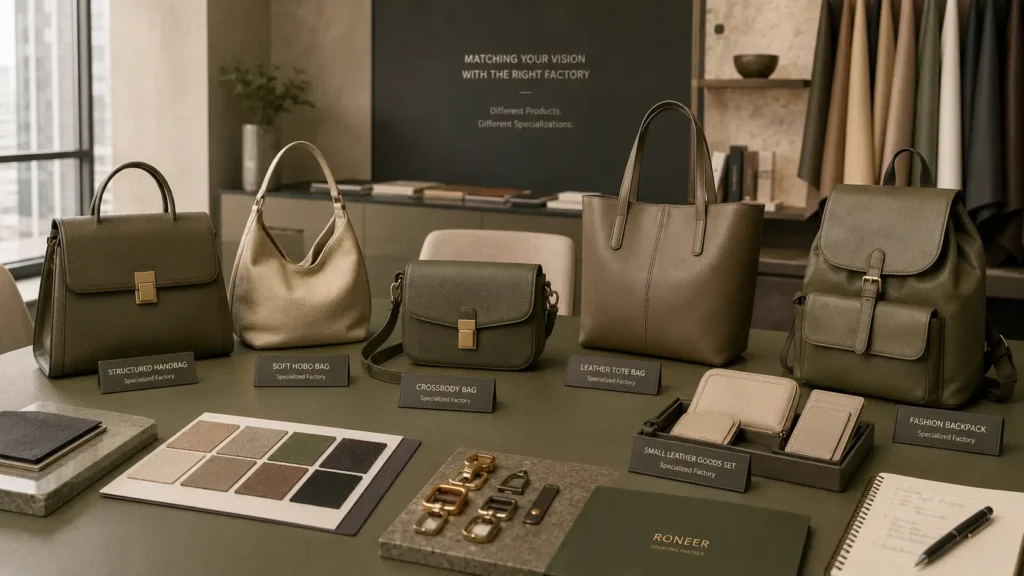
One of the most common sourcing mistakes is selecting a supplier because it appears on a list of handbag manufacturers in China without checking its strongest product category.
A factory focused on soft fashion bags may not be ideal for a rigid briefcase-style handbag. A genuine-leather specialist may not offer the best price or speed for promotional PU handbags. A large luxury-goods group may not accept a startup’s first small test order.
Before requesting quotations, classify the project:
- Structured handbag
- Soft shoulder or hobo bag
- Tote bag
- Crossbody bag
- Evening bag
- Genuine-leather handbag
- PU or microfiber handbag
- Minimalist handbag
- Laptop handbag
- Wallet and small leather goods collection
Send reference images of comparable construction, not only images showing a similar color or fashion style.
Confirm Whether You Need OEM, ODM, or Wholesale
OEM, ODM, and wholesale are not interchangeable.
OEM is appropriate when the buyer has an original design, tech pack, reference sample, special construction, custom hardware, or unique internal layout.
ODM uses a factory-developed base style that can be modified through materials, colors, logos, lining, straps, hardware, and packaging.
Wholesale generally means purchasing an existing style with limited customization.
The right model depends on launch timing, budget, differentiation, order quantity, and design ownership. Buyers should ask the factory to state clearly which model applies to the quotation.
Review Sampling Before Comparing Unit Price
A low quotation is not useful if the factory cannot reproduce the approved handbag.
Sampling should verify:
- Dimensions and proportion
- Material texture and thickness
- Handle position
- Strap length
- Pocket layout
- Zipper and closure function
- Hardware color
- Logo size and position
- Lining fit
- Stitching
- Edge finishing
- Packaging direction
The approved physical sample should become the reference for bulk production. Revision comments should be measurable rather than subjective.
“Move the logo 10 mm lower” is actionable.
“Make it look more premium” is not.
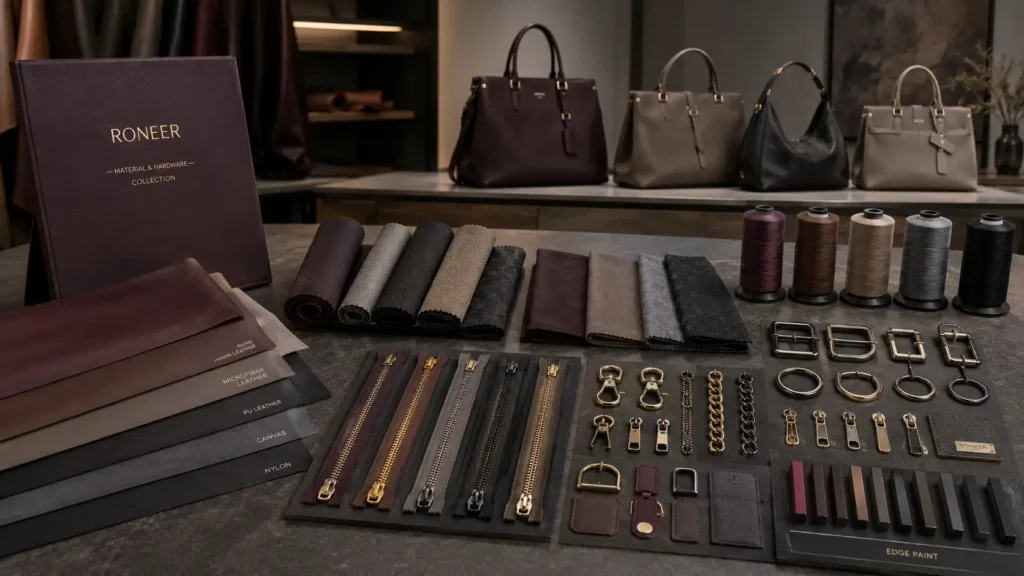
Compare Materials, Hardware, and Branding
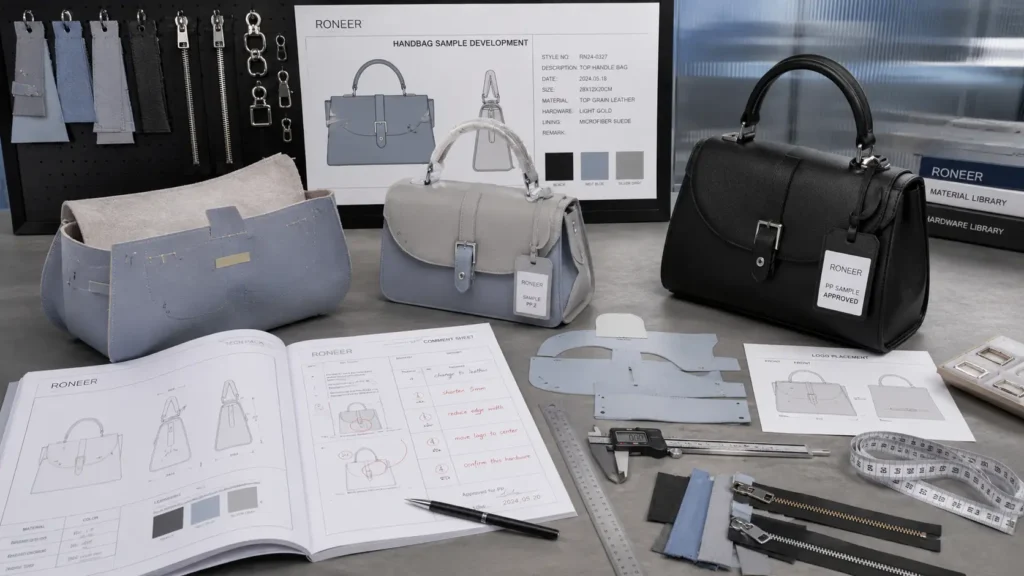
Two quotations may use completely different material and hardware standards.
Buyers can review RONEER’s material customization options when comparing PU leather, microfiber leather, genuine leather, nylon, canvas, lining, and mixed-material structures.
Important quotation details include:
- Material composition
- Thickness
- Surface grain
- Backing
- Lining specification
- Zipper type
- Hardware base metal
- Plating color
- Edge paint
- Reinforcement
- Thread specification
- Logo method
Logo development can include embossing, debossing, printing, woven labels, metal plates, custom zipper pullers, lining logos, hangtags, and packaging marks. Buyers can compare these options through RONEER’s logo customization guide.
Do not approve custom metal tooling before confirming artwork dimensions, ownership, tooling cost, sample process, and future reuse.
Verify MOQ in Detail
MOQ should be discussed at more than one level.
Ask for:
- MOQ per style
- MOQ per color
- MOQ per material
- MOQ per logo method
- MOQ for custom lining
- MOQ for custom hardware
- MOQ for packaging
- Minimum reorder quantity
A supplier may advertise a low overall MOQ but require a higher minimum for custom-dyed material or branded packaging.
For startup orders, standard materials, available colors, standard hardware, and simple logo methods usually provide more flexibility than fully exclusive components.
Quality Control and Export Readiness
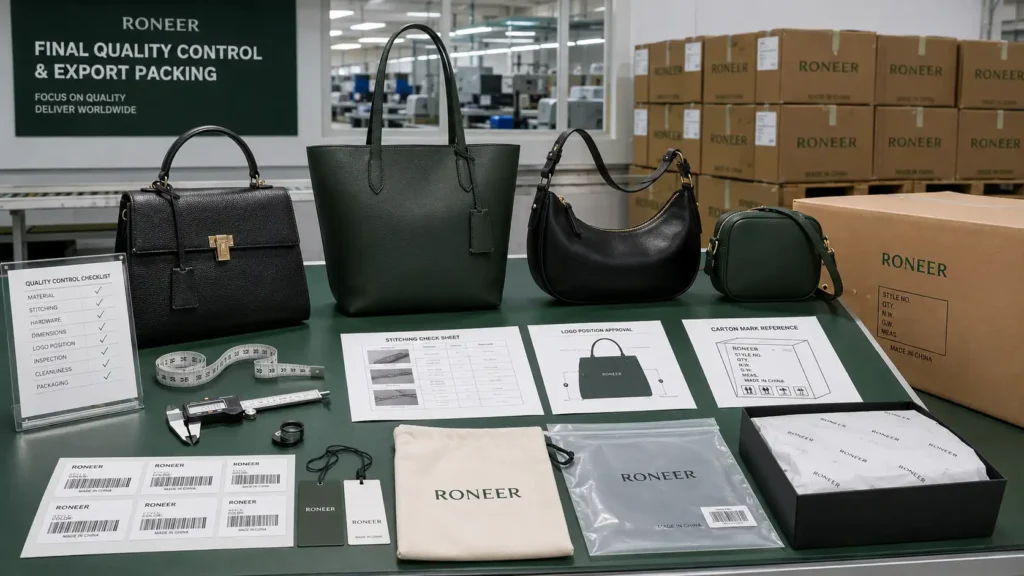
A reliable factory should define inspection points before production begins.
Typical handbag checks include:
- Material surface
- Color consistency
- Measurements
- Panel symmetry
- Stitching density
- Seam alignment
- Handle strength
- Zipper movement
- Hardware finish
- Logo position
- Edge paint
- Lining cleanliness
- Packaging
- Barcode labels
- Carton marks
Buyers considering independent inspection can refer to SGS bags and accessories testing and inspection for a general industry context. This reference does not mean every factory on this list is SGS-certified or that every order requires the same testing program.
Packaging should also be confirmed early. Depending on the sales channel, the order may require dust bags, tissue paper, care cards, hangtags, barcode labels, polybags, inner cartons, master cartons, or shape protection. RONEER’s packaging customization page explains common private label options.
Origin Marking and USA Market Claims
For products imported into the United States, buyers should discuss country-of-origin marking before bulk packing.
The U.S. Customs and Border Protection guidance explains that foreign-origin goods entering the United States generally require clear English country-of-origin marking unless an exception applies.
Brands should also avoid misleading origin claims. The Federal Trade Commission’s Made in USA guidance explains the standards applied to unqualified Made in USA claims.
A handbag produced in China should not be marketed as Made in USA merely because design, branding, inspection, or fulfillment occurs in the United States.
Importers should confirm product-specific decisions with qualified customs or compliance professionals.
Protect Original Designs and Brand Assets
A professional supplier should not be asked to copy protected logos, signature hardware, branded patterns, or highly recognizable luxury designs.
Buyers should prepare:
- Original logo files
- Original technical drawings
- Version-controlled tech packs
- Written tooling ownership terms
- Sample approval records
- Confidentiality terms, where appropriate
- Clear limits on factory photography and marketing use
A low price does not justify counterfeit branding or misleading claims about producing for famous luxury brands.
Red Flags When Comparing Handbag Manufacturers in China
Be cautious when a supplier:
- Gives a final quotation without dimensions or material detail
- Claims that every material has the same MOQ
- Refuses to provide a physical sample
- Avoids identifying the production location
- Promises exact copies of protected branded handbags
- Changes payment information without formal verification
- Cannot explain its inspection process
- Uses vague terms such as premium or top quality without specifications
- Provides incompatible business names across invoices and bank accounts
- Pressures the buyer to approve bulk production before sample confirmation
One red flag does not always prove fraud, but several together justify deeper verification.
Request-for-Quotation Checklist
Send the same specification to each shortlisted factory so quotations remain comparable.
Include:
- Handbag category
- Dimensions
- Reference images
- Tech pack if available
- Exterior material
- Lining
- Hardware finish
- Logo artwork
- Closure
- Strap and handle requirements
- Pocket structure
- Target quantity
- Number of colors
- Packaging
- Target market
- Expected sample date
- Required delivery date
Ask the supplier to separate:
- Sample fee
- Tooling fee
- Unit price
- Logo cost
- Packaging cost
- Testing or inspection cost
- Shipping terms
- Payment terms
This structure makes it easier to compare handbag manufacturers in China without treating incomplete quotations as equivalent.
FAQ About Handbag Manufacturers in China
1. What services do handbag manufacturers in China usually provide?
Handbag manufacturers in China may provide OEM development, ODM customization, private label production, pattern making, material sourcing, sample development, logo customization, packaging, bulk manufacturing, quality inspection, and export packing. The exact service scope depends on the factory’s size, product specialization, order quantity, and target market experience.
2. Why do international brands work with handbag manufacturers in China?
International brands often work with handbag manufacturers in China because the country has established supply chains for leather, PU leather, microfiber leather, lining, zippers, metal hardware, packaging, and other handbag components. Buyers may also benefit from flexible OEM/ODM development, scalable production, and access to different factory types.
3. How can I verify handbag manufacturers in China before ordering?
Buyers should verify the legal company name, factory address, production location, business documents, bank account information, sample quality, material specifications, inspection procedures, and commercial terms. Video calls, factory visits, third-party audits, physical samples, and smaller test orders can provide additional evidence.
4. What is the difference between factories and trading companies in China?
A factory directly manages handbag production, while a trading company usually coordinates orders through one or more manufacturers. Some trading companies offer useful sourcing and project management support, but buyers should understand who controls material purchasing, sampling, bulk production, quality control, and delivery.
5. What MOQ do handbag manufacturers in China usually require?
MOQ varies by style, material, color, hardware, logo method, lining, packaging, and factory schedule. Some handbag manufacturers in China may offer more flexible quantities for existing ODM styles and standard materials, while fully original OEM projects usually require higher minimums.
6. Can startups work with handbag manufacturers in China?
Yes. Startups can work with handbag manufacturers in China if they prepare a focused product plan, realistic budget, clear specifications, and practical MOQ expectations. Using available materials, standard hardware, simple packaging, and limited colors can make the first production run easier to manage.
7. What should I send when requesting a quotation?
A quotation request should include the handbag type, target dimensions, reference photos, tech pack if available, exterior material, lining, hardware finish, logo artwork, closure, strap details, pocket layout, target quantity, color count, packaging requirements, destination market, and expected delivery date.
8. How long does sampling take with handbag manufacturers in China?
Sampling time depends on the handbag’s structure, material availability, pattern development, custom hardware, logo tooling, and revision rounds. A modified ODM sample may be completed more quickly than a fully original structured handbag requiring new patterns and custom components.
9. Should I approve samples only through photos?
No. A physical sample allows buyers to evaluate material feel, weight, balance, measurements, zipper movement, handle comfort, hardware finish, logo depth, lining fit, edge finishing, and packaging. Photos are useful for recording revisions, but they should not replace physical approval for important projects.
10. What materials can handbag manufacturers in China source?
Common options include genuine leather, microfiber leather, PU leather, nylon, polyester, canvas, suede-like materials, lining fabrics, foam, reinforcement materials, webbing, zipper tape, and mixed-material constructions. Buyers should request exact specifications instead of relying on general descriptions such as premium or high quality.
11. Can handbag manufacturers in China develop custom metal hardware?
Many handbag manufacturers in China can coordinate custom logo plates, zipper pullers, buckles, locks, D-rings, sliders, chains, and other metal parts. Buyers should confirm tooling cost, artwork dimensions, mold ownership, plating finish, MOQ, testing requirements, and future reuse before approving development.
12. How should I compare quotations from different factories?
Use the same specification for every supplier and compare material grade, lining, hardware, construction, logo process, packaging, sample fees, tooling fees, MOQ, production lead time, inspection standard, payment terms, and shipping terms. Unit prices are not directly comparable when the underlying specifications are different.
13. What quality checks should handbag manufacturers in China perform?
Quality checks may include material surface, color consistency, measurements, panel symmetry, stitching, seam strength, handle attachment, zipper function, hardware finish, logo position, edge paint, lining cleanliness, packaging, barcode labels, quantity, and carton marks. Buyers should ask whether inspection occurs during production as well as before shipment.
14. Can handbag manufacturers in China provide private label packaging?
Yes. Depending on the project, factories may support dust bags, tissue paper, hangtags, care cards, barcode labels, polybags, gift boxes, inner cartons, and export cartons. Packaging MOQ and lead time may differ from the handbag production MOQ.
15. How can buyers protect an original handbag design?
Buyers should use original artwork, version-controlled tech packs, written confidentiality terms, sample approval records, tooling ownership agreements, and clear limits on factory photography or marketing use. Complete production files should not be shared with unverified suppliers during the earliest inquiry stage.
16. Are all handbag manufacturers in China suitable for luxury handbags?
No. Some factories specialize in promotional or basic fashion bags, while others focus on structured handbags, genuine leather products, premium finishing, or large branded programs. Buyers should request samples of comparable products and review the factory’s actual construction and material experience.
17. How does RONEER compare with other handbag manufacturers in China?
RONEER supports OEM and ODM handbag development, materials, logos, sampling, packaging, bulk production coordination, quality communication, and export preparation. Because RONEER publishes this article, buyers should independently compare its quotation, sample quality, technical response, production terms, and project fit with other shortlisted factories.
Conclusion
Handbag manufacturers in China serve very different segments of the global bag market. Some factories specialize in premium leather goods, some focus on trend-led fashion handbags, and others are more suitable for private label startups, wholesale programs, or multi-category bag collections. A supplier should therefore be evaluated according to the actual handbag project rather than general factory size or price.
The strongest sourcing process begins with product category fit. Buyers should confirm whether shortlisted handbag manufacturers in China have real experience with the required silhouette, material, construction, lining, hardware, logo method, and packaging standard. A factory that performs well with simple totes may not be the right choice for structured top-handle handbags or premium leather products.
Sampling is the next important test. Reliable handbag manufacturers in China should be able to translate drawings, tech packs, reference samples, and written specifications into a measurable physical sample. They should also explain production limitations, record revisions, and use the approved sample as the standard for bulk manufacturing.
Material and quotation comparisons must be detailed. Two factories may offer similar unit prices while using different leather grades, lining weights, hardware finishes, reinforcement methods, logo processes, or packaging standards. Buyers should align the complete specification before comparing prices.
Quality control should also be discussed before production begins. Professional handbag manufacturers in China should define inspection points for materials, measurements, stitching, hardware, logo placement, lining, finishing, packaging, labels, and carton marks. In-line inspection can identify problems before they affect the full order.
RONEER is one of the handbag manufacturers in China supporting international brands, retailers, wholesalers, e-commerce sellers, and private label buyers. Its service scope can include OEM/ODM development, material customization, logo options, sample development, packaging planning, production coordination, quality communication, and export packing.
A practical sourcing strategy is to prepare one clear specification, shortlist several relevant handbag manufacturers in China, request comparable quotations, approve physical samples, verify production details, and record every confirmed requirement. This approach reduces sourcing risk and makes future reorders easier to control.