 English
  Deutsch
  Español
  Français
  Italiano
  Русский
  日本語
日本語  العربية
  Türkçe
  한국어
한국어 A custom bag sample can look ready on a desk and still be unsafe to release into bulk production.
The dimensions may appear correct until the bag is filled. The logo may look balanced while the bag is empty but shift visually after the side gussets expand. A zipper may work during a quick inspection yet become difficult around a loaded corner. The material may have the right color but the wrong thickness, backing, stiffness, or surface finish. Even worse, the buyer may approve the latest physical sample while the factory still has an older measurement sheet or artwork file.
That is why a custom bag sample approval checklist should do more than confirm appearance.
For brands, sourcing teams, wholesalers, retailers, promotional buyers, and private-label businesses, final sample approval is the point where product-development decisions need to become controlled production instructions. A practical custom bag sample approval checklist helps the buyer identify unresolved details before those details are repeated across hundreds or thousands of finished bags.
The objective is simple: before bulk materials are cut and branded components are ordered, the buyer and manufacturer should know exactly which version is approved, what details must be reproduced, and which requirements still remain open.
This guide explains the 12 checks buyers should complete before releasing a custom bag sample for production.
Why Sample Approval Is Different From Simply Liking the Sample
During development, samples are expected to change.
A first prototype may help evaluate proportion and structure. A second version may correct pocket dimensions, handle drop, reinforcement, material stiffness, or branding. Another revision may introduce the final zipper, lining, hardware finish, packaging, or logo method.
The problem begins when those changes are discussed across separate emails, messaging apps, marked photos, spreadsheets, and verbal conversations without one final production reference.
A useful custom bag sample approval checklist therefore answers three questions:
- Is this the correct sample version?
- Does every important specification match the buyer’s approved requirement?
- Can the factory reproduce the approved result during bulk production?
Buyers developing a new handbag can also compare these requirements with the broader development process used by a Custom Handbag Manufacturer, where material selection, pattern development, sampling, revision, and production are connected rather than treated as separate decisions.
The final approval process should reduce interpretation. It should convert the physical sample, specifications, artwork, materials, and buyer comments into one controlled reference for production.
1. Confirm the Exact Sample Version Before Approval
Do not begin by checking stitching.
Begin by proving that everyone is reviewing the same sample.
A final approval record should identify information such as:
- Style or SKU number
- Product name
- Sample version
- Revision date
- Colorway
- Current tech pack or specification version
- Artwork version
- Packaging version
- Buyer-side approver
- Factory-side project reference
This becomes especially important after several sample rounds.
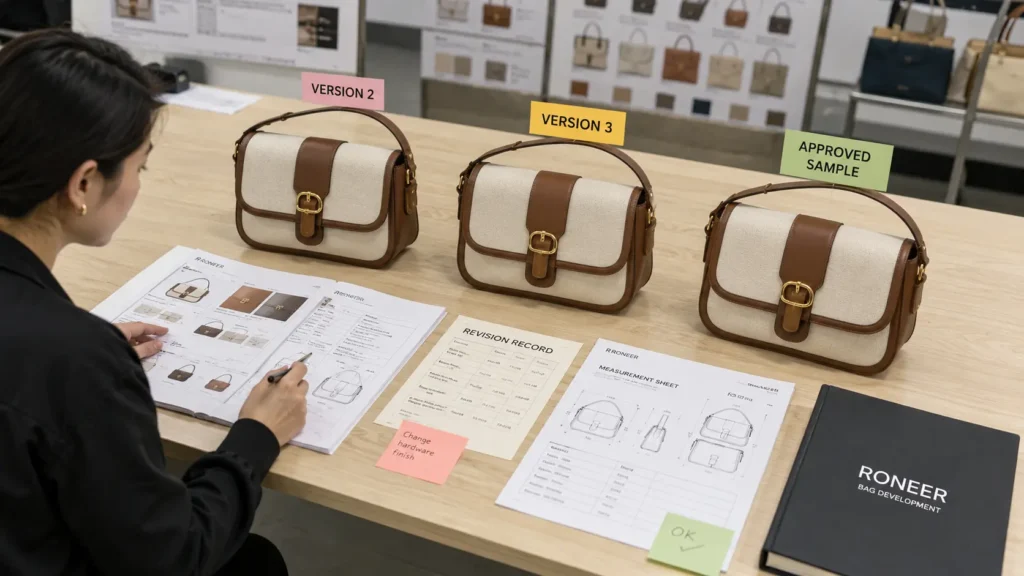
For example, Version 2 may have the correct body size while Version 3 contains a revised strap. Version 4 may change only the logo position. If the physical sample and the written specification are not synchronized, production can unintentionally combine details from different revisions.
Your custom bag sample approval checklist should therefore treat revision control as the first approval gate.
Never approve a sample simply by writing “OK” beneath a photo if important specifications exist elsewhere. The version number on the approved physical sample should correspond with the current measurement sheet, material reference, logo artwork, and revision record.
This first step makes every later check in the custom bag sample approval checklist more reliable because the buyer and production team are evaluating the same product version.
2. Measure the Finished Bag, Not Only the Pattern
A bag is a three-dimensional soft product.
Its finished dimensions can be affected by material thickness, seam construction, padding, binding, reinforcement, gusset design, edge finishing, and how the bag is measured.
Review the agreed measurement points, which may include:
- Overall width
- Height
- Depth
- Bottom width
- Gusset width
- Handle drop
- Handle length
- Shoulder strap length
- Shoulder strap width
- Zipper opening
- Pocket dimensions
- Laptop compartment
- Bottle pocket
- Logo location
- Hardware position
Do not assume that every measurement needs the same tolerance.
Instead, the buyer and manufacturer should define tolerances according to the construction, material, intended use, and commercial requirement of the specific product.
A structured handbag, soft tote, cosmetic pouch, backpack, laptop bag, and duffel bag may require different measurement priorities.
The most useful comments are measurable.
Instead of:
“Make the handle slightly longer.”
Use:
“Revise the finished handle drop to the approved measurement shown in the current specification.”
The goal is to remove interpretation before bulk production begins.
Dimensions should also be recorded in the custom bag sample approval checklist rather than confirmed only through visual comparison. A bag can look proportionally correct while still being outside the buyer’s required dimensions.
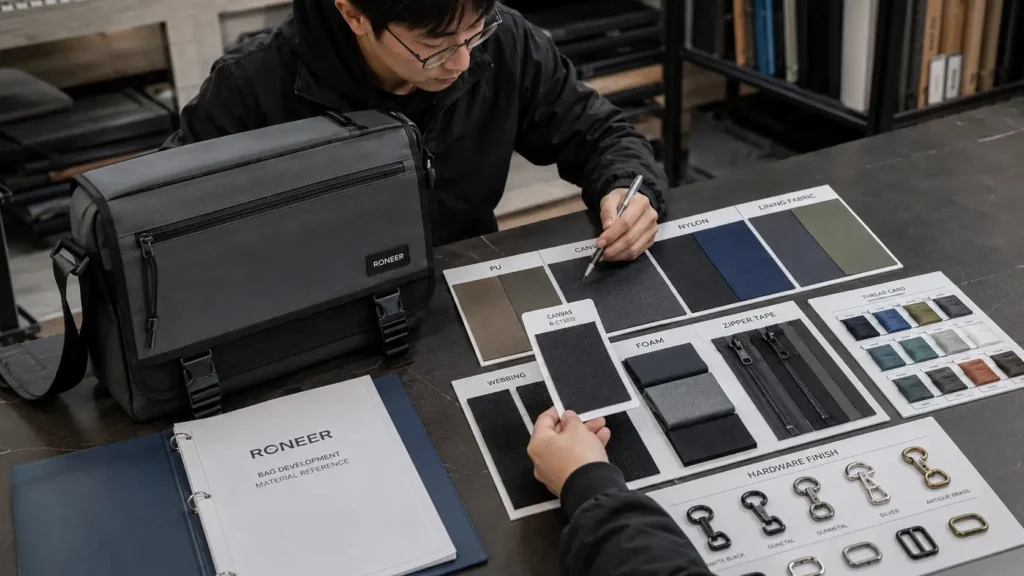
3. Lock the Actual Material Reference
One of the biggest sample-to-production risks is approving a material description that is too general.
Words such as:
- PU leather
- Nylon
- Polyester
- Canvas
- Microfiber
- Genuine leather
do not fully define a production material.
Two materials in the same category can differ significantly in thickness, weight, backing, grain, softness, coating, surface gloss, structure, abrasion behavior, and color.
Before approving the sample, confirm the material reference used for:
- Main outer material
- Secondary panels
- Lining
- Webbing
- Reinforcement
- Foam
- Binding
- Piping
- Thread
- Handle construction
- Strap material
Where practical, retain an approved physical swatch or supplier reference together with the sample record.
This is where the Material Customization process should connect directly with the custom bag sample approval checklist.
The sample should not merely demonstrate a general material direction. It should establish what material the buyer expects the bulk order to reproduce.
If a bulk-material substitution becomes necessary later, it should be reviewed again rather than silently treated as equivalent.
Material confirmation is particularly important when the bag depends on stiffness, surface texture, coating, thickness, grain, padding, or a specific hand feel. These characteristics may influence the finished shape, stitching behavior, logo application, edge finishing, and perceived product quality.
4. Review Color on the Actual Production Material
A digital color reference is helpful, but it is not the complete approval standard.
The same target color can appear different on:
- Smooth PU
- Pebbled PU
- Canvas
- Nylon
- Polyester
- Mesh
- Webbing
- Lining fabric
- Embroidery thread
- Printed logos
- Metal plating
Surface texture, gloss, coating, fiber structure, and lighting all influence perceived color.
When reviewing the sample, compare the body material, lining, webbing, zipper tape, thread, printed areas, patches, and hardware finish as a complete product rather than approving each item independently.
For multi-color collections, make sure the approval record identifies which components belong to each SKU or colorway.
This avoids a common production mistake: the right component being used in the wrong color combination.
The custom bag sample approval checklist should therefore identify the approved color reference together with the corresponding material or component. A color code without a material reference may not fully define the visual result.
5. Approve the Logo on the Finished Bag
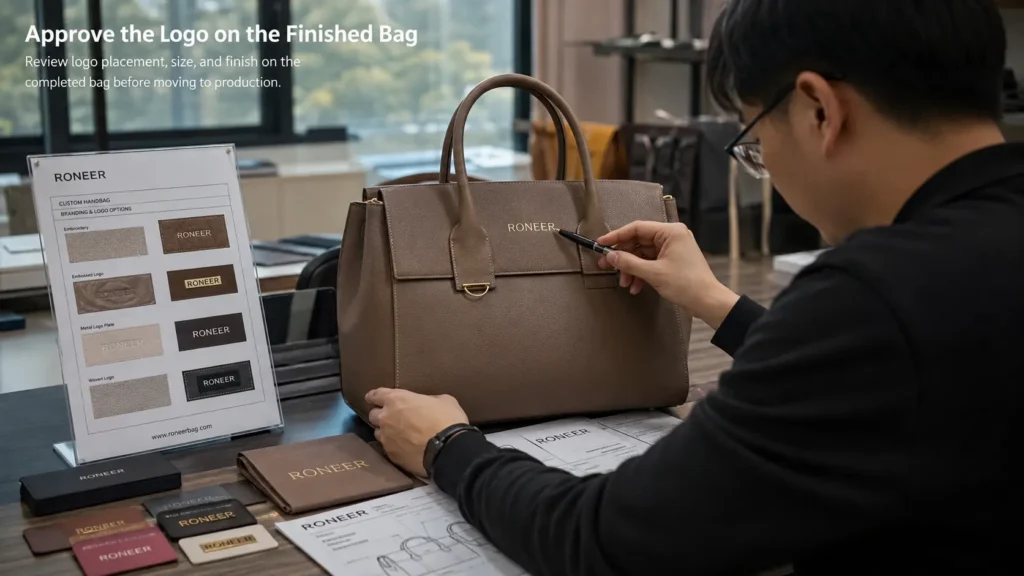
A logo sample on a separate piece of fabric is useful during development, but final approval should consider how the branding appears on the completed bag.
Check:
- Logo method
- Artwork version
- Size
- Position
- Orientation
- Color
- Surface finish
- Distance from seams or edges
- Visibility when the bag is filled
- Interaction with pockets, curves, folds, and hardware
Different logo methods create different production considerations.
Screen printing, heat transfer, embroidery, woven labels, rubber patches, embossing, debossing, metal logo plates, and custom zipper pullers do not behave identically across materials.
A logo that appears centered on a flat panel may look too high after the bottom gusset expands. Embroidery can influence the surrounding fabric. A metal plate may pull on a soft panel if reinforcement is insufficient.
The custom bag sample approval checklist should therefore evaluate branding as part of the finished structure rather than as artwork alone.
The approved logo record should connect the artwork file with the actual application method, dimensions, placement, color, and finished appearance. This is particularly useful when several logo trials were produced during sampling.
6. Test Every Closure and Hardware Component
A sample is the best stage to identify hardware that looks correct but feels wrong in use.
Review components such as:
- Main zipper
- Inner zipper
- Zipper slider
- Puller
- Magnetic snap
- Buckle
- D-ring
- Swivel hook
- Adjuster
- Rivet
- Metal feet
- Turn lock
- Snap hook
- Decorative chain
- Logo plate
Operate the product repeatedly.
Check whether the zipper runs smoothly around corners, whether hooks rotate correctly, whether adjustable straps stay in position, whether hardware scratches adjacent surfaces, and whether any edge feels uncomfortable during normal handling.
The hardware finish should also be compared across components.
“Gold” is not a sufficiently precise approval instruction if the bag combines several metal parts from different sources.
The finished sample should show whether the complete hardware set looks consistent enough for the project.
For functional hardware, the custom bag sample approval checklist should distinguish between visual approval and functional approval. A buckle may have the correct finish but still require a separate check for operation, attachment, or compatibility with the selected webbing or strap.
7. Inspect Construction at Stress Points
The cleanest visible seam is rarely the only construction point that matters.
Turn the bag, open it, load it, and examine the areas that will receive repeated force.
Depending on the product, important locations may include:
- Handle attachments
- Shoulder strap tabs
- D-ring tabs
- Bottom corners
- Zipper ends
- Side gussets
- Pocket openings
- Backpack shoulder straps
- Top handles
- Trolley sleeves
- Laptop compartment seams
- Drawstring channels
The buyer does not need to dictate every sewing method, but the required function and approved construction should be clear.
If reinforcement is important, make sure the approved sample actually contains it.
A prototype made more carefully than the planned production construction is not a useful bulk reference.
Your custom bag sample approval checklist should focus on whether the approved construction can realistically become the production standard.
Where a construction detail has already been revised, record the approved version rather than relying on the factory to remember which sample contained the final solution.
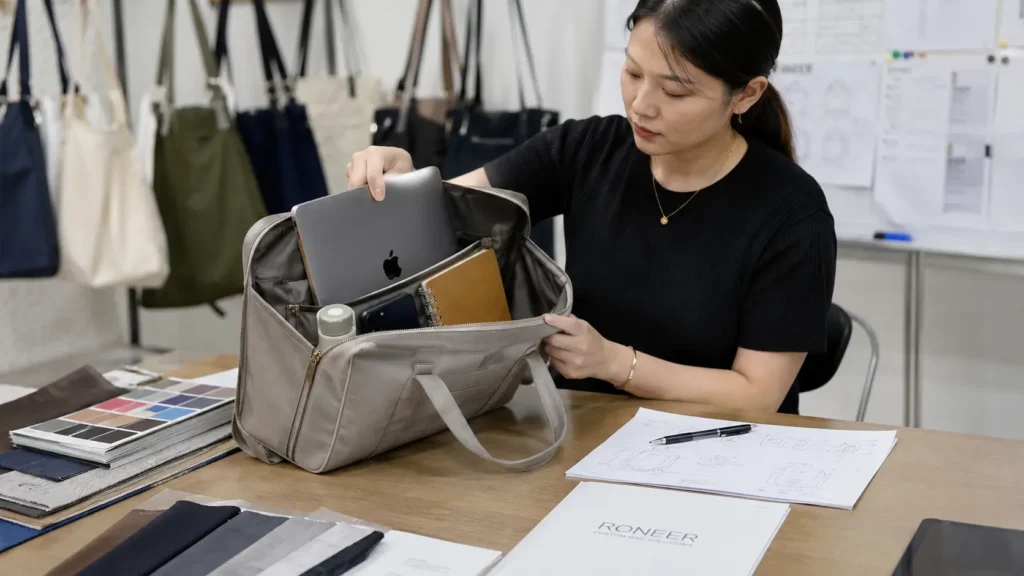
8. Put the Intended Contents Inside the Bag
This is one of the easiest checks to skip.
A bag that measures correctly can still fail its intended use.
Load the final sample with the type of product the customer is expected to carry.
For example:
- Laptop
- Tablet
- Phone
- Cosmetics
- Water bottle
- Documents
- Travel accessories
- Clothing
- Shoes
- Promotional gift set
- Retail product bundle
Then evaluate:
- Opening width
- Internal capacity
- Pocket access
- Zipper pressure
- Filled shape
- Handle comfort
- Strap position
- Weight balance
- Logo appearance
- Closure function
An empty sample can hide structural problems.
A pocket may be technically wide enough but difficult to access. A zipper opening may be shorter than the internal compartment. A bottle pocket may fit the stated diameter but become too tight after seam allowance and lining are considered.
For this reason, real-use checking deserves its own line in the custom bag sample approval checklist.
For laptop bags, travel bags, backpacks, cosmetic bags, and other function-led products, buyers can also record the intended test contents directly in the approval document. That makes repeat evaluation easier if another sample or production unit needs to be checked later.
9. Review the Entire Interior
Buyers naturally focus on the exterior because it drives first impressions.
End users, however, interact constantly with the inside.
Inspect:
- Lining material
- Lining color
- Lining fit
- Inner seams
- Pocket dimensions
- Pocket positions
- Interior zipper
- Labels
- Key hooks
- Laptop sleeves
- Padding
- Dividers
- Elastic loops
- Interior cleanliness
Open every pocket.
Test every zipper.
Insert the intended item.
A lining that looks acceptable when empty may bunch near the zipper. An internal pocket can interfere with the contents when the bag is full. A label can be placed where it scratches or blocks access.
Sample approval should therefore evaluate usability, not just external appearance.
Interior checks should remain part of the same custom bag sample approval checklist used for the exterior. Splitting the interior into informal comments increases the risk that a pocket, lining, label, or internal component revision is missed during production.
10. Confirm Labels and Market-Specific Information
Labels should not be left until the carton is being packed.
Before production, confirm which labels, markings, inserts, barcodes, or buyer-provided information must be included.
Depending on the product and destination market, this may involve:
- Brand label
- Country-of-origin marking
- Fiber information where applicable
- Care information where applicable
- SKU
- Barcode
- Retailer label
- Warning label where required
- Hangtag
- Packaging artwork
For products entering the United States, buyers should independently review the rules that apply to their specific product. The U.S. Federal Trade Commission provides official Apparel and Labeling guidance covering textile, wool, leather, labeling, country-of-origin, and related business requirements.
Not every rule applies identically to every bag. The buyer or importer should determine which requirements apply to the specific product, material composition, destination market, and sales channel.
The factory can manufacture and attach approved labels, but the buyer or importer should confirm the legal and retailer requirements for the destination market.
A custom bag sample approval checklist should therefore include a clear label-status field rather than assuming packaging teams will solve it later.
If label text is still pending when the product sample is approved, record it as an open item instead of treating the whole project as fully approved.
11. Approve Packaging Before Bulk Production
Product approval and packaging approval should be connected.
The sample may need to confirm or reference:
- Dust bag
- Polybag
- Tissue
- Shape support
- Hardware protection
- Hangtag
- Insert card
- Barcode
- SKU sticker
- Retail packaging
- Gift box
- Carton quantity
- Carton marks
- Packing direction
Packaging can affect the product itself.
A structured handbag may deform if packed too flat. Metal hardware may require protection from adjacent surfaces. Long straps may need a controlled folding method. Printed or coated surfaces may require separation.
If retail or warehouse barcodes are needed, test the position and packaging sequence before the order is finished.
A strong custom bag sample approval checklist does not stop at the bag. It checks how the approved product will actually leave the factory.
Where final retail packaging is not available during the physical sample review, the buyer can approve it through a separate packaging sample, artwork file, packing specification, or other agreed reference before bulk packing begins.
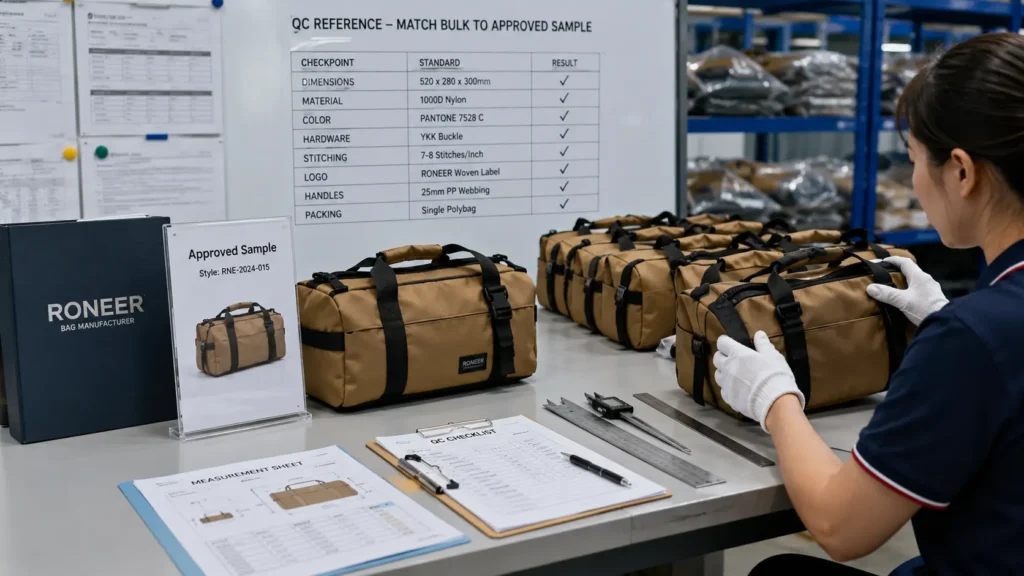
12. Turn the Approved Sample Into the QC Reference
Sample approval should not be the end of quality control.
It should create the reference used by production and inspection.
The final production file may include:
- Approved physical sample
- Current specification
- Measurement chart
- Approved material references
- Color references
- Artwork
- Hardware reference
- Logo instructions
- Packaging specification
- Approved revision list
- Functional requirements
- Buyer-defined tolerances
- Inspection requirements
This information should then flow into incoming material checks, first production review, in-line inspection, finished-product inspection, packaging checks, and any buyer-appointed third-party inspection.
For lot-by-lot acceptance sampling, ISO 2859-1:2026 defines AQL-indexed sampling schemes for inspection by attributes. It does not replace clear specifications or the approved product reference; rather, it provides a structured sampling approach when such an inspection method is used.
Buyers can connect this step with RONEER’s AQL Inspection for Bags guide when preparing the final inspection plan.
An AQL inspection evaluates a sample from a production lot against defined requirements. It does not correct unclear requirements created earlier in development. This is why the custom bag sample approval checklist and the final inspection plan should work together rather than being treated as separate quality systems.
This is the final purpose of the custom bag sample approval checklist: turning product development decisions into a reference that bulk production can be evaluated against.
Quick Custom Bag Sample Approval Checklist
Before authorizing bulk production, verify the following:
| Approval Area | Buyer Check |
|---|---|
| Sample identity | Correct SKU, version, date, and revision |
| Dimensions | Key finished measurements match approved specification |
| Materials | Outer, lining, reinforcement, and trims are identified |
| Color | Product components match approved color references |
| Branding | Logo method, size, position and finish are approved |
| Hardware | Zippers, hooks, buckles and metal finishes are correct |
| Construction | Stress points and reinforcement match the approved design |
| Function | Bag works correctly with intended contents |
| Interior | Lining, pockets, sleeves and internal details are approved |
| Labels | Required buyer, retailer and market information is confirmed |
| Packaging | Unit packing, labels and carton requirements are defined |
| QC reference | Approved sample and written specification are ready for production |
This condensed custom bag sample approval checklist can be used as a final review layer, but it should remain connected to the detailed measurement sheet, material references, artwork, packaging specification, and revision records.
Do not release bulk production if important rows still depend on phrases such as:
- “approximately”
- “similar to sample”
- “same as before”
- “close enough”
- “factory standard”
- “we will confirm later”
Those phrases may be acceptable during early development, but they are weak final production instructions.
What Should Be Recorded When a Sample Is Rejected?
A rejected sample is not necessarily a failed project.
Sampling is designed to expose decisions that still need improvement.
When rejecting or revising a sample, identify:
- The exact problem
- The required change
- The location of the change
- A measurable target where possible
- Whether the specification must be updated
- Whether the material or component reference changes
- Whether another physical sample is required
Avoid combining unrelated comments into vague instructions.
For example, “make the bag more premium” can mean material, structure, edge finishing, hardware, stitching, padding, proportion, or packaging.
Production teams need specific changes.
After a revised sample is received, the buyer should update the custom bag sample approval checklist rather than continuing to use comments attached to an obsolete sample version.
When Is a Photo Approval Not Enough?
Photos are useful for confirming visible details, but they cannot reliably communicate every property of a physical bag.
A photograph cannot fully demonstrate:
- Material hand feel
- Stiffness
- Weight
- Balance
- Zipper resistance
- Handle comfort
- Strap comfort
- Pocket accessibility
- Internal capacity
- Surface texture
- Hardware feel
For projects where these details matter commercially, buyers should consider reviewing a physical sample or agreeing on other documented references before releasing production.
The appropriate approval method depends on the product, quantity, schedule, material, complexity, and buyer requirements.
A photo can support the custom bag sample approval checklist, particularly for artwork position, color combinations, packaging layout, or minor revisions, but it should not automatically replace physical evaluation when function or material properties are important.
FAQ About Custom Bag Sample Approval Checklist
1. What is a custom bag sample approval checklist?
A custom bag sample approval checklist is a buyer-side record used before bulk production to confirm the approved sample version, dimensions, materials, colors, branding, hardware, construction, function, interior details, labels, packaging, and QC references.
It helps turn product-development decisions into instructions that can be followed during bulk production and inspection.
2. When should buyers use a custom bag sample approval checklist?
Use a custom bag sample approval checklist after the important sample revisions are complete and before authorizing bulk production. It is especially useful when materials, custom logos, special hardware, multiple colorways, private-label packaging, or detailed internal structures are involved.
3. Is the first prototype normally the production sample?
Not necessarily. A prototype may be used to evaluate shape, pattern, structure, or general appearance. If additional revisions are required, the final approved sample should reflect the latest confirmed specifications before it becomes the production reference.
4. Should the approved sample use the final production material?
Where material characteristics affect appearance, construction, branding, or function, buyers should confirm the actual approved material reference before bulk production. If substitutes are used during early sampling, this should be clearly documented and resolved before final approval.
The material reference should also be recorded in the custom bag sample approval checklist so that the approved sample is not separated from the bulk-material requirement.
5. What measurements should be checked on a custom bag sample?
The required measurements depend on the bag, but they may include width, height, depth, gusset, handle drop, strap dimensions, pockets, openings, internal compartments, logo position, and hardware position.
Measurements should follow defined points and agreed tolerances rather than being checked only visually.
6. Should buyers approve custom bag materials by photo?
Photos can support communication, but they may not accurately communicate hand feel, stiffness, texture, thickness, gloss, or some color differences. Physical material references may be more appropriate when these characteristics are commercially important.
7. What logo details should be approved before production?
Confirm the artwork version, application method, size, position, color, orientation, surface effect, and appearance on the finished bag. The logo should also be reviewed when the product is filled if the bag’s shape changes during use.
These details can be recorded directly in the custom bag sample approval checklist or in the linked branding specification.
8. What hardware should be included in the sample approval?
Review all relevant zippers, pullers, buckles, D-rings, hooks, adjusters, rivets, magnetic closures, metal feet, logo plates, and other functional or decorative components.
Both appearance and function should be checked where applicable.
9. Should packaging be included in the custom bag sample approval checklist?
Yes. A custom bag sample approval checklist should include packaging when unit packing, shape protection, hangtags, barcode labels, SKU labels, dust bags, retail packaging, carton quantity, or carton marks are part of the order requirements.
Packaging mistakes can create shipment or retail problems even when the finished bag itself is correct.
10. What happens if a material changes after sample approval?
The change should be documented and evaluated against the approved requirement. If the substitution can affect appearance, construction, function, branding, or quality expectations, the buyer should review the new material or revised sample before production continues.
The previous material should not remain listed as approved if the bulk-production reference has changed.
11. How does sample approval connect with AQL inspection?
The approved sample and written specifications provide the product reference, while an AQL-based inspection plan can be used to sample finished production lots according to an agreed inspection approach.
A custom bag sample approval checklist helps define what has been approved before production. AQL sampling then helps evaluate whether the completed production lot meets the defined inspection requirements. AQL sampling does not replace clear product requirements or pre-production approval.
12. How can RONEER support the sample approval process?
RONEER can support OEM/ODM projects through requirement review, material sourcing, size and structure development, logo trials, hardware selection, sample revisions, packaging customization, quality inspection, bulk production coordination, and repeat-order documentation.
The exact development and approval process depends on the bag design, materials, quantity, branding, target market, and buyer requirements.
Using a documented custom bag sample approval checklist can help both sides keep the latest approved sample, material, dimensions, branding, packaging, and production requirements aligned.
Conclusion
A custom bag sample approval checklist is most valuable when it prevents unclear development decisions from becoming expensive bulk-production problems.
Before approving a custom bag, buyers should know exactly which sample version is current, which materials are approved, how the finished product should measure, how the logo and hardware should appear, how the bag performs with its intended contents, and how it should be packed.
Just as importantly, those decisions should exist in a form that production and quality teams can actually follow.
The approved physical sample, material references, specification, artwork, packaging information, and buyer-defined quality requirements should work together as one production reference.
For RONEER OEM/ODM projects, sample development can include material sourcing, size and structure adjustments, logo trials, hardware selection, sample revisions, packaging planning, quality inspection, and bulk-production coordination according to the confirmed project requirements.
A disciplined custom bag sample approval checklist therefore does more than approve one sample. It creates the bridge between product development, controlled production, final inspection, and more consistent repeat orders.
For buyers preparing to release a new custom bag into bulk production, completing the custom bag sample approval checklist before cutting, branding, packing, and final inspection can make unresolved decisions visible while they are still easier to correct.