 Türkçe
  English
  Deutsch
  Español
  Français
  Italiano
  Русский
  日本語
日本語  العربية
  한국어
한국어 Finding a custom tote bag manufacturer China buyers can rely on is not only about getting a low unit price. For retail brands, promotional buyers, Amazon sellers, boutique stores, corporate gift buyers, and private label companies, the real challenge is choosing a factory that can turn a simple tote bag idea into a stable, brand-ready product.
Buyers moving from factory comparison to product development can review RONEER’s custom tote bag manufacturing service for canvas, cotton, RPET, logo, packaging, sampling and production options.
Tote bags look simple at first. However, material weight, handle strength, stitching, logo method, lining, inner pocket structure, folding method, barcode label, packing size, carton strength, and repeat production records can all affect the final result. A canvas tote for boutique retail is not the same as a foldable shopping tote for promotions or an RPET tote for a sustainability-focused campaign.
This guide explains how buyers can evaluate a custom tote bag manufacturer China through 11 practical sourcing rules. It covers product use, OEM/ODM development, materials, specifications, logos, MOQ, sampling, packaging, quality control, export details, and long-term reorder planning.
RONEER supports OEM and ODM custom bag production for global buyers, including tote bags, handbags, backpacks, cosmetic bags, travel bags, wallets, crossbody bags, and other private label bag categories. Buyers can review the RONEER custom bag manufacturing team before preparing a new custom tote bag project.
1. Define the Tote Bag Use Before Choosing a Factory
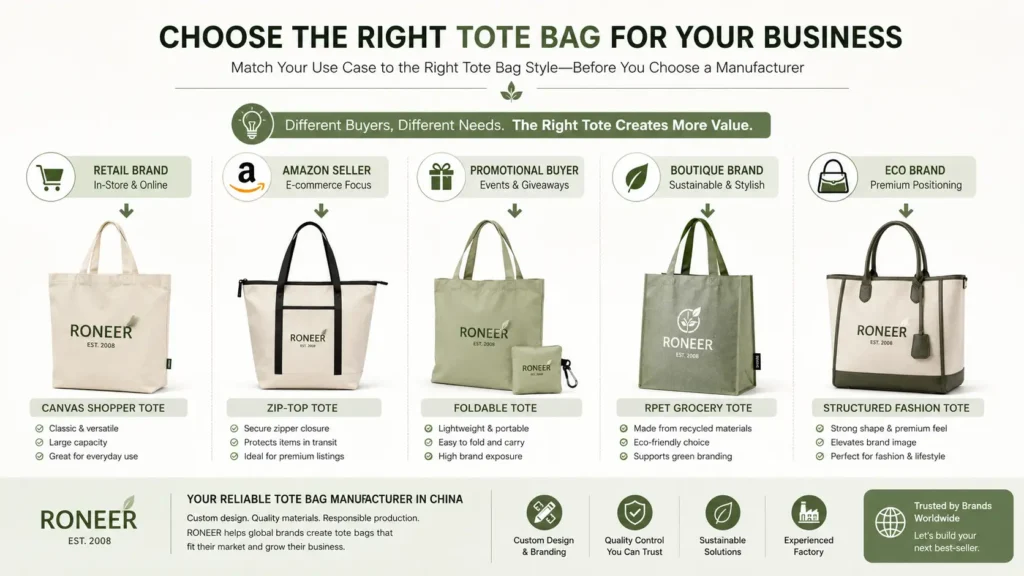
Before contacting a custom tote bag manufacturer China, buyers should first define how the tote bag will be used. The use case affects material, size, handle structure, logo method, packaging, and price.
A retail tote bag may need a clean shape, attractive material, stronger stitching, refined logo placement, and better packaging. A promotional tote bag may need simple construction, cost control, fast production, and clear logo visibility. A grocery tote may need foldability, load-bearing strength, washable materials, and compact packing. A boutique fashion tote may need structured panels, lining, interior pockets, hardware details, and stronger brand presentation.
Amazon sellers may care about barcode labels, shipping size, customer review risk, and product photos. Corporate buyers may focus on logo visibility, delivery timing, and bulk packing. Eco-conscious brands may need cotton, canvas, jute, RPET, or other material options, but they should also confirm documentation before making sustainability claims.
A reliable custom tote bag manufacturer China should not quote every tote bag the same way. The factory should ask about the sales channel, target customer, target price, usage scenario, and packaging requirement before recommending a production plan.
2. Decide Between OEM and ODM Tote Bag Development
When working with a custom tote bag manufacturer China, buyers usually need to decide whether OEM or ODM development is more practical.
ODM is suitable when the buyer wants to customize an existing tote bag style. The buyer may change material, color, handle length, logo, inner pocket, zipper, packaging, or hangtag. ODM can be useful for startups, promotional buyers, Amazon sellers, and brands that want faster market testing.
OEM is better when the buyer has an original tote bag design, tech pack, special dimensions, unique structure, special pocket layout, or specific brand requirement. OEM development may require more sampling time and more detailed communication, but it gives the buyer stronger product differentiation.
A simple cotton tote with a printed logo may be suitable for ODM customization. A structured fashion tote with lining, zipper closure, reinforced base, leather trim, and custom hardware may need a more detailed OEM workflow.
The best custom tote bag manufacturer China should explain what can be changed easily and what may affect MOQ, cost, tooling, sample time, or bulk lead time. This helps buyers avoid unrealistic expectations before production begins.
3. 
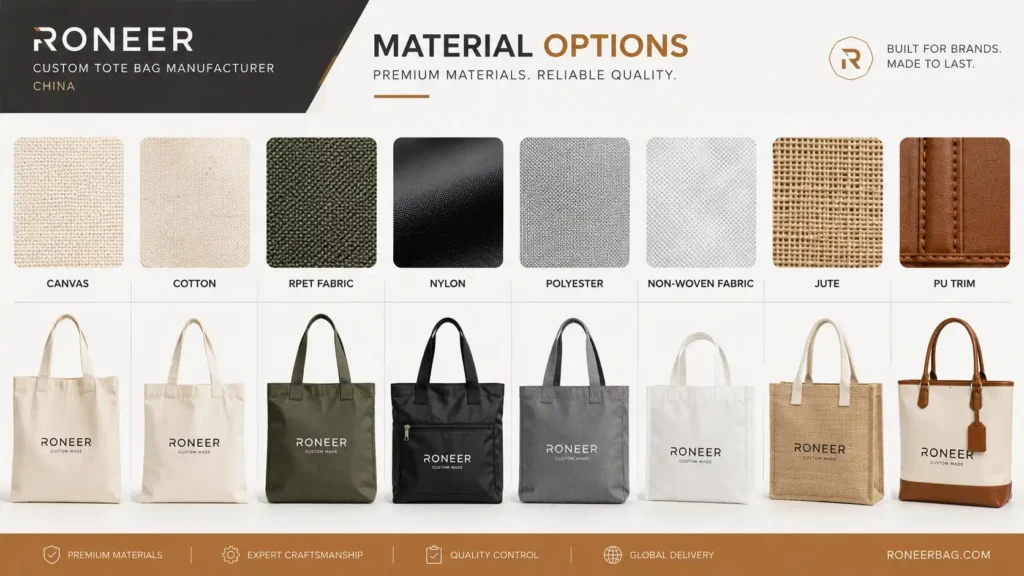
Material selection is one of the most important decisions in custom tote bag production. It affects appearance, weight, strength, durability, cost, washing method, printing result, packaging volume, and customer perception.
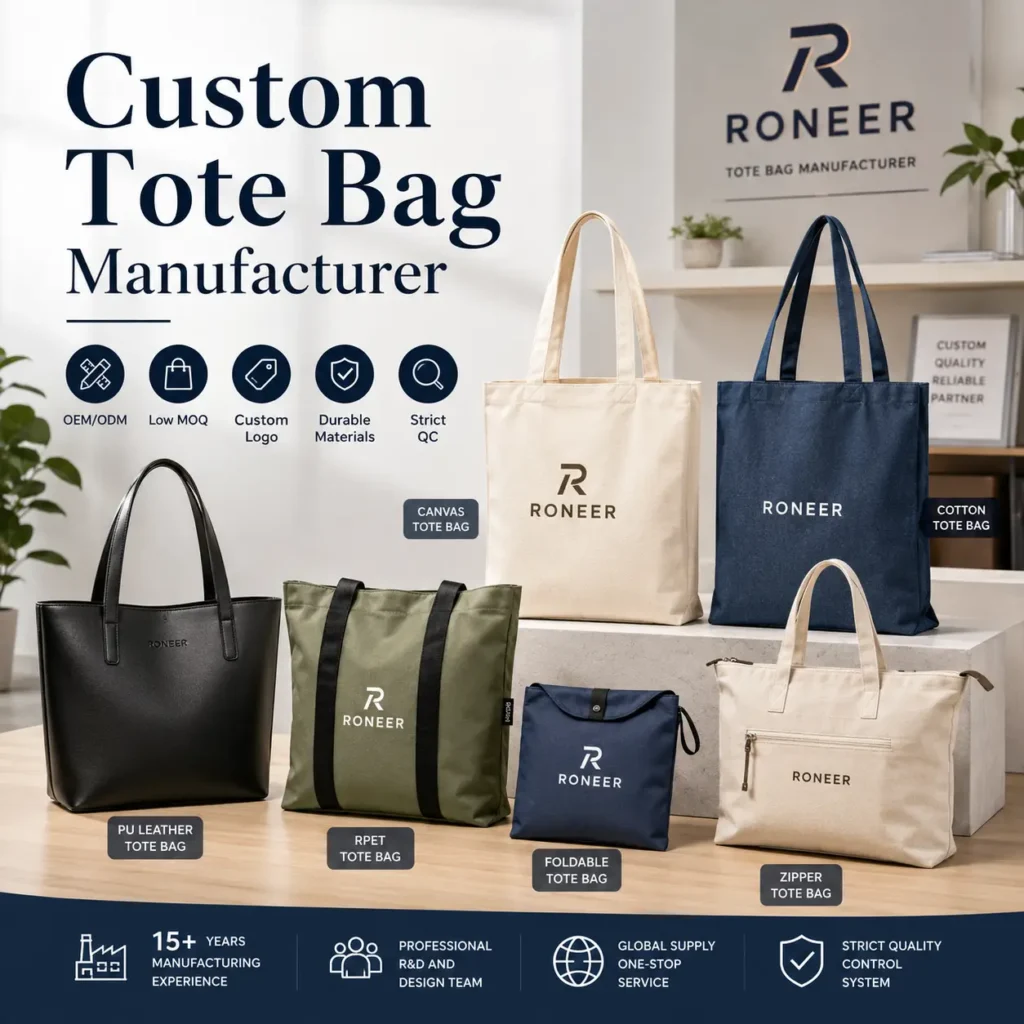
Canvas is popular for casual tote bags, lifestyle bags, boutique retail bags, and reusable shopping bags. Cotton can be suitable for lightweight promotional totes and simple branded bags. RPET fabric may support recycled-material positioning when documentation and claims are handled properly. Nylon and polyester are useful for lightweight, water-resistant, foldable, or travel-friendly tote bags. Jute can work for natural-looking shopping totes and gift packaging. Non-woven fabric may be suitable for cost-sensitive promotional projects.
Alıcılar, RONEER’in malzeme özelleşti̇rme options when comparing canvas, cotton, polyester, nylon, Oxford fabric, RPET, lining materials, and mixed-material tote bag structures.
For brands considering recycled or preferred materials, the Textile Exchange Materials Market Report can provide broader industry context. However, buyers should avoid broad environmental claims unless material source, certification status, supplier documentation, and marketing wording are properly checked.
A professional custom tote bag manufacturer China should help the buyer understand how material choice affects MOQ, printing method, sample lead time, shrinkage risk, color consistency, and final unit cost.
4. Prepare a Factory-Ready Tote Bag Specification
Many tote bag sampling problems happen because the buyer sends only a photo and asks for a quote. Photos are useful, but they do not give the factory enough production detail.
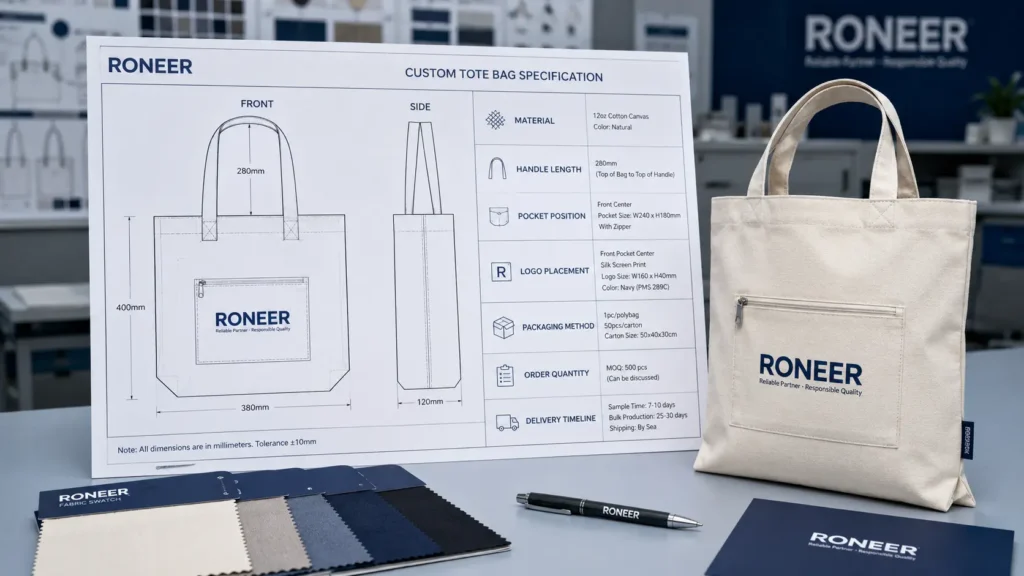
Before sampling, buyers should prepare a factory-ready specification. This file should include tote bag type, target dimensions, material weight, handle length, handle width, seam position, bottom structure, zipper or open-top design, lining, inner pocket, logo artwork, logo size, logo position, packaging method, target order quantity, and delivery timeline.
A custom tote bag manufacturer China can quote and sample more accurately when these details are clear. It also reduces misunderstandings about size, shape, sewing method, and material quality.
For example, a 12 oz canvas tote and a 16 oz canvas tote may look similar in a photo, but they can feel very different in real use. A printed logo and an embroidered logo also require different preparation, pricing, and production time. A zip-top tote may need different sewing steps from an open-top shopper tote.
Clear specifications are especially important for private label tote bags. If the buyer wants repeat production later, the factory should keep approved material samples, logo artwork, handle measurements, packaging details, and carton records.
5. Plan Logo, Printing, and Branding Details Early
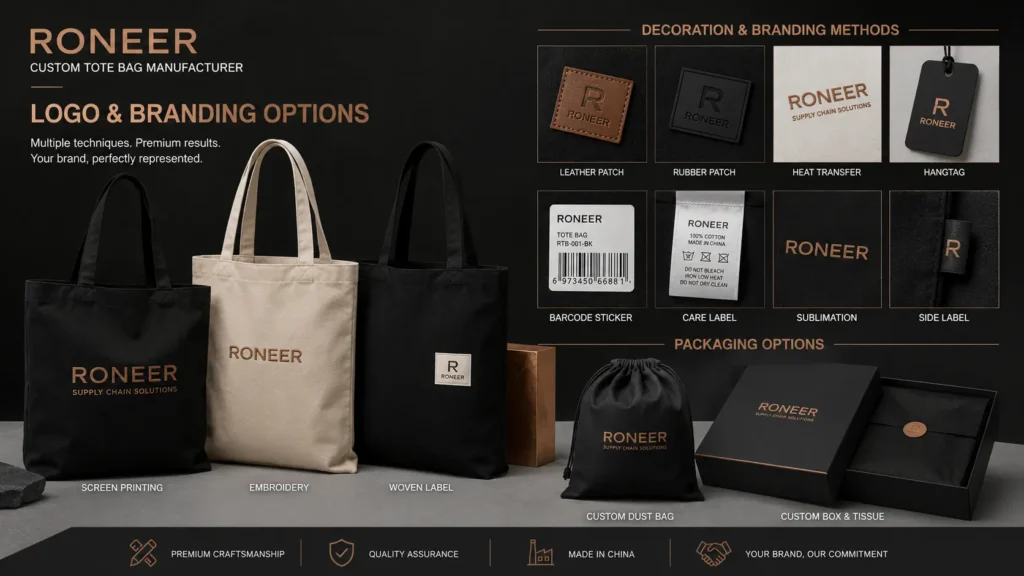
The logo method should be discussed before the sample is made. A custom tote bag manufacturer China may choose screen printing, heat transfer printing, embroidery, woven label, leather patch, rubber patch, metal plate, hangtag, or packaging logo.
Screen printing is common for canvas, cotton, and promotional tote bags. Embroidery can create a more textured look, but it may not suit every fabric or logo detail. Woven labels can be useful for boutique or private label totes. Leather patches or PU patches can add brand value to canvas and fashion tote bags. Heat transfer may work for some polyester and nylon styles, depending on the fabric and design.
Buyers can compare RONEER’s logo özelleşti̇rme options when choosing the right branding method for custom tote bags.
Logo size and position should be confirmed carefully. A large printed logo may work for promotional tote bags, while a small woven label may be better for a minimalist retail tote. The factory should check whether the logo file is suitable for the chosen process.
Branding should also include hangtags, care labels, barcode stickers, retail packaging, and carton marks when needed. A tote bag is often a simple product, but the brand presentation can still affect customer trust and perceived value.
6. Confirm MOQ by Style, Color, Material, and Logo Method
MOQ is not always one simple number. When choosing a custom tote bag manufacturer China, buyers should ask how MOQ changes by style, color, material, and logo method.
A factory may offer a lower MOQ for existing tote bag styles with standard materials. However, custom-dyed fabric, exclusive material, special lining, custom zipper, unique woven label, or special packaging may require a higher MOQ. The printing method can also affect the minimum quantity.
For example, a simple canvas tote with one-color screen printing may have a different MOQ from an RPET tote with multiple colors, a woven label, a dust bag, and a custom carton mark. A structured fashion tote may require a higher MOQ than a flat promotional tote because it involves more sewing steps and material control.
Buyers should also ask whether MOQ applies to one style, one color, one size, or one logo design. This is important for brands launching multiple SKUs.
A practical custom tote bag manufacturer China should explain the MOQ clearly instead of giving a vague answer. Clear MOQ planning helps buyers control budget, inventory, and launch risk.
7. Check Sample Cost, Sample Time, and Revision Rules
Sampling is where many custom tote bag projects succeed or fail. A good sample helps the buyer check material, size, logo position, stitching, handle strength, structure, packaging, and real product feel.
Before paying for a sample, buyers should confirm the sample cost, sample lead time, revision policy, and what is included. Some samples are simple logo samples based on existing styles. Others require pattern making, material sourcing, printing setup, embroidery setup, or special packaging samples.
A custom tote bag manufacturer China should explain whether the sample fee includes material, labor, logo setup, pattern development, and shipping. Buyers should also ask whether the sample cost can be deducted from bulk production.
Sample approval should not rely only on photos. Photos can show general appearance, but physical samples help buyers check hand feel, fabric weight, handle comfort, stitching quality, logo clarity, and packing method.
If revisions are needed, comments should be specific. Instead of saying “make it better,” buyers should mark the exact changes: handle length, logo size, pocket position, material thickness, zipper color, or stitching line.
8. Plan Packaging for Retail, E-Commerce, or Wholesale
Packaging is not only about protecting the tote bag. It also affects shipping cost, warehouse handling, retail presentation, barcode planning, and customer experience.
Alıcılar, RONEER’in ambalaj özelleşti̇rme service when planning polybags, dust bags, hangtags, care cards, barcode stickers, inner cartons, master cartons, and export carton marks.
A promotional tote may only need simple bulk packing. A retail tote may need individual packaging, a hangtag, a care label, and a better folding method. An Amazon tote bag may need barcode stickers, compact packing, and carton planning. A boutique tote may need a dust bag, tissue paper, and branded packaging.
The packaging method should match the material. Canvas tote bags may need cleaning, folding, and dust protection. Structured tote bags may need inner filling to maintain their shape. Nylon tote bags may be folded more compactly, but folding lines and logo position should still be checked.
A custom tote bag manufacturer China should confirm packing photos, carton size, quantity per carton, gross weight, net weight, and carton marks before shipment. These details help buyers estimate freight costs and avoid warehouse confusion.
9. Check Quality Control Before Bulk Shipment
Quality control should be planned before bulk production, not only after the goods are finished. Tote bags may look simple, but quality problems can still create returns, complaints, or poor customer reviews.
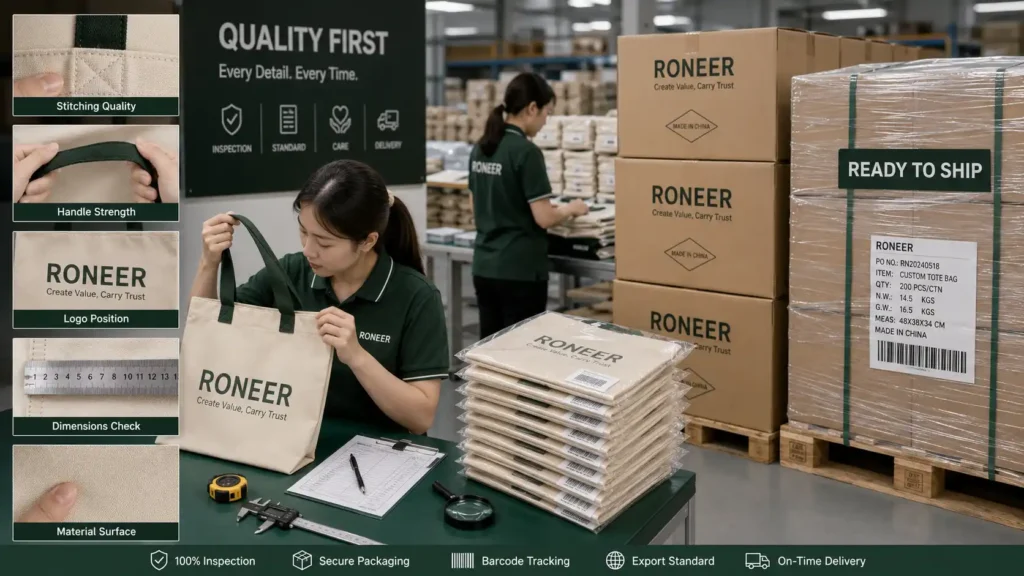
For custom tote bags, inspection points should include fabric condition, color consistency, material weight, stitching, handle strength, seam reinforcement, logo position, logo clarity, printing durability, embroidery quality, zipper function if applicable, lining, pocket position, measurements, packaging, barcode labels, and carton marks.
For larger or higher-risk orders, buyers may refer to third-party inspection providers such as SGS bags and accessories testing and inspection to understand how bags and accessories can involve structured checks for quality, safety, performance, and compliance. This does not mean every order needs the same testing plan, but it helps buyers think more clearly about inspection standards.
A reliable custom tote bag manufacturer China supplier should confirm the approved sample, acceptable tolerance, final material, logo method, packaging standard, and inspection points before shipment.
RONEER supports custom tote bag buyers through sample development, production coordination, packaging review, quality communication, and export packing support. A clear inspection plan helps reduce disputes and improves repeat production consistency.
10. Confirm Export Labels, Country of Origin, and Shipping Details
If tote bags are shipped internationally, buyers should confirm export labels, carton marks, country of origin marking, and shipping details before bulk packing.
For buyers importing tote bags into the United States, the U.S. Customs and Border Protection country of origin marking guidance explains that foreign-origin goods entering the United States generally need a clear English country of origin marking unless an exception applies.
Buyers should discuss whether the origin marking will appear on a sewn label, hangtag, sticker, packaging, or another suitable location. Carton marks should also be clear enough for warehouse handling.
Brands should also avoid misleading origin-related marketing language. If tote bags are manufactured in China, product pages, labels, ads, or packaging should not make inaccurate Made in USA claims. The Federal Trade Commission’s Made in USA guidance explains how Made in USA claims are evaluated.
A custom tote bag manufacturer China can provide production-side information such as product description, material, quantity, carton size, packing list information, and export packing photos. Import-side classification, customs decisions, and duty treatment should be confirmed by the importer or customs broker.
11. Keep Records for Repeat Tote Bag Production
A strong custom tote bag manufacturer partner in China should help buyers keep records for repeat production. Many tote bag projects are not one-time orders. If a design sells well, the buyer may need to reorder the same tote bag with the same fabric, logo, color, handle length, packaging, and carton standard.
Repeat production records should include approved sample photos, material name, fabric weight, color code, logo artwork, logo size, logo position, stitching details, handle measurements, packaging method, barcode requirements, carton size, quantity per carton, and carton mark format.
Without records, reorders may have color differences, logo placement issues, fabric weight changes, or packaging inconsistencies. These small changes can affect brand trust.
For private label tote bags, repeat production consistency is especially important. Buyers may sell the same tote bag across retail, e-commerce, wholesale, or corporate accounts. The product should feel consistent from one order to the next.
RONEER helps buyers organize production details so future orders are easier to repeat, inspect, pack, and ship. Long-term success depends not only on the first sample, but also on stable production records.
Common Mistakes When Choosing a Custom Tote Bag Manufacturer China
One common mistake is choosing only based on the lowest price. A low quote may not include the same fabric weight, logo method, handle reinforcement, packaging, or inspection standard.
Another mistake is asking for a quote without enough details. Without size, material, handle length, logo method, quantity, and packaging, the factory can only give a rough estimate.
Some buyers also choose material based only on appearance. Canvas, cotton, RPET, nylon, non-woven, and jute all have different strengths, costs, printing results, and care requirements.
A fourth mistake is approving samples only by photos. Physical samples are important for checking fabric weight, stitching, handle comfort, logo clarity, and folding method.
Another common mistake is leaving packaging and carton marks until the end. This can create shipping delays, labeling problems, and extra costs.
A professional custom tote bag manufacturer China should help buyers avoid these mistakes through clear communication, practical recommendations, and organized production records.
Custom Tote Bag Manufacturer China Buyer Checklist
Before working with a custom tote bag manufacturer China, buyers can prepare the following checklist:
Confirm the tote bag use case and sales channel.
Choose OEM or ODM development.
Select the right material and backup material.
Prepare tote bag size, handle length, and structure details.
Confirm logo method, logo size, and logo position.
Confirm MOQ by style, color, material, and logo process.
Confirm sample cost, sample lead time, and revision rules.
Confirm packaging method, barcode label, and carton mark.
Confirm quality inspection points.
Confirm country of origin marking and export packing details.
Keep records for repeat production.
This checklist helps buyers communicate more clearly with the factory and avoid common development mistakes.
How RONEER Supports Custom Tote Bag Projects
RONEER supports global buyers with OEM and ODM tote bag manufacturing. The process can include material selection, style discussion, logo customization, sample development, packaging planning, bulk production coordination, quality communication, export packing, and shipping support.
For startup brands, RONEER can help compare practical ODM tote bag options before the buyer invests in deeper OEM development. For established brands, RONEER can support more detailed projects based on tech packs, reference samples, private label requirements, and multi-SKU production plans.
A strong custom tote bag manufacturer China supplier should help buyers make practical decisions. This includes explaining which materials fit the target price, which logo methods work on specific fabrics, which packaging options match the sales channel, and which details should be confirmed before bulk production.
RONEER’s role is not only to produce tote bags but also to help buyers organize product details into a factory-ready plan. This is especially valuable for brands that need repeat orders, private label packaging, export packing, and long-term consistency.