 Türkçe
  English
  Deutsch
  Español
  Français
  Italiano
  Русский
  日本語
日本語  العربية
  한국어
한국어 A metal logo plate can make a bag look more finished, more branded, and more retail-ready. For many handbags, backpacks, cosmetic bags, travel bags, wallets, pouches, laptop bags, and private label collections, custom metal logo plate bags give buyers a stronger brand detail than simple printing or a standard woven label.
However, a metal logo plate is not only a decoration. In real OEM/ODM production, it affects material selection, bag structure, hardware finish, MOQ, mold cost, sample lead time, attachment strength, packaging protection, and final QC. A logo plate may look premium in a design mockup, but it can create problems if it is too heavy, too sharp, poorly plated, weakly attached, or mismatched with the bag material.
For B2B buyers, the goal is not just to add a shiny metal logo. The goal is to develop custom metal logo plate bags that look consistent, feel durable, match the brand position, and can be repeated in bulk production.
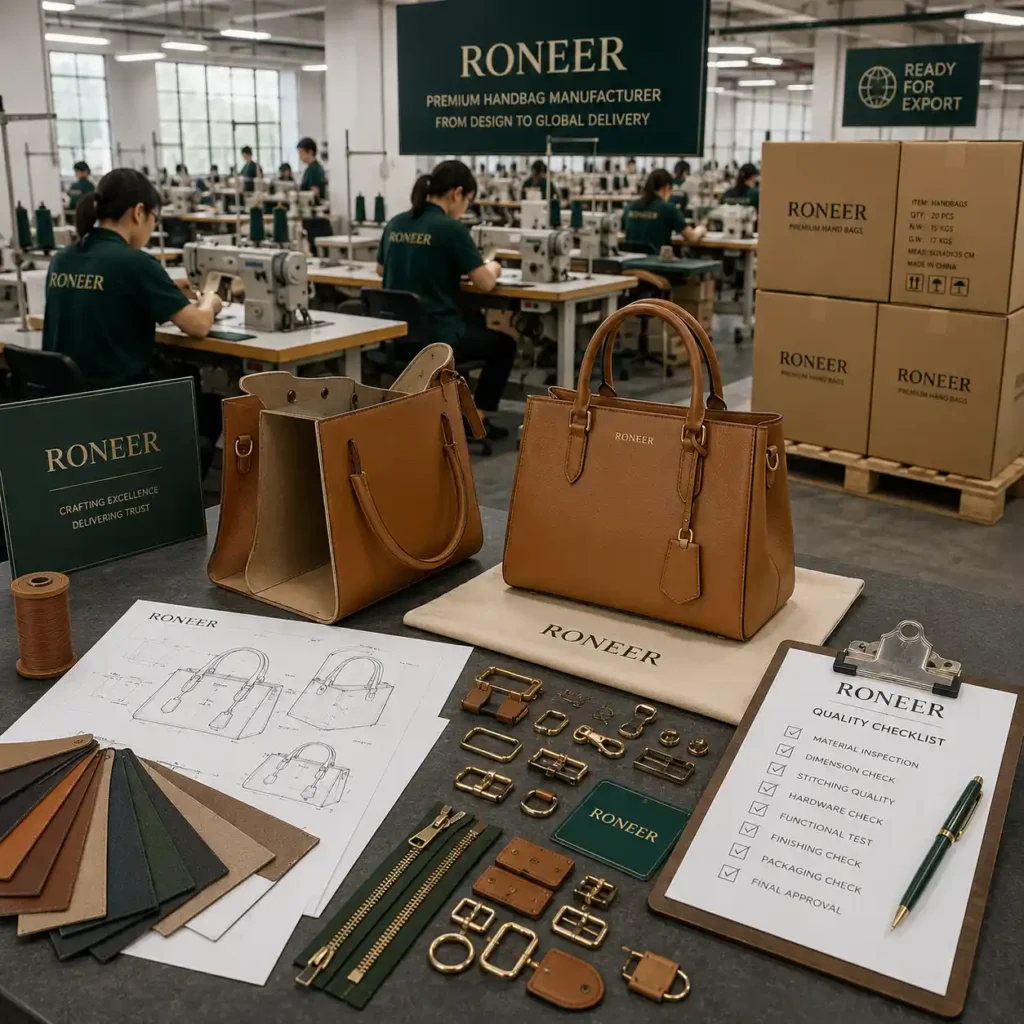
RONEER supports OEM/ODM custom bag projects with logo customization, hardware development, material customization, low MOQ planning where feasible, fast sampling, private label packaging, strict QC, export packing, and global shipping coordination. Buyers can review RONEER’s overall factory capabilities through RONEER özel çanta üretim hizmeti.
This guide explains how to choose metal logo plates for custom bags, what buyers should confirm before sampling, and how to reduce quality risk before bulk production.
Why Metal Logo Plates Matter in Custom Bag Branding
A metal logo plate is one of the most visible brand details on a bag. Compared with printed logos or woven labels, a metal plate can create stronger perceived value, especially for handbags, wallets, cosmetic bags, structured pouches, and premium private label products.
İyi custom metal logo plate bags can help buyers:
- Improve brand recognition
- Create a premium product impression
- Match hardware and zipper finish
- Build collection consistency
- Support private label positioning
- Increase retail presentation value
- Make product photos look more professional
- Add a durable logo detail
- Create a recognizable brand signature
But metal logo plates also require more planning than simple logo methods. They may need a mold, plating approval, attachment testing, and packaging protection. If the plate is not planned correctly, it can scratch the material, fall off, discolor, feel sharp, or make the bag look cheaper instead of better.
1. Choose the Right Metal Material
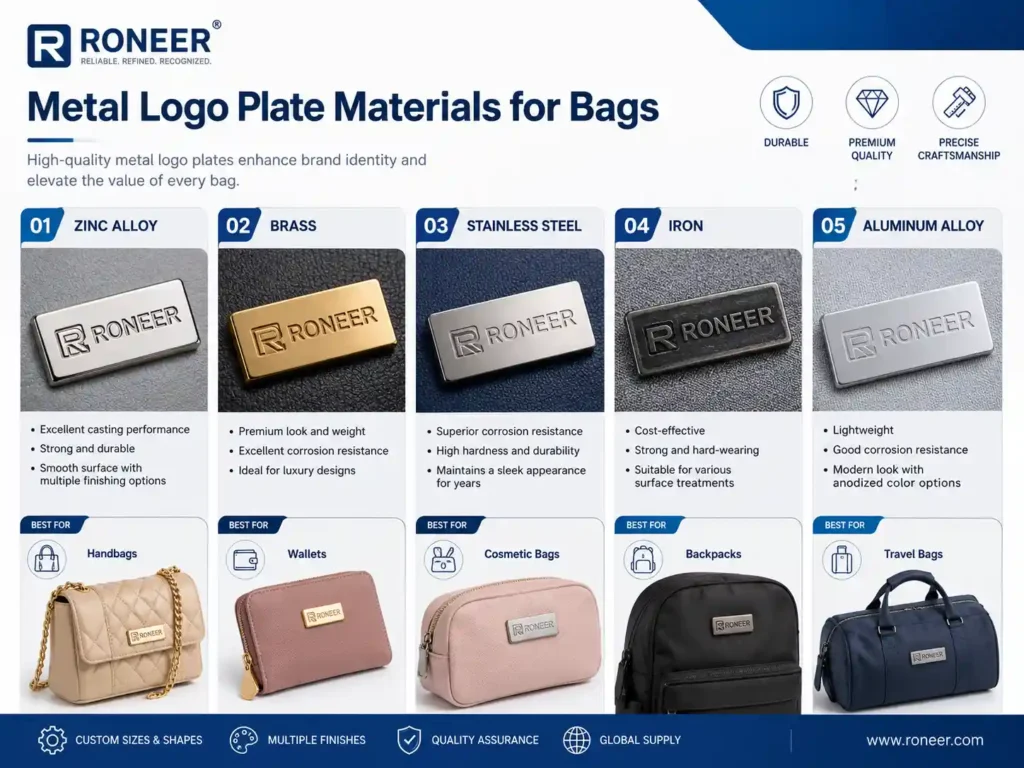
The material of the logo plate affects weight, cost, finish, durability, and production feasibility. For custom metal logo plate bags, common metal options include zinc alloy, brass, stainless steel, iron, and aluminum alloy.
Zinc Alloy Logo Plates
Zinc alloy is widely used for custom bag hardware because it supports molded shapes, raised logos, recessed logos, and different plating finishes. It is practical for handbags, cosmetic bags, wallets, pouches, and fashion bags.
Brass Logo Plates
Brass can feel more premium and is often used for higher-end hardware details. It may cost more than zinc alloy, but it can offer a refined finish depending on design and plating.
Stainless Steel Logo Plates
Stainless steel is strong and clean-looking. It may be suitable for modern, minimalist, or functional bag designs. However, the shaping and logo process should be confirmed with the supplier.
Iron Logo Plates
Iron can be cost-effective but requires good plating and anti-rust control. Buyers should be careful if the bag may be used in humid environments.
Aluminum Alloy Logo Plates
Aluminum can be lightweight and suitable for certain modern designs, but it may not fit every premium hardware style.
The best option depends on product level, logo design, bag material, finish requirement, MOQ, and target cost.
2. Match the Logo Plate With the Bag Material
A metal logo plate should match the bag material, not fight against it. The same plate may look premium on PU leather but too heavy on thin nylon. It may look modern on a travel bag but too industrial on a soft handbag.
For custom metal logo plate bags, buyers should review the logo plate together with:
- PU deri
- Mikrofiber deri
- Hakiki deri
- Naylon
- Polyester
- Oxford kumaş
- Tuval
- RPET kumaş
- PVC or TPU
- Coated materials
PU leather and microfiber leather usually work well with metal logo plates because the surface can support a premium fashion look. Nylon and Oxford fabric can also use metal plates, but reinforcement may be needed. Canvas bags may use metal plates for a more premium style, but the attachment method should be tested carefully.
Thin or soft materials may require backing support so the plate does not pull, wrinkle, or deform the panel.
3. Select the Right Logo Plate Shape and Size
The shape and size of a metal logo plate affect both appearance and function. A large plate may create a strong brand statement, but it can also feel heavy or unbalanced. A small plate may look refined, but the logo may become hard to read.
Common logo plate shapes include:
- Rectangle
- Oval
- Round
- Square
- Brand initial shape
- Shield shape
- Custom icon shape
- Long narrow nameplate
- Small corner badge
- Decorative emblem
For handbags and wallets, smaller refined plates usually work better. For backpacks and travel bags, a stronger plate can work if it matches the design. For cosmetic bags and pouches, the plate should be light enough to avoid pulling the surface.
Buyers should check whether the logo is still readable at the approved size. Very fine lines, small letters, and complex icons may not reproduce clearly on small metal plates.
4. Choose the Right Logo Process
Different logo processes create different visual effects. For custom metal logo plate bags, the logo process should match the brand style and production budget.
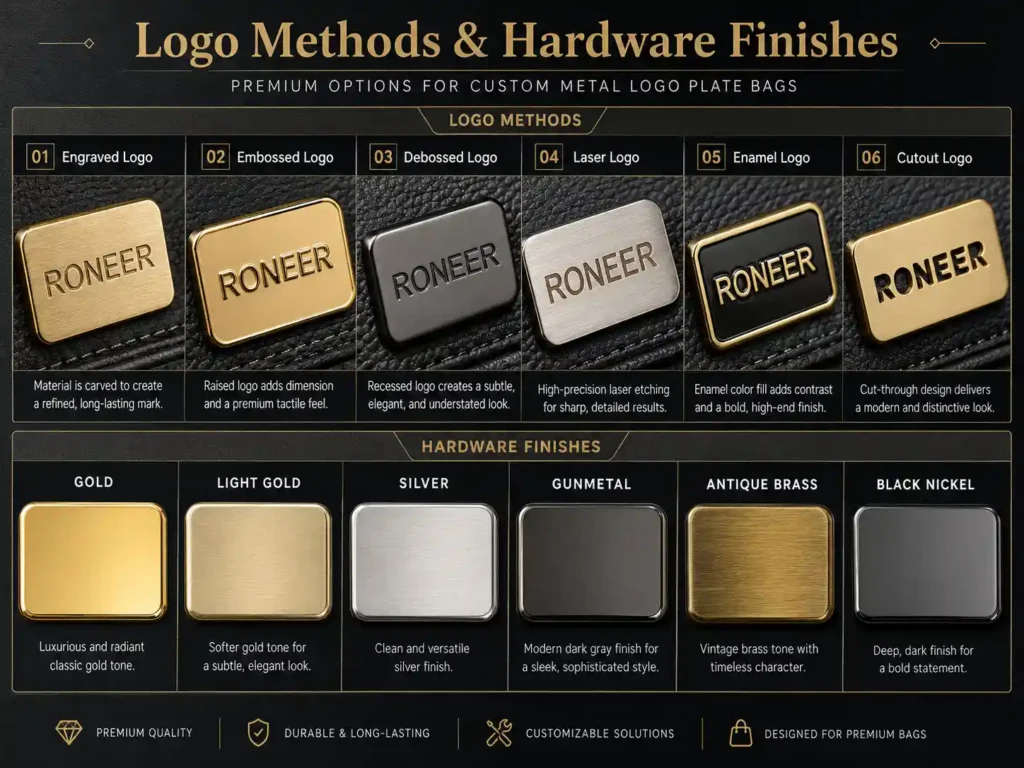
Common logo processes include:
Engraved Logo
An engraved logo is cut into the metal surface. It looks clean and subtle. It works well for minimalist and professional branding.
Embossed Logo
An embossed logo is raised from the plate surface. It gives a stronger 3D effect and can make the logo more visible.
Debossed Logo
A debossed logo is pressed down into the plate surface. It can look refined and understated.
Laser Logo
Laser marking can create a clean logo effect on certain metal surfaces. It may be suitable for simpler designs.
Enamel Logo Plate
Enamel filling adds color to the logo plate. It can make the brand color more visible, but it may increase cost and require more careful QC.
Cutout Logo
A cutout plate can create a distinctive look, but it may need careful mold and edge finishing.
Alıcılar, RONEER’in logo özelleşti̇rme options when planning metal plates together with printed logos, zipper pullers, woven labels, hang tags, and packaging.
5. Match Hardware Finish Across the Bag
One of the biggest mistakes in custom metal logo plate bags is mismatched hardware. A gold logo plate with silver zipper pulls, gunmetal buckles, and black nickel D-rings can make the product look inconsistent unless the mix is intentional.
A complete hardware finish plan should include:
- Metal logo plakası
- Zipper slider
- Zipper puller
- Tokalar
- D-rings
- Kancalar
- Perçinler
- Manyetik çıtçıtlar
- Strap adjusters
- Metal feet
- Decorative chains
- Logo letters if used
Common finishes include gold, light gold, silver, nickel, gunmetal, black nickel, antique brass, brushed gold, matte black, and rose gold.
Buyers should approve hardware finish with physical samples. Screen images can be misleading because metal color changes under different lighting.
6. Confirm the Attachment Method
A metal logo plate must be securely attached to the bag. The attachment method affects durability, appearance, production time, and QC risk.
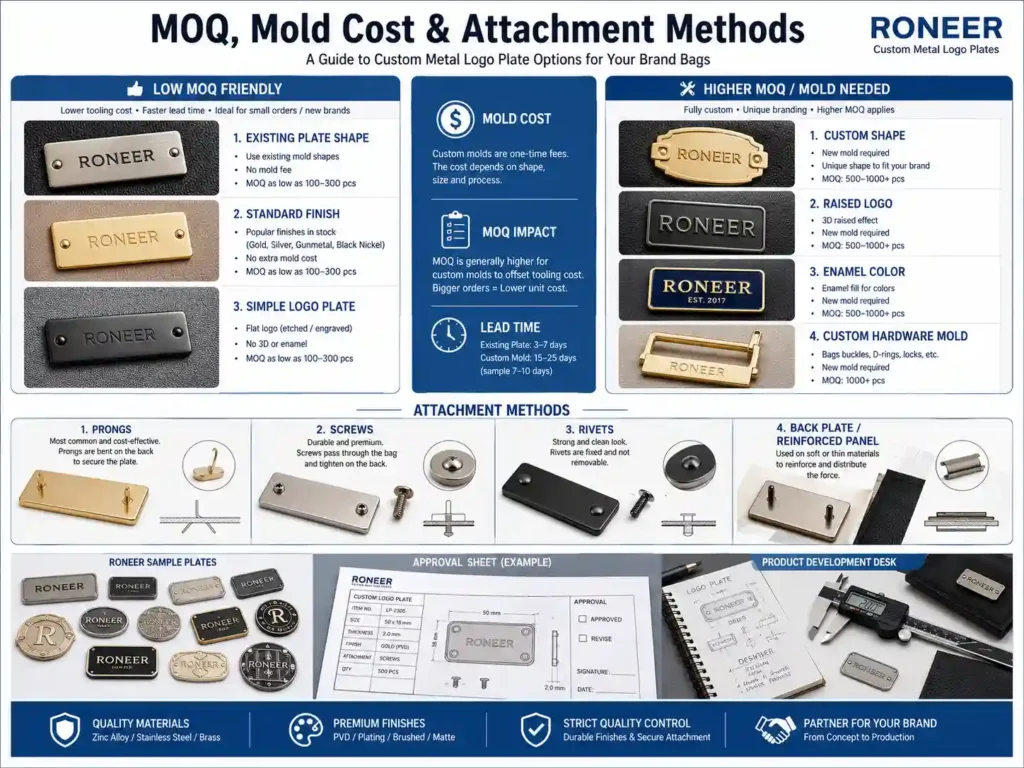
Common attachment methods include:
- Prongs
- Screws
- Perçinler
- Back plates
- Stitching holes
- Adhesive plus reinforcement
- Heat press support for certain designs
- Combination fixing
For handbags and wallets, prongs or screws with backing plates are common. For backpacks and fabric bags, reinforcement behind the panel may be needed. For soft bags, buyers should check whether the plate causes wrinkles or pulls the material.
İyi bir custom metal logo plate bags project should include attachment testing during sampling. Buyers should check whether the plate moves, bends, scratches the surface, or creates pressure marks inside the bag.
Markanız için özel çantalara mı ihtiyacınız var?
Contact RONEER for OEM/ODM production, fast sampling, low MOQ options, custom logo solutions, material customization, strict QC, and export packing support.
7. Understand MOQ, Mold Cost, and Lead Time
A custom metal logo plate often requires tooling. This means buyers should plan MOQ, mold cost, and sample time early.
Cost factors for custom metal logo plate bags include:
- Plate material
- Plate size
- Plate thickness
- Custom shape
- Mold development
- Logo process
- Plating finish
- Enamel filling if used
- Attachment method
- Order quantity
- Örnek düzeltmeler
- Ambalaj koruması
- QC requirement
For low MOQ projects, buyers may consider existing plate shapes, standard hardware finishes, smaller logo plates, or other logo methods before developing a fully custom mold.
For larger private label collections, a custom metal plate can be a good investment because the same plate may be reused across handbags, wallets, pouches, cosmetic bags, and travel accessories.
Buyers who need low MOQ planning can review RONEER’s guide on custom backpack MOQ cost planning. Many MOQ principles also apply to metal logo plates, zipper pullers, custom hardware, woven labels, patches, and packaging.
8. Protect the Logo Plate During Packaging and Shipping
Metal logo plates can scratch the bag surface or be scratched themselves if packaging is not planned properly. This is especially important for glossy hardware, light-colored PU leather, microfiber leather, and gift-box products.
Packaging protection may include:
- Protective film on logo plate
- Tissue paper around the logo area
- Foam sheet
- Inner bag support
- Individual poly bag
- Dust bag
- Carton divider if needed
- Correct folding method
- Avoiding direct metal-to-material pressure
For premium custom metal logo plate bags, packaging is not only for presentation. It protects the logo hardware during export shipping and warehouse handling.
Alıcılar, RONEER’in ambalaj özelleşti̇rme service when planning dust bags, poly bags, gift boxes, tissue paper, barcode labels, and export cartons together.
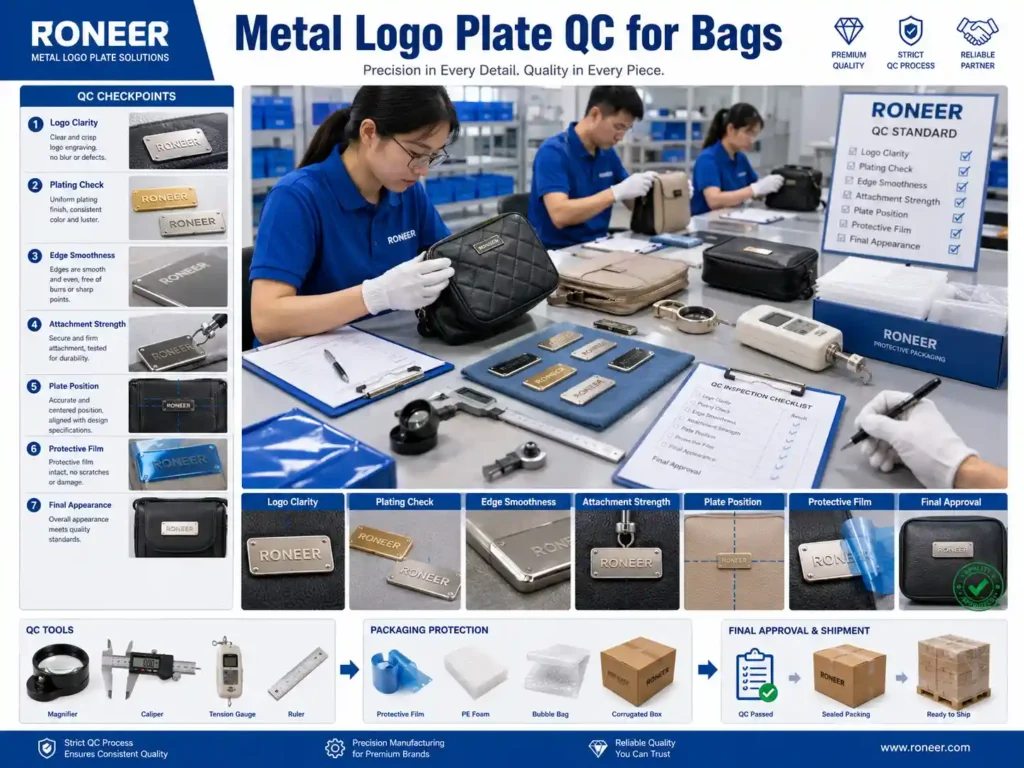
9. Check QC Before Bulk Production
Metal logo plates should be checked before bulk production and again during final inspection. Small hardware defects can make the whole bag look low quality.
Important QC points include:
- Logo clarity
- Plate size
- Plate thickness
- Surface smoothness
- Edge smoothness
- Plating consistency
- Color consistency
- Scratch marks
- Rust resistance if required
- Attachment strength
- Plate position
- Panel deformation
- Backing reinforcement
- Sharp edges
- Glue marks if used
- Protective film
- Final appearance on finished bag
For inspection and quality control background, buyers can refer to SGS. For harmful substance or textile safety background, OEKO-TEX can be used as an industry reference when relevant to bag materials. Buyers should confirm specific testing, retailer requirements, or compliance needs before production.
RONEER checks hardware, logo plate placement, attachment strength, packaging protection, and final appearance during sample development and QC review.
Custom Metal Logo Plate Bags by Product Type
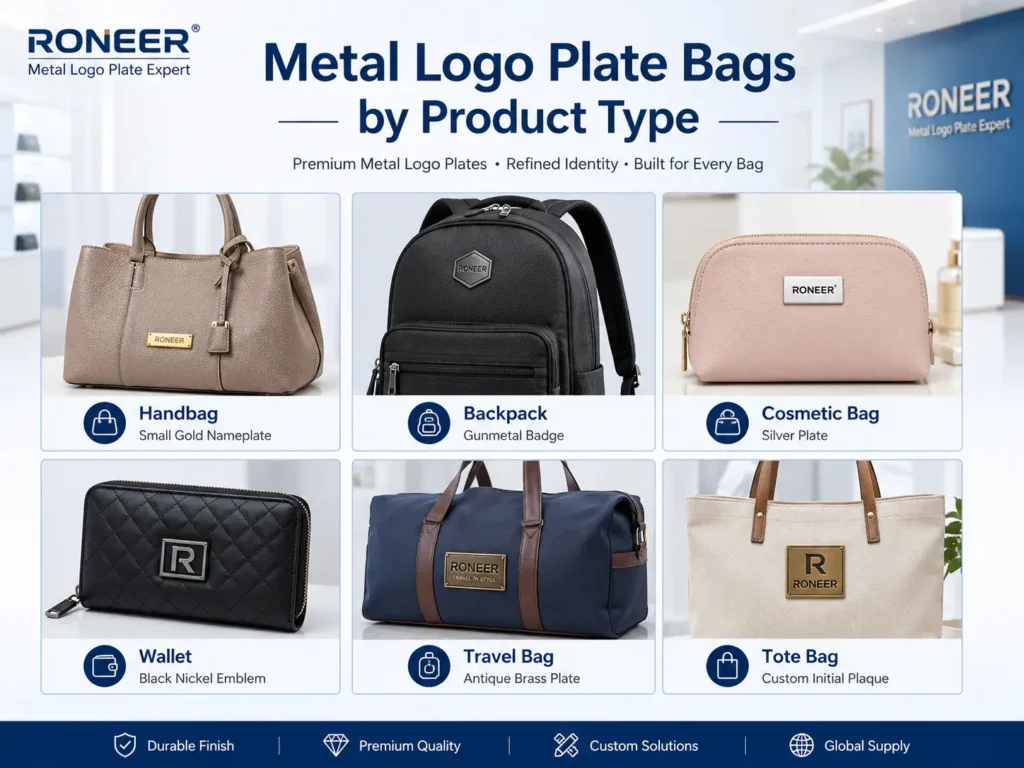
Different bag types need different logo plate solutions.
El Çantaları
Handbags are one of the best applications for metal logo plates. Small gold, light gold, silver, or gunmetal plates can create a premium look. The plate should match zipper pullers, buckles, and chain details.
Sırt Çantaları
Backpacks can use metal logo plates, but the plate should be lightweight, secure, and matched with the fabric. For casual or outdoor backpacks, rubber patches or woven labels may sometimes be more practical.
Kozmetik Çantaları
Cosmetic bags can use small metal logo plates for a premium beauty accessory look. Buyers should check whether the plate scratches easily or affects the pouch shape.
Cüzdanlar
Wallets often use small metal badges, metal letters, or slim logo plates. The logo should be refined and not too heavy.
Seyahat Çantaları
Travel bags can use metal plates, but durability and attachment strength matter. The plate should not be placed where it may be rubbed heavily during transport.
Alışveriş Çantaları
Tote bags can use metal logo plates when the buyer wants a more premium retail look. Canvas totes may need reinforcement behind the plate.
Metal Logo Plate vs Other Logo Methods
Metal logo plates are not the only branding method. Buyers should compare them with other logo options before deciding.
Metal Logo Plate
Best for premium, visible, durable branding. Higher cost and possible mold requirement.
Screen Printing
Good for flat graphics and cost control. Better for canvas, cotton, polyester, and promotional bags.
Heat Transfer
Good for detailed logos on certain fabrics. Works well on smooth surfaces but needs adhesion testing.
Nakış
Adds texture and craft feeling. Not ideal for all waterproof or thin materials.
Woven Label
Flexible for low MOQ and many bag materials. Good for casual, outdoor, and private label bags.
Rubber Patch
Good for backpacks, sports bags, and functional styles. Can be more practical than metal for lightweight bags.
A professional factory should help buyers choose the best logo method based on material, MOQ, style, and budget.
How RONEER Helps Buyers Develop Custom Metal Logo Plate Bags
RONEER helps buyers develop custom metal logo plate bags based on bag type, brand positioning, material, MOQ, hardware finish, logo process, packaging, and QC requirements.
RONEER can support:
- Metal logo plate planning
- Logo artwork discussion
- Existing hardware option review
- Mold development discussion
- Hardware finish matching
- Plate attachment testing
- Material and reinforcement review
- Sample development
- Low MOQ suggestions where feasible
- Private label packaging
- QC inspection
- Export packing coordination
For startups, RONEER can suggest practical logo plate or alternative logo options that control MOQ and cost. For established brands, RONEER can help develop more complete custom hardware systems across multiple bag styles.
FAQ About Custom Metal Logo Plate Bags
1. What are custom metal logo plate bags?
Custom metal logo plate bags are bags that use a metal badge, nameplate, emblem, or logo plate as the main branding detail. The plate can show a brand name, initials, icon, custom shape, or private label logo. These logo plates are commonly used on handbags, backpacks, wallets, cosmetic bags, pouches, tote bags, and travel bags to create a more premium and recognizable brand appearance.
2. Why do buyers choose custom metal logo plate bags?
Buyers choose custom metal logo plate bags because metal logo plates can make a product look more professional, more branded, and more retail-ready. Compared with simple printing or woven labels, a metal plate often gives stronger visual impact and better perceived value. It is especially useful for private label buyers who want a consistent logo detail across several bag styles.
3. What materials are used for metal logo plates?
Metal logo plates for custom metal logo plate bags are usually made from zinc alloy, brass, stainless steel, iron, or aluminum alloy. Zinc alloy is widely used for molded logo plates, brass can feel more premium, stainless steel gives a clean modern look, iron can be cost-effective with proper plating, and aluminum alloy is lightweight for certain designs.
4. Do custom metal logo plate bags require a mold?
Many custom metal logo plate bags require a mold if the buyer needs a unique logo shape, raised logo, recessed logo, custom size, or special hardware structure. If the buyer uses an existing plate shape with a simple engraved or printed logo, the mold cost may be lower or not needed. Buyers should confirm mold charge, MOQ, sample lead time, and whether the mold can be reused for repeat orders.
5. What hardware finishes are available for custom metal logo plate bags?
Common hardware finishes for custom metal logo plate bags include gold, light gold, silver, nickel, gunmetal, black nickel, antique brass, rose gold, brushed finish, and matte black. The logo plate finish should match zipper pullers, sliders, buckles, D-rings, hooks, rivets, chain straps, and other metal parts on the bag.
6. Are custom metal logo plate bags suitable for PU leather bags?
Yes. Custom metal logo plate bags are very suitable for PU leather, microfiber leather, and leather-look materials because the metal plate can create a premium fashion appearance. Buyers should check plate weight, attachment strength, backing support, and whether the logo plate creates pressure marks or surface deformation on the bag panel.
7. Are custom metal logo plate bags suitable for nylon or Oxford fabric bags?
Yes, custom metal logo plate bags can also be made with nylon, polyester, Oxford fabric, canvas, and coated fabrics. However, fabric bags may need reinforcement behind the logo plate. Without proper backing support, the plate may pull the fabric, wrinkle the panel, or become loose after repeated use.
8. What logo processes can be used on metal logo plates?
Logo processes for custom metal logo plate bags include engraving, embossing, debossing, laser marking, enamel color filling, cutout logo design, and molded raised logos. The best process depends on the logo artwork, plate size, material, finish, MOQ, and desired brand style. Simple logos usually reproduce better than very fine or complex artwork.
9. Can RONEER support low MOQ custom metal logo plate bags?
RONEER can discuss low MOQ custom metal logo plate bags based on available hardware options, existing plate shapes, standard finishes, logo method, supplier requirements, and order quantity. Fully custom molded metal plates usually need higher MOQ and mold cost, while existing shapes or smaller standard plates may be more practical for first orders.
10. What should buyers check before approving metal logo plate samples?
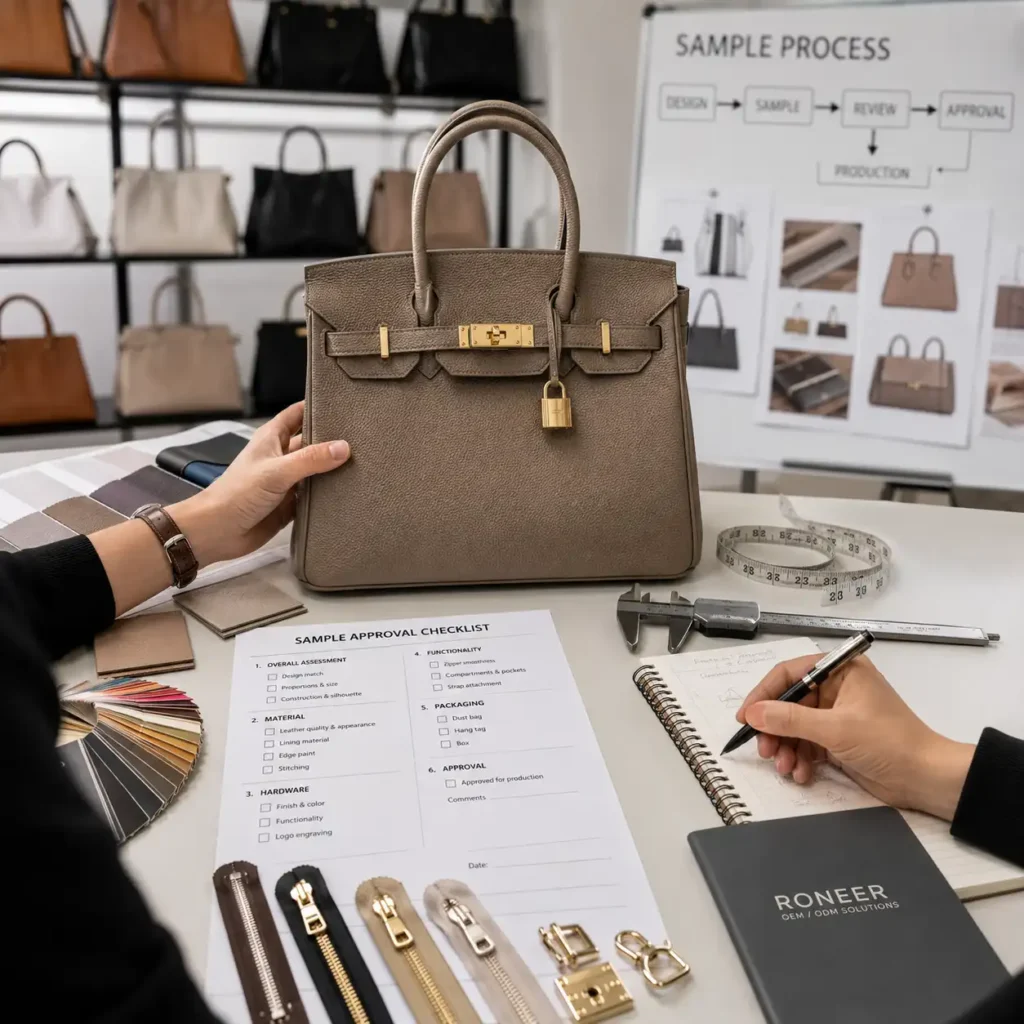
Before approving custom metal logo plate bags, buyers should check logo clarity, plate size, thickness, surface finish, color, edge smoothness, attachment method, weight, position, backing support, plating consistency, scratch marks, and how the plate looks on the finished bag. The logo plate should be approved as a physical sample, not only from a digital mockup.
11. How can buyers protect metal logo plates during shipping?
For custom metal logo plate bags, buyers should use proper packaging protection such as protective film, tissue paper, foam sheet, dust bags, individual poly bags, inner support, correct folding, and strong export cartons. This helps prevent scratches, pressure marks, plating damage, and metal-to-material friction during storage and international shipping.
12. Are metal logo plates better than printed logos?
Metal logo plates are not always better, but they are often more suitable when buyers want premium branding, stronger hardware detail, and a more durable logo effect. Printed logos are more cost-effective and flexible for many fabric bags. Custom metal logo plate bags are better for products that need a higher-end appearance, while printed logos may be better for low-cost promotional bags or lightweight styles.
13. Why choose RONEER for custom metal logo plate bags?
RONEER helps buyers develop custom metal logo plate bags with OEM/ODM support, logo customization, hardware finish matching, metal plate development, material reinforcement review, low MOQ planning where feasible, sample development, private label packaging, strict QC, export carton packing, and global shipping coordination. RONEER can help buyers choose a logo plate solution that matches the bag material, brand style, MOQ, and production budget.
Sonuç
Custom metal logo plate bags are a strong choice for buyers who want custom bags with a more premium, branded, and retail-ready appearance. A metal logo plate can make handbags, wallets, cosmetic bags, backpacks, pouches, tote bags, and travel bags look more professional than simple printed branding. However, a metal logo plate should never be treated as only a decorative item.
For B2B buyers, successful custom metal logo plate bags depend on the full production system. Buyers need to confirm the metal material, logo process, plate size, hardware finish, attachment method, backing reinforcement, MOQ, mold cost, packaging protection, and QC standard. A plate that looks good in artwork may not work well in bulk production if it is too heavy, too sharp, weakly attached, poorly plated, or not suitable for the bag material.
The best custom metal logo plate bags should also match the complete hardware system. The logo plate should work together with zipper pullers, sliders, buckles, hooks, D-rings, rivets, chain straps, metal feet, inner labels, hang tags, dust bags, and packaging. When all these details are planned together, the final product feels more consistent and more valuable to retail buyers.
RONEER supports OEM/ODM buyers with custom metal logo plate bags, custom logo development, hardware finish coordination, material customization, attachment testing, low MOQ suggestions where feasible, fast sampling, private label packaging, stable bulk production, strict QC, export carton packing, and global shipping experience.
Before bulk production, buyers should approve the physical metal logo plate sample, plating color, logo clarity, edge smoothness, attachment strength, placement, protective film, and final appearance on the finished bag. When custom metal logo plate bags are developed with clear approval records and proper QC, the collection becomes easier to reproduce, easier to reorder, and more consistent across future bag styles.