









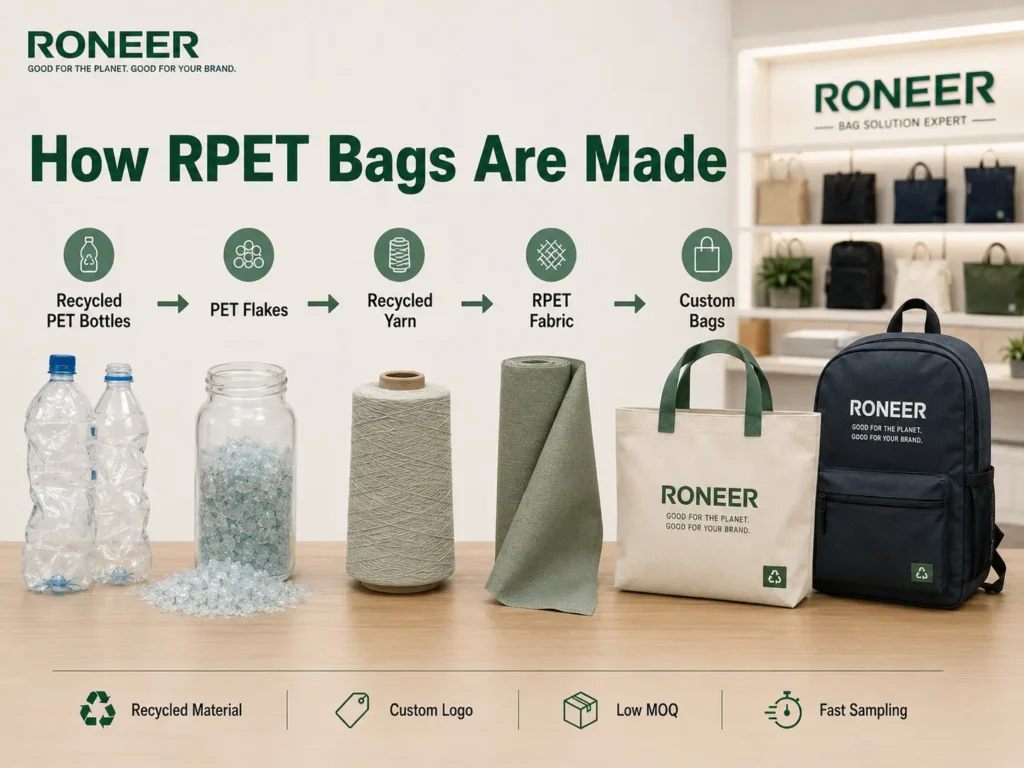
Choosing RPET bags is a practical option for brands, wholesalers, retailers, e-commerce sellers, promotional buyers, corporate gift buyers, and private label startups that want custom bags with a recycled material story. RPET, also known as recycled PET or recycled polyester, is commonly made from recycled plastic bottles or other PET waste and processed into fibers or fabrics for bag production.
For B2B buyers, RPET bags are not only about using a recycled fabric. The real purchasing decision should include material availability, documentation, MOQ, logo method, fabric strength, color options, sample lead time, bulk production quality, packaging, and export requirements. A recycled fabric must still meet the product’s function and customer expectations.
RONEER supports OEM/ODM custom bag projects with material customization, custom logo options, fast sampling, low MOQ support, private label packaging, strict QC, export packing, and global shipping coordination. Buyers can review overall factory capabilities through RONEER custom bag manufacturing service.
This guide explains how RPET bags work, which product types are suitable, what buyers should check before sampling, and how to develop recycled material bag projects with lower risk and stronger sourcing clarity.
What Are RPET Bags?
RPET bags are bags made from recycled PET material, often processed into recycled polyester fabric. RPET fabric can be used in many bag categories, depending on fabric specification, thickness, weave, coating, lining, and structure.
RPET is commonly used for:
- Tote bags
- Shopping bags
- Backpacks
- Drawstring bags
- Cosmetic bags
- Toiletry bags
- Pouches
- Travel organizers
- Cooler bags
- Promotional bags
- Foldable bags
- Gift bags
- Private label retail bags
For buyers who want a recycled material option with practical production flexibility, RPET bags can be a strong material direction. However, buyers should confirm whether the RPET material has proper documentation before making recycled or sustainability claims in product pages, packaging, or marketing.
Why Buyers Choose RPET Bags
Many buyers choose RPET bags because they want a product with recycled material value while keeping the advantages of polyester-based bag manufacturing.
Recycled Material Story
RPET gives buyers a clearer recycled material story than standard polyester. This can be useful for brands that want to communicate responsible material choices to retailers, corporate clients, or end customers.
Wide Product Application
Because RPET is often processed as recycled polyester fabric, it can be used in many common bag categories, including tote bags, backpacks, cosmetic bags, shopping bags, drawstring bags, and pouches.
Good Customization Flexibility
RPET fabric can support many logo and packaging options. Depending on the fabric surface, buyers can use screen printing, heat transfer, embroidery, woven labels, rubber patches, PU patches, hang tags, and branded packaging. Buyers can review RONEER’s logo customization options before confirming the best method.
Practical for Private Label Projects
For private label buyers, RPET bags can combine recycled material positioning with custom logo, custom color, custom structure, and branded packaging.
Suitable for Promotional and Corporate Orders
Many promotional buyers and corporate gift buyers prefer recycled material options for events, campaigns, staff gifts, retail giveaways, and reusable shopping programs.
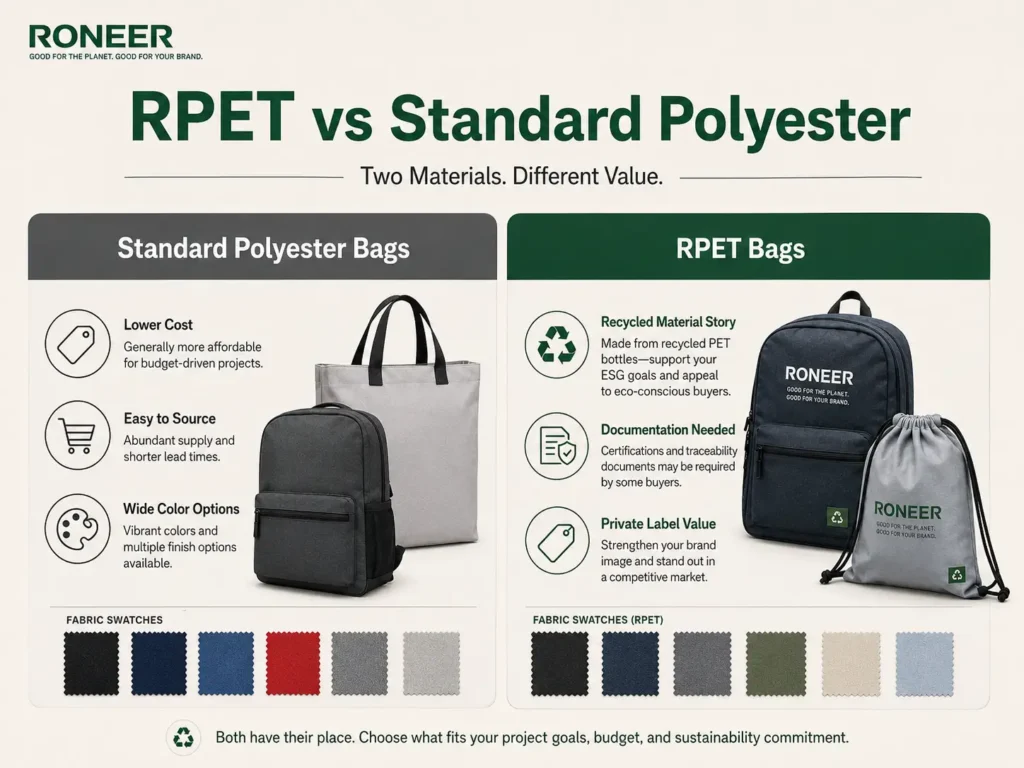
RPET bags and standard polyester bags may look similar, but the material source and sourcing requirements are different.
Standard polyester is usually easier to source, may have more color options, and can support cost-controlled production. RPET uses recycled PET material and may require extra documentation, supplier confirmation, and sometimes higher material MOQ depending on fabric availability.
Standard polyester may be better for:
- Lowest-cost projects
- Large color variety
- Very tight lead time
- Basic promotional orders
- Orders with no recycled material requirement
RPET may be better for:
- Recycled material positioning
- Corporate sustainability campaigns
- Private label eco-conscious lines
- Retail products with material story
- Promotional bags with responsible sourcing message
The better choice depends on target customer, cost, MOQ, documentation needs, logo method, and production timeline.
Common Types of RPET Bag Materials
Different RPET fabrics can be used for different bag products. Buyers should not treat all RPET as one material.
RPET Polyester Fabric
RPET polyester fabric is commonly used for tote bags, shopping bags, drawstring bags, cosmetic bags, pouches, and promotional bags. It can be lightweight, cost-effective, and suitable for custom printing.
RPET Oxford Fabric
RPET Oxford fabric can be used for backpacks, travel bags, cooler bags, laptop bags, and structured promotional bags. It offers better structure and durability than very lightweight fabrics.
RPET Non-Woven Fabric
RPET non-woven fabric can be used for shopping bags, gift bags, event bags, and promotional packaging bags. It can be cost-effective for simple reusable bag projects.
RPET Canvas-Look Fabric
Some RPET fabrics are designed to look like canvas or textured woven fabric. They can be suitable for retail tote bags, lifestyle bags, and private label collections.
Coated RPET Fabric
Coated RPET fabric can improve water resistance or structure. It may be useful for toiletry bags, cooler bags, travel organizers, and functional pouches.
For buyers comparing recycled fabric options, RONEER’s material customization service can help evaluate RPET material type, texture, MOQ, lead time, and product suitability.
Which Bag Types Are Suitable for RPET?
RPET bags can cover many product categories, especially when buyers want reusable products with recycled material positioning.
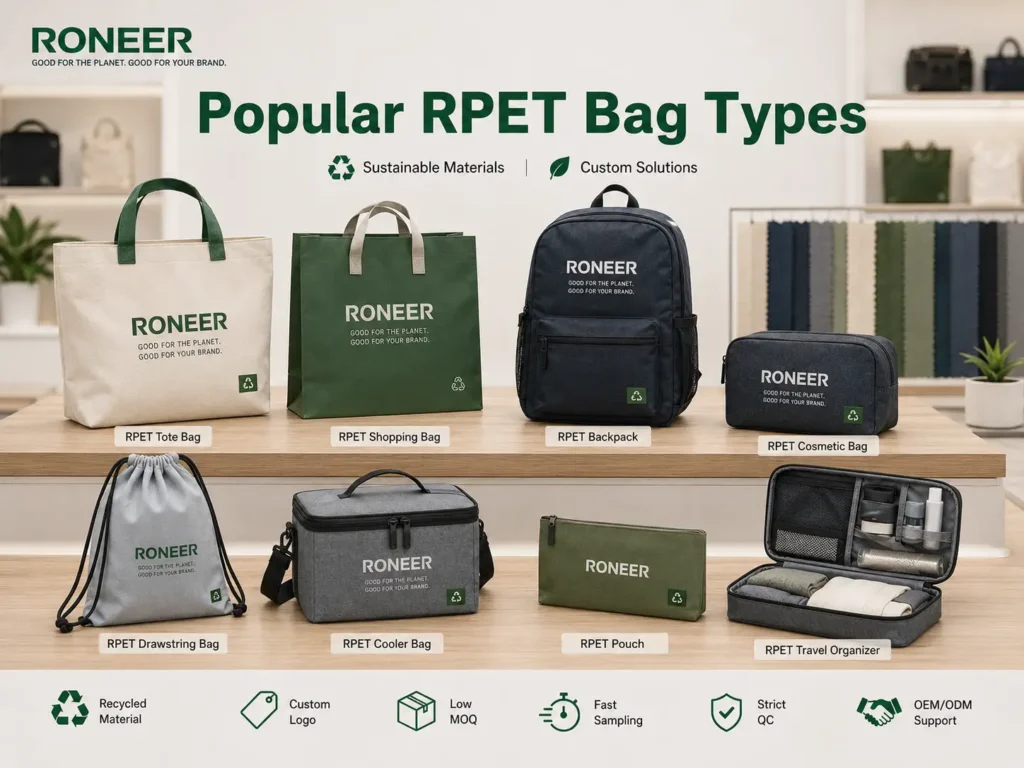
RPET Tote Bags
RPET tote bags are suitable for retail, promotional campaigns, trade shows, corporate gifts, and private label shopping bags. Buyers can choose simple RPET fabric, RPET canvas-look fabric, or RPET non-woven fabric depending on price and product level.
RPET Shopping Bags
Reusable shopping bags made from RPET can support supermarkets, retail stores, corporate campaigns, and lifestyle brands. Foldable structures are also common.
RPET Backpacks
RPET backpacks can be made with RPET polyester or RPET Oxford fabric. Buyers should confirm fabric strength, lining, zipper quality, strap reinforcement, and logo method.
RPET Cosmetic Bags
RPET cosmetic bags and toiletry bags can work well for beauty brands, travel brands, and private label accessory lines. Coated RPET or RPET fabric with wipeable lining may be useful.
RPET Drawstring Bags
RPET drawstring bags are suitable for sports, schools, events, promotional campaigns, and packaging programs.
RPET Cooler Bags
RPET Oxford fabric can be used as an outer material for cooler bags, paired with insulation lining. Buyers should confirm coating, insulation, stitching, zipper, and leak-resistance requirements.
RPET Pouches and Travel Organizers
Small RPET pouches, travel organizers, and storage bags can be useful for e-commerce brands, corporate gifts, and private label collections.
RPET Material Documentation and Claims
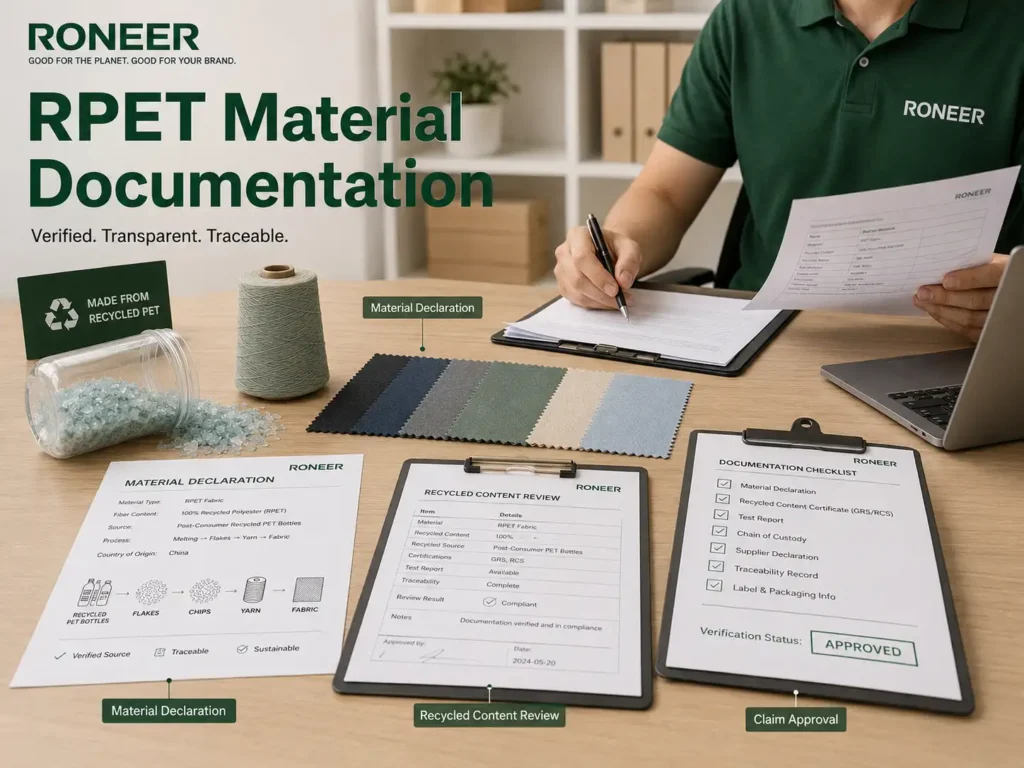
When developing RPET bags, documentation is very important. Buyers should not use recycled material claims without checking supplier documents.
Documents may include:
- Recycled material declaration
- Material composition sheet
- Recycled content information
- Supplier certification if available
- Transaction certificate if required
- Test report if requested
- Material swatch approval record
For general industry background on recycled and preferred materials, buyers can refer to 섬유 교환. However, any claim used on product labels, packaging, or marketing should be based on actual supplier documents and confirmed order materials.
RONEER can help buyers review available RPET fabric options and clarify what documentation may be available for a specific project. Buyers should confirm documentation needs before sampling, especially for retail, corporate, or compliance-sensitive orders.
Logo Options for RPET Bags
Logo customization is important for RPET bags, especially for private label, promotional, and retail projects. The best logo method depends on fabric surface, coating, bag type, MOQ, and target price.
Common logo methods include:
- Screen printing
- Heat transfer printing
- Embroidery
- Woven label
- Rubber patch
- PU patch
- Recycled content label
- Custom zipper puller
- Hang tag
- Printed lining logo
- Packaging logo
Screen printing is often practical for simple RPET tote bags and shopping bags. Heat transfer can work well on smooth RPET polyester surfaces. Woven labels and patches can create a more premium look for backpacks, cosmetic bags, and private label pouches.
Logo testing should happen during sample development. A professional factory should check logo clarity, adhesion, position, color, and durability before bulk production.
RPET Bags MOQ, Cost, and Lead Time
The MOQ, cost, and lead time of RPET bags depend on fabric availability, recycled material documentation, color, coating, logo method, bag structure, lining, hardware, packaging, and order quantity.
Available RPET fabric can support faster sampling and more practical MOQ. Custom-dyed RPET fabric, special texture, coated RPET, certified recycled materials, or exclusive colors may require higher MOQ and longer lead time.
Main cost factors include:
- RPET fabric type
- Recycled content level
- Documentation requirement
- Fabric weight
- Coating
- Color availability
- Logo method
- 안감
- 하드웨어
- Bag structure
- 포장
- Order quantity
For first orders, buyers should start with available RPET fabrics and practical logo methods. This helps reduce development cost, MOQ pressure, and delivery risk.
Buyers who need MOQ planning can review RONEER’s guide on custom backpack MOQ cost planning, because many MOQ principles also apply to RPET backpacks, tote bags, cosmetic bags, shopping bags, and promotional bags.
Packaging for RPET Bags
Packaging should match the recycled material story and sales channel. If the product is made with RPET but packed in unnecessary premium packaging that conflicts with the buyer’s brand message, the final presentation may feel inconsistent.
Common packaging options include:
- Individual polybags
- Recycled paper hang tags
- Insert cards
- Barcode labels
- Paper sleeves
- FSC-style paper boxes if required
- Dust bags
- Export cartons
Buyers can use packaging to explain recycled material content, care instructions, barcode information, and brand story. However, recycled material claims on packaging should be supported by actual documentation.
RONEER’s packaging customization service can help buyers align packaging with private label requirements, export packing, and product positioning.
Quality Control for RPET Bags
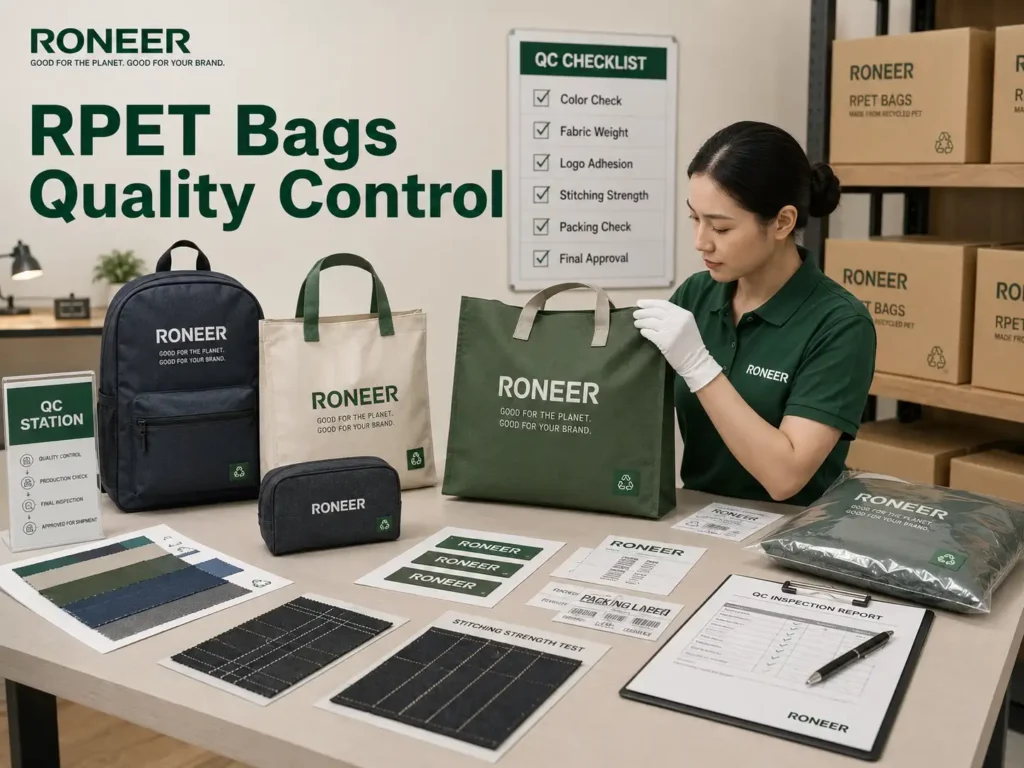
Quality control is important for RPET bags because recycled material positioning does not replace product performance. The bag still needs to meet buyer expectations for durability, appearance, stitching, logo, packaging, and shipment condition.
Important QC checks include:
- Fabric color consistency
- Recycled material documentation
- Fabric weight
- Surface defects
- Coating quality if applicable
- Logo clarity and adhesion
- Stitching quality
- Seam strength
- Zipper smoothness
- Hardware function
- Strap reinforcement
- Lining cleanliness
- Packaging accuracy
- Barcode label check
- Export carton condition
For inspection and testing background, buyers can refer to SGS. For harmful substance and material safety background, OEKO-TEX can also be used as an industry reference. Buyers should confirm any specific testing, certification, or compliance requirement before production.
RONEER follows QC steps during material checking, sample development, production, final inspection, and export packing to help buyers reduce risk and improve bulk consistency.
RPET Bags for Promotional Projects
Promotional buyers often choose RPET bags because they combine practical use with a recycled material story. RPET tote bags, shopping bags, drawstring bags, and pouches can be used for corporate campaigns, trade shows, schools, events, brand launches, and retail giveaways.
For promotional projects, buyers should confirm:
- Event date
- Quantity
- Logo artwork
- Printing method
- Bag size
- RPET fabric availability
- Documentation needs
- 포장
- Delivery schedule
- Export packing
Simple structures and available RPET materials can help control cost and lead time.
RPET Bags for Private Label Brands
Private label buyers can use RPET bags to build a product line with a recycled material angle. This can apply to tote bags, backpacks, cosmetic bags, travel organizers, pouches, and lifestyle accessories.
Private label buyers should pay attention to:
- Material story
- Product durability
- Logo method
- Packaging message
- Care label
- Hang tag copy
- Retail presentation
- Product photography
- Reorder planning
A professional manufacturer should help private label buyers balance recycled material positioning with production feasibility and quality control.
Common Mistakes When Developing RPET Bags
Many sourcing problems happen when buyers focus only on the recycled material name without checking the full product requirements.
Assuming All RPET Fabric Has the Same Quality
RPET fabric can vary by yarn quality, weave, weight, coating, color, and finishing. Buyers should review swatches before sampling.
Making Claims Without Documentation
Buyers should not claim recycled content, bottle count, or certification unless proper documents support the claim.
Ignoring MOQ and Lead Time
Some RPET fabrics may require higher MOQ or longer sourcing time than standard polyester.
Choosing the Wrong Logo Method
Logo performance depends on RPET surface texture and coating. Logo testing should happen before bulk production.
Ignoring Bag Function
A recycled material story is useful, but the bag still needs correct structure, stitching, zipper, lining, and reinforcement.
Overcomplicating the First Order
Too many colors, custom fabric, special packaging, and complex structure can increase cost and delay. Start with practical options first.
How RONEER Helps Buyers Develop RPET Bags
RONEER helps buyers develop RPET bags based on product type, target market, budget, MOQ, logo method, documentation needs, packaging, and quality expectations.
RONEER can support:
- RPET fabric selection
- Material swatch review
- Available recycled fabric recommendation
- Documentation discussion
- Logo compatibility testing
- Tote bag and shopping bag development
- Backpack and travel bag structure planning
- Cosmetic bag material matching
- Private label packaging
- Low MOQ planning
- Fast sampling
- Bulk production
- QC inspection
- Export packing
For startups, RONEER can recommend available RPET options that support faster sampling and lower MOQ. For established brands, RONEER can help develop more specific RPET fabric, logo, packaging, and structure solutions for private label collections.
FAQ About RPET Bags
1. What are RPET bags?
RPET bags are bags made from recycled PET material, usually processed into recycled polyester fabric. They are commonly used for tote bags, shopping bags, backpacks, cosmetic bags, pouches, drawstring bags, travel organizers, cooler bags, and promotional bags.
2. Are RPET bags durable?
Yes. RPET bags can be durable when the correct fabric weight, weave, coating, lining, stitching, and reinforcement are used. Durability depends on the actual RPET fabric specification and the bag structure.
3. Are RPET bags eco-friendly?
RPET uses recycled PET material, which can support a recycled material story. However, buyers should avoid unsupported claims. Any recycled content, sustainability, or certification statement should be confirmed with supplier documentation before use.
4. What products can be made as RPET bags?
RPET bags can include tote bags, shopping bags, backpacks, drawstring bags, cosmetic bags, toiletry bags, pouches, travel organizers, cooler bags, foldable bags, and promotional bags.
5. Can RPET bags have a custom logo?
Yes. RPET bags can support screen printing, heat transfer, embroidery, woven labels, rubber patches, PU patches, hang tags, printed lining logos, and packaging logos. The best method depends on fabric surface, coating, MOQ, and product type.
6. Do RPET bags support low MOQ orders?
Yes, RPET bags can support lower MOQ when buyers use available RPET fabrics, standard colors, practical logo methods, and simple packaging. Custom-dyed RPET fabric, special textures, coated fabrics, or specific documentation requirements may increase MOQ.
7. Are RPET bags more expensive than standard polyester bags?
Sometimes. RPET material may cost more than standard polyester depending on fabric availability, recycled content, documentation, color, coating, and supplier requirements. However, RPET can add value for buyers who need recycled material positioning.
8. What should buyers check before ordering RPET bags?
Buyers should check fabric type, recycled material documentation, color, fabric weight, coating, logo compatibility, stitching strength, lining, packaging, MOQ, lead time, and QC standards before ordering RPET bags.
9. Can RONEER provide RPET fabric swatches before sampling?
Yes. RONEER can help buyers review RPET fabric swatches before sample development. Swatch review helps confirm color, texture, fabric weight, coating, hand feel, logo compatibility, and production feasibility.
10. Are RPET bags suitable for promotional campaigns?
Yes. RPET bags are suitable for promotional campaigns, trade shows, retail giveaways, corporate gifts, schools, and events. RPET tote bags, shopping bags, drawstring bags, and pouches are especially common for promotional use.
11. Are RPET bags suitable for private label brands?
Yes. RPET bags can be suitable for private label brands that want custom logo, branded packaging, recycled material positioning, and reusable product lines. Buyers should confirm documentation, quality, packaging message, and reorder planning.
12. Why choose RONEER for RPET bags?
RONEER helps buyers develop RPET bags with OEM/ODM support, material customization, custom logo solutions, fast sampling, low MOQ options, private label packaging, strict QC, export packing, and global shipping coordination.
결론
RPET bags are a practical choice for buyers who want custom bags with recycled material positioning, flexible OEM/ODM development, and broad product application. They can be used for tote bags, shopping bags, backpacks, cosmetic bags, pouches, drawstring bags, travel organizers, cooler bags, and promotional bags.
For B2B buyers, successful RPET bags require more than choosing a recycled fabric name. Buyers need to confirm RPET fabric type, recycled material documentation, fabric weight, coating, logo method, lining, structure, packaging, MOQ, lead time, and QC requirements. A strong recycled material story should always be supported by real product performance and reliable documentation.
RONEER works as a practical manufacturing partner for buyers who need RPET bags with material customization, custom logo options, fast sampling, low MOQ support, private label packaging, durable recycled material options, stable bulk production, strict QC, export carton packing, and global shipping experience.
Whether you are developing RPET tote bags, shopping bags, backpacks, cosmetic bags, pouches, drawstring bags, cooler bags, travel organizers, or promotional bags, RONEER can help you compare available RPET materials, develop accurate samples, test logo methods, control quality, and prepare your custom bag project for stable production and international shipment.