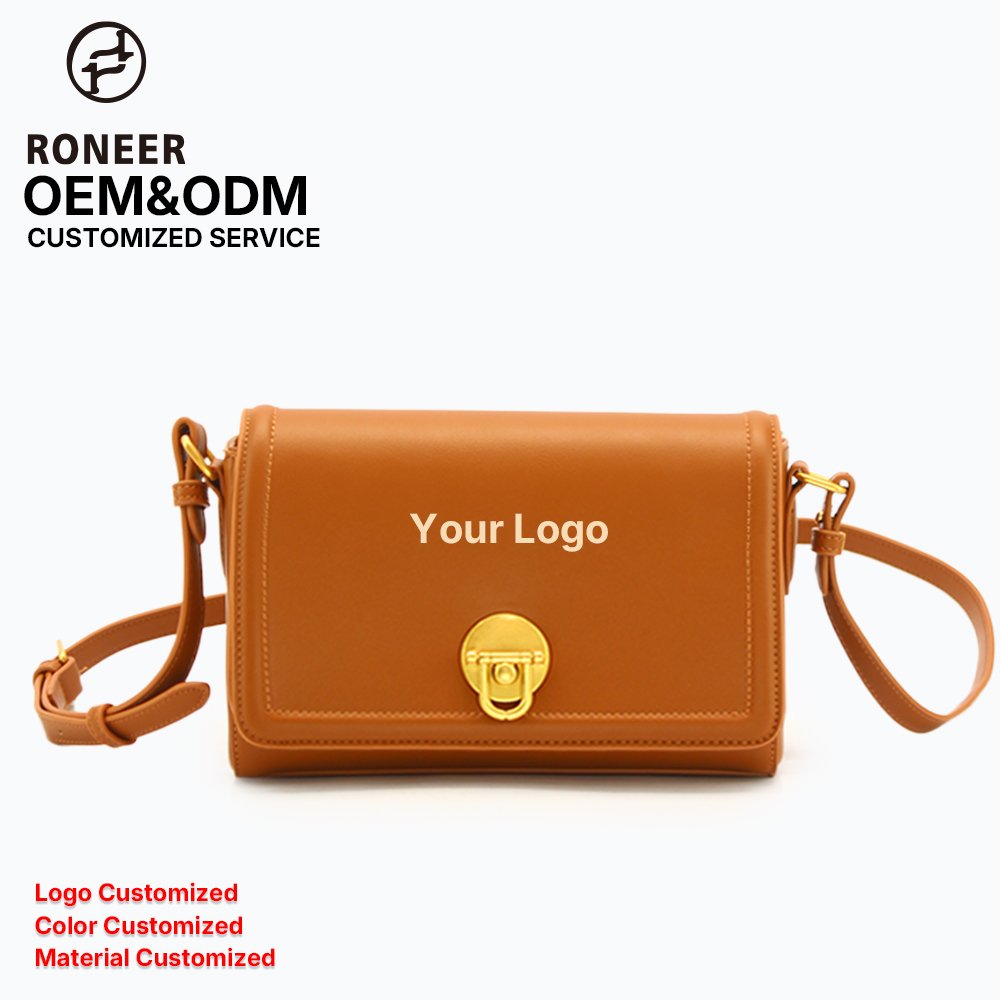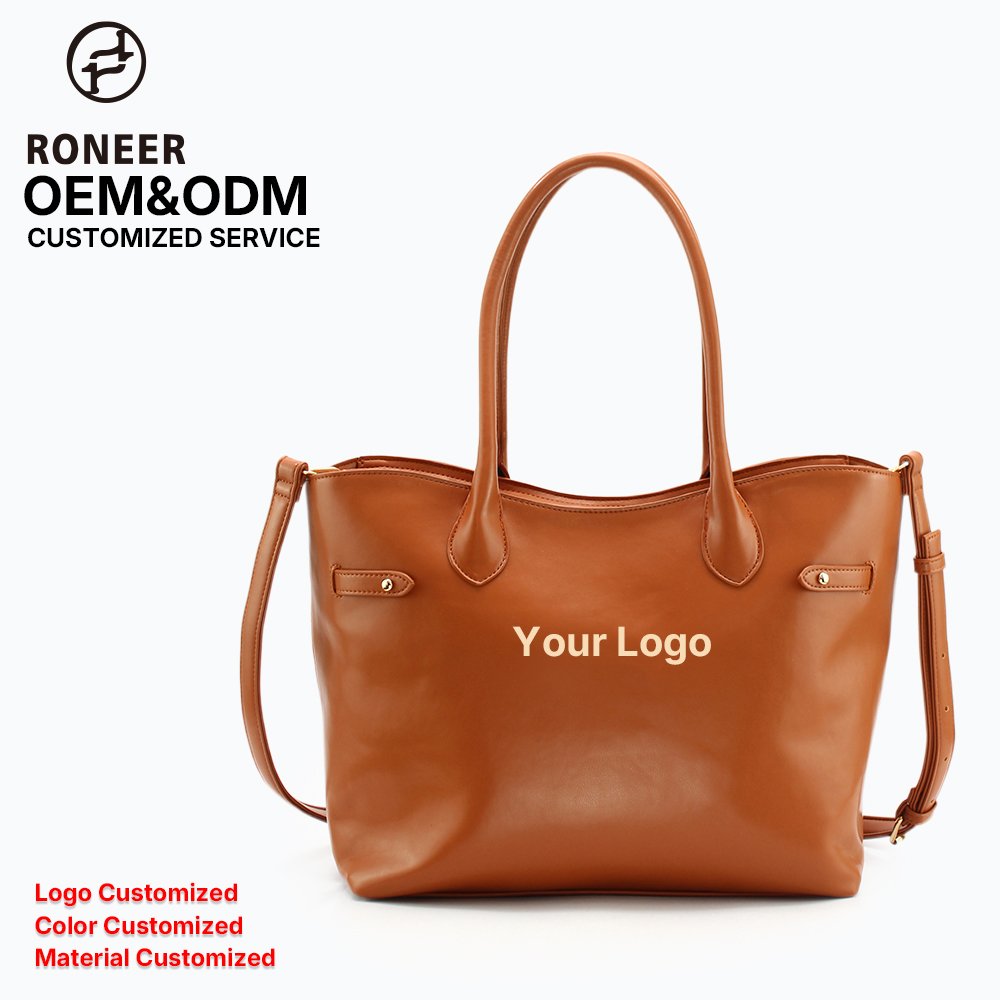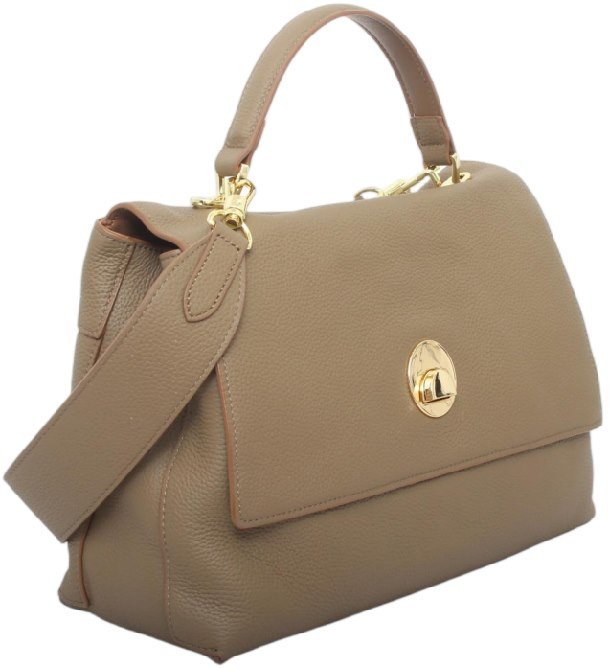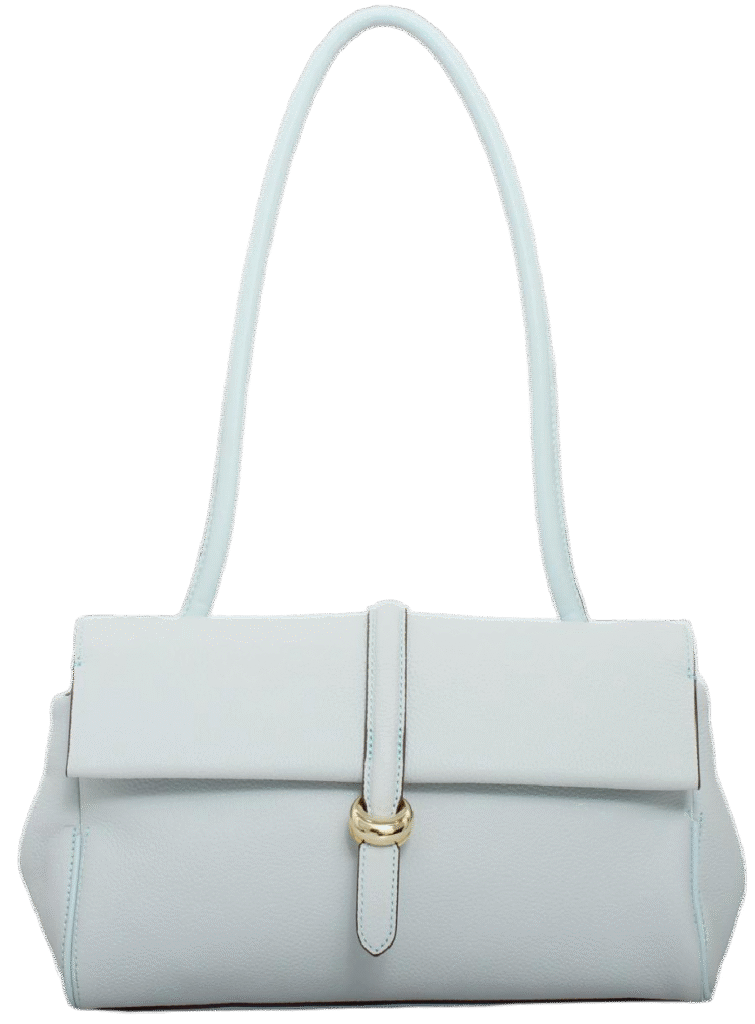









A tote bag may look like one of the simplest products in the bag industry. It usually has an open body, two handles, enough space for daily items, and a clean surface for branding. But for B2B buyers, a tote bag is not just a basic carrier. It can become a retail product, a promotional gift, a private label item, an e-commerce accessory, a fashion collection piece, or a reusable packaging solution.
This is why choosing the right custom tote bag manufacturer matters. A tote bag looks simple, but its commercial value depends on material quality, handle strength, stitching, logo clarity, size planning, packaging, MOQ, bulk consistency, and delivery reliability. A weak handle, poor printing, thin fabric, or cheap packaging can quickly make the product feel low-value.
For fashion brands, retailers, wholesalers, corporate buyers, supermarkets, beauty brands, event planners, startup labels, and e-commerce sellers, custom tote bags are one of the most flexible bag categories. They can be made from canvas, cotton, polyester, nylon, RPET, non-woven fabric, PU leather, jute, mesh, or mixed materials. They can also support screen printing, embroidery, woven labels, heat transfer, leather patches, rubber patches, hangtags, and branded packaging.
A professional custom tote bag manufacturer helps buyers turn a simple tote concept into a product that fits the target market, brand identity, MOQ plan, and quality standard. If you are developing custom tote bags for your brand, RONEER custom bag manufacturing services can support OEM/ODM development, material selection, custom logo options, low MOQ planning, sample development, packaging customization, bulk production, strict quality control, and export packing.
What Is a Custom Tote Bag Manufacturer?
A custom tote bag manufacturer is a bag factory that develops and produces tote bags according to a buyer’s design, size, material, handle, logo, color, lining, packaging, MOQ, and quality requirements.
Unlike buying generic ready-made tote bags, working with a manufacturer gives buyers more control over product details such as:
Bag size
Bag capacity
Material type
Fabric weight
Handle length
Handle width
Handle reinforcement
로고 방식
로고 위치
Color matching
Inside pocket
Zipper closure
Snap button
Lining option
Packaging style
Carton packing
QC standard
A simple custom tote bag project may use an existing factory pattern with a printed logo and available material. A more advanced OEM/ODM project may include custom size, special fabric weight, branded lining, reinforced handles, custom labels, zipper closure, inner pockets, dust bags, hangtags, and retail-ready packaging.
The role of a custom tote bag manufacturer is not only sewing a flat bag. A reliable factory should help buyers decide which material fits the market, which logo method works on the fabric, which handle structure can support weight, which packaging is realistic for MOQ, and how to keep bulk production consistent.
Why Tote Bags Are Strong Products for Custom Brands
Tote bags are strong products because they are practical, visible, lightweight, highly brandable, and suitable for many industries. Customers use them for shopping, commuting, gifting, events, daily carry, packaging, promotions, and lifestyle styling.
For fashion brands, tote bags can support seasonal graphics, simple silhouettes, premium fabrics, leather trims, and lifestyle collections.
For retailers and supermarkets, reusable tote bags can replace single-use shopping bags and improve brand visibility.
For corporate buyers, tote bags are useful for trade shows, conferences, employee gifts, product launches, and client programs.
For beauty and skincare brands, tote bags can be used for gift-with-purchase campaigns, retail bundles, and influencer kits.
For e-commerce sellers, tote bags are easy to photograph, ship, and test in different colors or prints.
For startup brands, working with a custom tote bag manufacturer can be a lower-risk way to launch branded merchandise or test a private label accessory before developing more complex bags.
A reliable custom tote bag manufacturer helps buyers connect these sales opportunities with real production decisions.
1. Choose the Right Tote Bag Type
Not all tote bags are the same. Different tote bag types require different materials, handle structures, logo methods, and production planning.
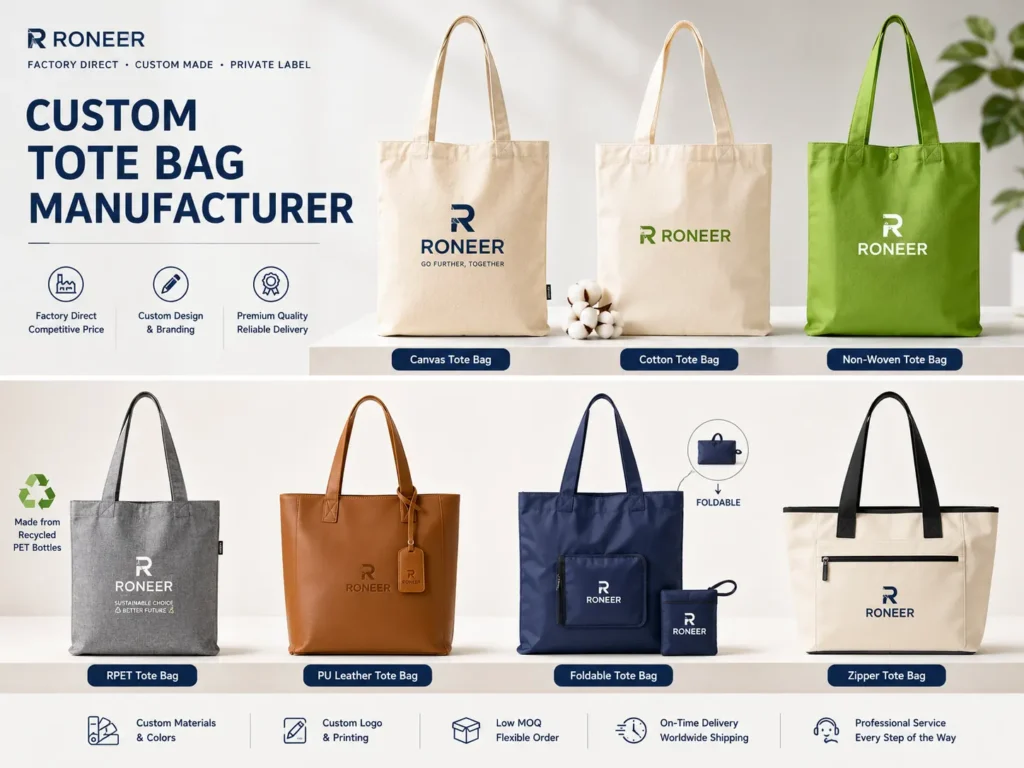
Canvas Tote Bags
Canvas tote bags are popular for lifestyle brands, bookstores, fashion labels, retail shops, and promotional programs. They offer a natural texture and work well with screen printing, embroidery, woven labels, and leather patches.
Cotton Tote Bags
Cotton tote bags are lightweight, soft, and suitable for eco-style branding, events, packaging, and casual retail use. Fabric weight should be confirmed because thin cotton may feel too weak for premium positioning.
Non-Woven Tote Bags
Non-woven tote bags are cost-effective and suitable for promotions, events, conferences, supermarkets, and giveaways. They are often used when buyers need large quantities at controlled cost.
RPET Tote Bags
RPET tote bags may be considered for buyers looking for recycled material options. These are suitable for brands that want reusable bag programs, but any recycled claim should be supported by real documents.
PU Leather Tote Bags
PU leather tote bags are suitable for fashion, office, lifestyle, and boutique retail markets. They can support structured shapes, metal logo plates, debossing, lining, and more premium packaging.
Foldable Tote Bags
Foldable tote bags are practical for travel, shopping, and promotional use. Fabric strength, folding method, and pouch design should be checked carefully.
Zipper Tote Bags
Zipper tote bags offer better security and are suitable for commuting, work, travel, and retail products. Zipper quality and opening width matter.
A professional custom tote bag manufacturer should recommend the tote type based on target customer, sales channel, price point, material direction, MOQ, and branding needs.
2. Match Materials With Use and Price Position
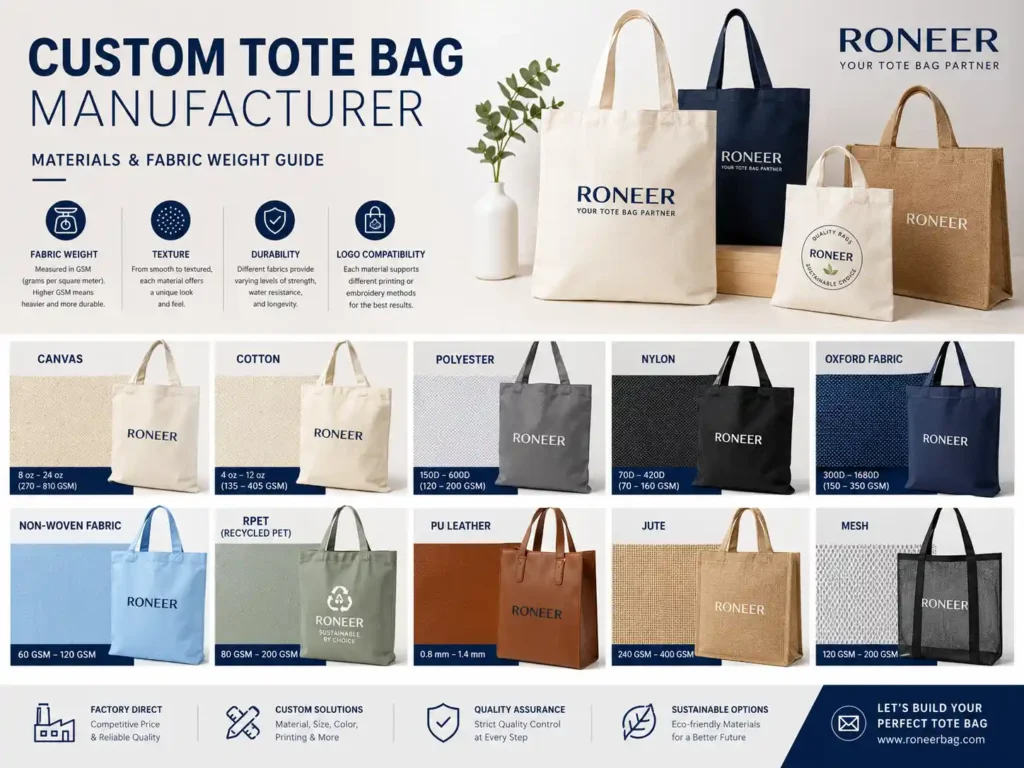
Material selection is one of the most important decisions in tote bag development. The material affects appearance, strength, weight, printing result, MOQ, cost, and customer experience.
Common tote bag materials include:
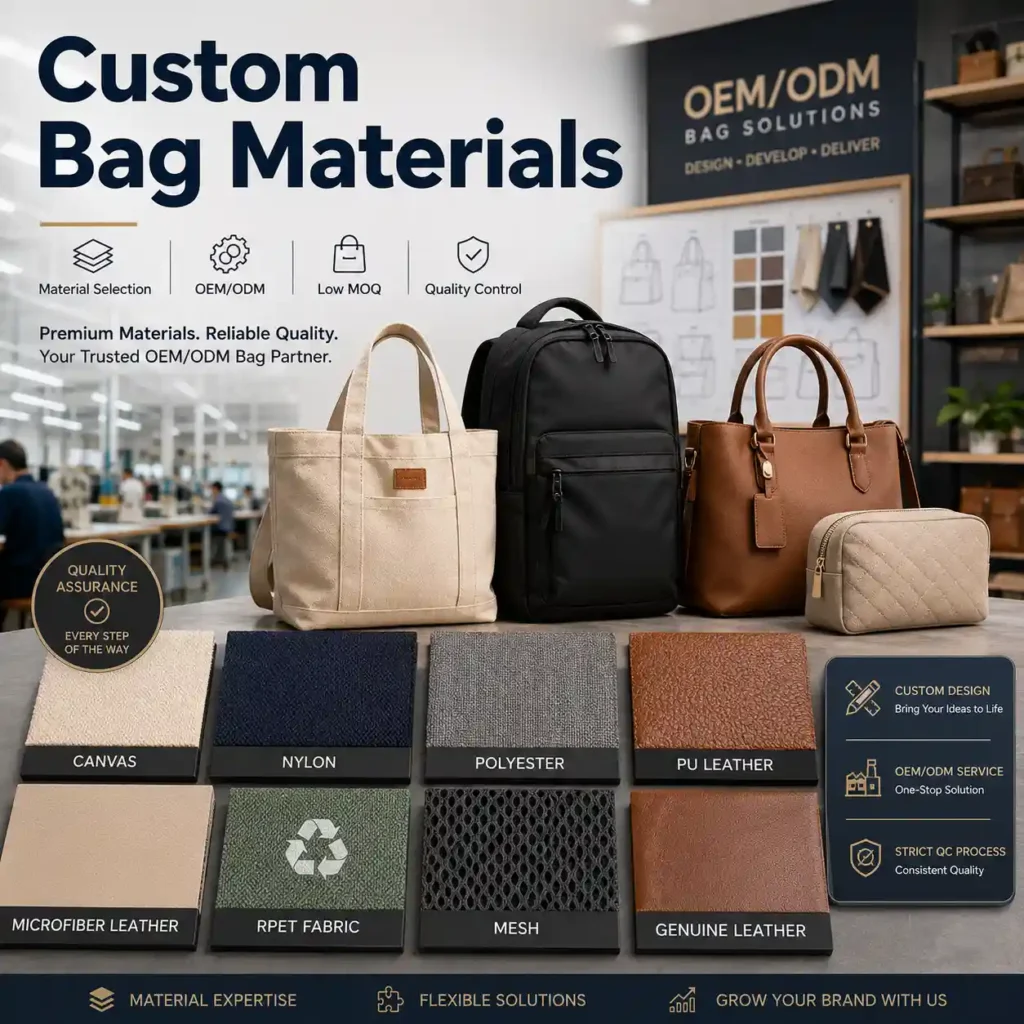
캔버스
면
폴리에스테르
나일론
Oxford fabric
Non-woven fabric
RPET fabric
PU 가죽
Microfiber leather
Jute
Mesh
TPU
PVC
Lining fabric
Webbing
Canvas is widely used for durable and natural-looking tote bags. It can be made in different weights, such as lighter canvas for giveaways and heavier canvas for retail products.
Cotton is soft and suitable for lightweight tote bags, but buyers should confirm thickness and shrinkage risk before bulk production.
Polyester and nylon are practical for foldable tote bags, shopping bags, travel totes, and water-resistant styles.
Oxford fabric can provide better durability for reusable shopping totes or heavier-use bags.
Non-woven fabric is suitable for low-cost promotional tote bags and event bags.
PU leather and microfiber leather are better for premium tote handbags, office totes, and fashion collections.
RPET fabric may be considered for reusable tote bag programs. Buyers can review industry information from 섬유 교환 when discussing preferred or recycled materials, but sustainability claims should only be used when supported by real documentation.
For broader material comparison, 머티리얼 사용자 지정 can help buyers connect material choice with MOQ, logo method, durability, cost, and product use.
A reliable custom tote bag manufacturer should provide material swatches before sampling so buyers can confirm hand feel, fabric weight, texture, color, printing compatibility, and price level.
3. Plan Tote Bag Size and Capacity Carefully
Tote bag size affects both function and cost. A small tote may look stylish but fail to carry enough. A large tote may be practical but use more material, increase shipping volume, and require stronger handles.
Common tote bag size considerations include:
Width
Height
Gusset depth
Handle drop
Handle width
Interior capacity
Foldability
Product weight
Carton packing volume
Target use scenario
For shopping tote bags, the gusset and handle strength matter. For fashion tote bags, proportion and silhouette are important. For promotional tote bags, material cost and print area may be the main concerns. For work tote bags, buyers may need enough space for laptop, documents, water bottle, and personal items.
A custom tote bag manufacturer should help buyers match size with customer use. The factory should also explain how size affects fabric consumption, printing area, packing method, carton quantity, and freight cost.
Buyers should not approve size only from a flat measurement chart. A real sample helps confirm whether the tote looks balanced, carries comfortably, and matches the target market.
4. Strengthen Handles and Stress Points
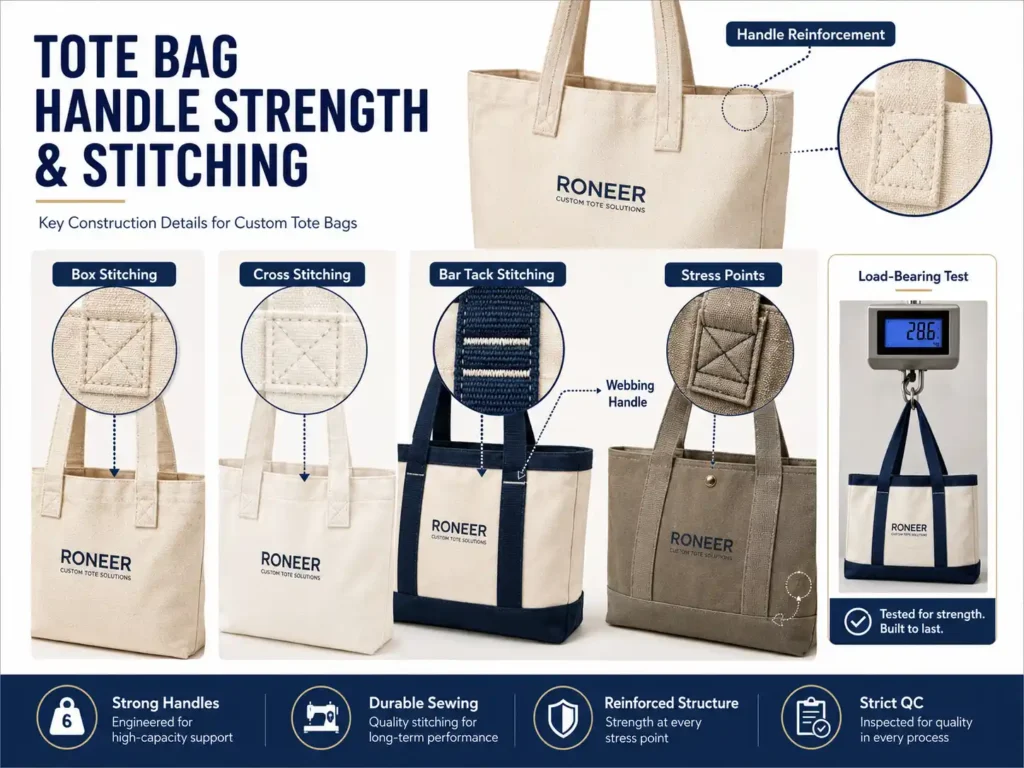
Handles are the most important structural part of a tote bag. Even a simple tote can fail if the handles are weak.
Important handle details include:
Handle length
Handle width
Handle material
Handle softness
Handle reinforcement
Box stitching
Cross stitching
Bar tack stitching
Webbing strength
Handle attachment depth
Thread quality
Load-bearing test
For canvas and cotton tote bags, handles are often made from the same fabric or cotton webbing. For polyester or nylon totes, webbing handles may be stronger. For PU leather tote bags, handle construction and reinforcement must be carefully controlled.
A tote bag used for shopping or daily carry should have stronger stitching at stress points. If the handle attachment is too shallow or stitching is too weak, the bag may tear during use.
A professional custom tote bag manufacturer should test handle strength during sampling and inspect handle attachment during bulk production.
5. Choose the Right Logo Method
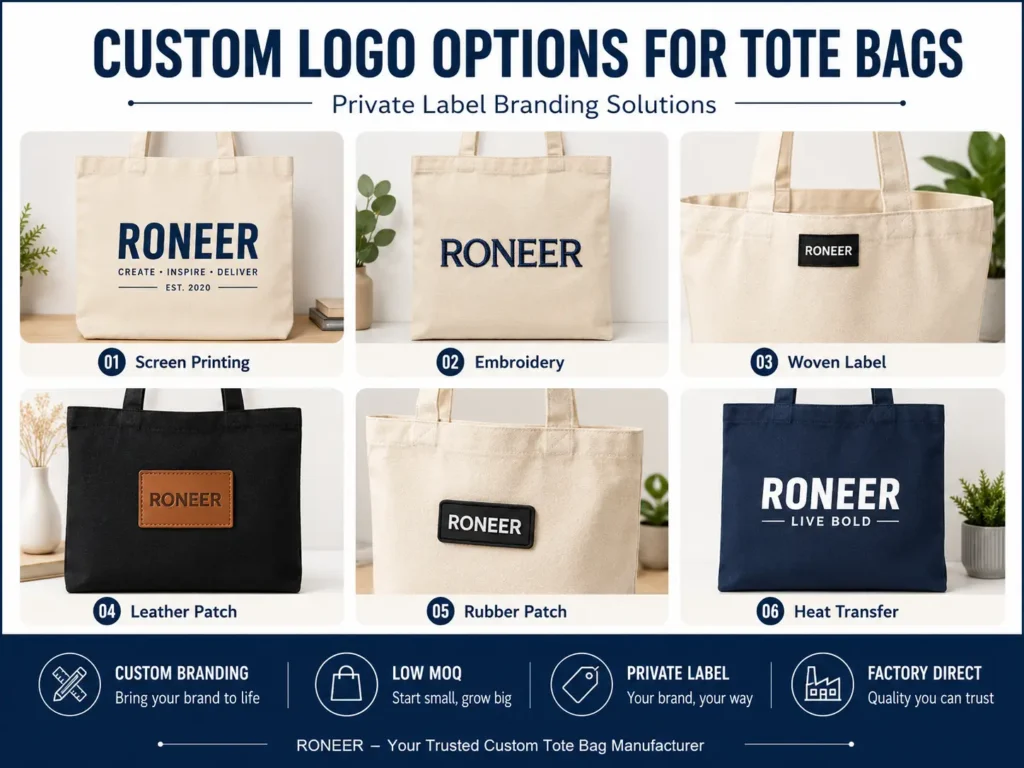
Tote bags are excellent for branding because they offer a large surface area. However, the logo method should match the material, order quantity, and brand style.
Common logo methods include:
스크린 인쇄
열 전달
Embroidery
직조 라벨
가죽 패치
고무 패치
Debossed logo
Embossed logo
Metal logo plate
Custom zipper puller
행태그
Packaging logo
Screen printing is common for canvas, cotton, non-woven, and polyester tote bags. It is cost-effective and suitable for larger graphics.
Embroidery can make a tote bag feel more premium, but it may not be suitable for every artwork or thin fabric.
Woven labels are useful for subtle branding and private label products.
Leather patches can improve perceived value on canvas or casual tote bags.
Debossing, metal logo plates, and hot stamping may be suitable for PU leather tote bags.
If your project focuses on branding, 로고 사용자 지정 can support printing, embroidery, woven labels, patches, metal plates, debossing, hot stamping, zipper pullers, and packaging logos.
A reliable custom tote bag manufacturer should test the logo on the actual material before bulk production. Logo clarity, color accuracy, print durability, placement, and scale should be confirmed in the sample stage.
6. Consider Lining, Pockets, and Closures
Not every tote bag needs lining or pockets. But when the product is positioned for retail, office use, travel, or fashion, these details can improve functionality and value.
Common tote bag functional details include:
Inner pocket
Zipper pocket
Slip pocket
Laptop pocket
Bottle pocket
Snap button closure
Magnetic button
Zipper closure
Lining fabric
Reinforced bottom
Key hook
Detachable pouch
A promotional cotton tote may not need lining. A PU leather tote handbag may need lining, inner pockets, and magnetic closure. A work tote may need a laptop pocket and zipper closure. A shopping tote may benefit from a gusset and reinforced bottom.
For buyers developing higher-value tote bags, these details should be planned during sampling, not added after production begins.
A professional custom tote bag manufacturer should help buyers decide which internal features are necessary and which may increase cost or MOQ without adding enough value.
7. Plan MOQ Around Material, Print, and Packaging
MOQ for tote bags depends on material, color, logo method, printing process, packaging, and customization level.
Lower MOQ is easier when buyers choose:
이용 가능한 자료
Stock colors
Existing tote patterns
Simple screen printing
Standard handles
기본 포장
Limited color options
Higher MOQ may be required for:
Custom-dyed fabric
Exclusive prints
Custom fabric weight
Special handles
Printed lining
Custom zipper pullers
Gift boxes
Multiple colors in one order
Large-area complex printing
For startup brands, a smart first order may use one tote style, one material, one or two colors, one logo method, and practical packaging. Once customer demand is confirmed, the next order can add special fabric, premium packaging, or upgraded logo details.
For MOQ and cost planning, smart ways to optimize custom backpack MOQ and costs can also apply to tote bags, promotional bags, handbags, and other custom bag projects.
A practical custom tote bag manufacturer should help buyers avoid over-customizing the first order before market validation.
8. Use Packaging to Improve Brand Presentation
Packaging can turn a simple tote bag into a more complete private label product.
Common tote bag packaging options include:
Individual polybag
Printed polybag
행태그
Care label
바코드 라벨
Thank-you card
먼지 봉투
Belly band
선물 상자
골판지 표시
Shipping label
Export carton
For retail brands, hangtags, barcode labels, and packaging inserts can improve shelf presentation. For e-commerce sellers, packaging affects unboxing and review experience. For corporate buyers, packaging helps organize distribution. For premium PU tote bags, dust bags and tissue paper may be useful.
For packaging planning, 패키징 사용자 지정 can support tote bag packaging, dust bags, hangtags, labels, polybags, gift boxes, carton marks, and shipping labels.
A reliable custom tote bag manufacturer should help buyers select packaging that fits the sales channel, budget, MOQ, and shipping method.
9. Check Quality Before Bulk Shipment
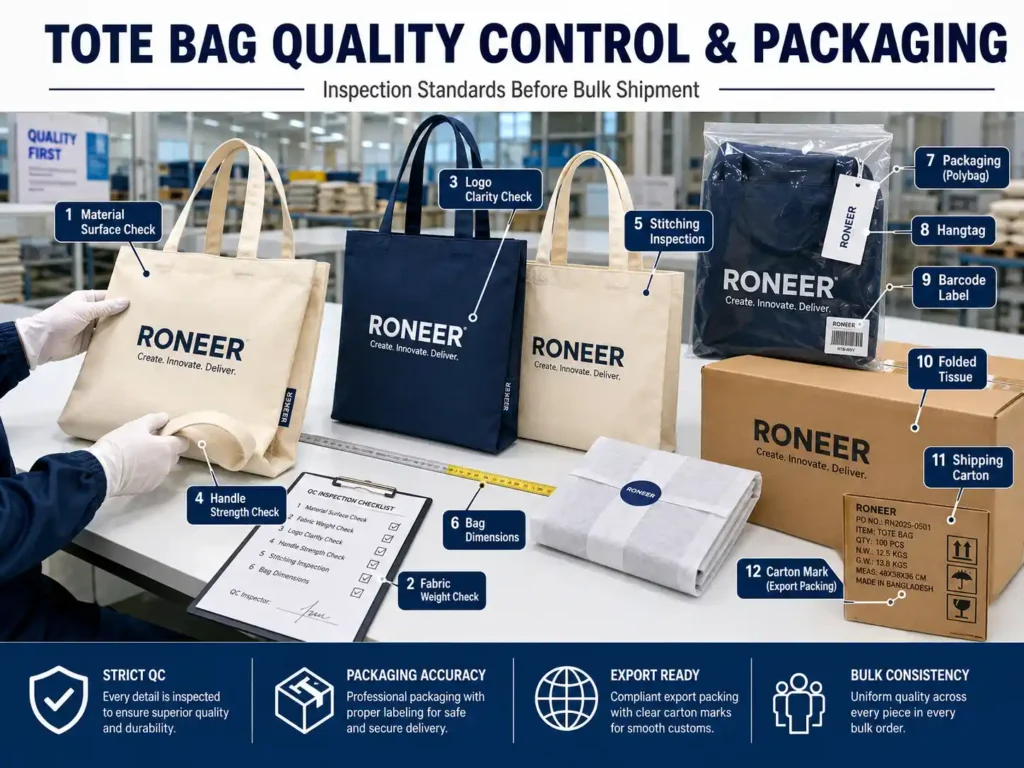
Tote bags may look simple, but quality issues are still common. A poor tote bag can damage brand image quickly, especially when it carries a visible logo.
A tote bag QC checklist may include:
Material surface
Fabric weight
색상 일관성
로고 위치
Logo clarity
Print durability
Handle strength
Handle stitching
Body stitching
Gusset shape
Bag dimensions
Inner pocket placement
클로저 함수
Lining quality
Packaging accuracy
골판지 표시
Final quantity
For third-party testing or inspection, organizations such as SGS may support material testing, color fastness review, shipment inspection, or product verification depending on buyer requirements.
A professional custom tote bag manufacturer should use the approved sample as the production standard and inspect bulk goods before shipment.
10. Plan Repeat Orders and Bulk Production Early
A successful tote bag should not be treated as a one-time project. If the product works, buyers may want repeat orders, new colors, upgraded materials, or seasonal versions.
To support repeat production, buyers should keep records of:
Material code
Fabric weight
Color reference
Logo artwork
로고 위치
Handle length
Stitching method
Packaging details
골판지 표시
QC standards
Sample approval notes
A reliable custom tote bag manufacturer should also keep these production records to help future orders stay consistent.
For wholesalers and retailers, repeat order stability is especially important. For e-commerce sellers, consistent color and print quality help avoid customer complaints. For fashion brands, a proven tote silhouette can become a long-term product base.
A good factory should support both low MOQ testing and later bulk tote bag production.
Buyer Types That Benefit From Custom Tote Bags
Fashion Brands
Fashion brands can use custom tote bags for seasonal collections, capsule drops, casual accessories, and lifestyle branding.
Retailers and Supermarkets
Retailers can use reusable tote bags for shopping programs, brand exposure, and customer loyalty campaigns.
Corporate Buyers
Corporate buyers can use tote bags for events, conferences, employee gifts, client programs, and promotional merchandise.
E-Commerce Sellers
E-commerce sellers can test custom tote bags with low MOQ, strong product photos, and practical shipping.
Beauty and Skincare Brands
Beauty brands can use tote bags for gift-with-purchase campaigns, product launch kits, retail bundles, and influencer packages.
Startup Brands
Startup brands can begin with a simple tote bag to test branding, logo design, and customer response before moving into more complex bags.
Wholesale Buyers
Wholesale buyers can develop repeatable tote bag programs for retailers, distributors, and regional markets.
Common Mistakes Buyers Should Avoid
One common mistake is choosing the cheapest fabric without considering strength, hand feel, or print result. Thin material can make the tote bag feel disposable.
Another mistake is ignoring handle strength. A tote bag may look fine when empty but fail when customers carry groceries, books, laptops, or retail products.
Some buyers use a logo file that is too low in resolution. This can create unclear printing, rough embroidery, or poor label results.
Another issue is over-customizing the first order. Custom-dyed fabric, special handles, printed lining, custom boxes, and multiple colors can increase MOQ before the product has been tested.
Packaging is also often underestimated. A tote bag used for retail or gifting should not be packed like a low-cost giveaway unless that matches the brand position.
The best approach is to confirm material, size, handle strength, logo method, packaging, sample, and QC standard before bulk production.
자주 묻는 질문
What does a custom tote bag manufacturer do?
A custom tote bag manufacturer develops and produces tote bags based on a buyer’s design, size, material, handle, logo, color, lining, packaging, MOQ, and quality requirements. A reliable factory can support OEM/ODM development, sample making, low MOQ production, bulk tote bag production, private label packaging, QC inspection, export packing, and global shipping preparation.
What types of tote bags can a custom tote bag manufacturer produce?
A professional custom tote bag manufacturer can usually produce canvas tote bags, cotton tote bags, non-woven tote bags, RPET tote bags, PU leather tote bags, shopping tote bags, foldable tote bags, zipper tote bags, promotional tote bags, retail tote bags, reusable tote bags, and private label tote bags. The best tote type depends on target market, use scenario, material direction, logo method, budget, and MOQ planning.
What materials are commonly used by a custom tote bag manufacturer?
A custom tote bag manufacturer may use canvas, cotton, polyester, nylon, Oxford fabric, non-woven fabric, RPET fabric, PU leather, microfiber leather, jute, mesh, TPU, PVC, lining fabric, and webbing. The right material should match the tote bag’s intended use, fabric weight, handle strength, logo method, durability, price level, MOQ, and brand positioning.
Can a custom tote bag manufacturer support low MOQ orders?
Yes. A custom tote bag manufacturer can support low MOQ tote bag orders when buyers choose available materials, stock colors, existing tote patterns, standard handles, simple logo methods, and practical packaging. Custom-dyed fabric, exclusive prints, special fabric weight, custom handles, printed lining, or premium gift boxes may require higher MOQ.
What logo methods can a custom tote bag manufacturer provide?
A custom tote bag manufacturer can provide logo methods such as screen printing, heat transfer, embroidery, woven labels, leather patches, rubber patches, debossed logos, embossed logos, metal logo plates, hangtags, care labels, dust bag logos, printed polybags, and packaging logos. The best method depends on the tote bag material, artwork complexity, logo size, order quantity, and buyer’s brand positioning.
How long does sampling take with a custom tote bag manufacturer?
Sampling time depends on tote bag structure, material sourcing, fabric weight, logo testing, handle construction, lining, closure, packaging, and revision requirements. A simple canvas tote bag with screen printing is usually faster to sample, while a PU leather tote, zipper tote, lined tote, or fully original tote design needs more development time.
Can a custom tote bag manufacturer make private label tote bags?
Yes. A custom tote bag manufacturer can make private label tote bags with custom logos, woven labels, branded lining, hangtags, care labels, barcode labels, dust bags, printed polybags, gift boxes, carton marks, and retail-ready packaging. Private label support helps buyers build a stronger brand identity instead of selling generic tote bags.
What should buyers check before approving bulk production?
Before approving bulk production, buyers should check material swatches, fabric weight, tote bag size, handle length, handle strength, logo clarity, logo position, stitching quality, color consistency, lining, pockets, closure function, packaging samples, carton marks, and the final pre-production sample. A reliable custom tote bag manufacturer should use the approved sample as the production standard.
Are custom tote bags suitable for startup brands?
Yes. Custom tote bags are suitable for startup brands because they can support low MOQ testing, clear logo branding, practical use, simple structure, and flexible packaging. A startup brand can work with a custom tote bag manufacturer to begin with one material, one tote style, and one logo method before expanding into more colors, premium materials, or upgraded packaging.
Can a custom tote bag manufacturer help with packaging?
Yes. A custom tote bag manufacturer can help plan individual polybags, printed polybags, hangtags, care labels, barcode labels, thank-you cards, dust bags, belly bands, gift boxes, carton marks, shipping labels, and export cartons. Good packaging helps improve retail presentation, e-commerce unboxing, warehouse handling, and shipment protection.
How can buyers reduce risk when working with a custom tote bag manufacturer?
Buyers can reduce risk by confirming real material swatches, approving a physical sample, checking fabric weight, testing handle strength, reviewing logo clarity, confirming packaging details, and setting clear QC standards before bulk production. Working with an experienced custom tote bag manufacturer helps identify weak points early, especially in handle stitching, logo printing, fabric quality, and bulk consistency.
How should buyers choose the right custom tote bag manufacturer?
Buyers should choose a custom tote bag manufacturer that understands material selection, fabric weight, handle strength, logo printing, low MOQ planning, sample approval, packaging customization, QC inspection, export packing, and bulk production. The right factory should provide practical production advice, not only a low quotation.
Need Help With a Custom Bag Project?
RONEER is a custom bag manufacturer supporting 맞춤형 핸드백 제조업체, 자사 브랜드 핸드백 제조업체, 그리고 custom backpack supplier projects for brand buyers.
Our team can help with 로고 맞춤 설정, 소재 맞춤 설정, 하드웨어 맞춤 설정, 안감 맞춤 제작, 그리고 포장 맞춤 제작.
결론
Tote bags may look simple, but successful custom tote bag development requires careful planning. Material weight, handle strength, bag size, logo method, print quality, packaging, MOQ, QC, and bulk production consistency all affect the final product value.
Choosing an experienced custom tote bag manufacturer helps brands avoid common problems such as weak handles, thin fabric, unclear printing, poor logo placement, unrealistic MOQ planning, low-value packaging, unstable color matching, and inconsistent bulk production. A good factory should understand both the simple structure of tote bags and the commercial details that influence customer satisfaction.
For fashion brands, a custom tote bag manufacturer can support seasonal tote collections, lifestyle accessories, private label branding, fabric testing, and color development. For retailers and supermarkets, the right factory can produce reusable tote bags with stable material quality, clear logo printing, and repeatable bulk production. For corporate buyers, a dependable custom tote bag manufacturer can help develop event tote bags, employee gifts, conference bags, client programs, and promotional merchandise with practical packaging and delivery planning.
For e-commerce sellers and startup brands, working with a flexible custom tote bag manufacturer allows low MOQ testing before scaling into larger orders. A brand can start with one tote style, one material, one logo method, and practical packaging, then upgrade into more colors, heavier fabric, zipper closures, inner pockets, or premium packaging after market validation.
For wholesalers and private label buyers, a reliable custom tote bag manufacturer can help maintain stable fabric supply, consistent logo placement, controlled cost, strict QC, and repeatable reorder quality. This is especially important when tote bags are sold across multiple retail channels or used as long-term branded merchandise.
Before bulk production, buyers should confirm tote bag type, material, fabric weight, size, handle construction, logo method, color, lining, pockets, closure, packaging, carton marks, inspection standards, lead time, and cost structure. These steps help reduce production mistakes, protect the buyer’s brand image, and improve long-term reorder stability.
If you are looking for an experienced custom tote bag manufacturer with flexible OEM/ODM support, fast sampling, low MOQ solutions, custom logo options, durable materials, stable bulk production, strict quality control, export packing, and global shipping experience, RONEER provides customized tote bag manufacturing services for global brands, wholesalers, retailers, corporate buyers, supermarkets, beauty brands, startup labels, private label buyers, and e-commerce businesses.