 Italiano
 English
 Deutsch
 Español
 Français
 Русский
 日本語
 العربية
 Türkçe
 한국어
The first carton of a private label handbag order is ready to close when someone scans the hangtag on a clay-colored bag. The warehouse screen calls it black. The logo is right, the dust bag looks good, and both versions passed the sample review. The buyer approved an artwork PDF, but nobody tested the printed identifier on the packed unit against the product record. A carton-level count would not have found the swap.
A Private Label Handbag Packaging Checklist brings the brand artwork, product protection, SKU data, carton configuration, and release decision into one purchase file. Use it to decide what the customer sees, what the warehouse needs to scan, and what the factory needs to repeat on the line. The examples below are illustrative order decisions. Agree the materials, labeling, verification, and shipment conditions that apply to your bag and channel before committing to bulk.
Build the Private Label Handbag Packaging Checklist by SKU

Start the Private Label Handbag Packaging Checklist by separating the saleable unit from the shipper. The unit pack may include shape support, handle or hardware protection, a dust bag, a hangtag, and a care insert. The master carton may include dividers, packing orientation, a carton label, and a closing method. Some sales channels add an intermediate pack or use a parcel shipper chosen by the distribution center. Identify who supplies and installs each layer and which party decides whether it can change.
Give each component a line in the bill of materials. Record its part number, specification, approved artwork revision if applicable, quantity per bag, attachment or placement, and the styles and variants it applies to. Separate shared elements from variant-specific labels. For a tote line with three colors, the branded insert might be common to all three while the scan label and style-color line differ. The packer needs to see that relationship before opening a mixed tray of printed tags. The buyer needs it when deciding what to reorder if one color sells through first.
| Component | Buyer decision | Evidence before release |
|---|---|---|
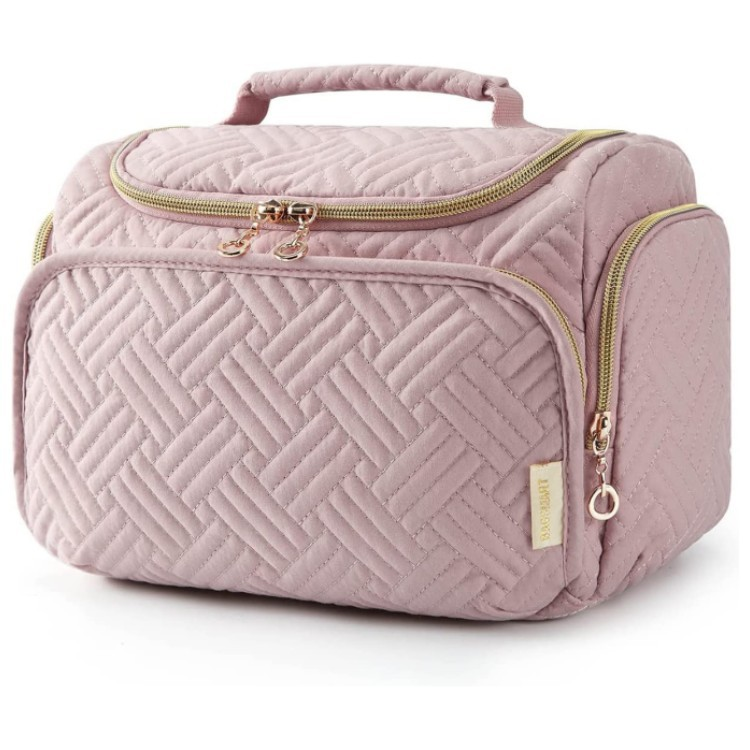
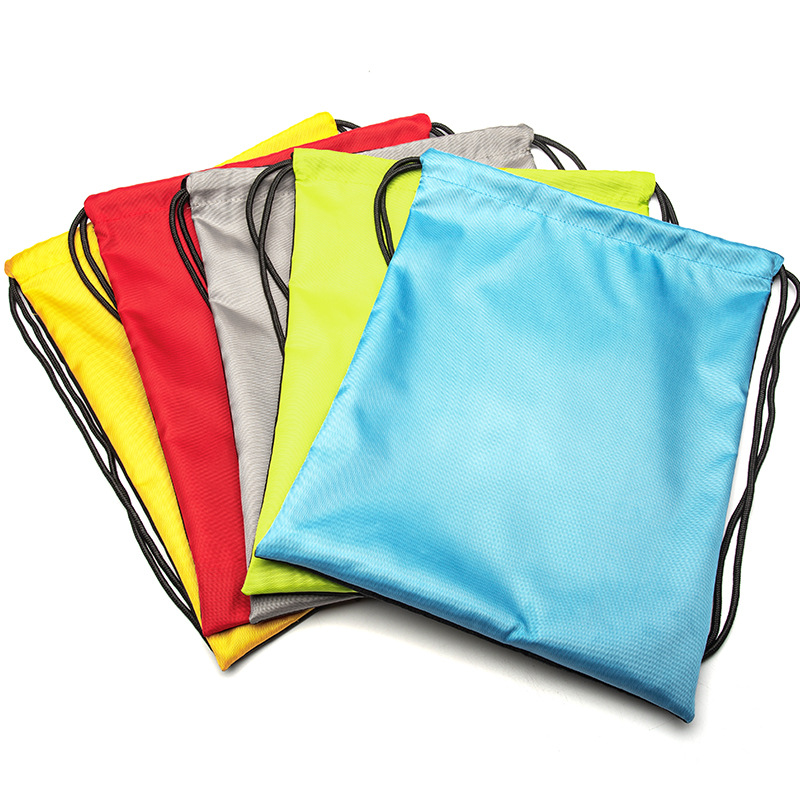
| Dust bag or sleeve | Fit, opening, contact material, and printed area | Bag and approved cover fitted together |
| Hangtag and care insert | Artwork revision, language, attachment, and placement | Actual print proof on the approved stock |
| Unit scan label | Item or variant ID, symbol, stock, and scan position | Decoded data matched to the item master |
| Master carton | Assortment, orientation, count, label, and closure | First packed carton opened and checked |
Put the packaging requirements in the RFQ so they can be priced and sampled with the bag. Ask whether items are included per unit, purchased separately, supplied by the buyer, or priced as one-time setup. If a custom-printed insert or pouch has its own production constraint, ask how overruns, remnants, and extra stock will be handled. Hold provisional items open in the Private Label Handbag Packaging Checklist and ask for a price or material confirmation before turning them into a purchase commitment.
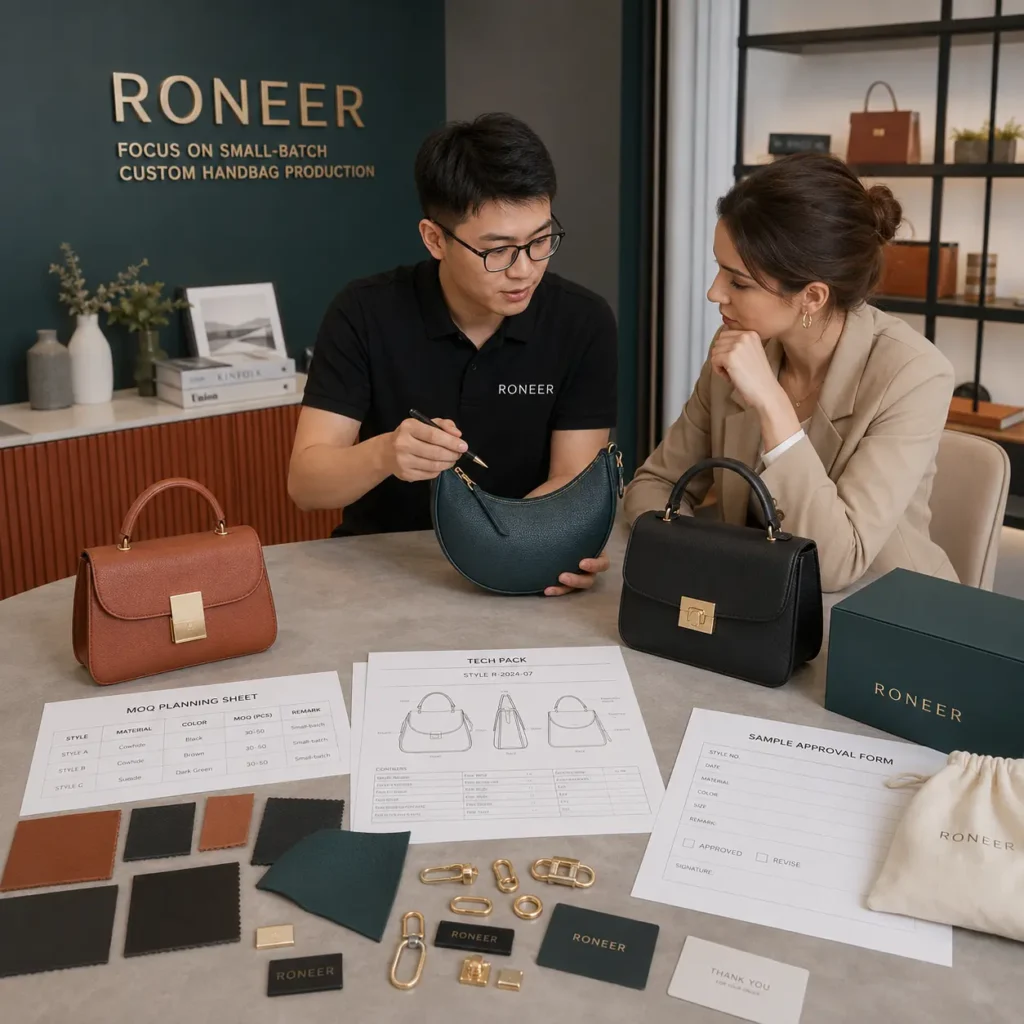
Write down the customer’s opening sequence. A wholesale buyer could want a plain protective unit pack that can be opened during receiving. A brand shipping directly to its customers might prioritize a tidy opening sequence or designate a place for a card. Decide which layers remain on the product at the point of sale and which can be discarded or separated at receiving. This keeps the supplier from placing a retail barcode on a wrap the destination warehouse will already have removed. Discuss available material, size, printing, and labeling options with RONEER’s servizio di personalizzazione degli imballaggi while the bag and pack dimensions are still being developed.
Make shared components explicit. The Private Label Handbag Packaging Checklist can list a common dust bag with a standard revision, then identify the product-specific labels for each finished handbag. If artwork approval is late, the pack supplier may still make unprinted samples to establish fit. Mark those pieces as development references. An unprinted fit sample and a printed retail pack answer different approval questions and can be reviewed independently.
Approve artwork, hangtags, and barcodes on real samples
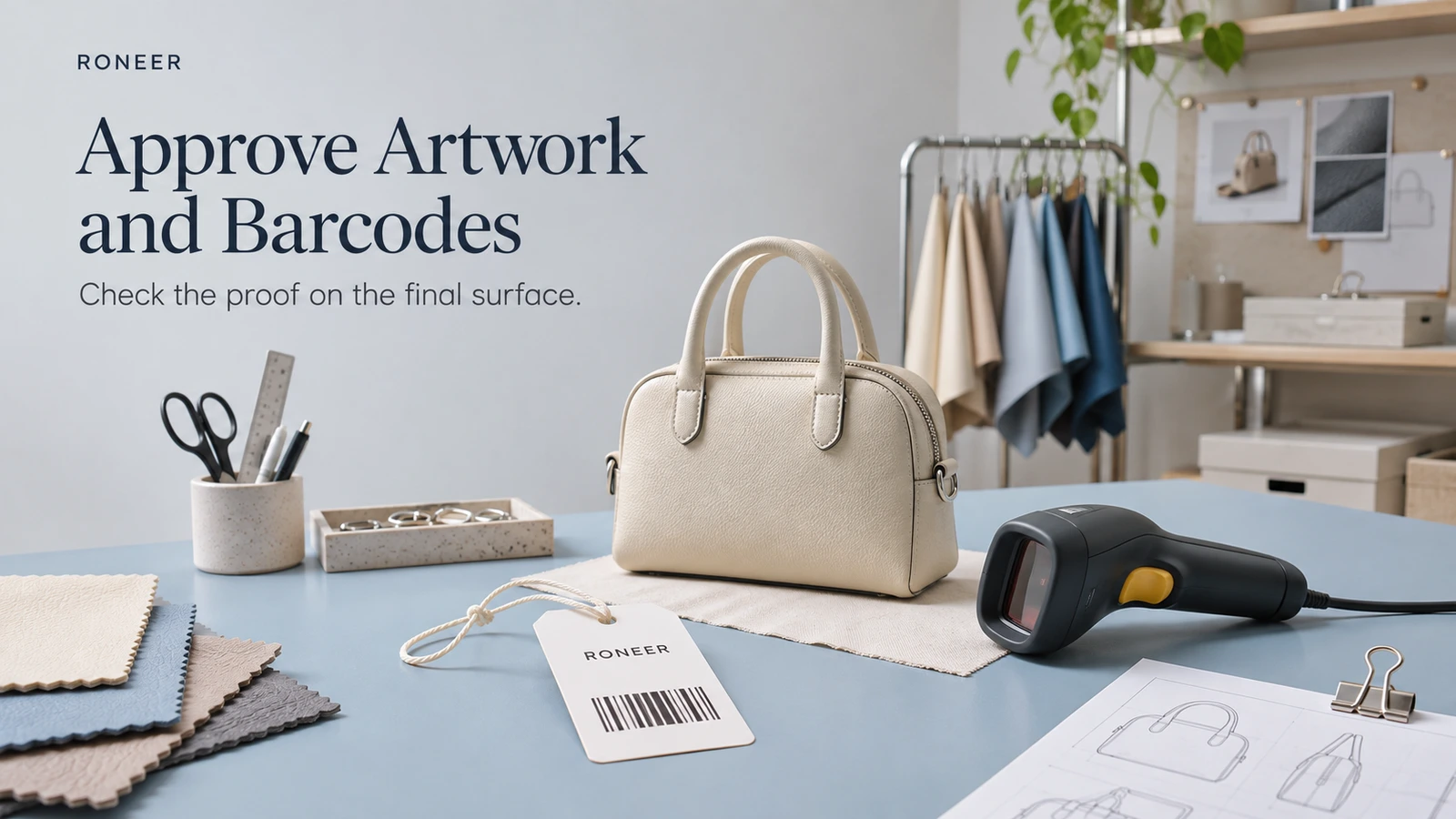
In the Private Label Handbag Packaging Checklist, identify the owner of every piece of information printed on a tag or label. The brand may own the logo, naming conventions, product identifiers, and care copy. The fulfillment partner may own where it expects to scan a code. The import or compliance team may own destination-specific markings, and the pack supplier may control the dieline and production tolerances. A single approval from design cannot resolve every data field. Record reviewers and approval dates with the correct revision.
Start from a print proof on the intended stock. A brand mark can look sharp on an electronic proof and fill in on a textured tag. Contrast, small type, folds, coatings, and the position of an attachment hole can affect what is readable. Check the front and back at the actual size. Put a printed tag on an assembled bag with the specified loop or attachment. In the Private Label Handbag Packaging Checklist, distinguish between visual approval, content approval, and permission to print the production quantity.
For projects using GS1 identification, check the required assignment with the brand’s item master. GS1 guidance on GTINs for size and color variations explains the need for unique GTINs for the variations it describes. Match the human-readable product information and the decoded number to the exact style and color being packed. A scanner showing a number confirms a read under those conditions. Comparing that number with the approved data establishes which item the scanner has identified. Capture both checks on the line trial.
Look at the packaging as it will be scanned. A sticker that sits flat on the proof sheet can become wrinkled across the seam of a sleeve. The attached hangtag can swing behind a handle. A fold or a second label can obstruct the code. If a buyer specifies formal barcode verification, obtain and retain the requested verification evidence for the symbol and its intended printing conditions. Use the Private Label Handbag Packaging Checklist to state where the packer places the label and where the receiving operator is expected to read it.
Agree how product claims, care language, and any destination-specific labels will be reviewed. The supplier can share confirmed material and construction facts, and the responsible owner can review which statements the channel or destination requires. Where a tag carries a recycled-material claim, check that supporting documentation covers the exact scope communicated to customers. Keep retailer-specific warnings or inserts versioned by destination rather than assuming one printed pack can serve every shipment.
Test the data workflow on two similar variants before printing a run. Pick the variant with the smallest visible color difference or the most similar product name. Ask another person to pack and identify both using only the instructions and the printed items. If they have to guess which sticker goes on which bag, add a clearer style-color column or use separated label bins. Build that correction into the Private Label Handbag Packaging Checklist rather than relying on the experience of one operator.
Protect the bag using an approved packing sequence

A Private Label Handbag Packaging Checklist should show how to assemble the unit pack, with photos in the order the packing team will follow. A structured handbag may need carefully fitted support to hold its silhouette. A soft crossbody may pack differently because there is no rigid frame to protect. Thick padding, heavy stuffing, or a tight wrap can create pressure where the bag would otherwise lie naturally. Choose protection with the assembled sample and the actual pack materials in front of you.
Inspect contact points first. Metal strap ends and chains can move in transit. A zipper pull can rub the front panel and a hangtag cord can leave a crease where a handle presses on a folded box. A care insert tucked into a pocket could catch a zip or distort a narrow pocket opening. Mark these risks where the packer can recognize them. Check where each part sits when the bag is upright, laid flat, and lifted out of the box. If a strap is detached for transport, define its own protective wrap and storage position.
Make the dust bag fit test practical. Insert and remove the actual handbag with the handles in the specified orientation. Check the opening, closure, clearance, print surface, and any rubbing points. A bag cover that fits around a sample can still be difficult to close with the final handle shape. For dark printed materials against pale bag surfaces, discuss any relevant transfer concern and the conditions under which the buyer wants it evaluated. Avoid assigning a universal material grade or weight in the Private Label Handbag Packaging Checklist when the project has yet to select the right cover.
In the Private Label Handbag Packaging Checklist, photograph the unpacked and packed versions as separate references. Include the support inside the handbag before closing it, the position of protective layers, and a view of the complete unit before carton loading. Add a short decision note if the buyer approves a subtle fold or intentionally leaves a branded tag visible. Clear points of reference help inspection staff distinguish a design choice from careless packing. Link this record to the bag sample approval file, so any change to hardware, shape, or straps is picked up in the packing review.
For transit testing, choose a method appropriate to the actual shipping configuration and route. ISTA describes Procedure 3A for individual packaged products shipped via a parcel delivery system within its stated weight range. A handbag packed in that system and a master carton distributed on a pallet present different evaluation questions. Discuss the route, sample configuration, applicable method, and acceptable product condition with the relevant partner. The Private Label Handbag Packaging Checklist should retain the tested pack revision and the evidence the buyer used for approval.
When protection changes, repeat the check on a representative unit. A newer insert might protect the clasp but push the handle into the carton wall. Open the pack after the agreed evaluation and inspect the bag separately from the carton. Cosmetic damage to retail packaging and damage to a clasp or bag surface can have different consequences. Record the observation before choosing whether to change the insert, the closing method, or the way the units are loaded.
Set carton counts, assortments, and label positions

The Private Label Handbag Packaging Checklist should make it possible for a warehouse to identify the carton and predict what is inside. Decide whether cartons hold one variant each or use a retailer-approved assortment. Record the units per carton, each style and color, packing orientation, permitted partial cartons, and the rules for mixing production batches where applicable. State which labels need to show the purchase order, destination, carton sequence, or other required receiver data. Use the receiving instructions for the actual order.
For an illustrative order with 36 black units and 20 clay units, suppose the buyer authorizes six units per master carton and disallows mixed colors. Black fills six cartons. Clay fills three full cartons and one two-unit partial carton. The partial carton needs the actual count and the same identification and protection decisions as the full cartons. The total pack-out is 56 units in ten cartons. Change the quantity or assortment in the Private Label Handbag Packaging Checklist only after reconciling what will actually ship.
Record the packed carton measurements and weight using the actual products, packing materials, closure, and carton selected for the shipment. Estimated dimensions from the development sample can help compare quotes, but final packing and carton choices can change freight data. Agree who provides confirmed values to the shipping team and at which milestone. For a mixed assortment, use a sample that represents the agreed pack-out rather than estimating every case from an empty carton.
Test label placement with cartons closed and stacked as the receiver is likely to see them. Keep receiver-directed labels visible where the buyer requests them. Avoid placing applicable scan labels across corners or over a join unless the receiving instructions and practical scan test support that layout. Confirm carton IDs against the packing list. Old labels on reused trial cartons can create ambiguity during a scan rehearsal, so keep sample marks and approved production marks distinguishable.
Link carton records back to the current bag and packaging revisions. If an order ships from two packing dates, a single item may appear in both while using different authorized label versions or approved lots. Put the identifying references in the Private Label Handbag Packaging Checklist so an exception can be traced later. Decide whether a finished unit already inside an approved carton can be reworked and reclosed as part of a label correction, and how the warehouse will identify that rework.
Release a first packed carton before bulk packing
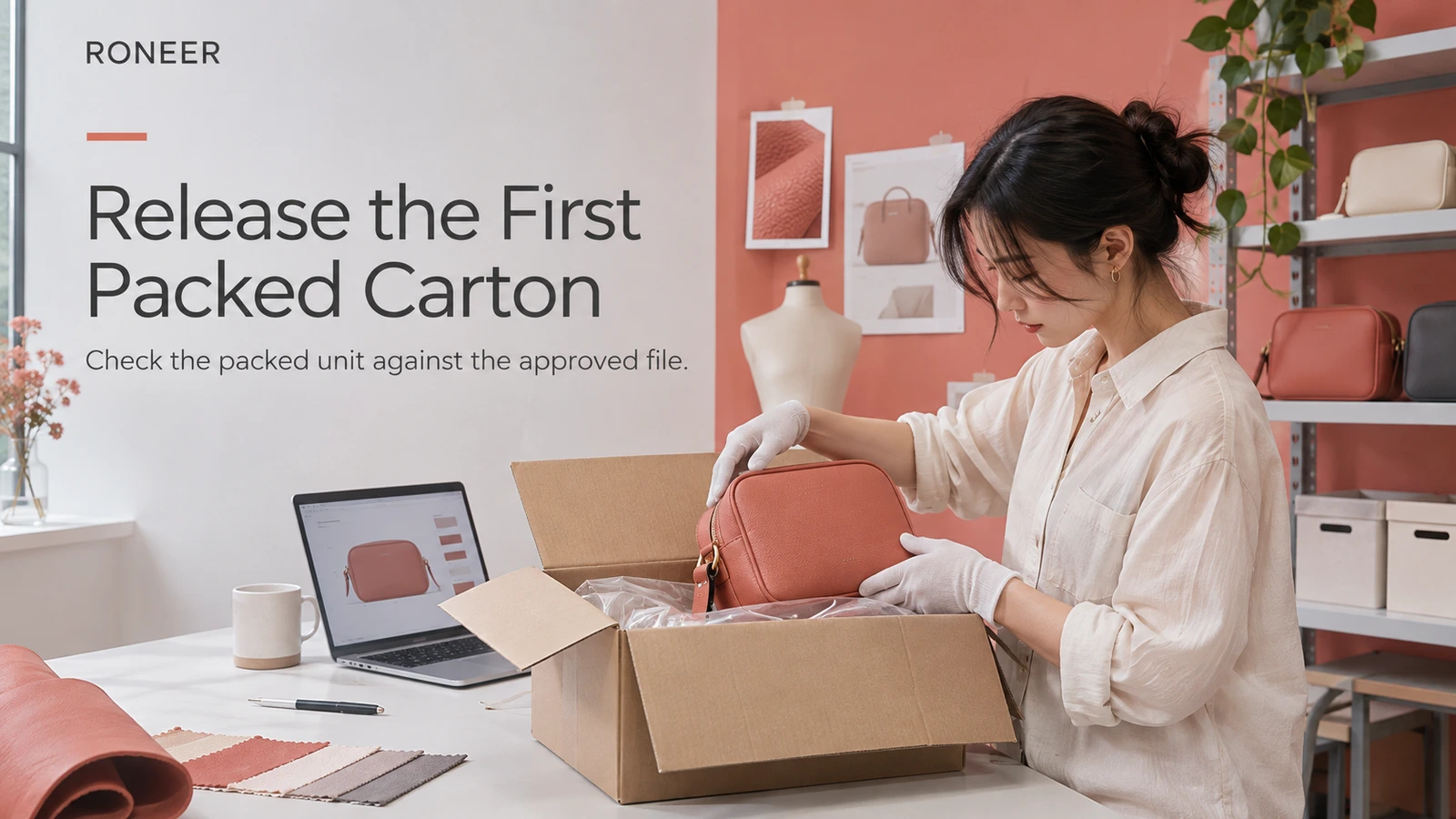
Use the Private Label Handbag Packaging Checklist to inspect one representative first carton and each materially different pack configuration the buyer identifies. Choose actual bags, production packaging, and printed labels from the intended run. Have the packing team follow the approved instructions. Scan the unit identifiers, reconcile them to the packed variants, and compare the carton label with the packing record. Open the carton, inspect the product condition and presentation, and confirm the sequence for returning the pack to its approved state if it will be shipped.
Agree which issues require a hold. A readable unit label with the wrong variant number can send a warehouse to the wrong stock record. A missing tissue fold may be an appearance issue unless it exposes hardware to damage. Evaluate the issue against the purchasing specification and channel requirements. Capture the location, quantity or lot affected if known, and the action assigned. Decide how inspected and accepted cartons will be separated from pending ones.
Keep the first-carton sign-off separate from later sampling during production or before shipment. The first carton tests the instructions and materials, while later checks establish whether the process was followed on the order. For projects using a sampling plan, the AQL inspection guide for bags explains how agreed defect classes and acceptance decisions fit into the broader inspection process. Use packaging examples in those discussions and record specific criteria for data errors, protection failures, and visual differences.
At release, point the final purchase file to the approved pack photos, artwork revisions, SKU-to-label matrix, and carton instructions. Keep change approvals beside them. A Private Label Handbag Packaging Checklist should also record whether a trial pack used interim materials and whether the final version was verified with production stock. The factory can then look up what was approved, the brand can see how its artwork was used, and fulfillment can prepare receiving records for the actual cartons.
Private Label Handbag Packaging Checklist FAQs
Does every handbag need a dust bag?
Decide which protection and presentation layers the channel actually needs. Fit the cover to the physical bag and assess the opening, handle clearance, and contact areas. A dust bag can be part of the retail experience or a protection layer. Its purpose determines the relevant material and fit checks.
Should the supplier print labels before the sample is approved?
Use a limited proof run to evaluate layout, stock, attachment, and scanning. Record final authorization separately in the Private Label Handbag Packaging Checklist. Bulk printing can wait until the buyer has confirmed the SKU data, artwork, destination copy, and the position tested on the final pack.
Can I use the same hangtag on every color?
A shared branding tag may work if a separate variant-specific label carries the correct identifier and the channel accepts the arrangement. If the hangtag itself identifies color, control its artwork and sorting by variant. Test two similar colors with their actual tags before approving the pack design.
Who provides the product barcode?
In the Private Label Handbag Packaging Checklist, identify the party that owns the item data and the party that prints and applies the label. Get the approved identifiers from the brand or other authorized owner, verify the decoded value against the item master, and confirm the fulfillment partner can use the chosen symbol and placement.
How do I choose the size of a master carton?
Test the actual bags and unit packs in the planned arrangement. Check clearances, orientation, handling, and receiver limits, then record the measurements and weight. The Private Label Handbag Packaging Checklist should include the final closed configuration and any separately approved partial-carton method.
Which material should touch bright hardware in the pack?
Discuss the surface and likely movement with the development team. Compare representative protective layers on the actual clasp or pull, then inspect after the agreed handling evaluation. Note how the protection is applied and removed, including any possibility of residue or transferred marks.
Can boxed and unboxed versions share the same pack instructions?
Keep shared steps where appropriate and give each variant its own instructions for any changed components, barcodes, shipping protection, or carton arrangement. Confirm with the item owner if the packaging change affects trade item identification or channel records before approving altered labels.
What if the approved care insert is unavailable at packing?
Record the reason and check the purchase order and artwork requirements. Hold the affected units if the insert is required. In the Private Label Handbag Packaging Checklist, capture how the buyer wants to approve replacement stock or authorize a revised pack and whether already packed units need rework.
Should packaging costs be included in the bag quotation?
Use the Private Label Handbag Packaging Checklist to ask suppliers to itemize packaging components, setup, buyer-supplied items, and any separately quoted protection or carton options. Compare quotations using the same approved specifications and quantities. This makes it easier to see whether an apparent price difference is caused by different pack contents.
Can I approve pouch fit using only a dimension drawing?
Use drawings to issue the inquiry and compare initial options. Confirm fit with the final handle geometry, hardware, and packed shape. Record the observed clearance and opening behavior on the Private Label Handbag Packaging Checklist before releasing the final component for production.
What should I retain for the next order?
Save the verified artwork, item mapping, master carton setup, and photos of the opened and closed pack. Retain any approved physical references when practical. On reorder, check whether product measurements, product data, destination requirements, or pack materials have changed before using the previous release.
Conclusione
A Private Label Handbag Packaging Checklist gives buyers a way to verify the product seen by the customer, the data read by the warehouse, and the protection used during shipment. Assign the components by SKU, sign off the physical artwork and barcode, and open a first packed carton before releasing the run. Discuss the intended retail and shipping setup with RONEER during private label handbag development, so the dust bag, hangtags, product protection, and carton preparation can be reviewed while the handbag sample is still available.