 Italiano
  English
  Deutsch
  Español
  Français
  Русский
  日本語
日本語  العربية
  Türkçe
  한국어
한국어 A buyer may request a purse while imagining a medium shoulder bag, but a supplier may understand the word as a small coin holder. Another buyer may use handbag for every women’s fashion bag, while a retailer uses the term only for structured top-handle products.
Understanding handbag vs purse terminology matters because the two words can carry different meanings across English-speaking markets. The difference may affect search keywords, quotations, sample development, packaging labels, customs descriptions, product categories, and communication with customers.
The handbag vs purse comparison is especially important for OEM/ODM buyers. A product name can begin the sourcing discussion, but it cannot replace dimensions, materials, carrying methods, internal construction, hardware, logo requirements, packaging, and an approved sample.
This guide explains handbag vs purse differences according to regional English, category scope, size, carrying method, materials, retail positioning, customs descriptions, and manufacturing requirements.
What Does Handbag vs Purse Mean?
A borsetta is generally a personal fashion accessory used to carry money, keys, a phone, cosmetics, and other daily items. It may have top handles, a shoulder strap, a crossbody strap, or a combination of carrying options.
A purse has two widely used meanings. In American English, purse commonly refers to a women’s handbag. In British English, purse more often describes a smaller container for money, cards, or coins. Merriam-Webster also records purse as a small bag for money and as a handbag in common usage.
This regional difference explains why handbag vs purse may appear to be a simple synonym question in one market but a product-size question in another.
The broader word bag can describe backpacks, totes, travel bags, laptop bags, cosmetic bags, cooler bags, handbags, and many other carrying products. Therefore, every handbag is a bag, but not every bag is a handbag or purse.
Quick Handbag vs Purse Comparison
| Buying Factor | Borsetta | Purse |
|---|---|---|
| Common international meaning | Personal fashion bag | Regional term with more than one meaning |
| American English | Handbag or purse | Usually a women’s handbag |
| British English | Personal fashion bag | Usually a small money holder |
| Typical size | Small to large | Small money holder or handbag, depending on market |
| Common carrying methods | Hand, shoulder, crossbody, underarm | Same as handbag in the US; handheld small item in the UK |
| Best B2B term | Clear for international sourcing | Useful when the target market commonly searches for purse |
| Main sourcing risk | Vague style description | Regional misunderstanding |
The table provides a practical overview, but handbag vs purse terminology should always be supported by a product image, dimensions, and a written specification.
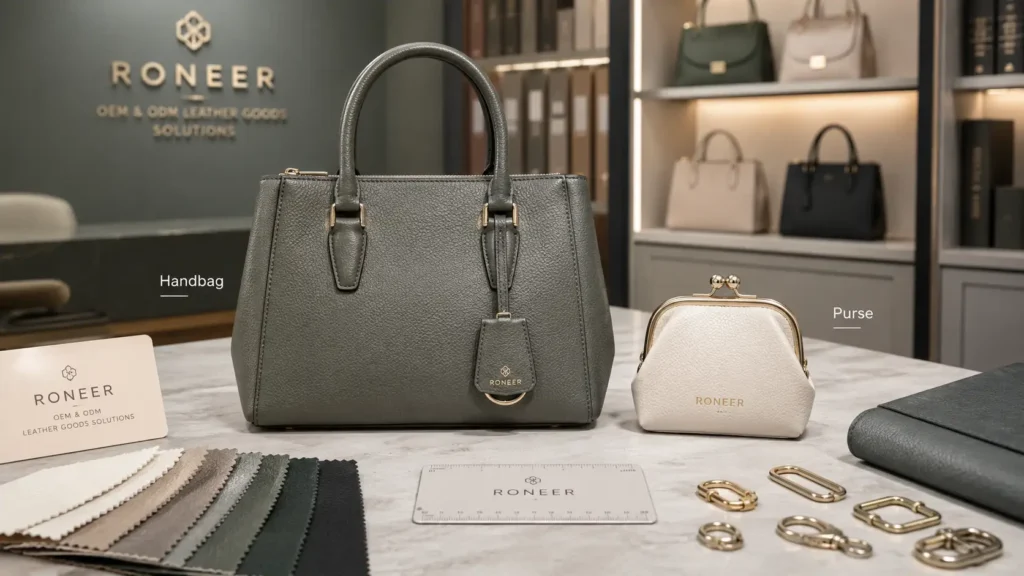
1. Handbag vs Purse in American and British English
Regional English is the most important difference in handbag vs purse usage.
In the United States, purse commonly refers to a women’s personal bag. A US customer may describe a shoulder bag, crossbody bag, top-handle bag, hobo, satchel, or small tote as a purse.
In the United Kingdom, handbag is generally used for the larger personal accessory. Purse usually refers to a smaller item used for coins, banknotes, or cards. That smaller product may be carried inside a handbag.
This difference affects product titles and category labels. A product described as a “women’s leather purse” may sound natural to US customers. For a UK audience, “women’s leather handbag” is usually clearer.
International B2B websites often use handbag because it communicates a fashion-bag category more consistently. Buyers comparing broader categories can also review RONEER’s types of bags guide. Purse can still be added as a related keyword when a brand sells mainly to the United States.

2. Product Size Changes the Meaning
Size does not create one universal language rule, but it strongly influences the handbag vs purse interpretation.
A medium or large fashion accessory is usually called a handbag in international English. In the US, the same product may also be called a purse. A very small product may be called a coin purse, card purse, mini pouch, or wallet.
Examples include:
- Large work tote: tote bag or handbag
- Medium top-handle style: handbag or purse in the US
- Small crossbody style: crossbody bag or crossbody purse
- Compact coin holder: coin purse
- Small evening style: clutch, evening bag, or evening purse
- Card-sized product: card holder, card purse, or wallet
Size also changes the manufacturing requirements. A larger handbag needs stronger handles, a wider strap, greater reinforcement, and more attention to finished weight. A small purse may require precise folding, compact hardware, card slots, a coin compartment, and a secure closure.
Buyers should therefore provide width, height, depth, handle drop, and strap length when requesting a quotation.
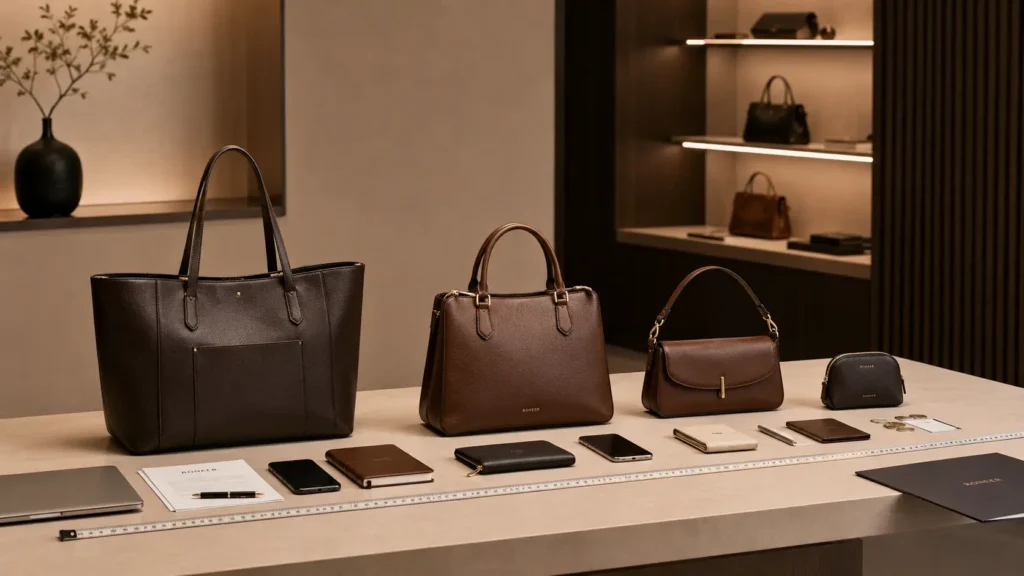
3. Carrying Method Influences Product Naming
Carrying structure is another practical part of the handbag vs purse distinction.
Handbags may use:
- Top handles
- Shoulder straps
- Crossbody straps
- Cinghie a catena
- Wrist straps
- Underarm handles
- Detachable or convertible straps
In American retail language, any of these products may also be described as a purse. However, the specific style name communicates more information than the general term.
“Adjustable crossbody handbag with a top zipper” is clearer than “purse.” “Structured top-handle handbag with a detachable strap” is more useful than “fashion bag.”
For accurate sampling, buyers should specify:
- Number of handles or straps
- Handle drop
- Larghezza della cinghia
- Minimum and maximum strap length
- Detachable components
- Hardware connection points
- Preferred carrying position
- Expected loaded weight
These details affect pattern balance, reinforcement, comfort, hardware size, and the appearance of the finished product. RONEER’s size and structure customization service helps buyers define these requirements before pattern development.
4. Materials and Construction Priorities Differ
The handbag vs purse name does not determine one material, but the intended size and use influence the best construction.
Common handbag materials include:
- Pelle PU
- Pelle in microfibra
- Vera pelle
- Tela
- Nylon
- Poliestere
- Suede-effect textiles
- Woven materials
- Raffia-effect materials
- Mixed-material constructions
A small coin purse may use the same exterior material as a handbag, but it requires different pattern pieces, folding methods, zippers, snaps, card slots, lining, and edge finishing.
A structured handbag may prioritize shape retention, panel reinforcement, edge paint, metal hardware, lining fit, and handle construction. A soft shoulder purse may prioritize drape, zipper access, strap comfort, and low finished weight.
Buyers should approve the actual material specification rather than requesting only “premium leather” or “high-quality PU.” The quotation should identify the material type, thickness, backing, color, surface grain, lining, reinforcement, and applicable logo process.
RONEER’s material customization service helps buyers compare material structure, color, thickness, hand feel, and compatibility with the intended bag design.
5. Handbag vs Purse for Retail and SEO Naming
Product naming influences search relevance, customer expectations, category organization, and retail positioning.
The same product might be described as:
- Women’s leather handbag
- Women’s leather purse
- Small shoulder bag
- Crossbody purse
- Structured top-handle handbag
- Everyday fashion bag
The best title depends on the target market and the most specific product style.
For a US consumer page, “small crossbody purse for women” may match natural customer language. For an international manufacturer page, “custom crossbody handbag manufacturer” usually communicates the product category more clearly.
Brands should not force handbag vs purse into every product title. One phrase should be selected as the primary keyword, while related terms can appear naturally in descriptions, FAQs, image ALT text, and category introductions.
A useful product naming structure is:
Target user + material + specific bag type + key feature
Examples:
- Women’s PU Leather Crossbody Handbag with Zipper
- Small Leather Purse with Adjustable Strap
- Structured Top-Handle Handbag with Metal Logo
- Compact Coin Purse with Card Slots
Specific titles help customers understand the product and give factories clearer sourcing information.

6. Customs Descriptions May Use Different Categories
Retail terminology and customs classification are not always identical.
A customer may casually call a large tote a purse, while customs authorities may distinguish handbags, tote bags, travel bags, shopping bags, wallets, purses, and backpacks according to construction, size, use, and outer-surface material.
This means handbag vs purse wording should not be the only basis for tariff classification.
Importers may need to confirm:
- Intended use
- Exterior material
- Dimensioni
- Carrying method
- Organizzazione interna
- Chiusura
- Product structure
- Destination-country tariff rules
A commercial invoice description such as “women’s PU leather shoulder handbag” provides more useful information than writing only “purse” or “bag.” U.S. Customs and Border Protection rulings under Heading 4202 show that handbags, purses, shopping bags, travel bags, and related containers can fall into different subcategories depending on construction and use.
The manufacturer can provide technical product details, but the importer or a qualified customs professional should confirm the final tariff classification.
7. Handbag vs Purse for OEM and Private Label Sourcing
For factories, handbag vs purse is not a complete product specification.
A buyer requesting “500 custom purses” has not provided enough information for an accurate quotation. The supplier still needs to know whether the product is a coin purse, wallet, clutch, crossbody bag, shoulder bag, or medium handbag.
A complete RFQ should include:
- Product category
- Reference images
- Width, height, and depth
- Exterior material
- Spessore del materiale
- Materiale del rivestimento
- Color references
- Handle and strap details
- Finitura dei componenti
- Closure method
- Interior pockets
- Logo artwork and method
- Individual packaging
- Quantity per style
- Quantity per color
- Destination market
- Required delivery date
The buyer should also state whether the product is an original OEM design, a modified ODM style, or an existing wholesale product with private label branding.
Clear terminology helps, but drawings, samples, and measurements reduce misunderstanding more effectively than the product name alone. Buyers developing fashion products can review RONEER’s servizio di produzione di borse su misura.
8. Sample Approval Is More Important Than the Name
The most reliable way to resolve a handbag vs purse misunderstanding is to approve a physical sample.
A sample allows the buyer to review:
- Finished dimensions
- Shape and symmetry
- Material feel
- Colore
- Peso
- Comfort dell'impugnatura
- Lunghezza della cinghia
- Zipper movement
- Finitura dei componenti
- Logo size and position
- Vernice per bordi
- Cuciture
- Fodera
- Interior organization
- Imballaggio
Photographs can support approval, but they do not fully show weight, balance, softness, surface feel, carrying comfort, or opening access.
The approved sample should be supported by a written handbag tech pack or specification sheet. The factory and buyer should record every revision and confirm which sample becomes the standard for bulk production.

How to Describe a Handbag or Purse to a Manufacturer
A product name should begin the conversation, not replace the specification.
State the Exact Product Type
Instead of:
We need a purse.
Use:
We need a medium women’s crossbody handbag with a top zipper and detachable strap.
Provide Complete Dimensions
Include width, height, depth, handle drop, and strap range.
Example:
Finished size: 25 cm wide × 18 cm high × 8 cm deep. Adjustable strap: 105–125 cm.
Specify the Material
State whether the product uses genuine leather, PU leather, microfiber leather, canvas, nylon, recycled polyester, or another material.
Explain the Structure
Confirm the closure, pockets, compartments, lining, reinforcement, base, edge treatment, and carrying methods.
Send Logo Artwork
Identify the required logo process, such as debossing, embossing, printing, embroidery, woven label, metal logo, or custom hardware. RONEER’s logo customization guide explains common options.
Confirm Packaging
Packaging may include a dust bag, polybag, tissue paper, hangtag, care card, barcode label, gift box, inner carton, and export carton.
Which Term Should Your Brand Use?
Use Handbag When:
- Targeting international B2B buyers
- Describing women’s fashion accessories
- Creating a manufacturing or supplier page
- Referring to top-handle, shoulder, hobo, satchel, or crossbody styles
- Building a broad fashion-handbag category
Use Purse When:
- Targeting US consumers
- Describing a US-market handbag
- Referring to a coin purse or small money holder
- Using an established phrase such as crossbody purse
- Supporting a US-focused related keyword
Use Bag When:
- Referring to a broad collection
- Describing backpacks, travel bags, laptop bags, or functional products
- Covering several product categories
- Writing a general factory-capability page
A brand can use more than one term, but each page should have one clear main keyword and one clear search intent.
Common Handbag vs Purse Naming Mistakes
Using Purse for Every Market
Purse may mean a handbag in the US but a small money holder in the UK. International content should consider handbag as the clearer primary term.
Using Bag Without a Specific Style
Bag is too broad for a useful quotation. Add the specific type, dimensions, material, and carrying method.
Treating Tote and Handbag as Identical
A fashion tote may be sold as a handbag, but tote construction, opening, size, capacity, and customs treatment may differ.
Copying Competitor Titles
Competitors may target different countries, customers, and price levels. Product naming should reflect the brand’s own market and keyword plan.
Changing the Name Across Documents
The quotation, tech pack, purchase order, packaging label, inspection checklist, and invoice should use consistent product names and SKU references.
Frequently Asked Questions About Handbag vs Purse
What Is the Main Handbag vs Purse Difference?
The main handbag vs purse difference is regional usage. In American English, purse often means handbag. In British English, purse usually means a smaller money or coin holder.
Are Handbag and Purse the Same in the United States?
They are frequently interchangeable in US consumer language. Purse may describe a shoulder bag, crossbody bag, top-handle bag, or other women’s personal bag.
What Does Purse Mean in the United Kingdom?
Purse usually refers to a small item used to hold coins, notes, or cards. The larger fashion accessory is normally called a handbag.
Is a Crossbody Bag a Purse?
In the US, a women’s crossbody bag may be called a crossbody purse. For international sourcing, crossbody bag or crossbody handbag is usually more precise.
Is a Tote Bag a Handbag?
A fashion tote may be included in a handbag collection. However, large shopping, promotional, and utility totes may be treated as separate bag categories.
Is a Wallet a Purse?
In British usage, purse can overlap with a women’s wallet or coin holder. In American usage, a wallet is usually the smaller item kept inside a purse or handbag.
Which Term Is Better for a Manufacturer Page?
Handbag is usually clearer for an international fashion-bag manufacturing page. Purse can be used as a related keyword for US-focused search traffic.
Does Handbag vs Purse Affect Product SEO?
Yes. Customers in different regions may search with different words. The primary keyword should match the target market, while related terms can be included naturally in supporting content.
Does the Product Name Affect the Quotation?
The name provides initial context, but the quotation depends on dimensions, materials, construction, hardware, logo, packaging, quantity, and production requirements.
Can One Product Be Marketed as Both a Handbag and a Purse?
Yes, especially in the US. However, the page should still use one main keyword consistently so the search intent remains clear.
How Should Buyers Describe a Product in an RFQ?
Provide the specific style, dimensions, materials, color, strap, hardware, closure, lining, compartments, logo, packaging, quantity, and reference images.
Can RONEER Manufacture Handbags and Purses?
RONEER supports OEM/ODM development for handbags, crossbody bags, shoulder bags, coin purses, wallets, cosmetic pouches, and related private label products, subject to the confirmed specification.
Conclusione
The handbag vs purse difference depends mainly on regional English, product size, intended use, and retail context. In American English, purse commonly refers to a women’s handbag. In British English, purse usually describes a smaller container for money, coins, or cards.
A reliable handbag vs purse decision should begin with the target customer. A shoulder bag may be marketed as a purse in the United States and as a handbag in the United Kingdom. International B2B pages usually benefit from the clearer handbag terminology, while US consumer pages may naturally include purse.
However, handbag vs purse wording should never replace a technical product specification. Buyers should provide dimensions, materials, carrying methods, closures, compartments, hardware, logo artwork, packaging, quantity, and reference images.
Physical sampling remains essential. The approved sample confirms shape, weight, hand feel, comfort, function, workmanship, branding, and packaging in a way that product terminology cannot.
RONEER helps OEM/ODM buyers develop products based on confirmed requirements rather than vague category names. By combining accurate handbag vs purse terminology with a complete specification, buyers can improve search relevance, reduce sourcing misunderstandings, and achieve more consistent sample and bulk-production results.