 Italiano
  English
  Deutsch
  Español
  Français
  Русский
  日本語
日本語  العربية
  Türkçe
  한국어
한국어 Shipping bags from China to USA is not just a logistics step after production. For American brands, retailers, Amazon sellers, corporate buyers, and private label companies, shipping decisions can affect product condition, customs clearance, warehouse handling, customer reviews, and reorder planning.
Before arranging production and delivery, use our Guida all'acquisto di borse personalizzate to prepare product specifications, quantity, packaging needs and destination details for supplier review.
Many buyers spend most of their time discussing design, price, MOQ, materials, logo method, and sample approval. These details are important, but shipping can create serious problems if it is discussed too late. A well-made handbag, backpack, cosmetic bag, tote bag, or travel bag can still arrive with crushed shapes, wrong labels, missing carton marks, unclear documents, or packaging that does not fit the buyer’s sales channel.
This guide explains how buyers can plan shipping bags from China to USA in a practical way. It covers bag type, shipping method, export packing, labeling, commercial documents, inspection, trade terms, supplier communication, and common mistakes to avoid.
RONEER supports OEM and ODM custom bag production for global buyers, including material selection, logo customization, packaging planning, bulk production coordination, export packing, and shipping support. Buyers can review the RONEER custom bag manufacturing team before preparing a new custom bag shipping plan.
Indice dei contenuti
Toggle1. Confirm What Type of Bags You Are Shipping
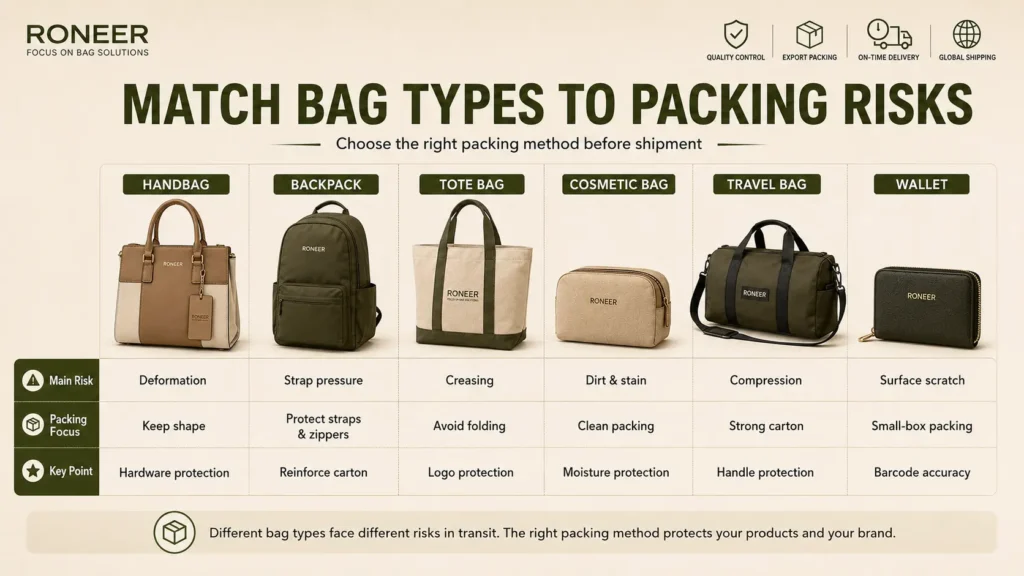
Before shipping bags from China to USA, the first step is to confirm what type of bags are being shipped. Different bag categories need different packing methods, carton sizes, protection details, label positions, and freight planning.
A structured handbag may need inner filling to keep its shape. A soft tote bag may be easier to fold, but the buyer still needs to prevent creasing, dirt, or logo damage. A backpack may require shoulder strap protection, zipper protection, and proper carton stacking. Cosmetic bags may need clean inner packaging, especially if they are sold as private label retail products. Travel bags may need stronger cartons because they are larger and may be compressed during shipment.
Wallets and small accessories have different risks. The main issues are often surface scratching, mixed SKU packing, barcode errors, or incorrect color sorting. Laptop bags and outdoor bags may need more attention to stitching, padding, hardware, waterproof fabric handling, and carton strength.
Shipping bags from China to USA becomes easier when the buyer and factory define the bag category clearly before bulk packing begins. The factory should know whether the buyer needs retail-ready packaging, Amazon-style label planning, wholesale carton packing, or simple export packing for later repacking in the United States.
RONEER can help buyers discuss bag type, material, structure, and packaging before shipment. Buyers preparing multiple SKUs should confirm the packing method for each style, not only the total order quantity.
2. Choose the Right Shipping Method
The best method for shipping bags from China to USA depends on order size, delivery deadline, product value, carton volume, buyer budget, and sales channel. There is no single shipping method that fits every project.
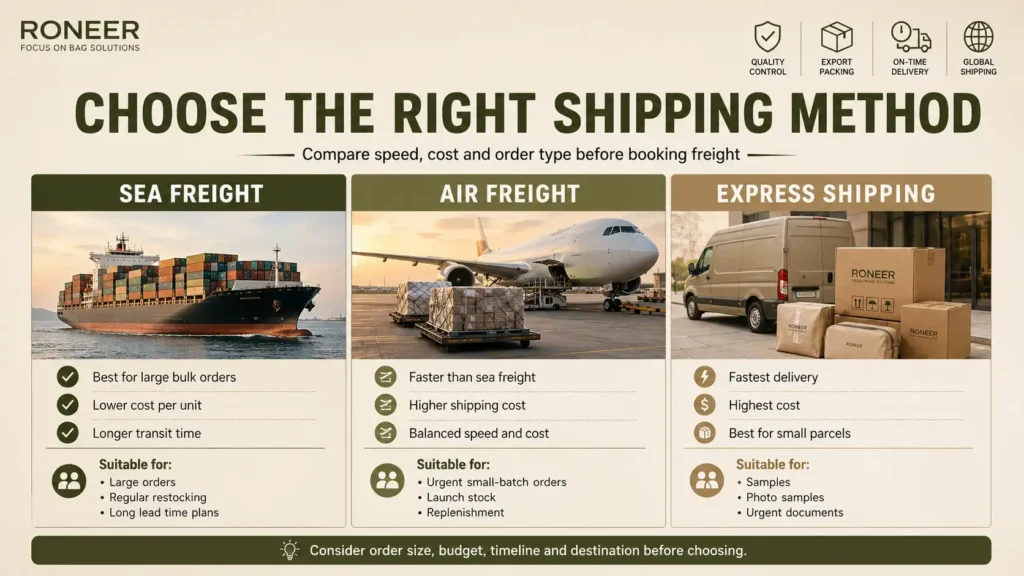
Express shipping is usually suitable for samples, small urgent parcels, sales samples, photo samples, or pre-production approval samples. It is faster and easier for small shipments, but it is usually not the most cost-effective choice for large bulk orders.
Air freight may be suitable for urgent small-batch production, early launch quantities, promotional deadlines, or replenishment orders when sea freight is too slow. Air freight is faster than sea freight, but the buyer should consider volume weight, carton size, and total landed cost.
Sea freight is often more practical for bulk orders, especially when shipping tote bags, backpacks, travel bags, handbags, cosmetic bags, or private label bags in larger quantities. Sea freight usually requires better planning because it involves export handling, vessel schedule, U.S. customs clearance, destination delivery, and possible warehouse appointment requirements.
For many buyers, the best approach is not choosing only one method. A brand may ship samples by express, launch stock by air freight, and repeat production by sea freight. This mixed approach can help balance speed and cost.
When shipping bags from China to USA, buyers should ask the supplier to provide carton dimensions, gross weight, net weight, quantity per carton, total cartons, and packing photos before confirming the freight option. These details help the freight forwarder estimate cost more accurately.
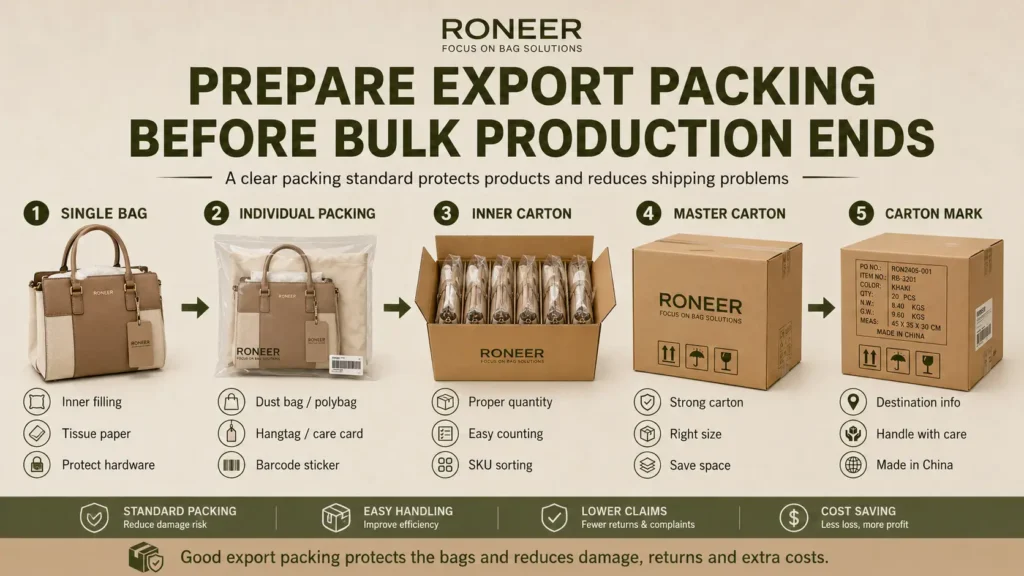
3. Prepare Export Packing Before Bulk Production Ends
Export packing should not be treated as a last-minute decision. When shipping bags from China to USA, packing affects product condition, warehouse handling, freight cost, retail presentation, and customer experience.
A basic export packing plan may include individual polybags, tissue paper, dust bags, hangtags, care cards, inner cartons, master cartons, carton marks, barcode stickers, and pallet planning if needed. For private label bags, packaging may also include branded dust bags, printed boxes, custom hangtags, QR code labels, or retail packaging.
Buyers can review RONEER’s personalizzazione degli imballaggi options when planning dust bags, polybags, hangtags, custom labels, carton marks, and export packing details.
The right packing method depends on the bag’s material and structure. PU leather bags may need surface protection to reduce friction marks. Canvas bags may need moisture control and clean folding. Nylon backpacks may need compact but not overly compressed packing. Structured handbags may need support inside the bag to avoid deformation.
Carton size is also important. Oversized cartons may increase freight cost and become difficult to handle. Weak cartons may collapse during transit. Overpacked cartons may deform the bags. Underfilled cartons may allow products to shift during shipping and damage the goods.
Before shipping bags from China to USA, buyers should ask for packing photos and carton information. For repeat orders, the factory should keep packing records so the next shipment follows the same standard.
4. Check Labels, Barcodes, and Country of Origin Marking
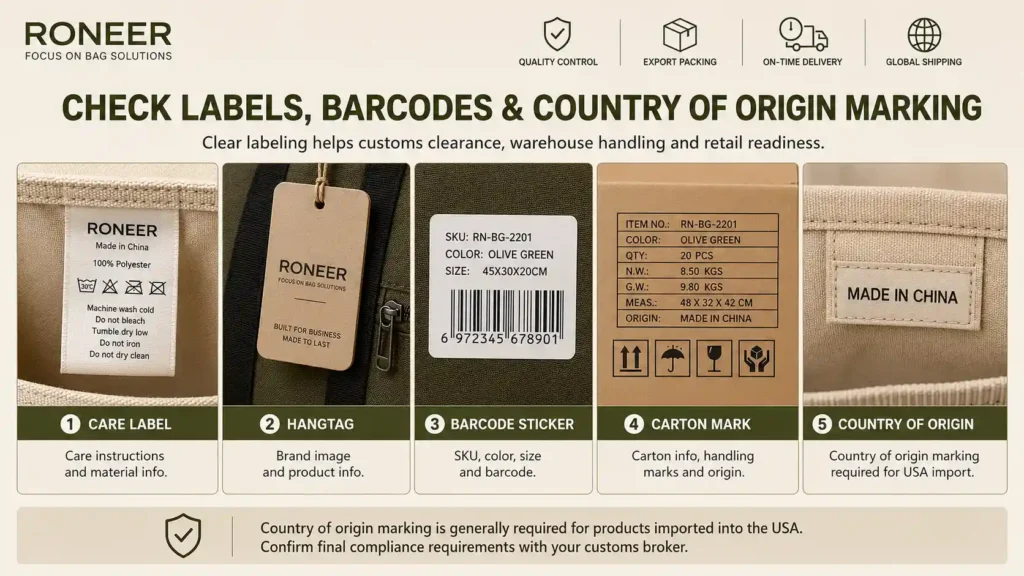
Labels and markings are among the most important details when shipping bags from China to USA. A buyer may need product labels, hangtags, care labels, SKU stickers, barcode labels, carton marks, and country of origin marking.
For bags made in China, the country of origin marking should be discussed before production packing starts. The marking may appear on a sewn label, hangtag, sticker, retail packaging, or another suitable location depending on the product and buyer’s requirements. Buyers can review the official U.S. Customs and Border Protection country of origin marking guidance, which explains that foreign-origin goods entering the United States generally need clear English country of origin marking unless an exception applies.
USA brands should also be careful with origin-related marketing language. If the bags are manufactured in China, product pages, advertisements, labels, and packaging should avoid misleading “Made in USA” claims. The Federal Trade Commission’s Made in USA guidance explains how Made in USA claims are evaluated and why unqualified claims must meet strict standards.
Barcode and SKU planning should also be confirmed early. Amazon sellers, retail buyers, warehouse distributors, and corporate buyers may have different labeling requirements. The factory should know whether the buyer needs labels on each product, each polybag, each carton, or each SKU group.
When shipping bags from China to USA, label mistakes can create warehouse delays, relabeling costs, or customer confusion. Buyers should confirm label artwork, label position, barcode readability, SKU code, color name, size information, and carton mark format before bulk packing.
5. Prepare Commercial Documents for USA Customs
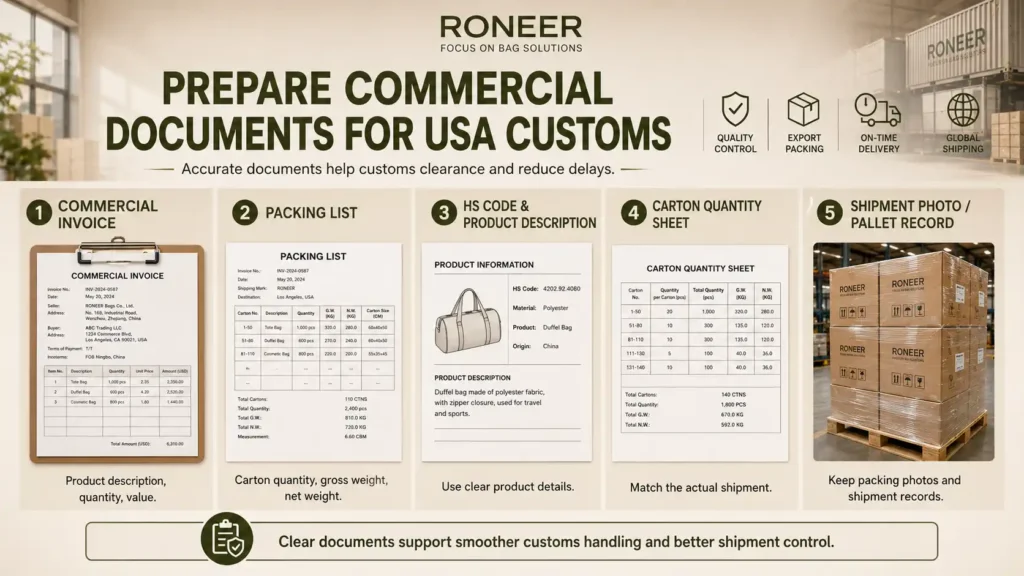
Shipping bags from China to USA requires clear commercial documents. The exact documents may vary depending on shipment method, importer requirements, freight forwarder, and product details, but buyers usually need a commercial invoice, packing list, product description, carton information, and shipping instructions.
The commercial invoice should describe the product accurately. Vague descriptions such as “goods,” “samples,” or “accessories” can create confusion. A clearer description may include the bag type, material, quantity, unit value, total value, and country of origin.
The packing list should match the actual shipment. It should show carton quantity, pieces per carton, gross weight, net weight, measurements, and total quantity. If there are multiple bag styles, colors, or SKUs, the packing list should make the assortment clear.
The buyer, supplier, and freight forwarder should also discuss HS code classification. The factory can provide product information, but the U.S. importer or customs broker should confirm the final classification and duty treatment when needed.
When shipping bags from China to USA, document accuracy is not only a paperwork issue. Incorrect quantity, unclear product descriptions, inconsistent values, or missing carton details can delay customs clearance and create extra costs.
A professional China bag manufacturer should provide production-side details such as carton measurements, packing list information, product photos, material description, and country of origin details. The buyer should work with a freight forwarder or customs broker for import-side decisions.
6. Inspect the Bags Before Shipment
Pre-shipment inspection is a practical step before shipping bags from China to USA. Once the goods leave the factory, fixing quality or packaging problems becomes much more expensive.
Inspection points should match the bag category. For handbags, buyers should check shape, stitching, edge finishing, lining fit, logo position, hardware color, zipper smoothness, surface marks, and packaging. For backpacks, buyers should check shoulder straps, seam reinforcement, zipper durability, padding, laptop compartment size, and load-bearing points. For cosmetic bags, buyers should check lining cleanliness, zipper function, shape retention, and easy-clean surfaces. For travel bags, buyers should check handle strength, bottom reinforcement, large zipper function, wheels or hardware if applicable, and carton packing protection.
For larger or higher-risk orders, buyers may also refer to third-party inspection providers such as SGS for bags and accessories testing and inspection. This type of industry reference can help buyers understand that custom bags may involve structured checks for materials, components, product performance, labeling, and overall quality before shipment.
Before shipping bags from China to USA, buyers should confirm the approved sample, final material, logo method, packaging standard, acceptable tolerance, carton mark, and inspection result. If the shipment includes multiple SKUs, the inspection should verify color, size, style number, label, and quantity.
RONEER supports quality communication before shipment, including sample confirmation, production detail checking, packaging review, and export packing coordination. A clear inspection plan helps reduce disputes and improves repeat production consistency.
7. Confirm Incoterms, Responsibility, and Delivery Point
Many shipping misunderstandings happen because the buyer and supplier do not clearly define responsibility. When shipping bags from China to USA, buyers should understand the agreed trade term, delivery point, and who is responsible for each cost and risk.
Some buyers ask the factory for FOB terms, where the supplier handles export-side delivery to a named port, and the buyer arranges main freight and destination-side handling. Other buyers may request EXW, where the buyer’s forwarder collects the goods from the factory. Some may ask for door-to-door service through a forwarder or logistics partner.
For shipping responsibility, buyers can review the International Trade Administration guide to Incoterms. Incoterms help define which party is responsible for freight, insurance, customs clearance, documentation, cost, and risk at different stages of the shipment. This is important when shipping bags from China to USA because FOB, EXW, and door-to-door arrangements can create very different cost responsibilities.
The right choice depends on the buyer’s experience. New importers may prefer more logistics support, while experienced importers may already have their own freight forwarder and customs broker.
The buyer should confirm whether the quotation includes product cost only, local export charges, freight, customs clearance, duties, destination delivery, insurance, or warehouse delivery. These costs can change the real landed cost significantly.
Before shipping bags from China to USA, confirm the final destination. Is the shipment going to a warehouse, Amazon FBA preparation center, retail distribution center, office, third-party logistics warehouse, or the buyer’s own facility? Each destination may have different label, appointment, carton, and pallet requirements.
A reliable supplier should not simply say “shipping included” without explaining the scope. Clear shipping responsibility helps both sides avoid misunderstanding after production is finished.
Common Mistakes When Shipping Bags from China to USA
One common mistake is discussing freight only after production is completed. At that stage, carton size, packing method, label position, and delivery schedule may already be difficult to change.
Another mistake is choosing the cheapest packing method without considering the product condition. Soft bags may tolerate compact packing, but structured handbags, premium wallets, and branded gift sets may need better protection.
Some buyers also forget to confirm barcode labels, SKU stickers, carton marks, and country of origin labels before packing. This can create warehouse problems after arrival in the United States.
A fourth mistake is approving only product photos without checking carton details. A bag may look correct, but the packing list, carton quantity, and SKU sorting may still be wrong.
Another common mistake is assuming that the factory, freight forwarder, and customs broker are responsible for the same things. In reality, each party has a different role. The factory provides product and packing information, the forwarder handles logistics, and the importer or customs broker usually manages import-side customs decisions.
When shipping bags from China to USA, clear communication is the best way to reduce risk. Buyers should create a simple shipping checklist and confirm every point before the goods leave the factory.
Practical Shipping Checklist for USA Buyers
Before shipping bags from China to USA, buyers can use this checklist:
Confirm the final approved sample and production standard.
Confirm bag type, material, color, size, and SKU list.
Confirm individual packaging, dust bag, polybag, hangtag, and label details.
Confirm barcode stickers, SKU labels, country of origin marking, and carton marks.
Confirm carton size, carton quantity, gross weight, and net weight.
Confirm whether the shipment will use express, air freight, sea freight, or mixed shipping.
Confirm commercial invoice, packing list, product description, and shipment value.
Confirm freight forwarder, customs broker, delivery address, and warehouse requirements.
Confirm the inspection result and packing photos before shipment.
Confirm repeat production records for future orders.
This checklist is especially useful for private label buyers, Amazon sellers, boutique brands, wholesalers, and corporate gift buyers. It helps connect production, packaging, documentation, and logistics into one controlled process.
How RONEER Supports Shipping Bags from China to USA
RONEER supports custom bag buyers from product development to export preparation. The process may begin with material selection, structure discussion, logo method comparison, sample development, and bulk production planning. Before shipment, RONEER can help buyers review packaging details, carton information, label planning, product photos, and packing list information.
Buyers can compare RONEER’s personalizzazione dei materiali options when choosing PU leather, microfiber leather, nylon, Oxford fabric, canvas, polyester, lining materials, and mixed-material structures. Material choice affects not only product appearance and cost, but also packing method, carton volume, and shipping risk.
Branding details should also be confirmed before shipment. RONEER’s personalizzazione del logo service can help buyers compare embossed logos, printed logos, woven labels, rubber patches, metal plates, zipper puller logos, hangtags, and packaging logos.
For buyers shipping bags from China to USA, the strongest result usually comes from early planning. Production, packing, labels, freight, and documents should work together instead of being handled separately at the last minute.
FAQ About Shipping Bags from China to USA
1. What does shipping bags from China to USA include?
Shipping bags from China to USA usually includes export packing, carton preparation, label checking, commercial invoice preparation, packing list preparation, freight booking, customs clearance support, and final delivery planning. The exact process depends on shipment size, shipping method, destination, and buyer requirements.
2. What is the best method for shipping bags from China to USA?
The best method depends on order size and timeline. Express shipping is suitable for samples and urgent small parcels. Air freight can work for urgent small-batch orders. Sea freight is often more practical for bulk custom bag production because it is usually better for larger volumes.
3. Is sea freight suitable for shipping bags from China to USA?
Yes. Sea freight is commonly used for shipping bags from China to USA when the order quantity is large enough, and the buyer has enough time. It is often suitable for bulk handbags, backpacks, tote bags, travel bags, cosmetic bags, and private label bag orders.
4. Is air freight suitable for shipping bags from China to USA?
Air freight can be suitable when the buyer needs faster delivery for launch stock, replenishment, promotional deadlines, or urgent retail orders. However, air freight cost depends heavily on volume weight, carton size, and shipment urgency.
5. Can samples be shipped by express before bulk production?
Yes. Many buyers ship samples by express before bulk production. This is useful for checking material, logo placement, structure, color, size, and packaging. Sample shipping is usually faster and simpler than bulk shipping.
6. What packaging is needed when shipping bags from China to USA?
Packaging may include dust bags, polybags, tissue paper, hangtags, barcode stickers, inner cartons, master cartons, carton marks, and protective filling. The right packing method depends on the bag type, material, structure, sales channel, and destination warehouse requirements.
7. Do bags shipped from China to USA need country of origin labels?
In many cases, imported bags entering the United States need proper country-of-origin marking unless an exception applies. Buyers should confirm the marking method, wording, label position, and packaging details before shipping bags from China to USA.
8. What documents are needed for shipping bags from China to USA?
Common documents may include a commercial invoice, packing list, shipment details, product description, and freight-related documents. For customs clearance, the U.S. importer or customs broker should confirm the final document requirements, HS code, and duty treatment.
9. Should USA buyers inspect the bags before shipment?
Yes. Pre-shipment inspection is strongly recommended before shipping bags from China to USA. Buyers should check stitching, material, logo position, zipper function, hardware color, measurements, packaging, labels, carton marks, and quantity before the goods leave the factory.
10. Can RONEER help with shipping bags from China to USA?
RONEER can support shipping bags from China to USA by preparing export packing information, carton details, product photos, packing lists, label discussions, packaging planning, and coordination with the buyer’s freight forwarder. Buyers should still confirm import-side customs decisions with their own broker or logistics provider.
11. How can buyers reduce shipping problems?
Buyers can reduce problems by confirming packing standards early, checking labels before production packing, approving physical samples, reviewing carton details, preparing accurate documents, and arranging inspection before shipment. Clear communication with the factory and forwarder is essential.
12. What should Amazon sellers check before shipping bags from China to USA?
Amazon sellers should confirm SKU labels, barcode stickers, carton labels, packaging condition, product dimensions, carton weight, and destination requirements. They should also check whether the shipment goes directly to Amazon, a prep center, or a third-party warehouse.
13. Why is export packing important for custom bags?
Export packing protects the product during transport and helps the shipment move through warehouse handling more smoothly. Good packing can reduce crushed shapes, scratched surfaces, mixed SKUs, missing labels, and carton damage when shipping bags from China to USA.
Conclusione
Shipping bags from China to USA should be planned before bulk production is finished, not after the goods are packed. For USA brands, Amazon sellers, retail buyers, private label companies, and corporate purchasing teams, shipping affects more than delivery time. It affects product condition, label accuracy, customs preparation, warehouse handling, customer experience, and future reorder consistency.
A practical shipping plan starts with the bag type. Handbags, backpacks, tote bags, cosmetic bags, wallets, and travel bags do not all need the same packing method. Buyers should confirm structure, material, logo placement, packaging, barcode labels, carton marks, and country of origin marking before the shipment leaves the factory.
The best strategy for shipping bags from China to USA also depends on the order stage. Samples may move by express, urgent launch stock may move by air freight, and larger bulk orders may move by sea freight. The buyer should compare speed, cost, volume weight, carton size, delivery deadline, and destination requirements before choosing the method.
RONEER helps buyers connect custom bag production with practical export preparation. Through OEM and ODM bag manufacturing, material selection, logo customization, packaging planning, sample development, bulk production coordination, quality communication, and export packing support, RONEER can help USA buyers prepare custom bag shipments with more control.
For any buyer planning shipping bags from China to USA, the safest approach is to prepare early, confirm labels and documents clearly, inspect the goods before shipment, and communicate with both the factory and the freight forwarder. When product details, packing details, and shipping details are aligned, custom bag orders become easier to deliver, easier to receive, and easier to reorder.