







A bag design can be copied long before the original brand reaches the market. Founders learning how to protect bag designs should begin protecting valuable assets before sharing prototypes, samples, or production files.
The risk may begin when a founder posts an early sample online, sends an unrestricted tech pack to several suppliers, hires a freelance designer without an ownership agreement, or allows a factory to retain patterns and custom hardware without written limitations. Understanding how to protect bag designs requires action before public disclosure and production.
Learning how to protect bag designs also involves more than registering a logo. A handbag may contain several intellectual property assets, including its appearance, artwork, technical drawings, brand name, custom hardware, printed lining, packaging, patterns, prototypes, and confidential manufacturing information.
No single registration or contract explains how to protect bag designs completely. Design rights, trademarks, copyright, confidentiality, ownership agreements, factory restrictions, and evidence records may protect different elements.
The most practical answer to how to protect bag designs is a layered strategy combining registered rights, controlled factory access, written ownership, confidential file management, evidence preservation, market monitoring, and enforcement.
Brands deciding how to protect bag designs should record creation dates, file versions, sample approvals, factory access, pattern ownership, and tooling ownership. A strong process for how to protect bag designs should also limit unauthorized photography, subcontracting, third-party sales, and use of rejected products.
This guide explains how to protect bag designs through ten practical safeguards for handbag startups, designers, private label brands, retailers, wholesalers, and established bag companies.
Because intellectual property rights are territorial, how to protect bag designs differs between countries. Before filing, brands asking how to protect bag designs should review local disclosure and ownership rules. During production, how to protect bag designs depends on contracts and access control. After launch, how to protect bag designs also requires evidence and market monitoring.
This article provides general information rather than legal advice.
Índice
ToggleWhat Can Protect a Bag Design?
Different rights protect different assets.
| Protection Method | What It May Protect | Main Limitation |
|---|---|---|
| Industrial design or design patent | Ornamental appearance, shape, configuration, or surface decoration | Territorial, time-limited, and dependent on filing requirements |
| Trademark | Brand name, logo, distinctive sign, or source identifier | Does not automatically protect the complete handbag shape |
| Copyright | Original drawings, artwork, prints, photographs, and qualifying artistic features | Functional products receive limited treatment in many jurisdictions |
| Trade secret protection | Confidential tech packs, patterns, BOMs, methods, and supplier information | Information must remain secret and be subject to reasonable controls |
| Contractual protection | Ownership, permitted use, confidentiality, subcontracting, and tooling rules | Usually binds only the parties to the agreement |
| Evidence and monitoring | Proof of creation, disclosure, use, and suspected copying | Evidence does not itself create every legal right |
A strong strategy for how to protect bag designs normally combines several of these methods instead of relying on only one.
1. Separate the Protectable Elements
The first step in how to protect bag designs is identifying exactly what is original and commercially important.
A handbag may contain several potentially protectable elements:
- Overall silhouette
- Panel configuration
- Flap shape
- Handle attachment
- Pocket arrangement
- Surface ornamentation
- Original print
- Embroidery pattern
- Decorative stitching
- Custom lock
- Zipper puller
- Metal Logo plate
- Forro con el logotipo de la marca
- Packaging structure
- Graphic artwork
- Product photographs
- Technical drawings
- Patterns and construction files
These elements may require different protection methods.
An industrial design registration or U.S. design patent generally focuses on ornamental appearance. The USPTO explains that a design patent protects how an article looks, including its shape, configuration, surface ornamentation, or a combination of these elements. It does not perform the same role as a utility patent, which concerns how an invention works.
A logo may be better addressed through trademark protection. An original printed pattern may involve copyright. A confidential pattern file or BOM may be managed as a trade secret. A custom mold may need both design registration and clear contractual ownership.
Create an IP asset list before approaching factories. Record which parts are:
- Original
- Adapted from an existing reference
- Factory-developed
- Purchased from a third party
- Licensed
- Intended to remain confidential
- Intended for public registration
This prevents the brand from claiming ownership over elements it did not create and helps legal advisers decide which assets deserve priority.
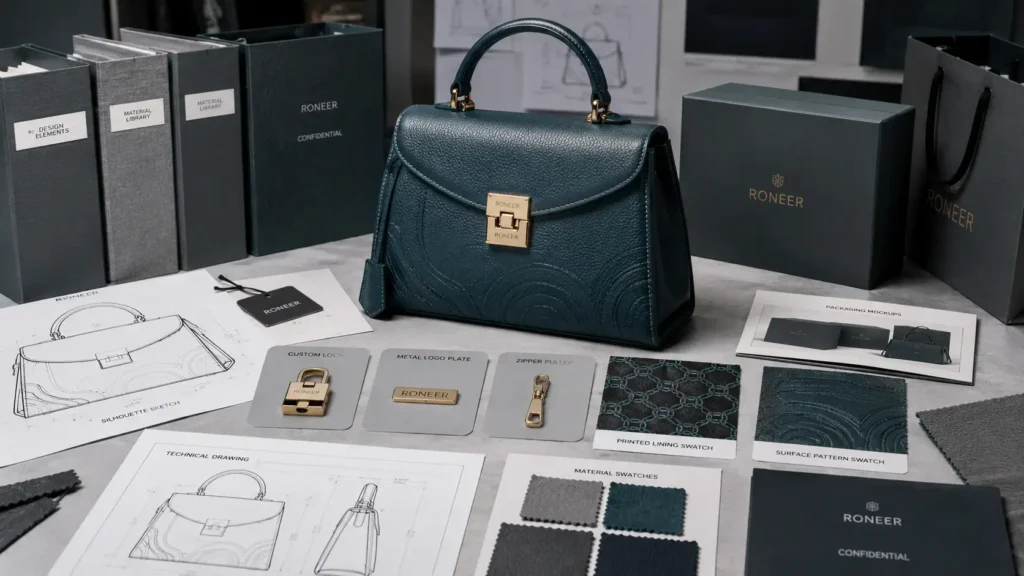
2. Keep the Design Confidential Before Filing
Public disclosure can be one of the most serious mistakes when deciding how to protect bag designs.
Publishing the design on Instagram, launching crowdfunding, displaying it at a trade show, sending it to buyers, listing it online, or allowing unrestricted factory photography may affect whether the design is considered new.
WIPO states that a design disclosed publicly before filing may no longer satisfy novelty or originality requirements. Some countries provide a 6- or 12-month grace period, but brands should not assume that the same grace period applies in every target market.
A safer sequence is:
- Identify the commercially important design.
- Choose target markets.
- Speak with an IP professional.
- Prepare filing drawings or photographs.
- File the relevant applications.
- Launch or disclose according to the legal strategy.
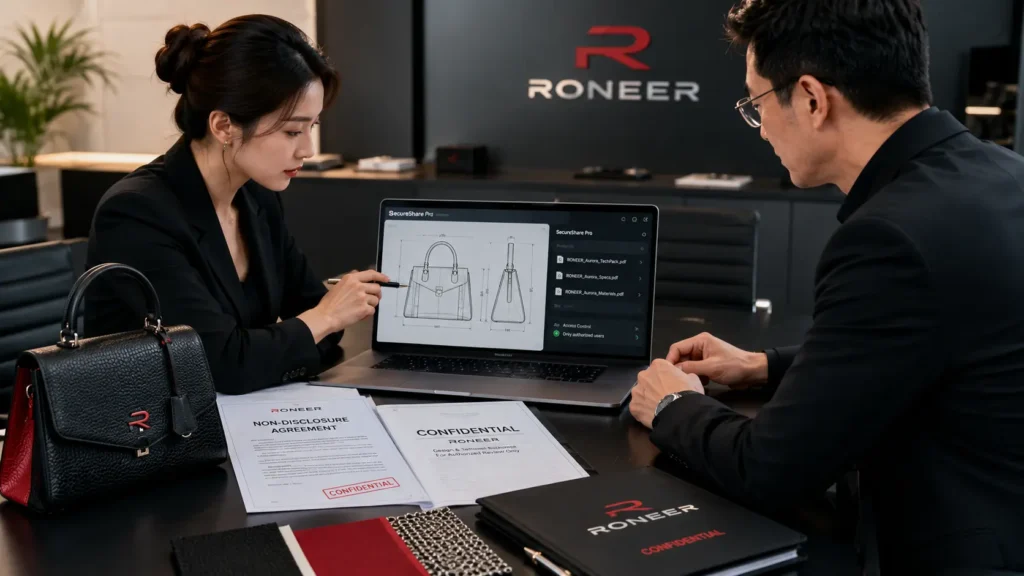
Before filing, share information only with people who need access.
Use:
- Confidentiality notices
- Non-disclosure agreements
- Password-protected files
- Restricted cloud folders
- Watermarked drawings
- Numbered tech packs
- Access logs
- Sample sign-out records
- Written photography restrictions
Confidential disclosure may be treated differently from public disclosure, but the exact effect depends on applicable law and the agreement. WIPO recommends confidentiality clauses when designs must be shown before registration.
3. Register the Design in Priority Markets
Registration is usually the strongest formal answer to how to protect bag designs against visually similar products.
Industrial design rights protect the appearance of a product rather than its general business idea. In the United States, design patents may be granted for new, original, and ornamental designs for articles of manufacture.
In the European Union, registered design protection can cover the appearance of a whole product or part of it, including lines, contours, colors, shape, texture, materials, and decoration.
Design rights are territorial. A registration in one country does not automatically provide worldwide protection.
Prioritize markets based on:
- Where will the handbags be sold
- Where major distributors operate
- Where manufacturing occurs
- Where the copying risk is highest
- Where enforcement is commercially realistic
- Where important online marketplaces are located
- Available legal budget
For brands seeking several territories, the WIPO Hague System allows eligible applicants to seek design protection in multiple designated countries or regions through one international application. Each designated office may still examine or refuse protection according to its own law.
Registration strategy should be planned before launch, not after copying appears.
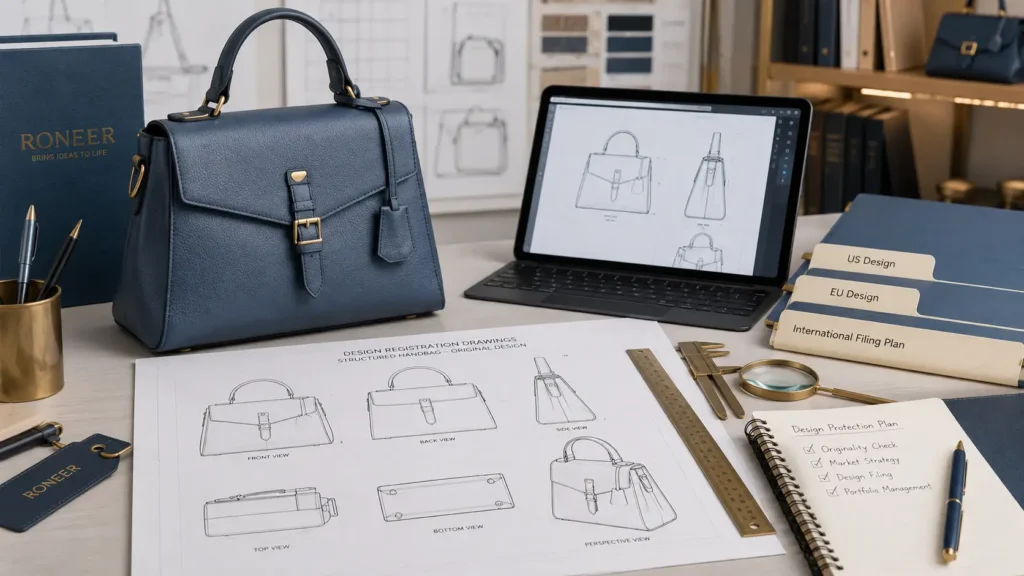
4. Prepare Registration Drawings Carefully
The drawings or photographs used in a design filing can influence the scope of protection.
When planning how to protect bag designs, decide which visual features should be claimed and which features should remain outside the claim.
Possible filing strategies may include:
- Complete handbag appearance
- Front panel configuration
- Handle structure
- Decorative flap
- Custom hardware
- Surface pattern
- Embalaje
- Several coordinated design variants
The appropriate strategy depends on local law and professional advice.
Prepare consistent views such as:
- Front
- Back
- Left side
- Right side
- Top
- Bottom
- Perspective
- Open or closed views where relevant
Avoid inconsistencies between views. A pocket, stitch line, handle connector, or side gusset appearing differently across drawings may create examination or enforcement problems.
Your production handbag tech pack and legal filing drawings do not necessarily serve the same purpose. A tech pack contains dimensions, materials, BOM information, and construction instructions, while design filing images focus on the protected appearance.
Coordinate the two documents, but do not assume one automatically replaces the other.
5. Protect the Brand Name, Logo, and Source Identifiers
A registered bag appearance does not automatically protect the brand name placed on it.
A trademark is a sign capable of distinguishing the goods or services of one business from those of another. Brand names, wordmarks, logos, and certain distinctive signs can therefore require separate trademark planning.
For brands researching how to protect bag designs, trademark protection may cover:
- Brand name
- Logotipo
- Monogram
- Product-line name
- Distinctive label
- Repeating brand pattern
- Packaging identifier
- Certain three-dimensional source-identifying features
Trademark rights should not be confused with design rights. Design protection generally focuses on appearance, while trademark protection focuses on identifying the commercial source.
In some jurisdictions, distinctive and nonfunctional product configuration may eventually qualify as trade dress or a three-dimensional mark. In the United States, product design trade dress raises additional distinctiveness and functionality requirements and should be assessed by qualified counsel rather than treated as automatic protection. USPTO materials recognize three-dimensional product design and packaging as forms of trade dress that require specialized drawings and descriptions.
RONEER’s personalización del logotipo page can help brands document how approved logos will be applied through embossing, printing, woven labels, metal plates, zipper pullers and packaging. The legal right to use the Logo must be resolved before production.
6. Use Copyright for the Right Assets
Copyright can support a strategy for how to protect bag designs, but its scope must be understood accurately.
Copyright commonly protects original creative works such as:
- Technical illustrations
- Fashion sketches
- Graphic prints
- Surface artwork
- Embroidery artwork
- Product photographs
- Marketing images
- Packaging graphics
- Catalog layouts
The U.S. Copyright Office states that original visual works can receive copyright protection once fixed in a tangible medium, and registration options are available for qualifying visual arts works.
A functional handbag is a useful article. Under U.S. copyright principles, artistic features incorporated into a useful article may qualify only when those features can be perceived separately from the article’s utilitarian aspects and would qualify as pictorial, graphic or sculptural works on their own. The entire functional shape of a bag should therefore not be assumed to receive automatic copyright protection.
A practical copyright file may include:
- Original sketches
- Source artwork
- Pattern graphics
- Date-stamped exports
- Photographer agreements
- Designer assignments
- Publication dates
- Registration records
Copyright, design rights, and trademarks may overlap in some situations, but each right has different requirements and purposes.
7. Put Designer Ownership in Writing
Many brands misunderstand how to protect bag designs created by freelancers, agencies,s or external product developers.
Paying for design work does not always answer every ownership question automatically. The agreement should state who owns:
- Concept sketches
- Technical drawings
- Tech packs
- Patterns
- Prototypes
- CAD files
- Artwork
- Hardware designs
- Molds
- Photographs
- Revised versions
- Rejected concepts
The agreement should specify whether rights are:
- Assigned completely
- Licensed for limited use
- Shared
- Restricted by the market
- Restricted by product category
- Subject to additional payment
- Retained by the designer
Include warranties that the work is original or properly licensed and does not knowingly copy third-party rights.
For collaborations, define whether each party can use the design independently, register it, modify it, sublicense it, display it in a portfolio, or manufacture it for another customer.
A written assignment or license creates a clearer chain of title when the brand later files registrations, works with distributors, raises investment, sells the company, or enforces rights.
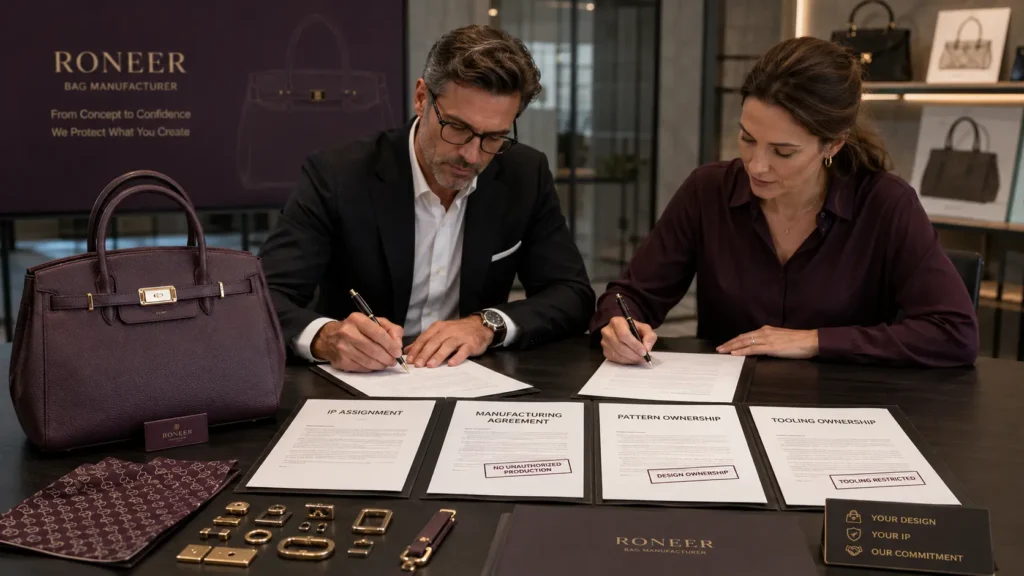
8. Use NDAs and Manufacturing Agreements
An NDA is useful, but it is not the complete answer to how to protect bag designs from factories.
WIPO describes NDAs and confidentiality clauses as important measures for keeping commercially valuable information secret. Trade secret protection generally requires the information to be secret, to have commercial value because it is secret, and to be subject to reasonable protective measures.
A factory NDA may address:
- Confidential information definition
- Permitted purpose
- Authorized employees
- Subcontractor disclosure
- File security
- Sample handling
- Photography
- Marketing use
- Return or deletion of files
- Duration
- Governing law
- Dispute procedure
The manufacturing agreement should go further.
It may include:
- Brand ownership of designs
- Pattern ownership
- Mold and tooling ownership
- Prohibition on unauthorized overruns
- Prohibition on sales to third parties
- No use in catalogs or showrooms
- No subcontracting without approval
- No alteration without permission
- Handling of rejected goods
- Destruction or return of excess labels
- Control of branded packaging
- Storage period for molds and materials
- Responsibility for breaches by subcontractors
An NDA normally binds only the parties covered by it. It does not create design registration against every independent competitor and does not prevent someone from independently creating a similar lawful design.
Use contracts together with registration, evidence,e and access control.
9. Control Tech Packs, Pattern Samples, a nd Tooling
Operational control is a major part of how to protect bag designs during product development.
A detailed tech pack can include commercially valuable information such as:
- Measurements
- Construction
- Material codes
- BOM
- Suppliers
- Hardware details
- Logo positions
- Cost targets
- Embalaje
- Quality tolerances
- Sample comments
Use a controlled handbag tech pack with:
- Style number
- Version number
- Issue date
- Owner name
- Confidentiality notice
- Page numbering
- Recipient record
- Superseded-file notice
- Approval status
Do not send the complete development package to every supplier at the first enquiry. Begin with enough information to evaluate capability and release sensitive files only after screening, confidentiality arrangements, and commercial alignment.
RONEER’s guide on how to find a bag manufacturer explains how buyers can verify business identity, production location, sampling capability, communication and quality systems before committing sensitive product information.
Also, define ownership of:
- Paper patterns
- Digital patterns
- Cutting dies
- Embossing plates
- Printing screens
- Metal molds
- Logo molds
- Sample bags
- Remaining custom materials
- Rejected units
Mark physical samples and tools with the brand, style number,r and ownership status.
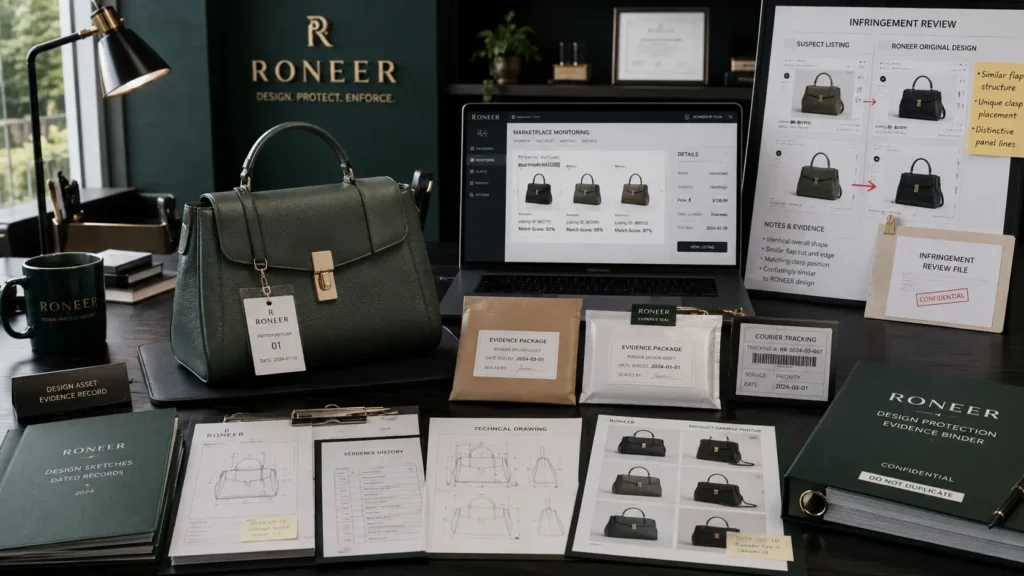
10. Build Evidence, Monitoring, and Enforcement Systems
Registration has limited practical value when the brand cannot prove what it owns or detect copying.
The final part of how to protect bag designs is creating an evidence and response system.
Keep:
- Original sketches
- Native design files
- Version history
- Dated emails
- Designer agreements
- Factory contracts
- Sample invoices
- Courier records
- Sample photographs
- Filing receipts
- Registration certificates
- First-use evidence
- Launch screenshots
- Sales records
- Product packaging
- Suspected-copy screenshots
- Test purchases
- Marketplace correspondence
Use consistent style numbers so that the design file, application, sample, production order, and online listing can be connected.
Monitor:
- Google Images
- Online marketplaces
- Wholesale platforms
- Redes sociales
- Competitor catalogs
- Trade exhibitions
- Distributor channels
- Factory marketing pages
When suspected copying appears, preserve evidence before contacting the seller. Listings can be changed or removed quickly.
Possible responses may include:
- Platform report
- Evidence preservation
- Test purchase
- Lawyer review
- Cease-and-desist communication
- Distributor notification
- Customs or border measures, where available
- Negotiated settlement
- Civil proceedings
Do not make public infringement accusations before obtaining a qualified assessment. Similarity alone does not establish infringement, and the legal scope depends on the right, jurisdiction, registered images, prior designs,s and functional features.
Protection Plan by Product Stage
| Product Stage | Main Protection Actions |
|---|---|
| Early concept | Limit disclosure, record creation dates, and sign designer agreements |
| Detailed design | Prepare filing strategy, NDA, controlled tech pack |
| Before the public launch | File priority design and trademark applications |
| Sampling | Restrict factory use, record sample versions, and define ownership |
| Producción a gran escala | Control subcontracting, overruns, labels, molds, and rejected goods |
| Market launch | Preserve first-use evidence, monitor listings and marketplaces |
| Reorders | Keep the same contracts, files, patterns, and approved ownership records |
| Suspected copying | Preserve evidence and obtain jurisdiction-specific legal assessment |
The practical answer to how to protect bag designs changes at each stage. Filing, contracts, and evidence should begin before the product becomes commercially visible.
Factory Agreement Checklist
Before sending complete original designs, confirm that the agreement addresses:
- Legal names of both parties
- Confidential information
- Ownership of supplied files
- Ownership of factory-created modifications
- Pattern ownership
- Sample ownership
- Mold and tooling ownership
- Authorized use
- Subcontracting
- Unauthorized production
- Excess production
- Marketing photographs
- Third-party sales
- Rejected goods
- Branded labels and packaging
- File return or deletion
- Storage periods
- Dispute mechanism
- Governing law
- Continuing confidentiality obligations
The contract should match the actual OEM handbag manufacturing process, including tech pack review, pattern making, sampling, PP sample approval, production and repeat-order records.
Common Mistakes When Protecting Bag Designs
Publishing Before Reviewing Filing Strategy
Public disclosure can affect novelty. Do not rely on a grace period without confirming the law in each target market.
Assuming a Logo Registration Protects the Whole Bag
Trademark registration and product-appearance protection serve different purposes.
Using Only an NDA
An NDA can control confidential relationships but does not replace design registration or evidence.
Paying a Designer Without an Assignment
Payment alone may not resolve every ownership or permitted-use question.
Sending Full Files to Too Many Suppliers
Release sensitive information according to need, capability, and contractual protection.
Ignoring Factory Modifications
Clarify whether revisions created by the factory belong to the buyer, the factory,y or both.
Forgetting Molds and Patterns
Owning the finished handbag design does not automatically clarify possession or use of every production tool.
Filing Only After Copying Begins
Late filing may face public disclosure, novelty, ty, and priority problems.
Making Unverified Infringement Claims
Obtain professional analysis before making legal threats or public accusations.
FAQ About How to Protect Bag Designs
1. How Do I Protect a New Handbag Design?
To understand how to protect bag designs, first identify the original visual features, keep them confidential, review design-registration options, document ownership, and control access to technical files. A combined strategy is usually stronger than relying on one NDA or trademark.
2. Can I Patent a Handbag Design?
A new and original ornamental handbag appearance may potentially qualify for a U.S. design patent, subject to legal requirements and examination. Functional inventions may require a different patent analysis. The official USPTO design patent guide explains the basic application framework.
3. Should I Apply Before Posting the Bag Online?
Brands deciding how to protect bag designs should normally review filing strategy before public disclosure. WIPO warns that disclosure can affect novelty, while grace-period rules vary by country.
4. Does an NDA Stop a Factory From Copying My Bag?
An NDA can create confidentiality obligations for covered parties, but it is not universal protection against everyone. Combine the NDA with ownership clauses, manufacturing restrictions, access control, registrations, and evidence.
5. Who Owns a Design Created by a Freelance Designer?
Ownership depends on applicable law and the agreement. Brands learning how to protect bag designs should use a written assignment or license defining sketches, tech packs, patterns, revisions, artwork, and registration rights.
6. Can Copyright Protect an Entire Handbag?
Not automatically. Copyright may protect original drawings, artwork, patterns, photographs,s and qualifying artistic features. A handbag is also a useful article, so functional shape and construction may receive limited copyright treatment, depending on jurisdiction.
7. Is a Trademark Enough to Protect a Handbag?
No. A trademark generally protects source identifiers such as a brand name or Logo. Brands studying how to protect bag designs should separately consider the handbag’s appearance, artwork, confidential files and contractual controls.
8. Can I Protect a Custom Lock or Zipper Puller?
Potentially. A custom component may be evaluated for design registration, copyright, trademark, or other protection depending on its appearance and use. The mold and production rights should also be defined contractually.
9. Can One Application Protect My Design Worldwide?
There is no single worldwide design right. The Hague System can simplify applications in multiple designated territories, but protection remains subject to each designated jurisdiction’s law.
10. What Evidence Should I Keep?
A practical how to protect bag designs file should contain original drawings, native files, dates, agreements, sample records, registration documents, launch screenshots, invoices, and suspected-copy evidence.
11. Can a Factory Display My Sample in Its Showroom?
The answer should be defined in the manufacturing agreement. Brands should prohibit photographs, showroom displays, exhibitions, catalogs,s and third-party presentations unless written permission is granted.
12. How Can I Protect Several Colorways?
One registration may not automatically cover every meaningful variation. Discuss whether separate applications, multiple designs, or coordinated filing images are needed. Keep each colorway, material, and hardware version clearly documented.
13. How Does RONEER Support Design Confidentiality?
RONEER can work from sketches, samples, and controlled tech packs during OEM/ODM development. Buyers should define confidentiality, ownership, permitted use, patterns, tooling, and sample handling in the commercial agreement before sharing sensitive files.
Conclusión
Learning how to protect bag designs begins before the first public post, buyer presentation, trade-show display, or factory sample. Early confidentiality gives a brand more time to evaluate design registration, trademarks, copyright, ownership agreements, and manufacturing restrictions before valuable information becomes public.
A practical strategy for how to protect bag designs should identify every important asset separately. The overall appearance, original artwork, technical drawings, brand identifiers, patterns, custom hardware, packaging, and confidential production information may require different forms of protection.
The strongest answer to how to protect bag designs is therefore a layered system. Industrial design registrations or design patents may protect ornamental appearance, trademarks may protect brand identifiers, copyright may protect qualifying artwork and drawings, and trade-secret measures may protect confidential technical information.
Contracts are equally important when planning how to protect bag designs. Brands should define ownership with founders, employees, freelance designers, product developers, sourcing companies, and factories. Agreements should address tech packs, patterns, prototypes, molds, tooling, modifications, photographs, subcontracting, unauthorized production, and third-party sales.
Operational control is another important part of how to protect bag designs. Sensitive files should use version numbers, confidentiality notices, restricted access, recipient records, and clear approval status. Samples, molds, patterns, custom hardware, and rejected products should be identified and handled according to written ownership terms.
Evidence also determines how effectively a brand can apply its strategy for how to protect bag designs. Original files, dated sketches, sample records, contracts, applications, certificates, production orders, sales records, and marketplace screenshots create a clearer history of creation, ownership, disclosure, and commercial use.
Market monitoring should continue after launch. Brands researching how to protect bag designs should regularly review marketplaces, social media, wholesale platforms, competitor websites, trade-show catalogs, and factory marketing pages. Suspected copying should be documented before listings or evidence disappear.
RONEER supports OEM and ODM bag development through technical file review, size and structure planning, material selection, samples, logo methods, packaging, production coordination, and repeat-order records. For brands evaluating how to protect bag designs, these manufacturing services should operate within their own registration, confidentiality, ownership, and factory-control strategy.
Ultimately, how to protect bag designs depends on identifying valuable assets, avoiding premature disclosure, registering priority designs, protecting brand identifiers, securing ownership, restricting factory use, preserving evidence, and monitoring the market.
No single document completely answers how to protect bag designs. However, a coordinated system of legal rights, contracts, operational controls, and evidence makes an original design easier to manage, commercialize, reproduce, and defend.