 Deutsch
 English
 Español
 Français
 Italiano
 Русский
 日本語
 العربية
 Türkçe
 한국어
The hangtags are approved and the first batch of totes is already on the cutting table when a retailer asks which fabric lots support the words “recycled polyester outer shell.” The merchandiser has a supplier brochure, the warehouse has two roll labels, and the purchasing team has a single invoice covering both deliveries. Each document looks plausible on its own. None tells the retailer whether the fabric in a particular carton came from the claimed lot.
A Recycled Polyester Bag Traceability Checklist helps buyers close that gap before they print claims or make production commitments. It connects the agreed wording to a bag component, the component to actual material receipts, and those receipts to finished units. This guide follows that chain from quotation to shipment. It also shows what to do when a mill changes, two lots are mixed, or a valid certificate turns out to cover a different transaction.
Define the claim before requesting a quote

Start the Recycled Polyester Bag Traceability Checklist with the exact sentence your business wants to put on the product page, hangtag, or carton. Ask which physical part the sentence describes. A tote may have a recycled polyester shell, a lining of a different composition, handles sourced separately, and a coated base. If you only have evidence for the shell fabric, build your wording and document requests around the shell. The lining, webbing, zipper tape, labels, and packaging each need their own decision.
Record the style code, bill of materials revision, destination market, and sales channel next to the proposed wording. Distinguish the composition of a fabric from the percentage by weight of a finished article. “The shell fabric contains recycled polyester” and a claim about the recycled content of the entire bag require different proof. Even for a component claim, check whether the supplier figure refers to a yarn, a woven fabric before finishing, or the finished coated fabric. Ask who supplied the figure and what its denominator represents.
| What you want to describe | What to identify in the file | Where buyers get caught |
|---|---|---|
| Outer fabric | Shell material code, color, construction, and the applicable composition basis | Evidence shows a similar fabric or an earlier finish |
| Handles or straps | Separate webbing or fabric part number and lot | Matching shade is taken as proof of matching composition |
| Whole bag | Claim basis and supporting data for all components within that basis | Shell percentage is reused as finished bag percentage |
| Verpackung | Packaging specification and purchasing evidence kept separately | A carton statement reads like a statement about the bag |
For products marketed in the United States, the FTC summary of the Green Guides explains why recycled content claims should be qualified when only part of a product or package uses recycled material. Check the applicable guidance for your destination and sales channel before approving public wording. Your Recycled Polyester Bag Traceability Checklist should carry the approved version of that wording so the graphic designer, marketplace team, and supplier are all working from the same statement.
Put the claim scope on the RFQ alongside performance requirements. For example, ask for a shell fabric candidate with traceable recycled polyester and a finish that can be assessed on a physical sample. Put color, hand feel, material composition, and the evidence requirement on separate lines. A supplier can then explain whether the quote covers an available lot, a new fabric run, or an alternate. Use RONEER’s RPET bag development service to discuss how documentation availability and bag construction affect the material routes you can compare.
Map each material to a physical lot
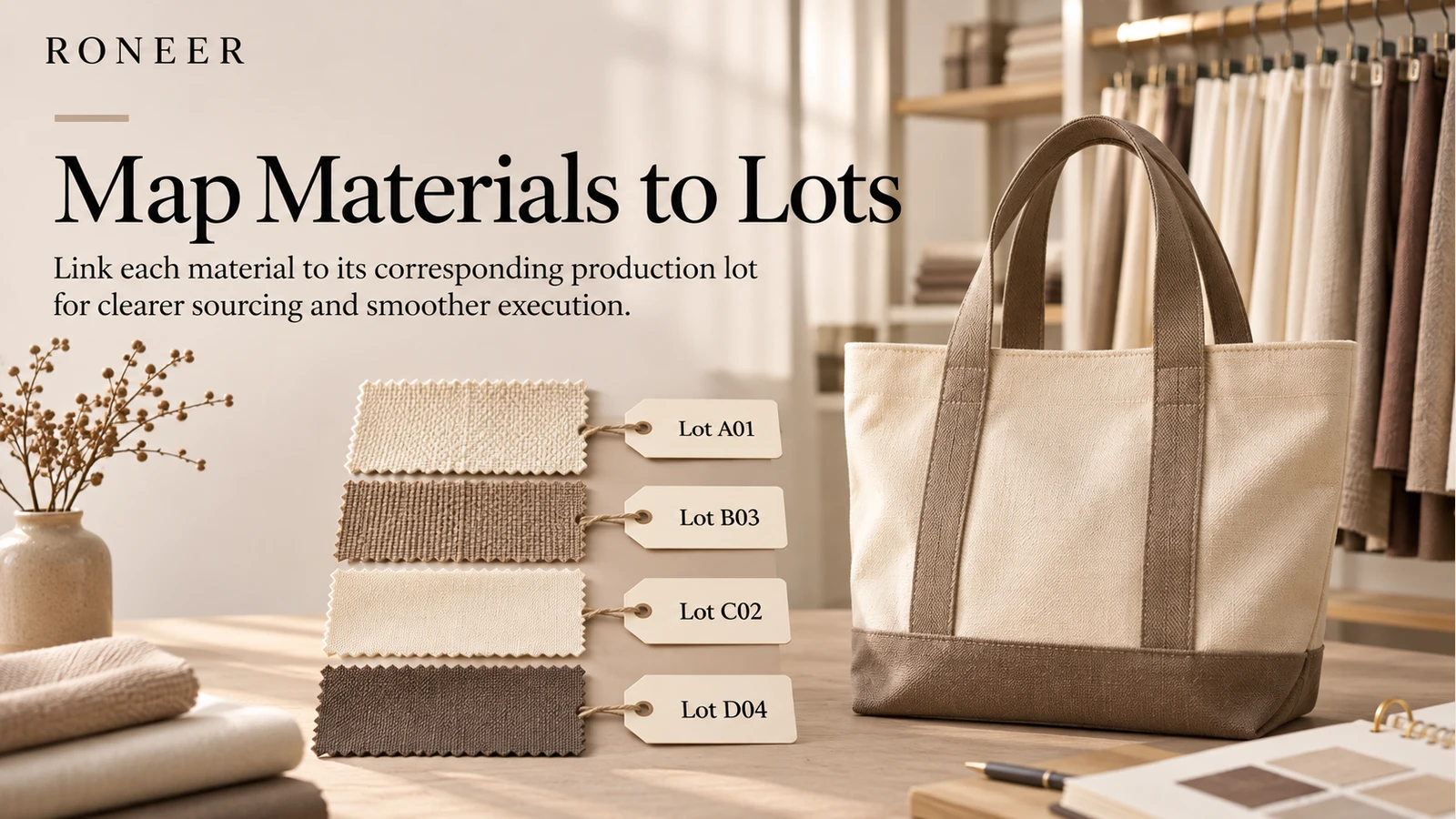
The Recycled Polyester Bag Traceability Checklist becomes useful on the production floor when the approved component has a unique material code and incoming goods have a lot or roll identifier that staff can actually read. Keep the factory code and supplier code side by side. If they differ, record the cross-reference when receiving takes place. A printed receiving label can show the factory ID while the supporting file retains a photograph of the mill label and the delivery note.
Start with the bill of materials for the approved sample. Identify exactly where the material is used, such as front and back shell panels versus the gusset or bottom patch. Then capture supplier, purchase order, lot, received quantity, date, and storage location. Match these records to the work order and cutting issue records. If the shell is cut in two batches, both need to link back to the relevant stock issue. The aim is for a reviewer to start with a finished lot and work back to the rolls without asking the buyer who remembers the delivery.
Think through how the cutting team handles a partial roll. The original paper label could be removed when the first quantity is issued. Assign a retained identifier to the remainder before it goes back to storage. Keep leftover material with known evidence separate from material with an unknown origin, even when both match visually. When your Recycled Polyester Bag Traceability Checklist asks for a roll photograph, make sure the photographed label is also connected to the receiving record. A folder of anonymous photos does little to identify which cut panels reached production.
A simple cross-reference for a retailer’s tote might read “Style T04, revision B, outer shell, supplier fabric P18, receipt GR12, rolls R01 and R02, cutting orders C31 and C32.” The names and codes are illustrative and can be replaced with the identifiers already in your Recycled Polyester Bag Traceability Checklist. The useful part is the connection from each cutting order back to a particular receipt, followed by a finished production lot or carton range. If several work orders feed one packing run, agree how the packer records those relationships before the workshop starts combining units.
Include subcontractors in the Recycled Polyester Bag Traceability Checklist if the fabric leaves the main facility for printing, lamination, or embroidery. Ask what goes out, what comes back, and whether the returned goods still carry a link to the originating lot. Keep the approval sample reference separate from the production allocation. A good hand feel and a matching sample establish what you approved physically. Bulk issue and return records establish what material went into the shipped units. Review the bag sample approval checklist for the physical approval tasks that should run alongside document control.
Review what each supplier document can prove
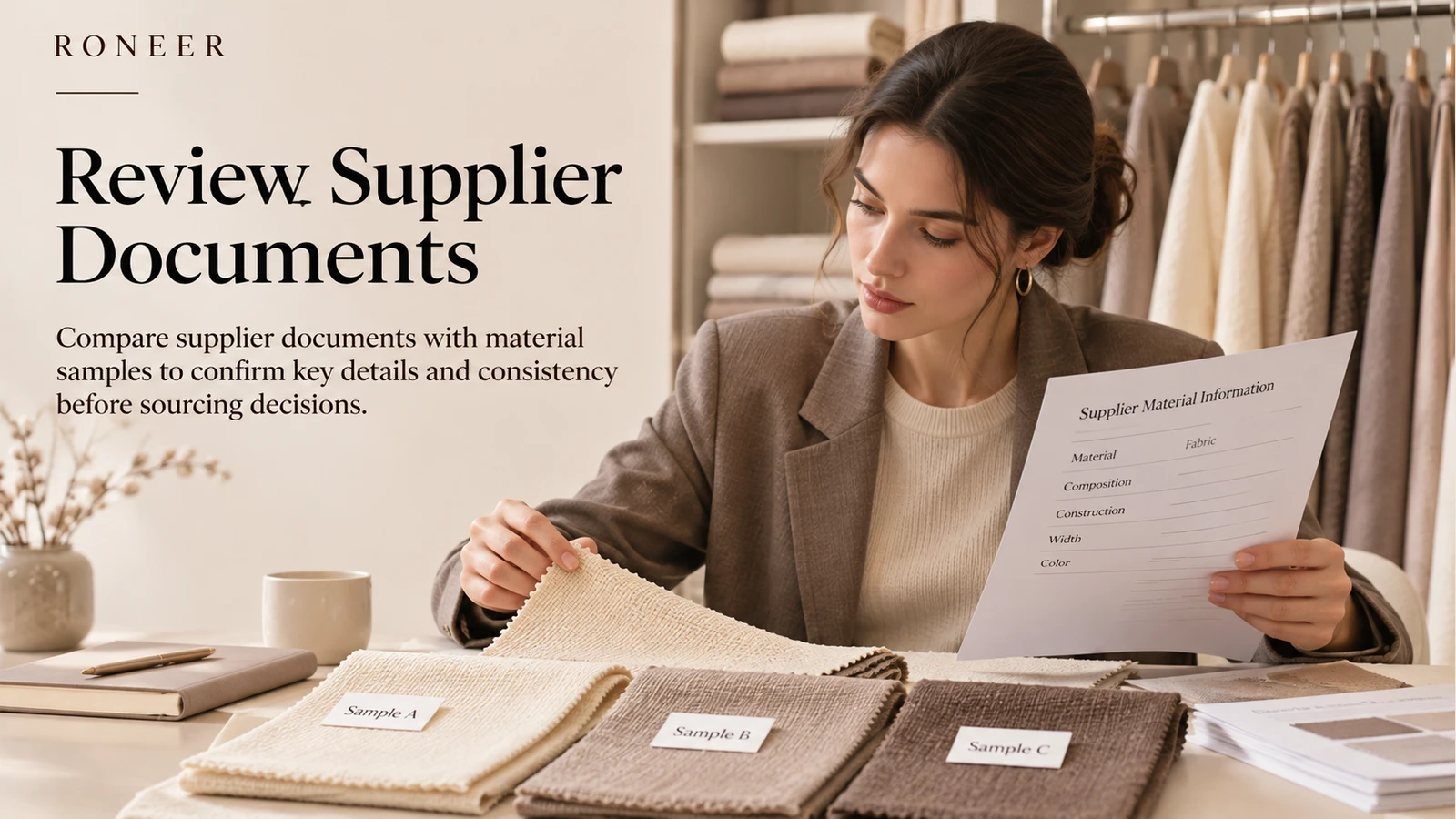
In a Recycled Polyester Bag Traceability Checklist, each document should have a job. A technical data sheet can identify the named construction and composition that the mill declares. An invoice can identify the parties, item and quantity billed. A delivery note and roll label help identify incoming stock. A production issue record ties a quantity of that stock to a job. Store these together and label their roles so people can see where a missing link remains.
When the purchase contract calls for a certification scheme, consult the scheme owner or the certifier for the documents and claim rules that apply. The Textile Exchange overview of RCS and GRS describes those schemes and their chain-of-custody context. The applicable scope certificate and transaction evidence answer different questions. Review the organization, site, covered activity, applicable product or material category, and relevant dates on the scope record. Then check whether the transaction evidence refers to the specific shipment, material, and quantity the buyer intends to rely on.
A certificate from the yarn supplier may be relevant upstream, while the nominated fabric supplier and subsequent processors still need evidence appropriate to the required chain. Ask the certified partner or certifier which identifiers should match when an invoice uses a short product name and the underlying transaction document uses a different description. Keep the written explanation with the file. If the mismatch materially changes what is covered, pause the claim or follow the correction process with the issuing party before accepting the document.
Give each entry in the Recycled Polyester Bag Traceability Checklist a status such as received, verified, pending, or out of scope. A verified scope record can coexist with a pending transaction record. When the expected transaction document is only issued after shipment, agree timing, responsible parties, and what activity is held pending its arrival. Some buyers can proceed with production while holding marketing artwork. Others need firmer documentary milestones before committing fabric. Make that decision explicit in the commercial record rather than leaving it to whoever checks the invoices later.
Use a brief exception log. Capture the document reference, mismatch, affected receipts, person following up, and the decision once resolved. For example, an invoice could list navy and black fabric on one line while the shipping records show separate lots. Ask for the allocation for each color. If only black can be supported, keep the claim decision separate for navy, even when both colors sell under the same parent style. Save the version used for the approval alongside any superseded copy so a later reviewer can retrace the decision.
Reconcile quantities and manage substitutions

A Recycled Polyester Bag Traceability Checklist needs a quantity check because a single verified receipt may be assigned to more than one order. Use consistent units for the same material. If receiving records show kilograms but cutting records use meters, document the measured conversion basis or obtain roll-specific records that reconcile the difference. Width, finish, lot variation, and a nominal fabric weight can make a rough conversion unsuitable for closing an actual stock account.
For a simple example, a workshop starts with 30 meters of identified shell fabric and receives 120 additional meters under an eligible lot. During the period, 116 meters are incorporated into panels, 12 meters are recorded as cutting waste, and 22 meters remain identifiable in stock. The balance is 150 meters before use and 150 meters accounted for. Those numbers are illustrative. A real job might also have test material, damaged rolls, panels rejected later, stock returned from an external printer, and work in progress. Assign each line a record and a date. When the cutting log already records gross fabric issued, avoid subtracting its waste a second time.
The Recycled Polyester Bag Traceability Checklist should connect that balance to the packed output. Check counts for accepted bags, rejected bags, and any units sent for rework. Compare expected fabric usage against the agreed cutting plan and investigate material discrepancies with the production team. A balanced worksheet provides a useful control. Evidence of physical allocation, mixing rules, and the actual composition of the material still comes from the supporting records.
Decide what happens if the approved fabric runs short. Suppose a mill can supply a visually similar charcoal fabric for the final 200 units but the documentation is still pending. The buyer and production lead can hold the affected run, approve a separate revision under a supported claim, or ship those units separately with different wording if the contract and channel allow. Record which units and packaging are affected. If cut pieces from both lots have already been mixed, establish which units can genuinely be distinguished before authorizing any claim. The unit price alone rarely captures the remarketing cost of that change.
Add a written change procedure to the Recycled Polyester Bag Traceability Checklist. Require notification for changes to the named material supplier, finish, composition, production site, or identified lot when the change affects the evidence. Assess physical appearance and performance on the revised sample where appropriate. Then check documentation coverage again. Update the bill of materials and carton mapping together. The team reviewing color should know which revision they are approving, and the person signing off the claim should know which revision is on the floor.
Approve the claim file before printing or shipment
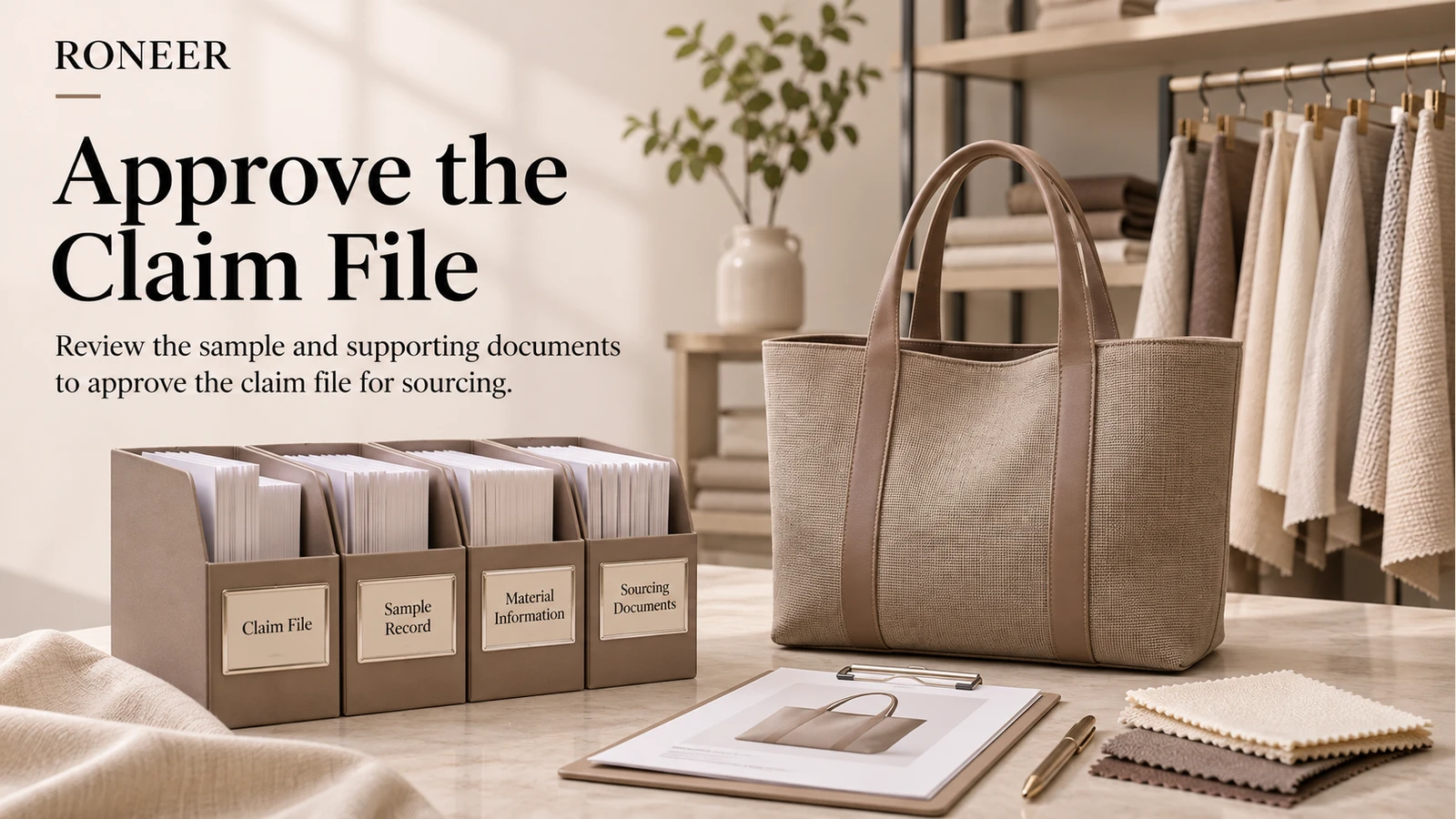
The final Recycled Polyester Bag Traceability Checklist should allow someone outside purchasing to reconstruct the decision. Organize it around the style and color or variant, production order, bill of materials revision, lot records, quantity reconciliation, and final label artwork. Include an owner and approval date. Keep public wording in a separate field from technical evidence so marketing can reference the approved copy without interpreting an unfinished spreadsheet.
Set review milestones at quotation, before bulk cutting, and before releasing labels or shipment. At quotation, confirm what the supplier expects to provide and where evidence may be limited. Before cutting, reconcile material identities and establish who records exceptions. At release, tie the actual packed lots to the approved wording and close any open exceptions or describe exactly which units remain on hold. A small team can manage the Recycled Polyester Bag Traceability Checklist in a spreadsheet with links to controlled documents. A larger program may already have an ERP or a compliance portal. Put the decision, revision, and supporting record identifiers where the people who need them can find them.
If marketing copy is already prepared, check each placement independently. A headline may imply the entire bag is made of recycled material even when a detail table correctly names the shell. Product page bullets, hangtags, packaging, and customer procurement portals should all match the same scope. Review photographs of the packout to make sure the correct label is on the correct variant. If a retailer requests a certification logo, ask which claim approval and permission processes apply before printing. Keep that evidence with the final artwork proof.
When quoting a repeat order, pull the approved sample and wording from the preceding order as references, then create a fresh line for the new receipts and work orders. A change in lots can leave the design untouched while changing the evidence. The Recycled Polyester Bag Traceability Checklist should distinguish a reused specification from newly verified production records. For early budgeting or comparisons between supplier offers, align what each option includes using the guide to comparing custom bag quotes. Ask each bidder whether certification or transaction documentation is in scope and on what timeline it can be delivered.
Recycled Polyester Bag Traceability Checklist FAQs
Can buyers use one checklist for the whole bag range?
Use one Recycled Polyester Bag Traceability Checklist template across a range and create separate records where styles, colors, and production lots differ. Several styles may legitimately draw from one receipt. Record the allocation for each so a single stock quantity is counted once. If a style is ordered again, connect each new shipment to the current lots.
Does an RPET swatch confirm the bulk fabric?
It shows the physical reference the buyer evaluated. In the Recycled Polyester Bag Traceability Checklist, give the swatch a date and material reference, then ask for separate bulk receipt and issue evidence. If the swatch came from a sample room and the exact lot is unavailable, document the difference and confirm how bulk properties and documentation will be evaluated.
What should happen when a supplier certificate expires?
Check the dates against the activity and transaction you are reviewing, and seek guidance from the relevant certifier when timing or scope is unclear. Mark the file pending if a valid supporting record is required and missing. Keep the original and any replacement with a clear note about which production or transaction each applies to.
Is a supplier declaration enough for every project?
Evidence should meet the wording, purchase contract, customer requirements, and applicable market rules. A declaration can provide useful composition information. Buyers whose contracts require a specific verified chain should add the required scheme records to their Recycled Polyester Bag Traceability Checklist and match them to actual materials and transactions.
Can shell fabric and lining use different recycled content claims?
Yes, when both claims have the appropriate evidence and identify their parts clearly. Give shell and lining their own material entries. If the lining information is pending, approve only the scope supported by the evidence and ensure the artwork does not imply it covers both components.
How should buyers record different colors from the same mill?
In the Recycled Polyester Bag Traceability Checklist, give each color its own receipt and allocation row where lots differ. The same mill can run colors at different times or supply them under different transactions. This structure lets the buyer approve one color and hold another when an evidence issue is specific to one receipt.
What if the supplier sends abbreviated item codes?
Have purchasing maintain a cross-reference from invoice item to mill material code, factory code, and approved bill of materials entry. Where the codes leave ambiguity, get confirmation from the issuing party before linking the documents. Keep the confirmation in the Recycled Polyester Bag Traceability Checklist file.
Does a laboratory test replace purchasing and lot records?
A suitable test can answer a defined question about the sample tested, such as a particular material or performance property. The purpose of the traceability file is to connect the claim and the approved material to the actual deliveries and finished lots. Ask the lab what its method establishes before using a result in claim substantiation.
How do we handle leftover fabric reserved for a future run?
Use the Recycled Polyester Bag Traceability Checklist to maintain the lot ID, quantity, evidence reference, storage location, and issue history. Deduct the actual amount assigned to each job and reconcile any remnants returned to stock. If the label or record is lost, isolate the remaining material until its identity can be established or approve a use that does not depend on the missing claim evidence.
Should buyers request traceability documents before paying for samples?
Ask what evidence is available for the proposed sample route and what will be available for bulk. Some transaction evidence relates to an actual shipment and is not available at initial quotation. Note those timing dependencies in the Recycled Polyester Bag Traceability Checklist and agree which decisions can proceed while evidence is pending.
Who signs off on the final wording?
Production or sourcing confirms physical allocation and quantities, and the buyer’s claim owner confirms the applicable wording for its channels. The specific roles depend on how the buyer and supplier work. Document the decision and affected lots in the Recycled Polyester Bag Traceability Checklist so a later stock transfer or web listing update can be checked against the same approval.
Schlussfolgerung
A Recycled Polyester Bag Traceability Checklist is ready for use when the exact claim, actual fabric lots, production allocation, and final carton or lot records can be read together. Start with the smallest scope you can describe accurately, give each component its own identifier, and reserve time to resolve paperwork and stock discrepancies before artwork release. With RONEER, buyers can bring the proposed wording and evidence requirements into material selection and sample development, then agree which documents and production records are available for the chosen OEM/ODM route. Keep the final claim tied to those records when the style is reordered.