 Deutsch
  English
  Español
  Français
  Italiano
  Русский
  日本語
日本語  العربية
  Türkçe
  한국어
한국어 A supplier can reply to “Please quote this bag” in less than a minute.
That does not mean the price is useful.
If the inquiry contains only one reference photo and an estimated quantity, the factory still has to guess the finished size, material grade, lining, internal structure, zipper, hardware, logo method, packaging, color breakdown, and delivery basis.
One supplier may assume a simple construction.
Another may assume a more structured retail product.
A third may refuse to provide a firm number until those details are clarified.
That is why a custom bag quotation checklist is useful before the buyer starts comparing prices.
For brands, wholesalers, retailers, e-commerce sellers, sourcing managers, promotional buyers, and private-label businesses, the purpose of an RFQ is not simply to receive a unit price.
It is to give every shortlisted supplier enough information to calculate approximately the same product.
Eine starke custom bag quotation checklist reduces assumptions, shortens repeated clarification, and makes later supplier comparison much more meaningful.
This guide explains the 10 areas buyers should define before requesting an OEM/ODM bag quotation.
Why a Custom Bag Quotation Checklist Matters Before You Ask for Price
A quotation is a commercial calculation built on product assumptions.
If those assumptions are incomplete, the price may be incomplete too.
Consider this inquiry:
Please quote 500 custom handbags based on the attached photo.
The factory still does not know:
- Fertigmaße
- Exterior material specification
- Auskleidung
- Verstärkung
- Interior pockets
- Zipper type
- Oberflächenbeschaffenheit der Beschläge
- Logo-Methode
- Number of colors
- Quantity per color
- Verpackung
- Sample requirement
- Target delivery date
- Destination
- Trade term
A supplier can still estimate a price, but the quotation may change substantially after these details are confirmed.
Using a custom bag quotation checklist before sending the RFQ gives suppliers a more consistent basis for calculation.
Buyers developing fashion handbags can also review the broader process of working with a Hersteller von maßgefertigten Handtaschen, where requirement review, materials, structure, quotation, sampling, confirmation, and bulk production are connected rather than treated as isolated steps.
The goal is not to make the first inquiry unnecessarily complicated.
The goal is to define the details that materially affect cost.
1. Give the Supplier a Clear Product Reference
A reference image is useful, but it rarely contains enough information for a production quotation.
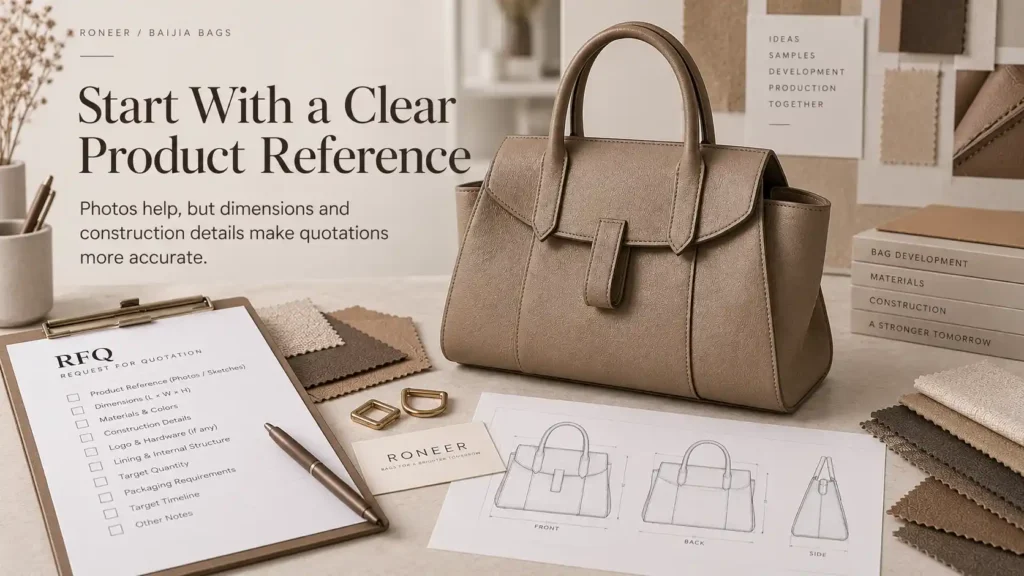
The supplier should first understand what product is being quoted.
Useful references may include:
- Front photo
- Back photo
- Side photo
- Interior photo
- Bottom view
- Technical drawing
- Existing physical sample
- Sketch
- CAD rendering
- Tech pack
For original designs, a technical drawing or marked reference can reduce interpretation.
If only a photograph is available, clearly state which details the factory should follow and which details can be adjusted.
Zum Beispiel:
Follow the overall silhouette, but the front hardware should use our own design.
or:
Use the reference only for approximate structure. Material, logo, and interior layout will be customized.
This distinction matters.
A supplier may otherwise calculate details that the buyer never intended to reproduce.
Your custom bag quotation checklist should therefore begin with a product reference plus a short written explanation of what the reference actually represents.
2. Define Finished Size and Important Structure
Dimensions directly affect material consumption, pattern development, packaging, and sometimes shipping volume.
At minimum, provide:
- Width
- Height
- Depth
For more structured products, also consider:
- Bottom width
- Gusset depth
- Top opening
- Handle drop
- Länge des Gurtes
- Pocket size
- Laptop compartment
- Divider position
- Zipper opening
A quotation based on a 26 cm handbag should not be compared directly with one calculated for a 32 cm version.
Structure also matters.
State whether the bag needs:
- Soft body
- Structured body
- Bottom reinforcement
- Side reinforcement
- Padding
- Rohrleitungen
- Einband
- Internal dividers
- Multiple compartments
Die custom bag quotation checklist should make it clear whether the dimensions are already confirmed or still approximate.
If dimensions are still flexible, tell the supplier.
That allows the factory to quote based on a realistic development assumption instead of treating an early estimate as a locked specification.
3. Describe the Material More Precisely Than “PU” or “Nylon”
Material category alone is rarely enough.
Words such as:
- PU-Leder
- Echtes Leder
- Nylon
- Polyester
- Segeltuch
- Oxford-Gewebe
- Mikrofaser
- Mesh
cover many different specifications.
Where relevant, provide information about:
- Dicke
- Gewicht
- Grain
- Surface texture
- Rückseite
- Beschichtung
- Softness or stiffness
- Farbe
- Fertigstellen
- Intended product positioning
If you do not know the exact specification, explain the desired result.
Zum Beispiel:
Medium-structured PU for a fashion handbag.
or:
Lightweight nylon for a foldable travel bag.
This gives the supplier more useful direction than a generic material name.
Ein praktischer custom bag quotation checklist should also distinguish between:
- Confirmed production material
- Preferred material direction
- Material still open for supplier recommendation
If the supplier recommends an alternative, ask that the quotation identify the material assumption clearly.
That will make later comparison easier.
4. State Quantity by Style and Color
Quantity needs to be defined as a purchasing structure, not just a total number.
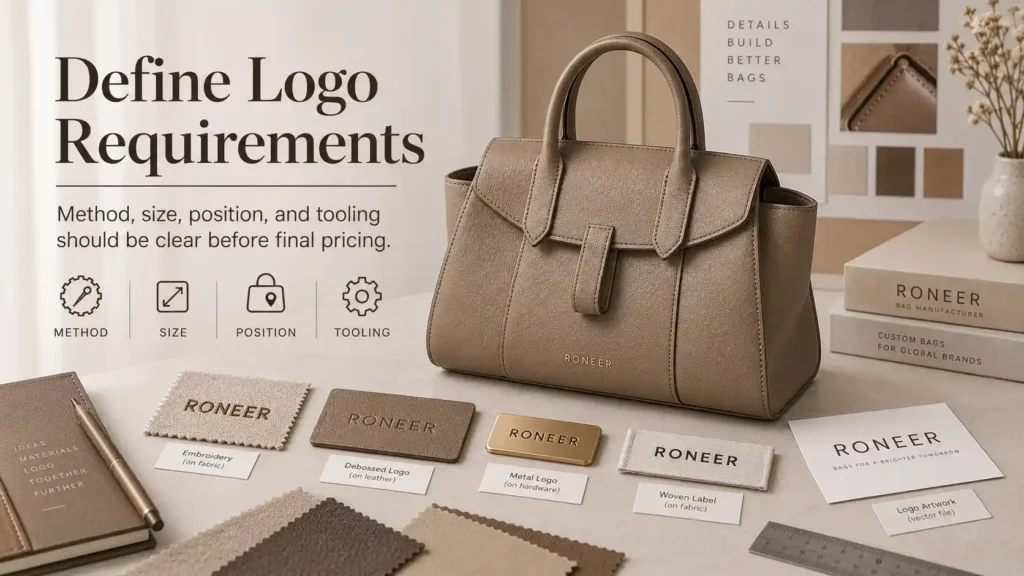
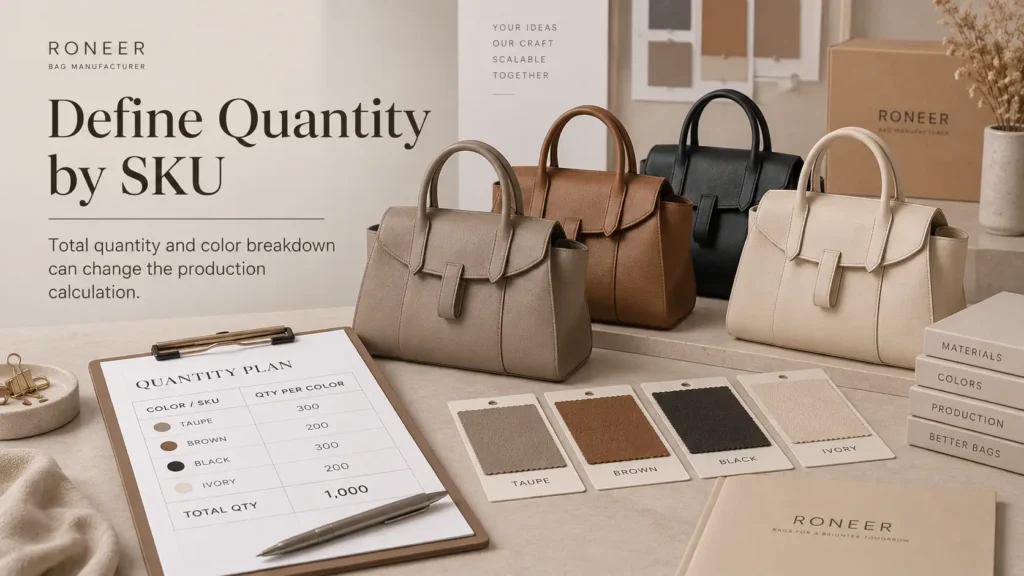
An inquiry for:
1,000 pcs
may mean:
- 1,000 pcs in one color
- 500 pcs × 2 colors
- 250 pcs × 4 colors
- Several styles sharing the total quantity
These are not necessarily equivalent production situations.
Material purchasing, hardware ordering, printing setup, cutting organization, and production planning can all be affected by SKU breakdown.
Your custom bag quotation checklist should state:
- Total quantity
- Quantity per style
- Quantity per color
- Number of SKUs
- Whether multiple logos are involved
If your final quantity is not confirmed, ask for price tiers.
Zum Beispiel:
- 300 Stück
- 500 pcs
- 1,000 pcs
This can be more useful than asking only:
What is your MOQ?
It allows the buyer to understand how production economics may change with order size.
5. Define the Logo Before Asking for a Final Quote
A logo request should describe the branding method, size, position, and number of applications.
“Add our logo” can mean many different things.
Common options include:
- Siebdruck
- Wärmeübertragung
- Stickerei
- Gewebtes Etikett
- Gummipflaster
- Embossing
- Debossing
- Heißprägung
- Logo-Plakette aus Metall
- Individuell gestalteter Reißverschlusszieher
- Futter mit Markenlogo
RONEER’s Logo-Anpassung options include multiple branding methods for bags and private-label projects.
For quotation purposes, provide:
- Logo artwork
- Preferred logo method
- Approximate size
- Position
- Number of locations
- Farbe
- Whether a mold is required
- Whether branding is also needed on packaging
Vector artwork can be particularly useful when a supplier needs to assess a custom metal logo, embossing die, printing setup, or other branded component.
Die custom bag quotation checklist should also identify whether logo tooling or setup is expected to be quoted separately.
This prevents a supplier from appearing more expensive simply because it included tooling that another quotation omitted.
6. Specify Zippers, Hardware, and Closures
Hardware can create surprisingly large differences between quotations.
Common components include:
- Zippers
- Pullers
- D-Ringe
- Schnallen
- Häkchen
- Magnetische Druckknöpfe
- Schlösser drehen
- Ketten
- Nieten
- Metal feet
- Logo-Schilder
For each important component, define what you know.
That may include:
- Typ
- Approximate dimensions
- Fertigstellen
- Farbe
- Logo requirement
- Standard or custom design
If hardware is not finalized, state whether the supplier may use an available equivalent for quotation purposes.
That gives the supplier permission to make a controlled assumption.
Zum Beispiel:
Quote with available gold-tone hardware first. Custom logo hardware to be quoted separately.
This is much clearer than leaving the supplier to decide whether a custom mold is already required.
A detailed custom bag quotation checklist does not need engineering drawings for every buckle, but it should make the cost-sensitive hardware decisions visible.
7. Define Packaging Before Comparing Unit Prices
Packaging should be specified before the supplier calculates the final commercial offer.
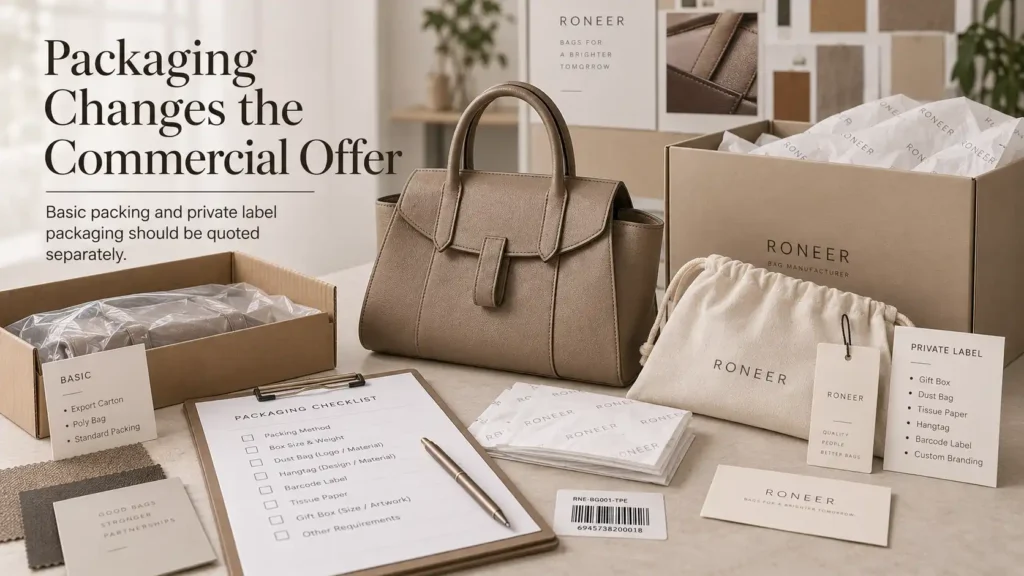
A “standard packing” quotation may include only:
- Tissue
- Polybag
- Export carton
A private-label quotation may include:
- Staubbeutel
- Anhängeetikett
- Pflegekarte
- Barcode-Etikett
- Branded polybag
- Tissue
- Geschenkbox
- Retail box
- Custom carton marks
RONEER’s Verpackungsanpassung process covers packaging type, size, logo, labels, barcode requirements, product protection, and shipping carton details according to project needs.
Your custom bag quotation checklist should identify:
- Unit packaging
- Retail packaging
- Branding requirement
- Barcode requirement
- Anhängeetikett
- Inner protection
- Export carton requirement
Packaging affects more than presentation.
It can also affect shipping volume.
FedEx explains in its official dimensional weight guide that parcel charges can be based on dimensional weight or actual weight, depending on which is greater.
That is especially relevant for structured bags that need larger cartons or additional shape protection.
8. Ask What Sample and Setup Costs Are Separate
The bulk unit price is only one part of the early commercial picture.
Depending on the project, suppliers may separately quote:
- Sample fee
- Pattern fee
- Logo setup
- Printing plate
- Embroidery setup
- Hardware mold
- Logo mold
- Packaging sample
- Courier charge
Some suppliers bundle certain setup costs.
Others separate them.
Neither format is automatically better.
The important point is transparency.
A useful custom bag quotation checklist should ask:
Which development, tooling, and sample costs are not included in the bulk unit price?
This becomes particularly important when the project contains custom metal hardware, complex structures, branded packaging, or several sample rounds.
If the buyer compares only unit price, one supplier may appear cheaper simply because more costs are listed separately.
9. Include Quality, Schedule, and Approval Requirements
A quotation should reflect the product the buyer actually expects to receive.
That includes quality expectations.
Where relevant, define important points such as:
- Critical measurements
- Position des Logos
- Farbkonsistenz
- Stitching appearance
- Hardware function
- Zipper operation
- Interior construction
- Verpackungsgenauigkeit
- Approved sample requirement
Do not write only:
High quality required.
That phrase cannot be priced or inspected precisely.
Use measurable or reviewable requirements where possible.
Schedule matters too.
State:
- Requested sample date
- Target order confirmation date
- Required production completion
- Required delivery date
If the project is linked to a retail launch, promotion, exhibition, gift event, or seasonal collection, explain that timing before the supplier confirms feasibility.
A custom bag quotation checklist should help the supplier understand both the product and the commercial deadline.
10. State Destination and Requested Trade Term
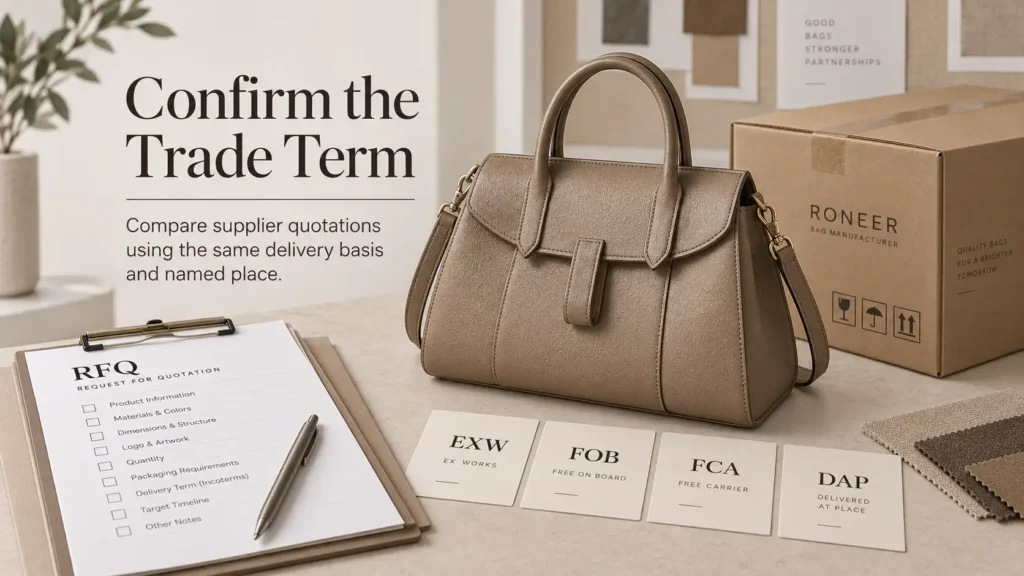
The final RFQ should also state the requested trade term and named place.
Zum Beispiel:
- EXW Jiangmen
- FOB Shenzhen
- FCA agreed location
- DAP buyer destination
Do not compare quotations using different delivery bases without adjusting the scope.
The International Chamber of Commerce explains that Incoterms® rules clarify the tasks, costs, and risks allocated between sellers and buyers in goods transactions.
ICC currently identifies Incoterms® 2020 as the latest version of the rules.
Your RFQ should therefore identify:
- Destination country
- Destination port or location where relevant
- Requested Incoterm
- Named place
- Whether freight should be quoted separately
This is a critical part of a custom bag quotation checklist because otherwise the buyer may compare an EXW product price with another supplier’s quotation that includes export handling or additional transportation responsibilities.
Quick Custom Bag Quotation Checklist
Before sending your inquiry, confirm the following:
| RFQ Item | Information to Provide |
|---|---|
| Product reference | Photos, drawing, sample, sketch, or tech pack |
| Bag type | Handbag, backpack, tote, cosmetic bag, travel bag, etc. |
| Finished size | Width × height × depth |
| Struktur | Compartments, pockets, padding, reinforcement |
| Main material | Type, thickness/weight, color, texture |
| Auskleidung | Material and color |
| Anzahl | Total and per color/style |
| Logo | Method, size, position, artwork |
| Hardware | Type, finish, standard/custom |
| Verpackung | Polybag, dust bag, hangtag, box, barcode, carton |
| Sample | Required sample and tooling scope |
| Quality | Critical specifications and approval requirements |
| Schedule | Sample, production, and delivery targets |
| Destination | Country, port, or delivery location |
| Trade term | EXW, FCA, FOB, DAP, or other agreed basis |
A custom bag quotation checklist like this can be used as the cover page of an RFQ even when a complete tech pack is not yet available.
What Should a Supplier Return in the Quotation?
A useful supplier response should make its assumptions visible.
Depending on the project, the quotation may identify:
- Product description
- Quoted quantity
- Unit price
- Material
- Logo-Methode
- Hardware assumption
- Verpackung
- Beispielkosten
- Tooling cost
- MOQ
- Trade term
- Price validity
- Production notes
- Payment terms
- Excluded items
The goal is not to force every manufacturer into one quotation template.
The goal is to make sure the buyer can identify what the number represents.
If a supplier gives a final price without clarifying major missing product details, ask what assumptions were used.
How to Send the Same RFQ to Multiple Suppliers
Use one controlled RFQ version.
Send the same:
- Product drawing
- Abmessungen
- Material requirement
- Anzahl
- Logo file
- Packaging requirement
- Quality expectation
- Trade term
to every shortlisted supplier.
If one specification changes, issue the revised information to all suppliers.
Do not compare:
Supplier A — Revision 1
with:
Supplier B — Revision 3
That turns a quotation comparison into a specification comparison.
A disciplined custom bag quotation checklist helps keep the commercial basis synchronized.
What If You Do Not Have a Full Tech Pack?
You can still request a preliminary quotation.
Send the best information available.
Zum Beispiel:
- Clear reference photos
- Approximate dimensions
- Intended material
- Anzahl
- Logo requirement
- Zielmarkt
- Packaging direction
Then clearly identify what remains open.
You might write:
Final material still open. Please quote one suitable mid-range PU option.
or:
Structure should follow the attached reference. Interior pocket layout is still under development.
This gives the supplier permission to quote an assumption without pretending that assumption has already been approved.
Die custom bag quotation checklist becomes especially useful in this situation because it separates confirmed information from open development decisions.
What Not to Put in an RFQ
Avoid vague requirements such as:
- Best quality
- Cheapest price
- Premium material
- Normal hardware
- Standard packaging
- Same as photo
- Good zipper
- Fast delivery
These phrases create interpretation.
Replace them with specifications or context.
Instead of:
Premium material.
Use:
Medium-structured PU suitable for a fashion handbag; please suggest available options.
Instead of:
Fast delivery.
Use:
Target delivery to Germany by March 15; please confirm whether the schedule is feasible.
Better information produces a more useful quotation.
FAQ About Custom Bag Quotation Checklist
1. What is a custom bag quotation checklist?
A custom bag quotation checklist is a list of product and commercial information buyers prepare before asking a bag manufacturer for pricing.
It normally covers product reference, size, material, quantity, logo, hardware, packaging, sample requirements, schedule, destination, and trade terms.
2. Can I request a bag quotation with only a photo?
Yes, but the first price may be only a rough estimate.
A photograph usually does not define material grade, lining, reinforcement, hardware, interior structure, packaging, or other important cost variables.
3. What information affects a custom bag quotation the most?
Important variables commonly include material, finished dimensions, construction, quantity, logo method, hardware, packaging, and delivery basis.
The relative impact depends on the specific bag design.
4. Should quantity be included in a custom bag quotation checklist?
Yes.
A custom bag quotation checklist should state total quantity and, where possible, quantity by color and style.
SKU breakdown can affect material purchasing and production planning.
5. Do I need to provide exact material specifications?
Not always.
If the exact material is not confirmed, give the supplier a clear target direction such as material category, stiffness, texture, color, product positioning, and intended use.
Ask the supplier to identify which material assumption is used in the quote.
6. What logo information should I send for quotation?
Provide artwork, preferred application method, approximate size, position, number of logo locations, and whether custom tooling may be required.
If you are unsure about the logo method, ask the supplier to quote suitable alternatives.
7. Should packaging be included in the RFQ?
Yes.
Basic export packing and branded retail packaging can have different material, printing, labor, and shipping-volume implications.
Include the required packaging level in the custom bag quotation checklist.
8. Should I ask suppliers for EXW or FOB pricing?
Use the trade term that fits your purchasing and logistics arrangement.
More importantly, ask shortlisted suppliers to quote on the same basis so the prices remain comparable.
9. Do sample fees need to be included in quotation comparison?
Yes.
Check whether sample development, patterns, logo setup, molds, packaging samples, revisions, and courier charges are included or listed separately.
10. What if my design changes after receiving the quotation?
Send the revised specification back to the supplier and request confirmation or updated pricing.
Do not assume the original price still applies after material, dimensions, hardware, branding, or packaging changes.
11. How can I make quotations from different suppliers easier to compare?
Send the same RFQ version to each factory.
Use one custom bag quotation checklist and ask each supplier to identify assumptions, included items, excluded items, trade terms, and separate setup costs.
12. How can RONEER support the quotation process?
RONEER can review OEM/ODM bag project requirements, including product type, dimensions, materials, logo methods, hardware, packaging, sampling, quality requirements, and quantit,y before preparing a quotation according to the confirmed project scope.
The exact price depends on the product specification and commercial requirements provided for the project.
Schlussfolgerung
A custom bag quotation checklist is not paperwork for the sake of paperwork.
It is a practical way to reduce the assumptions hidden inside a supplier’s price.
Before requesting quotations, buyers should define the product reference, dimensions, structure, material direction, quantity by SKU, logo, hardware, packaging, sample requirements, quality expectations, schedule, destination, and tradtermsrm.
Not every project needs a complete technical file before the first conversation.
But every supplier should understand which details are confirmed and which are still assumptions.
For RONEER OEM/ODM projects, quotation preparation can connect requirement review with material selection, branding, structural development, packaging, sampling, quality review, and production planning according to the buyer’s confirmed specifications.
A well-prepared custom bag quotation checklist therefore does more than help a factory calculate a number. It gives the buyer a stronger basis for comparing suppliers, planning sampling, controlling revisions, and moving toward a production-ready commercial decision.
Send the Same Quotation Brief to Every Supplier
Comparable pricing requires one consistent specification, including dimensions, material, construction, hardware, lining, logo, quantity, packaging and delivery terms. Review available customization options and the sample approval checklist.