 Deutsch
  English
  Español
  Français
  Italiano
  Русский
  日本語
日本語  العربية
  Türkçe
  한국어
한국어 Understanding custom bag sample cost is an important step before starting any OEM/ODM bag project. For brands, wholesalers, retailers, e-commerce sellers, promotional product buyers, and private label startups, a sample is not just a small trial product. It is the first real test of material, structure, logo placement, workmanship, size, function, packaging, and production feasibility.
Many buyers ask, “Why is the sample more expensive than the bulk unit price?” This is a normal question. A sample often requires pattern making, material sourcing, hand cutting, logo testing, sewing adjustment, communication time, and sometimes multiple revisions. Unlike bulk production, sample development does not benefit from large-scale efficiency. That is why custom bag sample cost is usually higher than the final mass production unit price.
However, a well-made sample can reduce serious risks. It helps buyers check the product before bulk production, avoid costly mistakes, confirm the final design, and improve order accuracy. RONEER supports OEM/ODM buyers with fast sampling, low MOQ options, custom logo solutions, material customization, private label packaging, strict QC, export packing, and global shipping coordination. Buyers can also review RONEER’s overall capabilities through RONEER – Maßgeschneiderte Taschenanfertigung.
This guide explains what affects custom bag sample cost, why sample fees vary, how to reduce unnecessary cost, and how to use sampling as a smart sourcing step instead of seeing it only as an expense.
What Is Custom Bag Sample Cost?
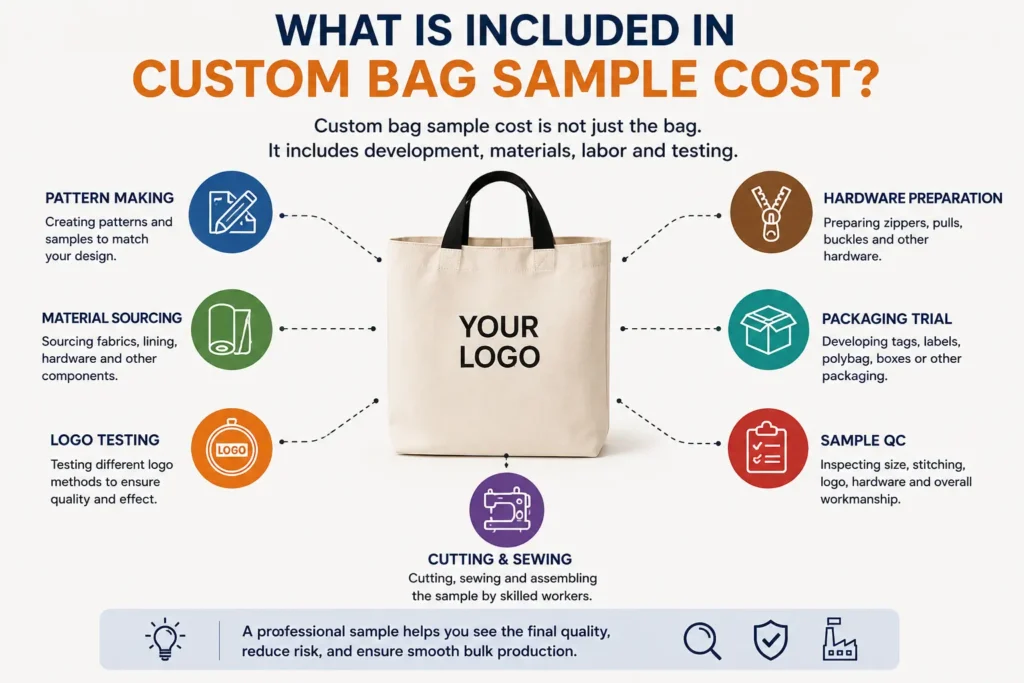
Custom bag sample cost is the fee charged by a manufacturer to develop a physical sample before bulk production. The sample may be based on a buyer’s design file, reference photo, original sample, tech pack, material requirement, logo file, or packaging instruction.
A sample cost can include:
- Pattern making
- Materialbeschaffung
- Cutting and sewing
- Logo-Test
- Hardware preparation
- Lining preparation
- Packaging trial
- Arbeitskosten
- Sample room cost
- Revision work
- Courier shipping if required
For a simple tote bag, the sample cost may be relatively low because the structure is simple and materials are easy to prepare. For a structured handbag, backpack, cooler bag, travel bag, laptop bag, or outdoor bag, the sample cost may be higher because the construction is more complex.
A professional factory should explain what is included in the custom bag sample cost and whether the sample fee can be refunded, deducted, or credited after bulk order confirmation.
Why Bag Samples Cost More Than Bulk Unit Prices
Many buyers compare the sample price with the bulk unit price and feel the sample is expensive. In custom manufacturing, this difference is normal.
Bulk production spreads setup costs across many pieces. Workers follow a repeated process, materials are prepared in larger quantities, and production lines become more efficient. A sample, however, is usually made one by one by sample makers. The factory must test the pattern, prepare small quantities of materials, adjust details, and sometimes remake parts manually.
For example, if a buyer wants a custom backpack with a woven label, special lining, laptop compartment, custom zipper puller, and branded packaging, the factory may need to prepare many components for only one or two samples. This makes the custom bag sample cost higher than the later bulk unit price.
A good sample is still worth the investment because it helps confirm:
- Size and proportion
- Material feeling
- Color matching
- Position des Logos
- Stitching quality
- Zipper and hardware function
- Inner structure
- Verpackungsart
- Product feasibility
- Buyer approval before mass production
Skipping a sample may save a small cost at the beginning, but it can create much larger problems during bulk production.
Main Factors That Affect Custom Bag Sample Cost
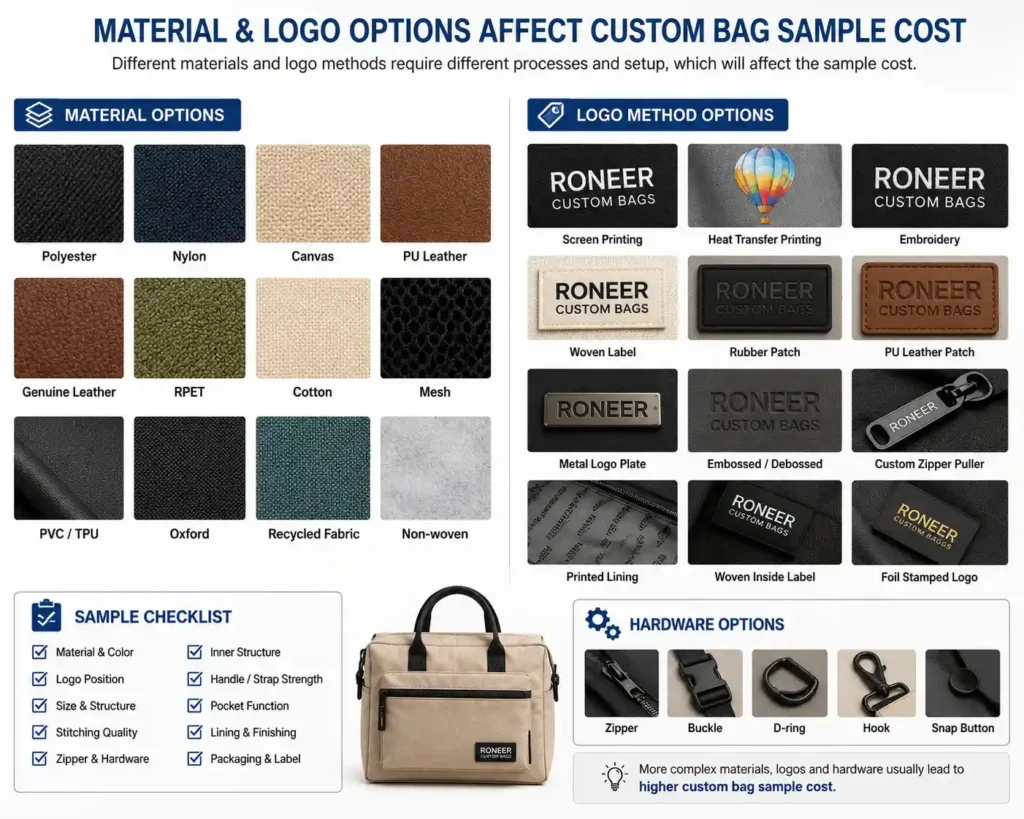
Die custom bag sample cost depends on the bag type, design complexity, material choice, logo method, hardware, packaging, and number of revisions. Buyers who understand these factors can control the sample budget more effectively.
1. Bag Type
Different bag types require different sample work. A simple cotton tote bag is easier to sample than a structured handbag, laptop backpack, cooler bag, or travel duffel bag. More complex bags require more pattern pieces, sewing steps, reinforcement areas, and functional testing.
Common sample complexity levels include:
- Simple tote bags
- Kordelzugbeutel
- Kosmetiktaschen
- Kulturbeutel
- Beutel
- Geldbörsen
- Rucksäcke
- Handtaschen
- Reisetaschen
- Cooler bags
- Outdoor-Taschen
The more structured and functional the product is, the more likely the custom bag sample cost will increase.
2. Material Selection
Material choice has a major impact on sampling. Available materials are easier and faster to use. Special materials may require extra sourcing time, higher minimum purchase, or supplier sample fees.
Common bag materials include polyester, nylon, canvas, cotton, PU leather, microfiber, genuine leather, RPET, mesh, PVC, TPU, and recycled fabrics. Buyers can review RONEER’s Anpassung des Materials options to understand how different materials affect sample development, cost, and production feasibility.
For recycled or preferred materials, buyers may refer to Textile Exchange for general industry background. However, actual material claims should always be confirmed with supplier documents before being used in marketing or product labels.
3. Logo Method
Logo testing can affect custom bag sample cost because different logo techniques require different setup processes. Simple printing may be easier, while metal logos, rubber patches, embroidery, embossing, debossing, or custom zipper pullers may require more preparation.
Zu den gängigen Methoden zur Logogestaltung gehören:
- Siebdruck
- Thermotransferdruck
- Stickerei
- Gewebtes Etikett
- Gummipflaster
- PU leather patch
- Logo-Plakette aus Metall
- Geprägtes Logo
- Geprägtes Logo
- Foil-stamped logo
- Individuell gestalteter Reißverschlusszieher
- Custom lining logo
Buyers can review Anpassung des Logos before confirming the final logo method. The right logo choice should match the material, target market, sample budget, and expected bulk order quantity.
4. Hardware and Components
Hardware can include zippers, sliders, buckles, hooks, D-rings, rivets, magnetic snaps, pullers, locks, and metal logo plates. Standard hardware usually keeps the sample cost lower. Custom hardware may require mold cost, plating setup, or supplier minimums.
Industry suppliers such as YKK can be used as a general reference for zipper and fastening component categories, but the actual zipper brand and specification should be confirmed during order negotiation. RONEER does not assume premium components unless the buyer requests and approves them.
5. Pattern Making
Pattern making is one of the core parts of sample development. If the buyer provides a complete tech pack with accurate measurements, the process may be smoother. If the buyer only provides a reference image, the factory may need more time to estimate proportions, create patterns, and adjust construction.
A structured handbag, backpack, or travel bag may require more pattern pieces than a simple tote bag. More pattern work usually increases the custom bag sample cost.
6. Inner Structure
Inner structure can include lining, zipper pockets, mesh pockets, laptop sleeves, card slots, bottle holders, elastic loops, dividers, padding, and reinforcement panels. These details improve product function but also require additional sample time.
For first samples, buyers should focus on the most important structure details and avoid adding too many untested features at once.
7. Packaging Trial
If the buyer needs private label packaging, the sample may include hang tags, insert cards, barcode labels, dust bags, paper sleeves, gift boxes, or custom polybags. Packaging can increase the sample cost, especially when suppliers need small-batch setup.
RONEERs Individuelle Gestaltung der Verpackung service can help buyers compare simple packaging and premium packaging before final order confirmation.
8. Sample Quantity
Some buyers need one sample for approval. Others may need several samples for internal review, buyer presentation, photography, sales meetings, or testing. More sample pieces naturally increase the total custom bag sample cost.
9. Number of Revisions
Revisions can include size adjustment, material change, logo position change, pocket modification, color correction, hardware replacement, or packaging update. Each revision may require additional labor and material.
To reduce revision cost, buyers should provide clear information before sampling, including reference photos, dimensions, logo file, target price, material preference, and expected order quantity.
What Is Usually Included in a Bag Sample Fee?
A sample fee is not only the cost of fabric and sewing. It usually covers the factory’s development work and sample room resources.
A typical custom bag sample cost may include pattern development, material preparation, labor, logo setup, hardware preparation, sewing, finishing, inspection, and sample packing. If the sample requires special material sourcing, custom hardware, printed lining, or premium packaging, these may be charged separately.
Some factories may refund or deduct the sample fee after the buyer confirms a bulk order. Other factories may not refund sample fees because sample development requires real labor and material cost. Buyers should confirm this policy clearly before starting the project.
A professional factory should explain:
- Whether the sample fee is refundable
- Whether it can be deducted from bulk orders
- Whether courier cost is included
- Whether logo setup is included
- Whether revisions are included
- Whether packaging samples are included
- How long sampling will take
- What information is needed before sampling
Clear communication helps avoid misunderstandings.
How to Reduce Custom Bag Sample Cost
Buyers can reduce custom bag sample cost without weakening product quality by planning the first sample carefully. The goal is not to make the cheapest possible sample, but to avoid unnecessary development waste.
Use Available Materials First
Available materials reduce sourcing time and cost. Buyers can still create a strong brand look through color selection, logo placement, structure, and packaging. If the market test is successful, special materials can be developed later.
Provide Clear Specifications
The more complete the information, the more accurate the sample will be. Buyers should provide size, material preference, logo file, color reference, reference photo, product use case, target price, and expected order quantity.
Confirm the Logo Method Early
Changing the logo method after the first sample can increase cost and delay the project. Buyers should compare printing, embroidery, woven labels, rubber patches, PU patches, and metal logos before sampling.
Start With a Production-Friendly Structure
A simple and functional first sample is better than an overly complex prototype. Buyers can add more details after confirming the product direction.
Limit Sample Revisions
Too many revisions increase time and cost. A clear review checklist can help buyers give organized feedback instead of making small changes one by one.
Avoid Custom Hardware at the First Stage
Custom hardware can improve brand identity, but it may be expensive for the first sample. Standard hardware with a good logo solution is often more practical for early development.
Keep Packaging Simple at First
A branded hang tag, barcode label, or simple insert card may be enough for the first sample. Gift boxes and premium packaging can be developed after the product structure is approved.
Buyers who also want to control later production minimums can review RONEER’s guide on Kostenplanung für die Mindestbestellmenge bei maßgefertigten Rucksäcken. Many cost-control principles apply to handbags, tote bags, travel bags, cosmetic bags, and other custom bag categories.
Sample Cost vs Bulk Production Cost
A common sourcing mistake is expecting the sample price to match the bulk price. The sample cost and bulk production cost are calculated differently.
Sample cost is based on individual development work. Bulk production cost is based on repeated production efficiency.
For example, one custom bag sample may require several hours of pattern making, cutting, sewing, logo testing, inspection, and communication. In bulk production, these steps are repeated across hundreds or thousands of pieces, reducing the cost per unit.
A responsible factory should provide both the custom bag sample cost and an estimated bulk production price range. However, the final bulk price may change after the sample is approved because the final material, structure, logo method, packaging, and quantity will affect the cost.
Buyers should treat the sample as a development investment. A good sample helps avoid poor bulk production, incorrect materials, wrong dimensions, weak stitching, or inaccurate branding.
How Sampling Helps Control Bulk Order Risk
A sample is a risk-control tool. It gives the buyer and factory a physical reference before mass production.
A finished sample helps confirm:
- Whether the product size is correct
- Whether the material matches the brand level
- Whether the structure works in real use
- Whether the logo is clear and correctly placed
- Whether the zipper and hardware work smoothly
- Whether stitching and reinforcement are strong enough
- Whether packaging meets the sales channel requirement
- Whether the product is suitable for bulk production
For e-commerce sellers, a sample can also be used for photography, listing preparation, video content, internal review, and customer testing. For wholesalers and retailers, the sample can support buyer presentations and sales meetings.
For private label brands, sampling confirms whether the product truly reflects the brand before committing to larger investment.
This is why custom bag sample cost should be judged by the value it creates, not only by the price itself.
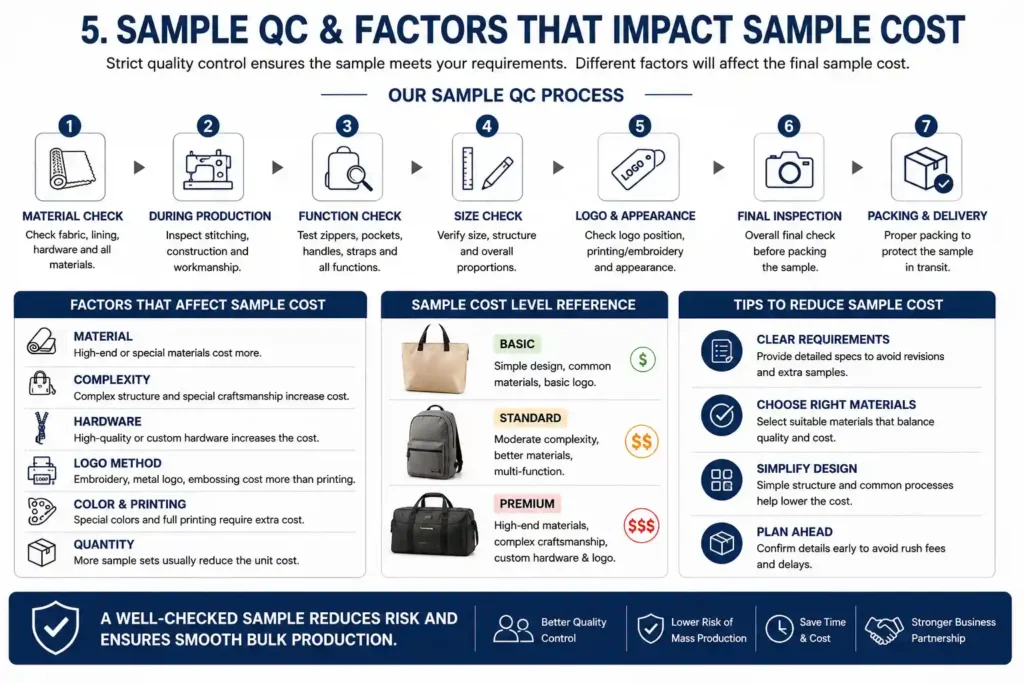
OEM vs ODM Sample Cost
OEM and ODM projects may have different sample cost structures.
OEM sampling is usually based on the buyer’s existing design. If the buyer provides a detailed tech pack, material specification, logo file, and packaging instruction, the factory can follow the requirements more directly. However, if the design is complex or uses special components, the sample cost may still be high.
ODM sampling may start from the factory’s existing structure or design direction. This can sometimes reduce sample time because the factory already understands the pattern, material, and production method. Buyers can customize the material, color, logo, lining, and packaging based on an existing design direction.
For new buyers, ODM may reduce development risk. For established brands, OEM may be better because it gives stronger control over product identity. Buyers can also review this guide on OEM and ODM bag development to understand how the two models affect sampling, MOQ, and production planning.
RONEER supports both OEM and ODM sample development, helping buyers choose the right approach based on budget, timeline, design readiness, and target market.
Sample Lead Time and Its Relationship With Cost
Sample lead time is closely related to custom bag sample cost. A simple bag using available materials can usually be sampled faster. A complex bag with special materials, custom logo hardware, printed lining, or private label packaging may take longer.
Several factors affect sample lead time:
- Verfügbarkeit von Material
- Pattern complexity
- Logo-Methode
- Hardware preparation
- Sample room schedule
- Revision requirements
- Packaging trial
- Buyer feedback speed
If a buyer needs an urgent sample, the factory may need to prioritize sample room resources, which can affect the cost. To avoid unnecessary rush fees, buyers should plan sampling early, especially before seasonal launches, trade shows, crowdfunding campaigns, or retail presentations.
RONEER supports fast sampling for qualified custom bag projects while keeping the sample practical for later bulk production.
Quality Control During Sample Development
Quality control should begin during sampling, not only during bulk production. A sample should be checked carefully before approval.
Important sample QC points include:
- Material color and texture
- Size measurement
- Logo position and clarity
- Stitching quality
- Kantenbearbeitung
- Laufruhe des Reißverschlusses
- Hardware function
- Lining cleanliness
- Pocket function
- Reinforcement points
- Verpackungsgenauigkeit
- Overall appearance
Informationen zum Hintergrund von Inspektionen und Prüfungen finden Käufer unter SGS. For material safety and harmful substance testing background, OEKO-TEX can also be used as an industry reference. Buyers should confirm any specific testing, compliance, or certification requirement before placing the order.
A professional manufacturer should not treat the sample as only a visual mockup. The sample should help confirm whether the product can be produced consistently in bulk.
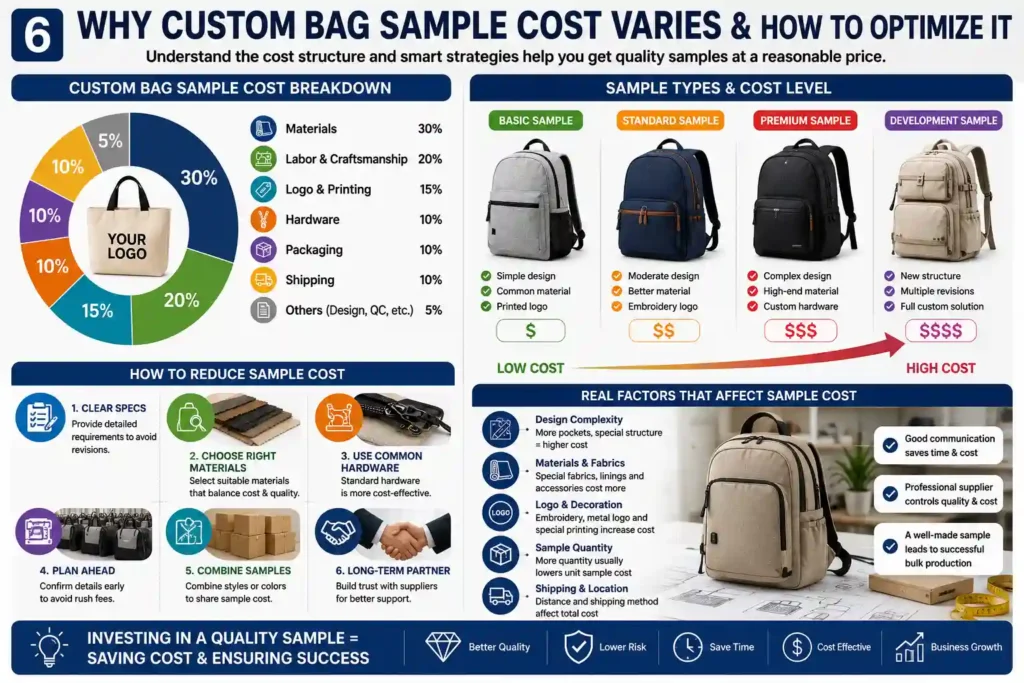
Common Mistakes Buyers Make With Bag Sample Costs
Many sampling problems come from unclear planning, incomplete information, or unrealistic expectations. Buyers can avoid unnecessary cost by understanding common mistakes.
Comparing Sample Cost Directly With Bulk Price
Sample making is individual development work. Bulk production has repeated efficiency. These two prices should not be compared as the same cost model.
Sending Only One Reference Photo
A single photo may not show size, side view, inner structure, material, lining, or function. Buyers should provide as much detail as possible.
Changing Materials Too Late
Material changes after the first sample can require new cutting, new sewing, and new logo testing. This increases sample cost and lead time.
Testing Too Many Logo Methods
Logo testing is useful, but too many methods can increase cost. Buyers should shortlist the most suitable options before sampling.
Ignoring Packaging During Sampling
If packaging is important for retail or e-commerce, it should be discussed early. Adding packaging after the product sample is approved can create delays.
Approving a Sample Without Checking Function
A bag sample should not only look good. Buyers should check capacity, comfort, zipper function, pocket usability, handle strength, and overall practicality.
Not Confirming Sample Fee Policy
Buyers should ask whether the sample fee is refundable, deductible, or separate from bulk order cost before starting.
How to Work With a Manufacturer on Custom Bag Samples
To make sample development smoother, buyers should prepare complete information before contacting the factory.
Useful information includes:
- Bag type
- Reference photos
- Size requirements
- Material preference
- Color reference
- Logo file
- Logo method preference
- Lining requirement
- Hardware requirement
- Packaging requirement
- Expected order quantity
- Target price range
- Target delivery time
- Sales channel
- Product use case
A professional factory can use this information to estimate custom bag sample cost, sample lead time, MOQ, and bulk production feasibility more accurately.
RONEER helps buyers review product ideas, confirm material options, select logo methods, prepare samples, check quality, and plan bulk production. This makes sampling more efficient and helps reduce misunderstandings before mass production.
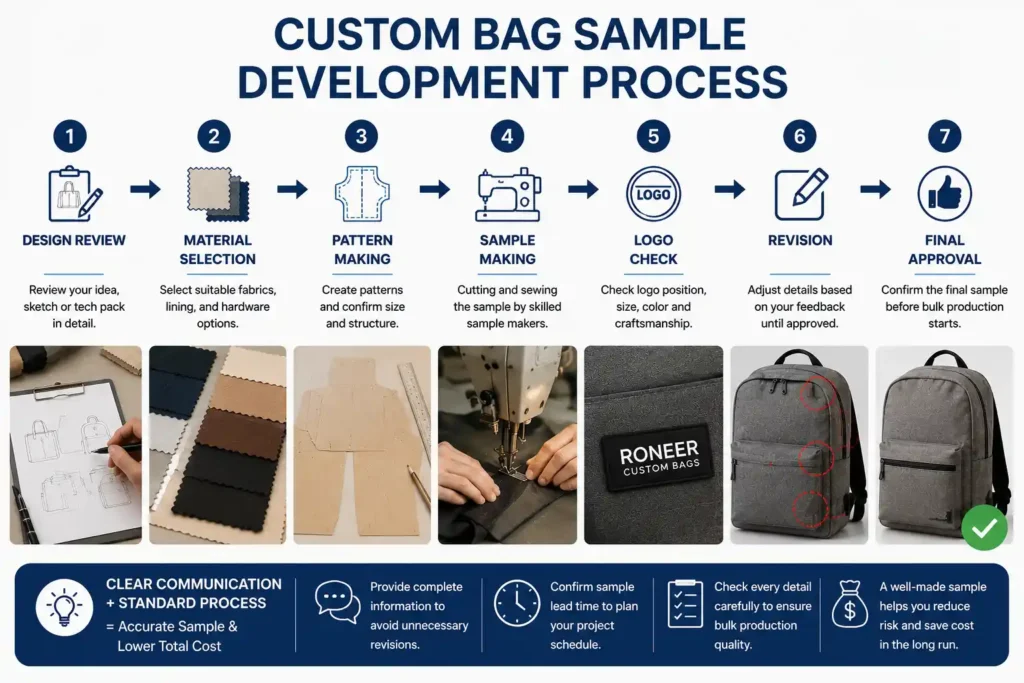
FAQ About Custom Bag Sample Cost
1. What is custom bag sample cost?
Custom bag sample cost is the fee a factory charges to develop a physical sample before bulk production. It usually includes pattern making, material preparation, cutting, sewing, logo testing, hardware preparation, sample inspection, and sample packing. For OEM/ODM buyers, understanding custom bag sample cost helps plan the project budget before moving into bulk production.
2. Why is custom bag sample cost higher than the bulk unit price?
Custom bag sample cost is usually higher than the bulk unit price because a sample is made individually. The factory needs to spend time on pattern development, small-quantity material preparation, logo testing, sewing adjustment, and sample room labor. Bulk production spreads these setup costs across many pieces, while sample development concentrates them into one or a few samples.
3. Can the custom bag sample cost be refunded after bulk order confirmation?
Some factories may refund, deduct, or credit the custom bag sample cost after the buyer confirms a bulk order, while others may not. It depends on the design complexity, material usage, logo setup, and factory policy. Buyers should confirm whether the sample fee is refundable or deductible before starting the custom bag sample process.
4. What affects custom bag sample cost the most?
The main factors affecting custom bag sample cost include bag type, material selection, logo method, pattern complexity, hardware, lining structure, packaging trial, sample quantity, and revision requirements. A simple tote bag usually has a lower sample cost than a structured backpack, handbag, cooler bag, or travel bag.
5. How can I reduce custom bag sample cost?
Buyers can reduce custom bag sample cost by using available materials, providing clear specifications, choosing practical logo methods, limiting sample revisions, avoiding custom hardware at the first stage, and keeping packaging simple before final approval. The goal is not to make the cheapest sample, but to avoid unnecessary development waste.
6. Do I need to pay custom bag sample cost before bulk production?
Yes, most custom bag projects require a sample fee before bulk production. Paying custom bag sample cost allows the factory to prepare materials, develop the pattern, test the logo, sew the sample, and check whether the design is suitable for mass production. A good sample can prevent costly mistakes in bulk orders.
7. How long does it take to make a custom bag sample?
Sample lead time depends on material availability, bag complexity, logo method, hardware preparation, packaging requirement, and revision needs. A simple bag using available materials can usually be sampled faster, while a complex bag with special materials or custom components may need more time. The custom bag sample cost may also increase if urgent sampling or special sourcing is required.
8. Is a custom logo included in the custom bag sample cost?
It depends on the project. Some basic logo methods may be included in the custom bag sample cost, while special logo techniques such as embroidery, rubber patches, metal logo plates, embossing, debossing, or custom zipper pullers may require additional setup cost. Buyers should confirm the logo method before sample development.
9. Can RONEER make samples from only a reference photo?
Yes. Buyers can send reference photos, target size, material preference, logo file, expected order quantity, and target price. RONEER can review the design and estimate the custom bag sample cost based on structure, material, logo, hardware, and packaging needs. However, more complete information usually helps reduce sample revisions and improve accuracy.
10. Does packaging affect custom bag sample cost?
Yes. Packaging can affect custom bag sample cost, especially when buyers need custom boxes, dust bags, insert cards, hang tags, barcode labels, printed polybags, or retail packaging. If packaging is important for your sales channel, it should be discussed before sampling so the factory can include it in the sample plan.
11. What is the difference between a prototype sample and a pre-production sample?
A prototype sample is usually used to test the design, structure, material direction, and basic function. A pre-production sample is closer to the final approved version and is used as a production reference before bulk manufacturing. Both stages may have different custom bag sample cost depending on how much development, adjustment, and testing are required.
12. Can I use the sample for product photos and buyer presentations?
Yes. Many buyers use custom bag samples for product photography, internal review, buyer presentations, trade shows, crowdfunding pages, or e-commerce listings. If the sample will be used for marketing, the custom bag sample cost should be viewed as part of product launch preparation, not only as a manufacturing expense.
13. Why choose RONEER for custom bag sample cost planning?
RONEER helps buyers plan custom bag sample cost with OEM/ODM development, fast sampling, low MOQ options, custom logo solutions, material customization, private label packaging, strict QC, export packing, and global shipping coordination. This helps buyers create accurate samples, reduce revision risk, and prepare the project for stable bulk production.
Schlussfolgerung
Understanding custom bag sample cost helps buyers plan custom bag projects with more realistic expectations. A sample is not only a small trial product. It is a key development step that confirms material, size, structure, logo placement, workmanship, packaging, and production feasibility before bulk production begins.
For startups, private label brands, wholesalers, retailers, promotional buyers, and e-commerce sellers, a clear custom bag sample cost can reduce sourcing confusion and prevent larger production mistakes. Instead of focusing only on the lowest sample fee, buyers should look at what the sample includes, how many revisions may be needed, whether the sample can represent the final product, and how it supports future bulk orders.
A professional factory should explain custom bag sample cost clearly before development starts. The buyer should understand whether the fee includes pattern making, material preparation, logo testing, hardware, packaging trial, revisions, sample inspection, and courier shipping. Clear sample cost planning helps both the buyer and factory avoid misunderstandings.
RONEER works as a practical manufacturing partner for buyers who need custom bag sample cost planning, OEM/ODM support, fast sampling, low MOQ options, custom logo solutions, material customization, private label packaging, durable materials, stable bulk production, strict QC, export carton packing, and global shipping experience.
Whether you are developing a tote bag, backpack, handbag, cosmetic bag, travel bag, wallet, pouch, or promotional bag, RONEER can help you review the design, control custom bag sample cost, improve sample accuracy, and prepare the project for stable production. For B2B buyers who want to reduce risk before placing a bulk order, understanding custom bag sample cost is one of the smartest steps in the custom bag sourcing process.