 Deutsch
  English
  Español
  Français
  Italiano
  Русский
  日本語
日本語  العربية
  Türkçe
  한국어
한국어 Choosing a private label handbag manufacturer is not only about finding a factory that can sew bags at a lower cost. For fashion brands, boutique labels, Amazon sellers, wholesalers, retailers, and startup handbag brands, the real question is whether the factory can turn a brand idea into a handbag product that is sample-ready, production-ready, shipment-ready, and easy to reorder.
A private label handbag project usually involves more decisions than buyers expect. Material choice, logo method, hardware finish, lining, packaging, MOQ, sample revisions, quality standards, export packing, and repeat production records can all affect the final result. A handbag may look attractive in one sample photo, but it still needs to perform well in real selling conditions.
This guide explains how buyers can evaluate a private label handbag manufacturer through 9 practical brand checks. It covers brand positioning, OEM and ODM development, factory-ready specifications, materials, logo and packaging decisions, brand identity protection, MOQ and lead time planning, quality control, and repeat production support.
RONEER supports OEM and ODM custom bag production for global buyers, including handbags, tote bags, crossbody bags, wallets, cosmetic bags, backpacks, travel bags, and other private label bag categories. Buyers can review the RONEER custom bag manufacturing team before preparing a new private label handbag project.
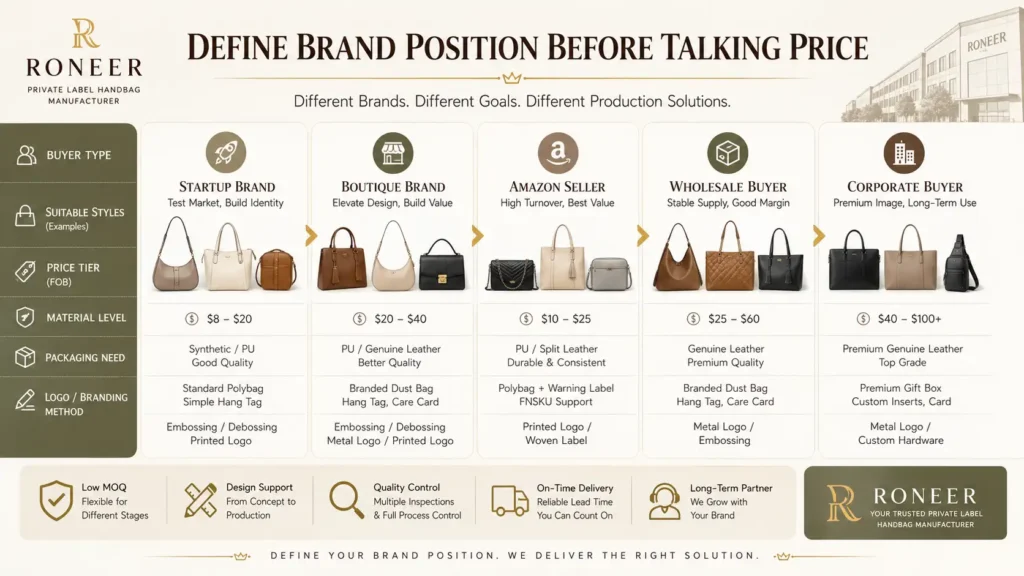
1. Define the Brand Position Before Talking Price
Before contacting a private label handbag manufacturer, buyers should define the product position clearly. A handbag project becomes much easier to quote, sample, and produce when the factory understands the buyer’s brand direction.
A boutique handbag brand may need a refined silhouette, better hand feel, clean stitching, attractive lining, carefully selected hardware, and stronger packaging presentation. An Amazon seller may care more about durable structure, repeat consistency, efficient carton packing, barcode labels, and customer review risk. A wholesaler may need practical styles, balanced cost, and stable repeat production. A startup brand may need lower-risk style testing before investing in original handbag development.
The same handbag design can be produced in different price tiers depending on material, hardware, lining, logo method, structure, and packaging. A private label handbag manufacturer should not recommend the same production solution for every buyer. The best starting point is to discuss the buyer’s sales channel, target customer, retail price, order quantity, and brand style.
A minimalist quiet luxury handbag needs a different development path from a promotional tote bag or a trend-driven fashion purse. The buyer should clarify whether the goal is boutique presentation, online marketplace sales, wholesale distribution, corporate gifting, or long-term private label collection building.
Clear positioning helps the factory recommend the right material, construction method, logo technique, and packaging standard. It also prevents unnecessary customization that increases cost without improving product value.
2. Decide Whether OEM or ODM Fits the Project
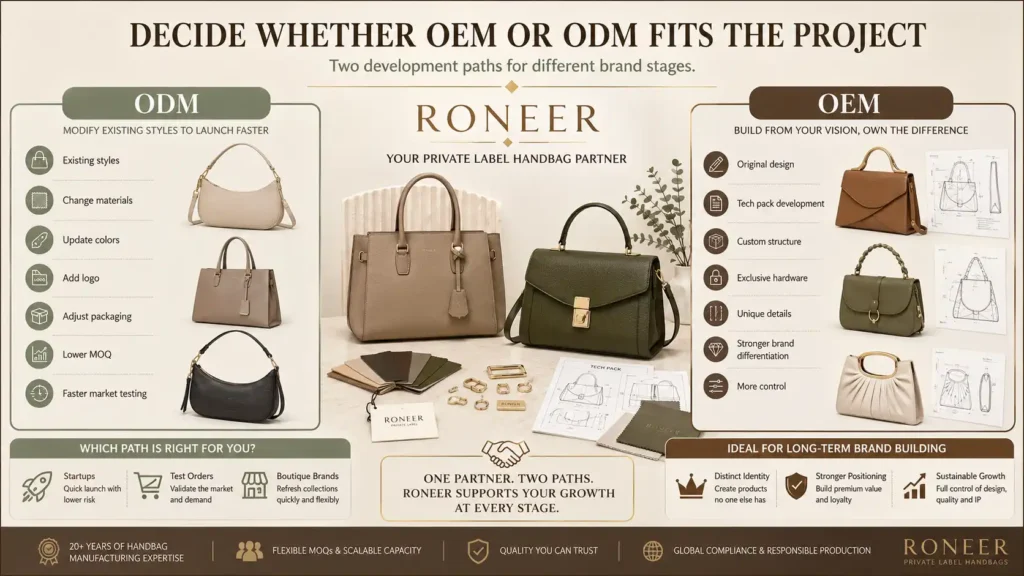
When working with a private label handbag manufacturer, buyers usually need to decide between OEM and ODM development.
ODM is suitable when the buyer wants to customize an existing factory style or a base design that can be adjusted. The buyer may change color, material, lining, logo, zipper puller, hardware color, strap length, packaging, and small structural details. ODM can be practical for startups, Amazon sellers, boutique buyers, and brands testing a new handbag category.
OEM is better when the buyer has an original design, tech pack, reference sample, special structure, or unique functional requirement. OEM handbag development may require more time and clearer technical communication, but it gives the brand more control over shape, function, and differentiation.
A first-time buyer does not always need full OEM development. If the buyer is still testing market response, ODM customization may reduce risk. If the buyer already has a clear brand direction and wants stronger originality, OEM development may be more suitable.
A private label handbag manufacturer should explain which parts of a design can be changed easily and which parts affect mold cost, MOQ, material sourcing, sampling time, or production price. Changing a lining color may be simple, while creating a new metal logo plate or unique frame structure may require additional tooling and more time.
The best manufacturing model depends on the buyer’s brand stage, launch timeline, budget, and product differentiation needs. A practical supplier should help the buyer choose a path that fits the project instead of pushing every buyer into the same process.
3. Prepare a Factory-Ready Handbag Specification
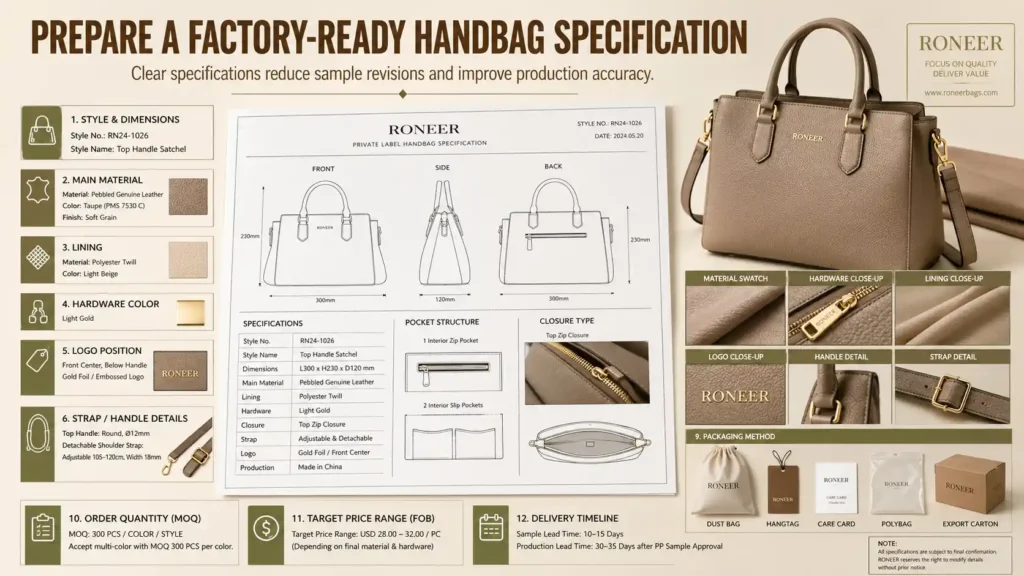
Many sampling problems happen because the buyer sends only inspiration photos. Photos are helpful, but they are not enough for accurate private label handbag production.
Before requesting a quote or sample, prepare a simple factory-ready specification. It does not need to be overly complicated, but it should include the most important production details.
Buyers should prepare the handbag type, target dimensions, main material, backup material, lining material, hardware color, logo file, logo size, logo position, strap length, closure type, pocket layout, edge finishing, reference images, packaging method, target order quantity, target price range, and expected delivery timeline.
A private label handbag manufacturer can quote more accurately when these details are clear. It also reduces misunderstandings during sample development. If the buyer has a physical reference sample, marked photos, or a simple tech pack, the factory can better understand structure and proportion.
The specification should also describe the sales channel. A handbag for boutique retail may need stronger presentation and better packaging. A handbag for online sales may need good product photography angles, efficient packing, and clear barcode planning. A handbag for wholesale may need practical cost control and stable repeat production.
RONEER can support material, structure, logo, and packaging discussions, but the buyer’s specification is still important. The clearer the buyer’s product brief, the easier it is to control sampling cost, development time, and final production quality.
4. Choose Materials That Match the Brand Level
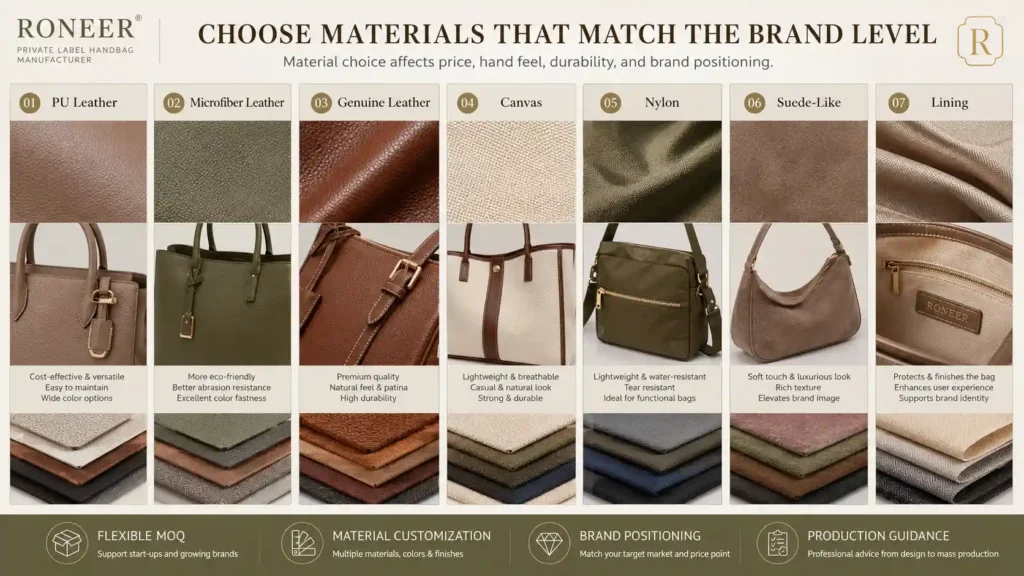
Material selection is one of the most important decisions in private label handbag manufacturing. The material affects appearance, hand feel, structure, price, durability, packaging, and customer perception.
PU leather may be suitable for fashion handbags, trend-based styles, cosmetic bags, small accessories, and cost-sensitive private label collections. Microfiber leather can provide a more refined look and improved performance for certain handbag categories. Genuine leather may be suitable for premium handbag lines, but it usually requires stricter material selection, higher cost planning, and more careful production control. Canvas, nylon, polyester, suede-like materials, mesh, and mixed-material structures may also be useful depending on the brand concept.
Käufer können die Produkte von RONEER Anpassung des Materials options when comparing PU leather, microfiber leather, genuine leather, nylon, Oxford fabric, canvas, polyester, lining materials, and mixed-material handbag structures.
For brands considering recycled or preferred materials, the Textile Exchange Materials Market Report can provide broader industry context. However, buyers should avoid making broad sustainability claims unless the material source, documentation, certification status, and marketing wording are properly confirmed.
A private label handbag manufacturer should help the buyer understand how material choice affects MOQ, sample lead time, production cost, color consistency, care instructions, packaging method, and long-term reorder stability. A material that looks good in photos may not always be the best choice for the product’s target price or sales channel.
The safest approach is to choose materials based on the handbag’s function, customer expectation, price tier, and brand identity. This helps the final product feel more consistent and easier to sell.
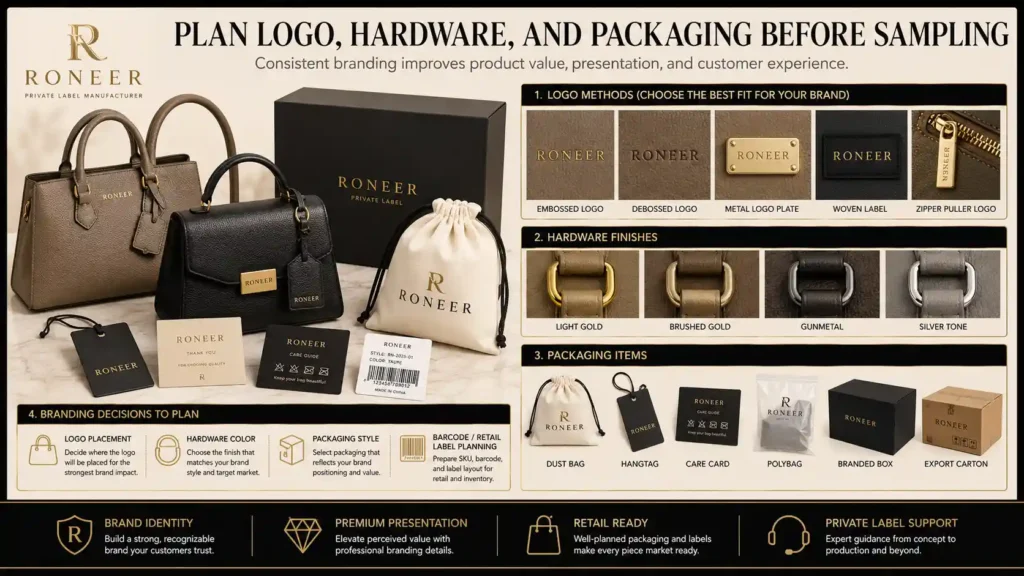
5. Plan Logo, Hardware, and Packaging Before Sampling
Private label handbags need clear branding decisions. Logo, hardware, lining, hangtags, and packaging should be planned before sample approval, not after bulk production begins.
Common logo methods include embossed logo, debossed logo, printed logo, woven label, rubber patch, metal logo plate, zipper puller logo, lining logo, hangtag logo, and packaging logo. Each method has a different cost, MOQ, durability, and visual impact.
Buyers can compare RONEER’s Anpassung des Logos options when deciding how to place the brand identity on the handbag. A minimalist brand may prefer subtle embossing or a small metal logo plate. A sportier brand may prefer rubber patches or woven labels. A boutique handbag brand may need coordinated logo placement across the bag, dust bag, hangtag, and packaging.
Hardware also affects brand perception. Zipper color, puller shape, buckle finish, chain quality, magnetic snap strength, and metal logo details can change the perceived value of the handbag. Buyers should confirm hardware color and finish during sampling because small color differences may be obvious in bulk production.
Packaging is equally important. Private label handbag buyers may need dust bags, tissue paper, care cards, hangtags, barcode stickers, polybags, inner boxes, master cartons, and carton marks. RONEER’s Individuelle Gestaltung der Verpackung service can support different packaging needs for private label bags, wholesale orders, and export shipments.
A private label handbag manufacturer should help the buyer connect logo method, hardware choice, and packaging style with the brand’s price position. Strong branding does not always mean expensive packaging. It means the details should feel consistent with the final customer experience.
6. Protect Brand Identity and Avoid Copycat Risk
Private label handbag development should build original brand value, not counterfeit risk. This is especially important for buyers working with handbag styles inspired by popular fashion trends.
A buyer should avoid copying famous logos, protected patterns, recognizable luxury hardware, signature silhouettes, or distinctive brand elements too closely. A factory may be able to produce similar-looking items, but that does not make the product safe for long-term brand building.
For buyers selling to the United States, origin-related and branding claims should also be accurate. If handbags are manufactured outside the United States, brands should avoid misleading Made in USA claims. The Federal Trade Commission’s Made in USA guidance explains how Made in USA claims are evaluated and why unqualified claims must meet strict standards.
For imported handbags entering the United States, buyers should also discuss country-of-origin marking before bulk packing. The U.S. Customs and Border Protection country of origin marking guidance explains that foreign-origin goods entering the United States generally need a clear English country of origin marking unless an exception applies.
A professional private label handbag manufacturer should support original customization, not encourage unsafe imitation. Buyers should provide their own logo files, original brand assets, and clear design direction. If the design is close to a well-known brand, the buyer should revise the shape, hardware, logo, proportion, stitching pattern, and presentation to create a more original product.
Protecting brand identity also includes keeping production details organized. Buyers should keep approved samples, logo size records, material names, hardware colors, packaging files, and repeat production notes. These records help prevent inconsistencies when the brand places a reorder for production later.
7. Confirm MOQ, Sample Cost, and Production Lead Time
MOQ, sample cost, and lead time should be confirmed before a buyer selects a private label handbag manufacturer. These details affect launch planning, cash flow, product testing, and repeat order decisions.
A low MOQ can be useful for startups, boutique buyers, and brands testing a new handbag style. However, a low MOQ does not always mean the best total value. Buyers should check whether the MOQ applies to one style, one color, one material, or one logo method. A factory may offer flexible quantities for simple ODM customization, but custom materials, special hardware, molded logo plates, or exclusive packaging may require higher minimums.
Sample cost should also be understood clearly. A private label handbag manufacturer may charge for material sourcing, pattern making, logo tooling, hardware development, packaging samples, or repeated revisions. Buyers should ask what is included in the sample fee and whether the cost can be refunded or deducted from bulk production.
Lead time is another important factor. A simple ODM handbag sample may be faster than a full OEM development project. Bulk production time may also change depending on material availability, order quantity, logo process, packaging requirements, and factory schedule.
A professional private label handbag manufacturer should explain MOQ, sample cost, sample lead time, production lead time, and possible cost changes before the buyer approves the project. Clear timing and cost planning help buyers avoid launch delays and unexpected budget problems.
8. Check Quality Control Before Bulk Shipment
Quality control is not only about checking the final shipment. It begins with sample approval and continues through material purchasing, cutting, sewing, edge finishing, hardware installation, logo placement, packing, and final inspection.
For private label handbags, common inspection points include material surface, color consistency, stitching, edge paint, lining fit, zipper smoothness, magnetic snap strength, logo position, hardware color, strap attachment, shape symmetry, measurement tolerance, packaging cleanliness, and carton marks.
For larger or higher-risk orders, buyers may refer to third-party inspection providers such as SGS Bags and Accessories Testing and Inspection to understand how bags and accessories can involve structured checks for product quality, performance, and compliance. This does not mean every order needs the same testing plan, but it helps buyers think more carefully about inspection standards.
A reliable private label handbag manufacturer should confirm the approved sample before bulk production. The buyer and factory should agree on acceptable tolerances, packaging standards, logo placement, hardware color, and final inspection points.
RONEER supports private label handbag buyers through sample development, production coordination, packaging review, quality communication, and export packing support. A clear inspection plan helps reduce disputes and improves production consistency.
9. Keep Repeat Production and Export Packing Records
A private label handbag manufacturer should help buyers keep clear records for repeat production. Many handbag brands do not require only one order. If a style sells well, the buyer may need to reorder the same handbag with the same material, logo size, hardware color, lining, packaging, and carton standard.
Repeat production records should include approved sample photos, material names, color codes, logo artwork, logo position, hardware finish, lining material, packaging method, carton size, quantity per carton, barcode requirements, and country of origin marking. These records help reduce color differences, logo placement errors, packaging changes, and quality inconsistencies in future orders.
Export packing records are also important for private label handbag buyers. A handbag that arrives in good condition depends on more than product quality. It also depends on inner filling, dust bags, polybags, carton strength, carton marks, barcode stickers, and packing consistency.
For buyers selling in the United States, export packing and labeling should be discussed before shipment. Private label handbags may need product labels, hangtags, barcode stickers, care cards, country of origin marking, and clear carton information. These details affect warehouse handling, retail presentation, and customer experience.
A reliable private label handbag manufacturer should not treat each order as a completely new project. The factory should help the buyer keep production and packing records so future orders are easier to repeat, easier to inspect, and easier to ship.
Common Mistakes When Choosing a Private Label Handbag Manufacturer
One common mistake is asking for a price before giving enough product details. Without size, material, structure, logo method, packaging, and quantity, the quote may not reflect the real production cost.
Another mistake is choosing a private label handbag manufacturer only because of a low MOQ. Low MOQ can be useful, especially for startups, but it should not replace quality, communication, material control, and production reliability.
Some buyers also change the logo method or packaging after sample approval. This can cause delays, extra costs, and inconsistency between the approved sample and bulk production.
A fourth mistake is focusing only on the handbag exterior. Lining, pocket layout, zipper function, strap comfort, hardware strength, and packaging can all affect customer satisfaction.
Another common mistake is copying luxury handbag details too closely. Private label development should create a brand’s own identity. A product that looks too close to a famous designer bag may create legal, marketplace, or brand trust problems.
A buyer should also avoid approving samples only by photos. Photos are useful, but physical samples allow the buyer to check weight, hand feel, structure, color, hardware, logo depth, zipper function, and packaging.
The best way to reduce risk is to communicate clearly, approve details early, and work with a manufacturer that understands private label handbag production from design to shipment.
Private Label Handbag Development Checklist
Before working with a private label handbag manufacturer, buyers can prepare the following checklist:
Confirm your sales channel and target customer.
Confirm handbag type, size, shape, and price tier.
Choose OEM or ODM development.
Prepare reference photos, tech pack, or physical sample.
Confirm material, lining, hardware, and strap details.
Confirm logo method, logo file, logo size, and logo position.
Confirm packaging, dust bag, hangtag, barcode label, and carton mark.
Confirm sample cost, sample lead time, and revision process.
Confirm MOQ, bulk production lead time, and payment terms.
Confirm inspection points and acceptable tolerance.
Confirm country of origin marking and export packing details.
Keep records for repeat production.
This checklist helps buyers avoid vague communication and gives the factory a clearer path to quote, sample, and produce the handbags.
How RONEER Supports Private Label Handbag Projects
RONEER helps global buyers develop private label handbags through OEM and ODM manufacturing support. The process can include style discussion, material selection, logo customization, sample development, packaging planning, bulk production coordination, and export packing.
For startup brands, RONEER can help compare practical ODM customization options before the buyer invests in a deeper OEM project. For established brands, RONEER can support more detailed development based on tech packs, reference samples, and brand-specific requirements.
A strong private label handbag manufacturer should help buyers make practical decisions. This includes explaining which materials fit the target price, which logo methods work best on specific materials, which packaging options match the sales channel, and which details should be confirmed before bulk production.
RONEER’s role is not only to produce handbags but also to help buyers organize product details into a production-ready plan. This is especially valuable for brands that need repeat orders, multiple SKUs, or private label collections with consistent presentation.
FAQ About Private Label Handbag Manufacturer
1. What is a private label handbag manufacturer?
A private label handbag manufacturer is a factory that produces handbags for brands, retailers, wholesalers, Amazon sellers, boutiques, and startups under the buyer’s own brand name. The factory may support OEM/ODM development, material selection, logo customization, packaging, sampling, bulk production, and export packing.
2. What does a private label handbag manufacturer do for brands?
A private label handbag manufacturer helps brands turn handbag ideas into production-ready products. This may include style development, sample making, material sourcing, logo placement, hardware selection, packaging planning, quality control, and repeat production support.
3. Is a private label handbag manufacturer suitable for startups?
Yes. A private label handbag manufacturer can be suitable for startups if the buyer starts with a clear product concept, realistic MOQ expectations, and a focused launch plan. Many startups begin with ODM customization before moving into full OEM handbag development.
4. What is the difference between OEM and ODM private label handbags?
ODM private label handbags are usually based on existing or factory-developed styles that can be customized with materials, colors, logos, and packaging. OEM private label handbags are made according to the buyer’s original design, tech pack, reference sample, or special structure.
5. What information should I prepare before contacting a private label handbag manufacturer?
You should prepare handbag type, target dimensions, material preference, logo file, reference photos, target quantity, packaging needs, price range, sales channel, and expected timeline. Clear information helps the private label handbag manufacturer quote and sample more accurately.
6. What materials are common for private label handbags?
Common materials include PU leather, microfiber leather, genuine leather, canvas, nylon, polyester, suede-like materials, mesh, and mixed-material structures. The right material depends on brand positioning, target price, durability needs, hand feel, and customer expectations.
7. Can a private label handbag manufacturer add my logo?
Yes. A private label handbag manufacturer can usually support logo methods such as embossing, debossing, printing, woven labels, rubber patches, metal logo plates, zipper puller logos, lining logos, hangtags, and packaging logos. The best option depends on material, MOQ, budget, and brand style.
8. Can I create custom packaging for private label handbags?
Yes. Custom packaging may include dust bags, hangtags, care cards, branded boxes, barcode stickers, polybags, tissue paper, carton marks, and retail packaging. Packaging should be confirmed early because it affects cost, presentation, shipping, and customer experience.
9. How can I reduce risk when working with a private label handbag manufacturer?
You can reduce risk by preparing clear specifications, approving physical samples, confirming materials early, checking logo placement, reviewing packaging, setting quality checkpoints, avoiding copycat designs, and keeping records for repeat production.
10. What should be checked before bulk production starts?
Before bulk production, buyers should confirm the approved sample, final material, lining, hardware color, logo size, logo position, packaging method, carton mark, country of origin marking, production timeline, and inspection standard.
11. Can a private label handbag manufacturer support low MOQ orders?
Some manufacturers can support lower MOQ orders depending on material, style, logo method, and packaging requirements. However, a lower MOQ may affect unit price, material availability, and customization options. Buyers should discuss the MOQ together with the full production plan.
12. Why is repeat production important for private label handbags?
Repeat production is important because brands often need to reorder successful styles. A reliable private label handbag manufacturer should keep records of approved materials, logo size, hardware color, packaging method, and sample standards so future orders stay consistent.
13. How does RONEER support private label handbag manufacturer projects?
RONEER supports private label handbag manufacturer projects through OEM/ODM development, material selection, logo customization, packaging planning, sample development, bulk production coordination, quality communication, export packing, and global shipping support.
Schlussfolgerung
Choosing a private label handbag manufacturer should be treated as a long-term brand decision, not only a price comparison. The right factory can help buyers plan the handbag structure, select suitable materials, choose logo methods, develop samples, prepare packaging, control quality, and support repeat production.
A strong private label handbag manufacturer should understand the buyer’s sales channel and brand positioning. A boutique handbag line, Amazon product launch, wholesale collection, corporate gift program, and startup private label brand may all need different development strategies. The factory should help the buyer make practical decisions instead of offering the same solution to every project.
For buyers who want faster market testing, ODM private label handbags may be a practical starting point. For brands that need stronger originality, OEM handbag development can provide more control over shape, structure, and details. In both cases, clear specifications, approved samples, material records, logo files, packaging standards, MOQ planning, lead time control, inspection points, and repeat production records are essential.
RONEER helps global buyers develop private label handbags through OEM and ODM manufacturing, material customization, logo options, packaging planning, sample development, production coordination, quality communication, export packing, and global shipping support. Whether the project is a startup test order, boutique collection, online marketplace product, or long-term private label handbag line, early planning can reduce risk and improve consistency.
A practical private label handbag manufacturer strategy starts with clear product positioning, accurate specifications, realistic customization choices, and careful control of branding, materials, packaging, MOQ, lead time, quality, and repeat production records. When these details are handled properly, private label handbags become easier to produce, easier to present, easier to ship, and easier to reorder.