 English
  Deutsch
  Español
  Français
  Italiano
  Русский
  日本語
日本語  العربية
  Türkçe
  한국어
한국어 Handbag brands preparing next year’s collection need to make material decisions long before the products reach stores.
A leather may look premium in a reference image but become too heavy when used on an oversized tote. Raffia can create a strong seasonal identity but introduces edge-finishing and consistency challenges. Technical nylon can reduce weight while changing the perceived price position of the handbag.
That is why 2027 handbag material trends should be treated as product-development signals rather than simply a list of fashionable surfaces.
One of the strongest professional references currently available is the APLF Spring-Summer 2027 Colour, Leather & Material Trends. Its handbag and material direction includes grained leather, patent leather, technical canvas, coated nylon, braided leather, natural raffia, washed linen, organic netting, ultra-supple nappa, nubuck, translucent nylon, textured canvas, sport-tech mesh, metallic effects, and mixed-material constructions.
The runway transition is already visible. Vogue’s Spring 2027 Copenhagen trend report highlights over-under woven textiles and plush tactile surfaces, while current 2026 handbag coverage continues to show strong interest in supple leather, suede, woven leather, raffia, and textured finishes.
For B2B buyers, the key question is not simply which 2027 handbag material trends look new.
The more important question is which materials can be converted into a stable sample, realistic MOQ, repeatable bulk specification, acceptable quality standard, and commercially viable handbag collection.
2027 Handbag Material Trends at a Glance
| Material Direction | Best For | Main Development Risk |
|---|---|---|
| Ultra-supple nappa and soft leather | Hobo, shoulder, clutch | Shape collapse, thickness variation |
| Grained and structured leather | Tote, baguette, doctor bag | Weight, edge finishing |
| Woven leather, raffia and netting | Resort, tote, hobo | Handwork consistency, abrasion |
| Patent and high-shine materials | Mini bag, vanity, evening | Scratches, coating marks |
| Suede and nubuck surfaces | Hobo, clutch, shoulder | Crocking, staining |
| Technical nylon, canvas and mesh | Crossbody, travel, sport-fashion | Coating and seam performance |
| Mixed-material construction | Urban, resort, fashion-tech | Color and structure compatibility |
These 2027 handbag material trends should still be evaluated according to handbag silhouette, target customer, price point, MOQ, logo method, hardware, lining, packaging, and expected use.
1. Ultra-Supple Nappa and Soft Leather
Soft leather is one of the clearest directions moving into 2027.
APLF’s S/S 2027 forecast includes full-grain leather with natural drape, supple nappa, ultra-supple pastel nappa, washed leather, soft-touch leather, and foamy surfaces. Its handbag examples include soft nappa shoulder bags and ultra-supple hobo constructions.
This direction also has strong momentum from 2026.
Marie Claire’s Fall 2026 handbag report highlights supple leather and softer structures across brands including Hermès, Loewe, Bottega Veneta, Coach, Ferragamo, and others.
Among the 2027 handbag material trends, soft leather is particularly suitable for:
- Hobo bags
- Slouchy shoulder bags
- Large clutches
- Soft totes
- Drawstring bags
- Ruched handbags
The main challenge is controlling shape.
A material can feel luxurious in the hand but still fail to support the intended silhouette after the handbag is loaded.
Buyers should define:
- Material thickness
- Temper
- Backing
- Lining
- Reinforcement
- Stretch
- Recovery
- Expected amount of slouch
The finished handbag should look intentionally relaxed rather than structurally weak.
What Buyers Should Test
Check:
- Body recovery after loading
- Wrinkle behavior
- Edge stretch
- Handle attachment
- Lining drag
- Surface scratching
- Color consistency
- Finished empty weight
Soft leather and controlled structure are developing in parallel rather than one completely replacing the other.
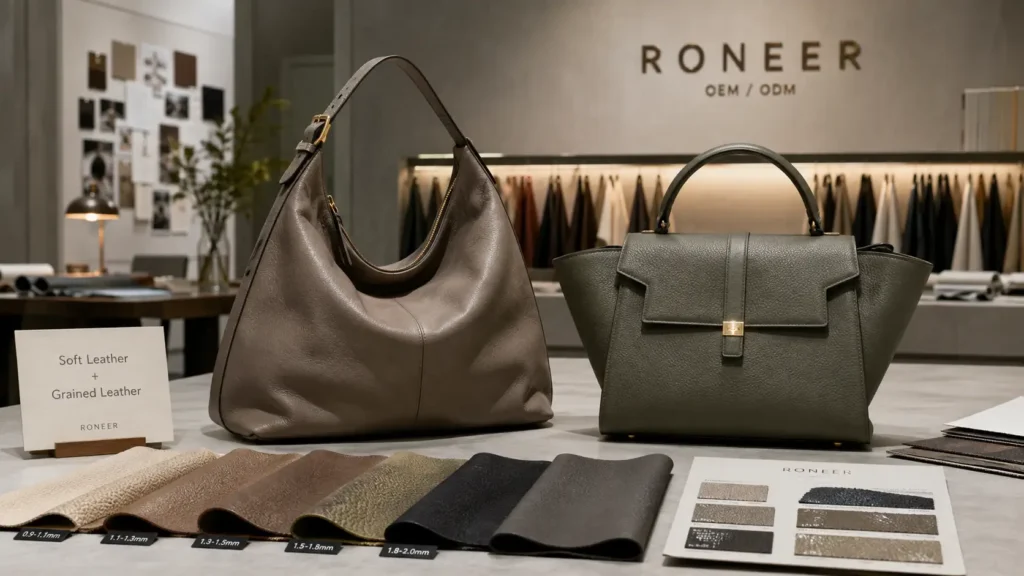
2. Grained and Structured Leather
Not every 2027 handbag is becoming soft.
APLF also identifies structured grained leather, geometric embossing, structured baguette bags, doctor bags, and architectural leather shoppers in its S/S 2027 direction.
This creates an important contrast within 2027 handbag material trends.
Material character is becoming more visible, but that character can come from softness, grain, embossing, structure, or surface treatment.
Grained materials work well for:
- Business totes
- Top-handle bags
- Baguette bags
- Doctor bags
- Structured crossbody bags
- Everyday shoulder bags
A grain can make the surface more visually tactile and may also make minor handling marks less noticeable than on an extremely smooth surface.
For private label buyers, the specification should go beyond simply saying:
“genuine leather”
or
“PU leather.”
A useful material specification should define:
- Grain size
- Gloss
- Thickness
- Backing
- Hand feel
- Flexibility
- Edge behavior
- Color tolerance
- Reinforcement requirements
A structured handbag may still need board, foam, reinforcement, or other internal support even when the exterior material feels firm.
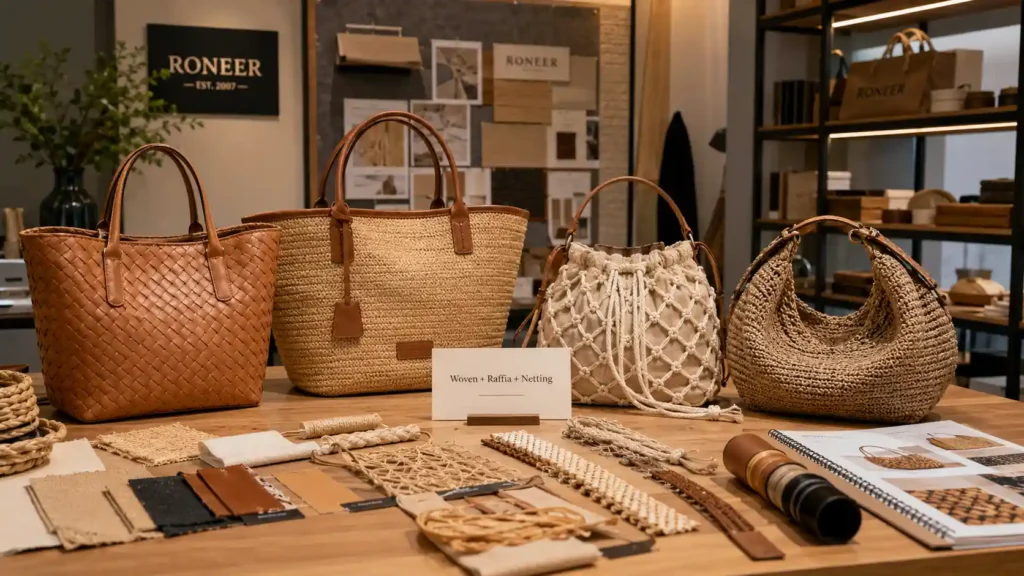
3. Woven Leather, Raffia, Netting and Handcrafted Surfaces
Woven construction is one of the strongest texture stories within 2027 handbag material trends.
APLF’s S/S 2027 direction includes handcrafted braided leather, natural raffia, organic netting, twisted cords, washed linen, varnished canvas, and handbags combining natural raffia with vegetable-tanned leather trims.
Vogue’s current Spring 2027 Copenhagen report also identifies over-under weaving as a visible runway direction.
Meanwhile, Who What Wear’s woven handbag coverage shows that woven bags are no longer restricted to basic straw beach totes. Current products span leather, raffia, straw, and suede constructions.
Possible 2027 executions include:
- Woven leather totes
- Braided hobo bags
- Raffia shoppers
- Netting beach bags
- Woven handbag panels
- Braided handles
- Leather-and-raffia combinations
- Canvas with cord details
The biggest production risk is consistency.
Handcrafted-looking surfaces still need measurable specifications for bulk production.
Buyers should define:
- Weave width
- Strip thickness
- Spacing
- Tension
- Edge finishing
- Backing
- Handle reinforcement
- Allowable visual variation
A handcrafted appearance should not become an excuse for uncontrolled bulk-production differences.
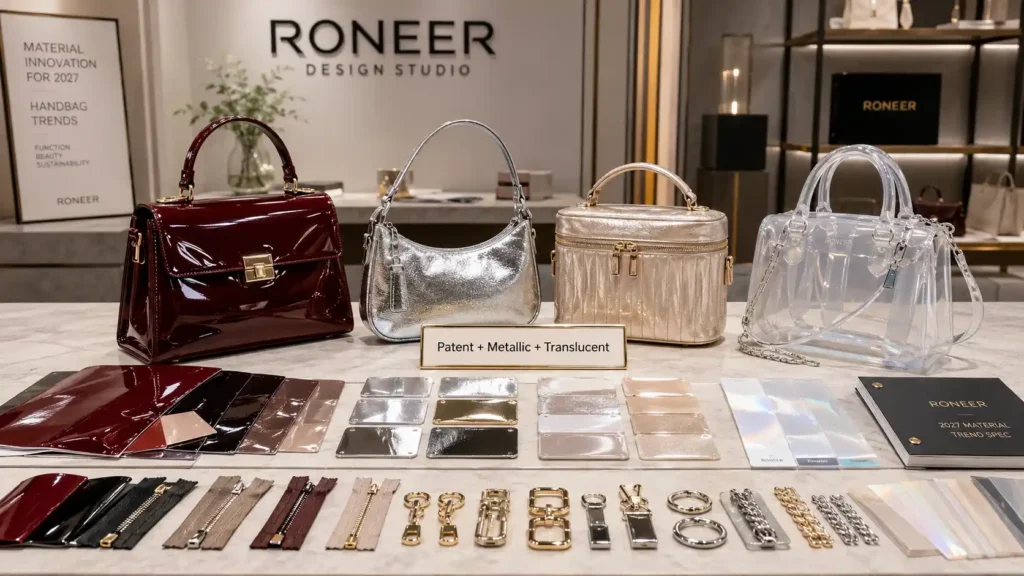
4. Patent, High-Shine, Metallic, and Translucent Surfaces
One of the more directional 2027 handbag material trends is the return of visible surface effects.
APLF’s forecast includes patent leather, mirror finishes, milky patent, high-shine leather, cracked patent, pearlized effects, holographic finishes, metallic surfaces, semi-translucent materials, and translucent “jelly” nylon.
These materials work particularly well on:
- Mini shoulder bags
- Vanity bags
- Box bags
- Evening clutches
- Bucket bags
- Small crossbody bags
Current Fall 2026 runway coverage provides additional evidence for texture-driven handbags. ELLE highlights croc-embossed surfaces and satin as important handbag material stories, alongside other tactile treatments.
However, glossy surfaces are less forgiving during production.
Potential problems include:
- Fingerprints
- Scratches
- Glue marks
- Uneven coating
- Creasing
- Edge damage
- Packing pressure marks
- Hardware impressions
High-shine materials should be approved on a complete sample rather than from a small swatch alone.
The finished sample should be inspected after cutting, sewing, turning, hardware assembly, packing, and handling.
5. Suede and Nubuck Become Broader Texture Materials
Suede and nubuck are no longer useful only for conventional fall handbags.
APLF’s S/S 2027 direction includes sporty technical nubucks, velvety nubuck, wrinkled sueded leather, stretch suede-like surfaces, and nubuck bags combined with technical hardware.
Who What Wear also includes suede within current woven handbag options, showing how the material can move beyond one seasonal category.
For 2027 handbag material trends, suede-like materials can work on:
- Soft hobo bags
- Clutches
- Bucket bags
- Shoulder bags
- Braided bags
- Mixed leather-and-suede designs
The major sourcing risks include:
- Crocking
- Nap direction
- Dust attraction
- Water spotting
- Color variation
- Surface flattening
- Packaging pressure
Brands that want the visual effect without using genuine suede can also evaluate microfiber suede-like materials during development.
The right option depends on:
- Target price
- Hand feel
- Color
- Logo application
- Cleaning expectations
- Destination market
- MOQ
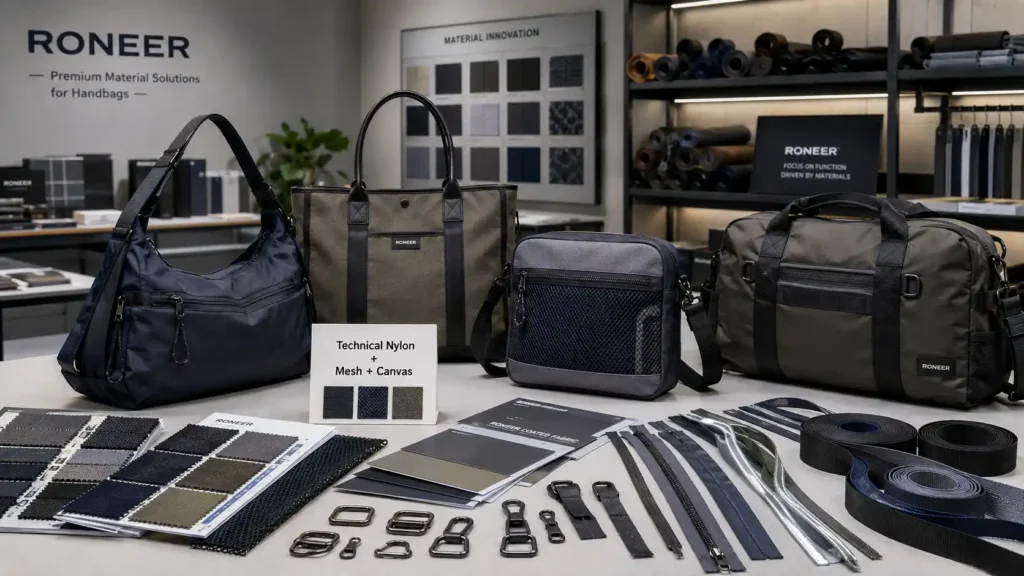
6. Technical Nylon, Coated Canvas and Sport Mesh
The 2027 handbag material trends story is not limited to leather.
APLF lists nylon canvas with colored coatings, metallic parachute nylon, technical nylon, tulle-like mesh, translucent nylon, sport-tech mesh, reflective fabrics, printed textured canvas, and leather-neoprene combinations.
These materials can support:
- Lightweight shoulder bags
- Urban crossbody bags
- Travel handbags
- Belt bags
- Sport-luxury bags
- Foldable totes
- Hybrid leather-textile collections
One advantage is weight control.
A large handbag made completely from thick leather can become heavy before the customer puts anything inside it.
A technical textile body with leather or microfiber trim can preserve visual value while reducing the overall weight.
Technical fabric should not automatically be described as waterproof.
Buyers should distinguish between:
- Coated fabric
- Water-repellent fabric
- Water-resistant fabric
- Waterproof base fabric
- Waterproof finished construction
Even when the material itself has a coating, needle holes, seams, zipper openings, bindings, and construction details can affect the complete bag.
B2B Questions to Confirm
Ask:
- Fabric construction?
- Finished weight?
- Coating type?
- Hanfeelsel?
- Abrasion requirement?
- Colorfastness requirement?
- Backing?
- Lamination?
- Seam construction?
- Logo compatibility?
7. Mixed-Material Construction Becomes a Design Language
Some of the strongest 2027 handbag material trends are not single materials at all.
They are combinations.
APLF shows handbag and accessory directions using:
- Lambskin with technical canvas
- Leather with neoprene
- Raffia with leather trim
- Washed linen with leather
- Mesh with reflective piping
- Canvas with tactile surfaces
- Nylon with patent leather details
This approach gives brands more freedom.
Examples include:
- Leather body + canvas side panel
- Raffia body + leather handle
- Nylon body + microfiber trim
- Suede front panel + smooth leather structure
- Mesh pocket + coated textile body
- Neoprene panel + leather edge
- Woven leather flap + plain body
Mixed materials can help control both cost and weight.
They can also create stronger visual differentiation without requiring the entire handbag to use an expensive fashion material.
However, mixed-material construction introduces technical risks.
Different materials can react differently to:
- Heat
- Humidity
- Stretch
- Adhesive
- Stitch tension
- Edge paint
- Color transfer
- Packing pressure
The complete combination should be approved as a finished sample rather than approving each material independently.
Why Texture Matters More Than the Material Name
One lesson from 2027 handbag material trends is that buyers need to specify the actual surface rather than only the material category.
“Leather” is too broad.
“Nylon” is too broad.
“Canvas” is too broad.
Two materials within the same category can have completely different:
- Thickness
- Grain
- Coating
- Softness
- Gloss
- Backing
- Weight
- Stretch
- Recovery
- Color depth
Those differences can dramatically change the finished handbag.
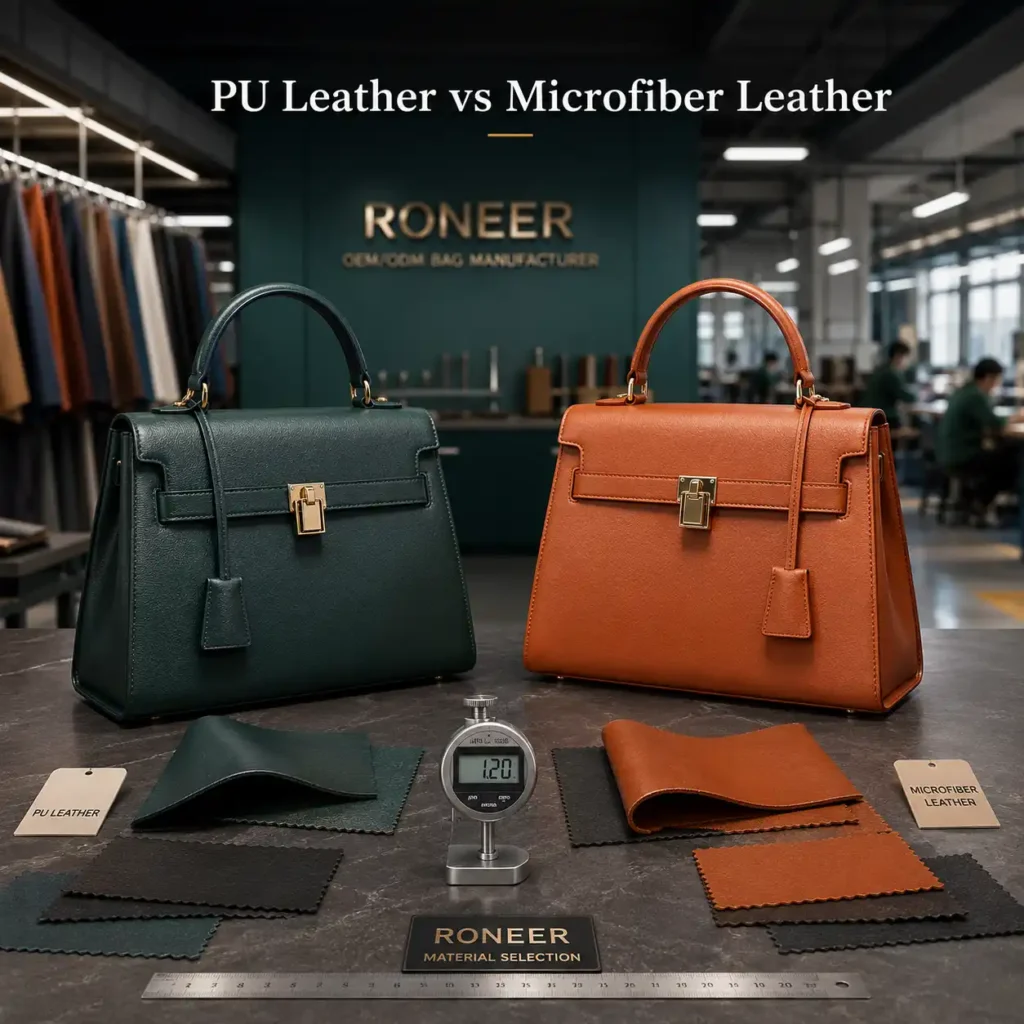
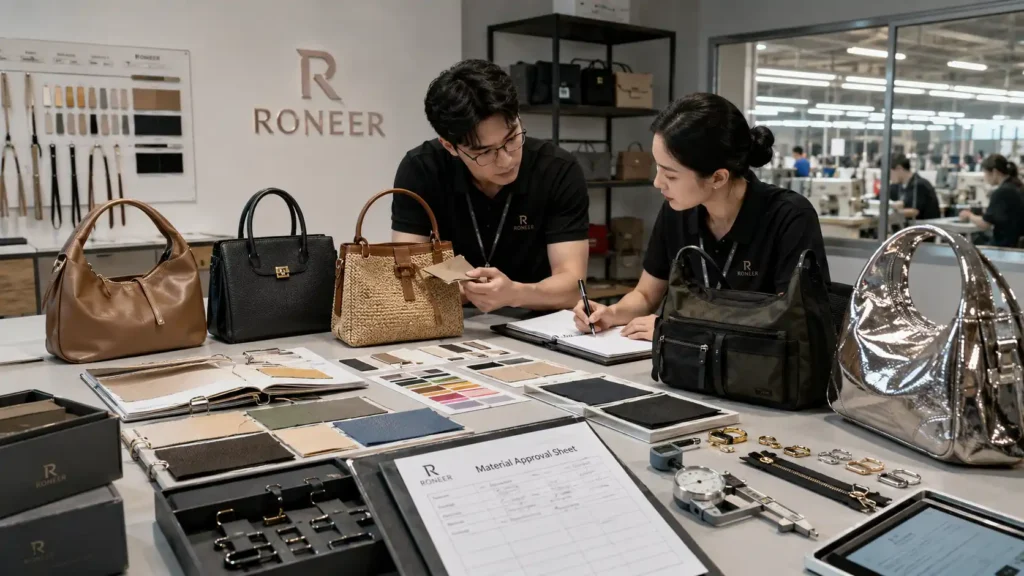
RONEER’s Material Customization process therefore considers product type, appearance, durability, cost, logo method, lining, structure, and brand positioning rather than material name alone.
Match 2027 Handbag Material Trends to the Right Silhouette
A fashionable material is useful only when it supports the product.
Soft Hobo Bag
Suitable directions include:
- Supple nappa
- Soft PU
- Microfiber leather
- Suede-like material
- Lightweight woven leather
Structured Tote
Suitable directions include:
- Grained leather
- Structured PU
- Microfiber leather
- Coated canvas
- Leather-textile combinations
Resort Tote
Suitable directions include:
- Raffia
- Woven surfaces
- Canvas
- Washed linen
- Rope
- Netting
- Leather trim
Fashion-Tech Crossbody
Suitable directions include:
- Coated nylon
- Technical canvas
- Mesh
- Neoprene combinations
- Microfiber trim
Evening Bag
Suitable directions include:
- Patent
- Satin
- Metallic surfaces
- Pearlized finishes
- High-shine materials
The correct material must support shape, price, logo, hardware, customer expectations, and intended use at the same time.
Do Not Confuse Trend Material With Bulk-Ready Material
A material can look impressive on a trend board but still be difficult to manufacture consistently.
Bulk production requires much more control.
Before adopting 2027 handbag material trends, buyers should confirm:
- MOQ
- Color MOQ
- Material lead time
- Available width
- Thickness tolerance
- Lot variation
- Backing
- Surface defect standard
- Cleaning requirements
- Cutting efficiency
- Logo method
- Edge finishing
- Packaging protection
A material that cannot be reordered consistently may work better as a limited seasonal SKU than as the core of a long-term handbag collection.
Approve Material and Hardware Together
Material and hardware should not be developed independently.
The same gold buckle can look completely different on:
- Matte suede
- Glossy patent
- Natural raffia
- Technical nylon
- Pebbled leather
Hardware weight can also affect the structure.
A heavy lock may pull a soft leather flap downward.
A large chain may overpower a lightweight nylon body.
Before bulk production, buyers should review:
- Main material
- Reinforcement
- Hardware weight
- Hardware finish
- Logo
- Thread
- Edge paint
- Lining
- Zipper taAs
as one finished system.
For brands translating 2027 handbag material trends into real products, RONEER’s Material Customization service can support the comparison of PU leather, genuine leather, vegan leather, microfiber leather, nylon, polyester, canvas, rPET, lining, padding, mesh, and other bag materials according to the project requirements.
Plan Material MOQ Before Finalizing the Collection
A seven-material mood board does not mean a brand should manufacture seven completely different materials.
Each custom material can create its own:
- MOQ
- Color MOQ
- Sample cost
- Lead time
- Storage requirement
- Reorder risk
A more practical strategy is to create a three-level material architecture.
Core Material
Used across several handbag styles.
Trend Material
Used on one or two hero products.
Accent Material
Used only on:
- Flaps
- Handles
- Pockets
- Panels
- Trims
This approach makes 2027 handbag material trends easier to commercialize.
For example, a brand might use one-grained microfiber across three handbag silhouettes, introduce raffia on one resort style, and reserve high-shine patent for one mini handbag.
Frequently Asked Questions About 2027 Handbag Material Trends
What is the biggest handbag material trend for 2027?
There is no single material replacing everything else. The strongest 2027 handbag material trends combine supple leather, tactile grain, woven construction, raffia, high-shine finishes, suede-like surfaces, and technical textiles. APLF’s S/S 2027 forecast supports all of these directions.
Is soft leather still trending in 2027?
Yes. APLF includes naturally draping leather and supple nappa in its S/S 2027 direction, while Fall 2026 runway coverage already shows strong momentum toward softer leather handbags.
Are woven handbags still relevant for 2027?
Yes. Woven and braided surfaces remain among the clearest 2027 handbag material trends. APLF includes braided leather, raffia, and organic netting, while Vogue’s Spring 2027 Copenhagen report highlights woven textile construction.
Is raffia only suitable for summer handbags?
Raffia is particularly suitable for resort and warm-season products, but it can also be combined with leather, canvas, structured trim, or darker colors to create a more urban handbag.
Will suede bags remain relevant?
Yes. Suede and nubuck remain useful because tactile surfaces continue into the 2027 material direction. Buyers should pay particular attention to crocking, staining, nap consistency, and packaging.
Is patent leather returning?
High-shine and patent effects are clearly visible in APLF’s S/S 2027 forecast, including patent, cracked patent, mirror effects, and pearlized finishes.
What technical materials are relevant for 2027 handbags?
Technical 2027 handbag material trends include coated nylon, technical canvas, mesh, reflective materials, translucent nylon, and hybrid leather-textile constructions.
Can nylon be used for a premium handbag?
Yes.
A nylon handbag can still achieve premium positioning when fabric quality, coating, trim, hardware, lining, stitching, structure, and branding are developed consistently.
Which 2027 handbag material trends are easier to commercialize?
Grained leather or microfiber, soft leather-like materials, coated canvas, nylon, and selected woven constructions can generally be easier to scale than highly fragile glossy, translucent, or heavily handcrafted surfaces.
The exact difficulty depends on the material specification and supplier.
Can PU leather follow 2027 material trends?
Yes.
PU and microfiber materials can be developed with:
- Soft hand feel
- Grain
- Embossing
- Patent effect
- Suede-like surface
- Metallic finish
- High-gloss coating
Brands should evaluate the actual physical sample rather than assuming a trend requires genuine leather.
How should brands choose between genuine leather and microfiber?
Compare:
- Target price
- Hand feel
- Weight
- Surface consistency
- Logo method
- Structure
- MOQ
- Care requirements
- Brand positioning
There is no universal best material.
Can mixed materials reduce handbag cost?
Sometimes.
A brand may use a premium material on high-visibility areas and a lighter or lower-cost material on larger panels.
However, mixed construction may increase sewing complexity and quality-control requirements.
What should buyers inspect on material samples?
For 2027 handbag material trends, buyers should inspect:
- Thickness
- Grain
- Hand feel
- Color
- Backing
- Stretch
- Recovery
- Rubbing
- Scratching
- Edge behavior
- Logo effect
- Stitching response
- Adhesive response
Should the material be approved before the full handbag sample?
A material swatch should normally be approved first, but the final decision should be confirmed on the complete handbag sample.
Cutting, sewing, reinforcement, turning, edge finishing, hardware, and lining can change how the material behaves.
How can Material Customization help a private label brand?
RONEER’s Material Customization service helps buyers compare materials according to handbag type, appearance, durability, cost, logo method, structure, lining, MOQ, and brand positioning.
Conclusion
The strongest 2027 handbag material trends are developing in two directions at the same time: more tactile, handcrafted-looking surfaces and more expressive technical or high-shine materials.
Soft nappa and naturally draping leather support relaxed hobo and shoulder silhouettes.
Grained and structured materials continue to work for business totes, doctor bags, baguettes, and architectural handbag shapes.
Woven leather, raffia, netting, braided details, washed linen, and canvas bring a stronger handcrafted identity to 2027 handbag material trends, while patent, metallic, pearlized, translucent, and reflective surfaces create a more experimental fashion direction.
Technical nylon, coated canvas, sport mesh, and mixed leather-textile construction also give brands opportunities to control weight and introduce a more functional or urban character.
The most important purchasing decision is not to copy every material trend.
Brands should decide which 2027 handbag material trends match their target customer, handbag silhouette, price point, MOQ, logo method, hardware, and expected use.
A trend material should then be converted into measurable specifications for:
- Thickness
- Grain
- Color
- Coating
- Backing
- Reinforcement
- Lining
- Edge finishing
- Quality standards
Physical sampling remains essential.
A swatch can show color and texture, but only the finished handbag can reveal whether the material folds correctly, supports the shape, works with hardware, accepts the logo, survives packing, and remains consistent during realistic use.
RONEER’s Material Customization service supports PU leather, genuine leather, vegan leather, microfiber leather, canvas, nylon, polyester, Oxford fabric, rPET, mesh, lining, padding, and other bag materials according to product type and project requirements.
The best 2027 handbag material trends strategy is therefore not about selecting the most unusual surface.
It is about choosing a trend direction that can be sampled accurately, produced consistently, inspected clearly, and reordered efficiently.
Explore the 2027 Bag Trend Series
This guide is part of RONEER’s 2027 trend research for brands and product teams. Start with the 2027 handbag trends overview, then compare the detailed guides to 2027 handbag colors, 2027 handbag shapes, 2027 handbag materials, and 2027 men’s bag trends. Each article covers a different product-development decision so buyers can use the series without repeating the same topic.