 한국어
 English
 Deutsch
 Español
 Français
 Italiano
 Русский
 日本語
 العربية
 Türkçe
The factory sends a photo of a tote marked “PP approved.” Three weeks later, the inspector is given a different tote with a handwritten “golden” tag. One has the agreed zipper pull and the other has a stock substitute. Both look finished, but neither label tells the inspector which version the buyer approved. Golden Sample vs Pre-Production Sample for Bags is a distinction worth settling before production starts, when a disagreement can still be resolved without opening cartons or reworking finished stock.
Use this guide to assign a job to each sample, document the transition from review to approval, and give production and inspection teams the same reference. For the physical checks to carry out on the bag itself, use RONEER’s custom bag sample approval checklist alongside this guide.
Golden Sample vs Pre-Production Sample for Bags: Define the Roles
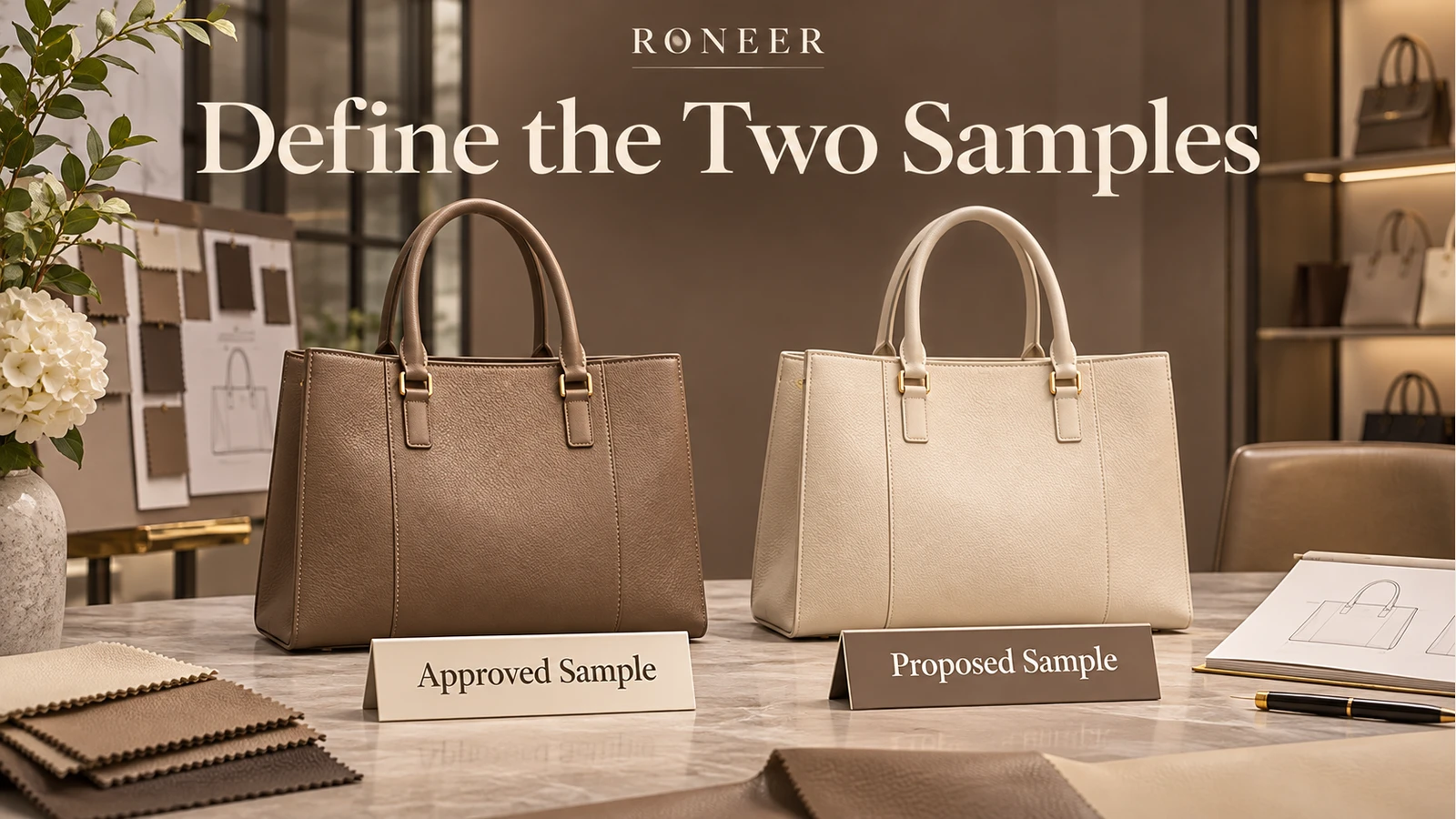
A pre-production sample shows the design and construction that the supplier proposes to make for the order. Buyers use it to check whether specified materials, hardware and work instructions come together in a finished bag. Ideally it represents the planned bulk materials and process. When a part is provisional, a written exception should say exactly which part differs and whether production can proceed.
A golden sample is a controlled physical reference designated after approval. It may be the signed pre-production sample or a matching approved copy. A retailer may require separate copies for its own team, the factory and an inspector. The Product QA and QC approval requirements provide one example of a buyer program requiring a golden sample identical to the approved pre-production sample. Confirm the terminology and copy requirements in your own order documents.
| Decision | Pre-production sample | Golden sample |
|---|---|---|
| Purpose | Check the proposed production configuration | Keep an approved physical reference for reproduction and inspection |
| 상태 | Submitted, under review or approved | Approved and designated for a defined scope |
| Typical evidence | Sample ID, specification revision and pending deviations | Matching revision, sign-off, custody and approved exceptions |
| Change response | Revise the sample or resolve open items | Assess impact and replace or update the controlled reference |
In a Golden Sample vs Pre-Production Sample for Bags comparison, the same physical bag can serve both roles at different times. Until the approval record exists, a label alone has no reliable authority. Conversely, if a buyer approves a written packaging proof separately, the golden bag may represent the product but still need that second document for carton and barcode checks.
Set the Approval Gate Before Cutting Bulk Material
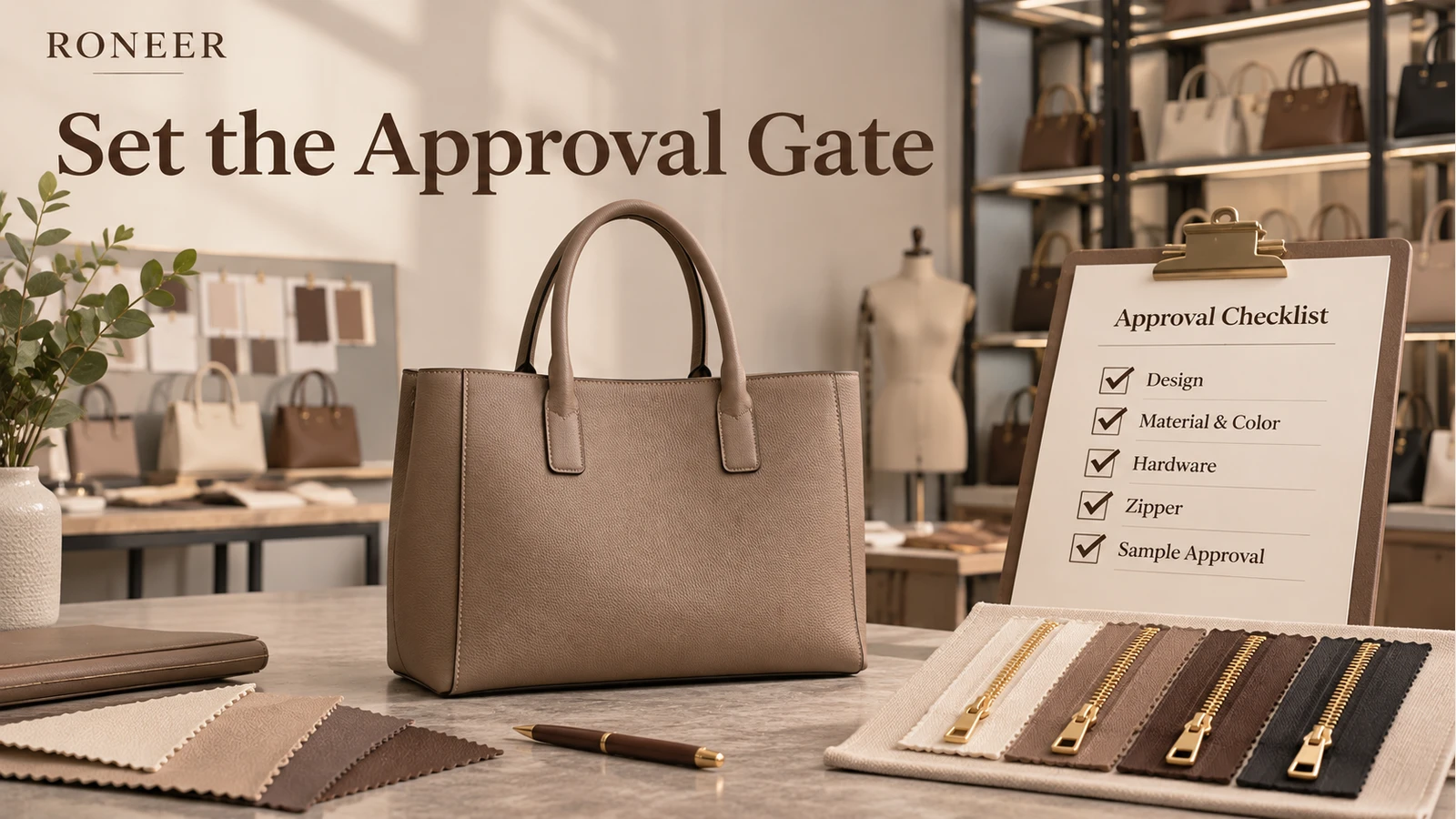
Before requesting a pre-production sample, define which decisions must be closed before the order is released. For an e-commerce travel tote, these may include finished measurements, the opening needed to fit the intended contents, handle attachment, strap drop, external logo alignment, protective packing and the label applied at the warehouse. Give every requirement a reference or test method so an approver can explain the decision later.
A workable Golden Sample vs Pre-Production Sample for Bags process records details at three levels. First, identify the product with a style, color and order number. Second, identify the proposed revision with the sample ID, specification version, component references and artwork date. Third, record the decision and accountable approver, including any item that still requires a physical retest. If the buyer approved a close-up image of the logo only, do not record it as approval of the whole sample.
For a handbag with a rigid base insert, the team might accept the outline while requiring a second review of the opening width. If the opening affects how the product is used, put the order on hold for that requirement. If the remaining item is a packing label that can be approved independently, document the production stages that may proceed and the point at which packing must stop. A conditional approval is useful when it authorizes specific work and has an explicit expiry or checkpoint.
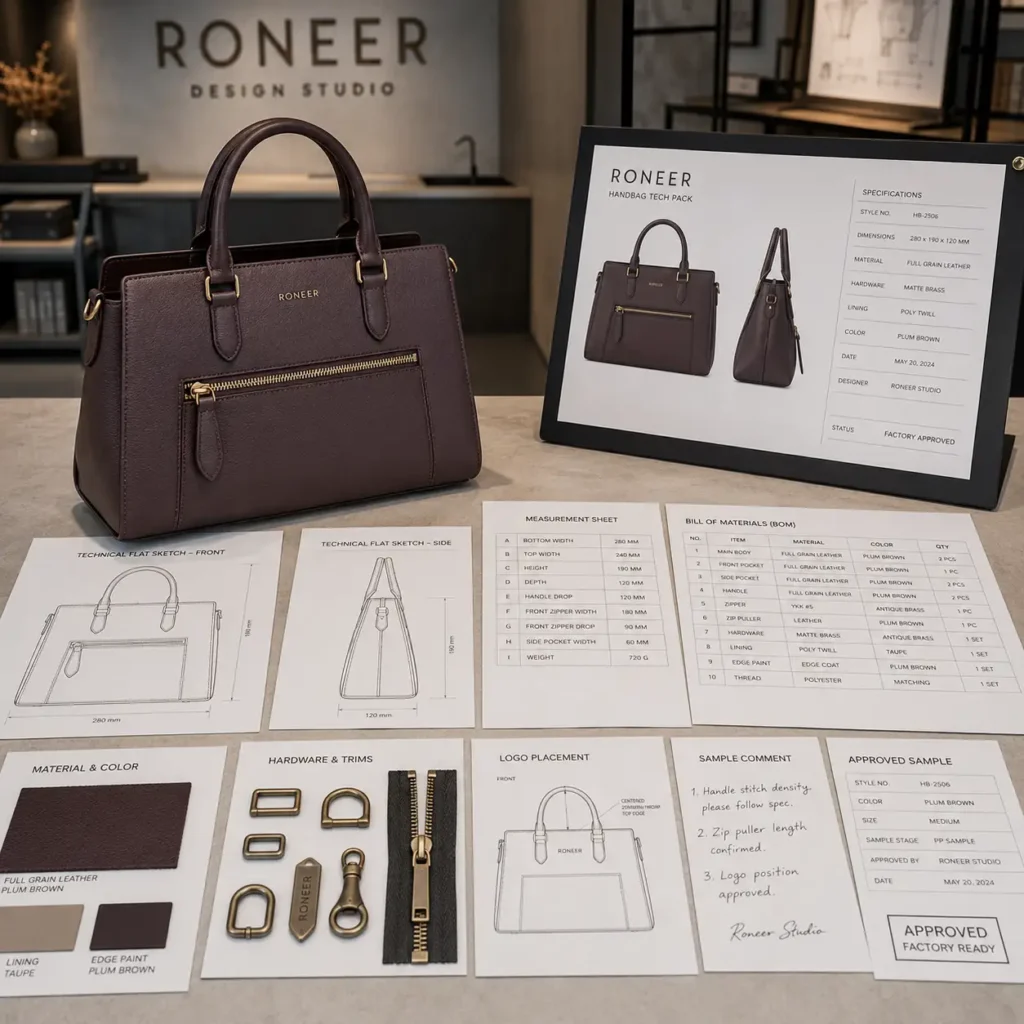
For Golden Sample vs Pre-Production Sample for Bags, keep drawings and the bill of materials attached to the decision. The handbag tech pack guide explains how to document dimensions, materials and construction. A sample confirms how those decisions look and feel together. A signed record prevents the sample room, production line and inspection team from working from different revisions.
Record the Approved Revision and Control Its Copies
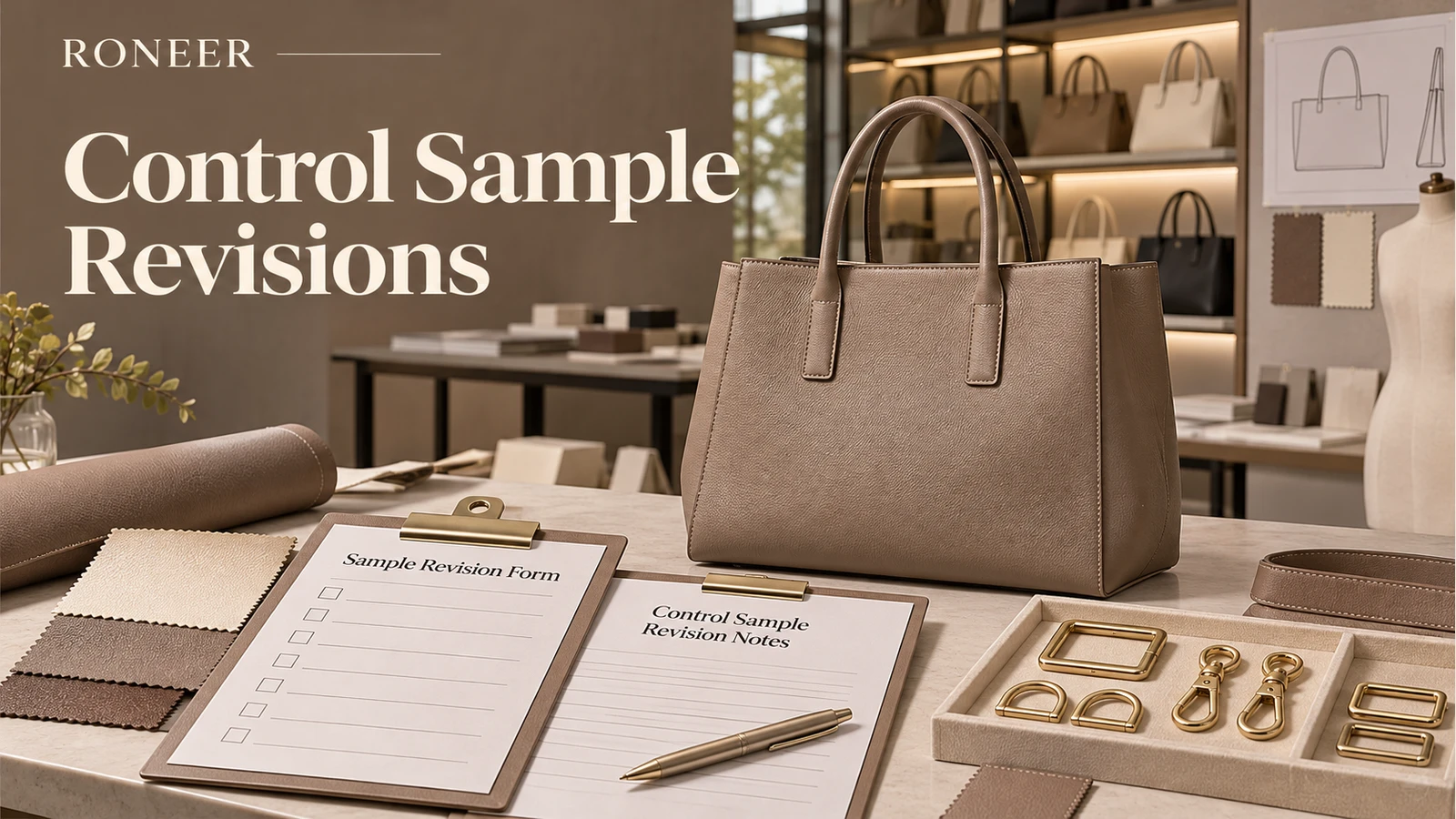
Give each approved copy a label that travels with it. Include the style identifier, color, revision, sample ID, approval date and approving parties. For a sealed reference, record the seal or tag identifier and take photographs of the label and relevant views. Make the record available where the sample is stored, and give the inspection booking contact the same details. Store the bag in a way that protects its finish and makes it accessible without damaging it.
With Golden Sample vs Pre-Production Sample for Bags, the most important handover is often administrative. A factory might keep the approved sample in the development room, while the line leader receives a visually similar working copy. Check that the working copy matches the approved configuration and carries a traceable ID. If its trim differs, label it as a working aid and remove it from approval comparisons.
Do the same for digital copies. Save an approval sheet with the same version as the physical label, and bundle the drawings, artwork, packing proof and approved exceptions in a dated folder. If two records disagree, identify which is authoritative before proceeding. A screenshot of a chat approval may explain the decision, but it is hard to use on a production line unless it points to the exact reference and attributes.
Take photos of the product front, back, interior and any detail likely to be disputed. Document the lighting conditions for shade comparisons where practical. Photos make remote handovers easier, but screen color and perspective can hide differences in finish, stiffness and construction. If shade is material to the decision, agree on physical swatches or samples and how they will be assessed.
Brief Inspectors on What to Compare and What to Measure

An inspector needs the approved sample and a written inspection brief. The sample can illustrate shape, finish and workmanship. Specifications should give measurable limits, such as where to measure a handle drop, and the defect list should describe what happens when a product falls outside the agreed criteria. If the sample and measurements disagree, the brief should state who decides and how the discrepancy is recorded. Do not expect the inspector to settle design intent on the spot.
Golden Sample vs Pre-Production Sample for Bags also affects which comparisons are fair. If the tote on file was approved without a final barcode sticker, the inspector should look to the approved artwork and packaging proof for that check. If only black was approved as a physical bag, identify separate swatches or samples for olive and any other color. A Golden Sample vs Pre-Production Sample for Bags packet can combine several references as long as the scope of each one is clear.
Acceptance sampling answers a separate question about whether sampled production units meet an agreed lot decision rule. ISO 2859-1:2026 describes sampling schemes for inspection by attributes indexed by acceptance quality limit. The appropriate sampling plan, defect definitions and any product-specific tests must be agreed for the order. A golden sample does not set the AQL, prove the batch is defect-free or replace testing for a performance requirement. See RONEER’s bag AQL inspection guide for the inspection workflow.
Respond When Bulk Materials or Components Change

Suppose the approved tote uses a matte zipper pull, and the supplier says the next batch will come with a glossier finish. Start by comparing the proposed part with the agreed reference. Determine whether the change affects appearance, pull operation, logo compatibility, cost or delivery. Ask for a replacement component sample or a revised bag when the interaction with construction matters. Document a decision before the changed parts are issued to the line.
In a Golden Sample vs Pre-Production Sample for Bags workflow, the approved reference should follow the approved decision. If the buyer accepts a different pull for one short run, record the scope, quantity and expiry of the deviation, and give the inspector that written instruction. If the change applies to future orders, update the bill of materials and issue a new reference when the physical differences cannot be communicated reliably in writing. Mark superseded copies and keep them away from active production.
When applying Golden Sample vs Pre-Production Sample for Bags to an active order, use a dated change record. If the change is discovered after production starts, set aside the affected goods, identify the lot or carton range, and record the actual difference. The buyer may choose to approve a documented exception, request rework or hold the order while the impact is investigated. A verbal agreement is difficult to reconcile later if another team books inspection against the older configuration. Ask the supplier to record what changed and what evidence supports the proposed disposition.
A short handover example makes Golden Sample vs Pre-Production Sample for Bags easier to explain. Suppose a navy carryall is approved at revision C and the buyer later accepts a new carton label. Leave the bag reference on revision C if the physical bag is unaffected. Issue the new label proof with its own version and record it against the order. In the Golden Sample vs Pre-Production Sample for Bags handover, list both references on the same sheet. That lets someone who was absent from the meeting identify the correct bag and label on inspection day. If the retailer changes the label again, retain the old version for traceability and remove it from the active checklist.
Buyer FAQs
1. Can a pre-production bag become the golden sample?
Yes. In Golden Sample vs Pre-Production Sample for Bags, an approved pre-production unit can become the designated reference once its revision, approved scope and custody are recorded.
2. Is a prototype first shown at a trade fair good enough?
It can be a starting reference for shape or styling. Verify the exact materials, construction and artwork required for the production order, then approve a sample representative of those requirements.
3. Who signs off each stage in Golden Sample vs Pre-Production Sample for Bags?
Use the approvers named in the order process. Product development, sourcing or quality may share responsibility. Record the person with release authority and the supplier’s acknowledgment of which reference applies.
4. Do I need an approved physical bag in every color?
It depends on what the color change affects. Swatches may be adequate for an agreed shade, while a new coating or trim combination can warrant a finished sample. State the coverage in the approval record.
5. Should a reference travel with every inspection?
Confirm where the inspector can access a traceable copy, ideally before booking. If using photos or swatches in place of some physical comparisons, specify which checks can be performed and which require a hold.
6. Can a supplier start cutting while sample approval is pending?
Golden Sample vs Pre-Production Sample for Bags makes the authorization boundary visible. Agree in writing which preparation, if any, may proceed, and specify which work must wait for approval.
7. What if the golden sample differs from the tech pack?
Document the conflict, identify the approved requirement and update the affected documents. The inspector should receive an explicit decision before treating either version as the acceptance reference.
8. Can a golden sample stand in for load or waterproof testing?
No. Define the required performance, method and sample conditions separately. A sealed reference can show construction, but its appearance does not establish verified performance.
9. Do repeat orders need another sample?
Check whether materials, components, tooling or packing changed, and examine the condition of the retained reference. Golden Sample vs Pre-Production Sample for Bags still matters if a repeat order introduces a new configuration.
10. What should I send with a request to replace the golden sample?
Include the old and proposed revision IDs, what changed, affected orders, required reviews and the date the new reference takes effect. Ask production and inspection teams to acknowledge the change.
Turn Approval Into a Reference Everyone Can Use
Golden Sample vs Pre-Production Sample for Bags comes down to the difference between reviewing a proposed configuration and controlling the one approved for production. Decide which features must be signed off, align the physical reference with its documentation, and tell the inspector how to handle exceptions. In an OEM or ODM project with RONEER, bring the target materials, construction details and approval requirements into the sample discussion early. The team can then review how revisions and inspection references should be recorded for your specific order.