 한국어
한국어  English
  Deutsch
  Español
  Français
  Italiano
  Русский
  日本語
日本語  العربية
  Türkçe
 A bag project can fail long before production starts. The design may look good on a screen, the logo may be clear, and the target price may seem realistic—but if the material is wrong, the final product will feel cheap, lose shape, scratch too easily, or miss the buyer’s market position.
바로 그 때문에 custom bag materials should never be chosen only by photo. A material that works well for a canvas tote may not work for a structured handbag. A soft PU may look attractive for a small pouch but fail on a large tote that needs shape retention. A lightweight nylon may reduce cost, but it may not provide enough strength for a travel bag. For B2B buyers, material choice affects almost everything: MOQ, sample time, unit cost, logo method, durability, packaging, shipping volume, and customer feedback.
In OEM/ODM bag manufacturing, the best material is not always the most expensive one. The best material is the one that matches the bag category, target market, retail price, functional requirement, and production plan. If you are developing a new private label collection, RONEER custom bag manufacturing services can support material sourcing, sample development, logo customization, low MOQ planning, and bulk production for different bag categories.
What Are Custom Bag Materials?
Custom bag materials are the fabrics, leathers, synthetic materials, linings, coatings, trims, and reinforcement components selected for a bag based on its function, appearance, price target, MOQ, and brand positioning.
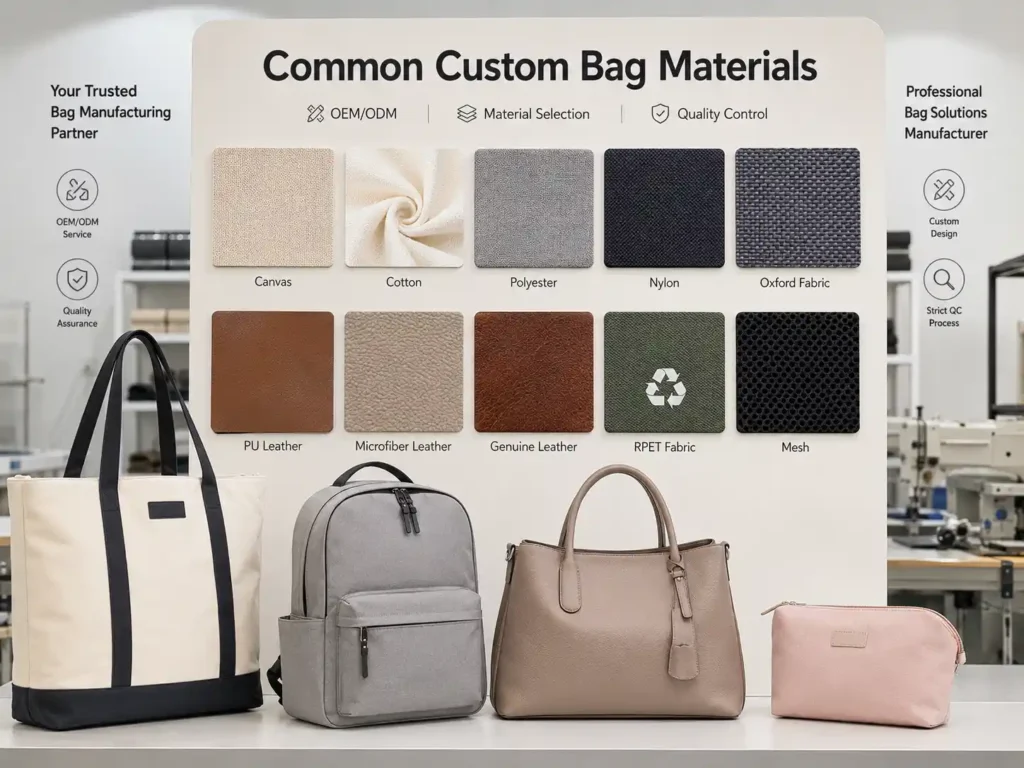
In factory production, custom bag materials may include canvas, cotton, polyester, nylon, Oxford fabric, PU leather, microfiber leather, genuine leather, RPET fabric, mesh, PVC, TPU, jute, non-woven fabric, suede-like materials, lining fabrics, foam padding, webbing, binding tape, and reinforcement boards.
For buyers, the key is to understand that material selection is not a single decision. A finished bag often uses several materials at the same time:
Outer shell material
Lining material
Interlining or padding
Webbing
Binding tape
Zipper tape
손잡이 보강
Bottom support
Logo patch material
하드웨어 마감
Packaging material
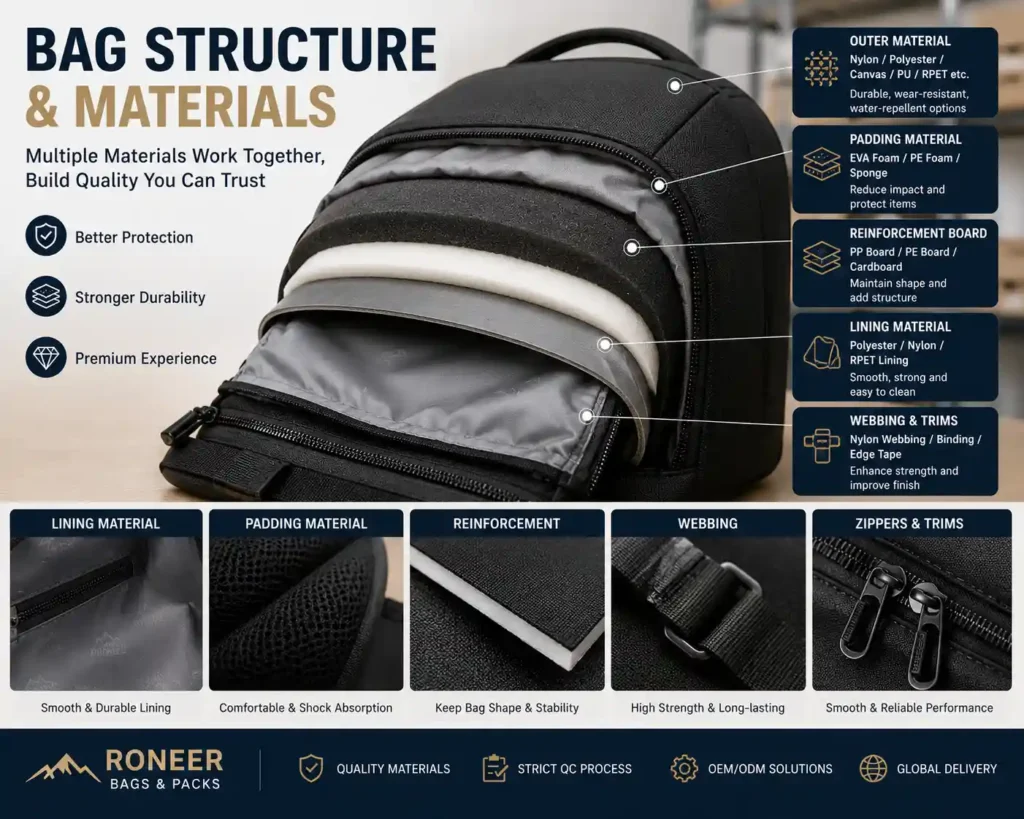
A backpack, for example, may use polyester or nylon as the shell, foam padding for the back panel, mesh for breathable sections, webbing for straps, PU leather for logo patches, and polyester lining inside. A handbag may use PU leather or microfiber as the surface, polyester lining inside, edge paint, metal hardware, and reinforcement material to hold shape.
This is why custom bag materials should be confirmed together with structure, logo, hardware, lining, and packaging—not as an isolated choice.
1. Start With the Bag Category, Not the Material Name
Many buyers begin by asking for “nylon,” “canvas,” or “PU leather.” That sounds specific, but it is not enough. The same material name can have different thicknesses, coatings, hand feels, weights, backing structures, and durability levels.
A better starting point is the bag category.
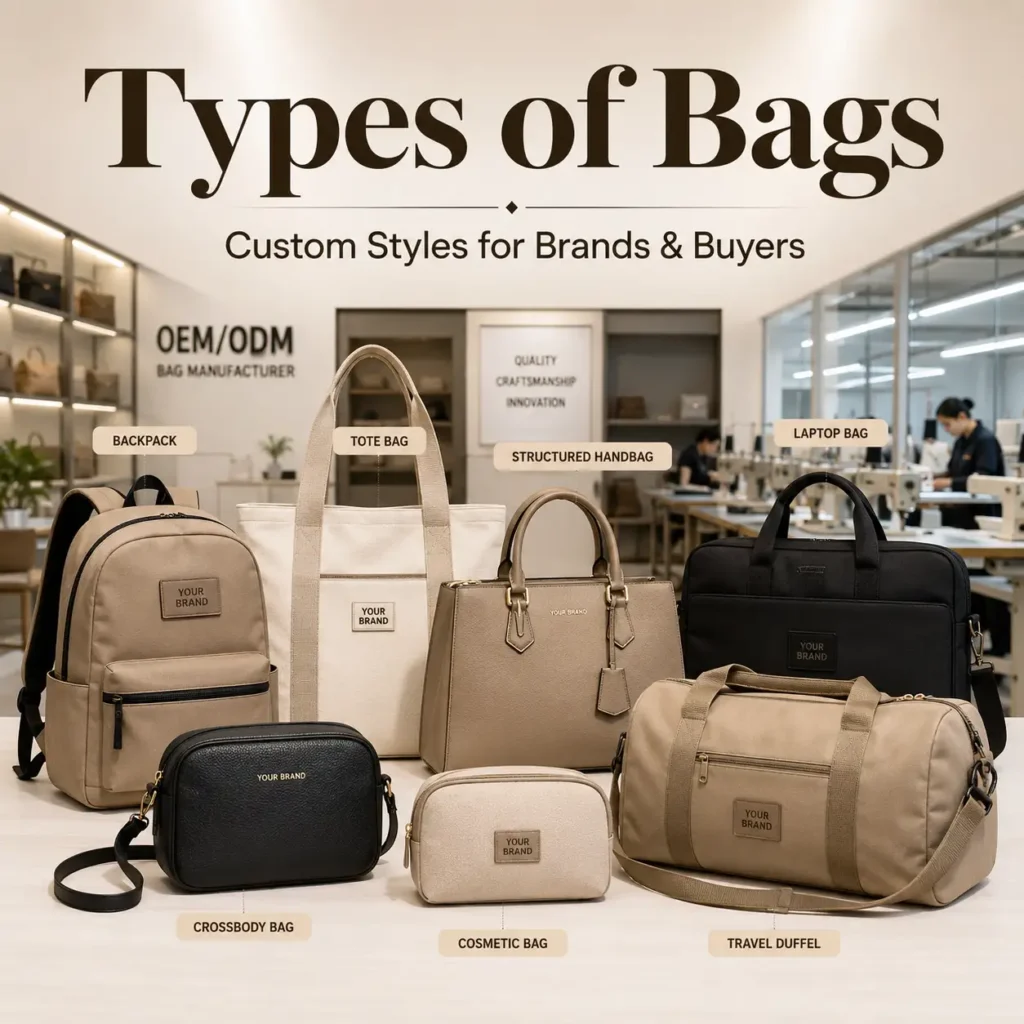
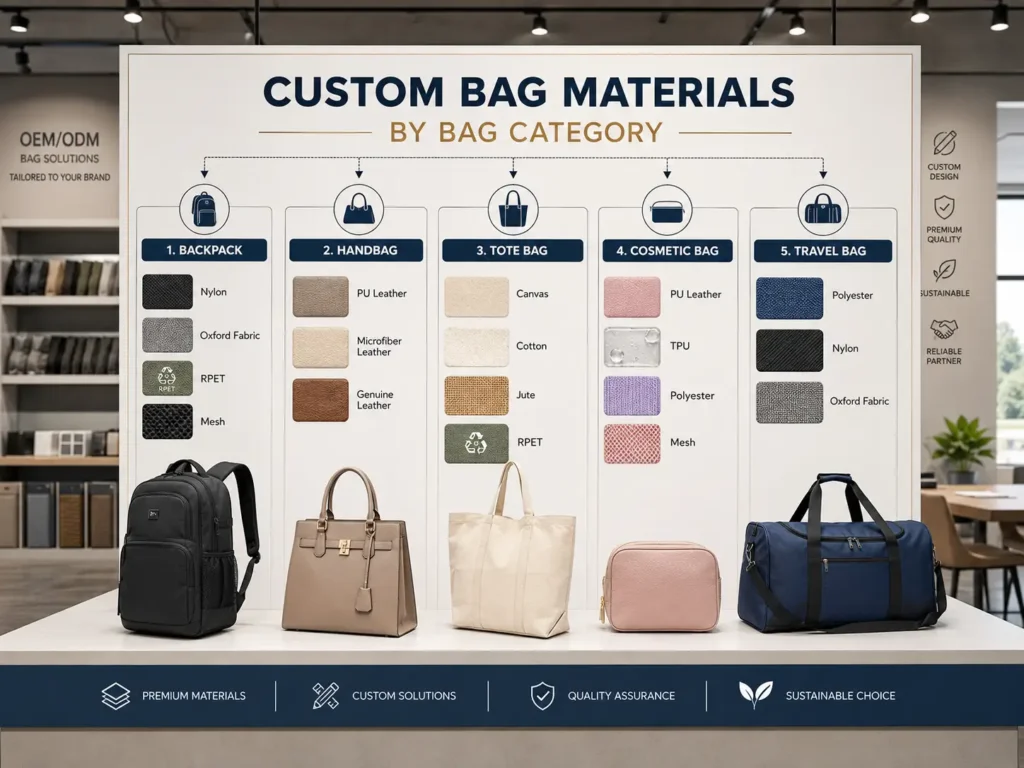
Backpacks usually need strength, tear resistance, comfortable straps, durable zippers, and stable lining. Polyester, nylon, Oxford fabric, RPET, coated fabric, and mesh are common options.
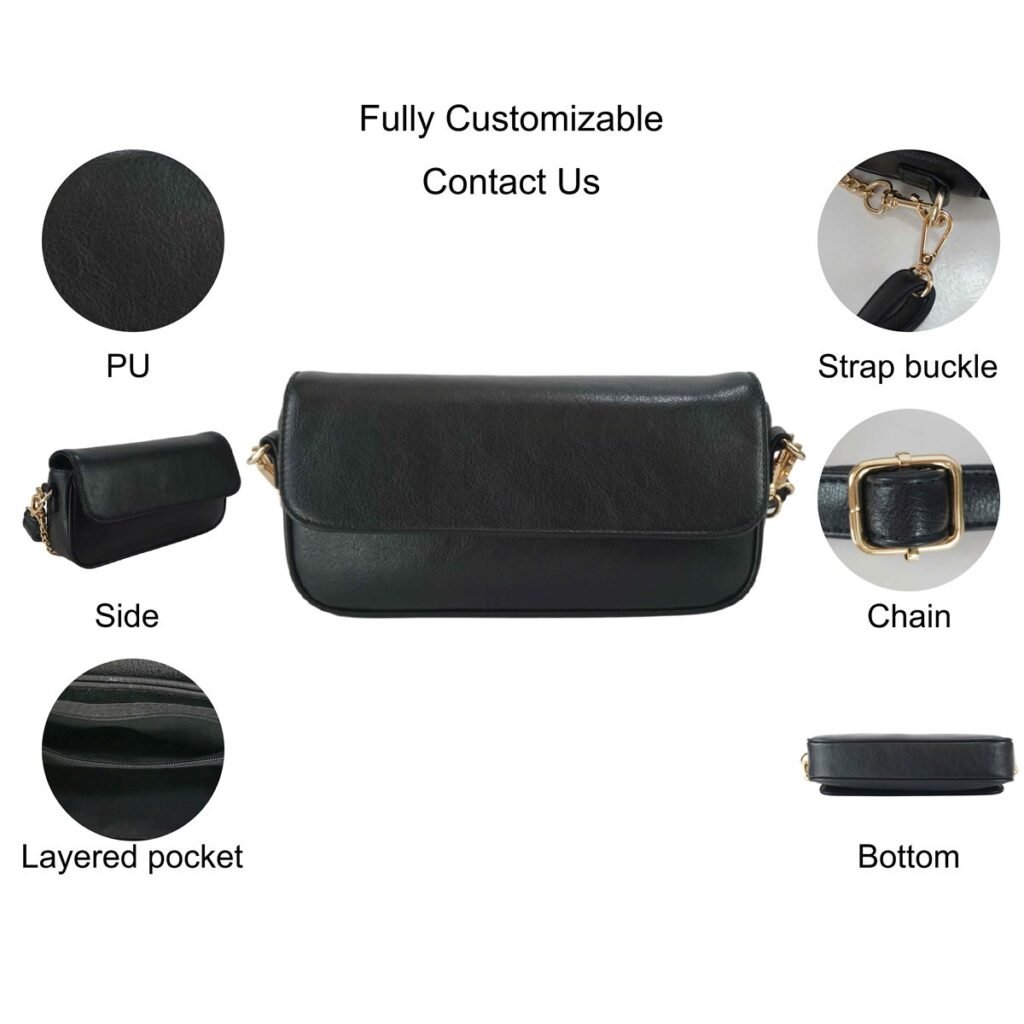
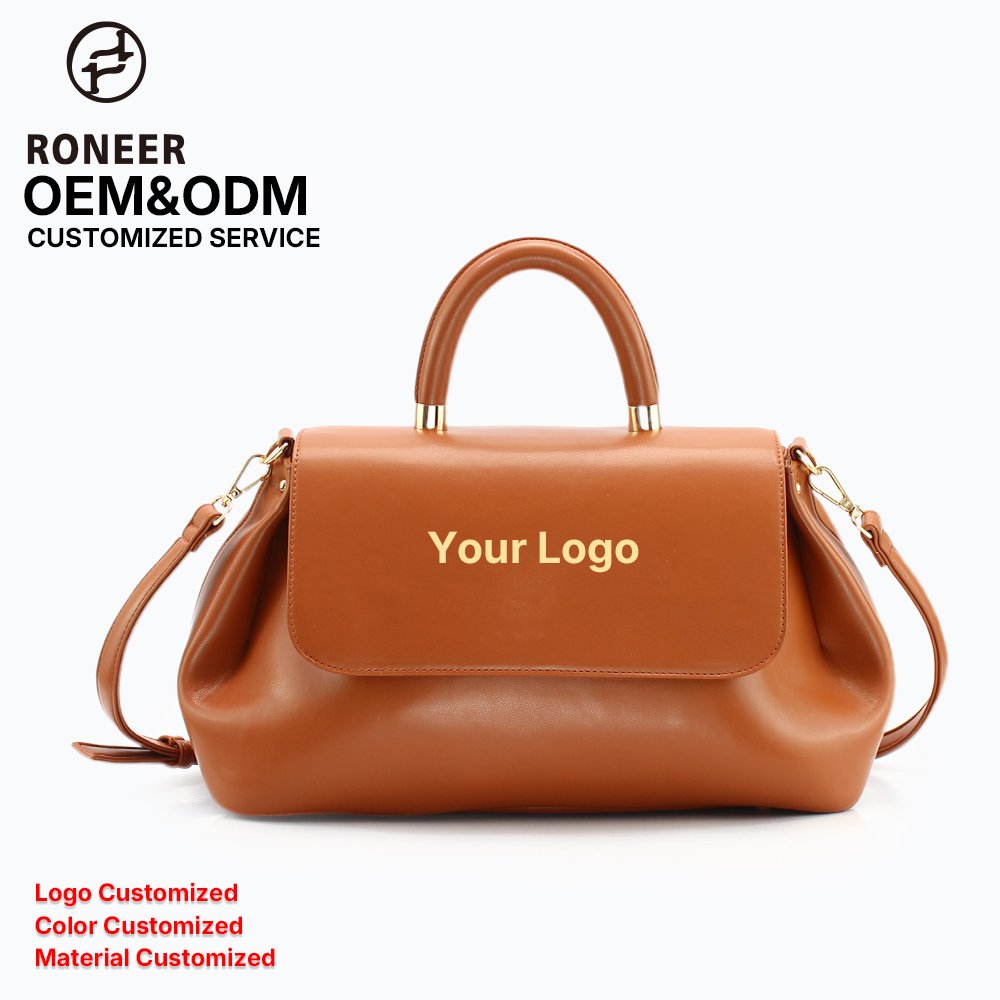
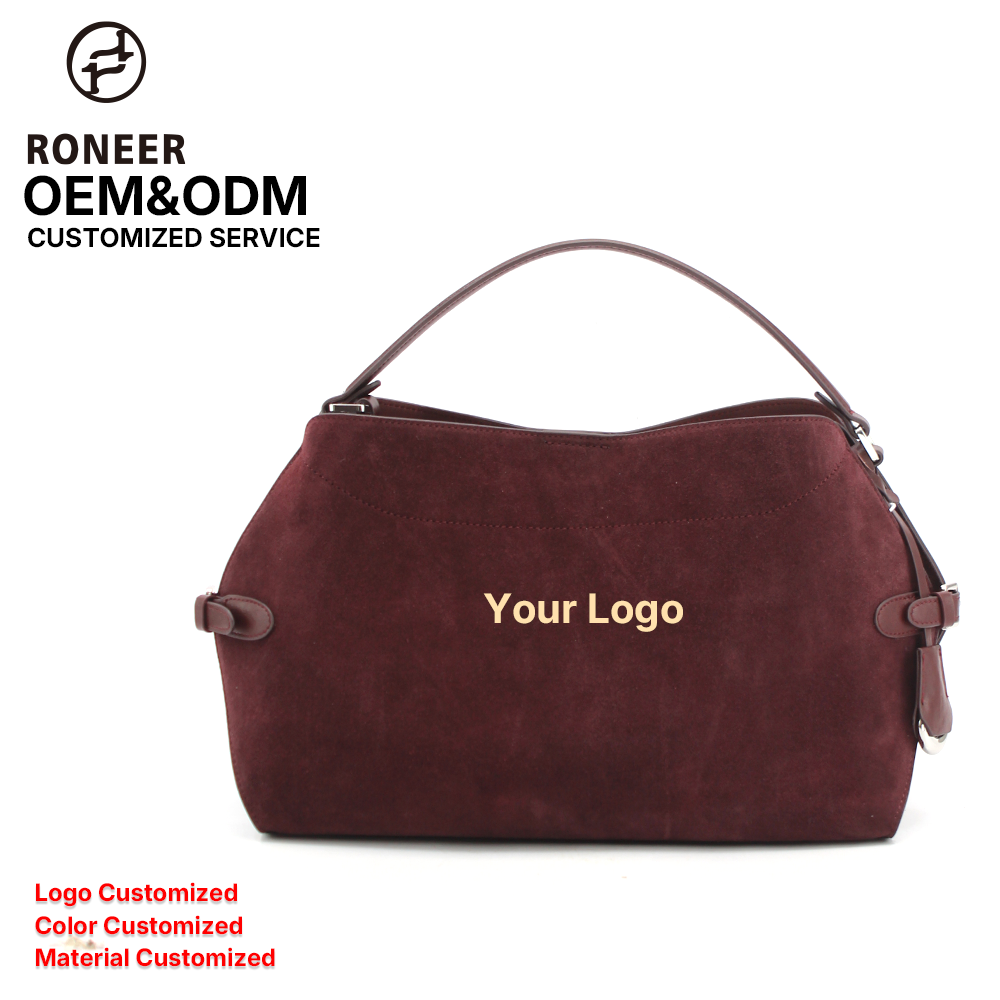
Handbags need surface appeal, shape control, stitching quality, edge finishing, and hardware compatibility. PU leather, microfiber leather, genuine leather, suede-like materials, woven fabrics, and structured textiles are often used.
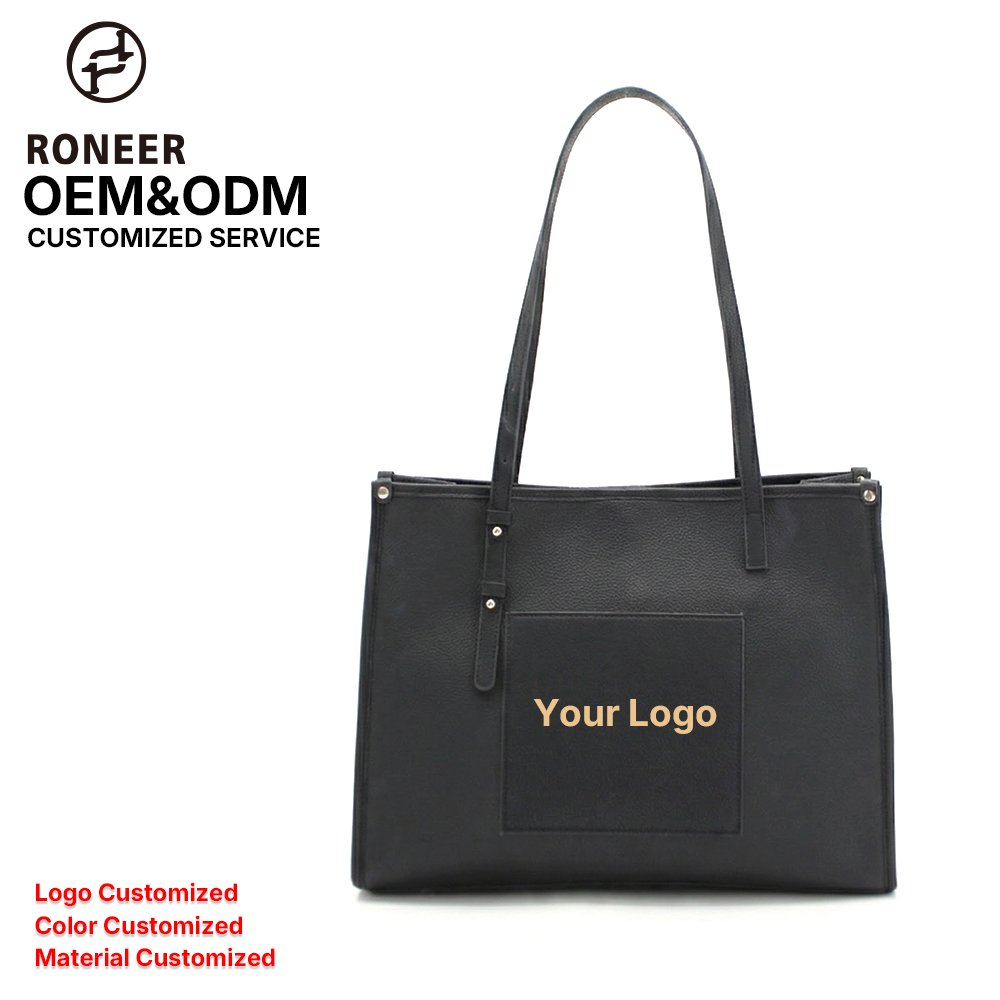
Tote bags can be flexible. Canvas, cotton, polyester, RPET, nylon, jute, PU leather, and laminated materials may all work depending on whether the product is for retail, promotion, fashion, or corporate use.
Cosmetic bags need easy cleaning, compact structure, attractive branding, and often water-resistant or wipeable interiors. PU leather, PVC, TPU, nylon, polyester, satin, mesh, and printed fabrics are common choices.
Travel bags require load-bearing strength, abrasion resistance, handle reinforcement, and packing efficiency. Nylon, polyester, Oxford fabric, canvas, PU-coated fabric, and webbing details are often used.
For buyers comparing bag structures before selecting custom bag materials, custom backpack and wholesale backpack development can help explain how fabric, compartments, padding, zippers, and reinforcement work together in real production.
2. Match Material Quality With Target Price
Material cost can change the entire quotation. Two bags may look similar in a product photo, but their production cost can be very different because of fabric weight, coating, backing, lining, hardware, reinforcement, and finishing.
For entry-level promotional products, buyers may choose non-woven fabric, basic polyester, simple canvas, or standard PU. These materials are useful when logo visibility and budget control are the main priorities.
For mid-range retail products, buyers may choose better canvas, Oxford fabric, nylon, PU leather, microfiber leather, RPET, or mixed-material designs. This level is common for e-commerce brands, private label sellers, and wholesalers.
For premium collections, buyers may consider genuine leather, high-grade microfiber, special woven fabrics, heavy canvas, premium nylon, or custom-developed textures. These options can improve perceived value but may increase MOQ, sampling time, and material cost.
The mistake is not choosing a lower-cost material. The mistake is choosing a material that does not match the expected retail price. A low-cost material can work well for an event tote. It may not work for a boutique handbag that needs premium shelf appeal.
Good custom bag materials planning should balance product value and buyer budget instead of blindly pushing the most expensive option.
3. Compare Common Material Options
Different materials solve different product problems.
Canvas and Cotton
Canvas and cotton are often used for tote bags, casual bags, shopping bags, promotional bags, and lifestyle products. They offer a natural look, good printability, and strong compatibility with screen printing, embroidery, woven labels, and patches.
Canvas can feel more durable and structured than plain cotton. It is suitable for brands that want a casual, eco-style, or retail-friendly look. However, buyers should confirm fabric weight, shrinkage, color fastness, and whether the product needs lining or coating.
폴리에스테르
Polyester is widely used because it is cost-effective, stable, and suitable for many bag types. It can be used for backpacks, travel bags, drawstring bags, cosmetic bags, cooler bags, and promotional products.
It supports printing, lamination, coating, and different textures. For buyers needing low MOQ and controlled cost, polyester is often practical. The final quality depends on denier, weave, coating, color fastness, and backing.
나일론
Nylon usually feels stronger and smoother than many standard polyester options. It is often used for backpacks, outdoor bags, travel bags, lightweight fashion bags, and performance-style products.
It can be more expensive than polyester, but it may provide better hand feel, tear resistance, and premium appearance depending on specification. For outdoor or travel categories, nylon is often a strong option.
옥스포드 원단
Oxford fabric is popular for backpacks, travel bags, tool bags, outdoor bags, and functional products. It is known for its woven texture, durability, and practical appearance.
Buyers should check coating, water resistance, thickness, and abrasion performance before bulk production.
PU 가죽
PU leather is common for handbags, wallets, cosmetic bags, laptop sleeves, and fashion accessories. It offers a leather-like appearance at a lower cost than genuine leather and supports many textures, colors, and logo methods.
However, PU quality varies widely. Buyers should check peeling resistance, surface coating, softness, backing, smell, color fastness, and long-term performance.
Microfiber Leather
Microfiber leather is a higher-performance synthetic material. It can provide better strength, hand feel, and durability than many standard PU options. It is useful for brands that want a premium synthetic alternative or vegan-style positioning.
정품 가죽
Genuine leather is suitable for premium handbags, wallets, small leather goods, business bags, and luxury-style collections. It offers natural value and higher positioning, but buyers should confirm leather grade, surface finish, thickness, color variation, and cost.
RPET Fabric
RPET fabric is made using recycled polyester sources and is often considered by brands looking for recycled material options. Buyers should request proper documents if they plan to make recycled or sustainability claims.
For responsible material discussions, buyers can reference 섬유 교환 as an industry resource. This should support education only; factories should not claim specific certifications unless documents are available for the actual material or order.
4. Check Logo Compatibility Before Sampling
Logo design and material choice are closely connected. A logo method that works on one material may fail on another.
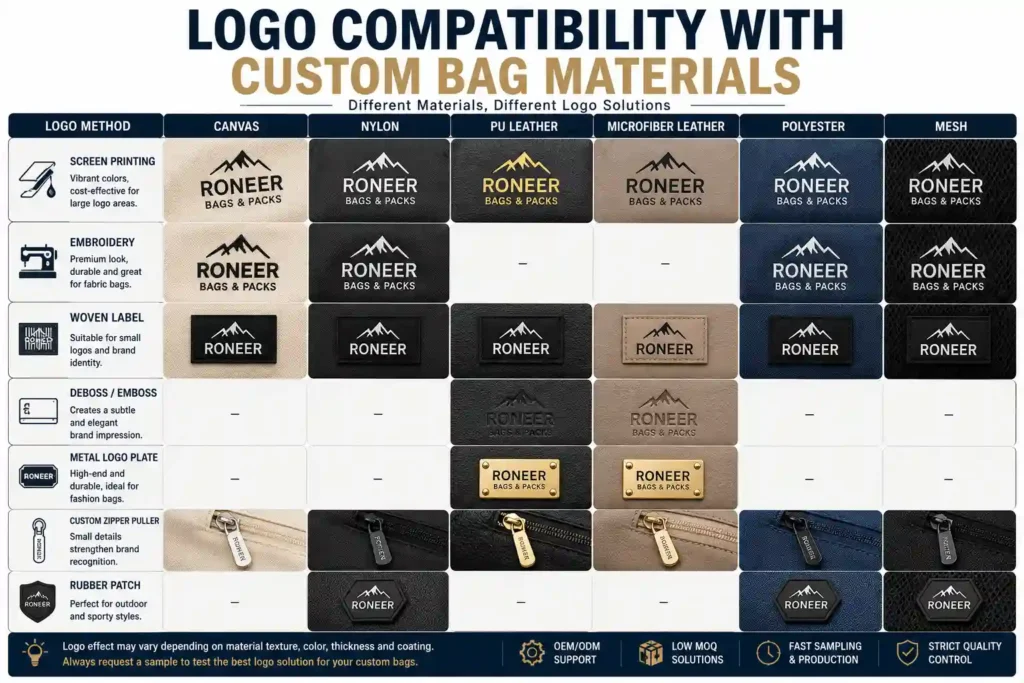
Canvas works well with screen printing, embroidery, woven labels, and patches. Polyester can support heat transfer, screen printing, woven labels, and rubber patches. Nylon may require special testing because some coatings affect adhesion. PU leather can support debossing, embossing, metal logo plates, hot stamping, and custom zipper pullers. Mesh may need woven labels, patches, or alternative branding because direct printing may not be clear.
~에 대하여 custom bag materials, buyers should ask the factory to test logo clarity, adhesion, stitching stability, and color accuracy during sample development.
A detailed logo may not work well on textured material. A metallic logo may look premium on handbags but unnecessary on low-cost promotional bags. A rubber patch may work well on outdoor backpacks but feel too sporty for a boutique fashion line.
If branding is a major part of your project, 로고 사용자 지정 can connect material selection with logo methods such as printing, embroidery, woven labels, metal plates, debossing, and zipper pullers.
5. Think About MOQ Before Choosing Special Materials
MOQ often becomes a problem when buyers choose special materials too early. A custom color, custom texture, special coating, exclusive print, or non-stock material may require a higher minimum order than expected.
Stock materials usually support faster sampling and lower MOQ. Custom-dyed fabric, special PU textures, exclusive prints, custom jacquard fabric, or unusual color combinations may require higher material MOQ.
For startup brands, the smartest route is often to begin with available materials, test the market, then upgrade materials after sales are proven.
A practical low-risk path may look like this:
Start with one core bag style
Use available material colors
Choose a reliable logo method
Keep hardware simple
Confirm packaging step by step
Test customer feedback
Upgrade material in the next order
This approach helps buyers avoid over-investing before they understand demand.
For brands managing low MOQ and cost, smart ways to optimize custom backpack MOQ and costs provides useful planning logic that can also apply to handbags, cosmetic bags, tote bags, and travel bags.
6. Do Not Ignore Lining, Padding, and Reinforcement
Many buyers focus only on outer custom bag materials, but internal materials are equally important. A bag may look good outside but fail in daily use if the lining tears, padding is too thin, or reinforcement is weak.
Lining materials may include polyester, nylon, cotton, satin, RPET lining, printed lining, or waterproof lining. For cosmetic bags, wipeable lining may be important. For laptop bags, soft lining and padding help protect devices. For handbags, branded lining can improve private label presentation.
Padding is important for backpacks, laptop bags, camera bags, and travel products. EVA foam, PE foam, sponge, and other cushioning materials may be used depending on protection needs.
Reinforcement materials help bags keep shape. Structured handbags, bottom panels, handles, and flap covers may require internal support. Without proper reinforcement, the bag may collapse or deform after use.
This is where OEM/ODM factory experience matters. A buyer may choose a beautiful outer material, but the factory must still build the correct internal structure.
For private label projects where material, lining, logo, and presentation need to work together, Private Label Handbag Manufacturer can support the connection between product identity and production details.
7. Confirm Material Testing and QC Standards
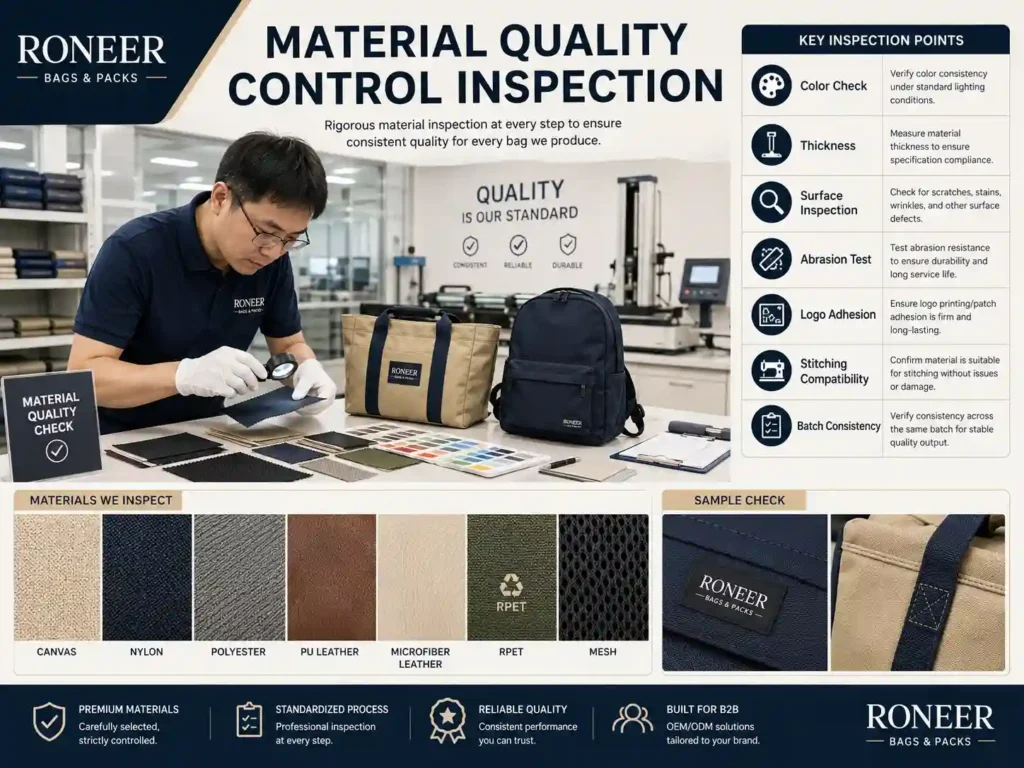
Before bulk production, material quality should be checked carefully. A material that looks acceptable in one sample may create problems in bulk if color, coating, thickness, or backing is inconsistent.
Common material checks include:
Color matching
Thickness check
Surface defect inspection
Color fastness
Peeling resistance
Abrasion resistance
Tear strength
Coating stability
Smell check
Shrinkage check
Water resistance
Logo adhesion
Batch consistency
For zippers and fastening components used with the selected material, buyers may reference YKK for general zipper and fastening knowledge. This should be treated as an industry reference only and not as a claim unless branded components are confirmed in the order.
For material safety and restricted substance requirements, buyers may review OEKO-TEX as a reference for harmful substance testing discussions. Testing claims should be supported by actual documents, not assumptions.
For third-party inspection or shipment verification, organizations such as SGS may support testing and inspection depending on the buyer’s requirements.
A reliable factory should compare bulk materials against approved swatches and final samples before mass production continues.
How Different Buyers Should Choose Materials
An e-commerce seller often needs materials that photograph well, support fast sampling, and keep cost controlled. PU leather, polyester, nylon, canvas, and compact textured materials can be practical choices.
A wholesale buyer needs materials that are stable for repeat orders. Standard colors, proven fabrics, and consistent suppliers help reduce reorder risk.
A startup brand should avoid too many custom-developed materials at the beginning. Available materials with strong logo and packaging presentation may be enough for market testing.
A corporate buyer usually needs practical materials with clear logo visibility and reliable delivery. Polyester, canvas, Oxford fabric, and PU are often useful depending on the product.
A fashion brand may need more seasonal material direction, such as special textures, microfiber leather, woven fabric, mesh, metallic finishes, or structured PU. In this case, sampling and swatch approval become more important.
최고의 custom bag materials strategy depends on how the product will be sold, who will use it, and how much risk the buyer can accept in the first order.
Common Mistakes Buyers Should Avoid
One common mistake is choosing material only from photos. Real swatches are necessary because hand feel, thickness, flexibility, shine, and color can look different in person.
Another mistake is copying a luxury material without matching the target price. A premium-looking reference may require a much higher material budget than expected.
Some buyers choose too many colors at once. More colors can increase MOQ, material management difficulty, and inventory risk.
Another issue is ignoring the logo method. A buyer may choose a textured material, then discover that the logo cannot be printed clearly.
A final mistake is ignoring packaging and shipping. Some materials wrinkle, scratch, deform, or transfer color if packed incorrectly. Material selection should always consider how the bag will be packed and shipped.
자주 묻는 질문
What are custom bag materials?
Custom bag materials are the fabrics, leathers, synthetic materials, linings, coatings, padding, trims, and reinforcement components used to produce a bag according to the buyer’s product type, brand positioning, target price, MOQ, and quality requirements. Common options include canvas, cotton, polyester, nylon, Oxford fabric, PU leather, microfiber leather, genuine leather, RPET fabric, mesh, PVC, TPU, and lining fabrics.
What are the most common custom bag materials for OEM/ODM production?
The most common custom bag materials for OEM/ODM production include canvas for tote bags, nylon and polyester for backpacks, Oxford fabric for travel and outdoor bags, PU leather and microfiber leather for handbags, RPET fabric for recycled material projects, and mesh for breathable or sporty designs. The best choice depends on the bag category, logo method, durability target, MOQ, and budget.
Which custom bag materials are best for backpacks?
For backpacks, the most practical custom bag materials are polyester, nylon, Oxford fabric, RPET fabric, coated fabric, mesh, webbing, foam padding, and durable lining materials. Buyers should check tear strength, abrasion resistance, coating quality, zipper compatibility, strap reinforcement, back panel comfort, and water resistance before approving backpack materials.
Which custom bag materials are suitable for handbags?
For handbags, common custom bag materials include PU leather, microfiber leather, genuine leather, suede-like materials, woven textiles, structured fabrics, polyester lining, reinforcement boards, and metal hardware trims. The right material should match the desired shape, surface texture, hand feel, logo method, hardware finish, edge treatment, and retail price.
Are sustainable custom bag materials available?
Yes. Sustainable or lower-impact custom bag materials may include RPET fabric, recycled PU, organic cotton, recycled lining, reusable packaging materials, or other preferred materials depending on supplier availability. Buyers should request supporting documents before using recycled, organic, eco-friendly, or sustainable claims in product listings or marketing materials.
How do custom bag materials affect MOQ?
Custom bag materials can directly affect MOQ. Stock materials usually support lower MOQ, faster sampling, and better cost control. Special materials such as custom-dyed fabric, exclusive PU textures, printed fabric, special coatings, custom jacquard, or rare colors may require higher material MOQ because suppliers need minimum production quantities.
Can one bag use multiple custom bag materials?
Yes. Most custom bags use multiple custom bag materials in one product. A backpack may combine nylon shell fabric, mesh back panel, polyester lining, foam padding, webbing straps, PU logo patches, and reinforcement materials. A handbag may combine PU leather, microfiber trim, polyester lining, metal hardware, edge paint, and internal support boards.
How should buyers choose the right custom bag materials?
Buyers should choose custom bag materials based on product category, target user, retail price, durability needs, logo method, MOQ, shipping method, and brand positioning. Instead of choosing only by appearance, buyers should request swatches, test samples, confirm hand feel, check color, review thickness, and approve the final production standard.
Which logo methods work best with different custom bag materials?
Different custom bag materials support different logo methods. Canvas works well with screen printing and embroidery. Nylon and polyester often work with woven labels, heat transfer, rubber patches, and zipper puller branding. PU leather and microfiber can support debossing, embossing, hot stamping, metal plates, and custom hardware logos. Logo testing should be done before bulk production.
What quality tests are important for custom bag materials?
Important checks for custom bag materials include color consistency, thickness, surface defects, coating stability, abrasion resistance, peeling resistance, color fastness, tear strength, smell, shrinkage, logo adhesion, stitching compatibility, and batch consistency. For bulk orders, the factory should compare production materials against approved swatches and final samples.
Do custom bag materials affect shipping and packaging?
Yes. Custom bag materials can affect packaging method, carton size, folding style, shipping volume, and product protection. Structured PU handbags may need stuffing and surface protection, while nylon backpacks may need careful folding and strap placement. Light-colored materials may require dust protection and color-transfer prevention during shipment.
결론
Custom bag materials play a major role in how a bag looks, feels, performs, photographs, ships, and sells. For B2B buyers, material selection is not just a design choice. It affects MOQ, sample development, logo application, production cost, durability, packaging method, QC standards, and customer satisfaction after purchase.
A strong custom bag materials strategy should begin with the bag category and target market. Backpacks need strength, comfort, padding, and wear resistance. Handbags need surface appeal, structure, lining, and finishing details. Tote bags need printability, cost balance, and daily-use durability. Cosmetic bags need compact structure and easy-clean interiors. Travel bags need reinforced materials, strong webbing, and abrasion-resistant surfaces.
Before bulk production, buyers should confirm custom bag materials through swatches, sample bags, logo tests, lining checks, padding review, reinforcement details, color tolerance, packaging method, and material QC standards. This process helps reduce material mistakes, avoid unstable bulk quality, and protect the buyer’s brand reputation.
For startup brands, using available custom bag materials can reduce MOQ and speed up sampling. For wholesale buyers, stable material supply helps support repeat orders. For fashion brands, material texture and color direction can shape the entire collection. For corporate buyers, practical materials with clear logo compatibility can improve usability and brand exposure.
If you are looking for an experienced bag factory with flexible OEM/ODM support, fast sampling, low MOQ solutions, stable bulk production, strict quality control, and export experience, RONEER provides custom bag materials sourcing and customized bag manufacturing services for global brands, wholesalers, retailers, corporate buyers, and e-commerce businesses.