 한국어
한국어  English
  Deutsch
  Español
  Français
  Italiano
  Русский
  日本語
日本語  العربية
  Türkçe
 Bulk bag pricing is one of the most important questions for brands preparing a custom bag order. For startups, retailers, wholesalers, Amazon sellers, boutique brands, corporate buyers, and private label companies, the challenge is not only finding a lower unit price. The real goal is understanding what affects bulk pricing, how MOQ changes the final quotation, and how to control cost without reducing product quality.
In this guide, bulk bag pricing refers to bulk pricing for custom bags and private label bag orders, not industrial FIBC bulk bags. The article focuses on B2B bag production for handbags, tote bags, backpacks, cosmetic bags, laptop bags, travel bags, duffel bags, promotional bags, and private label collections.
A bulk bag quote can change depending on material, bag size, structure, MOQ, logo method, hardware, lining, labor difficulty, packaging, QC, export packing, and sample approval. Two bulk orders may look similar from the outside, but their final pricing can be very different if one uses standard fabric and simple logo printing while another uses upgraded materials, custom hardware, branded packaging, and stricter inspection requirements.
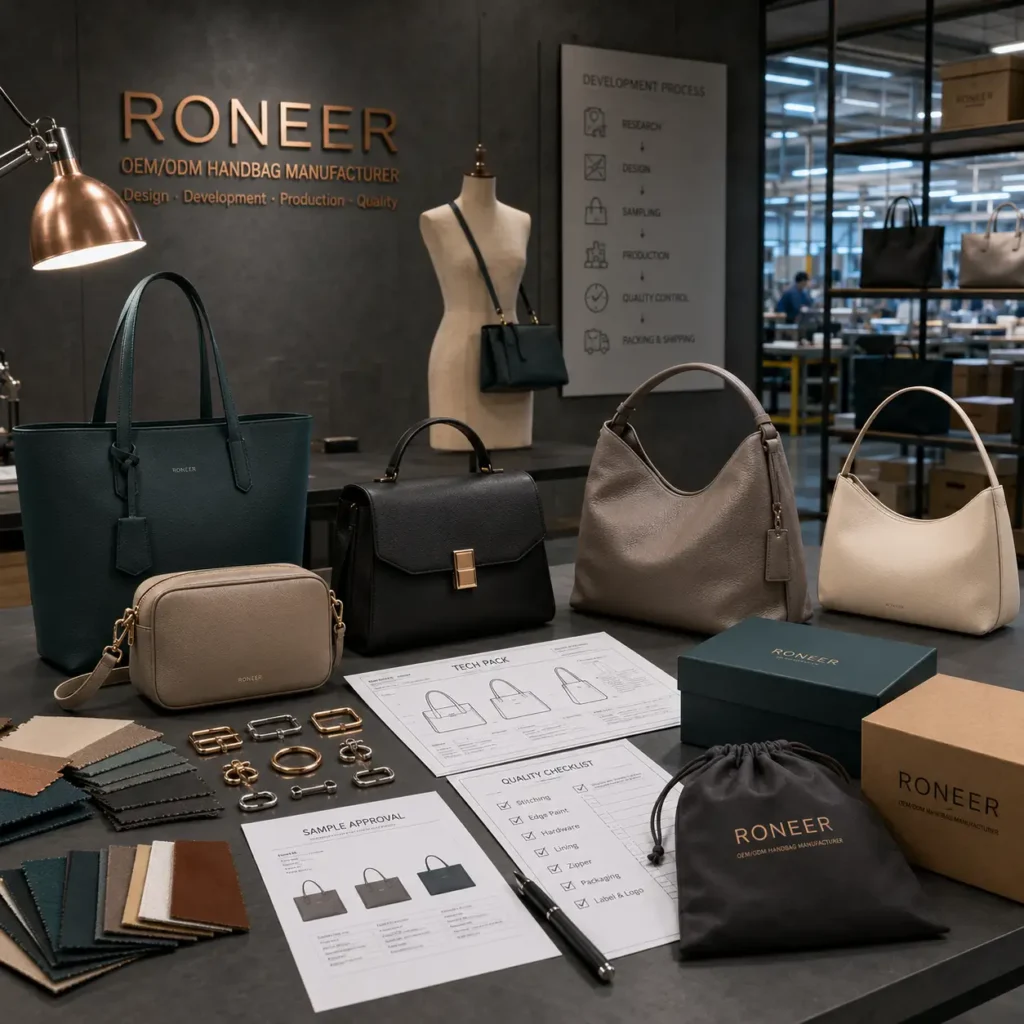
RONEER supports OEM/ODM custom bag development for global buyers, including private label bags, custom logo bags, low MOQ discussion, material customization, logo customization, packaging customization, QC, bulk production, export packing, and global shipping support. Buyers can review RONEER’s wider production direction on the custom bag manufacturing website.
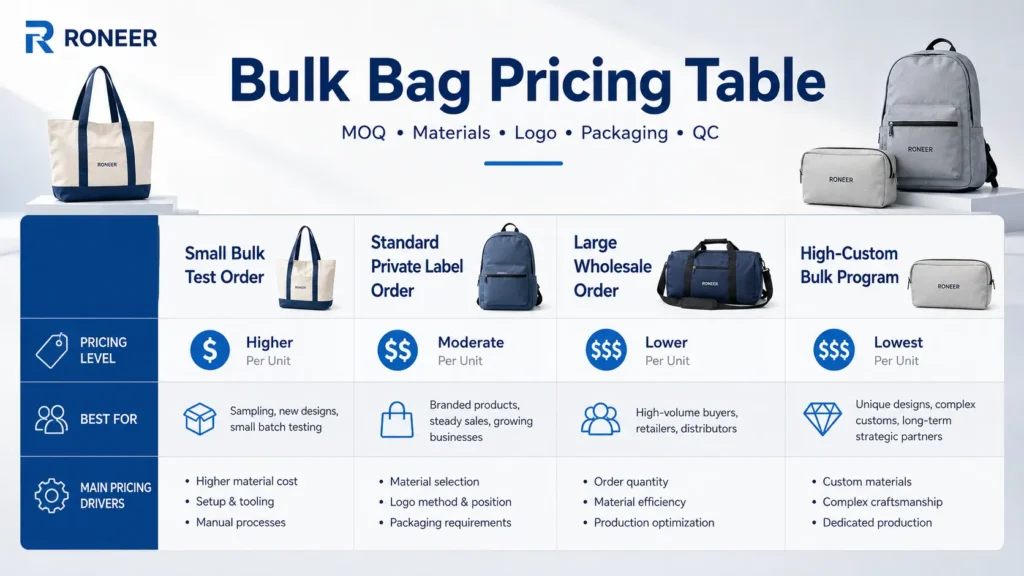
Bulk Bag Pricing Table for Brand Buyers
Bulk bag pricing should not be treated as one fixed number. A small test order, a standard private label order, a large wholesale order, and a high-custom bulk program all require different materials, production planning, packaging, and QC arrangements.
The table below gives buyers a practical bulk pricing framework. It is not a fixed quotation. It helps explain why different bulk custom bag orders fall into different pricing levels.
| Bulk Order Level | Typical Pricing Influence | 최상의 대상 | Buyer Notes |
|---|---|---|---|
| Small bulk test order | Higher unit cost because setup work, material sourcing, logo preparation, and QC are spread across fewer pieces | Startups, new product testing, first private label orders | Useful for testing the market, but buyers should keep materials, colors, hardware, and packaging simple. |
| Standard private label bulk order | Moderate pricing when using better materials, custom logo, standard hardware, lining, dust bag, hang tag, and carton labels | Boutique brands, Amazon sellers, DTC brands, small retail collections | Often the most practical level for brands that need a balance of MOQ, cost, and brand presentation. |
| Large wholesale order | More competitive unit cost because material purchasing, labor arrangement, production planning, and packing efficiency improve | Wholesalers, retail buyers, repeat orders, established product lines | Requires clear specifications, approved samples, stable materials, and organized QC before bulk production. |
| High-custom bulk program | Higher total investment due to custom molds, exclusive materials, multiple colorways, premium packaging, and strict quality requirements | Established brands, premium launches, long-term private label programs | Best for buyers with detailed specifications, realistic MOQ, and enough time for sample revisions and production planning. |
This bulk bag pricing table helps buyers understand why one quote may be lower and another may be higher. A factory cannot calculate accurate bulk pricing from a rough photo alone. Reference images, dimensions, material preferences, order quantity, logo method, packaging details, and target market all matter.
What Does Bulk Bag Pricing Include?
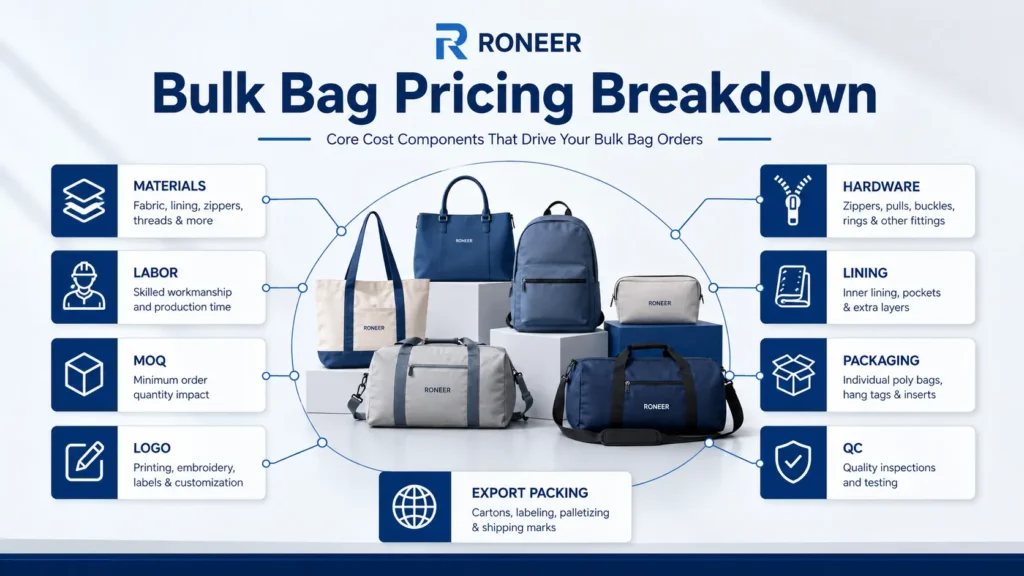
Bulk bag pricing is built from several production and sourcing layers. A reliable factory quotation should include the work required to prepare, produce, inspect, pack, and ship the order.
The main bulk pricing factors include:
- Main material
- Lining material
- 하드웨어
- Zippers and closures
- 로고 방식
- Size and structure
- 패턴의 복잡성
- Labor and sewing difficulty
- MOQ and production efficiency
- Sample development
- 포장
- QC inspection
- Export carton packing
- Special testing or documentation if required
A low quote may look attractive, but it may not include the same material quality, stitching standard, logo finish, hardware level, packaging method, or QC scope as a higher quote. This is why buyers should avoid comparing bulk bag pricing by unit price alone.
For example, one tote bag order may use basic canvas, standard webbing, and screen printing. Another tote bag order may use heavier cotton canvas, contrast handles, inner pockets, embroidery, woven labels, dust bags, barcode stickers, and export carton labels. The second project will naturally have higher bulk bag pricing because each added detail increases material, labor, setup, and inspection work.
Material Choice Has a Major Impact on Bulk Bag Pricing
Material is one of the strongest factors behind bulk bag pricing. The surface material affects cost, appearance, durability, hand feel, weight, MOQ, cutting efficiency, and customer perception.
Common materials for bulk custom bag orders include:
- PU 가죽
- Microfiber leather
- 캔버스
- Cotton fabric
- 나일론
- Oxford fabric
- 폴리에스테르
- RPET fabric
- Mesh fabric
- Denim
- Jacquard fabric
- Waterproof coated fabric
- Lining fabric
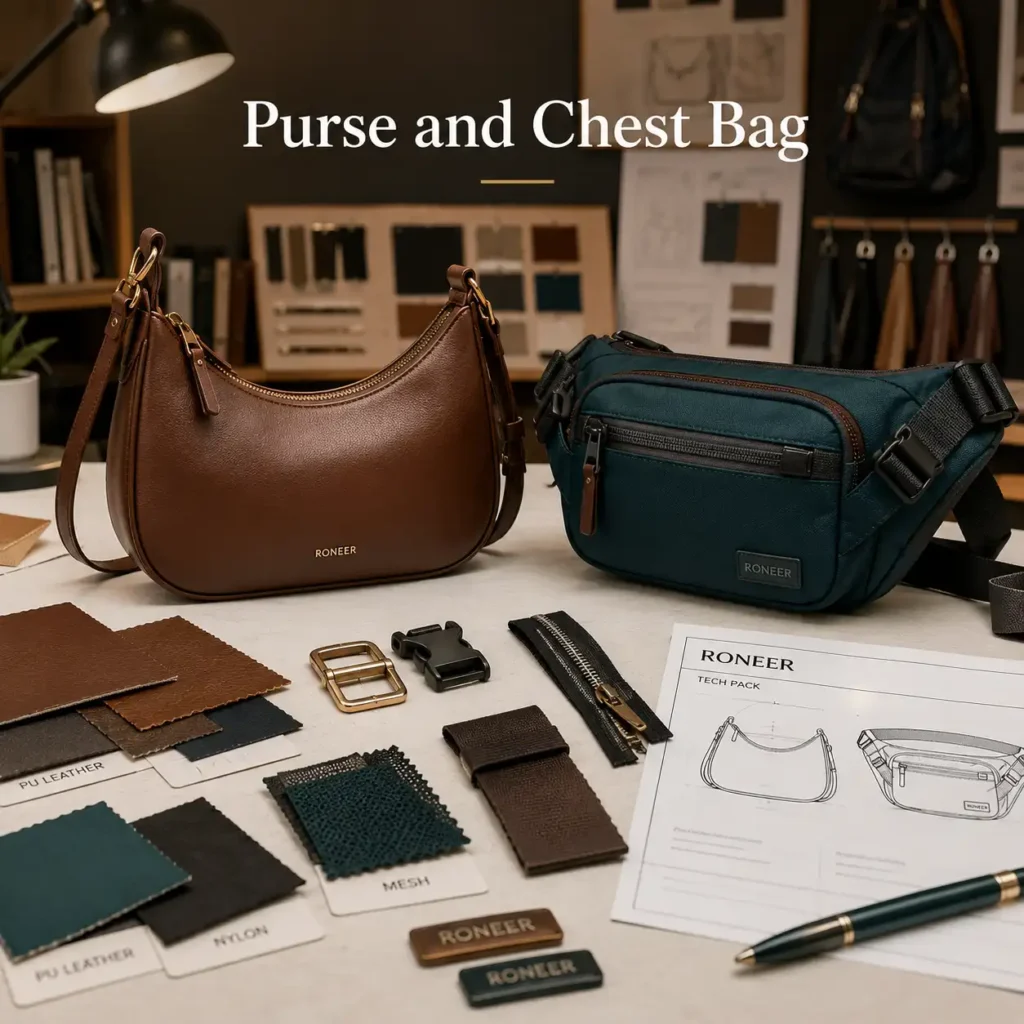
Canvas and cotton fabrics are common for tote bags, lifestyle bags, promotional bags, and retail shopping bags. Nylon and Oxford fabric are often used for backpacks, laptop bags, travel bags, duffel bags, and outdoor bags because they can offer durability and lighter weight. PU leather and microfiber leather are more common for handbags, fashion bags, wallets, and premium private label collections.
If your brand is considering recycled or preferred materials, resources such as 섬유 교환 can be used as an industry reference for broader material trends. However, recycled content, sustainability claims, and certification documents should always be confirmed for each specific order. Buyers should not assume a material is certified unless valid documentation is provided for that project.
RONEER can support material discussions based on your bag type, target price, MOQ, and brand positioning. Buyers can review more options through RONEER’s material customization service.
How MOQ Changes the Unit Price
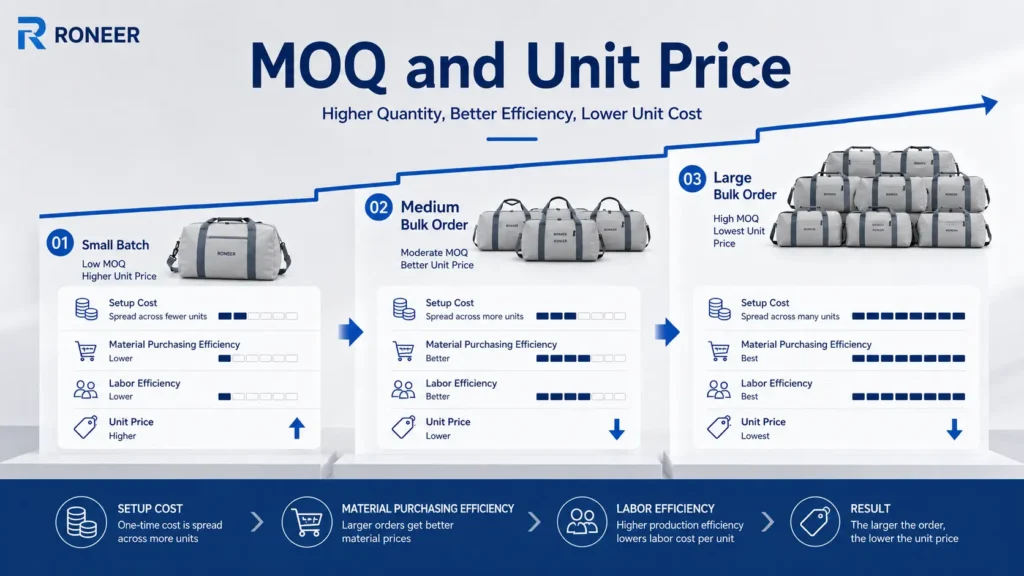
MOQ has a direct effect on bulk bag pricing. Many buyers expect larger quantities to reduce unit cost, and this is often true, but the reason is not only “more pieces mean cheaper.” The real reason is production efficiency.
Factory setup may include:
- Material sourcing
- Pattern making
- Cutting preparation
- Logo setup
- Hardware sourcing
- Packaging preparation
- Worker arrangement
- Production line setup
- QC arrangement
- Carton packing preparation
When the quantity is low, these setup costs are spread across fewer bags. This makes the unit price higher. When the order quantity increases, material purchasing becomes more efficient, cutting and sewing can be better organized, packaging preparation becomes smoother, and QC resources can be planned more effectively.
Bulk bag pricing becomes more competitive when the design uses stable materials, standard hardware, confirmed logo methods, approved packaging, and repeatable production steps. However, a larger quantity does not automatically solve every cost issue. If the project requires exclusive material colors, custom molds, multiple SKUs, complex packaging, or strict testing requirements, the total order investment may still be higher.
To improve bulk pricing, buyers can consider:
- Starting with fewer colorways
- Using available materials
- Choosing standard hardware
- Simplifying the logo method
- Reducing packaging complexity
- Avoiding custom molds in the first order
- Confirming one core style before expanding the collection
- Planning repeat orders with the same material and hardware
RONEER can discuss low MOQ and bulk order options based on bag type, material, logo method, packaging, and production requirements. Buyers can also review this guide on custom bag MOQ and cost optimization to understand how quantity and production setup affect unit cost.
Bag Structure and Labor Difficulty
Bag structure also affects bulk bag pricing. A simple flat tote bag is easier to produce than a structured backpack, laptop bag, travel bag, or handbag with multiple compartments and reinforced panels.
Details that may increase labor cost include:
- Multiple compartments
- Internal zipper pockets
- Reinforced bottom panels
- Structured side panels
- Padded shoulder straps
- Laptop compartments
- Piping
- Edge painting
- Detachable straps
- Metal feet
- Hidden magnetic buttons
- Multiple material combinations
- Complex flap closures
A more complex design can improve product function and perceived value, but it also increases material consumption, sewing time, pattern accuracy requirements, and QC work. For large orders, even small production details can affect the final pricing because they are repeated across hundreds or thousands of pieces.
A factory should review not only the product photo but also the internal structure, reinforcement method, pocket layout, stitching details, and hardware attachment points. This helps avoid inaccurate quotations and unexpected production problems.
Logo, Hardware, and Packaging Affect Bulk Pricing
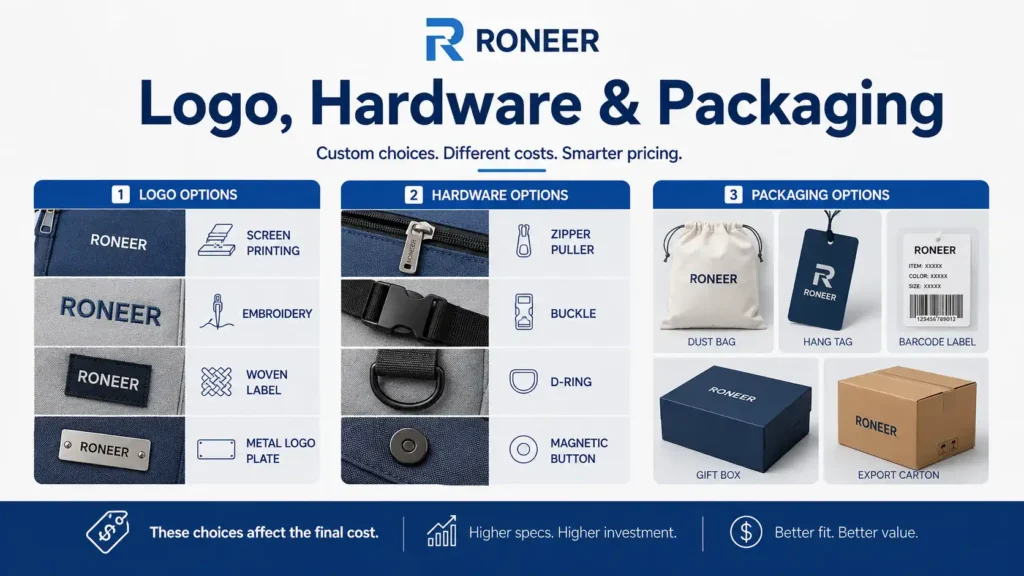
Branding details are important in private label bulk orders. Logo, hardware, and packaging can improve the final product presentation, but they also affect bulk bag pricing.
Common logo methods include:
- 스크린 인쇄
- Heat transfer printing
- Embroidery
- 직조 라벨
- 고무 패치
- PU patch
- Metal logo plate
- Debossed logo
- Embossed logo
- Foil stamping
- Custom zipper puller
- Custom hardware logo
A simple printed logo is usually more cost-effective. Embroidery can work well for canvas and fabric bags. Metal logo plates, custom zipper pullers, and custom hardware can create a stronger brand identity, but they may require molds, a higher MOQ, plating, a longer development time, and additional approval steps.
Buyers can explore RONEER’s logo customization options before deciding which logo method fits the product and budget.
Hardware also affects bulk bag pricing. Buckles, hooks, D-rings, sliders, magnetic buttons, zipper pullers, rivets, metal logo plates, plastic buckles, and decorative trims all add cost. Standard hardware is usually more affordable and easier to source. Custom hardware can make the product more distinctive, but it can also increase setup cost and lead time.
Zippers and fastening components also influence quality and price. Buyers may use well-known fastening companies such as YKK as an industry reference when discussing zipper types and fastening performance. This does not mean a specific zipper brand is used by default. Final component selection should be confirmed based on order requirements, budget, and approved sample.
Packaging can also change bulk bag pricing. Private label packaging may include dust bags, printed polybags, hang tags, barcode stickers, care labels, tissue paper, insert cards, gift boxes, carton labels, and export carton packing. RONEER can support packaging discussions based on product type and sales channel. Buyers can review the packaging customization service for more packaging ideas.
Sample Cost vs Bulk Production Cost
Sample cost is different from bulk production cost. Buyers sometimes expect the sample price to match the final bulk unit price, but sampling is a separate development stage.
A sample may require:
- Pattern making
- Material sourcing
- Small quantity cutting
- Manual adjustment
- Logo testing
- Hardware matching
- Structure correction
- Sample worker time
- Revisions after buyer feedback
Because sample production is not as efficient as bulk production, the sample cost is often higher than the final bulk unit price. This is normal for custom bag development.
For bulk orders, the sample stage is important because it confirms the approved design before mass production. Buyers should check material, size, structure, stitching, logo position, hardware color, zipper function, lining, packaging, and overall appearance before moving into bulk production.
When reviewing bulk bag pricing, buyers should separate sample development cost from bulk production cost. A clear sample approval process can reduce production mistakes and protect the buyer’s budget.
QC and Export Packing Protect Bulk Orders
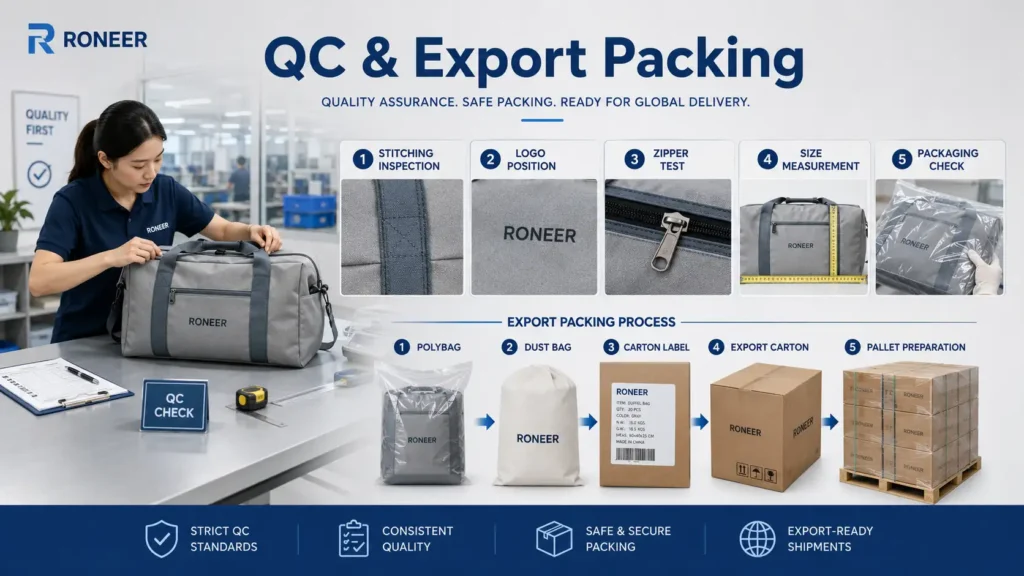
Quality control is part of real bulk bag pricing. A very low quote may look attractive, but if it does not include enough inspection and production control, the risk can be much higher.
Common QC checkpoints include:
- Material inspection
- Color checking
- Cutting accuracy
- Stitching quality
- 로고 위치
- Hardware function
- Zipper smoothness
- Size measurement
- 라이닝의 청결도
- Strap strength
- Packaging accuracy
- Final random inspection
For testing, inspection, and quality control background, organizations such as SGS can be used as an industry reference. This does not mean every product automatically needs third-party inspection, and it does not mean RONEER has a specific certification unless confirmed. Buyers should decide inspection and testing requirements based on product type, sales channel, market, and order requirements.
Export packing also affects bulk bag pricing. Large orders need organized carton packing, carton marks, SKU labels, barcode labels, polybags, dust bags, shape protection, and shipping preparation. Poor packing can cause deformation, scratches, stains, carton damage, or shipment confusion.
For international bulk orders, QC and export packing should not be treated as optional extras. They help reduce returns, claims, delays, and brand damage after shipment.
How to Reduce Bulk Bag Pricing Without Reducing Quality
The best way to reduce bulk bag pricing is not to remove every detail. The better approach is to decide which details matter most to your customer and which details can be simplified.
Practical ways to control bulk pricing include:
- Use available materials for the first order
- Start with fewer colorways
- Choose standard hardware before custom molds
- Keep the structure clean and efficient
- Use a logo method that matches the material
- Avoid overcomplicated packaging in the first production run
- Confirm all details before sampling
- Approve the sample carefully before bulk production
- Keep clear written specifications
- Plan MOQ realistically
- Use repeat materials and hardware for future orders
Cost control should not damage the bag’s core quality. Reducing unnecessary packaging may be reasonable, but using weak hardware on a premium bag may create problems. Simplifying an internal pocket may be acceptable, but reducing stitching strength at stress points may affect durability.
A professional factory should help buyers find this balance. RONEER can review your bag design, target price, MOQ, material preference, logo requirement, and packaging needs to suggest practical bulk pricing options.
What Buyers Should Send to Get an Accurate Bulk Bag Quote
To get realistic bulk bag pricing, buyers should provide clear project details. A vague inquiry such as “Please quote bulk bags” is not enough for accurate pricing.
Prepare the following information:
- Bag type
- Reference images or design sketch
- 크기
- Material preference
- 색상
- Lining requirement
- Hardware color
- 로고 방식
- Logo size and position
- Pocket structure
- Strap or handle details
- 예상 주문 수량
- Target price range
- Packaging requirements
- Destination country
- Expected delivery time
- Sales channel or target market
If you do not have a complete tech pack, you can still start with reference images and a clear explanation of your target market. A capable factory can help organize the next development steps.
The more complete your information is, the easier it is for the factory to calculate bulk bag pricing accurately. If you only send one product photo without size, material, quantity, logo, or packaging details, the factory can only provide a rough estimate.
Bulk Pricing for Wholesale and Repeat Orders
Bulk bag pricing becomes more efficient when buyers plan repeat orders. If the same material, hardware, logo method, packaging, and pattern are reused, the factory can reduce development uncertainty and improve production planning.
Wholesale buyers often benefit from:
- More stable material purchasing
- Better production scheduling
- More efficient labor arrangement
- Repeated quality standards
- Faster sample confirmation
- More consistent packaging
- Easier carton planning
For buyers developing backpacks, travel bags, outdoor bags, or wholesale bag collections, repeat order planning can make sourcing more predictable. Buyers can also review RONEER’s wholesale backpack production page for related bulk order ideas.
However, repeat orders still need quality control. Material batches, color shades, hardware finishes, and packaging details should be checked each time. A stable supplier should keep records of approved samples, material specifications, logo details, and packing requirements.
자주 묻는 질문
1. What does bulk bag pricing mean?
Bulk bag pricing refers to the cost structure for producing custom bags or private label bags in larger quantities. It usually includes material, labor, logo, hardware, packaging, QC, export packing, and MOQ-related production setup.
2. Why does bulk bag pricing vary between factories?
Bulk bag pricing varies because factories may quote different materials, hardware quality, logo methods, packaging levels, QC standards, labor processes, and production capabilities. Buyers should compare specifications, not only the unit price.
3. Does MOQ affect bulk bag pricing?
Yes, MOQ strongly affects bulk bag pricing. Smaller bulk orders usually have higher unit costs because setup work is spread across fewer pieces. Larger orders may reduce unit cost through better material purchasing, labor efficiency, and production planning.
4. What information is needed for accurate bulk bag pricing?
To get accurate bulk bag pricing, buyers should send bag type, reference images, size, material, color, logo method, hardware, lining, quantity, packaging needs, target price, destination country, and expected delivery time.
5. Is bulk bag pricing lower than small batch pricing?
Bulk bag pricing is usually more competitive than small-batch pricing because production setup, material sourcing, logo preparation, and QC planning can be spread across more pieces. However, complex customization can still increase the total cost.
6. Do custom logos increase bulk bag pricing?
Yes, custom logos can increase bulk bag pricing depending on the method. Screen printing may be more cost-effective, while embroidery, metal logo plates, embossed logos, debossed logos, custom zipper pullers, and custom hardware may require higher setup costs or MOQ.
7. How does packaging affect bulk bag pricing?
Packaging affects bulk bag pricing when buyers need dust bags, printed polybags, hang tags, barcode labels, insert cards, tissue paper, gift boxes, carton labels, and export carton packing. The packaging level should match the sales channel and brand positioning.
8. Can RONEER support bulk bag pricing for private label brands?
Yes, RONEER can help buyers estimate bulk bag pricing based on bag type, material choice, MOQ, logo method, hardware, lining, packaging, QC needs, and export packing requirements. Buyers can send project details for a more accurate discussion.
9. How can brands reduce bulk bag pricing?
Brands can reduce bulk bag pricing by using available materials, starting with fewer colors, choosing standard hardware, simplifying structure, selecting practical logo methods, controlling packaging complexity, and confirming all details before bulk production.
10. Is sample cost included in bulk bag pricing?
Sample cost is usually separate from bulk bag pricing. Sample development may require pattern making, material sourcing, logo testing, hardware matching, manual adjustment, and sample worker time. Bulk pricing becomes more efficient after the sample is approved.
11. Why should buyers not choose only the lowest bulk bag pricing?
The lowest bulk bag pricing may mean thinner materials, weaker hardware, poor stitching, simple lining, basic packaging, or limited QC. Buyers should compare pricing together with material quality, workmanship, logo finish, packaging, inspection, and production reliability.
12. What types of bags can be quoted for bulk bag pricing?
Bulk bag pricing can apply to handbags, tote bags, backpacks, cosmetic bags, laptop bags, travel bags, duffel bags, wallets, outdoor bags, promotional bags, and private label collections. The exact price depends on specifications and order requirements.
결론
Bulk bag pricing depends on many connected factors, including material, structure, MOQ, logo method, hardware, labor, packaging, sample development, QC, and export packing. Buyers should not treat the unit price as the only decision point. A realistic bulk pricing breakdown helps brands understand what they are paying for and how to control the budget without damaging quality.
For private label brands, the best approach is to start with clear product positioning. Decide your target customer, retail price, material level, logo style, packaging standard, order quantity, and sales channel before requesting a quote. This helps the factory recommend suitable materials, realistic MOQ options, practical logo methods, and cost-effective production solutions.
RONEER supports global buyers who need OEM/ODM bag production, fast sampling, low MOQ discussion, custom logo solutions, material customization, private label packaging, strict QC, stable bulk production, export packing, and global shipping support. Whether you are developing handbags, tote bags, backpacks, cosmetic bags, laptop bags, travel bags, duffel bags, or private label collections, RONEER can help you understand bulk bag pricing more clearly before production starts.
A professional bag factory should help buyers balance price, quality, and brand value. By understanding bulk bag pricing in detail, you can avoid weak quotations, reduce sourcing mistakes, improve sample approval, and build bags that match your market expectations. If your brand is planning a bulk custom bag order, RONEER can support your next steps from design review and material selection to sample making, bulk production, QC, and export packing.