 한국어
한국어  English
  Deutsch
  Español
  Français
  Italiano
  Русский
  日本語
日本語  العربية
  Türkçe
 Many buyers focus on the outside material of a custom bag first: PU leather, nylon, canvas, Oxford fabric, RPET, microfiber leather, or waterproof coated fabric. That is understandable because the outer material affects the first impression. But inside the bag, custom bag lining quietly controls a lot of the final product experience.
A good lining can make a bag feel cleaner, stronger, more organized, and more brand-ready. A poor lining can make the same bag feel cheap, even when the outside material looks good. It can tear near pockets, wrinkle badly, bleed color, trap odor, shrink during production, or make the inner structure difficult to use.
For OEM/ODM buyers, custom bag lining is not just “inside fabric.” It affects function, cost, MOQ, sample approval, private label branding, quality control, and customer satisfaction. A handbag, backpack, tote bag, cosmetic bag, wallet, cooler bag, and travel bag may all need different lining solutions.
RONEER supports custom bag projects with material customization, lining selection, logo customization, private label packaging, fast sampling, low MOQ planning, strict QC, export packing, and global shipping coordination. Buyers can review RONEER’s overall factory capabilities through RONEER custom bag manufacturing service.
This guide explains how custom bag lining works, which lining materials are suitable for different bag types, what details buyers should check during sampling, and how lining decisions affect bulk production.
Why Custom Bag Lining Matters More Than Buyers Expect
The lining is one of the first things customers notice when they open a bag. It affects how the product feels in daily use. A smooth lining makes a backpack easier to use. A soft lining protects electronics. A wipeable lining helps cosmetic bags stay clean. A branded printed lining can make a handbag feel more premium.
Good custom bag lining can improve:
- Inner appearance
- Product durability
- Pocket function
- Shape support
- Customer experience
- Brand identity
- Product organization
- Cleaning convenience
- Perceived value
- Bulk quality consistency
Bad lining can create problems even when the outer bag looks acceptable. Buyers may receive complaints about tearing pockets, weak seams, rough hand feel, color transfer, unpleasant odor, poor zipper pocket function, or loose inner fabric. These are small problems at the sample stage but serious issues during bulk production.
A professional factory should help buyers choose lining based on product use, not only price.
1. Polyester Lining: Practical for Many Custom Bags
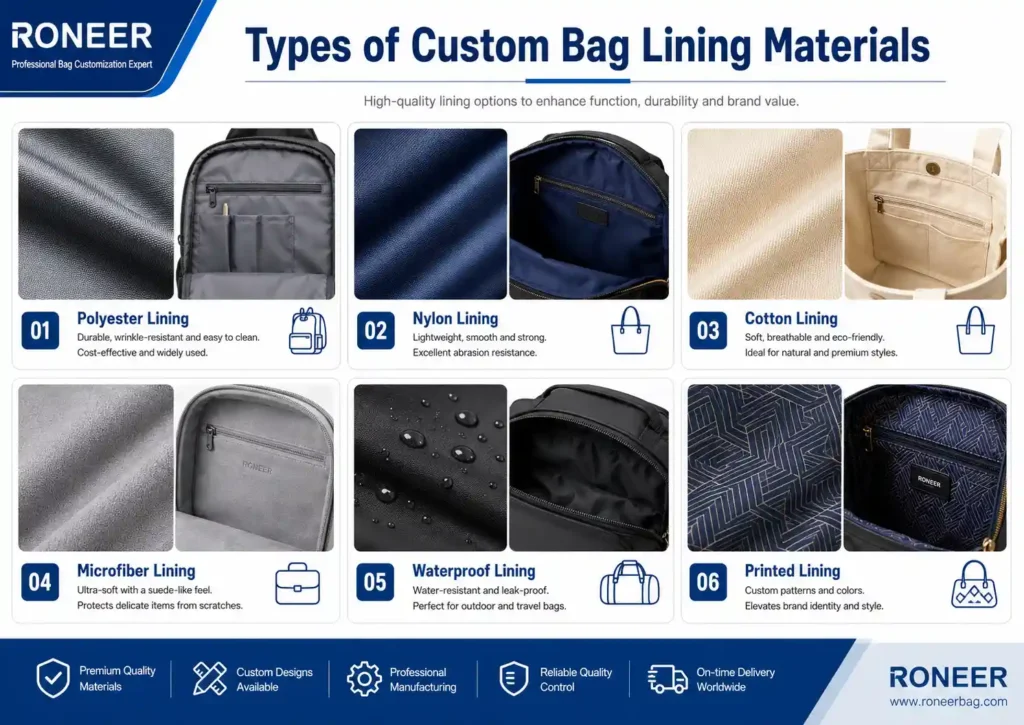
Polyester is one of the most common custom bag lining materials because it is practical, cost-controlled, easy to source, and suitable for many bag categories.
Polyester lining is often used in:
- 배낭
- 토트백
- 핸드백
- 화장품 파우치
- 여행 가방
- Pouches
- Wallets
- 홍보용 가방
- Laptop bags
It can be smooth, lightweight, printed, plain, or slightly textured depending on the fabric specification. For many B2B buyers, polyester lining is a good starting point because it works for low MOQ projects and standard production timelines.
However, buyers should not approve polyester lining only by color. They should check thickness, hand feel, tearing strength, color fastness, seam performance, and whether it matches the outer material. A very thin polyester lining may reduce cost, but it may also feel weak or wrinkle easily.
2. Nylon Lining: Smooth and Strong for Functional Bags
Nylon lining is often used when buyers want a smoother hand feel, better strength, or a more functional interior. It can be suitable for backpacks, travel bags, laptop bags, sports bags, crossbody bags, and outdoor-style bags.
Nylon lining can work well for:
- Laptop compartments
- Inner zipper pockets
- Travel organizers
- Premium backpacks
- Lightweight functional bags
- Daily-use bags
Compared with basic polyester lining, nylon can feel smoother and more durable depending on the specification. It can also work well with padded compartments and inner pockets.
For buyers developing backpacks or laptop bags, the lining should be reviewed together with foam padding, zipper position, binding tape, and pocket construction. The lining itself may be good, but if the pocket seam is weak or the compartment size is wrong, the user experience will still be poor.
3. Cotton Lining: Natural Look for Casual and Lifestyle Bags
Cotton lining is useful when the buyer wants a softer, more natural interior. It is often seen in casual handbags, canvas tote bags, lifestyle pouches, gift bags, and some premium handmade-style products.
Cotton lining can create a warmer and more natural feel than synthetic lining. It can also support printed patterns, brand stories, or lifestyle aesthetics.
Cotton lining may be suitable for:
- Canvas tote bags
- Casual handbags
- Lifestyle pouches
- Gift bags
- Boutique-style bags
- Natural-look collections
However, cotton lining may wrinkle more easily and may not be ideal for wet-use products. Buyers should check shrinkage, color fastness, thickness, and cleaning requirements before choosing cotton lining for bulk production.
For low MOQ custom bags, available cotton lining may be easier than custom printed cotton. Custom print can increase MOQ, cost, and lead time.
4. Microfiber or Suede-Like Lining for Premium Feel
Microfiber lining or suede-like lining is used when the buyer wants a softer, more premium inner feel. It is common in some handbags, jewelry pouches, watch cases, eyewear cases, laptop sleeves, and high-value accessories.
This type of custom bag lining can improve perceived value because it feels soft and protective. It can also help protect delicate items such as glasses, electronics, jewelry, or leather goods.
Microfiber or suede-like lining may be suitable for:
- Premium handbags
- Wallet gift boxes
- Laptop sleeves
- Eyewear cases
- Jewelry pouches
- Watch cases
- Business accessories
- Luxury-style pouches
The main concern is cost and cleaning. Soft lining can collect dust or marks more easily than smooth polyester or nylon. Buyers should check color transfer, shedding, thickness, and compatibility with the outer structure.
5. Waterproof or Wipeable Lining for Cosmetic and Toiletry Bags
For cosmetic bags, toiletry bags, wet bags, cooler bags, and travel organizers, the lining may need to be wipeable or water-resistant. In these products, inner cleaning is often more important than a premium textile feel.
Common waterproof or wipeable lining options include:
- PVC lining
- TPU lining
- PEVA lining
- Coated polyester lining
- Coated Oxford lining
- Aluminum foil insulation lining for cooler bags
This type of custom bag lining is useful for products that may contact liquid, cosmetics, skincare products, food, or moisture. It helps improve cleaning convenience and reduce customer complaints.
However, buyers should confirm whether the lining is wipeable, water-resistant, leak-resistant, or fully waterproof. These are different performance levels. A wipeable lining does not automatically mean the whole bag is waterproof.
Buyers developing waterproof or water-resistant bags can also review RONEER’s 소재 맞춤 설정 options to compare lining and outer material combinations.
6. Printed Lining for Private Label Branding
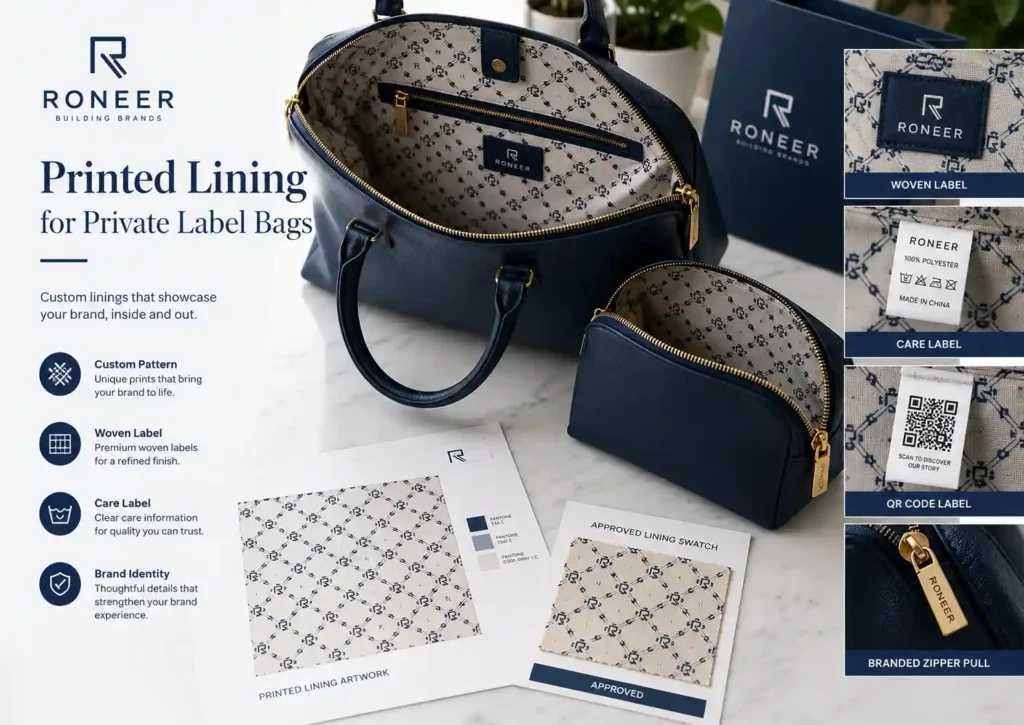
Printed lining can make a bag feel more custom and more branded. It is especially useful for handbags, wallets, cosmetic bags, premium pouches, and private label collections.
Printed lining can include:
- Repeating brand logo
- Monogram pattern
- Simple graphic pattern
- Brand color
- Product series pattern
- Care message
- Custom artwork
Printed custom bag lining can improve brand identity, but it also needs careful planning. Custom printing may increase MOQ, sample cost, color approval time, and production lead time. The print must also be tested for color fastness and rubbing resistance.
For first orders or low MOQ projects, buyers may start with available lining colors and add printed lining after the product sells well. This reduces early risk while keeping the option open for future upgrades.
7. Inner Labels and Care Labels
Lining is also where many private label details are placed. A buyer may add a woven label, printed label, care label, size label, country-of-origin label, material label, or QR code label inside the bag.
These details are small, but they affect professional presentation.
Common inner label options include:
- Woven brand label
- Printed satin label
- Care instruction label
- Material composition label
- Size label
- Country-of-origin label
- QR code label
- Serial number label if required
Buyers should approve label size, position, folding method, stitching, text accuracy, and compliance wording. A label placed too high may look exposed. A label placed too low may be hard to find. A care label with incorrect material information can create problems.
For brand consistency, inner labels should match the wider private label system, including hang tags, dust bags, poly bags, care cards, and cartons. Buyers can review RONEER’s 포장 맞춤 제작 service when planning labels and packaging together.
브랜드에 맞는 맞춤형 가방이 필요하신가요?
Contact RONEER for OEM/ODM production, fast sampling, low MOQ options, custom logo solutions, material customization, strict QC, and export packing support.
8. Inner Pocket Structure and Lining Function
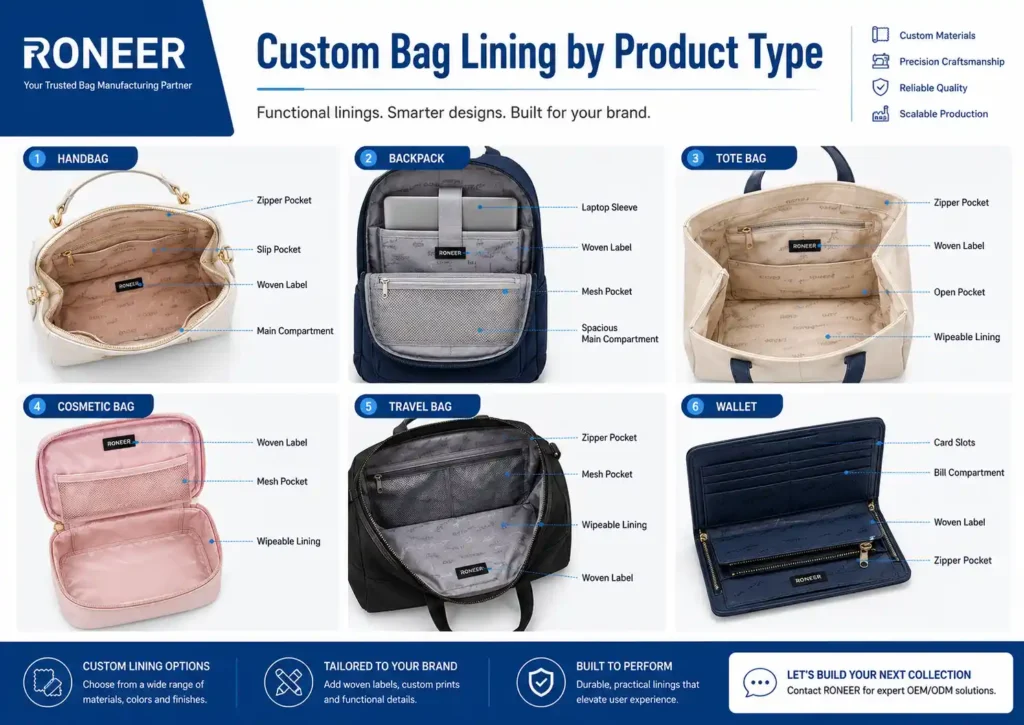
A lining is not only a fabric layer. It also supports the internal structure of the bag. Pockets, zipper compartments, dividers, laptop sleeves, card slots, bottle pockets, mesh pockets, and elastic loops all depend on correct lining planning.
A good custom bag lining plan should consider:
- Main compartment lining
- Zipper pocket
- Slip pocket
- Mesh pocket
- Laptop sleeve
- Card slot
- Bottle pocket
- Key hook position
- Elastic loop
- Divider panel
- Pen holder
- Cable pocket
- Makeup brush slot
For backpacks and travel bags, inner organization can be a selling point. For cosmetic bags, brush slots, wipeable lining, and mesh pockets may be important. For handbags, a zipper pocket and slip pocket may be enough. For wallets, lining and card slot thickness must be precise.
Buyers should approve pocket size and position during sample development, not after bulk production begins.
9. Lining Color: Practical and Brand-Driven
Lining color affects both appearance and usability. A black lining may hide dirt, but it may make small items hard to find. A light lining looks clean and premium, but stains may be more visible. A brand-color lining can make the product feel more custom, but custom dyeing may increase MOQ.
Common lining colors include:
- 검정
- Gray
- Beige
- Navy
- Brown
- Burgundy
- Green
- Brand color
- Printed pattern
For e-commerce brands, lining color also affects product photography. A light lining may show the inner structure better. A dark lining may look more premium but may require better lighting.
Buyers should confirm lining color with physical swatches. Screen color is not reliable enough because lighting, fabric texture, and dye batch can affect the result.
Custom Bag Lining by Bag Type
Different bag categories need different lining decisions.
Handbag Lining
Handbags often need a clean, attractive, and durable lining. Polyester, nylon, cotton, microfiber, suede-like lining, and printed lining can all work depending on the product positioning. Inner zipper pockets and woven labels are common.
Backpack Lining
Backpacks need lining that supports compartments, padding, laptop sleeves, zipper pockets, and daily use. Polyester and nylon linings are common. The lining must work with foam, binding tape, straps, and compartment structure.
Tote Bag Lining
Some tote bags are unlined, especially simple canvas totes. More premium totes may use polyester, cotton, or printed lining. A lined tote can feel more finished but may increase cost and production time.
Cosmetic Bag Lining
Cosmetic bags often need wipeable lining, PVC lining, TPU lining, coated polyester, or easy-clean inner fabric. Buyers should check zipper construction, seam finishing, and whether the lining can handle cosmetic spills.
Travel Bag Lining
Travel bags need durable lining, zipper pockets, mesh compartments, and packing organization. Nylon or polyester lining is common. Strong seams and clean binding are important.
Wallet Lining
Wallets need precise lining thickness and clean folding performance. The lining should not make card slots too tight or too loose. Microfiber, polyester, PU backing, or fabric lining may be used depending on the wallet structure.
How Custom Bag Lining Affects MOQ, Cost, and Lead Time
Custom bag lining affects cost and lead time more than many buyers expect. Standard available lining is usually easier for low MOQ orders. Custom printed lining, custom-dyed lining, special waterproof lining, microfiber lining, or imported lining may require higher MOQ and longer preparation time.
Cost factors include:
- Lining material
- Lining thickness
- Color availability
- Printing method
- Custom pattern
- Inner pocket complexity
- Label quantity
- Cutting and sewing difficulty
- Bag structure
- Order quantity
For first-time orders, buyers should choose lining that supports the product function without overcomplicating the project. A standard lining with a well-placed inner label may be more practical than a custom printed lining with high MOQ.
Buyers who need low MOQ planning can review RONEER’s guide on custom backpack MOQ cost planning. Many MOQ principles also apply to lining, pocket structure, labels, and packaging.
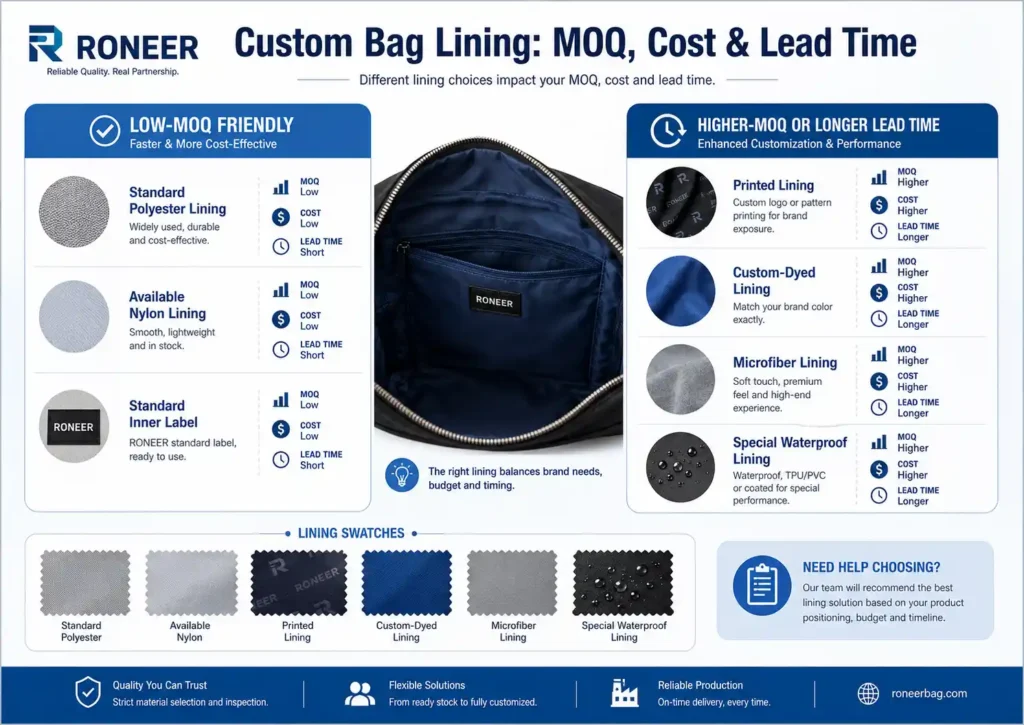
Logo and Branding Options Inside the Lining
Inner branding is subtle but important. Some buyers only put a logo on the outside, while others use the lining area to build a more complete brand experience.
Branding inside the bag can include:
- Woven inner label
- Printed lining logo
- Embossed patch inside pocket
- Branded zipper pull inside
- Care label
- QR code label
- Custom printed pocket panel
For buyers comparing logo methods, RONEER’s 로고 맞춤 설정 service can help align outer logo, inner label, zipper pull, hang tag, and packaging.
A good private label bag should feel consistent inside and outside. The customer should open the bag and see the same level of care that appears on the exterior.
Quality Control for Custom Bag Lining
Lining QC is important because many defects are not visible in product photos. A bag may look good from the outside, but the customer will notice lining problems during use.
Important QC points include:
- Lining color consistency
- Fabric thickness
- Hand feel
- Color fastness
- Odor
- Pocket size
- Pocket position
- Zipper pocket function
- 이음매 강도
- Loose threads
- Wrinkles
- Lining fit
- Label position
- Label text accuracy
- Cleaning marks
- Inner bottom shape
- Stitching alignment
For inspection and quality control background, buyers can refer to SGS. For harmful substance and textile safety background, OEKO-TEX can be used as an industry reference. Buyers should confirm any specific testing, retailer requirement, or compliance need before production.
RONEER checks lining details during sample development, pre-production confirmation, final inspection, and export packing to help reduce defects before shipment.
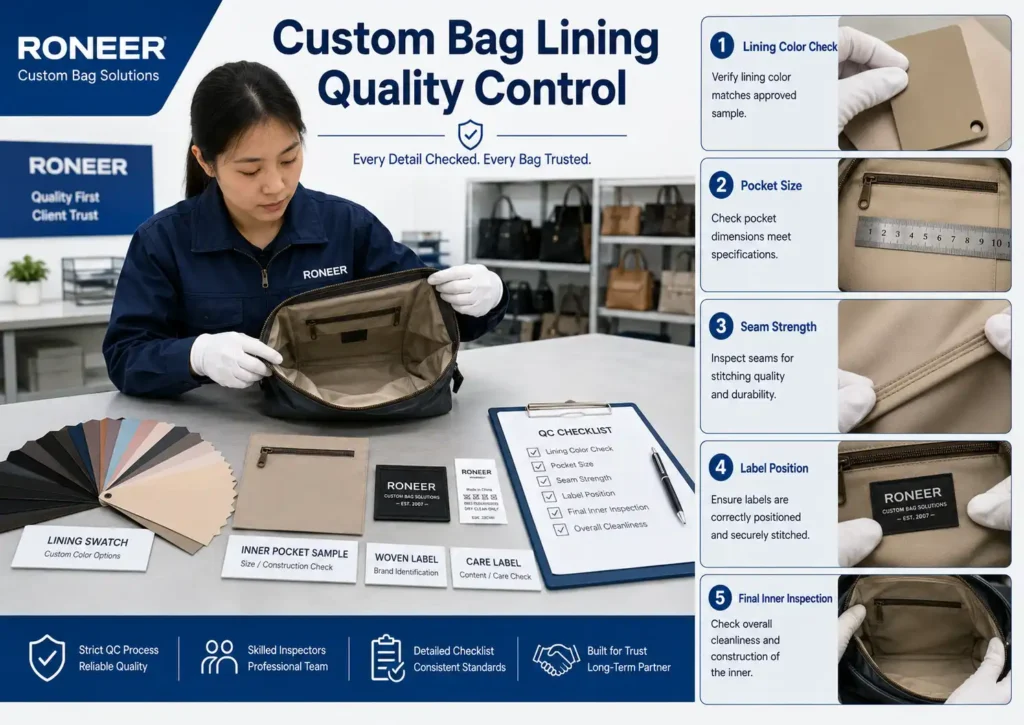
Common Mistakes When Choosing Custom Bag Lining
Choosing the Cheapest Lining
Low-cost lining can reduce unit price, but it may tear, wrinkle, smell, or make the product feel less professional.
Ignoring Pocket Function
A lining pocket should not only exist. It should be usable. Buyers should check pocket depth, zipper opening, phone fit, card slot fit, and placement.
Approving Only by Photos
Photos cannot show thickness, softness, noise, odor, color transfer, or strength. Physical lining swatches are important.
Using Dark Lining Without Considering Usability
Dark lining hides dirt but can make items harder to find. This matters for backpacks, handbags, and travel bags.
Adding Printed Lining Too Early
Printed lining looks branded, but it may increase MOQ and lead time. It may be better for repeat orders after the product is proven.
Forgetting Care Label Accuracy
Care labels and material labels should match the actual materials used. Incorrect labels can create compliance and customer service problems.
How RONEER Helps Buyers Develop Custom Bag Lining
RONEER helps buyers plan custom bag lining based on product type, target market, material, budget, MOQ, inner structure, logo method, packaging, and quality expectations.
RONEER can support:
- Lining material selection
- Available lining swatch review
- Printed lining discussion
- Waterproof lining options
- Inner pocket development
- Woven label placement
- Care label planning
- Private label detail coordination
- Low MOQ lining suggestions
- Sample development
- Bulk production follow-up
- Lining QC inspection
- Export packing
For startups, RONEER can suggest practical lining options that keep cost controlled. For established brands, RONEER can help develop more detailed custom lining systems across multiple bag styles.
FAQ About Custom Bag Lining
1. What is custom bag lining?
Custom bag lining is the inner material and structure used inside a bag. It can include polyester lining, nylon lining, cotton lining, microfiber lining, waterproof lining, printed lining, inner pockets, zipper compartments, woven labels, and care labels.
2. Why is custom bag lining important?
Custom bag lining affects the user experience, inner appearance, pocket function, durability, branding, and perceived quality of the bag. A good lining makes the bag feel more finished, while a weak lining can make the product feel cheap or fail during use.
3. What is the most common lining material for custom bags?
Polyester is one of the most common custom bag lining materials because it is practical, cost-controlled, widely available, and suitable for many handbags, backpacks, tote bags, cosmetic bags, pouches, and travel bags.
4. What lining is best for backpacks?
For backpacks, polyester and nylon are common lining choices. A good backpack lining should support compartments, zipper pockets, laptop sleeves, padding, binding tape, and daily-use durability.
5. What lining is best for cosmetic bags?
For cosmetic bags, wipeable or waterproof lining is often better. PVC lining, TPU lining, PEVA lining, coated polyester lining, or coated Oxford lining can help make the inside easier to clean.
6. Can RONEER support printed custom bag lining?
Yes. RONEER can discuss printed custom bag lining for private label projects. Printed lining can include brand logos, monogram patterns, custom colors, or artwork. Buyers should confirm MOQ, print color, sample time, and color fastness before bulk production.
7. Does custom bag lining affect MOQ?
Yes. Standard available lining usually supports lower MOQ, while custom printed lining, custom-dyed lining, special waterproof lining, microfiber lining, or imported lining may require higher MOQ and longer lead time.
8. Can custom bag lining include a brand label?
Yes. Custom bag lining can include woven labels, printed labels, care labels, material labels, QR code labels, or country-of-origin labels. Buyers should approve label content, position, size, stitching, and wording before production.
9. What should buyers check before approving lining samples?
Buyers should check lining material, color, thickness, hand feel, pocket size, zipper pocket function, label position, seam strength, odor, wrinkles, color fastness, and how the lining fits inside the bag.
10. Is printed lining worth the extra cost?
Printed lining can improve brand identity and make the bag feel more custom. However, it may increase MOQ, sample cost, and lead time. It is often more suitable for premium collections, repeat orders, or private label brands with stable demand.
11. Can a bag be made without lining?
Yes. Some canvas totes, simple pouches, drawstring bags, and promotional bags may be unlined to reduce cost and weight. However, lined construction usually makes a bag feel more finished and can improve inner organization.
12. Why choose RONEER for custom bag lining development?
RONEER helps buyers develop custom bag lining with material selection, printed lining options, waterproof lining discussion, inner pocket planning, private label labels, low MOQ suggestions, sample development, strict QC, export packing, and global shipping coordination.
결론
Custom bag lining plays a bigger role in product quality than many buyers expect. It affects how the bag looks inside, how pockets function, how the product feels during use, how well the brand is presented, and how stable the bag is during bulk production.
For B2B buyers, the best custom bag lining should match the product type and use case. A backpack may need durable polyester or nylon lining with organized compartments. A handbag may need a cleaner, more attractive lining with an inner zipper pocket and woven label. A cosmetic bag may need wipeable or waterproof lining. A wallet may need precise lining thickness. A premium pouch may benefit from microfiber or suede-like lining.
RONEER supports buyers with custom bag lining development, OEM/ODM production, material customization, custom logo options, printed lining discussion, private label labels, low MOQ planning where feasible, fast sampling, stable bulk production, strict QC, export carton packing, and global shipping experience.
Before bulk production, buyers should approve the physical lining material, color, pocket structure, label position, seam quality, and inner finish. When custom bag lining is planned together with the outer material, logo, hardware, packaging, and QC standard, the finished product feels more professional, more consistent, and easier to reorder.