 Français
 English
 Deutsch
 Español
 Italiano
 Русский
 日本語
 العربية
 Türkçe
 한국어
Custom Bag Production Lead Time: 8 Proven Delay Risks
A buyer usually starts thinking about timing when a launch date, retailer delivery window, trade show, campaign, or stockout risk becomes real. At that point, asking a supplier “How many days does production take?” sounds simple, but the answer can be misleading if both sides are counting different things.
Custom Bag Production Lead Time should not be treated as one unsupported number. A usable schedule separates development, material readiness, bulk manufacturing, inspection, packing, and logistics, then defines exactly when each stage starts and ends.
For OEM/ODM projects, the most common timing problem is not necessarily slow sewing. It is an unresolved decision that blocks the next stage: a material is still pending, hardware has not been released, artwork is not final, the sample needs another revision, or packaging information arrives after production planning has already started.
That means buyers need more than a promised completion date. They need a milestone-based plan.
Ce guide explique comment Custom Bag Production Lead Time should be evaluated for handbags, backpacks, totes, cosmetic bags, travel bags, briefcases, and other custom sewn products, and which decisions can create avoidable delay before bulk shipment.
What Custom Bag Production Lead Time Actually Means
In manufacturing, lead time refers to the time required to move work through a defined process. Oracle’s manufacturing documentation describes manufacturing lead time as including activities such as order preparation, queue time, setup, run time, movement, inspection, and put-away, assuming purchased items are already available. See the official reference: Oracle Manufacturing Lead Time.
For a custom bag order, that definition is useful because it shows why “sewing days” and total production time are not the same thing.
A practical Custom Bag Production Lead Time plan may need to account for:
- Production release
- Material preparation
- Cutting
- Printing or logo work
- Sewing
- Assembly
- Hardware installation
- Finishing
- In-line checks
- Corrections
- Inspection finale
- Packing
- Carton preparation
- Shipment handover
Sampling and international freight should usually be shown as separate periods unless the quotation explicitly combines them.
This distinction prevents a common misunderstanding: the buyer hears “production lead time” and assumes it means the number of days from purchase order to warehouse receipt, while the supplier may only mean the period after all production inputs are approved and released.
The Production Clock Needs a Defined Start Trigger
Custom Bag Production Lead Time becomes meaningful only when the start trigger is defined.
An inquiry is not a production release.
A quotation is not a production release.
Even a deposit may not be enough if the factory is still waiting for the approved sample, final artwork, color confirmation, packaging file, or a custom component.
For that reason, buyers should ask the supplier to confirm what must be complete before the production clock starts.
A project may require some or all of the following:
- Final quantity by style and color
- Approved sample or pre-production reference
- Confirmed material
- Approved hardware
- Final logo artwork
- Confirmed dimensions
- Final packaging specification
- Carton or label requirements
- Commercial approval
- Deposit or payment condition
- Testing or inspection requirements
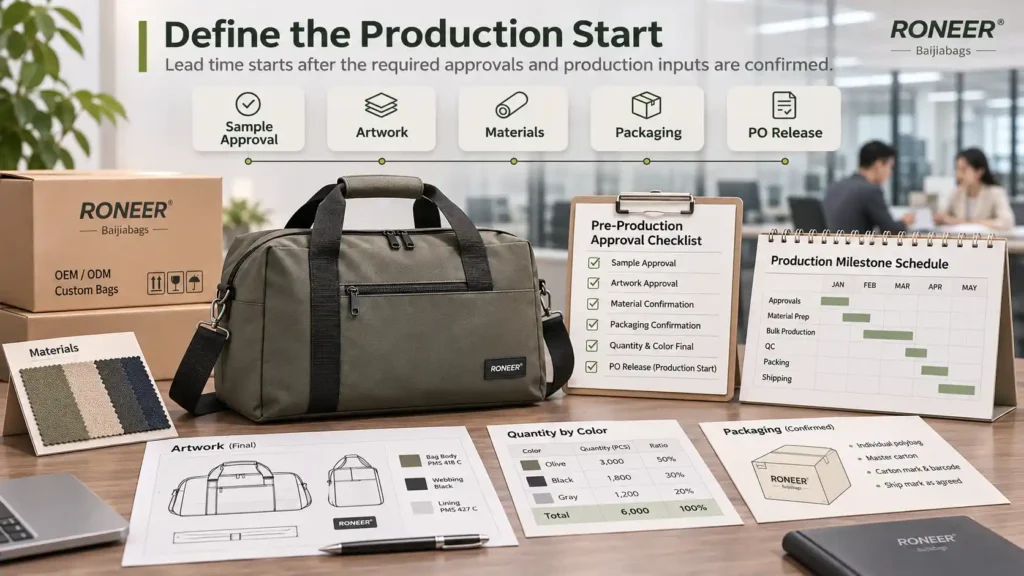
RONEER’s Custom Bag Quotation Checklist is useful before this stage because it helps buyers define product, quantity, branding, packaging, quality, schedule, destination, and trade terms before the order becomes a production program.
If one critical item is still open, the supplier should show it as a dependency instead of silently counting time from an earlier date.
Sampling and Approval Need Their Own Timeline
A custom bag often goes through development before bulk production begins.
This can involve:
- Initial brief review
- Conception de motifs
- Sélection des matériaux
- First physical sample
- Buyer comments
- Revised sample
- Color or logo confirmation
- Pre-production approval
The number of rounds depends on the design and how much is already defined.
Custom Bag Production Lead Time should therefore not hide sample development inside the bulk production schedule.
A buyer developing a new structured handbag with custom hardware and several revisions has a different timeline from a buyer applying a logo to an existing proven construction.
The buyer’s response speed matters too.
If a sample reaches the buyer on Monday but comments are returned ten days later, those ten days affect the overall project calendar even though the factory was not manufacturing bulk goods during that period.
A better schedule records both supplier and buyer actions.
| Milestone | Owner | Status Needed Before Next Step |
|---|---|---|
| Sample completed | Supplier | Sample sent for review |
| Sample comments | Buyer | Consolidated feedback |
| Revision confirmed | Both | Construction and material locked |
| Pre-production approval | Buyer | Bulk release |
| Calendrier de production | Supplier | Dated factory plan |
The goal is not to eliminate revision. It is to prevent unclear approval status from being mistaken for production time.
Material Availability Can Become the Critical Path
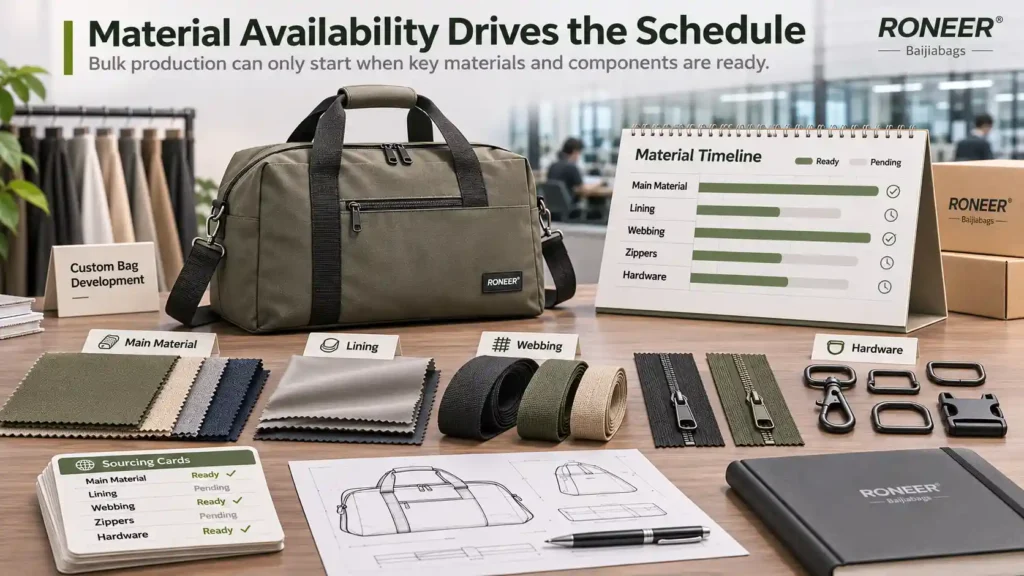
Material sourcing can control Custom Bag Production Lead Time before cutting starts.
A bag may require several independent inputs:
- Main exterior material
- Doublure
- Reinforcement
- Foam
- Sangle
- Fermetures éclair
- Boucles
- Crochets
- Plaques de logo
- Labels
- Printed components
- Emballage
Some are available from stock. Others may require color matching, custom production, special finishing, or supplier minimums.
This is why a factory can have sewing capacity available but still be unable to start the order.
RONEER’s Personnalisation des matériaux page explains how material type, thickness, color, surface finish, backing, lining, coating, and structural compatibility can affect a custom bag project. Those decisions also affect timing because the selected specification determines what must be sourced and approved.
Buyers should ask four timing questions about critical materials:
- Is the material already available?
- Does it require custom color or finish?
- Is the bulk lot the same reference approved during sampling?
- What happens to the schedule if that material is unavailable?
The same logic applies to hardware.
A standard D-ring is very different from a new branded metal component requiring tooling, finish approval, and production.
A schedule that ignores these dependencies may look fast on paper but fail before the sewing line even receives the components.
Product Complexity and SKU Mix Change the Production Plan
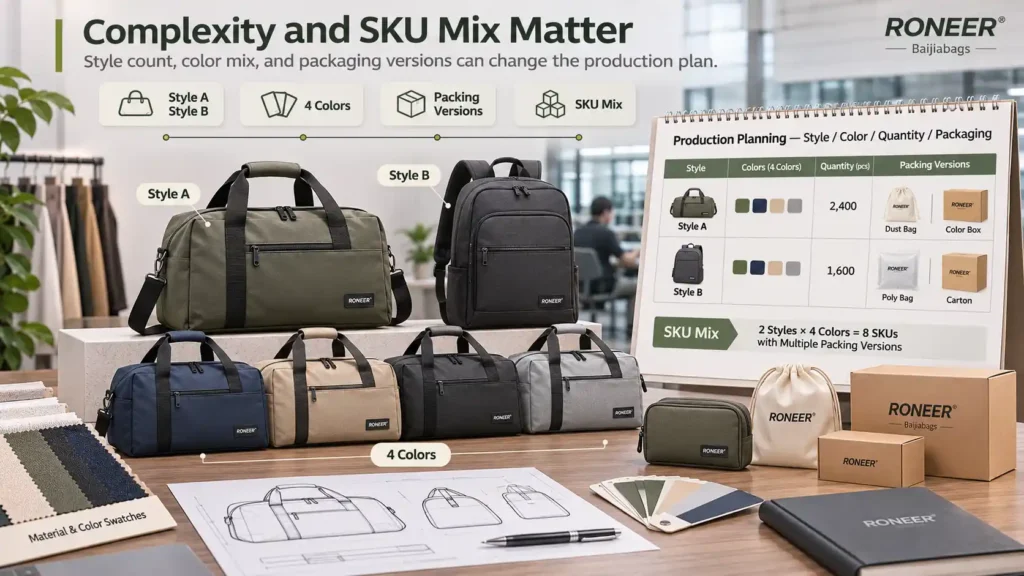
Two orders with the same quantity can require different Custom Bag Production Lead Time.
Consider 1,000 units.
Order A
- One style
- One color
- Standard material
- Standard hardware
- Simple logo
- Basic export packing
Order B
- Two styles
- Four colors
- Custom hardware
- Printed lining
- Multiple logo locations
- Retail packaging
- Different barcode labels by SKU
Both orders contain 1,000 bags, but the second order requires more material coordination, changeovers, sorting, artwork control, packing control, and inspection references.
Construction matters too.
A flat tote can have fewer operations than a structured handbag with reinforcement, piping, edge finishing, multiple compartments, and hardware.
A backpack may require padding, webbing, several zipper chains, multiple pockets, binding, and reinforced load points.
Therefore, Custom Bag Production Lead Time should be linked to the actual style architecture, not only to total quantity.
When requesting a schedule, provide quantity by:
- Style
- Couleur
- Matériau
- Logo version
- Packaging version
- Market or SKU if labels differ
This makes production planning more realistic.
Bulk Production Is More Than Sewing Time
Once the order is released, the factory still has to move the product through a sequence of operations.
Depending on the bag, this can include:
- Material receiving and verification
- Cutting
- Printing, embroidery, embossing, or other branding
- Reinforcement preparation
- Component subassembly
- Main sewing
- Lining assembly
- Zipper and hardware installation
- Finition des bords
- Thread trimming and cleaning
- Functional checks
- Final assembly
- Inspection
- Packing
Some operations happen in parallel; others cannot start until the previous operation is complete.
This is why Custom Bag Production Lead Time should be planned as a workflow rather than a single sewing estimate.
For example, a logo process applied before assembly can block sewing if the printed or embroidered panels are late. A hardware component installed near the end can still delay finished goods if it does not arrive on time.
Queue time also matters. A factory may have the machinery required for a process but still need to schedule that order around other confirmed production.
Buyers should therefore request milestone dates rather than only a final completion date.
Useful milestones include:
- Material ready
- Cutting starts
- Branding completed
- Sewing starts
- First bulk pieces reviewed
- Main production completed
- Inspection finale
- Packing completed
- Shipment ready
This creates earlier warning points if the schedule begins to slip.
Quality Control and Packing Need Reserved Time
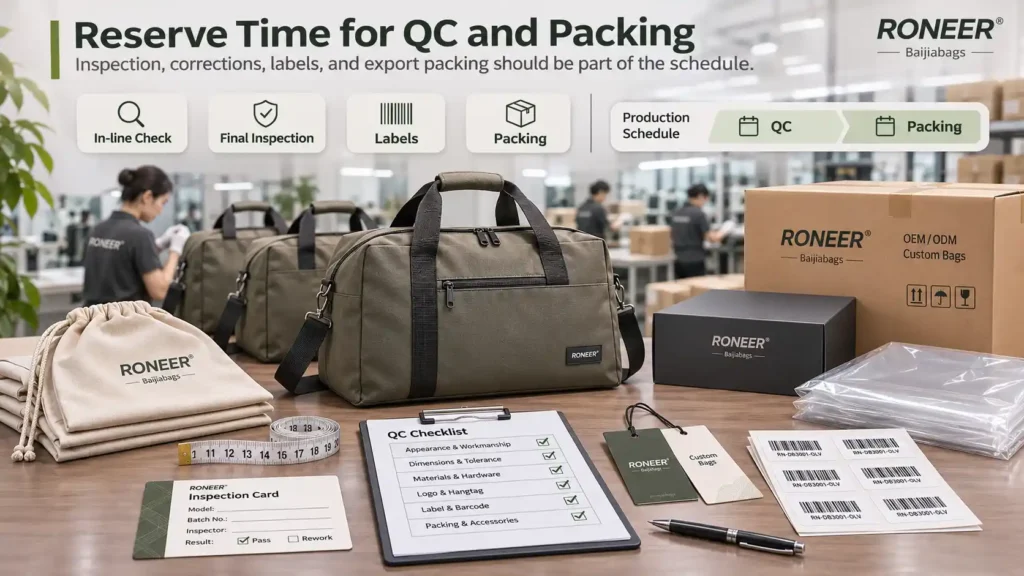
Quality control should not be treated as extra time added only when something goes wrong.
It is part of a realistic Custom Bag Production Lead Time plan. A realistic Custom Bag Production Lead Time should preserve those controls instead of deleting them to create an artificial deadline.
RONEER’s Bag Quality Control Guide explains why material review, approved samples, in-line checks, final inspection, and packing verification should connect to the same product specification.
A useful schedule allows time for:
- Incoming material checks
- First-piece or early production review
- In-line checks
- Correction of repeated problems
- Inspection finale
- Packaging verification
If an order uses acceptance sampling, the inspection plan should also be agreed before the shipment deadline. ISO’s current ISO 2859-1:2026 provides AQL-indexed sampling schemes for lot-by-lot inspection by attributes.
Referencing the standard does not mean a specific RONEER order automatically uses a particular AQL level; the project inspection requirement should be confirmed separately.
Packing can also create delays when requirements arrive late.
Typical last-stage dependencies include:
- Hangtags
- Étiquettes à code-barres
- Polybags
- Sacs à poussière
- Fiches de soins
- Carton marks
- SKU stickers
- Retail boxes
- Packing ratios
A completed bag is not shipment-ready if the required labels or packaging are still missing.
Shipping Is a Separate Lead-Time Block
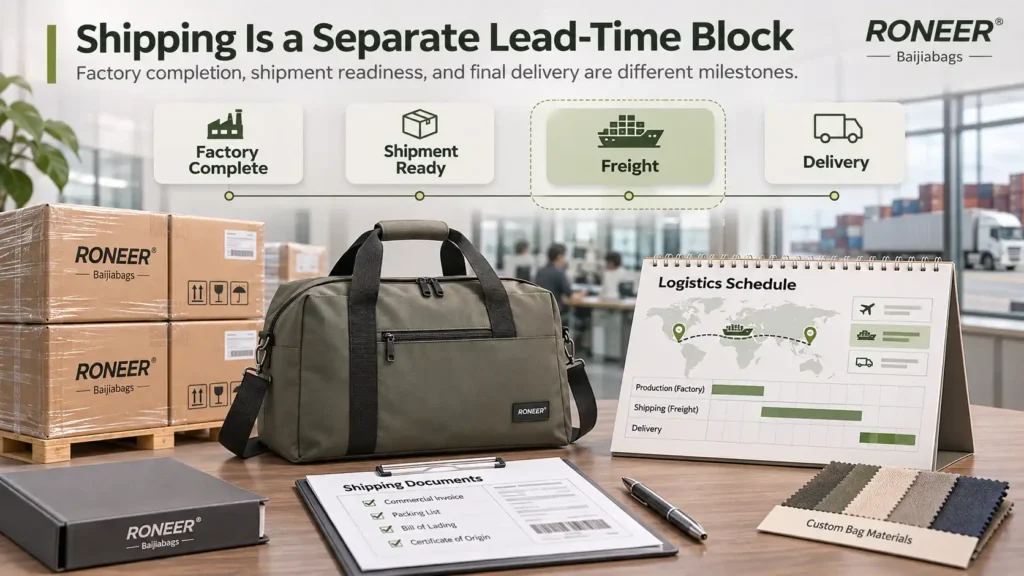
Production completion and delivery are different milestones.
Custom Bag Production Lead Time should normally end at a clearly defined factory handover point, such as inspected and packed goods ready for the agreed shipment process.
Then logistics begins.
Shipping time can include:
- Factory pickup
- Export handling
- Booking
- Port or airport processing
- Main freight
- Import customs clearance
- Destination handling
- Final delivery
The trade term changes which party is responsible for each step.
The International Chamber of Commerce publishes the Incoterms® rules, which define responsibilities, costs, and risk allocation between seller and buyer under different trade terms.
For U.S.-bound projects, buyers can also review RONEER’s Shipping Bags from China to USA guide for packing, documents, inspection, shipping methods, and delivery planning.
Do not schedule a launch by taking a factory production estimate and assuming the goods will arrive immediately afterward.
Keep at least three dates separate:
Factory completion date
The order is manufactured.
Shipment-ready date
The order has passed the agreed checks and is packed for handover.
Required delivery date
The goods reach the buyer’s warehouse, retailer, event, or other destination.
Those dates may be weeks apart depending on the logistics route.
Build the Calendar Backward From the Required Delivery Date
Forward planning starts with today.
Better sourcing planning often starts with the date the goods must arrive.
Suppose a brand needs stock in its warehouse before a seasonal launch.
Work backward through:
- Warehouse receipt date
- Destination delivery
- Customs and freight allowance
- Shipment handover
- Final inspection and packing
- Production en série
- Material readiness
- Validation d'échantillon
- Development and revisions
- Initial RFQ and project review
This makes Custom Bag Production Lead Time part of a full commercial calendar instead of an isolated factory promise.
It also reveals which dates are flexible.
For example, the campaign date may be fixed, while the number of sample revisions or packaging complexity can still be adjusted.
A backward plan gives the buyer and factory a shared deadline structure.
How Buyers Can Reduce Delay Risk Without Rushing Quality
The safest way to shorten Custom Bag Production Lead Time is usually to remove uncertainty before production, not to remove necessary production or QC steps.
Send a More Complete RFQ
Provide product references, dimensions, materials, quantity by SKU, logo artwork, hardware direction, packaging, and required delivery date.
Consolidate Sample Comments
One organized revision list is more efficient than scattered messages sent over several days.
Lock Materials Before Bulk Release
Do not approve one material during sampling and introduce a different bulk material without allowing time for confirmation.
Separate Must-Have Details From Optional Details
If a decorative element is still undecided, identify whether it is critical to launch or can be simplified without changing the core product.
Approve Packaging Earlier
Late hangtags, labels, boxes, or barcode files can hold completed goods.
Confirm Inspection Requirements Before Production
Do not introduce a new inspection or testing requirement when the order is already waiting to ship.
Keep One Current Specification
The factory should not have to decide whether an old email, a sample comment, or a newer tech pack is the final instruction.
Ask for Milestone Updates
A short update at material readiness, cutting, early production, final inspection, and packing gives the buyer more control than discovering a delay at the final deadline.
Practical Production Timeline Checklist
Use this checklist when discussing Custom Bag Production Lead Time with a supplier:
| Planning Item | What to Confirm |
|---|---|
| Start trigger | What must be approved before the clock starts? |
| Sample status | Which physical sample is the production reference? |
| Material status | Stock, custom, pending, or approved? |
| Hardware status | Standard, custom, tooling required? |
| Quantité | Total plus breakdown by style and color |
| Artwork | Final logo and label files released? |
| Production milestones | Cutting, branding, sewing, completion |
| QC | In-line and final inspection requirements |
| Emballage | Unit packing, labels, carton marks |
| Shipment-ready point | What does “finished” mean? |
| Trade term | EXW, FOB, DAP, or other agreed basis |
| Required delivery | Warehouse, retailer, event, or launch date |
This is more useful than asking only:
“Can you finish quickly?”
A supplier can evaluate a defined schedule. It cannot reliably plan around an undefined urgency.
FAQ About Custom Bag Production Lead Time
1. What is Custom Bag Production Lead Time?
Custom Bag Production Lead Time is the period required to manufacture a confirmed custom bag order through the agreed factory production scope. It can include preparation, cutting, branding, sewing, assembly, inspection, finishing, and packing, depending on how the supplier defines the production period.
2. Does production lead time include sampling?
Usually, sampling should be shown separately from bulk production. Sampling converts a design brief or technical file into an approved physical reference, while bulk production begins after the required approvals and production inputs are released.
3. When should the production clock start?
The start trigger should be written into the project plan. It may depend on sample approval, final specifications, material confirmation, artwork release, quantity confirmation, commercial approval, and agreed payment conditions.
4. Why can material sourcing delay custom bag production?
Custom colors, coatings, leather, lining, zippers, webbing, branded hardware, or packaging may come from different suppliers. If a critical component is not ready, cutting or assembly may not be able to proceed.
5. Does a larger order always take longer?
Not automatically. Quantity matters, but complexity, SKU count, material availability, construction, line scheduling, packaging, and approvals also affect Custom Bag Production Lead Time.
6. Can custom hardware extend the schedule?
Yes. A new metal logo, buckle, zipper puller, or other custom component may require tooling, sample approval, finish confirmation, and bulk component production before bag assembly can be completed.
7. Does packaging affect production timing?
Yes. Finished bags may still be unable to ship if dust bags, hangtags, barcode labels, retail boxes, carton marks, or other required packaging components are not ready.
8. Is QC included in Custom Bag Production Lead Time?
A realistic plan should reserve time for agreed quality checks and any necessary corrections. The exact inspection scope depends on the project and should be confirmed before bulk production.
9. Is shipping included in production lead time?
It should normally be shown separately unless the supplier explicitly defines a combined delivery timeline. Factory completion, shipment readiness, freight transit, customs clearance, and final delivery are different milestones.
10. How can buyers reduce production delays?
Provide clearer specifications, approve samples promptly, lock materials and artwork earlier, consolidate revision comments, confirm packaging before production ends, and request milestone updates rather than relying only on one final date.
11. Should a buyer build buffer time into the schedule?
Yes. A commercial calendar should allow for project-specific uncertainty such as sample revisions, material availability, quality corrections, logistics changes, or external disruptions. The buffer should be based on the actual project rather than a universal fixed number.
12. How does RONEER confirm production timing?
RONEER can review the bag type, specifications, material route, quantity, customization, packaging, sample status, quality requirements, and target delivery date before confirming a project-specific schedule.
Final timing depends on the actual order conditions rather than a fixed promise applied to every custom bag project.
Conclusion
Custom Bag Production Lead Time is most useful when it is treated as a controlled project schedule rather than a single number in a quotation.
The buyer should know when the production clock starts, which materials and approvals are on the critical path, how the style and SKU mix affect production, when quality checks occur, when packing is complete, and where factory lead time ends and logistics begins.
For RONEER OEM/ODM projects, timeline planning can connect product specifications, material sourcing, sample approval, logo and hardware decisions, bulk production, quality control, packaging, and shipment preparation according to the confirmed project requirements.
A well-managed Custom Bag Production Lead Time does not depend on an unrealistic promise of speed. It depends on clear dependencies, dated milestones, fast decisions, and a shared definition of what must be complete before the order can move to the next stage.