 Français
  English
  Deutsch
  Español
  Italiano
  Русский
  日本語
日本語  العربية
  Türkçe
  한국어
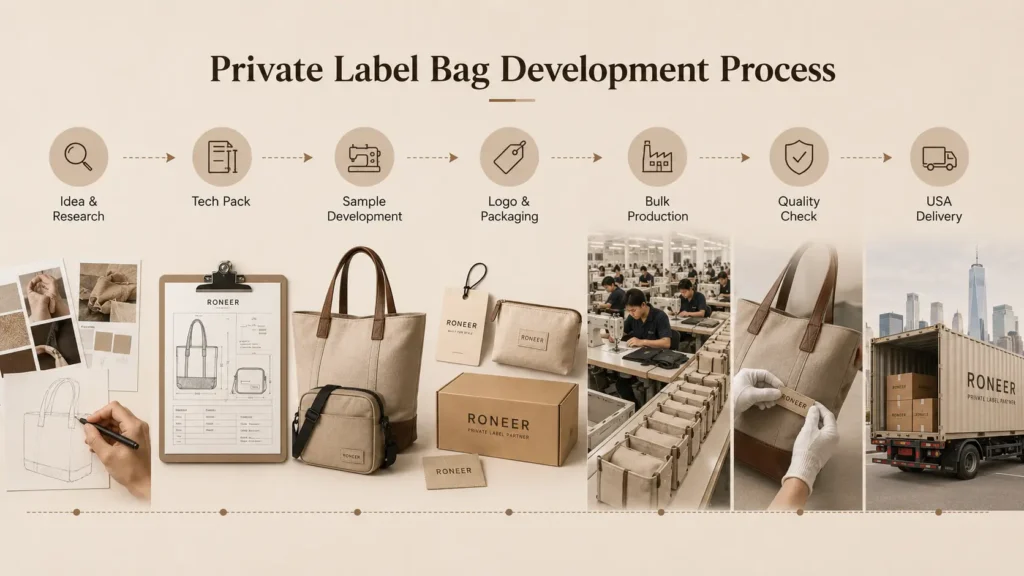
한국어 Private label bags for USA brands are not just blank products with a logo added at the end. For American retailers, Amazon sellers, boutique owners, DTC startups, corporate buyers, and growing fashion labels, private label bag development is a full sourcing process that connects product positioning, material choice, logo application, packaging, sampling, compliance, and repeat production.
Many new buyers start by asking a simple question: “Can you put my logo on this bag?” That question is important, but it is not enough. A bag that works for a Shopify store may not be right for Amazon. A tote for corporate gifting may need a different price structure from a boutique handbag collection. A travel bag sold in the USA may require stronger stress points, clearer carton marks, and more careful packaging than a simple promotional tote.
This guide explains how to plan private label bags for USA brands in a practical factory-ready way, so your product idea can move from concept to sample, from sample to bulk order, and from first order to stable reorder.
Why Private Label Bags Are Different From Generic Wholesale Bags
Generic wholesale bags are usually selected from existing inventory. The buyer chooses a style, color, and quantity, then sells the item with limited changes. Private label bags for USA brands require more control. The product may still begin from an existing ODM base style, but the final result should feel like it belongs to your brand.
Private label development can include custom materials, logo placement, zipper pullers, lining color, labels, hangtags, dust bags, carton marks, barcode stickers, packaging inserts, and sometimes structural changes. A professional factory should help you understand which changes are simple, which changes affect MOQ, and which changes require new molds or longer sampling time.
For buyers who want to compare service options, the RONEER custom bag manufacturing team can support OEM and ODM discussions across different bag categories, including handbags, backpacks, cosmetic bags, travel bags, tote bags, and outdoor bags.
The best private label bags for USA brands usually balance three things: a clear brand identity, realistic production cost, and a product structure that fits the sales channel.
Start With the Sales Channel Before Choosing the Bag
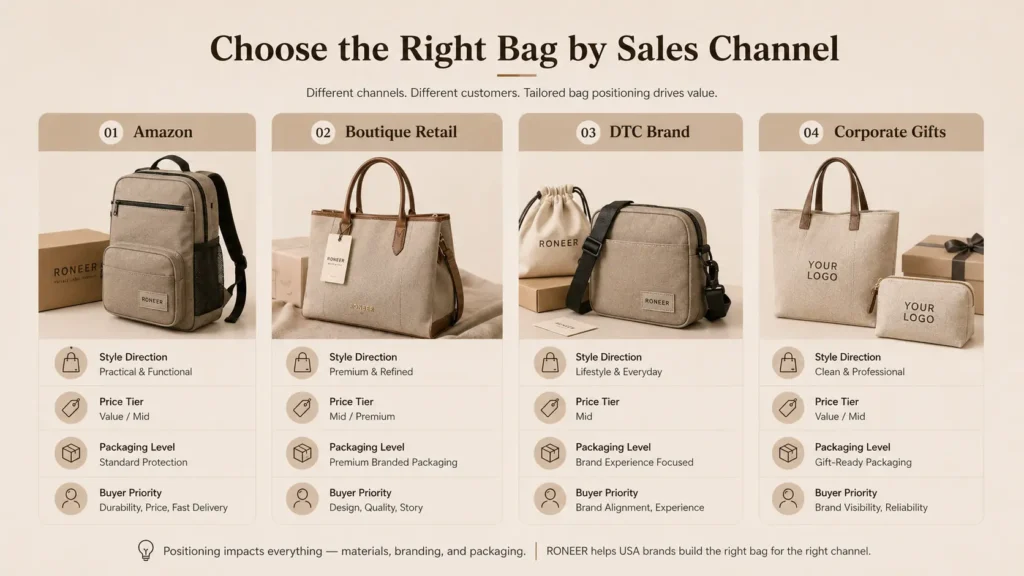
Before choosing materials or logo methods, define where the bag will be sold. This decision affects almost every production detail.
A boutique handbag brand may care more about silhouette, touch feeling, lining, hardware color, and premium packaging. An Amazon private label seller may focus more on durability, photo-ready packaging, review risk, carton efficiency, and consistent repeat orders. A corporate gift buyer may care about logo visibility, delivery time, cost control, and practical daily use. A DTC travel brand may need stronger zippers, reinforced handles, water-resistant fabric, and better packing protection.
When planning private label bags for USA brands, ask these questions first:
- Will the product be sold online, in retail stores, through wholesale channels, or as promotional merchandise?
- Is the buyer looking for a premium look, a practical daily item, or a price-sensitive product?
- Does the bag need to carry heavy items, electronics, cosmetics, sportswear, or travel goods?
- Will customers compare this product mainly by style, material, function, or price?
- Is the first order a market test or a long-term brand collection?
A clear sales channel helps the factory recommend the right structure and avoid over-customizing the wrong details.
Choose Between ODM and OEM Development
For private label bags for USA brands, both ODM and OEM can work, but they serve different business stages.
ODM is usually faster. The factory already has existing base styles or proven structures. The buyer can adjust colors, materials, lining, logo, zipper puller, packaging, and small details. This is often useful for startups, Amazon sellers, boutique buyers, and brands testing a new category.
OEM is more customized. The buyer provides sketches, a tech pack, reference samples, exact dimensions, material requirements, and construction details. OEM development is better when a brand needs a more unique shape, a specific function, or a product that cannot be created from an existing base.
If you are unsure which model fits your project, reviewing the difference between Développement de sacs en OEM et ODM can help you decide how much customization is practical for your timeline and budget.
The wrong choice can waste time. A startup may not need a fully custom mold for the first test order. A brand with strong design IP may not want to rely only on generic ODM styles. The decision should match your market stage.
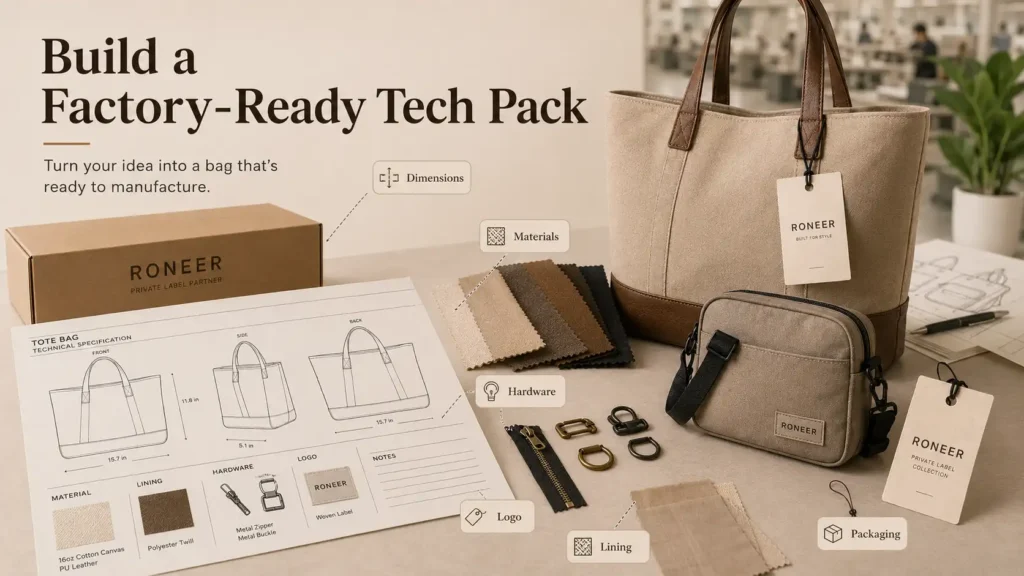
Turn Your Idea Into a Factory-Ready Specification
A common problem in private label bag sourcing is that the buyer sends many inspiration photos but no clear production specifications. Inspiration is useful, but factories need production information.
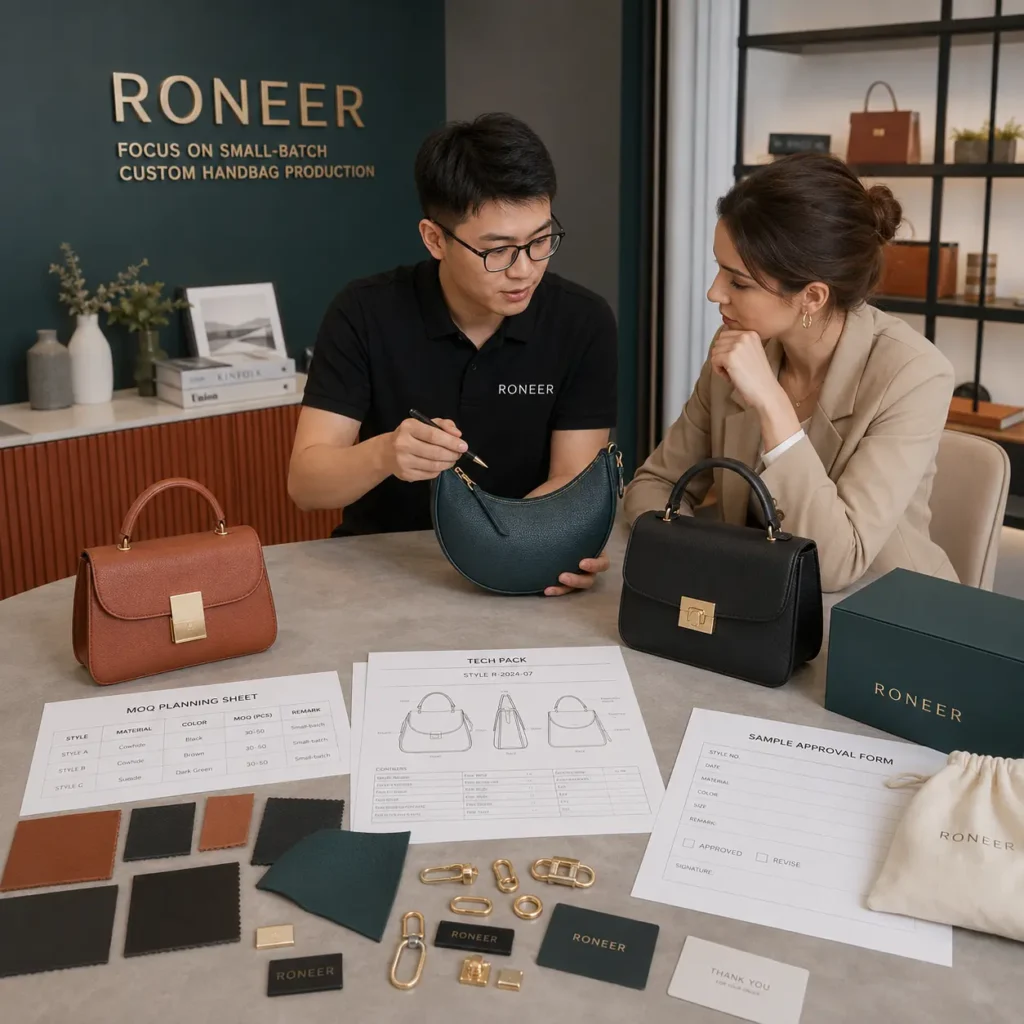
A factory-ready specification should include:
- Bag type and target size
- Main material and backup material
- Matière de la doublure
- Hardware color and finish
- Logo method and logo size
- Strap length and adjustability
- Pocket layout
- Zipper, buckle, snap, or magnetic closure requirements
- Méthode d'emballage
- Target order quantity
- Fourchette de prix cible
- Reference sample photos
- Expected testing or inspection requirements
For private label bags for USA brands, a simple specification sheet can prevent misunderstanding before sampling begins. It also helps the factory evaluate whether the target price is realistic.
RONEER can support material, color, logo, structure, and packaging discussions, but the more clearly a buyer explains the intended market, the easier it is to recommend workable production choices.
Plan Materials Around Price Tier and Use Case
Material selection should not be based only on appearance. The right material depends on positioning, durability, cost, function, and customer expectations.
PU leather may work for fashion handbags, cosmetic pouches, small accessories, and price-sensitive collections. Microfiber leather can offer a more refined feel and stronger performance for some styles. Nylon and Oxford fabric are practical for backpacks, travel bags, outdoor bags, laptop bags, and utility products. Canvas can work well for totes, casual bags, and lifestyle collections. RPET or recycled-content materials may be requested by brands with sustainability goals, but claims should be managed carefully and supported by appropriate documentation when required.
Les acheteurs peuvent consulter les produits RONEER personnalisation des matériaux options when comparing PU leather, microfiber leather, nylon, Oxford fabric, canvas, polyester, lining materials, and other bag materials.
For recycled or preferred material discussions, brands may also reference industry resources such as the Textile Exchange materials market report. However, brands should avoid making broad sustainability claims unless the material source, documents, and product claims are properly checked.
Private label bags for USA brands should be designed around real use. A lightweight tote does not need the same fabric strength as a travel duffel. A cosmetic bag may need easy-clean lining. A laptop backpack needs structure, padding, and seam strength. A premium handbag may require better edge finishing and hardware consistency.
Branding Without Counterfeit Risk
Private label branding should build your own identity, not copy another brand’s signature design. USA buyers should be careful with logo plates, monograms, pattern layouts, metal hardware shapes, and famous silhouette references.
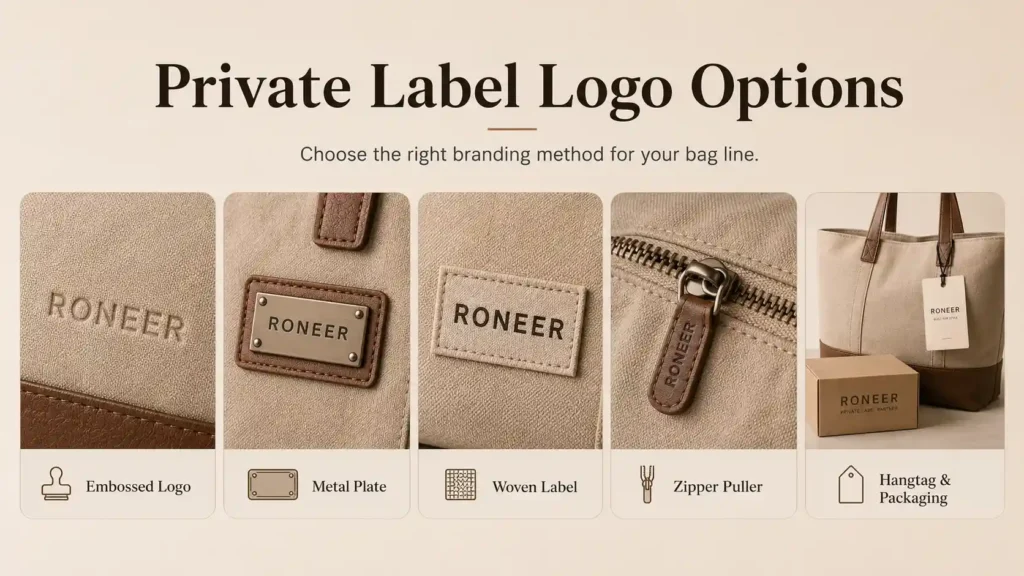
A good private label bag manufacturer should help buyers place their own logo in a legal and brand-appropriate way. Common logo options include embossed logo, debossed logo, printed logo, woven label, rubber patch, metal logo plate, zipper puller logo, lining logo, hangtag, care label, and packaging logo.
RONEER’s personnalisation du logo service can help buyers compare logo methods based on material, brand style, MOQ, cost, and durability.
For private label bags for USA brands, the safest branding strategy is to create a clear identity through color, proportion, material mix, hardware tone, label design, and packaging instead of copying a luxury brand’s recognizable elements. A private label product does not need to look like a famous bag to sell well. It needs to look coherent, useful, and trustworthy to the target customer.
Packaging Should Match the Retail Channel
Packaging is not only decoration. It affects shipping protection, customer experience, retail presentation, and warehouse handling.
For online sales, packaging should protect the bag during long-distance shipping and reduce deformation. For boutique retail, dust bags, hangtags, tissue paper, and branded cartons may improve presentation. For corporate gifts, outer packaging may need clear labeling and simple logo visibility. For Amazon or third-party logistics, barcode placement, carton marks, and packing consistency may be important.
RONEER’s personnalisation des emballages options can support polybags, dust bags, hangtags, labels, inserts, inner cartons, master cartons, and export packing discussions.
For private label bags for USA brands, packaging should be planned before bulk production, not after the goods are finished. If packaging is decided too late, it may affect carton size, freight cost, labeling, and final delivery schedule.
Sampling Is a Decision Process, Not Just a Photo Check
Many buyers approve or reject samples too quickly based only on photos. That is risky. A sample should be reviewed as a decision tool.
When the first sample is ready, evaluate:
- Overall shape and proportion
- Material hand feel
- Color accuracy
- Logo position and size
- Qualité des coutures
- Fluidité de la fermeture éclair
- Handle or strap strength
- Interior pocket layout
- Ajustement de la doublure
- Hardware finish
- Packaging fit
- Weight and structure
- User experience
Private label bags for USA brands often need at least one sample revision. That does not mean the factory failed. It means the buyer and factory are aligning the product before mass production. The key is to give clear feedback with photos, measurements, and priority notes.
Avoid vague feedback such as “make it better” or “more premium.” Instead, say “increase handle width by 0.5 cm,” “move logo 2 cm lower,” “change lining to black polyester,” or “make the front pocket opening wider.”
Clear feedback saves time and reduces sampling cost.
MOQ and Cost Planning for USA Buyers
MOQ is not just a factory rule. It is connected to material sourcing, logo process, hardware color, packaging, and production setup.
A low MOQ may be possible for existing materials, standard colors, and simple logo methods. A higher MOQ may be required for custom-dyed materials, exclusive hardware, molded logo parts, special lining, printed fabric, or fully customized packaging.
Private label bags for USA brands should be planned with a first-order strategy. If the buyer is testing a market, it may be better to simplify customization and focus on the most visible brand elements. If the buyer already has proven sales, deeper customization can make sense.
For buyers comparing quantity and cost structure, RONEER’s guide on custom backpack MOQ and cost planning is also useful for understanding how material, logo, packaging, and production details affect pricing.
A practical first order should answer three questions:
- Can the product represent the brand clearly?
- Can the quantity support real market testing?
- Can the design be repeated or improved in the next order?
USA Import and Labeling Considerations
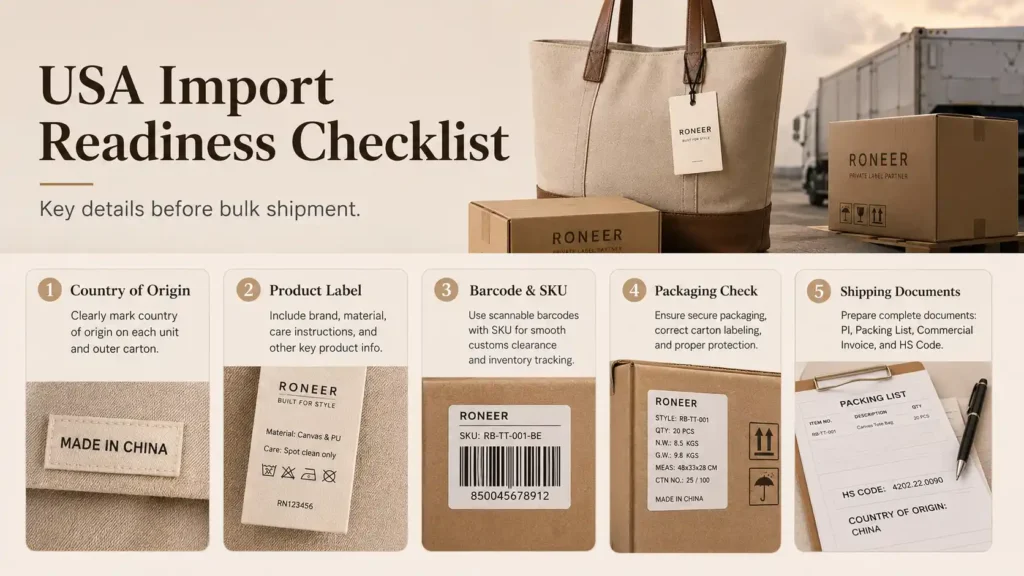
USA buyers should not treat labeling as a last-minute detail. Imported bags may require proper country-of-origin marking. The U.S. Customs and Border Protection country of origin marking guidance explains that foreign-origin goods entering the United States generally need to be legibly marked with the English name of the country of origin unless an exception applies.
This means buyers should confirm where and how the country-of-origin label will appear. It may be on a sewn label, hangtag, sticker, packaging, or another acceptable method depending on the product and situation.
USA brands should also be careful with “Made in USA” language. The Federal Trade Commission’s Made in USA guidance explains standards for unqualified Made in USA claims. If the bags are manufactured outside the USA, buyers should avoid misleading wording in product pages, packaging, ads, and labels.
For private label bags for USA brands, a safer approach is to use accurate brand language such as “Designed by [Brand Name]” only when true, and to mark the actual country of origin correctly. Buyers should consult qualified compliance support for legal decisions.
Quality Control Should Focus on Real Risk Points
Bag quality is not only about neat stitching. Different bag categories have different risk points.
For handbags, check edge finishing, surface marks, lining fit, hardware color, strap attachment, and logo alignment. For backpacks, check shoulder strap strength, zipper function, seams, padding, and load-bearing points. For cosmetic bags, check lining cleanliness, zipper smoothness, shape retention, and easy-clean materials. For travel bags, check handle strength, bottom reinforcement, fabric durability, zipper strength, and packing method.
Third-party testing or inspection may be useful for some orders. Buyers can refer to industry service providers such as SGS for bags and accessories testing and inspection when considering independent testing, inspection, or compliance support. This does not mean every order requires the same testing plan, but it shows that bags and accessories can involve structured quality and performance checks.
For private label bags for USA brands, quality control should be discussed before mass production. The buyer and factory should agree on inspection points, approval sample status, packaging requirements, and acceptable tolerance.
Supplier Evaluation Checklist for USA Brands
A good supplier for private label bags for USA brands should be able to discuss more than price. Price matters, but a low quote without production clarity can become expensive later.
Use this checklist when evaluating a factory:
- Does the factory understand the differences between OEM and ODM?
- Can it explain which customization details affect MOQ?
- Can it recommend materials based on a use case?
- Can it support logo, label, and packaging development?
- Can it review the tech pack and identify unclear points?
- Can it provide sample revision support?
- Can it discuss export packing and carton marks?
- Can it maintain repeat production records?
- Can it communicate clearly in English for B2B orders?
- Can it avoid unrealistic promises about certifications or branded components?
A reliable private label bag manufacturer should help the buyer reduce uncertainty. The goal is not only to make one order. The goal is to build a repeatable product system.
Common Mistakes USA Brands Should Avoid
Many sourcing problems happen before production begins. Here are common mistakes:
Choosing a bag only because it looks good in a photo. A product photo does not show material thickness, lining quality, stitching strength, or hardware durability.
Starting with too many custom details. For a first order, over-customization can increase MOQ, cost, and sampling time before the market is tested.
Ignoring packaging until the end. Packaging affects shipping, retail presentation, barcode placement, and carton planning.
Copying famous designs too closely. Private label branding should create an original identity, not a counterfeit risk.
Approving samples without measurements. Photos are useful, but dimensions, strap length, logo size, and pocket layout should be checked carefully.
Using vague claims. Sustainability, origin, material, and quality claims should be accurate and supported when needed.
For private label bags for USA brands, the strongest sourcing plan is usually simple, clear, and repeatable.
FAQ About Private Label Bags for USA Brands
1. What are private label bags for USA brands?
Private label bags for USA brands are bags produced by a manufacturer and customized with a buyer’s own brand identity. This may include logo labels, hangtags, packaging, colors, materials, lining, hardware, and product structure. The goal is to create a product that looks and feels like it belongs to the buyer’s brand, rather than a generic wholesale bag.
2. How are private label bags different from regular wholesale bags?
Regular wholesale bags are usually ready-made products with limited changes. Private label bags for USA brands involve deeper customization, such as branding, material selection, packaging planning, and sometimes design adjustments. This gives USA brands more control over product presentation, customer experience, and repeat production consistency.
3. What should USA brands prepare before sourcing private label bags?
Before sourcing private label bags for USA brands, buyers should prepare the bag type, target size, preferred materials, reference photos, logo files, packaging requirements, target quantity, target price range, and sales channel. These details help the factory understand whether the project is suitable for ODM adjustment, OEM development, or a simplified private label solution.
4. Can startups order private label bags for USA brands with a low MOQ?
Yes, many startups can start private label bags for USA brands with a lower MOQ if they use existing materials, standard colors, and simple logo methods. However, custom-dyed fabric, molded hardware, special lining, exclusive packaging, or fully custom structures usually require a higher MOQ and longer production planning.
5. Which bag types are suitable for private label bags for USA brands?
Common options include tote bags, handbags, backpacks, cosmetic bags, crossbody bags, travel bags, laptop bags, duffel bags, wallets, and small pouches. The best choice depends on the USA brand’s sales channel, price tier, customer profile, and product positioning.
6. What logo methods work best for private label bags for USA brands?
Common logo methods include embossed logo, debossed logo, woven label, printed logo, metal logo plate, rubber patch, zipper puller logo, lining logo, hangtag, and packaging logo. For private label bags for USA brands, the best method should match the material, brand style, MOQ, cost target, and durability expectations.
7. How long does sampling take for private label bags?
Sampling time depends on material availability, logo method, bag structure, packaging needs, and revision requirements. A simple private label adjustment is usually faster than a fully custom OEM design. For private label bags for USA brands, buyers should allow enough time to review the first sample and request practical improvements before bulk production.
8. What materials are commonly used for private label bags for USA brands?
Private label bags for USA brands often use PU leather, microfiber leather, nylon, Oxford fabric, canvas, polyester, RPET materials, mesh, and mixed-material combinations. The right material should be selected based on function, price tier, durability, hand feel, and the expectations of the target USA customer.
9. Do private label bags for USA brands need country-of-origin labels?
Imported bags entering the USA generally need proper country-of-origin marking unless an exception applies. For private label bags for USA brands, buyers should confirm label placement, wording, packaging marks, and carton information before bulk production to avoid last-minute shipment problems.
10. Can USA brands use “Made in USA” on private label bags made overseas?
No. If private label bags for USA brands are manufactured outside the United States, buyers should not use misleading “Made in USA” claims. Product pages, packaging, labels, and marketing materials should use accurate origin language and avoid claims that could confuse customers.
11. How can USA brands reduce private label bag production costs?
USA brands can reduce cost by using existing materials, choosing standard colors, simplifying hardware, selecting practical logo methods, avoiding unnecessary mold development, and planning packaging early. For private label bags for USA brands, the most cost-effective approach is to focus customization on visible brand details that customers actually notice.
12. What is the biggest sourcing mistake when developing private label bags for USA brands?
The biggest mistake is starting production without clear specifications. If size, material, logo position, lining, packaging, and quality expectations are unclear, the sample may require multiple revisions. For private label bags for USA brands, a simple factory-ready specification can save time, reduce sampling cost, and improve production accuracy.
13. Should USA brands choose OEM or ODM for private label bags?
ODM is often suitable for USA brands testing a new product category because it can be faster and more cost-efficient. OEM is better when the brand needs a unique shape, special function, or original structure. Many private label bags for USA brands begin with ODM customization and later move into deeper OEM development as sales become stable.
14. How does RONEER support private label bags for USA brands?
RONEER supports private label bags for USA brands through OEM/ODM development, material selection, logo customization, packaging planning, sample development, bulk production coordination, export packing, and global shipping support. The process is designed to help buyers turn a brand idea into a practical, production-ready bag collection.
Conclusion
Private label bags for USA brands should be planned as a complete sourcing project, not just a simple logo service. A successful private label bag program starts with product positioning, sales channel analysis, realistic material selection, clear specifications, suitable logo methods, practical packaging, and careful sample approval.
For USA buyers, the details behind the product are just as important as the outside appearance. Country of origin labels, accurate marketing language, barcode placement, carton marks, packing lists, material consistency, and repeat production records can all affect the final customer experience. When these details are planned early, private label bags for USA brands become easier to produce, inspect, ship, and reorder.
RONEER helps buyers develop private label bags for USA brands through OEM and ODM manufacturing support, custom materials, logo options, packaging solutions, sample development, bulk production, export packing, and global shipping coordination. Whether the project is a first test order for a startup or a repeat collection for an established brand, the key is to keep the product clear, practical, and repeatable.
The best private label bags for USA brands are not necessarily the most complicated designs. They are the bags that match the buyer’s market, communicate the brand clearly, meet real customer needs, and can be produced consistently over time. With the right factory communication and a well-prepared sourcing plan, private label bags for USA brands can become a reliable product line instead of a one-time order.