 Español
  English
  Deutsch
  Français
  Italiano
  Русский
  日本語
日本語  العربية
  Türkçe
  한국어
한국어 Three suppliers receive the same handbag reference image, target quantity, and logo file.
The first quotation looks surprisingly low. The second is noticeably higher. The third supplier asks more questions before giving any price at all.
It is easy to assume that one factory is expensive or another is offering a bargain.
But that may not be what is happening.
If the RFQ does not define material thickness, lining, reinforcement, zipper grade, hardware finish, internal construction, packaging, inspection requirements, and delivery terms, each supplier has to fill those gaps with its own assumptions.
That is one of the main reasons why bag suppliers quote different prices even when buyers believe they are asking for exactly the same product.
For brands, wholesalers, retailers, importers, sourcing teams, and private-label businesses, the objective should not be to find the lowest number as quickly as possible.
The objective is to determine whether every supplier is actually quoting the same bag.
This guide explains 11 common reasons quotations differ, what buyers should check before comparing prices, and how to turn several inconsistent offers into a meaningful supplier comparison.
First Ask: Are the Suppliers Actually Quoting the Same Specification?
A quotation is only as comparable as the information behind it.
Consider a request that says:
500 custom women’s handbags, beige PU leather, metal logo, individual packing.
There are still many unanswered questions.
Which PU?
How thick?
What backing?
What type of lining?
How many internal pockets?
Does the bag need reinforcement?
Which zipper?
What hardware finish?
How is the logo attached?
Does “individual packing” mean a basic polybag or a branded dust bag and box?
Without those details, Factory A may calculate a basic construction while Factory B assumes a more structured retail-quality product.
This is why understanding why bag suppliers quote different prices begins with specification alignment rather than price negotiation.
Buyers developing fashion handbags can also review the process of working with a Custom Handbag Manufacturer to see how dimensions, construction, materials, hardware, branding, sampling, and production requirements connect before a final quotation is confirmed.
1. Suppliers May Be Quoting Different Material Grades
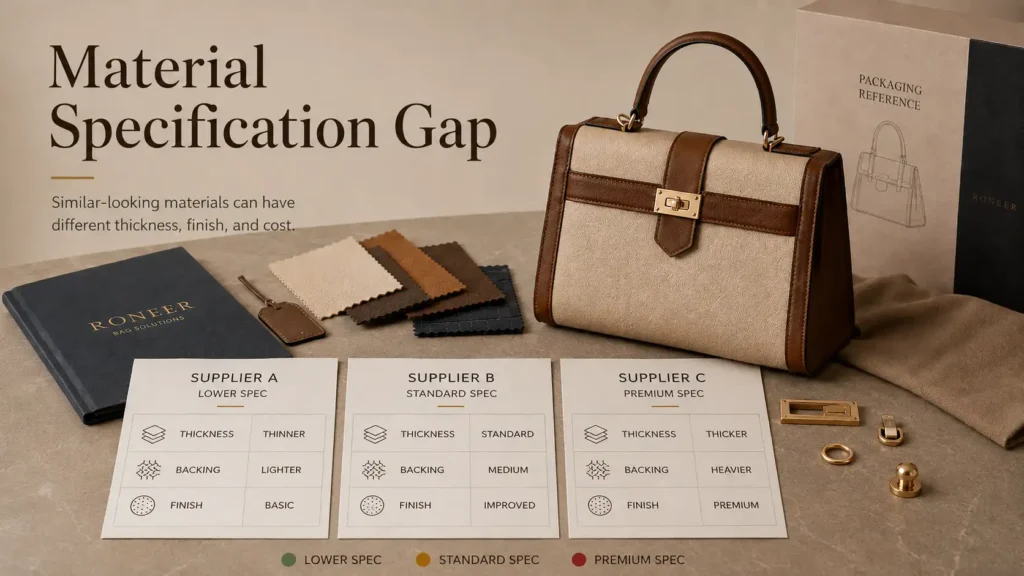
“PU leather,” “nylon,” “polyester,” “canvas,” or “genuine leather” does not define one material.
Within the same general material category, suppliers may quote different:
- Thicknesses
- Weights
- Backings
- Coatings
- Surface finishes
- Grain patterns
- Softness levels
- Color processes
- Supplier sources
Two materials can look similar in a reference photograph while having different purchasing costs and different effects on the finished bag.
A thicker or more structured material may also change cutting, sewing, folding, edge finishing, reinforcement, and material consumption.
This is a major reason why bag suppliers quote different prices.
RONEER’s Personalización de materiales process considers material type, texture, thickness, color, structure, surface finish, and compatibility with the intended bag construction.
When comparing quotations, do not ask only:
Is this PU leather?
Ask:
Which exact material specification is included in the quotation?
Where possible, compare physical swatches or clearly documented references before deciding that two suppliers are quoting the same material.
2. The Same Bag Can Be Built With Different Internal Structures
Exterior appearance does not reveal everything inside a bag.

A structured handbag may contain reinforcement in:
- Front panels
- Back panels
- Bottom
- Gussets
- Handles
- Hardware attachment points
- Zipper areas
One supplier may include these components because it believes they are necessary to achieve the reference shape.
Another may quote a softer construction with less reinforcement.
Both suppliers can still describe the product as the “same handbag.”
Internal pockets also affect cost.
A bag with one simple slip pocket is different from one containing:
- Zipper pocket
- Phone pocket
- Divider
- Padded sleeve
- Anilla para llaves
- Ranuras para tarjetas
- Bottle pocket
When buyers ask why bag suppliers quote different prices, invisible construction is often part of the answer.
The correct comparison therefore needs more than a front-view photo.
Front, back, side, bottom, opening, and interior requirements should be defined wherever they affect construction.
3. Pattern Complexity Changes Labor and Production Efficiency
A bag with many panels takes more work to cut, position, sew, reinforce, and inspect than a simple construction.
Cost can be influenced by:
- Number of pattern pieces
- Curved panels
- Gusset construction
- Piping
- Binding
- Folded edges
- Multiple compartments
- Recessed zipper openings
- Structured bases
- Fabricación de asas
- Edge painting
- Decorative stitching
A complex design can also require more production operations.
This helps explain why bag suppliers quote different prices even if both suppliers use a similar main material.
One factory may interpret a reference image with a simplified pattern.
Another may quote the construction needed to reproduce the shape more closely.
Before treating the higher quotation as inefficient, compare the actual proposed construction.
4. Zippers and Hardware Can Create Large Specification Gaps
Metal components are another common source of quotation differences.
A product may include:
- Zipper sliders
- Pullers
- Anillas en D
- Hebillas
- Ganchos
- Broches magnéticos
- Turn locks
- Cadenas
- Remaches
- Metal feet
- Placas con logotipo
Suppliers may quote standard available components, upgraded components, or specially developed hardware.
Finish also matters.
“Gold hardware” can refer to different shades, plating methods, component suppliers, and surface expectations.
Custom hardware adds another layer because molds, engraving, branded plates, special dimensions, and unique finishes may require separate development.
This means a quotation containing standard off-the-shelf hardware should not automatically be compared with a quotation based on custom-developed components.
To understand why bag suppliers quote different prices, buyers should request a component description rather than comparing “gold hardware” against “gold hardware.”
5. Branding Methods Do Not Carry the Same Cost
“Add our logo” is not a complete manufacturing specification.
A bag may use:
- Serigrafía
- Transferencia de calor
- Bordado
- Etiqueta tejida
- Parche de goma
- Embossing
- Debossing
- Placa metálica con el logotipo
- Tirador de cremallera personalizado
Each process involves different materials, equipment, setup, labor, and production requirements.
Logo size and number of locations also matter.
A small debossed logo on one front panel is not equivalent to a custom metal logo on the exterior, woven label inside, branded zipper puller, and printed packaging.
If one supplier assumes a basic branding method and another includes a more customized private-label package, the quotation difference may be reasonable.
This is another practical explanation for why bag suppliers quote different prices from the same initial inquiry.
6. MOQ and Order Structure Change the Unit Price
Quantity affects more than the number of finished bags.
Production involves preparation that may include:
- Material ordering
- Cutting setup
- Logo preparation
- Machine adjustment
- Component purchasing
- Production planning
- Inspection
- Packing
Some of these costs can be distributed more efficiently across a larger production quantity.
Color breakdown also matters.
An order for 1,000 pieces in one color may be easier to organize than 1,000 pieces divided across many colors, particularly when material or hardware suppliers have their own minimum requirements.
The buyer should therefore specify:
- Total quantity
- Quantity per style
- Quantity per color
- Number of logo versions
- Packaging variations
RONEER’s existing Custom Bag MOQ & Cost Guide explains how material availability, customization, order quantity, and production planning can interact.
When investigating why bag suppliers quote different prices, make sure all factories are quoting the same quantity breakdown rather than simply the same total quantity.
7. Packaging Can Change the Quote More Than Buyers Expect
“Standard packaging” can mean very different things.
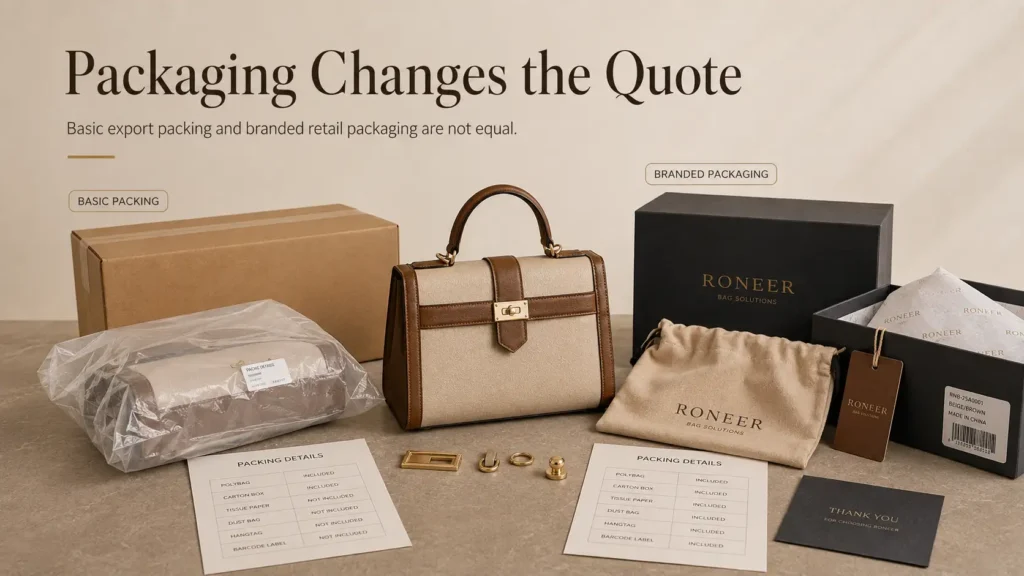
One quotation may include:
- Tissue stuffing
- Basic polybag
- Export carton
Another may include:
- Shape support
- Protección de hardware
- Bolsa para el polvo
- Etiqueta colgante
- Tarjeta de asistencia
- Barcode sticker
- Branded polybag
- Caja de regalo
- Custom carton marks
These are not equivalent packaging specifications.
RONEER’s Personalización de envases options can include dust bags, hang tags, care cards, polybags, barcode stickers, gift boxes, color boxes, carton marks, shipping cartons, and other private-label packaging according to project requirements.
Packaging can also affect shipping volume.
A structured handbag packed in an individual box may occupy substantially more space than the same product packed efficiently with appropriate shape protection.
FedEx explains in its official dimensional weight guidance that shipping charges may be calculated using dimensional weight or actual weight, depending on which is greater.
So why bag suppliers quote different prices may sometimes have less to do with the bag itself and more to do with what happens after sewing is finished.
8. Quality Requirements May Not Be Included at the Same Level
“Good quality” is not an inspection standard.
A quotation may reflect different expectations for:
- Measurement tolerance
- Stitching appearance
- Posicionamiento del logotipo
- Hardware consistency
- Defectos superficiales
- Color variation
- Packaging accuracy
- Inspection frequency
- Finished-product checking
A supplier quoting against a clearly approved specification may allocate more production and inspection attention than one assuming only a basic commercial standard.
Buyers should be cautious about assuming that every supplier includes identical quality-control scope.
Likewise, a higher quotation does not automatically prove better quality.
The factory should be able to explain what specification, approved sample, defect requirements, or inspection process the quotation assumes.
The useful question is:
What quality level does this price actually represent?
That question is more informative than asking only why one supplier costs more.
9. Sample, Mold and Setup Costs May Be Included Differently
One supplier may separate development costs from bulk-production price.
Another may spread some setup costs into the unit price.
Possible additional items include:
- Sample fee
- Pattern development
- Logo setup
- Printing plate
- Embroidery setup
- Hardware mold
- Custom buckle mold
- Muestra de embalaje
- Revision sample
When investigating why bag suppliers quote different prices, check whether these items appear separately or have already been absorbed into the quoted unit cost.
A quotation that looks higher may actually include development items that another supplier will charge later.
This is especially important for projects involving custom metal hardware, exclusive packaging, unusual structures, or repeated sample revisions.
10. EXW, FOB, FCA and Delivered Prices Are Not the Same Quote
Two suppliers can quote the exact same production cost and still present different final numbers because they are using different delivery terms.
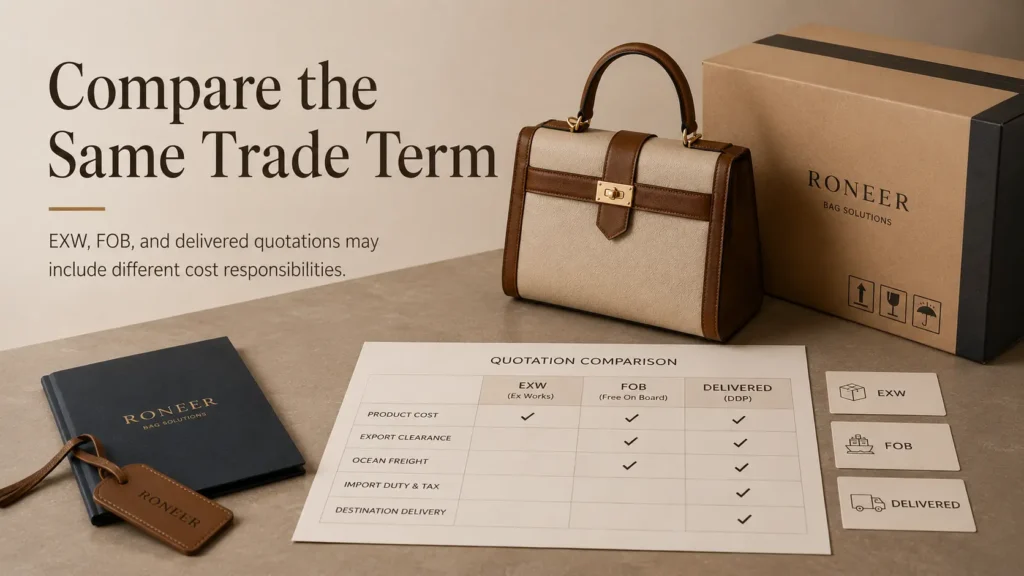
A quotation may be based on:
- EXW
- FCA
- FOB
- CIF
- DAP
- Another agreed commercial term
These terms determine which transport-related responsibilities and costs are included at different points.
The International Chamber of Commerce’s official Incoterms® 2020 rules explain the allocation of delivery obligations, costs, and risks under commonly used trade terms.
For example, EXW places goods at the buyer’s disposal at the named location, while other Incoterms® rules assign additional transport or delivery responsibilities to the seller.
This is a critical reason why bag suppliers quote different prices.
Do not compare an EXW unit price directly with a quotation that already includes additional export handling or transportation responsibilities.
Every quotation comparison should record the applicable delivery term and named place.
11. Suppliers May Be Making Different Assumptions About Your Target Product
This is the most overlooked reason.
A reference photo does not tell a factory whether the buyer wants:
- Promotional quality
- Entry-level retail quality
- Mid-market private label quality
- Boutique presentation
- Premium structured construction
- Cost-first mass-market production
If the buyer does not provide a target market or target product level, each supplier may make a different commercial assumption.
Supplier A may optimize aggressively for price.
Supplier B may prioritize appearance and structure.
Supplier C may include better hardware, stronger reinforcement, improved packaging, or more development work.
The resulting quotations are not truly comparable.
This explains why bag suppliers quote different prices even when no supplier has made an obvious calculation error.
A useful RFQ should therefore communicate not only the physical specifications but also the commercial context.
Tell suppliers:
- Target customer
- Sales channel
- Target retail position
- Expected quantity
- Important quality priorities
- Features that cannot be changed
- Features where alternatives are acceptable
This gives suppliers a better chance of quoting toward the same product objective.
Quick Quote Comparison Table
Before selecting a supplier, put every quotation into one comparison table.
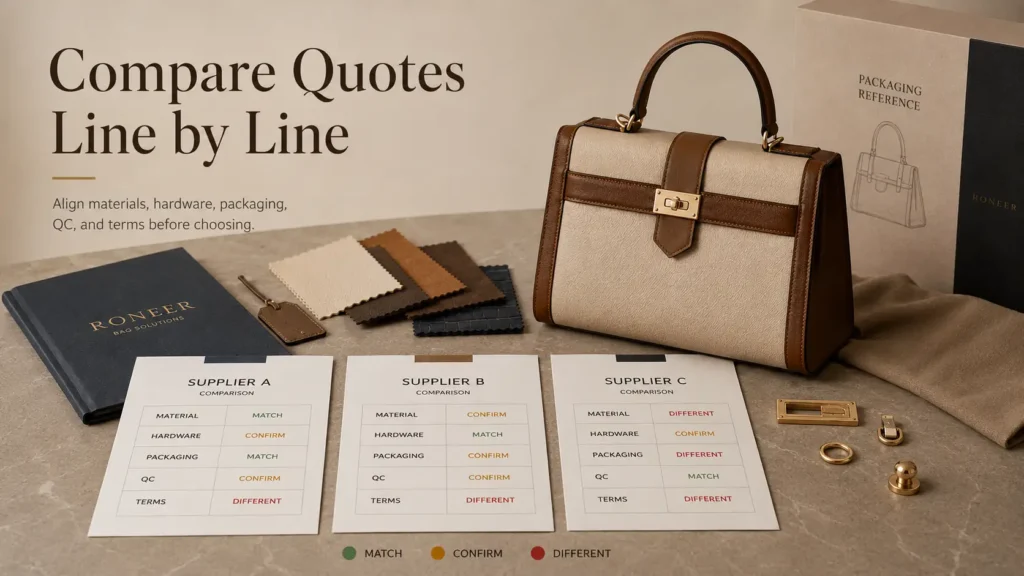
| Quote Item | Supplier A | Supplier B | Supplier C |
|---|---|---|---|
| Main material specification | Confirm | Confirm | Confirm |
| Forro | Confirm | Confirm | Confirm |
| Dimensiones | Confirm | Confirm | Confirm |
| Structure/reinforcement | Confirm | Confirm | Confirm |
| Hardware | Confirm | Confirm | Confirm |
| Método del logotipo | Confirm | Confirm | Confirm |
| Quantity per color | Confirm | Confirm | Confirm |
| Sample/setup charges | Confirm | Confirm | Confirm |
| Embalaje | Confirm | Confirm | Confirm |
| QC scope | Confirm | Confirm | Confirm |
| Trade term | Confirm | Confirm | Confirm |
| Shipping included? | Confirm | Confirm | Confirm |
This table often reveals why bag suppliers quote different prices before any negotiation begins.
If the specifications are not aligned, the lowest quotation is not yet evidence of a lower manufacturing cost.
It may simply be a different product.
A Better Way to Request Comparable Bag Quotations
Instead of sending only a photograph and quantity, prepare a structured RFQ.
Include:
Producto
State the exact bag type and intended use.
Finished Dimensions
Specify width, height, depth, handle drop, strap dimensions, and critical compartments.
Material principal
Provide material type, preferred thickness or weight where relevant, color, texture, and reference.
Forro
Specify material and color.
Hardware
List the required components and preferred finish.
Branding
State the logo method, dimensions, locations, and artwork requirements.
Interior
Define pockets, sleeves, dividers, padding, and other functional details.
Cantidad
Break the total quantity down by style and color.
Embalaje
Define the unit packing and retail packaging requirements.
Quality Requirements
Identify the approved sample, critical measurements, appearance expectations, and inspection requirements.
Delivery Basis
Request quotations using the same commercial terms and named place.
Once these variables are aligned, why bag suppliers quote different prices becomes much easier to analyze.
The remaining difference may reflect sourcing, manufacturing efficiency, overhead, supplier margin, production approach, or commercial strategy rather than an incomplete specification.
Should You Always Choose the Lowest Bag Supplier Quote?
No.
But you should not automatically choose the highest quotation either.
The right decision begins by making the quotations comparable.
A lower price can be attractive when the supplier has genuinely found a more efficient manufacturing solution without changing the approved product requirement.
It becomes risky when the saving comes from an unapproved difference such as:
- Different material
- Reduced reinforcement
- Cheaper hardware
- Simplified lining
- Different logo process
- Lower packaging level
- Excluded development cost
- Different shipping basis
Conversely, a higher price only adds value when the supplier can explain what additional requirement or service it includes.
Ask every supplier to explain significant differences.
Professional quotation comparison is not about defending the expensive option.
It is about identifying what each number represents.
FAQ About Why Bag Suppliers Quote Different Prices
1. Why do bag suppliers quote different prices for the same design?
Why bag suppliers quote different prices often comes down to different assumptions about material, construction, hardware, lining, logo application, packaging, MOQ, quality requirements, and delivery terms.
A reference image alone rarely defines all of these variables.
2. Does a lower bag quotation always mean lower quality?
No.
A supplier may have more efficient sourcing, simpler overhead, or a different production solution.
However, buyers should confirm that the lower quotation is based on the same material, construction, components, packaging, and commercial terms before treating it as a saving.
3. Why do two suppliers quote different prices for the same PU bag?
PU is a broad material category.
Thickness, backing, grain, coating, softness, finish, color, and material source can vary. Those differences can affect both material cost and manufacturing behavior.
4. Does MOQ explain why bag suppliers quote different prices?
Yes, it can be an important factor.
Order size and quantity per color can influence material purchasing, component ordering, production setup, and unit efficiency.
Always compare quotations at the same quantity breakdown.
5. Can hardware cause a large quotation difference?
Sí.
Standard buckles, hooks, zippers, and logo plates can differ from custom-developed hardware requiring special dimensions, finishes, branding, or molds.
Ask suppliers to identify the hardware included in the quote.
6. Why does packaging change bag pricing?
Packaging may range from basic tissue, polybag, and export carton packing to dust bags, hangtags, barcode labels, branded boxes, inserts, and customized shipping cartons.
Packaging can also change shipping volume.
7. Should suppliers quote using the same Incoterm?
For accurate comparison, using the same delivery basis and named place is strongly recommended.
An EXW quotation should not be compared directly with a price that includes additional transportation or delivery responsibilities.
8. How can I know whether two suppliers quoted the same bag quality?
Compare the detailed specification rather than the sales description.
Check material, dimensions, reinforcement, lining, hardware, zipper, logo method, workmanship requirements, packaging, and inspection scope.
9. Why does one supplier ask many questions before quoting?
Detailed questions can indicate that the supplier is trying to remove assumptions before calculating the product.
This does not automatically mean that the supplier is better, but it can produce a more clearly defined quotation.
10. Should sample cost be included when comparing suppliers?
Sí.
Check whether sampling, pattern development, logo setup, molds, packaging samples, revisions, and courier costs are included or quoted separately.
11. What should I send suppliers to receive comparable quotations?
Provide reference images or drawings, dimensions, material requirements, hardware, logo method, internal structure, quantity by color, packaging, quality requirements, and the requested trade term.
Clearer input reduces quotation assumptions.
12. How can RONEER support quotation comparison for a custom bag project?
RONEER can review OEM/ODM project requirements including material sourcing, size and structure, hardware, logo methods, sampling, packaging, quality inspection, bulk-production coordination, and repeat-order documentation.
A quotation can then be prepared according to the confirmed project specification, quantity, and commercial requirements.
Conclusión
Understanding why bag suppliers quote different prices begins with recognizing that suppliers are not always quoting the same product, even when they receive the same reference image.
Material grade, internal construction, pattern complexity, hardware, branding, MOQ, packaging, quality requirements, development costs, and trade terms can all change the final number.
The first task is therefore not to negotiate every supplier toward the lowest price.
It is to remove the differences hidden behind those prices.
Give each supplier the same dimensions, materials, structure, components, branding, packaging, quantity, inspection requirements, and delivery basis. Then compare what remains.
For RONEER OEM/ODM projects, quotation preparation can be connected with material sourcing, product structure, sample development, branding, packaging, quality requirements, and production planning according to confirmed buyer specifications.
Once every supplier is working from the same commercial and technical reference, why bag suppliers quote different prices becomes a useful sourcing question rather than a confusing one—and buyers can make supplier decisions based on what each quotation actually includes.