 Español
  English
  Deutsch
  Français
  Italiano
  Русский
  日本語
日本語  العربية
  Türkçe
  한국어
한국어 A custom zipper puller is a small detail, but it can change how a bag feels in the customer’s hand. It affects brand recognition, zipper usability, product style, material matching, hardware quality, and perceived value. For handbags, backpacks, cosmetic bags, travel bags, wallets, pouches, laptop bags, and toiletry bags, the zipper puller is often touched many times during daily use.
Many buyers think of zipper pullers only as decorative accessories. In real OEM/ODM production, a custom zipper puller is part of the bag’s function and construction system. It must match the zipper slider, zipper size, bag material, hardware finish, logo method, MOQ, sample lead time, and QC standard. A puller can look good in artwork but fail in production if it is too heavy, too weak, difficult to grip, poorly plated, or incompatible with the slider.
RONEER supports custom bag projects with logo customization, hardware development, material customization, sample development, low MOQ planning where feasible, strict QC, export packing, and global shipping coordination. Buyers can review RONEER’s overall factory capabilities through Servicio de fabricación de bolsas a medida de RONEER.
This guide explains how to choose a custom zipper puller, which materials are available, what buyers should confirm before sampling, and how to reduce risk before bulk production.
Why a Custom Zipper Puller Matters in Bag Manufacturing
A zipper puller is one of the most visible and frequently used parts of a bag. It is not only a branding element. It also affects daily handling, zipper movement, comfort, durability, and the overall quality impression.
A well-designed custom zipper puller can help buyers:
- Strengthen brand identity
- Improve zipper usability
- Add private label detail
- Match hardware and logo style
- Increase perceived value
- Mejorar la consistencia del producto
- Support premium packaging presentation
- Create a recognizable collection detail
A poor zipper puller can create the opposite effect. It may feel sharp, break easily, scratch the bag surface, fade after use, make noise, discolor, pull off from the slider, or look inconsistent with other hardware.
For B2B buyers, the best custom zipper puller is not always the most expensive one. It is the option that matches the product level, target market, order quantity, bag structure, and production budget.
1. Metal Custom Zipper Puller
Metal is one of the most common choices for a custom zipper puller, especially for handbags, wallets, cosmetic bags, business bags, travel bags, and premium pouches. It can create a strong branded look and can be developed in different shapes, finishes, and logo styles.
Metal zipper pullers can use:
- Die-cast zinc alloy
- Latón
- Acero inoxidable
- Iron
- Aluminum alloy
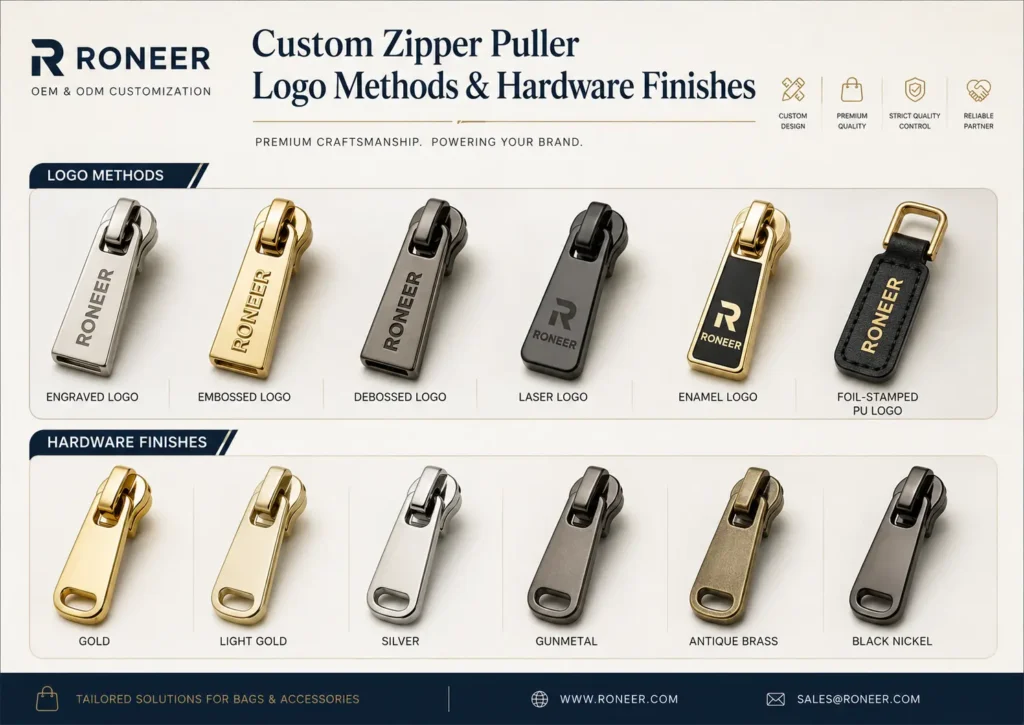
Common finish options include gold, light gold, silver, nickel, gunmetal, black nickel, antique brass, matte black, and brushed finishes.
A metal custom zipper puller can include engraved logos, embossed logos, debossed logos, cutout shapes, enamel filling, or brand initials. However, custom metal pullers often require mold development, plating confirmation, and minimum quantity planning.
Buyers should check weight carefully. A heavy puller may feel premium on a handbag, but it may be too heavy for a lightweight nylon pouch or small cosmetic bag.
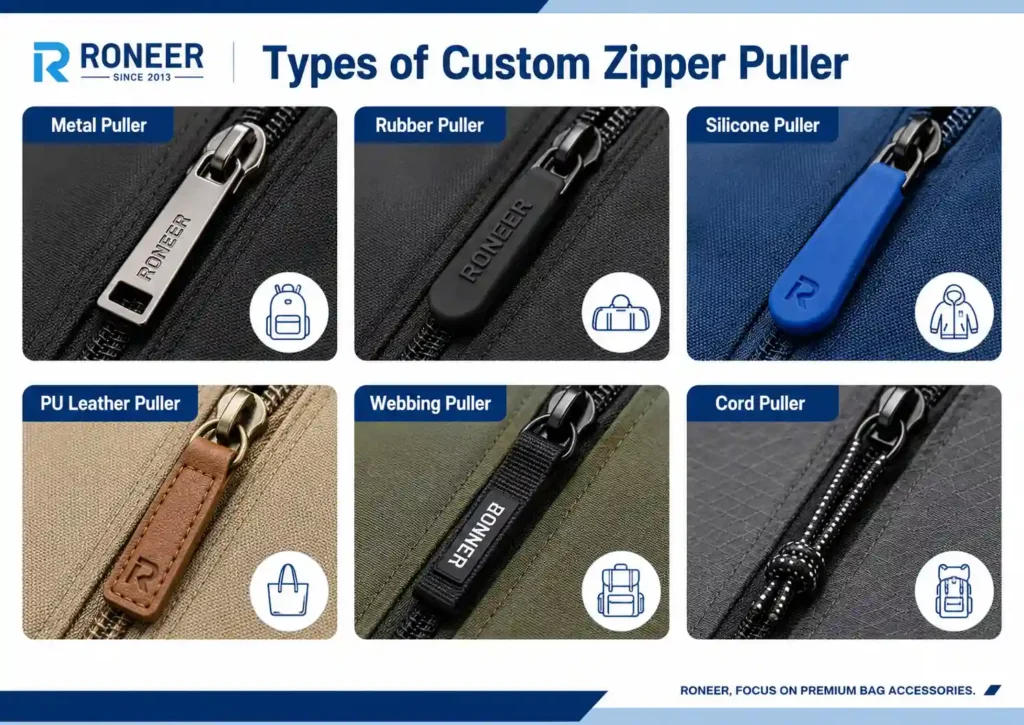
2. Rubber or Silicone Zipper Puller
Rubber and silicone zipper pullers are practical for backpacks, outdoor bags, sports bags, kids’ bags, promotional bags, cooler bags, and casual pouches. They can provide better grip and a softer touch than metal.
A rubber or silicone custom zipper puller can use raised logos, recessed logos, color blocks, molded shapes, or brand icons. These pullers are useful when the product needs a sporty, functional, or casual look.
Rubber and silicone pullers can work well for:
- Mochilas
- Outdoor bags
- Sports bags
- Travel organizers
- School bags
- Cooler bags
- Kids’ bags
- Promotional bags
They may require molds, especially for custom shapes. Buyers should confirm mold cost, logo clarity, color matching, flexibility, odor, pulling strength, and connection method.
For low MOQ projects, standard rubber pullers with a simple printed or embossed logo may be more practical than fully custom molded shapes.
3. PU Leather or Microfiber Leather Puller
PU leather and microfiber leather zipper pullers are common for handbags, wallets, cosmetic bags, pouches, travel accessories, and leather-look collections. They can match the main bag material and create a softer, more refined appearance.
This type of custom zipper puller can use:
- PU leather strip
- Microfiber leather strip
- Genuine leather strip if required
- Folded and stitched puller
- Logotipo grabado en relieve
- Foil-stamped logo
- Metal rivet detail
- Edge-painted finish
PU leather pullers are often suitable when buyers want the zipper detail to match the bag body. For example, a PU leather cosmetic pouch may use a small tonal puller with debossed logo. A handbag may use a longer puller with edge paint and metal rivet.
Buyers should confirm thickness, edge finishing, stitching, logo method, color consistency, and whether the puller can handle repeated pulling without tearing.
4. Fabric, Webbing, and Rope Pullers
Fabric, webbing, cord, and rope pullers are useful for casual bags, outdoor bags, sports bags, backpacks, and travel products. They are lightweight, flexible, and often cost-effective.
Common options include:
- Woven webbing puller
- Polyester tape puller
- Nylon cord puller
- Paracord-style puller
- Fabric loop puller
- Reflective tape puller
This type of custom zipper puller may include woven labels, printed logos, rubber end tips, heat-cut ends, knots, or small plastic parts. It is useful when the bag needs a soft and practical hand feel.
For outdoor and travel bags, rope or cord pullers can make the zipper easier to grip, especially when the user is wearing gloves. For promotional bags, simple webbing pullers can keep cost controlled.
Buyers should check fraying, pulling strength, end finishing, color fastness, and whether the puller style matches the bag’s target market.
5. Zipper Puller Shape and Size
The shape and size of a custom zipper puller should match both the bag style and the zipper size. A puller that is too small may be hard to use. A puller that is too large may look awkward or hit the bag surface during movement.
Common puller shapes include:
- Rectangle
- Oval
- Round
- Bar shape
- Brand initial
- Logo icon
- Strap shape
- Ring puller
- Tab puller
- Geometric shape
- Custom molded shape
For wallets and cosmetic bags, smaller pullers usually work better. For backpacks and travel bags, larger pullers can improve grip. For handbags, the puller should look refined and match the hardware style.
Buyers should also consider safety and comfort. Sharp corners, thin metal edges, and heavy parts can create user complaints.
6. Logo Methods for Custom Zipper Puller
A custom zipper puller can carry brand identity in many ways. The best logo method depends on material, size, surface, MOQ, and budget.
Common logo methods include:
- Engraved logo
- Logotipo en relieve
- Logotipo grabado en relieve
- Laser logo
- Enamel color logo
- Printed logo
- Foil-stamped logo
- Molded raised logo
- Woven logo
- Rubber patch logo
- Metal badge detail
For metal pullers, engraving, embossing, debossing, laser marking, and enamel filling are common. For PU leather pullers, debossing, foil stamping, and stitching details are common. For rubber pullers, molded raised or recessed logos are practical. For webbing pullers, woven or printed labels may work better.
Los compradores pueden consultar la oferta de RONEER personalización del logotipo options when planning the zipper puller together with the main bag logo, inner label, hang tag, dust bag, and packaging.
7. Match the Puller With the Zipper Slider
A custom zipper puller must fit the zipper slider. This sounds basic, but it is one of the most important technical details. The puller connection hole, ring, hook, or attachment point must match the slider shape and size.
Los compradores deben confirmar:
- Zipper size
- Slider type
- Slider hole size
- Puller attachment method
- Pulling direction
- Strength requirement
- Finish matching
- Anti-rust needs
- Color de la cinta de la cremallera
- Slider color
- Puller movement
Industry suppliers such as YKK can be used as a general reference for zipper and fastening component categories. However, the actual zipper brand, slider type, specification, color, and cost should be confirmed during order negotiation. RONEER does not assume premium zipper components unless the buyer requests and approves them.
A beautiful puller is not useful if it does not move smoothly with the zipper slider.
8. Hardware Finish and Color Matching
For metal or mixed-material pullers, hardware finish should match the rest of the bag. A gold zipper puller on a bag with silver buckles may look inconsistent unless it is an intentional design choice.
A complete custom zipper puller plan should check:
- Zipper teeth color
- Slider finish
- Puller finish
- Hebillas
- Anillas en D
- Ganchos
- Remaches
- Logo plate
- Ajustadores de correas
- Metal feet
- Decorative hardware
Common hardware finishes include gold, light gold, silver, nickel, gunmetal, antique brass, black nickel, and matte black. Each finish has a different brand feeling. Gold can look premium, gunmetal can look modern, antique brass can look vintage, and matte black can look technical or minimalist.
Buyers should approve hardware finish on physical samples because photos and screens can show metal color differently.
9. MOQ, Mold Cost, and Lead Time
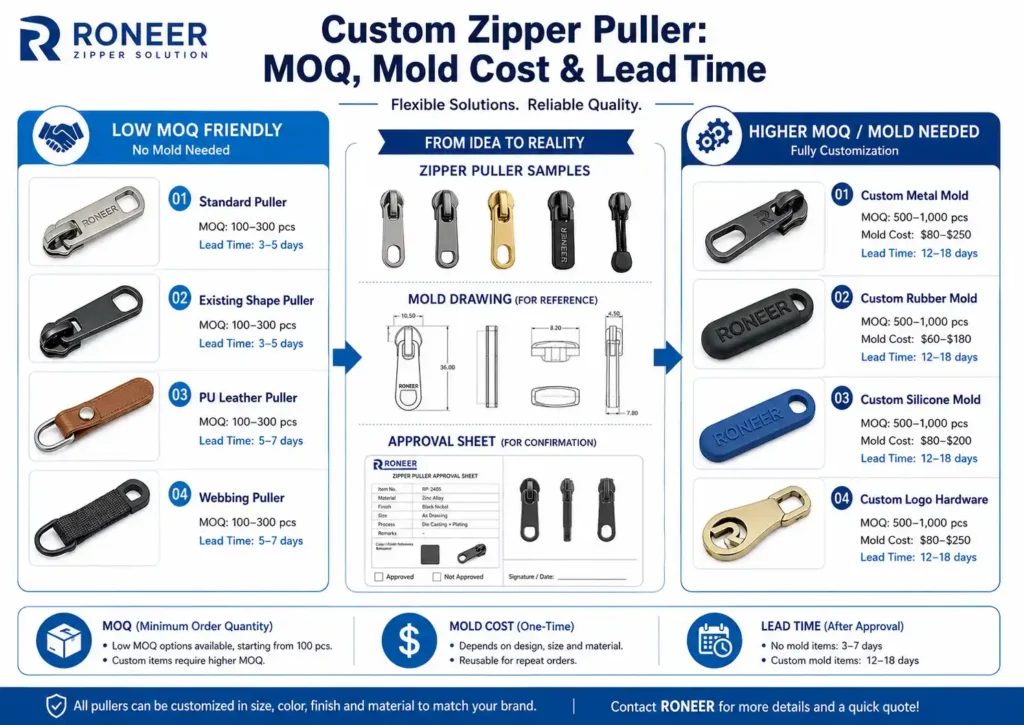
A custom zipper puller can affect MOQ, cost, and lead time more than buyers expect. Simple standard pullers are usually easier for low MOQ projects. Fully customized metal, rubber, or silicone pullers often need molds and supplier minimums.
Entre los factores que influyen en el coste se incluyen:
- Puller material
- Custom shape
- Método del logotipo
- Mold charge
- Plating finish
- Color filling
- Cantidad del pedido
- Slider compatibility
- Revisiones de ejemplos
- Packaging requirement
- Testing requirement
For low MOQ projects, buyers may consider:
- Standard metal puller with small logo
- Existing puller shape with custom logo
- PU leather puller using available material
- Webbing puller with woven label
- Standard rubber puller if available
Buyers planning low MOQ custom bag orders can review RONEER’s guide on Planificación de costes y cantidad mínima de pedido (MOQ) para mochilas personalizadas. Many MOQ principles also apply to zipper pullers, custom hardware, logo plates, patches, labels, and packaging.
¿Necesitas bolsas personalizadas para tu marca?
Póngase en contacto con RONEER para la producción OEM/ODM, la creación rápida de muestras, opciones con cantidades mínimas de pedido (MOQ) reducidas, soluciones de logotipos personalizados, personalización de materiales, un estricto control de calidad y asistencia con el embalaje para la exportación.
Custom Zipper Puller by Bag Type
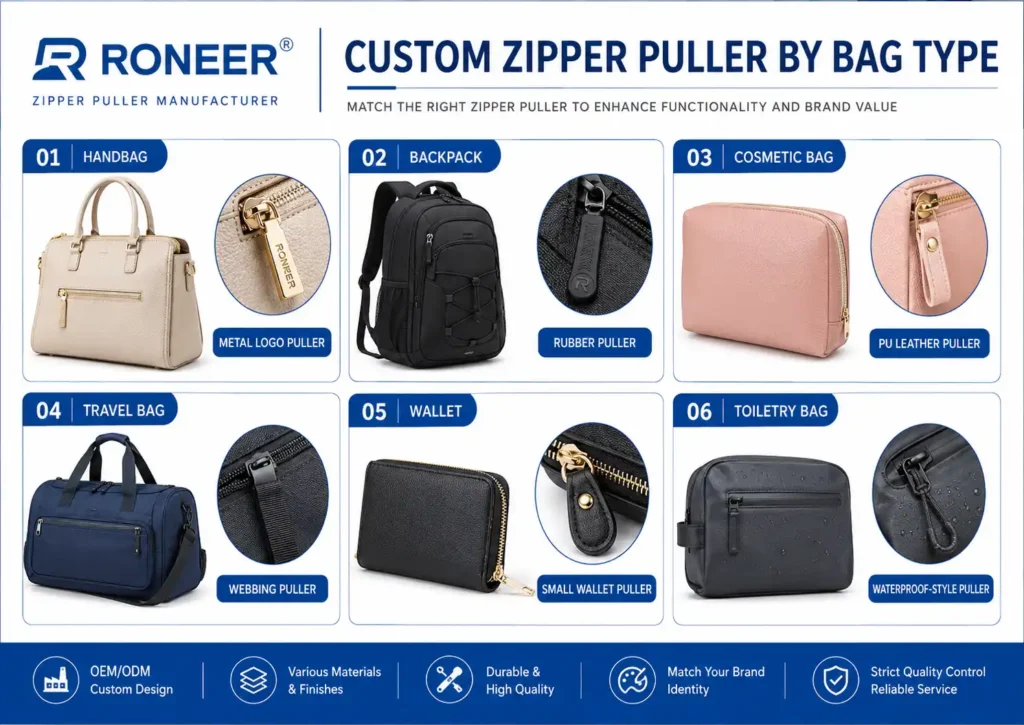
Different bags need different zipper puller decisions.
Bolsos
For handbags, metal pullers, PU leather pullers, microfiber leather pullers, and branded pull tabs are common. The puller should match the bag’s hardware finish and overall style. Too large or heavy a puller may feel unbalanced.
Mochilas
Backpacks often use rubber, webbing, rope, metal, or molded pullers. The puller should be easy to grip and durable for daily use. For outdoor backpacks, rubber or cord pullers may work better than delicate metal pullers.
Neceseres
Cosmetic bags often use small metal pullers, PU leather pullers, rubber pullers, or simple branded tabs. The puller should be easy to hold, smooth to open, and not scratch the bag surface.
Bolsas de viaje
Travel bags need stronger zipper pullers because they are used frequently and may carry heavier loads. Metal, rubber, webbing, or reinforced pullers are common. Pulling strength and slider compatibility are important.
Carteras
Wallets usually need small and refined pullers. Metal pullers, PU leather tabs, or slim logo pullers can work. Heavy pullers may not suit small wallets.
Toiletry Bags
Toiletry bags may use waterproof or wipeable materials, so the puller should resist moisture and be easy to clean. Rubber, silicone, plastic, or coated pullers can be practical.
Packaging and Branding Around the Zipper Puller
The zipper puller should also match the wider private label system. A buyer may use the same logo style across the front logo, inner label, hang tag, dust bag, insert card, and zipper puller.
Por ejemplo:
- A premium handbag may use a metal logo plate and matching metal zipper puller.
- A sporty backpack may use a rubber logo patch and rubber zipper pullers.
- A cosmetic pouch may use a foil-stamped PU leather puller and branded poly bag.
- A travel bag may use webbing pullers and clear barcode packaging.
De RONEER personalización del embalaje service can help buyers plan the zipper puller together with hang tags, care cards, barcode labels, dust bags, poly bags, gift boxes, and export cartons.
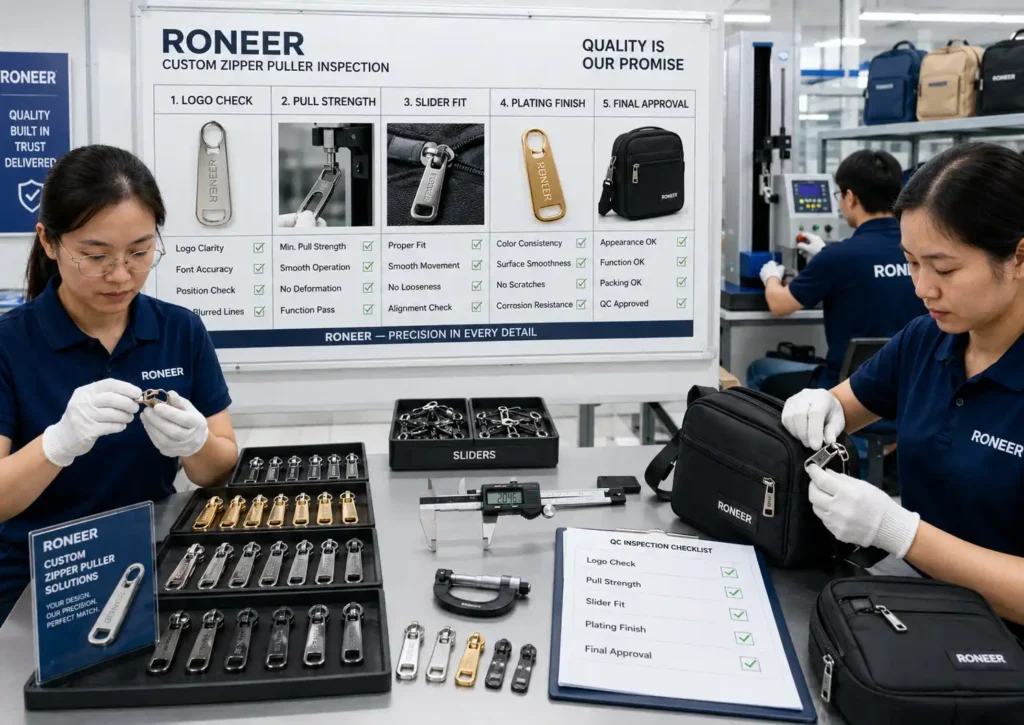
Quality Control for Custom Zipper Puller
A zipper puller should be checked before and during bulk production. Even small hardware issues can affect customer satisfaction.
Entre los puntos importantes de control de calidad se incluyen:
- Puller size
- Nitidez del logotipo
- Edge smoothness
- Uniformidad del recubrimiento
- Consistencia del color
- Pulling strength
- Resistencia de la fijación
- Slider compatibility
- Rust resistance if needed
- Scratch marks
- Bordes afilados
- Rubber odor if applicable
- PU leather peeling
- Stitching on leather pullers
- Movement during zipper opening
- Final bag appearance
Para obtener información sobre la inspección y el control de calidad, los compradores pueden consultar SGS. For harmful substance or material safety background, OEKO-TEX can be used as an industry reference for textile-related materials. Buyers should confirm any specific testing, retailer requirement, or compliance need before production.
RONEER checks zipper puller details during sample development, pre-production confirmation, final inspection, and export packing to help reduce avoidable quality issues.
Common Mistakes When Choosing a Custom Zipper Puller
Choosing by Appearance Only
A puller may look good in a rendering but feel heavy, sharp, weak, or difficult to use in the real product.
Ignoring Slider Compatibility
The puller must match the zipper slider. Wrong connection size can cause assembly problems or weak pulling strength.
Using Custom Molded Hardware for Very Low MOQ
Custom molds may not be cost-effective for small orders. Buyers should compare standard options first.
Forgetting Hardware Finish Matching
The puller should match zipper teeth, slider, buckles, hooks, rivets, and logo plates.
Making the Puller Too Heavy
Heavy metal pullers may look premium but can damage lightweight bags or feel uncomfortable on small pouches.
Not Testing Pulling Strength
A zipper puller is used repeatedly. Buyers should check attachment strength before bulk production.
How RONEER Helps Buyers Develop a Custom Zipper Puller
RONEER helps buyers develop a custom zipper puller based on bag type, material, brand positioning, MOQ, logo method, zipper specification, hardware finish, packaging, and quality expectations.
RONEER es compatible con:
- Puller material selection
- Standard puller options
- Custom logo discussion
- Metal puller development
- PU leather puller planning
- Rubber or silicone puller discussion
- Zipper slider matching
- Hardware finish coordination
- Low MOQ suggestions
- Desarrollo de muestras
- Pulling strength review
- Bulk production follow-up
- QC inspection
- Export packing
For startups, RONEER can suggest practical zipper puller options that keep cost and MOQ under control. For established brands, RONEER can help develop more detailed private label pullers across multiple bag styles.
FAQ About Custom Zipper Puller
1. What is a custom zipper puller?
A custom zipper puller is the pull tab or handle attached to a zipper slider. It helps users open and close the zipper while also adding brand identity, style, and product detail to custom bags.
2. What materials are used for a custom zipper puller?
A custom zipper puller can be made from metal, rubber, silicone, PU leather, microfiber leather, genuine leather, webbing, fabric tape, cord, rope, or plastic. The best material depends on bag type, brand style, MOQ, budget, and zipper function.
3. Can a custom zipper puller include a logo?
Sí. A custom zipper puller can include engraved logos, embossed logos, debossed logos, laser logos, molded rubber logos, foil-stamped PU leather logos, woven labels, or printed artwork depending on the material and size.
4. Does a custom zipper puller require a mold?
Some custom zipper puller designs require a mold, especially custom metal shapes, rubber pullers, silicone pullers, and unique logo hardware. Standard puller shapes with simpler logo methods may be easier for low MOQ projects.
5. What is the best custom zipper puller for handbags?
For handbags, metal pullers, PU leather pullers, microfiber leather pullers, and refined branded tabs are common. The puller should match the hardware finish, zipper color, bag material, and overall brand positioning.
6. What is the best custom zipper puller for backpacks?
For backpacks, rubber, silicone, webbing, cord, metal, or molded pullers can work. A backpack custom zipper puller should be easy to grip, durable, and suitable for repeated daily use.
7. Can RONEER support low MOQ custom zipper puller options?
RONEER can discuss low MOQ custom zipper puller options based on available puller shapes, material choice, logo method, zipper supplier requirements, and order quantity. Standard pullers or simple PU leather pullers may be easier than fully custom molded hardware.
8. How long does custom zipper puller sampling take?
Sampling time depends on artwork, material, mold development, plating finish, logo method, supplier schedule, and revision needs. A simple puller can be faster, while custom molded metal or rubber pullers usually need more time.
9. What should buyers check before approving a custom zipper puller?
Buyers should check size, logo clarity, material, edge smoothness, pulling comfort, attachment strength, slider compatibility, plating finish, color, weight, and overall match with the bag.
10. Can the same custom zipper puller be used on different bag styles?
Sometimes. The same custom zipper puller can be used across a collection if zipper size, slider type, hardware finish, and bag style are compatible. However, a puller suitable for a travel bag may be too large for a wallet or cosmetic pouch.
11. Does a custom zipper puller affect bag cost?
Sí. A custom zipper puller can affect cost because material, logo method, mold charge, plating, size, color filling, and quantity all influence pricing. Custom hardware usually costs more than standard pullers.
12. Why choose RONEER for custom zipper puller development?
RONEER helps buyers develop a custom zipper puller with OEM/ODM support, logo customization, hardware finish coordination, zipper slider matching, low MOQ planning where feasible, sample development, strict QC, export packing, and global shipping coordination.
Conclusión
A custom zipper puller is a small part of the bag, but it plays an important role in branding, usability, durability, and product value. The right puller should match the bag material, zipper slider, hardware finish, logo style, MOQ, cost target, and expected customer use.
For B2B buyers, choosing a custom zipper puller should not be based on appearance alone. Metal pullers can create a premium look, rubber and silicone pullers improve grip for functional bags, PU leather pullers match leather-look products, and webbing or cord pullers work well for casual, travel, and outdoor bags. Each material has different cost, MOQ, sample time, and QC requirements.
RONEER supports OEM/ODM buyers with custom zipper puller development, custom logo options, hardware finish planning, material customization, low MOQ suggestions where feasible, fast sampling, stable bulk production, strict QC, export carton packing, and global shipping experience.
Before bulk production, buyers should approve the physical puller sample, logo effect, hardware color, slider compatibility, pulling strength, edge smoothness, and final appearance on the finished bag. When a custom zipper puller is planned together with the main bag logo, hardware, lining, packaging, and QC standard, the final product looks more consistent, feels more professional, and becomes easier to reorder across future collections.