 English
  Deutsch
  Español
  Français
  Italiano
  Русский
  日本語
日本語  العربية
  Türkçe
  한국어
한국어 A material can look correct on a swatch and still become the wrong choice once it is cut, folded, rubbed, stitched, loaded, or exposed to daily use.
A black fabric may transfer color onto light clothing. A coated nylon may resist a quick splash but perform differently under sustained water pressure. A soft PU can look attractive during sampling but show surface wear in high-contact areas. A woven fabric may feel strong by hand while still being unsuitable for a large travel bag carrying heavier loads.
This is why bag material testing should begin with the product risk, not with a random list of laboratory tests.
For brands, sourcing teams, retailers, private-label buyers, and importers, the objective is not to test every possible property.
It is to identify which material characteristics could cause the specific bag to fail its intended use, appearance, or buyer requirement.
A fashion handbag, school backpack, cosmetic pouch, laptop bag, outdoor bag, and travel duffel do not need identical test plans.
A useful bag material testing process therefore connects four things:
- The material specification
- The intended bag use
- The buyer’s required performance
- The approved test method and acceptance requirement
The result should help buyers decide whether a material is suitable before large quantities are cut and assembled.
Why Bag Material Testing Should Happen Before Cutting
Material problems become more expensive after production begins.
If a bulk fabric has unacceptable color transfer, weak coating, inconsistent thickness, poor abrasion behavior, or unexpected strength characteristics, sewing the material into finished bags does not solve the underlying issue.
That is why material verification should normally connect with incoming material inspection and pre-production approval.
RONEER’s Bag Quality Control Guide places incoming materials at the beginning of the QC process because material type, color, surface condition, thickness or weight, lining, zippers, hardware, and related components should be reviewed before later production stages.
However, visual inspection and bag material testing are not the same thing.
Visual inspection may detect:
- Surface scratches
- Stains
- Color differences
- Obvious coating defects
- Weaving defects
- Creases
- Incorrect material
- Batch inconsistency
Testing is used when the buyer needs evidence about a particular physical or performance property.
That distinction matters.
A fabric can look visually clean and still have poor rubbing fastness. A coated textile can look water resistant but need a defined water-penetration test before any performance claim is made.
1. Define the End Use Before Choosing a Test
The correct test plan starts with the bag’s intended use, not with a generic list of laboratory methods.
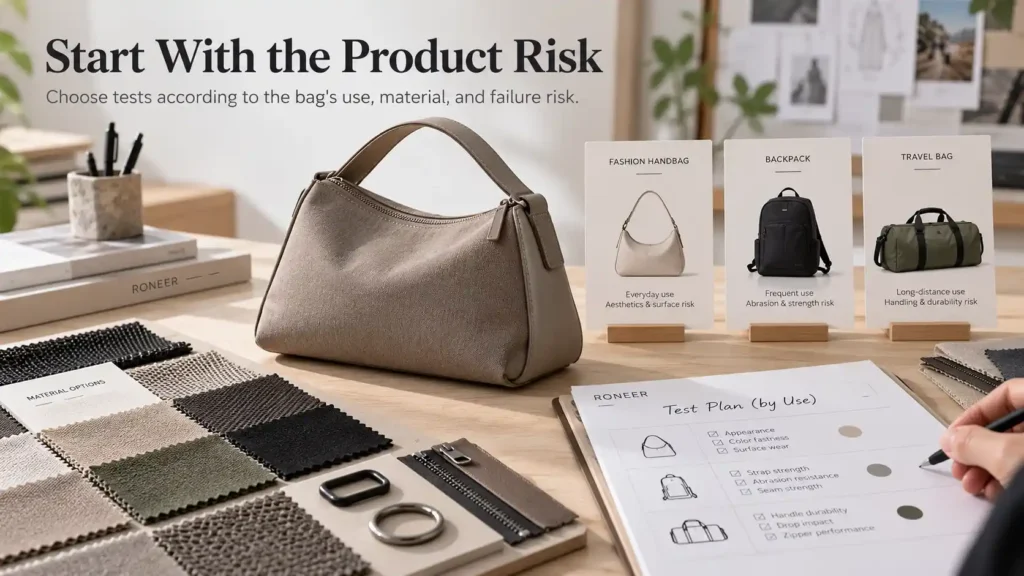
Consider three products.
A small fashion handbag may be exposed mainly to friction against clothing, repeated handling, metal hardware contact, and cosmetic appearance expectations.
A school backpack may need to handle heavier loads, repeated shoulder-strap movement, abrasion, zipper use, and outdoor exposure.
A travel duffel may place greater demands on fabric strength, handles, bottom panels, seams, and coated surfaces.
The material risks are therefore different.
Before requesting bag material testing, define:
| Question | Buyer Decision |
|---|---|
| What type of bag is it? | Handbag, backpack, tote, travel bag, cosmetic bag, etc. |
| What will it carry? | Lightweight personal items, laptop, clothing, equipment |
| Where will it be used? | Indoor, commuting, travel, outdoor |
| Which surfaces receive friction? | Body panels, bottom, straps, handles |
| Does color transfer matter? | Especially against light clothing or lining |
| Is water resistance required? | Define the expected level rather than saying “waterproof” |
| Is the material structural? | Soft, semi-structured, reinforced |
| Is a specific standard required? | Confirm with the buyer or technical specification |
For projects where the material is still being selected, buyers can review RONEER’s Material Customization options before deciding which properties need verification.
A sensible test plan begins with the actual product requirement.
2. Check Color Fastness and Color Transfer Risk
Color performance is particularly important for dark, highly saturated, printed, coated, suede-like, and surface-finished materials.
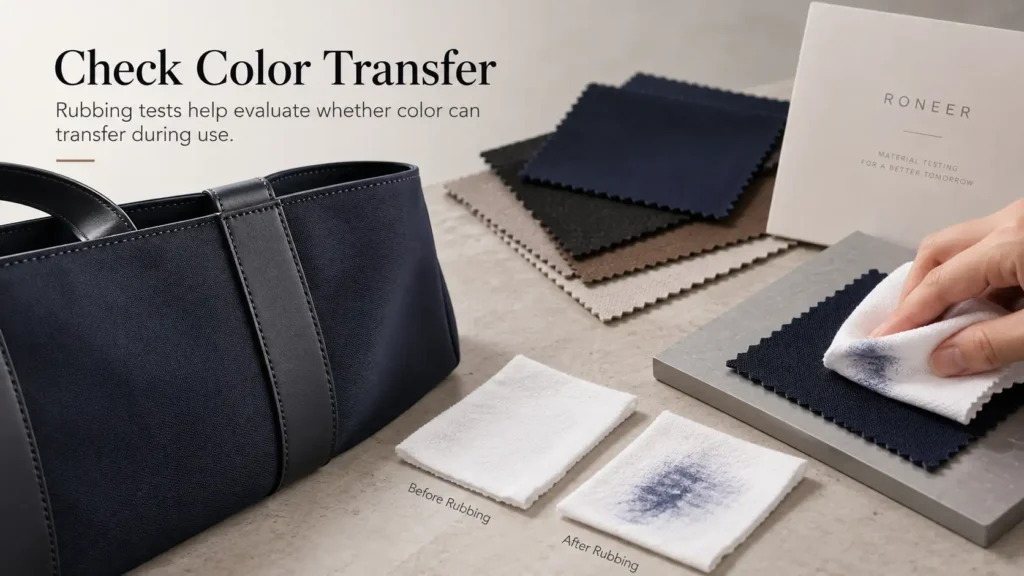
A bag repeatedly rubs against:
- Clothing
- Hands
- Straps
- Lining
- Other panels
- Packaging
- Furniture
If the color transfers, the material may create complaints even when the bag remains structurally intact.
For textile materials, ISO 105-X12:2016 specifies a method for determining resistance to rubbing off and staining other materials. ISO 105-X12:2016 — Colour Fastness to Rubbing
The test is applicable to textiles in yarn or fabric form, including dyed and printed fabrics.
For leather, the test method is different. ISO 11640:2018 addresses the behaviour of leather surfaces during repeated rubbing with wool felt. ISO currently also lists a replacement edition under development, so buyers specifying this standard should confirm the required edition with their laboratory or technical document. ISO 11640:2018 — Leather Colour Fastness to Rubbing
A bag material testing request should therefore identify the actual substrate rather than simply asking for a “colorfastness test.”
Testing fabric, finished leather, coated synthetic material, and printed surfaces may require different methods.
3. Evaluate Abrasion Where the Material Receives Repeated Friction
Abrasion is not equally important on every part of every bag.
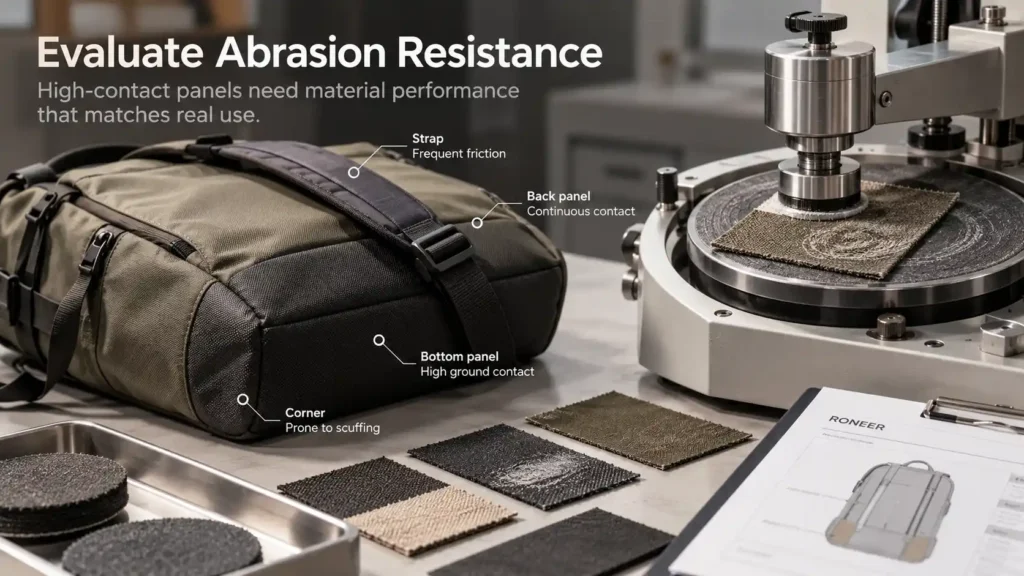
High-friction areas can include:
- Bottom panels
- Corners
- Shoulder straps
- Backpack backs
- Handle areas
- Side panels
- Pocket openings
A decorative evening bag may have different abrasion requirements from a commuter backpack that is used every day.
For applicable textile fabrics, ISO 12947-2:2016 describes the Martindale procedure for determining specimen breakdown under abrasion. ISO 12947-2:2016 — Martindale Abrasion Resistance
This does not mean every bag material should automatically be tested to ISO 12947-2.
Material type and the buyer’s performance requirement determine whether the method is appropriate.
The important point for bag material testing is to define:
- Material being tested
- Test method
- Number of cycles or endpoint where applicable
- Evaluation criteria
- Buyer acceptance requirement
Avoid vague instructions such as:
Test abrasion and make sure it is good.
A test only becomes useful when the buyer knows how the result will be evaluated.
4. Test Tensile or Tear Performance When Strength Is Material-Critical
Material strength becomes more important when the fabric itself carries meaningful load.
Examples can include:
- Travel bags
- Large totes
- Backpacks
- Tool bags
- Sports bags
- Shoulder straps
- Webbing-connected panels
For appropriate woven textile fabrics, ISO 13934-1:2013 specifies a strip method for measuring maximum force and elongation at maximum force. ISO notes that the method is mainly applicable to woven textile fabrics and is not normally applicable to certain categories such as coated fabrics and nonwovens. ISO 13934-1:2013 — Textile Tensile Properties
This limitation illustrates an important rule:
bag material testing must use a method that actually applies to the material being evaluated.
A buyer should not request a familiar standard simply because another supplier used it on a different bag.
Tear, tensile, bursting, seam, and finished-bag load tests answer different questions.
For example, acceptable fabric tensile performance does not prove that:
- A shoulder strap attachment is strong enough
- A seam will not open
- A rivet will remain attached
- A handle construction can carry the intended load
Those require appropriate component, seam, or finished-product evaluation.
5. Define Water Performance Precisely
“Waterproof” is one of the easiest words to misuse in bag sourcing.
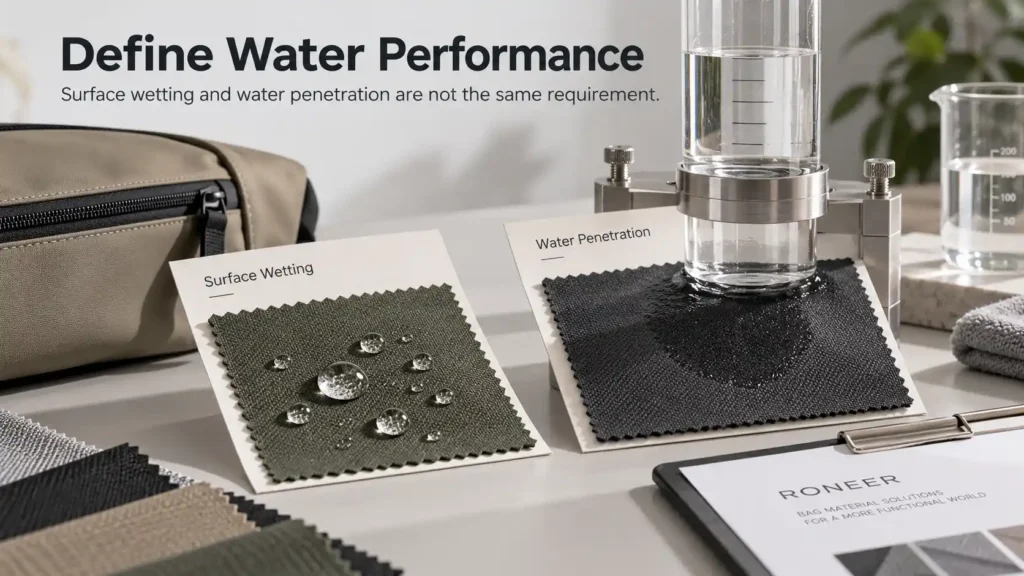
Water behaviour can involve several different properties:
- Surface wetting
- Water repellency
- Water penetration
- Hydrostatic resistance
- Coating integrity
- Seam leakage
- Zipper leakage
- Finished-bag construction
These should not be treated as interchangeable.
For textiles intended to resist water penetration, ISO 811:2018 specifies a hydrostatic-pressure method for determining resistance to water penetration. The current edition was confirmed by ISO in 2025. ISO 811:2018 — Water Penetration by Hydrostatic Pressure
For surface wetting, ISO 4920:2012 uses a spray test, but ISO explicitly notes that this method is not intended to predict rain-penetration resistance because it does not measure water passing through the fabric. ISO 4920:2012 — Resistance to Surface Wetting
That distinction is extremely useful for buyers.
A good spray-test result is not automatically evidence that a finished backpack is waterproof.
The complete product may still allow water through:
- Seams
- Needle holes
- Zippers
- Openings
- Binding
- Panel joints
Therefore, bag material testing can verify a fabric property, while a finished-product water-resistance claim may require additional evaluation of the entire construction.
6. Treat Coated Fabrics as Their Own Material System
Nylon and polyester bags frequently use coatings or laminated constructions.
The coating can influence:
- Water resistance
- Hand feel
- Stiffness
- Surface appearance
- Adhesion
- Flexibility
- Long-term wear
A coated textile should not automatically be treated as the same material as an uncoated woven fabric.
For rubber- or plastics-coated fabrics, ISO 1420:2016 specifies methods for evaluating resistance to water penetration under hydrostatic pressure and was reconfirmed in 2026. ISO 1420:2016 — Coated Fabric Water Penetration Resistance
This is especially relevant when a buyer requests:
- PU-coated nylon
- PVC-coated fabric
- Laminated materials
- Waterproof-style travel fabric
- Outdoor bag fabric
Before ordering bag material testing, record the complete material construction.
For example:
420D nylon with specified PU coating
is more useful than:
nylon fabric.
Different coatings can create different test requirements and different results.
7. Check Thickness, Weight, Surface, and Batch Consistency
Not every useful material check requires a complex performance test.
Basic specification control can be equally important.
Depending on the material, incoming checks may include:
- Thickness
- Fabric weight
- Width
- Color
- Grain
- Surface gloss
- Backing
- Coating appearance
- Hand feel
- Odor
- Defects
- Batch consistency
These properties can influence production even when they do not appear on a laboratory certificate.
A thicker material may change:
- Seam bulk
- Folding
- Edge paint
- Hardware installation
- Zipper construction
- Finished measurements
A softer material may change the silhouette.
A different backing can affect reinforcement or adhesive behaviour.
RONEER’s material service allows buyers to review material type, texture, thickness, color, surface finish, backing, lining, padding, mesh, coating, and structural compatibility through Material Customization.
The approved material swatch and written specification should remain connected with any bag material testing report.
A passing laboratory report for Material A does not automatically approve Material B simply because both are described as “600D polyester” or “PU leather.”
8. Connect Material Test Results With Production QC and AQL
Material testing answers questions about the tested material specimen.
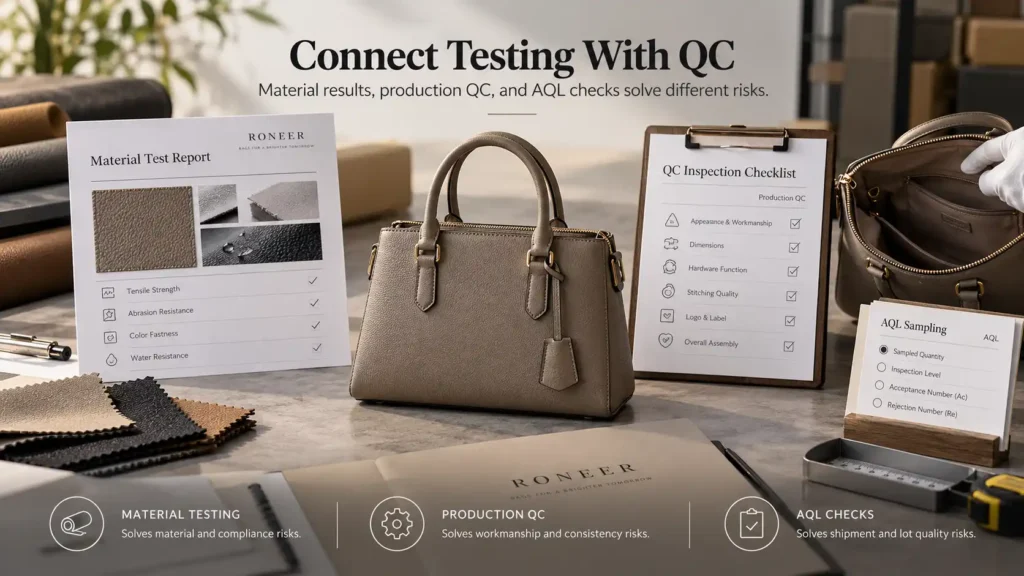
Production inspection answers a different question:
Did the factory use the approved material correctly and manufacture the finished order according to the confirmed specification?
This distinction should remain clear.
After material approval, RONEER’s Bag QC Inspection guide covers checks such as material consistency, stitching, zipper function, hardware, logo, lining, measurements, appearance, function, packaging, and cartons.
For lot-based finished-product sampling, buyers can separately reference the AQL Inspection for Bags guide.
AQL does not replace bag material testing.
Likewise, a material laboratory result does not replace final inspection.
A practical quality system can therefore follow this sequence:
Material specification → material sample approval → relevant material testing → incoming material inspection → production QC → finished-product inspection → AQL sampling where specified
This makes the purpose of each quality step easier to understand.
Quick Bag Material Testing Matrix
| Material Risk | Possible Evaluation | Typical Use |
|---|---|---|
| Color transfer | Rubbing / crocking test | Dark or highly colored fabrics, leather |
| Surface wear | Abrasion resistance | Backpacks, straps, bottom panels |
| Material strength | Tensile or tear testing | Travel, outdoor, load-bearing applications |
| Water penetration | Hydrostatic resistance | Coated or water-resistant fabrics |
| Surface wetting | Spray test | Water-repellent textile surface |
| Coating performance | Coated-fabric specific testing | PU/PVC coated textiles |
| Material consistency | Thickness, weight, visual checks | Incoming bulk material |
| Leather surface behavior | Leather-specific rubbing tests | Genuine leather products |
This matrix should not be used as a universal pass/fail specification.
The buyer, supplier, laboratory, and technical requirements should determine which test method and acceptance value apply to the project.
What Bag Material Testing Cannot Prove
This is one of the most important purchasing distinctions.
A passing fabric test does not automatically prove the finished bag will perform the same way.
Material-level testing may not evaluate:
- Seam strength
- Strap attachment
- Handle construction
- Rivet pull-out
- Zipper durability
- Hardware corrosion
- Finished-bag load capacity
- Water leakage through seams
- Pocket construction
- Overall product workmanship
For example, strong fabric can still be assembled with a weak seam.
A water-resistant textile can still become a finished bag that leaks around zippers or stitch holes.
Good rubbing fastness does not guarantee that metal hardware will resist scratching or plating wear.
This is why the Bag Quality Control Guide and bag material testing should work together rather than being treated as substitutes.
Should Every Custom Bag Project Use Laboratory Testing?
Not necessarily.
Testing should be proportional to:
- Product risk
- Intended use
- Buyer requirements
- Retailer requirements
- Destination-market requirements
- Material claims
- Order value
- Product complexity
A simple promotional pouch may not require the same test program as a heavy travel bag or outdoor backpack.
Likewise, a buyer requesting a specific performance claim may need more formal evidence than a buyer choosing a standard fashion material from an already approved supplier reference.
The key is to define the requirement before production rather than discovering after shipment that the buyer expected a test that was never specified.
How to Write a Material Test Requirement for a Supplier
Avoid:
Please test the material quality.
Instead, define:
Material
Which exact material or supplier reference is being tested?
Property
What are you trying to measure?
Method
Which applicable test method should be used?
Condition
Are there conditioning, wet/dry, color, coating, or sample requirements?
Acceptance Requirement
What result does the buyer require?
Report
Is a laboratory report required?
Production Link
Does the tested specimen represent the actual bulk material?
This structure makes bag material testing easier to reproduce and review.
FAQ About Bag Material Testing
1. What is bag material testing?
Bag material testing is the evaluation of specific material properties before or during bag production. Depending on the project, this may include color fastness, abrasion, tensile or tear behavior, water resistance, coating performance, thickness, weight, or other buyer-defined requirements.
2. When should bag material testing happen?
Testing is most useful before bulk material is cut when the result could affect material approval. Additional testing may be required if the material source, coating, construction, color, or buyer requirement changes.
3. Do all bags need the same material tests?
No. A handbag, backpack, travel bag, cosmetic bag, and outdoor bag can have different material risks and use conditions. The test program should match the product and material.
4. What is the difference between material inspection and material testing?
Material inspection usually checks visible or measurable characteristics such as color, surface condition, thickness, defects, and batch consistency. Bag material testing measures defined properties using an agreed method or laboratory procedure.
5. Should nylon and polyester be tested for color fastness?
They can be when color transfer or color performance is relevant to the project. The test method should match the material, dye or print system, and buyer requirement.
6. Is abrasion testing useful for backpacks?
It can be useful when repeated surface wear is a meaningful risk, particularly for high-contact areas. The appropriate material and test method should be confirmed before testing.
7. Does a waterproof fabric test prove that the whole bag is waterproof?
No. A fabric test evaluates the tested fabric according to the specified method. Finished-bag seams, zippers, openings, stitching, and construction can affect overall water resistance.
8. Can leather use the same rubbing test as textile fabric?
Not necessarily. Leather has dedicated test methods, such as ISO 11640 for leather surface behaviour during rubbing. The laboratory should use a method applicable to the actual substrate.
9. Does passing a material test guarantee bulk quality?
No. The tested specimen must correspond with the bulk material, and production still requires material consistency checks, sewing control, component inspection, and finished-product QC.
10. How does bag material testing relate to AQL?
Bag material testing evaluates defined material properties. AQL is generally used as a statistical sampling approach for evaluating production lots against defined defect requirements. They perform different functions.
11. Should test requirements be written before sampling?
Where performance is commercially important, defining the requirement early is preferable. Material selection, sample construction, cost, and supplier sourcing may change depending on the test requirement.
12. Can RONEER support material testing requirements?
RONEER can support material selection, swatch review, specification confirmation, incoming material checks, sampling, and production QC according to the confirmed project requirements. Where specific laboratory testing or third-party documentation is required, the test method, specimen, acceptance criteria, and reporting requirements should be confirmed for the individual project.
Conclusion
Bag material testing is most effective when it answers a defined product question.
A buyer should not begin with “test everything.” Start with the bag’s intended use, identify the material failure that would create the greatest commercial risk, and choose an applicable method for that property.
Color fastness may matter for dark fashion materials. Abrasion can matter for high-contact panels. Strength becomes more important for load-bearing applications. Water testing should distinguish between surface wetting, penetration resistance, coated-material performance, and finished-product construction.
The test result should then remain connected with the approved material reference.
For RONEER OEM/ODM projects, material development can be coordinated with swatch selection, structure, lining, hardware, sample confirmation, incoming material review, production quality control, and final inspection according to the buyer’s confirmed requirements.
A disciplined bag material testing plan therefore does more than generate a report. It helps buyers decide whether the chosen material is appropriate before that material becomes hundreds or thousands of finished bags.