 العربية
  English
  Deutsch
  Español
  Français
  Italiano
  Русский
  日本語
日本語  Türkçe
  한국어
한국어 A laptop tote can look polished enough for a business meeting while failing at its most important job.
The computer may strike the bottom when the bag is placed on the floor. Handles may stretch after several weeks of commuting. A heavy laptop can pull the tote away from the body, while a poorly positioned water bottle or charger can make the bag lean to one side.
These problems are not solved by adding a thin laptop sleeve to an ordinary tote bag.
A professional laptop tote bag manufacturer must coordinate device fit, padding, bottom protection, bag weight, handle reinforcement, shoulder drop, interior organization, closure, materials, packaging, and repeat-production standards.
The product must protect valuable electronics while still looking appropriate for office, retail, travel, lifestyle, or women’s business markets. RONEER’s wider custom laptop bag content also identifies laptop totes as products that need both appearance and device protection.
Brands should therefore evaluate a laptop tote bag manufacturer through real devices, real daily contents, physical samples, and measurable production standards rather than catalog photographs alone.
This guide explains 11 checks for selecting a laptop tote bag manufacturer. It is written for fashion brands, work-bag labels, private label companies, boutiques, wholesalers, retailers, corporate buyers, e-commerce sellers, and established companies developing laptop totes for new collections.
RONEER supports custom bag development across handbags, laptop bags, backpacks, travel bags, and other functional categories. Project feasibility, MOQ, materials, pricing, samples,s and production terms should still be confirmed for every individual design.
1. Define the Laptop and Daily Carry Requirements
The first task is identifying what the tote must carry.
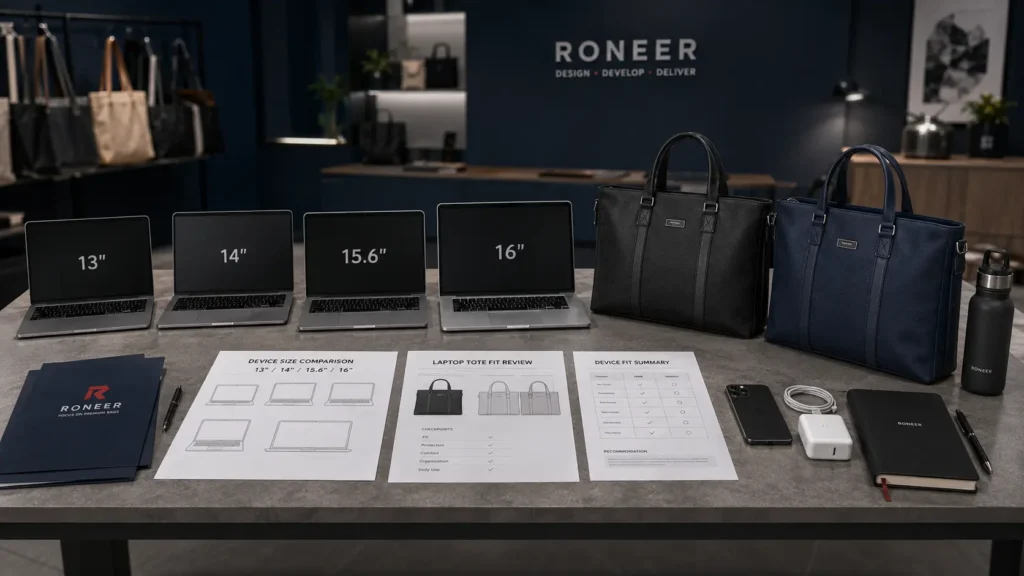
“Fits a 15-inch laptop” is not a complete manufacturing specification. Two computers marketed with the same screen size can have different body dimensions, thicknesses, corner shapes, and charging requirements.
Provide the laptop tote bag manufacturer with:
- Maximum device width
- Maximum device height
- Maximum device thickness
- Device weight
- Tablet dimensions
- Charger size
- Document size
- Water bottle size
- Daily personal items
- Target customer
- Carrying distance
- Intended sales market
The internal laptop compartment should be developed from the physical device dimensions rather than the advertised screen diagonal.
The product brief should also explain whether the tote is intended for:
- التنقل اليومي
- Business meetings
- Hybrid work
- University
- Air travel
- الهدايا المؤسسية
- Fashion retail
- Professional women
- Mobile sales teams
A commuter carrying a computer, charger, lunch container and water bottle needs a different structure from a customer carrying only a slim laptop and notebook.
The laptop tote bag manufacturer should review the complete expected load before confirming the bag dimensions, materials, handles and reinforcement.
2. Confirm Internal Fit Instead of Exterior Size
A large exterior does not guarantee a usable laptop compartment.
Padding, seams, binding, lining, pockets and reinforcement reduce the available internal space. A laptop may technically enter the tote but become difficult to remove after the other compartments are filled.
The specification should identify:
- Finished exterior width
- Top opening width
- Base width
- Finished height
- Base depth
- Laptop sleeve width
- Laptop sleeve height
- Sleeve opening
- Padding thickness
- Closure clearance
The laptop tote bag manufacturer should test the device in the finished physical sample.
Check whether the computer:
- Enters without force
- Can be removed with one hand
- Does not scrape against the zipper
- Does not press against metal hardware
- Remains upright
- Does not distort the tote
- Does not interfere with the main closure
The buyer should also specify whether the compartment is intended for a bare laptop or for a laptop already placed inside a protective sleeve.
A factory-ready handbag tech pack can record the internal dimensions, points of measure, material layers, padding,g and tolerances required for the laptop tote.
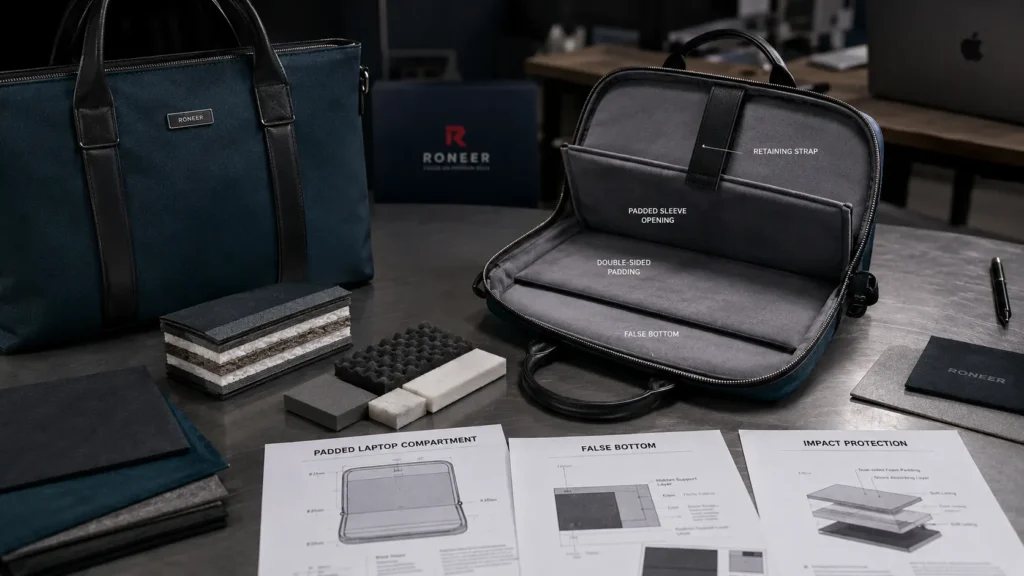
3. Engineer the Padded Laptop Compartment
A thin foam panel may improve appearance without providing meaningful protection.
A laptop compartment may need:
- Front padding
- Back padding
- Bottom padding
- Side protection
- Soft scratch-resistant lining
- Secure opening
- Device-retention strap
- Reinforced divider
- False bottom
A false bottom positions the computer above the exterior base so the device does not directly absorb the full impact when the tote is placed down.
The required construction depends on:
- Device weight
- مادة الهيكل الخارجي
- Base rigidity
- Tote structure
- السعر المستهدف
- Expected use
- Packaging method
The laptop tote bag manufacturer should explain the padding material, thickness, density, placement,nt and compression behavior.
Very thick padding can reduce internal capacity and make the bag bulky. Very soft foam may compress too easily. Excessively rigid reinforcement can make a fashion tote look like a technical briefcase.
The approved sample should balance protection with the intended silhouette.
4. Control Empty Weight and Loaded Balance
Laptop totes often carry more than handbags designed for light personal essentials.
The typical load may include:
- Laptop
- Tablet
- Charger
- Phone
- Documents
- Notebook
- Water bottle
- Cosmetic pouch
- المحفظة
- Keys
A large amount of metal hardware, thick reinforcement, or heavy exterior material can make the empty tote unnecessarily heavy before the computer is added.
The laptop tote bag manufacturer should measure and record the approved empty product weight.
Research available through the U.S. National Library of Medicine examined how shoulder-carried bags and other load-carrying methods can influence posture. Although one study cannot define the correct construction for every product, it supports testing the tote under realistic loaded conditions rather than evaluating only the empty sample.
The laptop tote bag manufacturer should therefore test the approved product with the intended computer, charger, documents, water bottle, and personal items. The review should consider empty weight, shoulder pressure, handle width, load position, bag balance, and comfort while walking.
5. Reinforce the Handles and Attachment Points
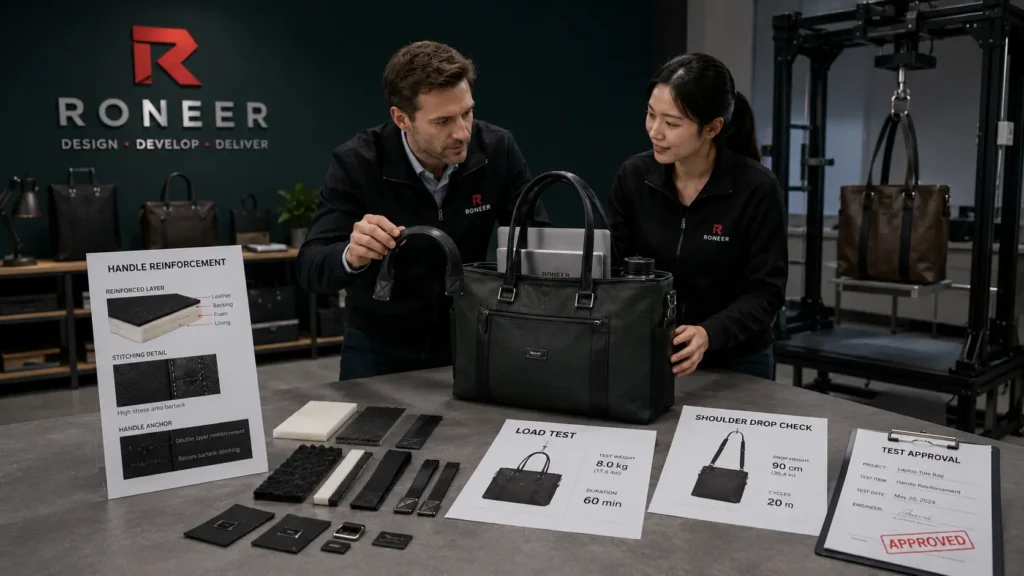
Handles carry the combined weight of the laptop, documents,s and personal items.
A visually clean attachment may still fail when the internal reinforcement is too small, or the stitching concentrates force in one area.
A laptop tote bag manufacturer should define:
- Handle material
- Handle width
- Finished thickness
- Handle drop
- Internal reinforcement
- Stitching pattern
- Rivets or hardware
- Connection position
- تشطيب الحواف
- Expected load
Handle drop affects both appearance and use. The tote should fit over the target customer’s shoulder while wearing realistic clothing.
A product developed over a thin shirt may become difficult to carry over a blazer or winter coat.
Testing should include:
- Hand carry
- Shoulder carry
- Loaded walking
- Repeated lifting
- Opening while worn
- Placement on a desk or floor
The handle bases should be examined for distortion, stretching, loose stitching, and surface marks after testing.
A professional laptop tote bag manufacturer should update the reinforcement method after sample testing rather than treating the first construction as automatically final.
6. Select Materials for Weight, Structure, and Daily Use
Material selection affects weight, appearance, durability, water resistance, cleaning, MO, Q, and retail position.
Possible exterior materials include:
- جلد طبيعي
- جلد من الألياف الدقيقة
- جلد بولي يوريثان
- نايلون
- بوليستر
- اللوحة القماشية
- Twill
- Coated fabric
- Recycled polyester
- Mixed-material structures
A leather laptop tote may support premium positioning but can become heavy when combined with a large size, thick lining and metal hardware.
Nylon or polyester can support a lighter commuter product, although the correct fabric weight, coating, reinforcement and lining still need approval.
Canvas may provide a casual workwear appearance but can require additional structure and protection around the computer compartment.
RONEER’s تخصيص المواد page lists materials used across laptop bags, handbags, backpacks and other custom bag projects.
Ask the laptop tote bag manufacturer for physical swatches showing:
- Composition
- Material code
- اللون
- Thickness or fabric weight
- Surface finish
- الدعم
- Water-repellent treatment where applicable
- Expected batch variation
- Reorder availability
Digital photographs cannot fully communicate weight, stiffness, hand feel, grain, coating, or backing.
7. Design a Practical Interior and Secure Opening
A laptop tote should prevent smaller items from pressing against or scratching the device.
The interior may include:
- Padded laptop sleeve
- Tablet pocket
- Zipper security pocket
- Phone pocket
- Charger compartment
- Cable holder
- Pen slots
- Document section
- Key leash
- Water bottle pocket
- Luggage sleeve
The laptop tote bag manufacturer should position heavier contents close to the body and prevent the water bottle or charger from moving freely across the compartment.
Pocket dimensions should be tested with real objects. A pocket can meet its drawing dimensions while remaining too narrow or difficult to access after the tote is filled.
The main opening may use:
- Full zipper
- Recessed zipper
- Magnetic closure
- Flap
- Snap
- Open top with internal security pocket
A full zipper can improve security but must not scrape the computer during removal. A recessed zipper may preserve a clean exterior while reducing the usable opening.
The correct solution depends on the customer, product style, and expected carrying environment.
8. Select Private Label, ODM, or OEM Production
The development route affects cost, MOQ, originality, and lead time.
Private Label Laptop Totes
Private label usually begins with an existing tote structure. The buyer may customize:
- الشعار
- Available color
- Interior label
- بطاقة التعليق
- Dust bag
- التعبئة والتغليف
This route may support faster product validation when the base dimensions and laptop protection already match the intended market.
ODM Laptop Totes
ODM begins with a factory-developed style that can be modified through:
- مادة الهيكل الخارجي
- Laptop sleeve
- تصميم الجيب
- Handle drop
- الختام
- الأجهزة
- البطانة
- الشعار
- التعبئة والتغليف
ODM can balance customization and development efficiency.
OEM Laptop Totes
OEM develops an original product from a tech pack, drawing, prototype,e or detailed specification.
It may require:
- New pattern
- Internal structure development
- Several samples
- Padding tests
- Custom hardware
- Special material
- Detailed tolerances
A laptop tote bag manufacturer should recommend the production route that supports meaningful product differences without creating unnecessary development expense.
Brands needing several computer-bag categories can review RONEER’s broader custom laptop bag manufacturer guide.
9. Understand MOQ and Complete Cost
MOQ may apply separately to:
- Finished laptop totes
- Individual styles
- الألوان
- Exterior materials
- Custom fabric colors
- Printed lining
- Zippers
- الأجهزة
- Logo components
- Dust bags
- Retail boxes
- Reorders
A laptop tote bag manufacturer should explain the source of every minimum.
Ask:
- Is MOQ per order, style, or color?
- Can several colors share one material?
- Are standard materials available?
- Does custom lining have a separate minimum?
- Can several styles use the same hardware?
- Who owns unused components?
- Can unused materials be stored?
- What is the repeat-order MOQ?
- How does unit price change by quantity?
- Is packaging included?
The quotation should separate:
- رسوم العينة
- Pattern fee
- Tooling
- Materials
- Padding
- الأجهزة
- الشعار
- التعبئة والتغليف
- Unit production price
- Inspection
- Trade terms
A lower unit price is not automatically the safer offer if it requires excessive inventory or removes important laptop protection.
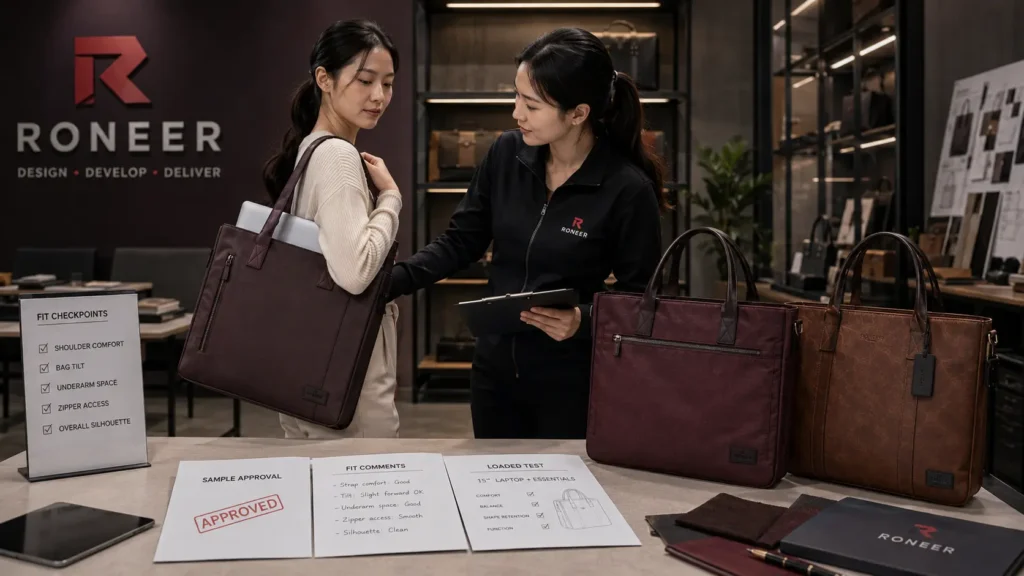
10. Approve a Fully Loaded Physical Sample
The sample should be evaluated empty and fully loaded.
Before paying for sample development, confirm:
- رسوم العينة
- Pattern cost
- Available materials
- Estimated timeline
- Revision policy
- Logo tooling
- Hardware development
- Shipping responsibility
- Pattern ownership
- Tooling ownership
Test the physical sample with the intended laptop and daily contents.
Check:
- Laptop fit
- False-bottom clearance
- Padding coverage
- Base protection
- Handle comfort
- Loaded balance
- Shoulder drop
- Opening access
- Zipper scratch risk
- Bottle stability
- Pocket access
- Empty weight
- Loaded appearance
- التعبئة والتغليف
The sample should also be carried while walking, opening doors, sitting at a desk, and entering a vehicle.
After revisions, the laptop tote bag manufacturer should identify an approved pre-production sample connected to the final tech pack, BOM, material card, hardware finish, colorway,y and packaging instructions.
11. Define Bulk Quality and Reorder Standards
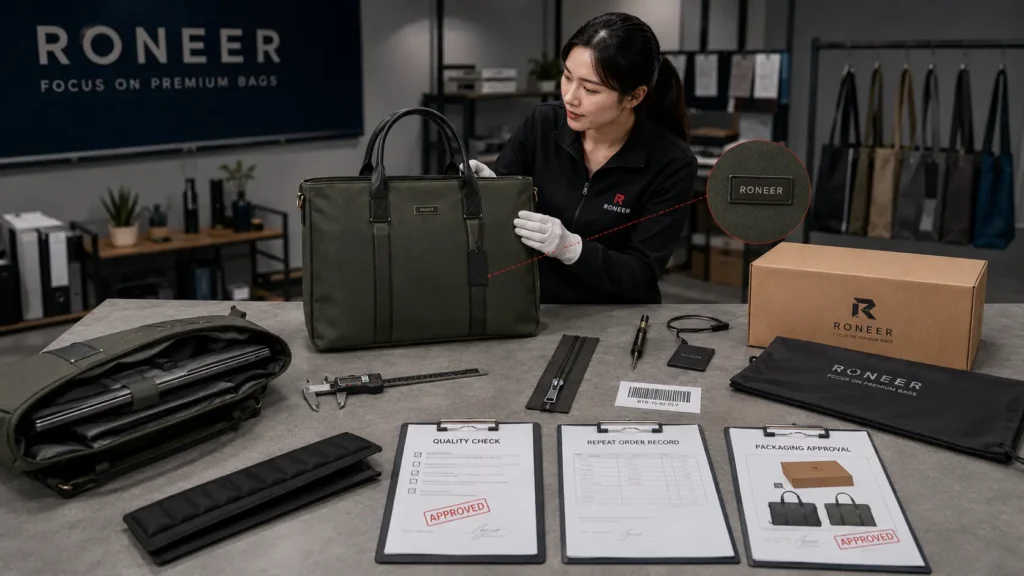
“Good quality” is not a measurable production standard. Before bulk production begins, the buyer and laptop tote bag manufacturer should agree on the exact product details that will be inspected.
Laptop tote quality control may include:
- Exterior material and color consistency
- Finished bag dimensions
- Laptop sleeve width and height
- Padding thickness and position
- False-bottom height
- Handle drop and handle attachment
- Base structure
- حركة السحاب
- تشطيب الأجهزة
- حجم الشعار وموضعه
- نظافة البطانة
- Pocket dimensions
- التعبئة والتغليف
- ملصقات الباركود
- علامات الكرتون
The approved tech pack, bill of materials, physical sample, material card, packaging sample, and inspection requirements should work together as the bulk-production standard.
Testing and inspection requirements should reflect the tote structure, materials, components, intended use, product claims, destination market, and buyer requirements. Brands can review the independent SGS Bags and Accessories testing and inspection services when preparing a product-specific quality plan.
SGS services may cover materials, components, product performance, testing, and inspection. However, linking to SGS does not mean that every RONEER order or laptop tote bag manufacturer automatically has SGS certification.
For retail, wholesale, or marketplace sales, barcode planning should be completed before packaging artwork is approved. The official GS1 US barcode guidance explains how brands can obtain product identifiers and prepare UPC barcodes.
Different laptop tote styles, colors, sizes, sets, or packaging variations may require separate product identifiers. Buyers should therefore calculate the number of SKUs before ordering barcode labels or printed packaging.
Textile-based laptop totes sold in the United States may also be subject to labeling requirements. Buyers can review the official Federal Trade Commission apparel and textile labeling guidance before approving material descriptions, sewn labels, hangtags, packaging, or online product information.
Depending on the product construction, applicable labels may need to disclose fiber content, country of origin, and the identity of the manufacturer or another responsible business. The buyer or importer should confirm which rules apply to the individual laptop tote.
Country-of-origin information should also be confirmed before the laptop tote bag manufacturer produces sewn labels, packaging inserts, retail boxes, or carton marks. Buyers importing products into the United States can review the official U.S. Customs and Border Protection import guidance.
The buyer should provide the factory with the approved country-of-origin wording, position, label size, and packaging instructions. The laptop tote bag manufacturer can apply the confirmed information, but the importer remains responsible for verifying the requirements that apply to the product and shipment.
Before a repeat order is placed, the laptop tote bag manufacturer should retain:
- Final pattern
- Current tech pack version
- Laptop sleeve dimensions
- Padding specification
- False-bottom construction
- Exterior material code
- مواصفات البطانة
- Handle reinforcement
- تشطيب الأجهزة
- تصميم الشعار
- Packaging files
- Approved physical sample
- Inspection tolerances
If an approved material, zipper, hardware finish, foam, lining, or packaging component becomes unavailable, the laptop tote bag manufacturer should notify the buyer before making a substitution.
Any replacement should be approved through a new material swatch, component sample, or revised physical sample. Repeat production should not depend on the factory selecting a material that is only described as “similar.”
A reliable laptop tote bag manufacturer should preserve the approved production records so later orders can reproduce the laptop fit, padding, handles, materials, branding, packaging, and overall quality of the original approved sample.
Laptop Tote Structure Comparison
| Laptop Tote Type | Main Production Controls |
|---|---|
| Structured leather work tote | Weight, reinforcement, edge finish and base stability |
| Lightweight nylon laptop tote | Fabric strength, padding and lining structure |
| Fashion laptop tote | Silhouette, hardware scale and concealed protection |
| Zippered commuter tote | Opening width, zipper clearance and security |
| Corporate laptop tote | Logo visibility, durability, MOQ and packing |
| Travel laptop tote | Luggage sleeve, secure closure and organization |
| Large 16-inch laptop tote | Device fit, base support and handle load |
| Convertible laptop tote | Detachable strap, hardware strength and balance |
The laptop tote bag manufacturer should develop each type according to its actual market and expected load instead of applying one standard tote construction.
Information to Send Before Requesting a Quote
Provide:
- Target customer
- Laptop dimensions
- Laptop weight
- Tote dimensions
- صور مرجعية
- Tech pack
- مادة الهيكل الخارجي
- البطانة
- Padding requirements
- Handle drop
- الختام
- Interior pockets
- تصميم الشعار
- الكمية المستهدفة
- عدد الألوان
- التعبئة والتغليف
- Destination market
- Sample deadline
- Delivery target
Also identify which requirements are fixed and which can be adjusted.
This allows the laptop tote bag manufacturer to propose suitable materials, available components, practical padding, and realistic MOQ options.
Red Flags When Comparing Manufacturers
توخَّ الحذر عندما يقوم المورد بما يلي:
- Quotes without requesting device dimensions
- Uses only screen size to define the laptop sleeve
- Adds thin foam without bottom protection
- Cannot explain handle reinforcement
- Does not test the tote while loaded
- Places exposed metal against the laptop compartment
- Refuses to make a physical sample
- Changes materials without approval
- Cannot explain component MOQ
- Offers no measurable QC standard
- Promises unrealistic delivery dates
- Does not retain production records
A technically responsible laptop tote bag manufacturer may explain that a requested material, weight, price, MOQ, or delivery schedule is not practical.
A clear limitation is more useful than an unsupported promise.
FAQ About a Laptop Tote Bag Manufacturer
1. What does a laptop tote bag manufacturer do?
A laptop tote bag manufacturer develops and produces totes with padded computer compartments, reinforced handles, organized interiors, secure closures, custom branding, packaging,g and bulk-production controls.
2. Which laptop sizes can be supported?
A laptop tote bag manufacturer may develop products for 13-inch, 14-inch, 15.6-inch, 16-inch or other devices. The compartment should be based on actual device width, height, and thickness rather than screen size alone.
3. Does a laptop tote need a false bottom?
A false bottom can help position the computer above the exterior base and reduce direct contact when the tote is placed down. The required construction depends on the product design and protection target.
4. Which materials are suitable for laptop totes?
Common choices include leather, microfiber, PU, nylon, polyester, canvas, twill, coated fabric,c and mixed-material structures. The laptop tote bag manufacturer should balance appearance, empty weight, structure, price,ce and intended use.
5. Can a laptop tote look like a fashion handbag?
Yes. Padding and functional pockets can be integrated into a fashion-oriented silhouette. The factory must control bulk, weight, hardware scale and interior construction.
6. Can the handles be customized?
Yes. Handle length, drop, width, thickness, material, reinforcement, edge finish and attachment method can be customized according to the load and target customer.
7. Can a laptop tote bag manufacturer add a luggage sleeve?
Yes. A rear luggage sleeve can be added for travel use. Its width, position, reinforcement, and compatibility with suitcase handles should be tested on a physical sample.
8. What is the MOQ for custom laptop totes?
MOQ depends on style, color, material, padding, hardware, lining, logo method, packaging and production setup. Buyers should request a written breakdown.
9. Is a physical sample necessary?
Yes. The sample should be tested with the intended computer, charger, documents, bottle,e and personal items before bulk production.
10. What should be included in laptop tote quality control?
Inspection may cover laptop fit, sleeve dimensions, padding, false bottom, handles, seams, zippers, hardware, balance, lining, pockets, logo, packaging, labels and carton marks.
11. Can laptop totes use private label packaging?
Yes. Options may include hangtags, care cards, dust bags, polybags, barcode labels, retail boxes, inserts and export cartons.
12. How can brands maintain reorder consistency?
The laptop tote bag manufacturer should retain the final pattern, material code, padding specification, handle reinforcement, tech pack, hardware finish, logo file, packaging, ng and approved sample.
13. How does RONEER work as a laptop tote bag manufacturer?
RONEER reviews laptop tote projects according to device dimensions, product structure, materials, padding, handles, interior organization, logo, quantity, packaging, destination, and production schedule.
As a laptop tote bag manufacturer, RONEER may support OEM and ODM development, material selection, patterns, samples, branding, packaging, production communication, quality preparation, export packing and repeat-order documentation.
الخاتمة
A laptop tote bag manufacturer should provide more than an ordinary tote with a thin internal sleeve. The product must balance computer protection, professional appearance, shoulder comfort, interior organization and repeatable production.
Device fit comes first. A capable laptop tote bag manufacturer should develop the laptop compartment from actual device width, height and thickness rather than depending only on the advertised screen size.
Padding must also be planned as a complete system. Front, back, side and bottom protection, soft lining, a secure opening and a false bottom may all influence how the device is protected.
The laptop tote bag manufacturer should control empty product weight before adding the computer and daily essentials. Excessively heavy exterior materials, hardware and reinforcement can make a visually attractive work tote uncomfortable during commuting.
Handles and attachment points require measurable reinforcement. The approved sample should be tested through repeated lifting, shoulder carrying,g and realistic loading rather than evaluated only on a tabletop.
Interior organization should keep chargers, bottles, keys and other items from pressing against or scratching the laptop. Pocket dimensions and opening access should be tested after the tote is fully packed.
MOQ and price must be reviewed across the complete project. Materials, colors, padding, lining, hardware, logos and packaging may have separate minimums from the finished laptop totes.
A reliable laptop tote bag manufacturer should also define quality standards before production. Laptop sleeve dimensions, padding position, false-bottom height, handle drop, stitching, zippers, hardware, logos and packaging should be checked against the approved technical file and physical sample.
Repeat-order planning should begin before the first shipment. The laptop tote bag manufacturer should retain the final pattern, BOM, material codes, padding, reinforcement, hardware, logo, packaging and inspection records.
RONEER supports fashion brands, work-bag labels, corporate buyers, private labels, wholesalers, retailers and e-commerce companies developing custom laptop tote projects through OEM and ODM manufacturing.
The most suitable laptop tote bag manufacturer is not simply the supplier offering the lowest quotation. It is the manufacturing partner that can protect the device, preserve a professional silhouette, control loaded comfort, reproduce the approved sample, le and maintain reliable records for future orders.