How much does it cost to manufacture a handbag? This is one of the most common questions private label brands, startups, retailers, boutique owners, wholesalers, Amazon sellers, and e-commerce buyers ask before starting a custom handbag project. The simple answer is: it depends on the full specification, not only the handbag shape.
A handbag can be simple, soft, and cost-focused, or it can be structured, hardware-heavy, fully branded, and premium. The final manufacturing cost may change based on material, size, structure, MOQ, labor difficulty, logo method, hardware, lining, packaging, sample development, QC, and export packing.
When buyers ask how much does it cost to manufacture a handbag, they often expect one fixed price. In real OEM/ODM production, a reliable factory needs to review the product details first. Two handbags may look similar in a product photo, but their manufacturing cost can be very different if one uses basic PU leather and standard hardware, while the other uses microfiber leather, custom metal logo plates, reinforced structure, premium lining, and private label packaging.
For brand buyers, the goal is not simply to find the cheapest unit price. The better goal is to understand the cost structure, know what affects the quotation, and decide which details are worth paying for. This guide explains how handbag factories calculate cost, what buyers should prepare before asking for a quote, and how to control cost without damaging quality.
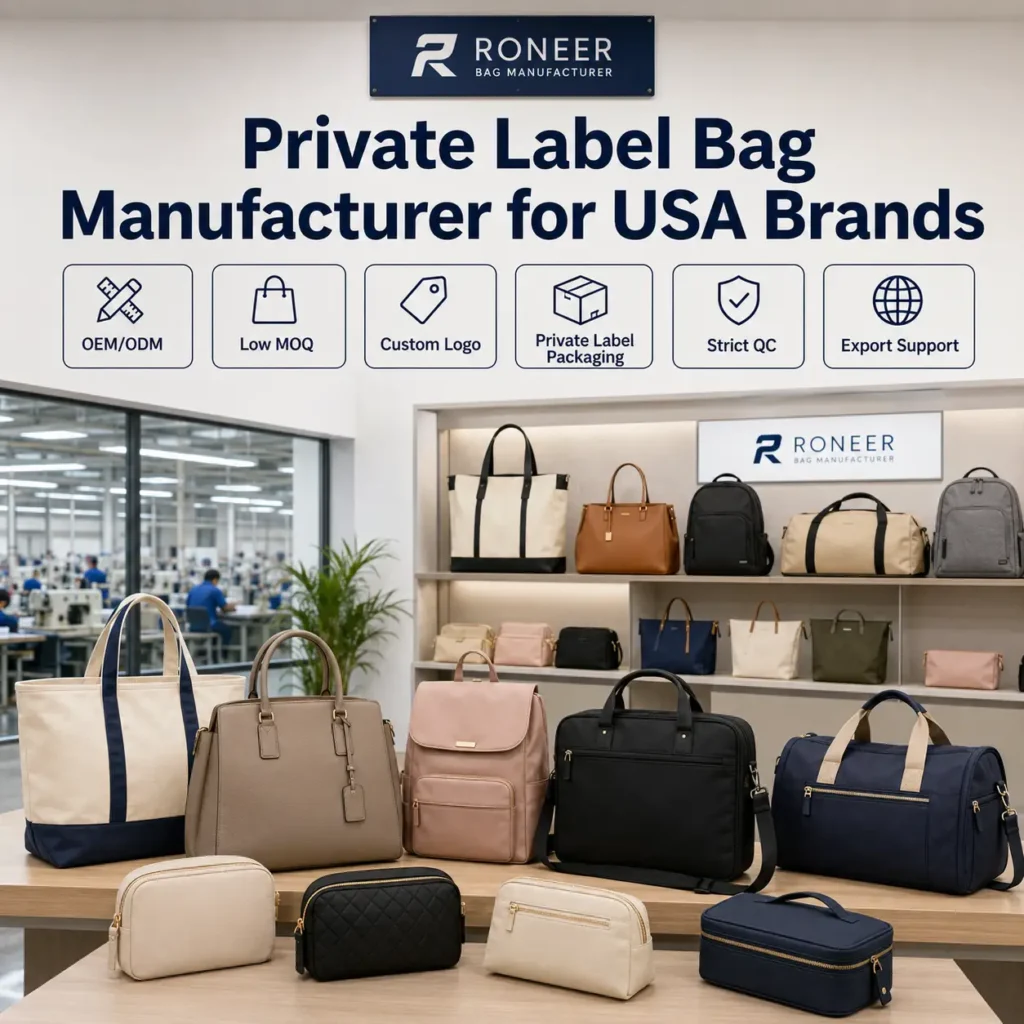
RONEER supports OEM/ODM custom bag development for global buyers, including private label handbags, custom logo bags, low MOQ discussion, material customization, packaging customization, QC, bulk production, export packing, and global shipping support. Buyers can review RONEER’s wider production direction on the custom bag manufacturing website.
Quick Answer: How Much Does It Cost to Manufacture a Handbag?
If you are asking how much does it cost to manufacture a handbag, the practical answer is that the cost can vary widely depending on the design and order requirements. A simple handbag using available materials, standard hardware, and basic packaging will usually be more cost-efficient. A structured private label handbag with custom logo hardware, premium lining, branded packaging, and stricter QC will require a higher budget.
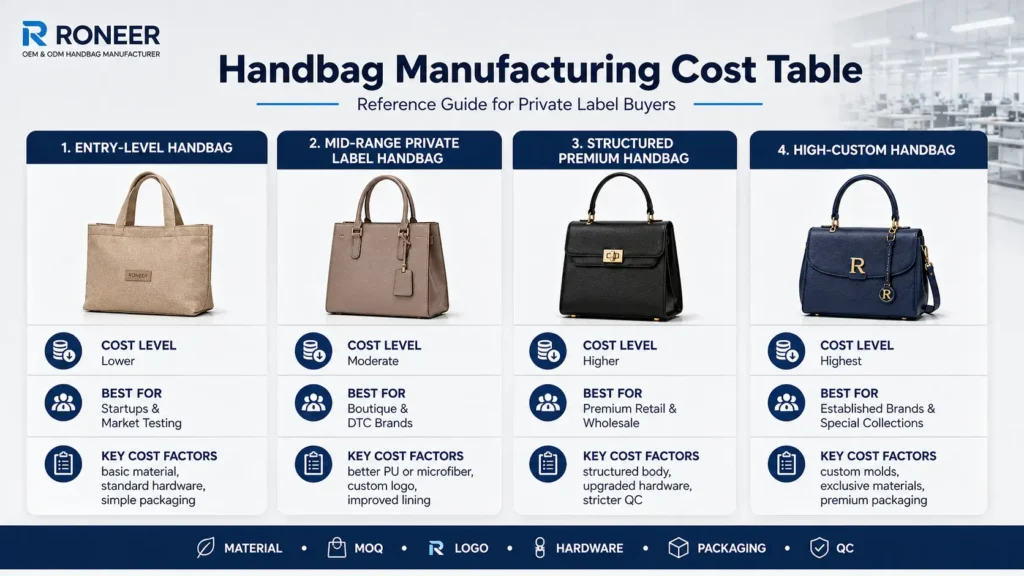
The table below gives buyers a practical cost planning framework. It is not a fixed quotation. Instead, it helps explain why different handbag projects may fall into different cost levels.
Handbag Type / Project Level
Typical Cost Influence
Best For
Buyer Notes
Entry-level PU or fabric handbag
Lower cost when using available materials, standard hardware, simple lining, and basic logo methods
Good for market testing, but buyers should still check stitching, zipper quality, and packaging.
Mid-range private label handbag
Moderate cost due to better PU, microfiber leather, improved hardware, custom logo, and better lining
Boutique brands, DTC brands, Amazon sellers, small retail collections
Usually, the most practical level for brands that need a balance of cost, appearance, and quality.
Structured or premium handbag
Higher cost because of structure, reinforcement, custom hardware, premium logo methods, and stricter QC
Premium private label brands, fashion retailers, and wholesale buyers
Requires careful sample approval, shape control, and hardware confirmation before bulk production.
High-custom handbag with molds or special materials
The highest cost level is due to custom molds, exclusive colors, special trims, complex packaging, and longer development time
Established brands, premium launches, special collections
Best for buyers with clear specifications, realistic MOQ, and enough time for sampling and revisions.
After reviewing the cost table, the answer to how much does it cost to manufacture a handbag should be based on your actual product specification. A factory cannot give an accurate quotation from a rough idea alone. Reference images, dimensions, material preferences, logo method, order quantity, packaging details, and target market all matter.
What Changes the Cost Most?
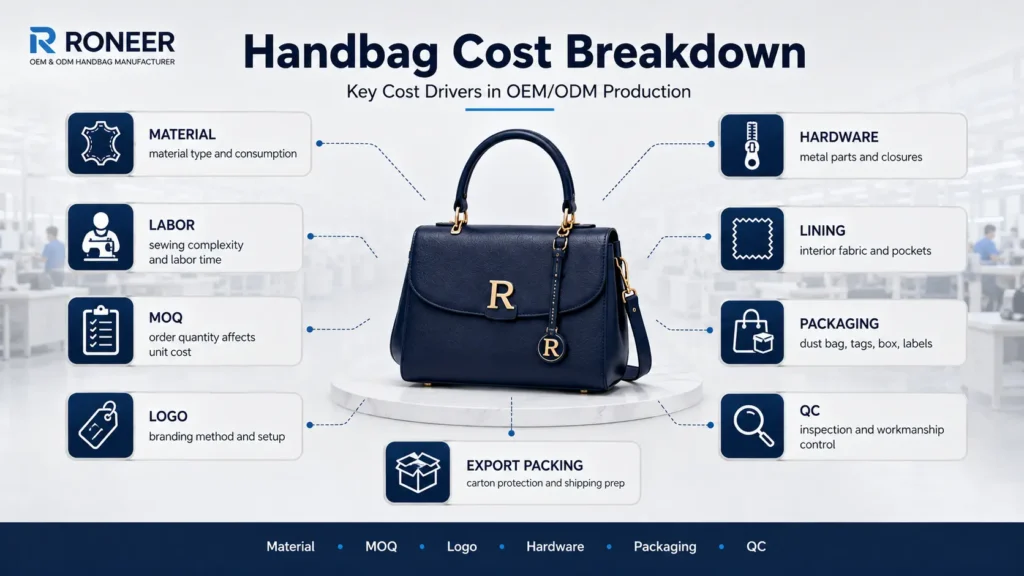
The cost to manufacture a handbag is not decided by one factor. It is built from several cost layers. When a factory prepares a quote, it usually calculates material consumption, cutting, sewing, labor time, hardware, lining, logo process, sample development, packaging, QC, and export packing.
The biggest cost drivers usually include:
Main material
Handbag size
Structure and pattern complexity
Hardware quantity and quality
Logo method
Lining and internal pockets
MOQ
Packaging level
Sample revisions
QC requirements
Export packing
When buyers ask how much does it cost to manufacture a handbag, they should avoid comparing prices without comparing specifications. A simple handbag with available material and standard hardware is easier to quote and produce. A structured handbag with custom metal trims, multiple compartments, edge finishing, logo plates, dust bags, gift boxes, and strict inspection naturally costs more.
A lower quotation may look attractive at first, but it may use thinner materials, weaker hardware, simpler lining, basic packaging, or less inspection. A higher quotation may be reasonable if the product has a better structure, more stable workmanship, improved hardware, and stronger private label presentation.
Material Choice Is Usually the Biggest Cost Driver
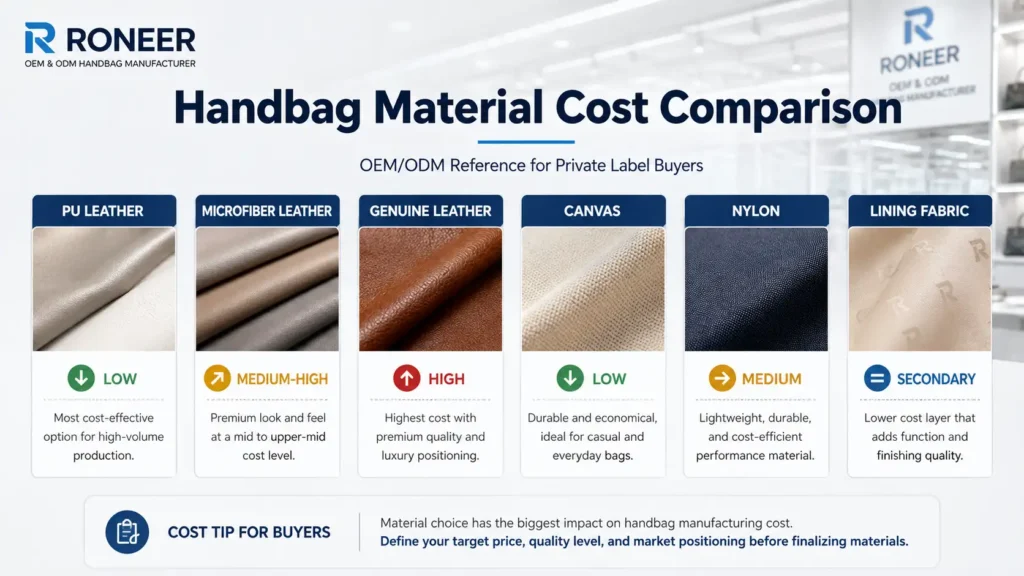
Material is one of the strongest factors behind the handbag production cost. The surface material affects price, appearance, durability, hand feel, cutting efficiency, MOQ, and customer perception. So, when buyers ask how much does it cost to manufacture a handbag, material selection is usually one of the first details a factory needs to confirm.
Common handbag materials include:
PU leather
Microfiber leather
Genuine leather for selected projects
Canvas
Nylon
Oxford fabric
Polyester
Jacquard fabric
Suede-like material
RPET fabric
Lining fabric
PU leather is often used for cost-effective fashion handbags because it offers many colors, textures, and finishes. Microfiber leather usually costs more than basic PU leather but can provide a better hand feel, stronger durability, and a more premium appearance. Genuine leather may be suitable for selected premium projects, but it usually requires higher material cost, stricter cutting control, and more careful production management.
Canvas and fabric handbags can be practical for casual brands, promotional collections, and lifestyle products. Nylon and Oxford fabric are more common in functional bags but may also be used for lightweight fashion styles. The best material depends on the product category, retail price, target customer, and brand positioning.
If your brand is considering recycled or preferred materials, resources such as Textile Exchange can be used as an industry reference for understanding broader material trends. However, material claims, recycled content, and certification documents should always be confirmed for each specific order.
RONEER can support material discussions based on handbag style, target price, MOQ, and brand positioning. Buyers can review more options through RONEER’s material customization service.
Size, Structure, and Labor Difficulty
When buyers ask how much does it cost to manufacture a handbag, they often focus on the material first. Material is important, but structure and labor difficulty also matter.
A simple soft handbag may require fewer panels, less reinforcement, and a shorter production process. A structured handbag may need more accurate pattern making, reinforced panels, better shape control, edge finishing, internal support, and more inspection. These details increase labor time and production management.
Structural details that may increase cost include:
Multiple compartments
Internal zipper pockets
Reinforced bottom panels
Structured side panels
Piping
Edge painting
Complex handles
Detachable shoulder straps
Metal feet
Hidden magnetic buttons
Multiple material combinations
Special flap closures
A more complex design is not always a problem. It may improve the handbag’s function and perceived value. However, buyers should understand that every added detail may increase material consumption, production time, and QC work.
If your target price is tight, a factory may suggest simplifying the structure, reducing unnecessary pockets, using standard hardware, or adjusting the construction method to make production more efficient. This is why the answer to how much does it cost to manufacture a handbag should always include a review of structure and workmanship, not only material price.
Logo, Hardware, and Packaging Costs
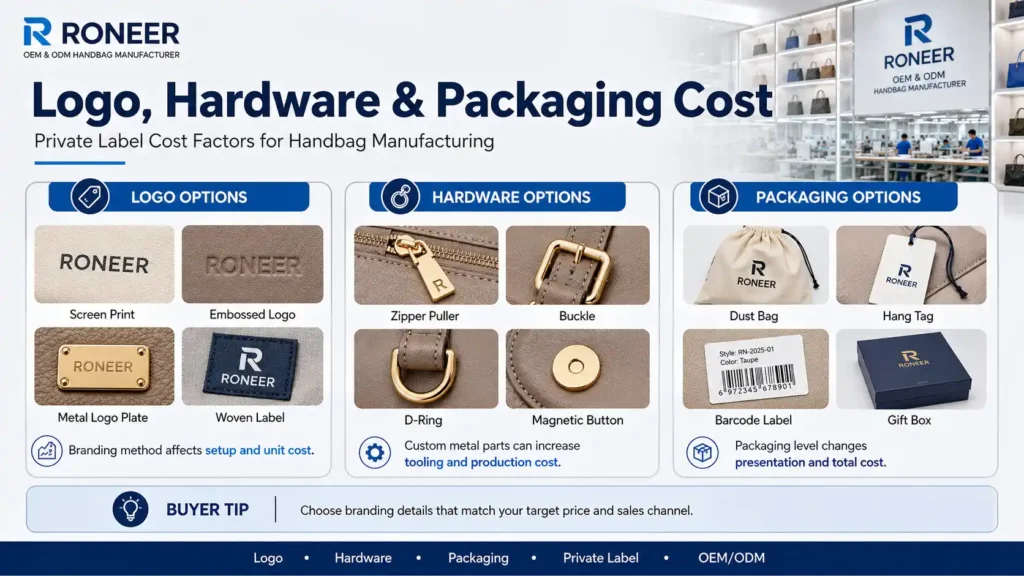
Logo, hardware, and packaging are important for private label handbag brands. These details can make a handbag look more professional, but they also affect the final cost.
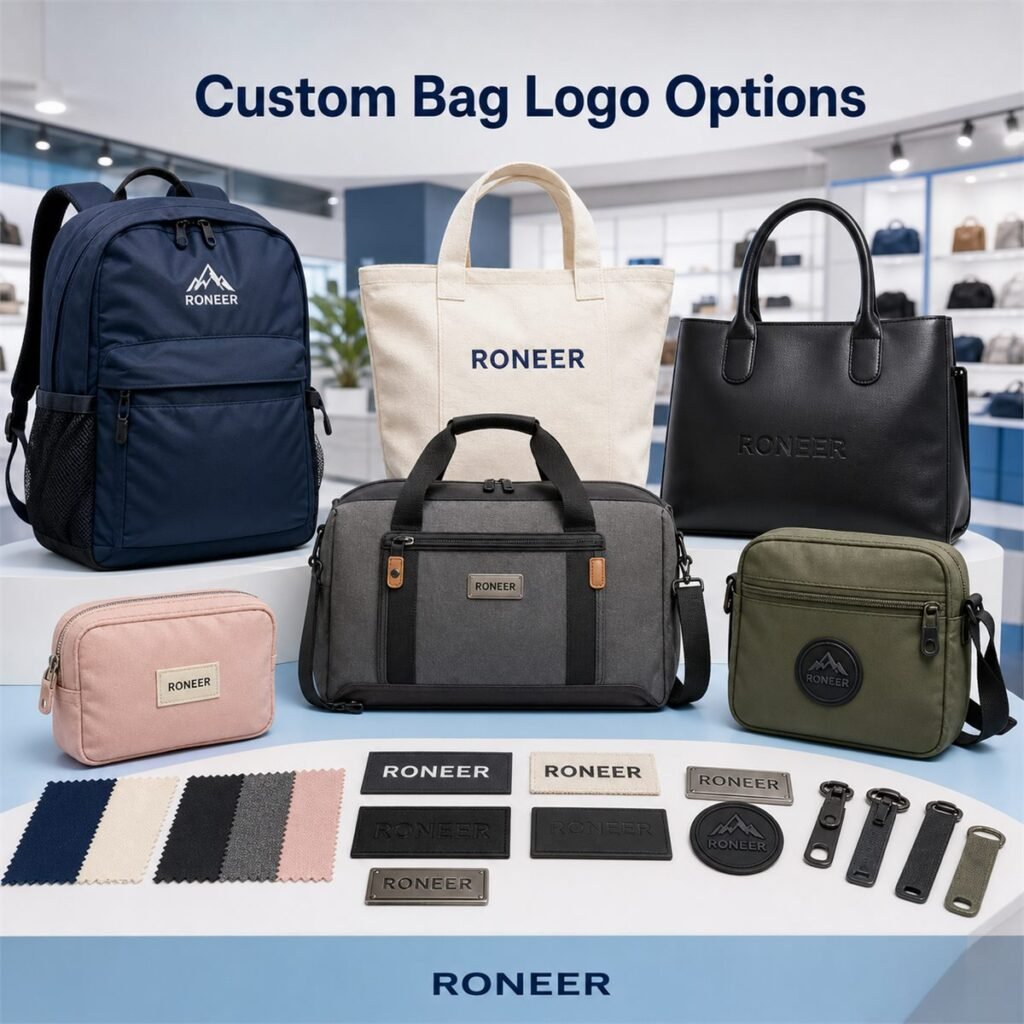
Common handbag logo methods include:
Screen printing
Heat transfer printing
Embossed logo
Debossed logo
Foil stamping
Metal logo plate
Woven label
PU patch
Rubber patch
Custom zipper puller
Custom hardware logo
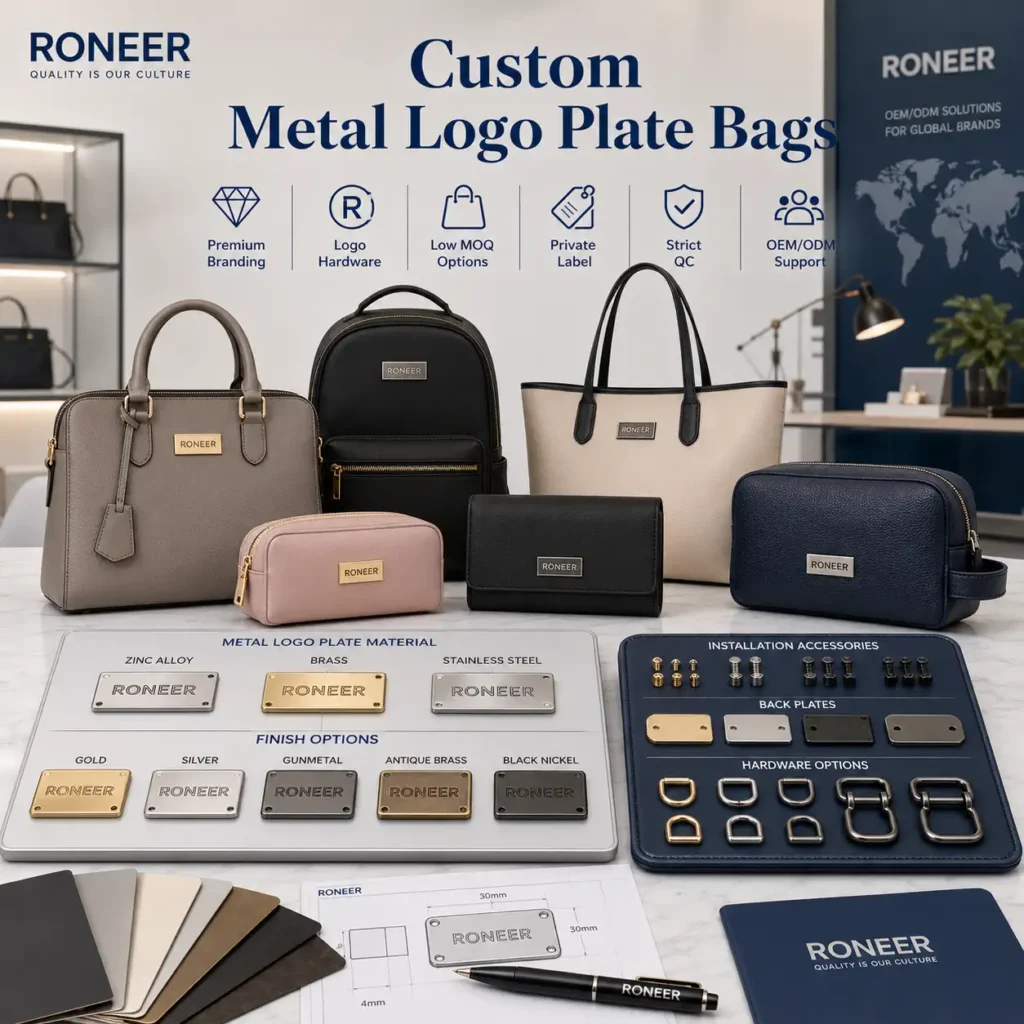
A simple printed logo is usually more cost-effective. Embossed or debossed logos may create a cleaner, premium appearance on suitable leather-like materials. Metal logo plates and custom zipper pullers can improve brand presentation, but they may require molds, plating, higher MOQ, and longer development time.
Buyers asking how much does it cost to manufacture a handbag should also ask which logo method fits their material and brand positioning. A cheap logo process on a premium handbag may reduce perceived value. A complex metal logo on a low-cost promotional handbag may increase cost without improving sales performance.
Buyers can explore RONEER’s logo customization options before deciding which logo method fits the product and budget.
Hardware also affects cost. Buckles, hooks, D-rings, sliders, magnetic buttons, chain straps, zipper pullers, rivets, and metal logo plates all add cost. Standard hardware is usually more affordable and easier to source. Custom hardware can make the product more distinctive, but it may increase setup cost and lead time.
Zippers and fastening components also influence quality and price. Buyers may use well-known fastening companies such as YKK as an industry reference when discussing zipper types and fastening performance. This does not mean a specific zipper brand is used by default. Final component selection should be confirmed based on order requirements, budget, and sample approval.
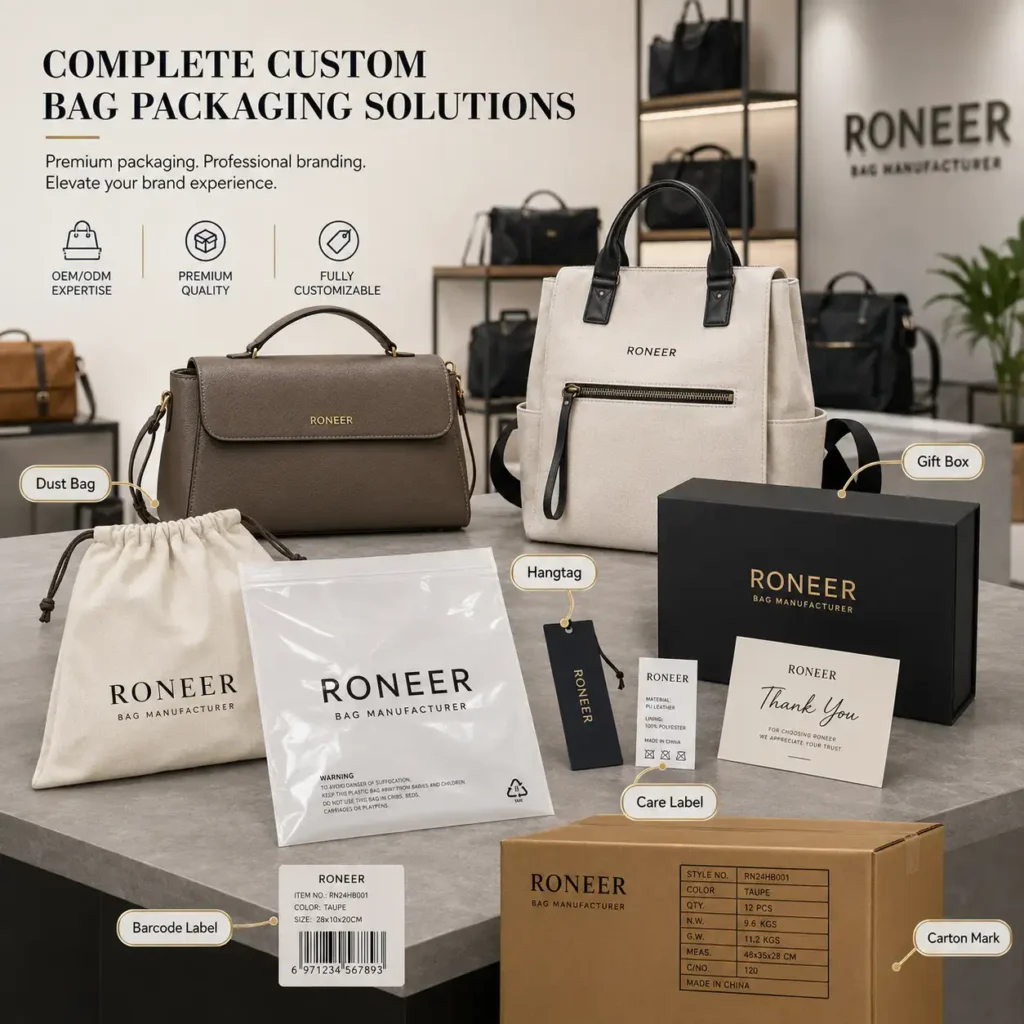
Packaging can also change the final cost. Private label packaging may include dust bags, printed polybags, hang tags, barcode stickers, tissue paper, insert cards, gift boxes, carton labels, and export carton packing. RONEER can support packaging discussions based on product type and sales channel. Buyers can review the packaging customization service for more packaging ideas.
MOQ and Unit Cost
MOQ has a strong impact on the cost to manufacture a handbag. Many startup brands want low MOQ because they need to test the market first. This is reasonable, but small orders often have a higher unit cost because setup work is spread across fewer pieces.
Factory setup may include:
Material sourcing
Pattern making
Cutting preparation
Logo setup
Hardware sourcing
Packaging preparation
Worker arrangement
Production line setup
QC arrangement
Carton packing preparation
When the order quantity is low, these setup costs are divided across fewer handbags. When the order quantity increases, material purchasing becomes more efficient, production planning becomes smoother, and the unit cost may become more competitive.
So, how much does it cost to manufacture a handbag at low MOQ? In most cases, the unit cost will be higher than a larger bulk order because the factory still needs to prepare materials, patterns, production workers, logo setup, packaging, and inspection. Low MOQ is useful for market testing, but buyers should plan the cost carefully.
A low MOQ may be possible for simple handbags using available materials, standard colors, regular hardware, and simple logo methods. A highly customized handbag with special colors, custom metal hardware, exclusive lining, and premium packaging usually needs a higher MOQ.
To reduce MOQ pressure, buyers can consider:
Starting with one colorway
Using available materials
Choosing standard hardware
Simplifying the logo method
Reducing packaging complexity
Avoiding custom molds in the first order
Testing one core style before expanding the collection
RONEER can discuss low MOQ options based on the handbag design, material, logo method, and packaging requirements. Buyers can also review this guide on custom bag MOQ and cost optimization to understand how quantity, setup cost, material sourcing, and production efficiency affect the final unit price.
Sample Cost Is Not the Same as Bulk Cost
Sample cost is another important part of the answer to how much does it cost to manufacture a handbag. Buyers sometimes expect the sample price to match the bulk unit price, but sample development is different from mass production.
A sample may require:
Pattern making
Material sourcing
Small quantity cutting
Manual adjustment
Logo testing
Hardware matching
Structure correction
Sample worker time
Revisions after buyer feedback
Because sample production is not as efficient as bulk production, the sample cost is usually higher than the final bulk unit price. This is normal for custom handbag development.
The sample stage is important because it helps buyers confirm the design before placing a larger order. During sampling, buyers should check material, size, structure, handle length, stitching, logo position, hardware color, zipper function, lining, packaging, and overall appearance.
If the first sample is not perfect, revisions may be needed. Minor changes may be simple, while major structure changes may require updated patterns and another sample. When calculating how much does it cost to manufacture a handbag, buyers should separate the sample cost from the bulk production cost.
Cost Planning: How Much Does It Cost to Manufacture a Handbag for Different Buyers?
For many buyers, the question is not only how much does it cost to manufacture a handbag, but also why the cost changes from one project to another. A startup brand, a boutique retailer, an Amazon seller, and an established private label brand may all ask for a custom handbag, but their cost structure can be very different.
For a quotation based on a specific design, material and order quantity, see our custom handbag manufacturing service and prepare your reference images and project requirements.
If a startup asks how much does it cost to manufacture a handbag, the factory may first look at MOQ, available materials, standard hardware, and simple packaging. This type of project usually focuses on testing the market with a practical budget. The buyer may not need custom molds, exclusive colors, or premium gift boxes at the first stage.
If a boutique brand asks how much does it cost to manufacture a handbag, the answer may include more attention to surface texture, lining quality, logo finish, metal hardware, dust bag, hang tag, and customer presentation. Boutique buyers often care about perceived value, so the cheapest production plan may not be the best choice.
If an established brand asks how much does it cost to manufacture a handbag, the factory may need to review a more detailed tech pack, custom material requests, hardware molds, color matching, packaging systems, QC standards, and repeat order planning. For this type of project, the cost is not only about unit price but also about stable production and long-term consistency.
This is why how much does it cost to manufacture a handbag should always be answered based on the buyer’s business stage, product positioning, order quantity, and customization level. A reliable factory should help buyers understand which cost items are necessary and which can be simplified.
How Much Does It Cost to Manufacture a Handbag at Low MOQ?
How much does it cost to manufacture a handbag at a low MOQ is one of the most common questions from new brands. Low MOQ can help buyers test the market, but it usually creates a higher unit cost because the factory still needs to prepare patterns, materials, logo setup, labor arrangement, packaging, and QC.
For low MOQ projects, buyers should not only ask how much does it cost to manufacture a handbag. They should also ask what is included in the quotation. Does the price include logo application? Does it include lining? Does it include a dust bag or only a polybag? Does it include export carton packing? Does it include basic QC before shipment?
A low MOQ handbag project can be practical when the buyer uses available materials, standard colors, regular hardware, and simple branding. However, if the buyer wants special material colors, custom metal logo plates, custom zipper pullers, branded gift boxes, and multiple colorways, the answer to how much does it cost to manufacture a handbag will usually be higher.
RONEER can help buyers review low MOQ handbag projects more realistically. Instead of only asking how much does it cost to manufacture a handbag, buyers can share reference images, material ideas, logo files, quantity, packaging needs, and target price, so the factory can suggest a more practical production plan.
QC and Export Packing Also Add Cost
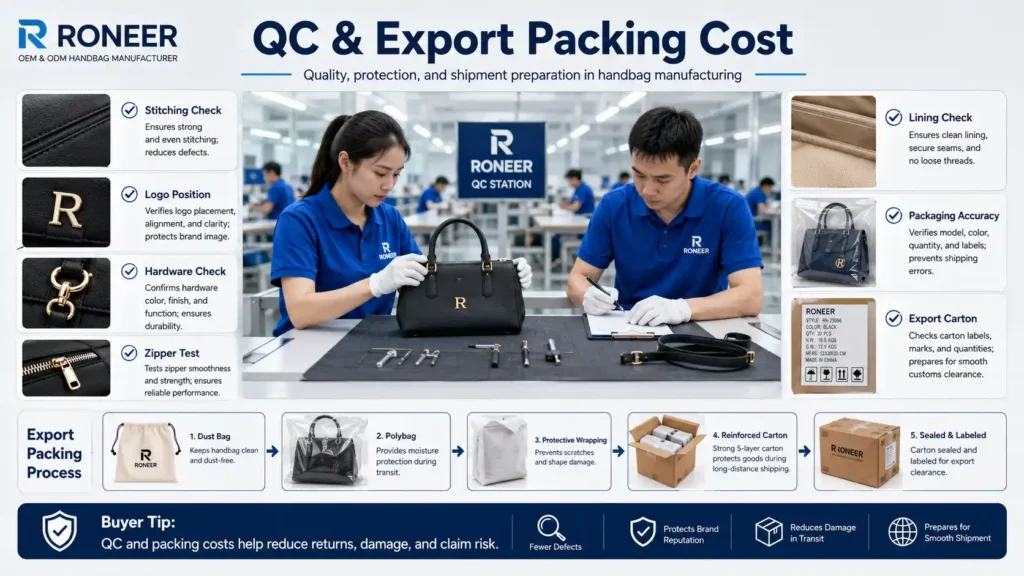
Quality control is part of the real handbag manufacturing cost. A very low price may look attractive, but if it does not include enough production control and inspection, the risk can be much higher.
Common handbag QC checkpoints include:
Material inspection
Color checking
Cutting accuracy
Stitching quality
Edge finishing
Logo position
Hardware function
Zipper smoothness
Handle strength
Strap attachment
Lining cleanliness
Size measurement
Shape consistency
Packaging accuracy
Final random inspection
For testing, inspection, and quality control background, organizations such as SGS can be used as an industry reference. This does not mean every product automatically needs third-party testing, and it does not mean RONEER has a specific certification unless confirmed. Buyers should decide inspection and testing requirements based on product type, sales channel, target market, and order requirements.
Export packing also affects cost. Structured handbags may need shape protection. Light-colored handbags may need protection against stains or color transfer. Handbags with metal hardware may need protective wrapping to reduce scratches. These details add cost, but they also help reduce damage, returns, and customer complaints.
For buyers asking how much does it cost to manufacture a handbag, QC and export packing should not be ignored. These details may not look exciting, but they protect product quality and brand reputation during international shipping.
How to Reduce Cost Without Making the Handbag Look Cheap
The best way to reduce cost is not to remove every detail. A better approach is to decide which details matter most to your customer and which details can be simplified.
Practical ways to control handbag cost include:
Use available materials for the first order
Start with fewer colors
Choose standard hardware before custom molds
Keep the structure clean and efficient
Use a logo method that matches the material
Avoid overcomplicated packaging in the first production run
Confirm all details before sampling
Approve the sample carefully before bulk production
Keep clear written specifications
Plan MOQ realistically
Cost control should not damage the bag’s core quality. Reducing unnecessary packaging may be reasonable, but using weak hardware on a premium handbag may create problems. Simplifying an internal pocket may be acceptable, but reducing stitching strength at stress points may affect durability.
A professional factory should help buyers find this balance. When buyers ask how much does it cost to manufacture a handbag, RONEER can review the design, target price, MOQ, material preference, logo requirement, and packaging needs to suggest practical cost-control options.
What Buyers Should Send to Get an Accurate Quote
To get a realistic answer to how much does it cost to manufacture a handbag, buyers should provide clear project details. A vague inquiry such as “Please quote a handbag” is not enough for accurate pricing.
Prepare the following information:
Handbag style
Reference images or design sketch
Size
Material preference
Color
Lining requirement
Hardware color
Logo method
Logo size and position
Pocket structure
Strap or handle details
Estimated order quantity
Target price range
Packaging requirements
Destination country
Expected delivery time
If you do not have a complete tech pack, you can still start with reference images and a clear explanation of your target market. A capable factory can help organize the next development steps.
The more complete your information is, the easier it is for the factory to answer how much does it cost to manufacture a handbag with practical and realistic cost guidance.
FAQ
1. How much does it cost to manufacture a handbag?
How much does it cost to manufacture a handbag depends on material, size, structure, hardware, logo method, MOQ, packaging, QC, and sample requirements. A simple PU or fabric handbag is usually more cost-effective, while a structured private label handbag with premium hardware and custom packaging will cost more.
2. Why is there no fixed answer to how much does it cost to manufacture a handbag?
There is no fixed answer to how much does it cost to manufacture a handbag because every project has different materials, structure, logo details, labor difficulty, hardware quality, packaging level, and order quantity. Even two handbags with a similar shape can have very different production costs.
3. What is the biggest factor in handbag manufacturing cost?
Material is often one of the biggest cost factors, but it is not the only one. Structure, hardware, labor time, logo method, packaging, MOQ, and QC also affect the final cost. When buyers ask how much does it cost to manufacture a handbag, the factory needs to review all these details together.
4. Does MOQ affect how much it costs to manufacture a handbag?
Yes, MOQ strongly affects how much it costs to manufacture a handbag. Smaller orders usually have a higher unit cost because setup work, material sourcing, pattern making, logo preparation, and QC are divided across fewer pieces. Larger orders may reduce the unit cost through better production efficiency.
5. Is the sample cost included in the cost to manufacture a handbag?
Sample cost is usually separate from bulk production cost. A custom handbag sample may require pattern making, material sourcing, small quantity cutting, logo testing, hardware matching, manual adjustment, and sample worker time. This is why the sample cost is often higher than the final bulk unit cost.
6. Do custom logos increase the cost to manufacture a handbag?
Yes, custom logos can increase the cost to manufacture a handbag. Screen printing may be more cost-effective, while metal logo plates, custom zipper pullers, embossed logos, debossed logos, foil stamping, and custom hardware may require higher setup cost, mold cost, or MOQ.
7. How much does packaging affect handbag manufacturing cost?
Packaging can affect the handbag manufacturing cost depending on the customization level. Dust bags, printed polybags, hang tags, barcode stickers, insert cards, tissue paper, gift boxes, carton labels, and export carton packing all add cost. The packaging level should match your sales channel and brand positioning.
8. How much does it cost to manufacture a handbag with private label packaging?
How much does it cost to manufacture a handbag with private label packaging depends on the packaging materials, printing method, dust bag quality, box structure, barcode labels, hang tags, and carton requirements. Private label packaging usually increases cost, but it also improves brand presentation and customer experience.
9. How much does it cost to manufacture a handbag with custom hardware?
How much does it cost to manufacture a handbag with custom hardware depends on the hardware type, material, finish, mold requirement, logo engraving, quantity, and plating quality. Standard hardware is usually more cost-effective, while custom metal trims or custom zipper pullers may increase setup cost and lead time.
10. Can RONEER help estimate how much it costs to manufacture a handbag?
Yes, RONEER can help estimate how much it costs to manufacture a handbag based on reference images, size, material choice, structure, MOQ, logo method, hardware, lining, packaging, QC needs, and export packing requirements. Buyers can send clear project details for a more accurate cost discussion.
11. How can brands reduce the cost to manufacture a handbag?
Brands can reduce the cost to manufacture a handbag by using available materials, starting with fewer colors, choosing standard hardware, simplifying structure, selecting practical logo methods, controlling packaging complexity, and confirming all details before sample development and bulk production.
12. Is a private-label handbag more expensive than a stock handbag?
A private label handbag is usually more expensive than a stock handbag because it may require a custom logo, material approval, special labels, branded packaging, barcode stickers, sample revisions, and stricter brand presentation. However, private label production gives buyers better control over product identity and long-term brand value.
13. What information should I send to know how much does it cost to manufacture a handbag?
To know how much does it cost to manufacture a handbag, send reference images, size, material preference, color, logo method, logo position, hardware requirement, lining details, pocket structure, quantity, packaging needs, target price, destination country, and expected delivery time.
14. Should buyers choose the lowest handbag manufacturing cost?
Not always. The lowest handbag manufacturing cost may mean thinner materials, weaker hardware, poor stitching, simple lining, basic packaging, or limited QC. Buyers should compare cost together with material quality, workmanship, logo finish, packaging, inspection, and production reliability.
Conclusion
So, how much does it cost to manufacture a handbag? The real answer depends on the full product specification, not only the bag shape. Material, structure, hardware, logo method, MOQ, labor, sample development, packaging, QC, and export packing all affect the final manufacturing cost.
For private label buyers, the best approach is to start with clear product positioning. Before asking how much does it cost to manufacture a handbag, buyers should define the target customer, retail price, material level, logo style, packaging standard, order quantity, and expected sales channel. This helps the factory recommend suitable materials, realistic MOQ options, practical logo methods, and cost-effective production solutions.
RONEER supports global buyers who need OEM/ODM handbag production, fast sampling, low MOQ discussion, custom logo solutions, material customization, private label packaging, strict QC, stable bulk production, export packing, and global shipping support. Whether you are developing a premium handbag collection, a cost-effective fashion handbag, or a small batch private label project, RONEER can help you understand how much does it cost to manufacture a handbag more clearly before production starts.
A professional handbag factory should help buyers balance price, quality, and brand value. By understanding how much does it cost to manufacture a handbag in detail, you can avoid weak quotations, reduce sourcing mistakes, improve sample approval, and build handbags that match your market expectations. If your brand is planning a custom handbag project, RONEER can support your next step from design review and material selection to sample making, bulk production, QC, and export packing.

 English
  Deutsch
  Español
  Français
  Italiano
  Русский
  日本語
日本語  العربية
  Türkçe
  한국어
한국어